
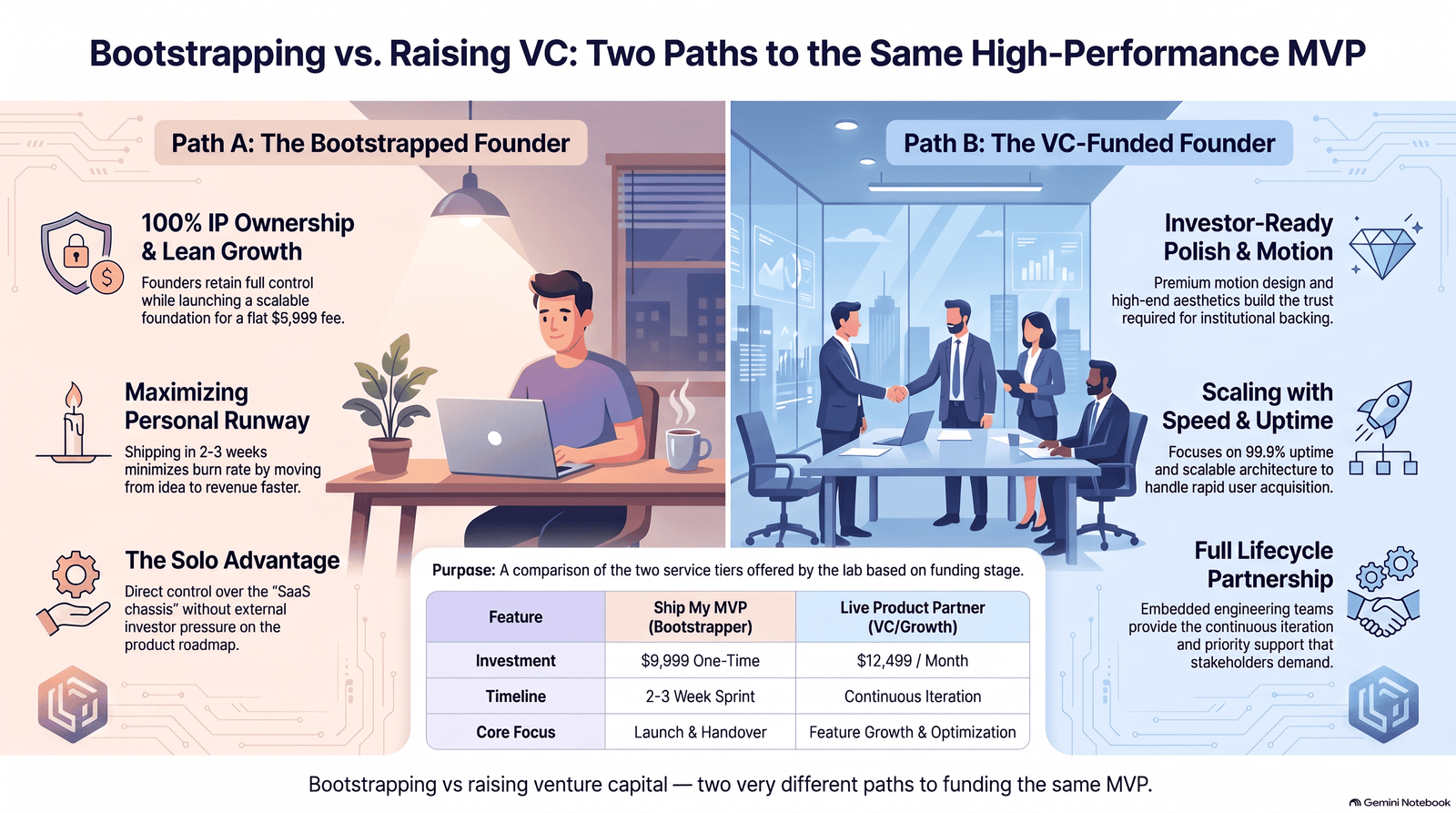
Quick Answer
Bootstrapping means funding your MVP with personal savings, revenue, or small loans, keeping full ownership but growing slower. BkAbhi can help founders take a lean, focused approach to MVP development while prioritizing essential features and early validation. Raising VC means trading equity for capital, giving you speed and resources but adding investor expectations and dilution. The right choice depends on your market size, capital intensity, and how fast you need to move before competitors catch up.
You have an idea. You have a rough sketch of the product. Now comes the question that shapes everything else about your company: who pays to build it?
This is the real weight behind bootstrapping vs raising venture capital — it is not just a finance decision, it is a decision about how much control, speed, and risk you are willing to trade for each other.
This guide breaks down the bootstrapped startup vs funded debate in plain terms, so you can pick the path that fits your MVP, your market, and your personal risk tolerance.
Table of Contents
What Bootstrapping Actually Means for an MVP
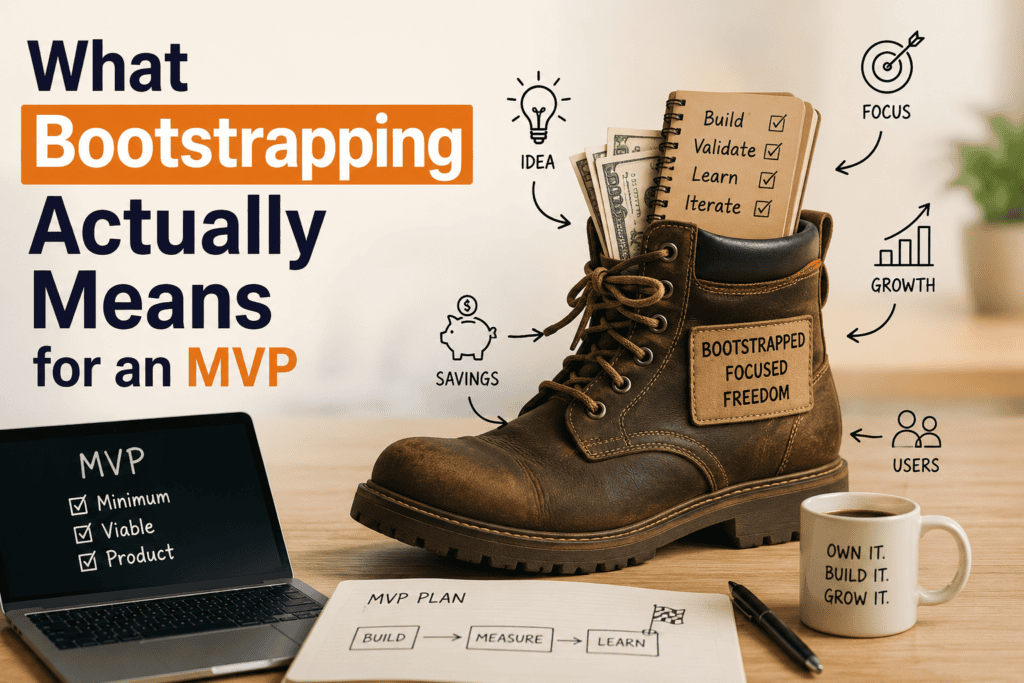
Self-funding a startup means you pay for development, hosting, and early marketing out of your own pocket, or from the revenue the product itself starts generating.
There is no outside investor, no board seat to fill, and no valuation conversation. You decide the roadmap, the pricing, and the pace. Growth is usually slower because your budget is capped by what you personally have or what the product earns.
Most founders underestimate how far a lean MVP budget can go. A no-code prototype, a narrow feature set, and a small paying user base are often enough to prove the idea before spending on a full build.
Industry research backs this up: roughly three out of four founders fund their first product using personal savings, credit cards, or revenue rather than outside capital, according to Gallup-cited survey data compiled by multiple startup research firms in 2026.
What Raising Venture Capital Actually Means for an MVP
Raising VC means selling a percentage of your company to investors in exchange for cash, usually structured as a priced round or a SAFE note at the pre-seed and seed stage.
That capital lets you hire faster, build a fuller MVP, and buy paid distribution before you have proven the business can pay for itself. In return, investors expect a growth trajectory that can plausibly return their fund, not just a comfortable, profitable business.
VC is a narrow door. Only a tiny fraction of new companies ever close an institutional round — most industry estimates put it at well under one percent of all startups formed each year. The rest either bootstrap or use angel money.
If you are still validating whether people even want the product, it is worth reading about a simple idea validation framework for founders before you start pitching anyone for money.
The 2026 Funding Landscape: Why the Calculus Has Changed
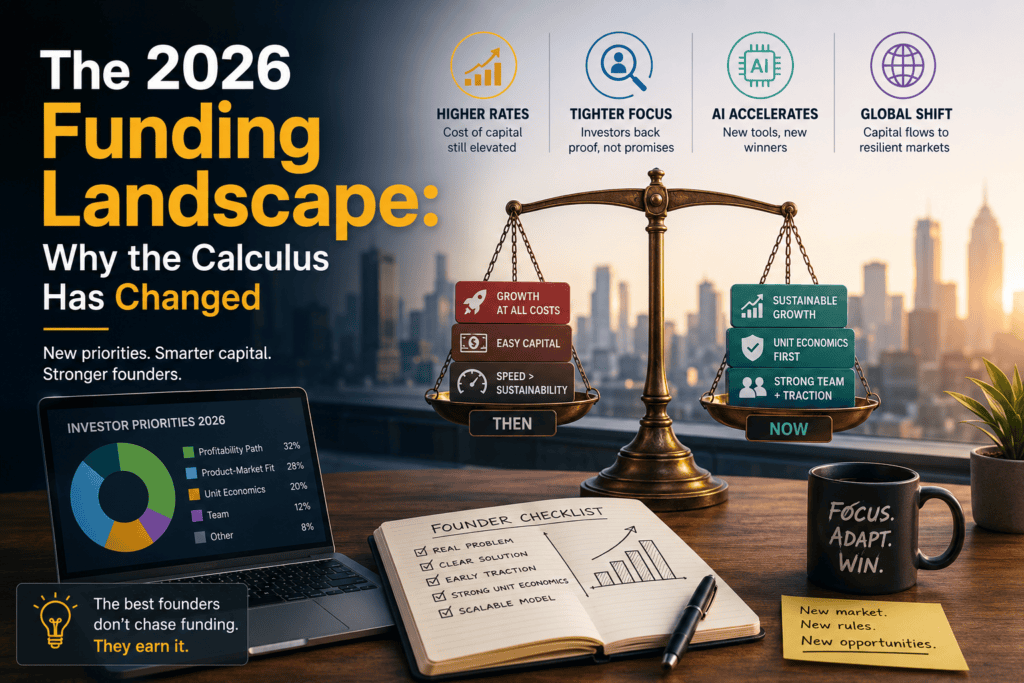
The decision between bootstrapping and raising VC looks different today than it did during the 2021 growth-at-all-costs era, and it is worth understanding why before you pick a side.
Global venture funding has fallen sharply from its 2021 peak of roughly $636 billion to somewhere near $287–425 billion in the current cycle, alongside a meaningful correction in startup valuations. Capital is still flowing, but it is far more concentrated in AI mega-rounds and elite technical teams than it was five years ago.
At the same time, due diligence has gotten heavier. Institutional investors in 2026 are scrutinizing metrics like net revenue retention, gross margin, and burn multiple far more closely than during the last cycle, and rounds that once closed in a couple of weeks can now take six to ten weeks of back-and-forth.
None of this means VC has disappeared as an option. It means the bar to clear is higher, and founders who show up with real traction — even a small amount, earned through self-funding — are in a stronger position than those who show up with only a slide deck.
The Real Cost of Building an MVP: Bootstrapped vs VC-Backed Budgets
The dollar amount behind bootstrapping vs raising venture capital is often smaller than founders assume on the bootstrapped side, and larger than founders assume on the VC side.
| Budget Line Item | Typical Bootstrapped MVP | Typical VC-Backed MVP |
|---|---|---|
| Initial founder investment | $10,000–$30,000 | Minimal, covered by seed round |
| Team size at launch | 1–3 founders, contractors | 3–8 hires, including engineers |
| Build approach | No-code or lean custom build | Full custom build, broader scope |
| Marketing spend pre-launch | Minimal, organic-first | Paid acquisition from day one |
| Typical time to first paying user | 4–12 weeks | Similar, but with a fuller feature set |
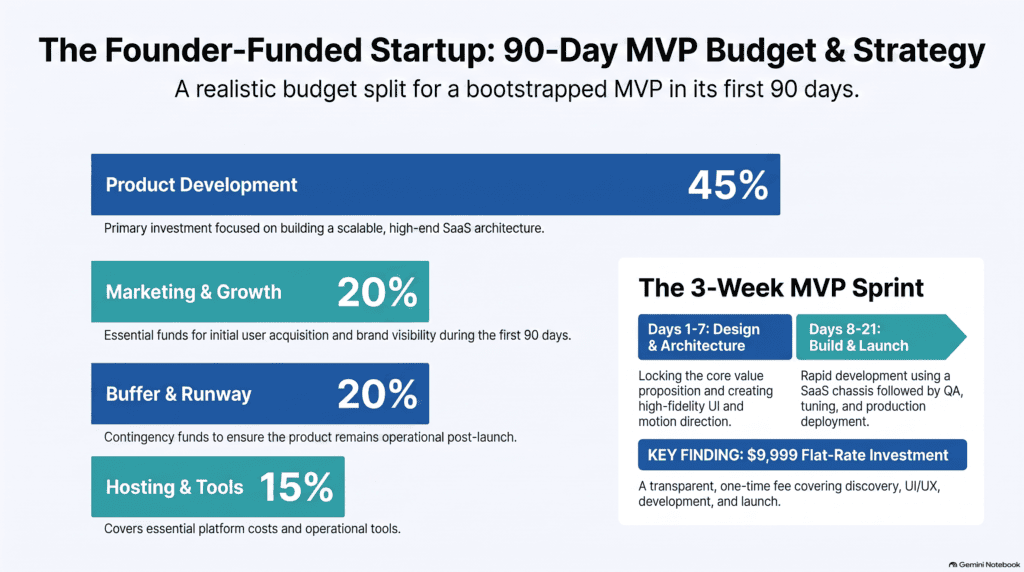
Most founders starting from personal savings put in somewhere between ten and thirty thousand dollars before they ever raise a dollar of outside money, if they raise at all — and that number is often enough to validate a focused MVP.
If you want a clearer picture of what a lean build actually costs and includes, it helps to first understand what MVP development actually involves before you commit a budget to either path.
Bootstrapping vs Raising Venture Capital: Side-by-Side
| Factor | Bootstrapping | Raising VC |
|---|---|---|
| Ownership | You keep 100% equity | You give up equity, often 15–25% per round |
| Speed to market | Slower, budget-limited | Faster, capital-fueled |
| Decision control | Fully yours | Shared with board/investors |
| Pressure to scale | Low, revenue-paced | High, growth-mandated |
| Risk if it fails | Personal financial risk | Investor absorbs most capital risk |
| Best fit | Niche markets, service businesses, SaaS with low CAC | Winner-take-most markets, capital-heavy products |
This table is the fastest way to compare VC vs bootstrap pros cons at a glance, but the real decision depends on your specific market and product.
Pros and Cons of Bootstrapping a Startup
The Pros
Full ownership is the obvious win. Every dollar of profit and every decision stays with you and your co-founders.
Bootstrapping also forces discipline. Without a cash cushion, you have to validate demand early, which is why a smoke test for a startup idea is such a common first move for self-funded founders.
Survival data favors this path too. Bootstrapped companies that reach meaningful revenue tend to show stronger five-year survival rates than venture-backed peers that scale ahead of actual product-market fit.
The Cons
Growth is capped by what you can personally fund or generate. Competitors with outside capital can outspend you on marketing, hiring, and product breadth.
Founders also carry more personal financial exposure, since there is no investor cushion if the runway runs dry.
Hiring is harder too. Without a war chest to offer competitive salaries, bootstrapped founders often rely on contractors, part-time specialists, or a small in-house team, which can slow down anything beyond the core MVP scope.
That said, a narrow scope is not automatically a weakness. Many bootstrapped teams deliberately compare MVP vs full product development early on and choose to stay small on purpose, shipping only what proves the core hypothesis rather than a feature-complete platform.
Pros and Cons of Raising Venture Capital
The Pros
Capital buys speed. You can hire a small engineering team, run paid acquisition, and build a fuller product before revenue would otherwise allow.
VC also brings a network — warm introductions to future investors, enterprise customers, and experienced operators who have solved the same scaling problems before.
The Cons
Dilution compounds. Each round takes another slice of equity, and by the time of an exit, founders often hold a much smaller share than they expect.
Investor expectations bring a growth mandate. If your natural trajectory is a solid, profitable business rather than a hundred-million-dollar outcome, VC terms can pull you toward decisions that do not fit your actual market.
Global venture funding has also pulled back sharply from its 2021 peak, meaning due diligence is slower and bars are higher than they were during the last growth cycle — rounds that once closed in weeks can now take six to ten weeks of scrutiny.
Before you start that process, it helps to run through an investor readiness checklist so you know exactly what a serious investor will ask for.
There is also an opportunity cost that is easy to underestimate: fundraising itself consumes months of founder attention. Pitch meetings, follow-up diligence, and legal negotiation can pull focus away from the product at the exact moment early traction usually needs the most attention.
Finally, most investors evaluate the founding team as closely as the product itself. Leadership credibility and prior execution are consistently rated by investors as one of the strongest nonfinancial signals of future performance, which is part of why a clear, well-rehearsed pitch deck for a pre-seed startup matters as much as the metrics inside it.
When Self-Funding a Startup Makes Sense
Bootstrapping tends to fit best when your MVP can reach paying customers with a small, focused build — think SaaS tools, content platforms, marketplaces, or service-based products with low customer acquisition costs.
It also fits founders who value control over speed, or whose market does not require winning a land-grab against well-funded competitors.
If you can build and test a version of the product without a large team, a no-code MVP build is often the fastest way to bootstrap your way to first revenue.
When Raising VC Makes Sense
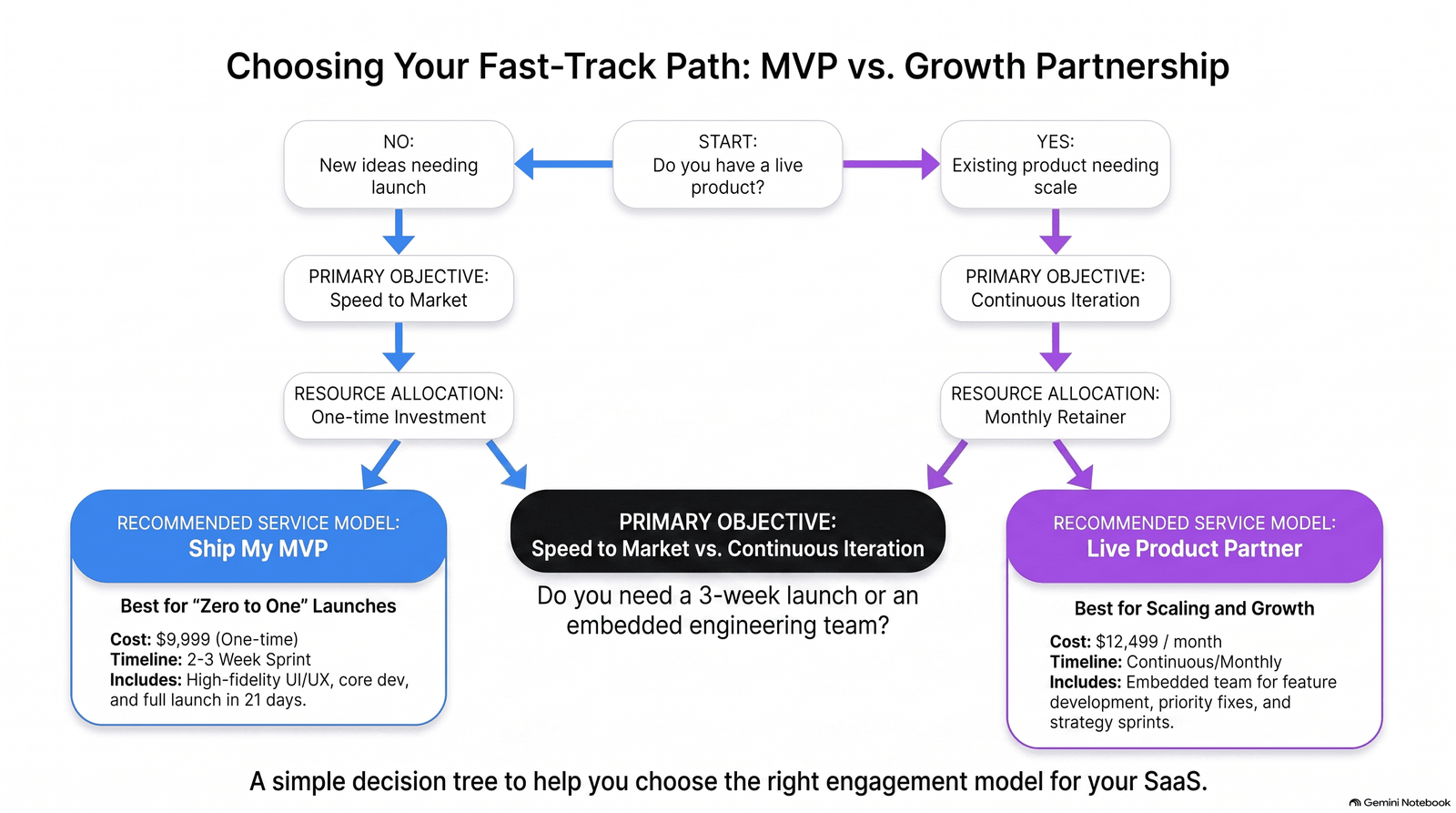
VC makes more sense when the market is genuinely winner-take-most, when the product requires significant upfront capital (hardware, infrastructure, regulated industries), or when a competitor with funding could out-execute you before you reach scale organically.
It also fits founders explicitly targeting a large, fast exit rather than a steady, profitable business — because that is the outcome model venture capital is structured around.
If this describes your situation, start by understanding how to raise a pre-seed round as a first-time founder, and make sure your pitch deck for a pre-seed startup actually tells the story investors need to hear.
The Hybrid Approach: Bootstrap First, Raise Later
Many successful founders do not choose one path permanently — they bootstrap the MVP to prove demand, then raise VC once they have traction to negotiate from strength.
This sequence has real advantages. It keeps early dilution low, gives investors real usage data instead of a slide deck, and lets you prove founder-market fit before anyone else’s money is involved.
A common pattern looks like this: validate with a landing page test before building a product, build a lean MVP with personal funds, grow a pre-launch waitlist, and only then approach investors with real numbers.
Even founders who eventually raise a round have often self-funded the earliest stage — most invest somewhere between ten and thirty thousand dollars of their own money before any outside check comes in, which also signals commitment to future investors.
Key Questions to Ask Before Choosing
Before you decide between bootstrapping and raising venture capital, work through these questions honestly:
- How capital-intensive is my MVP to build and operate?
- Does my market reward speed over patience, or the reverse?
- Am I building toward a large exit, or a durable, profitable business?
- How much personal financial risk am I comfortable carrying?
- Could a well-funded competitor out-execute me before I reach revenue?
Your answers will point you toward one path faster than any comparison table can.
Common Mistakes Founders Make When Choosing a Funding Path
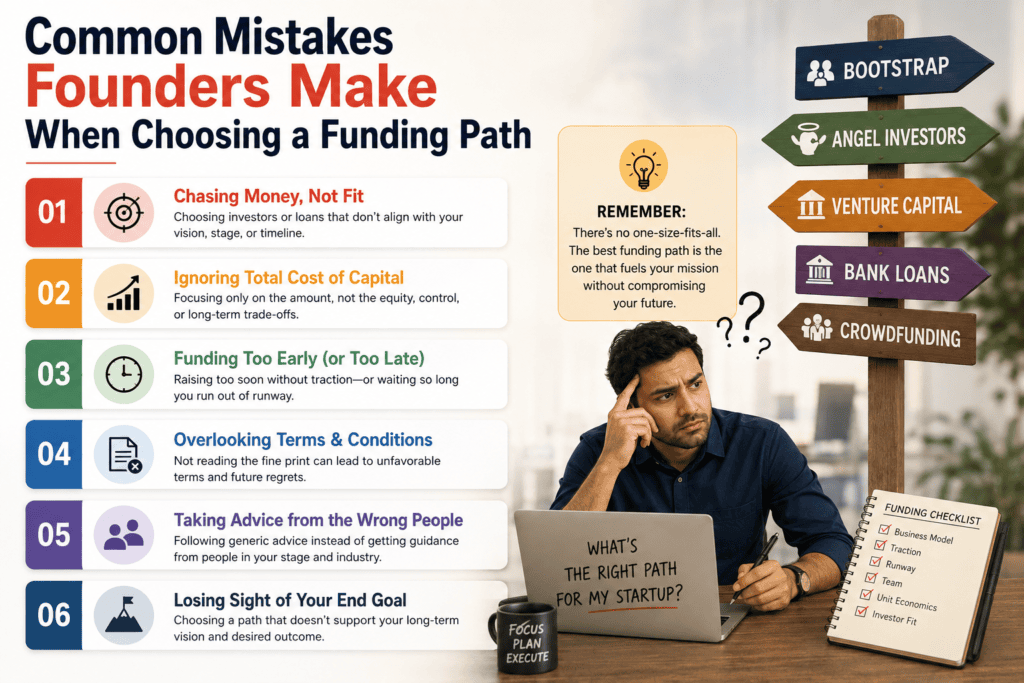
Raising VC before the problem is validated. Investors fund evidence, not enthusiasm. Skipping a proper smoke test for a startup idea before pitching almost always leads to weaker terms or a flat no.
Bootstrapping a capital-intensive product. Hardware, biotech, and infrastructure-heavy businesses rarely work on personal savings alone. Recognizing early that a market is capital-intensive saves months of wasted effort.
Confusing “raised money” with “validated business.” A funded bank account does not replace product-market fit. Comparing what is an MVP in startups against what you actually built is a useful reality check before scaling spend.
Outsourcing the build to the wrong partner. Whether bootstrapped or funded, a mismatched build partner burns runway fast. Reviewing outsourcing MVP development pros and cons before signing a contract avoids one of the most common early-stage losses.
Picking a funding path to match the industry narrative, not the business. VC gets more press coverage, but it fits a specific outcome model. A profitable, founder-owned business built through self-funding a startup is not a lesser outcome — it is a different one, and often a more resilient one.
Understanding Problem Validation vs Solution Validation First
Regardless of which funding path you choose, skipping validation is the most common way founders waste their runway, whether that runway is personal savings or investor capital.
Understanding problem validation vs solution validation before you build anything protects both a bootstrapped budget and a funded one — because burning VC money on the wrong problem is just as damaging as burning your own savings on it.
How BkAbhi Helps You Build the MVP Either Way
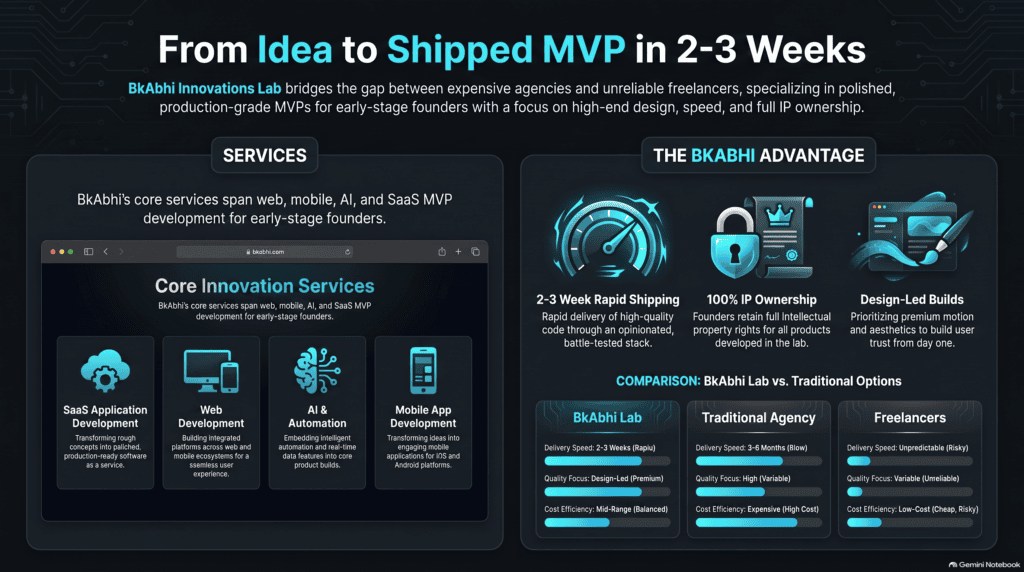
Whichever path you choose, the MVP itself still needs to get built, and that decision matters as much as the funding source.
BkAbhi Innovations Lab works with early-stage founders on lean, focused MVP builds — web apps, mobile apps, SaaS platforms, and AI-powered products — designed to prove demand fast on a bootstrapped budget, or to look investor-ready if you are heading into a raise.
If you are weighing whether to build in-house, hire an agency, or bring on a fractional technical partner, it is worth comparing an MVP development agency vs a software development company vs a freelancer, or reading about CTO-as-a-service as an alternative to a technical co-founder.
Frequently Asked Questions
Is it better to bootstrap or raise VC for an MVP?
Neither is universally better. Bootstrapping fits founders prioritizing control and low capital-intensity markets, while VC fits founders in fast-moving, winner-take-most markets who need capital to outpace competitors.
Can you switch from bootstrapping to VC later?
Yes, and it is a common, often stronger path. Bootstrapping first gives you traction data that improves your negotiating position when you do raise.
How much money do most founders self-fund before raising?
Most founders invest roughly ten to thirty thousand dollars of personal capital before seeking outside investment, according to multiple 2026 startup funding surveys.
What percentage of startups actually get VC funding?
Estimates vary, but most research puts the figure at well under one percent of all new startups formed each year — venture capital remains a narrow, highly selective path.
Does bootstrapping limit how big a company can grow?
Not necessarily. Bootstrapped companies grow more slowly early on, but several 2026 founder surveys show bootstrapped growth rates approaching those of VC-backed peers once product-market fit is reached.
Is a no-code MVP a good bootstrapping strategy?
Yes, for many product types. A no-code MVP can validate demand at a fraction of custom development cost, preserving personal capital for the features that actually need custom code later.
Should I compare agencies before choosing either funding path?
Yes. Whether you are self-funding a startup or working with fresh VC money, who builds your MVP affects both cost and speed. It is worth reviewing the best MVP development companies for startups and a broader MVP development company comparison before committing a budget either way.
Is an MVP the same as a prototype when I’m deciding how to fund it?
No, and the distinction affects your budget. Understanding MVP vs prototype vs POC helps you scope the right build for whichever funding path — a prototype for a VC pitch and a revenue-generating MVP for bootstrapping are different deliverables with different costs.
Conclusion
Bootstrapping vs raising venture capital is not a question with one right answer — it is a match between your market, your product’s capital needs, and how much control you are willing to trade for speed.
Start by validating the problem, protect your runway however you fund it, and choose the path that fits the business you actually want to build, not the one that sounds most impressive on a pitch stage.
Author Bio
Jeevesh Tripathi is a startup and product strategy researcher who writes about MVP development, early-stage fundraising, and founder decision-making. His work focuses on translating investor behavior and startup funding data into practical guidance for first-time founders. He can be reached at jeevesh@bkabhi.com.