
Quick Answer: A landing page test before building a product means publishing a simple page describing your idea, sending real traffic to it, and measuring how many people click, sign up, or try to pay. It’s the fastest, cheapest way to know if anyone wants what you’re about to spend months building.
Most founders skip this step. They fall in love with a feature list before a single stranger has seen the idea.
That’s expensive. A landing page test costs a weekend and a small ad budget. A wrong MVP costs months and real savings.
This guide walks through exactly how to run one — the fake door test, the pre-launch landing page, the tools, the benchmarks, and the mistakes that quietly ruin the results.
Table of Contents
What Is a Landing Page Test Before Building a Product?
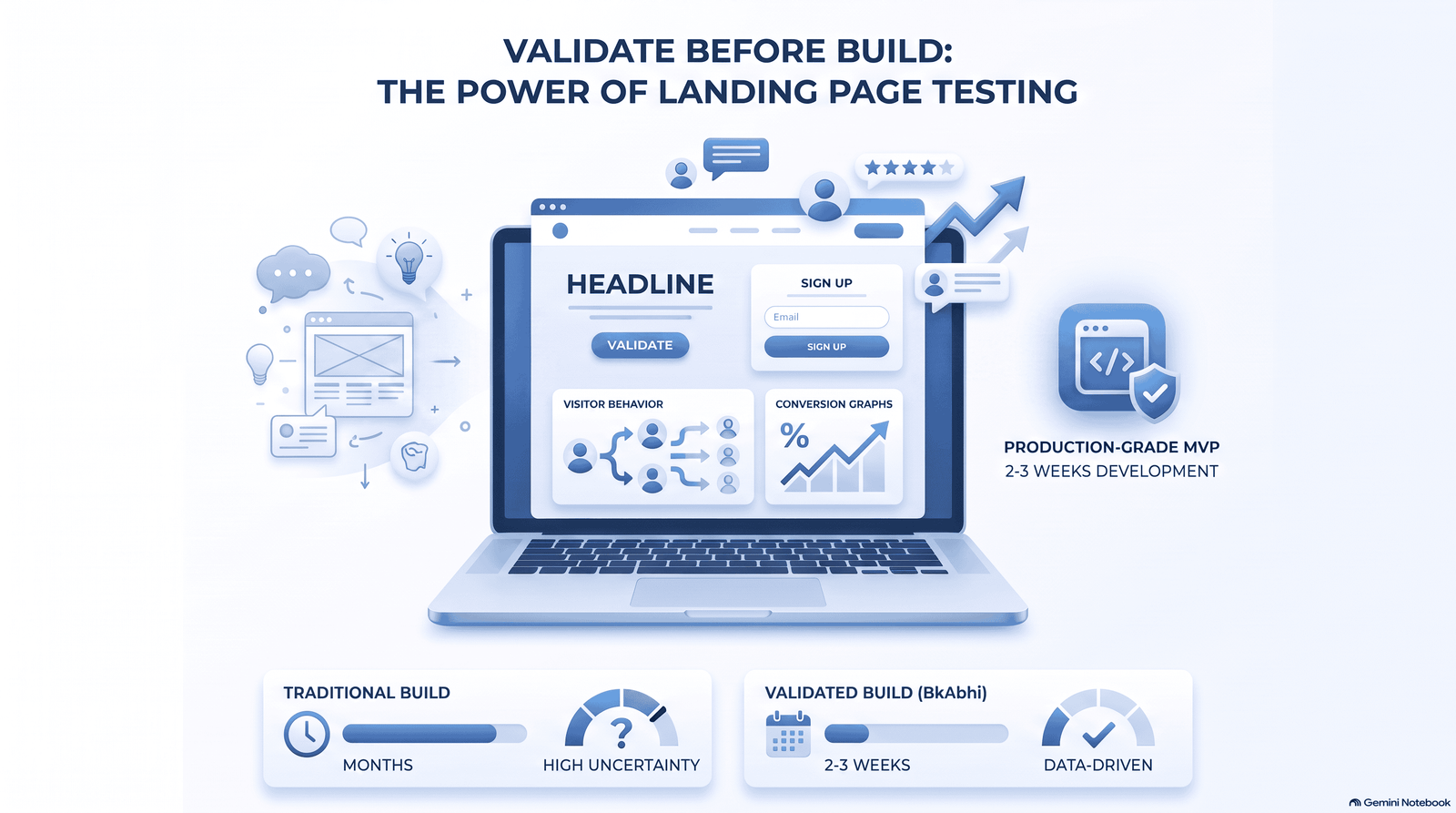
A landing page test before building a product is a validation method where you publish a page describing your future product and measure real user behavior instead of opinions.
There’s no working software behind it. Just a headline, a value proposition, and a clear call to action.
You’re not asking “would you use this?” You’re watching whether people actually click, type in an email, or reach for a credit card.
That distinction matters more than anything else in this guide. Opinions are free. Actions cost people something — time, attention, or money — and that’s what makes them trustworthy signals.
This approach sits early in the same thinking behind an MVP for startups: prove demand before you spend a dollar on development.
Why Testing Demand Actually Saves Your Runway
Building first and validating later is the single most common reason early products die quietly.
You spend three months coding. You launch. Nobody signs up. Now the runway clock is louder than it was before.
A demand test landing page flips that order. You learn in days, not months, whether the core assumption behind your idea holds up.
Three things make this worth doing before you write a line of code:
It’s cheap. A landing page test typically costs a few hundred dollars in ad spend, not tens of thousands in development.
It’s fast. You can have real click and conversion data within a week, sometimes within 48 hours.
It’s honest. Behavior doesn’t flatter you the way a friend’s “that’s a great idea!” does.
If you’re still deciding whether your idea is even ready for a build phase, our guide on what an MVP actually is covers the readiness signals worth checking first.
The Fake Door Test: The Core Method Explained
A fake door test is a landing page test where you advertise a feature or product that doesn’t exist yet, then measure how many people try to access it.
The name comes from the idea of a door painted on a wall. It looks real. Nobody can walk through it. But you can count how many people tried the handle.
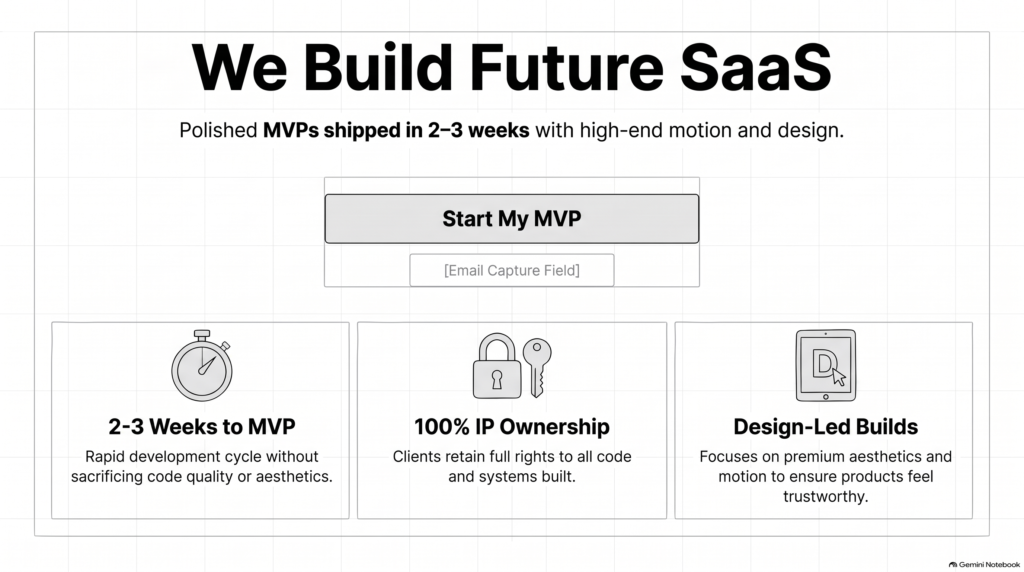
In practice, this usually looks like a button that says “Start Free Trial” or “Join the Waitlist.” Clicking it doesn’t unlock the product — it captures an email or shows a “coming soon” message.
The click itself is the data point. It tells you someone was interested enough to act, even though nothing was delivered yet.
Important distinction: a fake door test is about honestly measuring interest, not tricking people into paying for something that will never exist. Google’s own guidance on misleading functionality is a useful reminder here — sites that promise a service and quietly deliver nothing but ads or dead ends erode trust fast. Keep your test transparent: say “coming soon,” not “buy now” for something you can’t ship.
Pre-Launch Landing Page vs a Working MVP: What Each One Proves
These two methods often get confused, but they answer different questions.
A pre-launch landing page proves interest. People said, through their clicks, that the idea is worth a closer look.
A working minimum viable product proves usage and retention. People said, by coming back, that the product actually delivers value.
You need both, in that order. A landing page with zero conversions saves you from building something nobody wanted. A landing page with strong conversions doesn’t guarantee retention — it just earns you the right to build and find out.
If you’re unsure which stage your idea is at right now, our breakdown of MVP vs MMP vs full product lays out what to build at each stage of validation.
Step-by-Step: How to Run a Demand Test Landing Page
Here’s the process founders actually use, broken into steps you can start today.
Step 1: Name Your Riskiest Assumption
Before writing a single word of copy, write down the one belief that could kill your idea if it’s wrong.
Usually it’s not “can we build this.” It’s “does anyone care enough to act.”
A landing page test before building a product only works if it’s aimed at that specific assumption, not a vague general concept.
Step 2: Write a One-Sentence Value Proposition
If you can’t explain the product in one sentence, your landing page will confuse visitors and the test results will be meaningless.
Keep it specific. “A tool that helps freelancers send invoices in 30 seconds” beats “an all-in-one freelancer platform.”
Step 3: Choose a Landing Page Tool
You don’t need custom code for this. Tools like Carrd and Unbounce let you publish a page in under an hour.
For founders who want a no-code approach across the whole validation phase, our guide to no-code MVP development covers when skipping custom code makes sense and when it doesn’t.
Step 4: Design One Clear Call to Action
One headline, one sub-headline, one button. Every extra choice on the page dilutes your data.
Common CTA options include “Join the Waitlist,” “Get Early Access,” or a mock “Start Free Trial” button that leads to an honest “we’re building this — leave your email” message.
Step 5: Drive Targeted Traffic
Organic traffic alone won’t give you enough data fast enough. Most founders use a small budget on Google Ads or Meta Ads pointed at their exact target audience.
Aim for a few hundred visitors minimum before drawing conclusions. Smaller sample sizes make the results unreliable either way.
Step 6: Set Your Benchmark Before You Launch
Decide what “good” looks like before the data comes in. Otherwise you’ll unconsciously bend the numbers to match what you hoped to see.
Write down your target conversion rate and stick to it as your honest threshold.
Step 7: Read the Data Without Flinching
If the numbers come back weak, that’s not a failed test — that’s the test working exactly as intended.
A landing page test before building a product exists to save you from a bad build, not to confirm a decision you’d already made.
What Good Conversion Numbers Actually Look Like
There’s no single magic number, but a few reference points help you calibrate.
Cold traffic (ads): A 2-5% email sign-up rate is considered a reasonably strong signal for an unfamiliar audience.
Warm traffic (existing audience, communities, newsletter): 10-20% or higher is achievable and expected.
Fake door “purchase intent” clicks: Even 1-2% clicking a “Start Free Trial” button on cold traffic is a meaningful early signal, since it reflects a stronger action than an email address.
Numbers below these ranges don’t automatically mean the idea is dead. They mean the messaging, audience, or problem framing needs another look before you commit to a build.
Reading Mixed Signals: High Clicks, Low Sign-Ups
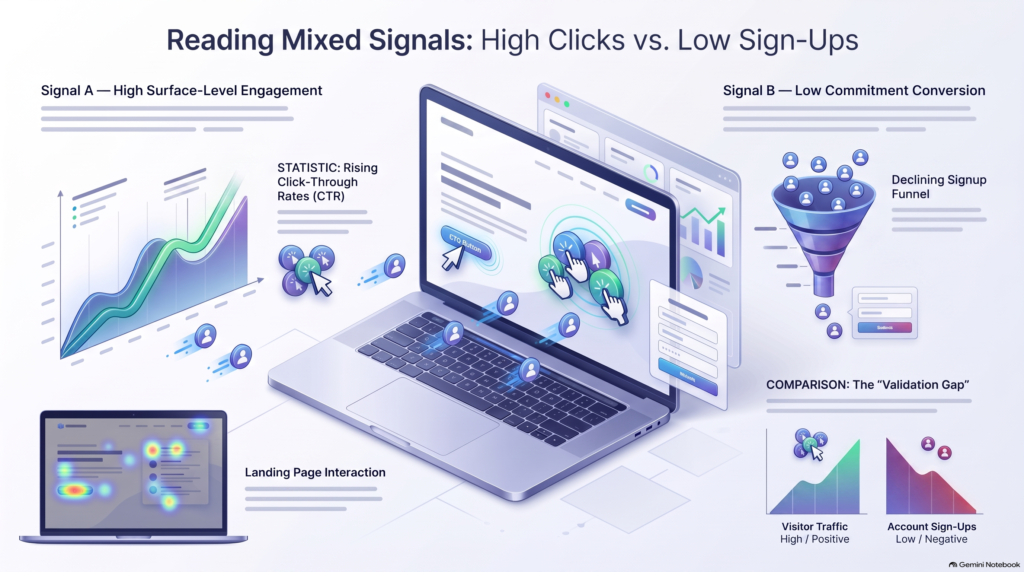
Sometimes a demand test landing page gets plenty of traffic and clicks, but the email sign-up rate stays disappointing. This is more common than a clean pass or fail.
Usually it means the headline earned attention, but the offer itself didn’t feel worth the next step. People were curious, not convinced.
Check three things before writing off the idea. First, is the value proposition specific enough, or does it still sound generic? Second, does the CTA ask for too much too soon, like a full signup form instead of just an email? Third, is the traffic source actually matched to your target user, or just cheap and broad?
A landing page test before building a product is diagnostic, not just a pass/fail gate. Mixed signals usually point to a fixable messaging problem rather than a dead idea.
Run a second version with one variable changed — the headline, the CTA wording, or the audience targeting — and compare the results directly against your first benchmark.
How Much Should You Spend on a Landing Page Test?
Budget expectations trip up a lot of first-time founders before they even start.
Most successful fake door tests run on $200 to $500 in ad spend, spread across a one to two week window. That’s usually enough to reach a few hundred targeted visitors.
Spending more doesn’t necessarily produce a clearer answer. Spending too little just means you won’t hit a sample size large enough to trust.
If your product targets a very narrow professional audience, expect cost-per-click to run higher than a broad consumer idea. Budget accordingly rather than cutting the test short to save money.
Tools Founders Use to Build a Test Landing Page Fast
You have more options than most people realize, spanning page builders, traffic sources, and behavior tracking.
Page builders: Carrd for simple single pages, Unbounce for more advanced A/B testing needs, and Webflow for teams that want design flexibility.
Email capture: Mailchimp or ConvertKit both connect easily to any landing page builder for waitlist collection.
Behavior tracking: Microsoft Clarity gives free heatmaps and session recordings, showing exactly where visitors hesitate or drop off.
Traffic: Google Ads and Meta Ads remain the fastest way to get targeted strangers onto your page within hours of publishing.
None of these require a developer. That’s the entire point — the test should cost you a weekend, not a sprint.
Real Founders Who Tested Demand Before Building
The pattern shows up across some of the most recognizable startups, and it’s worth studying closely.
Buffer’s founder published a simple landing page explaining the product with a pricing page behind the button, before writing any code. The click-through data on that pricing page told him exactly what people were willing to pay before he built anything.
Dropbox took a different angle — a short explainer video stood in for the product entirely. Sign-ups spiked overnight, proving demand for a feature that didn’t technically exist yet at scale.
Neither founder guessed. They watched what strangers did, then built based on that evidence instead of instinct.
Common Mistakes That Ruin a Fake Door Test
A few recurring errors quietly invalidate otherwise well-intentioned tests.
Testing with friends and family. People who like you personally will click things they’d never act on as strangers. Their data isn’t representative.
Vague value propositions. If visitors can’t tell what the product does in five seconds, low conversions reflect confusion, not lack of demand.
Too many competing CTAs. A page with three buttons and two forms splits attention and muddies the signal you’re trying to read.
Declaring victory too early. A handful of clicks from twenty visitors isn’t a dataset. Wait for a meaningful sample size before deciding anything.
Ignoring the qualitative side. Numbers tell you what happened. A short follow-up survey or a few user calls tell you why — don’t skip that layer entirely.
Changing too many variables at once. If you tweak the headline, the CTA, and the audience simultaneously, you won’t know which change actually moved the numbers.
Keeping Your Demand Test Honest and Ethical
A pre-launch landing page test only works long-term if people trust what they see on it.
Say “coming soon” or “joining the waitlist,” not “buy now,” if the product isn’t ready to ship. Collecting real payment for something you can’t deliver crosses from a demand test into a promise you’re not keeping.
This isn’t just an ethics point — it protects your future brand. Early sign-ups remember how they were treated, and many of them become your first real customers.
If you plan to run paid traffic, review your ad platform’s policies before launch. Both Google Ads and Meta Ads have clear rules against pages that promise functionality they don’t deliver, similar to how Google’s search spam guidance treats misleading functionality on any public web page.
What to Do After the Test: From Landing Page to MVP
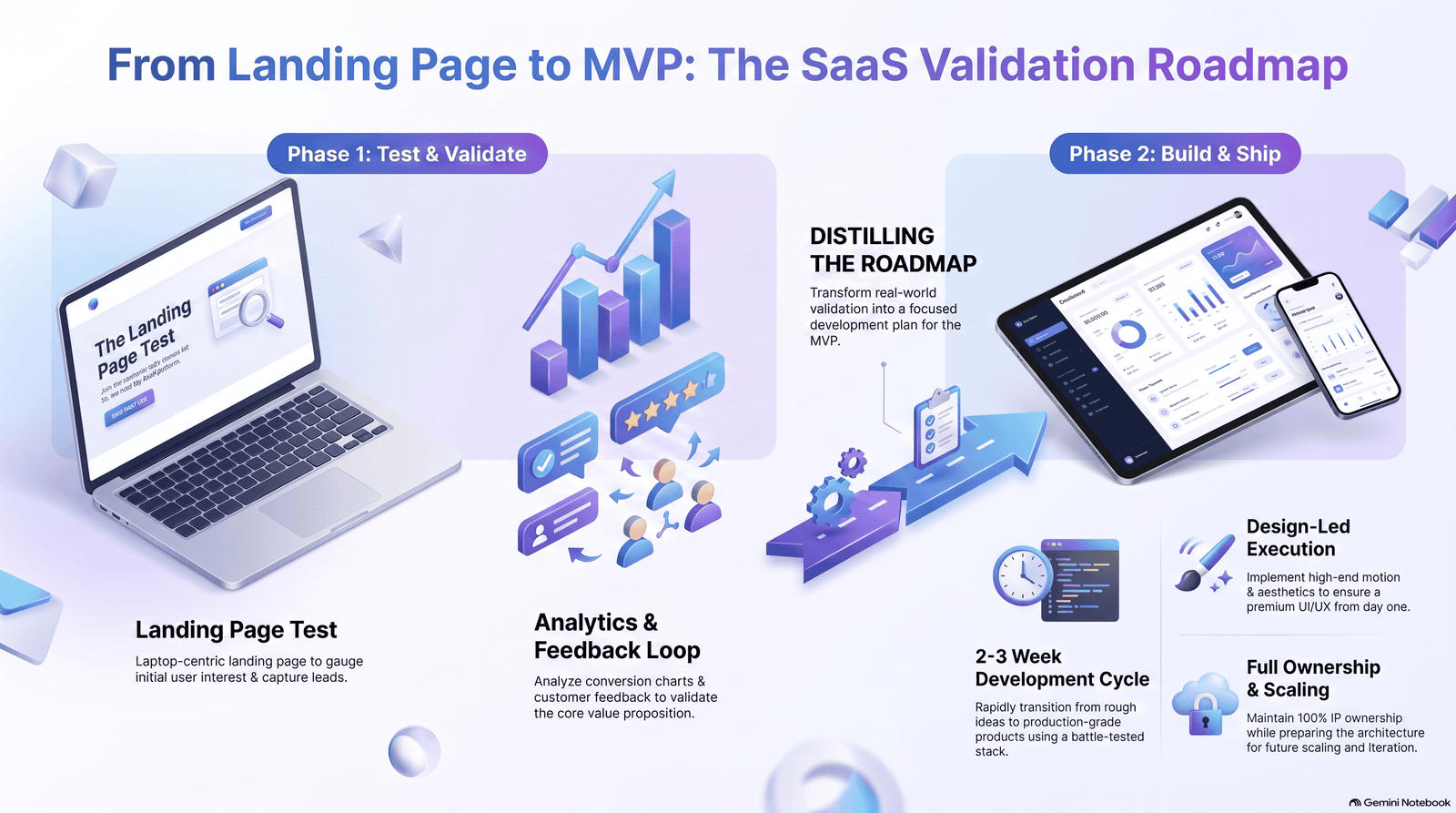
Strong signal from your landing page test means it’s time to move from validation into building, not straight into a full product.
Start with the narrowest version of the idea that still delivers on your one-sentence value proposition. Resist the urge to add every feature the waitlist emails mentioned.
If you’re not building in-house, this is usually the point where founders start evaluating an outside partner. Our guide on how to hire an MVP development team without overpaying covers exactly what to look for at this stage.
For teams still deciding between different types of build partners, the comparison in MVP app development company: what to look for is worth reading before any contracts get signed.
And if what you actually need is a technical lead rather than a full outsourced team, CTO-as-a-service explains that alternative path in detail.
Weak signal doesn’t necessarily mean the idea is dead — it often means the audience, pricing, or framing needs adjusting before you test again.
Landing Page Demand Test Checklist
Run through this before you call the test complete.
- [ ] Named the one riskiest assumption you’re testing
- [ ] Written a one-sentence value proposition
- [ ] Built a page with a single, clear call to action
- [ ] Set a target conversion benchmark before launch
- [ ] Driven at least a few hundred visitors from a relevant audience
- [ ] Labeled the page honestly (“coming soon,” not “buy now”)
- [ ] Reviewed both the numbers and any qualitative feedback
- [ ] Decided on a build, pivot, or another round of testing
If most of these are checked, you have a real dataset to make a build decision from — not a guess dressed up as a decision.
Frequently Asked Questions
What is a landing page test before building a product? It’s a validation method where you publish a simple page describing your idea and measure real clicks, sign-ups, or purchase intent before writing any product code.
What’s the difference between a fake door test and a regular landing page? A fake door test specifically simulates a feature or button that doesn’t work yet, measuring how many people try to use it. A regular pre-launch landing page usually just collects interest through an email sign-up.
How much traffic do I need for reliable results? A few hundred visitors is a reasonable minimum. Smaller samples make it hard to separate a real signal from random noise.
Is it ethical to advertise something that doesn’t exist yet? Yes, as long as the page is honest about the product’s status — “coming soon” or “joining a waitlist” rather than implying it’s ready to use or buy today.
How long should a landing page test run? Most founders see reliable data within one to two weeks, assuming steady traffic. Running longer rarely changes the conclusion once you’ve hit a meaningful sample size.
What happens if the test shows weak demand? Revisit your value proposition, targeting, or pricing before assuming the idea itself is wrong. Many weak first tests turn into strong second tests after a messaging change.
Should I test a landing page or build a prototype first? Test the landing page first. A prototype takes real time to design, while a pre-launch landing page can be live within a day and still answers the more urgent question: does anyone care.
Can I run a landing page test without any ad budget? Yes, using existing channels like a newsletter, relevant online communities, or your personal network of strangers rather than friends. It will take longer to reach a meaningful sample size, but the signal is still valid.
Final Thoughts
A landing page test before building a product isn’t a shortcut around real validation — it is real validation, just faster and cheaper than any alternative.
The founders who skip this step aren’t braver. They’re usually just in a hurry to build something, and that hurry is expensive when the market doesn’t want what gets shipped.
Give your idea a fair, honest test first. Then build with evidence instead of hope.
For more founder guides on turning early validation into a real product, explore BkAbhi’s blog, covering MVP costs, build timelines, and how to choose the right development partner for your stage.
Author Bio
Jeevesh Tripathi researches early-stage product validation and MVP strategy at BkAbhi Innovations Lab, where he works directly with founders testing new ideas before committing development budget to them. His guides draw on real landing page and fake-door test data from startups across SaaS and consumer products, following an Experience, Expertise, Authoritativeness, and Trustworthiness (E-E-A-T) approach to research and writing.