
Quick Answer: An MVP, or minimum viable product, is the smallest working version of a product that still solves a real problem for real users. Startups build one first to test demand, gather feedback, and avoid spending months (and savings) on features nobody actually wants. At BkAbhi, we believe a well-planned MVP helps founders validate ideas faster, reduce risk, and build products customers truly need.
If you’ve spent any time in startup circles, you’ve heard the term thrown around constantly. But what is an MVP in startups, really, beyond the buzzword?
This guide breaks it down in plain language. No jargon. No fluff. Just what an MVP is, why it matters, and how to actually build one.
Table of Contents
What Is an MVP in Startups? The Simple Definition
An MVP stands for minimum viable product. It’s the leanest version of your idea that you can put in front of real users.
The goal isn’t to impress anyone. The goal is to learn something true about your market before you spend real money.
That’s the whole point of an MVP for startups: validate the idea before you build the empire.
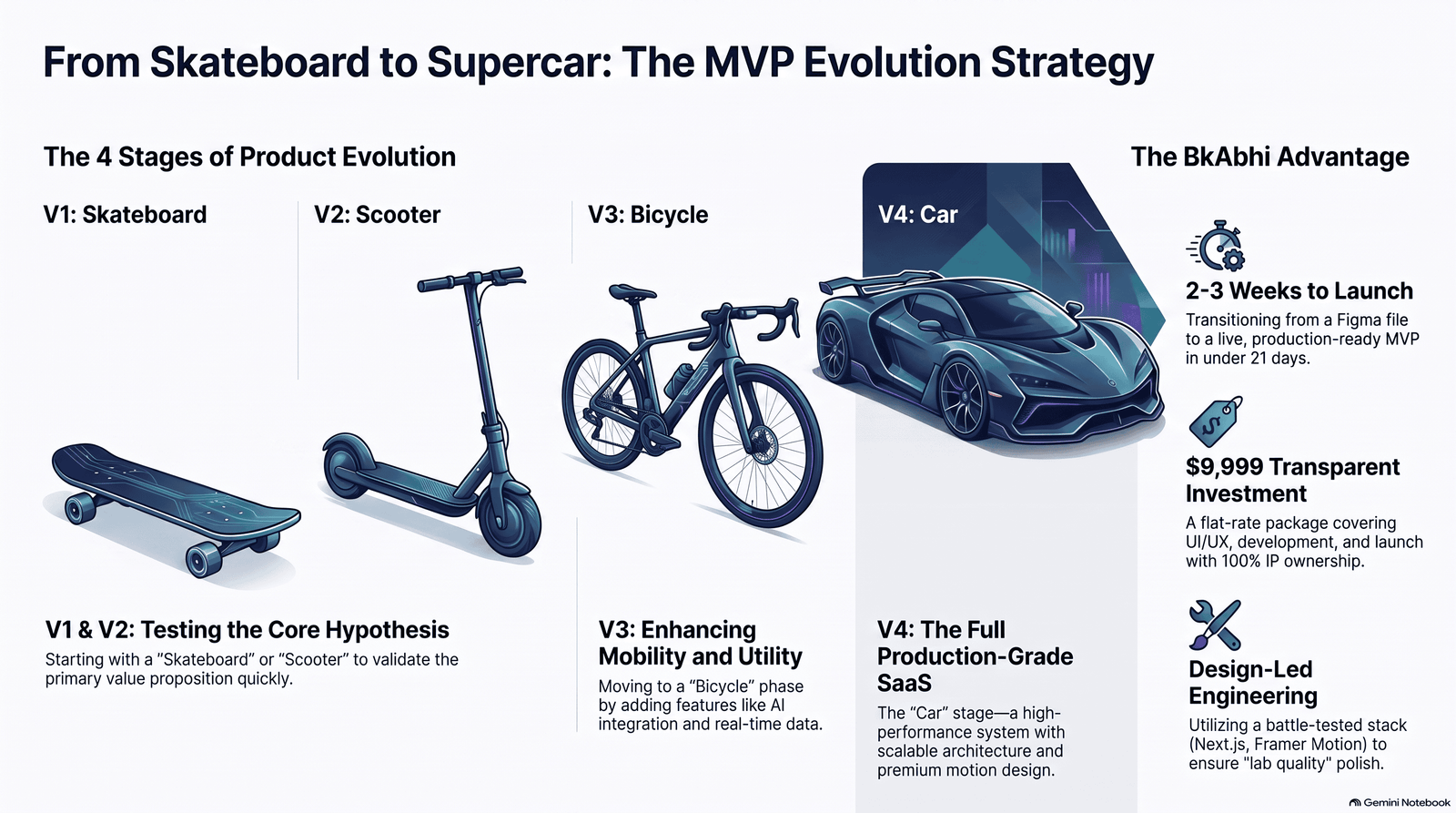
Think of it this way. If you’re building a car, your MVP isn’t a car with no paint job. It’s a skateboard that gets someone from point A to point B. Crude, but functional.
Why Does the Word “Viable” Matter So Much?
Most founders get stuck on “minimum.” They forget the second word entirely.
Viable means the product actually works. It solves one problem, reliably, for one type of user.
A minimum viable product isn’t an unfinished app with bugs everywhere. It’s a small, complete solution to a narrow problem.
This distinction is why so many first-time founders build the wrong thing. They cut corners on quality instead of cutting corners on scope.
Why Startups Build an MVP Before Anything Else
Startups operate under two constraints that big companies don’t: limited money and limited time. An MVP respects both.
Here’s why founders lean on startup MVP thinking instead of building a full product on day one.
It tests real demand. Surveys and opinions are cheap to give. Money and attention are not. An MVP forces users to show you what they actually want through their behavior.
It saves runway. A full build can burn six figures before you know if anyone wants it. An MVP for startups typically costs a fraction of that, leaving cash for the pivots every founder eventually needs.
It speeds up learning. You can’t fix what you don’t know is broken. Real user feedback in week six beats internal opinions in month eighteen, every time.
It reduces technical debt. Building small and learning first means you architect your product around what users actually do, not what you guessed they’d do.
For a deeper look at the financial side of this decision, our guide on why startups need MVP development services first walks through real founder numbers and what happens when this step gets skipped.
MVP vs Prototype vs Proof of Concept: What’s the Difference?
This is where a lot of confusion starts. These three terms get used interchangeably, but they mean different things.
A proof of concept answers one question: is this technically possible? It’s rarely shown to real users.
A prototype shows how the product looks and feels. It’s often not fully functional — think clickable mockups.
An MVP is a working product. Real users can use it, and in most cases, pay for it.
If you’re trying to decide which one your startup actually needs right now, our detailed comparison of MVP vs prototype vs POC breaks down exactly when each one fits.
Core Principles of a Good MVP for Startups
Not every “minimum” build qualifies as a real MVP. A few principles separate a smart one from a wasted one.
Solve one problem well. Pick a single, painful problem. Ignore every adjacent one for now.
Build for a narrow audience. Trying to please everyone means pleasing no one. Define your first 50 users clearly.
Ship fast. If your MVP takes longer than 8-12 weeks, it’s probably not minimum anymore.
Measure everything. Without analytics, your MVP is just a guess with extra steps. Track what users actually do, not what they say.
Expect to be wrong. Your first version will miss the mark somewhere. That’s not failure — that’s the entire purpose of building one.
The MVP Development Process: Step by Step
Understanding what is an MVP in startups only gets you halfway. The other half is knowing how to actually build one.
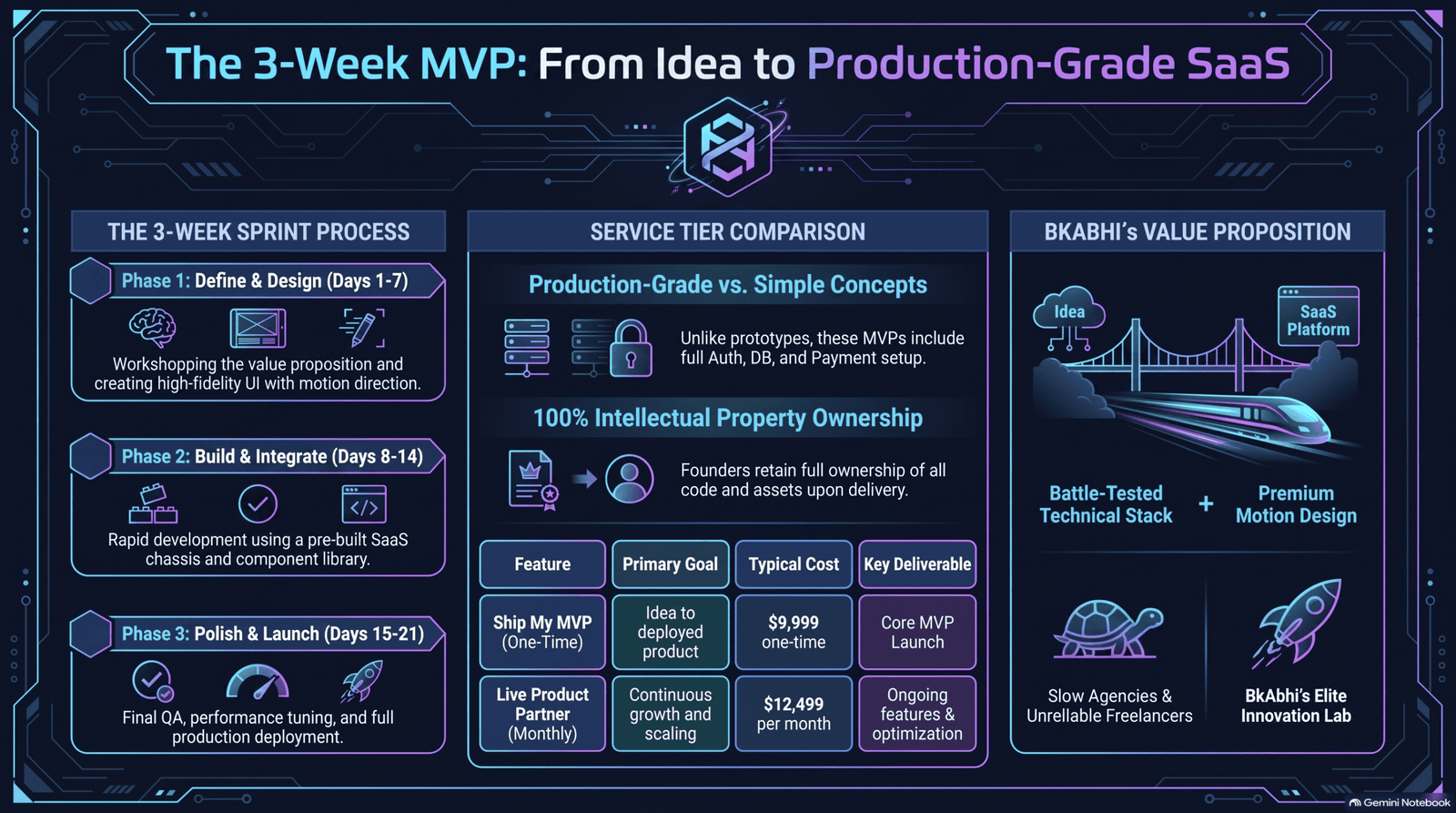
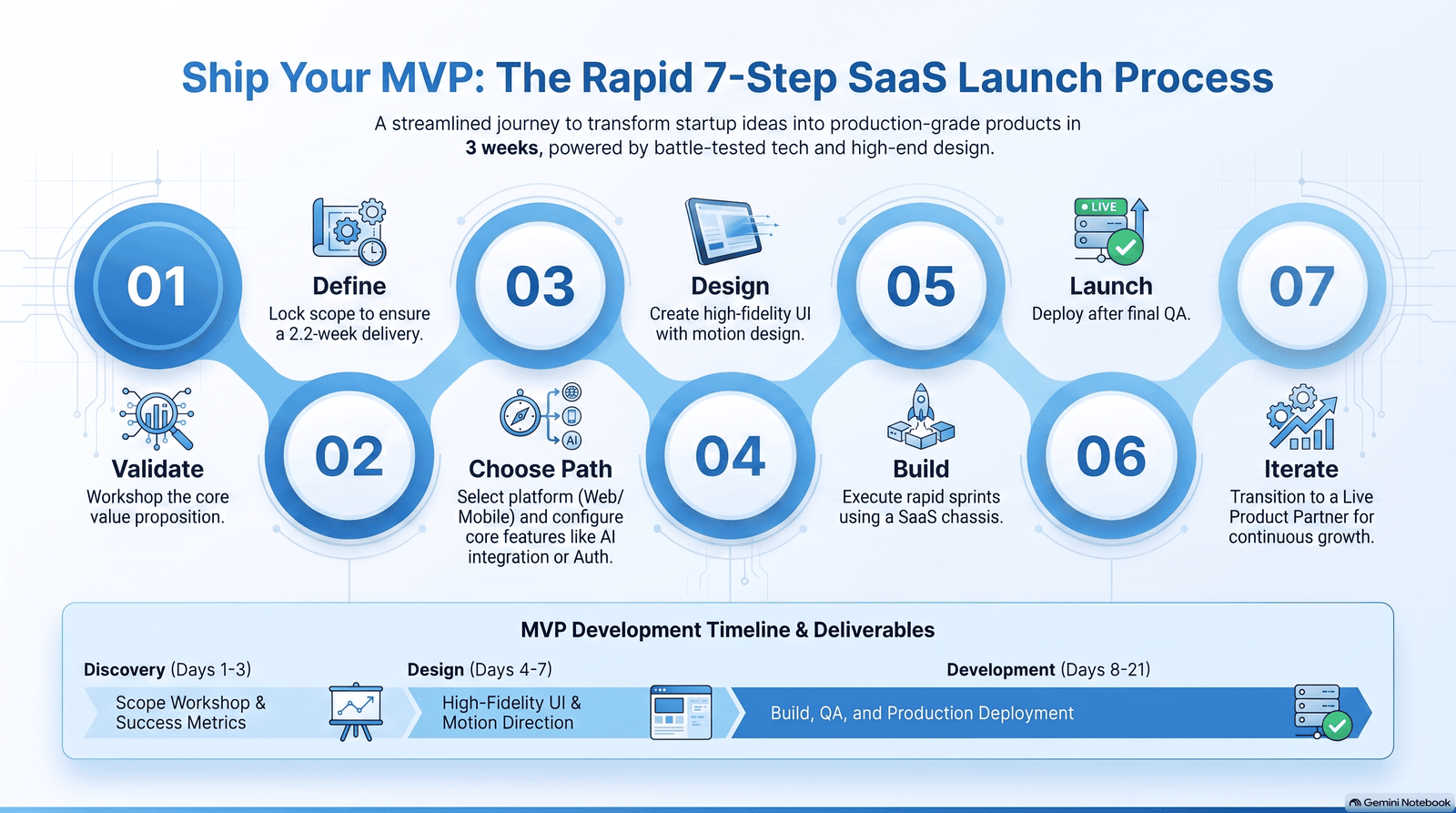
Here’s the typical MVP development process most founders follow, from idea to launch.
Step 1: Validate the Problem
Talk to 20-30 potential users before writing a single line of code. Ask about their current workarounds, not their opinion of your idea.
Step 2: Define the Core Feature Set
Write down every feature you can imagine. Then cut it down to the three or four that solve the core problem without extras.
Step 3: Choose Your Build Path
Decide between no-code tools, an in-house team, or an outside MVP development partner based on your budget, timeline, and technical skill.
Step 4: Design the Minimum Flow
Map the shortest path a user takes to get value. Every extra screen or click is a reason for someone to leave.
Step 5: Build and Test
Development typically runs 6-12 weeks for a standard MVP for startups, depending on complexity and platform.
Step 6: Launch to Early Adopters
Release to a small, targeted group first. Their honest feedback matters more than a big splashy launch.
Step 7: Iterate Based on Real Data
Use what you learn to decide your next build — more features, a pivot, or a full-scale rebuild.
For a much deeper breakdown of each stage, including timelines and team structures, see our complete MVP development process guide.
Minimum Viable Product Examples Every Founder Should Know
Theory is easier to grasp with real examples. Here are a few well-known minimum viable product examples that started small on purpose.
Airbnb. The founders rented out air mattresses in their own apartment and photographed them manually. No booking engine, no payment automation — just a simple test of whether strangers would pay to stay in someone’s home.
Dropbox. Before building the actual product, the founder released a short demo video explaining how file syncing would work. Sign-ups spiked overnight, validating demand before a single feature was coded.
Zappos. The founder photographed shoes from local stores and posted them online. When someone ordered, he’d buy the shoes himself and ship them. No inventory, no warehouse — just proof that people would buy shoes online.
Buffer. The team launched a simple landing page describing the product with a “Learn More” button, then a pricing page, before writing any code. Click-through rates told them exactly what to build.
Notice the pattern. None of these were unfinished apps. They were narrow, working solutions to one specific question.
Types of MVPs Startups Actually Use
Not every MVP looks like a stripped-down app. There are several formats founders use depending on what they’re trying to learn.
Landing page MVP. A single page describing the product with a signup or waitlist button, used to gauge interest before building anything.
Concierge MVP. The founder manually delivers the service by hand, without any software, to a handful of early users.
Wizard of Oz MVP. Users interact with what looks like a working product, while a human handles the process behind the scenes.
Single-feature MVP. A fully functional app that does exactly one thing, with everything else deliberately left out.
No-code MVP. Built using tools like Bubble or Webflow to test an idea quickly without custom development.
Each format answers a slightly different question, so the right one depends on what you’re actually trying to validate.
How Much Does MVP Development Cost?
Budget is usually the first question founders ask, right after they understand what an MVP actually is.
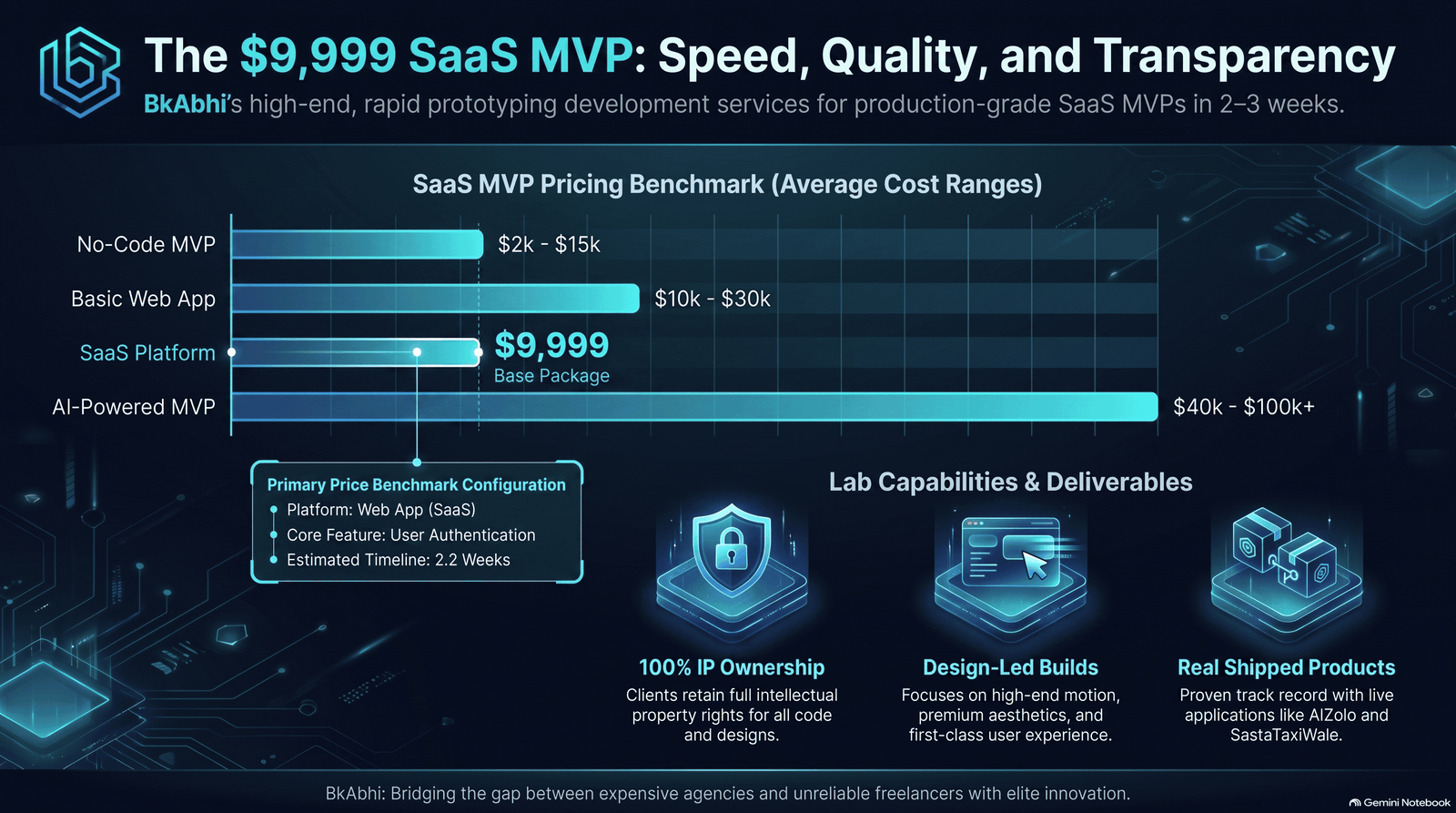
Costs vary widely based on region, team type, and feature complexity. A basic MVP can run anywhere from a few thousand dollars using no-code tools, up to $70,000 or more for a custom-built SaaS product with a professional team.
Region matters too. Development costs in India typically run lower than agencies based in the US, without necessarily sacrificing quality.
If you want exact numbers broken down by feature set and team structure, these two guides go deep on regional pricing:
- MVP development cost in India (2026 pricing guide)
- MVP development cost in the USA (2026 pricing breakdown)
Common Mistakes Startups Make When Building an MVP
Even founders who understand the theory often trip on execution. A few mistakes show up again and again.
Adding too many features. The word “minimum” gets forgotten the moment a founder starts imagining what’s possible instead of what’s necessary.
Skipping user interviews. Building based on assumptions instead of conversations is the single most common cause of a wasted MVP.
Chasing perfection. A polished MVP that launches six months late has already lost its head start on learning.
Ignoring analytics from day one. Without tracking, you can’t tell whether users are struggling or simply not interested.
Picking the wrong build partner. A mismatched developer or agency can turn an 8-week build into a 6-month one.
Confusing “cheap” with “minimum.” A low-quality build that needs a full rebuild in three months usually costs more than doing it right the first time.
Waiting for the perfect moment to start. There’s no such thing. The market rewards founders who ship, learn, and adjust — not the ones who wait for certainty that never comes.
That last point trips up more founders than any other. If you’re weighing whether to hire an agency, a freelancer, or build in-house, our guide on rapid MVP development services for SaaS startups covers how to move fast without cutting corners that matter.
Choosing the Right MVP Development Partner
Not every founder codes, and not every founder should try to learn just to ship a first version.
If you’re evaluating outside help, look for a team that pushes back on your feature list instead of agreeing to everything. That single trait tends to separate good partners from expensive mistakes.
Fixed-scope pricing, a senior-led team, and a portfolio of shipped products — not just designs — are worth asking about directly in your first call.
For a filtered shortlist built specifically around early-stage constraints, see our guide to the best MVP development companies for startups, which ranks partners by team type and budget range rather than star ratings.
How AI Is Changing MVP Development in 2026
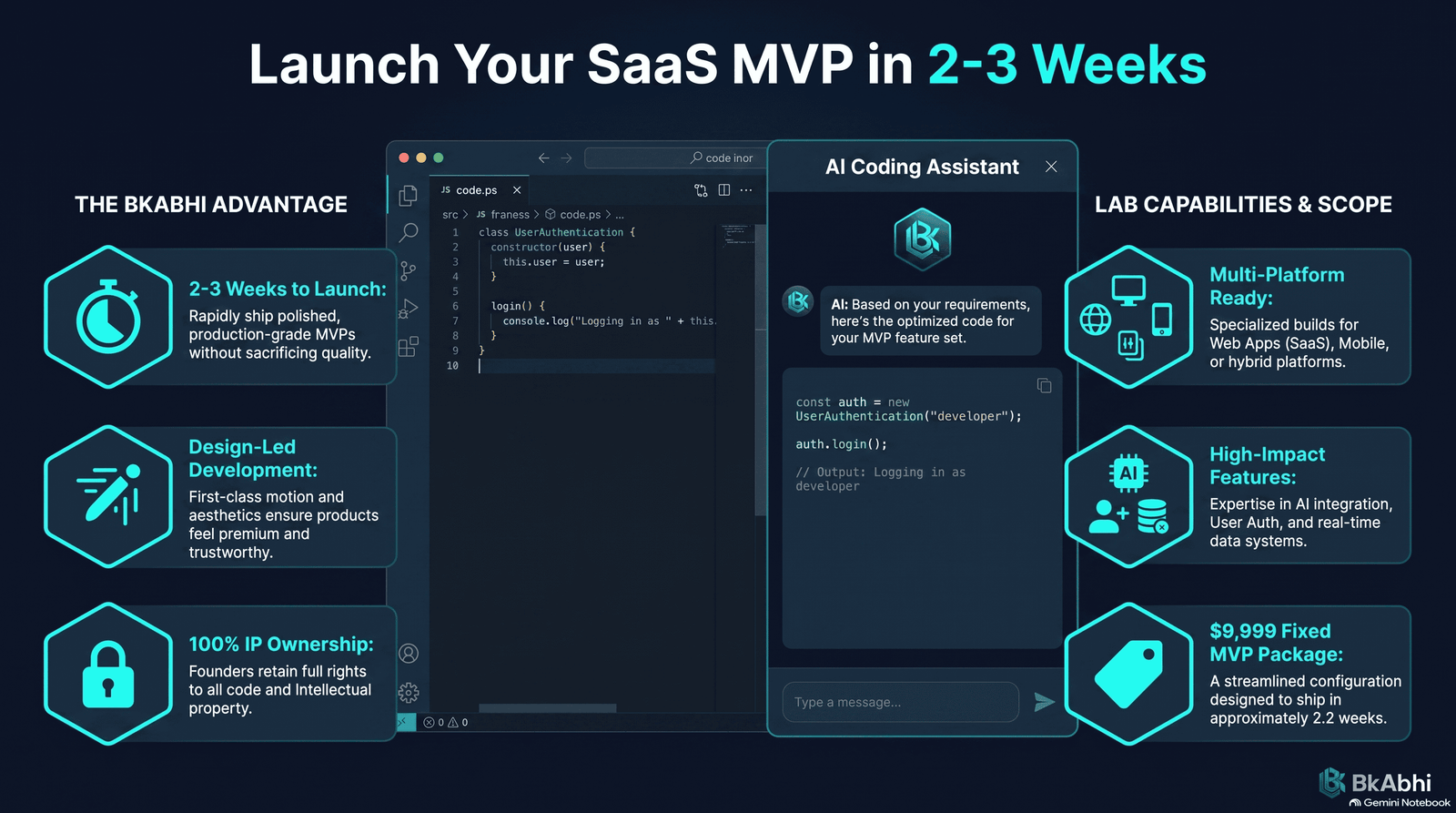
AI tools have shortened the distance between an idea and a working MVP more than any single trend in the last few years.
Founders now use AI to speed up wireframing, generate boilerplate code, and even automate parts of customer support inside their MVP itself.
This doesn’t replace the fundamentals — validating demand still matters more than ever. But it does mean a minimum viable product can go from idea to live product faster than it could even two years ago.
If you’re curious how AI fits into a broader software strategy beyond just the MVP stage, our guide on AI-driven software solutions for startups explores where AI genuinely adds value versus where it’s just noise.
Signs Your Startup Is Actually Ready to Build an MVP
Not every idea is ready for development just because a founder is excited about it. A few signals suggest you’re actually ready.
You can name your riskiest assumption. If you can’t articulate the one thing that could kill your idea, you’re not ready to test it yet.
You’ve talked to real potential users. Not friends and family who’ll say anything to be supportive — actual strangers who fit your target profile.
You can describe the MVP in one sentence. If your pitch takes five minutes and three slides, you don’t have a minimum viable product yet. You have a vision.
You have a way to measure success. Signups, activation rate, or revenue — pick one clear metric before you build anything.
If you’re missing any of these, spend another week or two on research. Building too early is just as costly as building too much.
MVP vs Full Product: When to Move Past the MVP Stage
An MVP isn’t meant to last forever. At some point, every successful startup MVP graduates into a full product.
The signal to move on usually isn’t a calendar date — it’s user behavior. When people are actively asking for features you deliberately left out, that’s validation, not scope creep.
Revenue is another strong signal. Once paying customers show consistent retention, it’s usually safe to invest in scaling infrastructure, adding team members, and building beyond the core.
The mistake to avoid is scaling too early, before you’ve confirmed the core problem-solution fit actually holds up with a wider audience. Growing a product nobody wants just means failing at a larger, more expensive scale.
This is also the point where many founders bring on a development partner who understands both MVP-stage discipline and how to build for growth. Understanding what is an MVP in startups versus what a scaled product needs is what separates founders who build sustainably from those who overbuild too soon.
MVP Development Checklist for First-Time Founders
Before you commit any budget, run through this short checklist.
- [ ] Have you interviewed at least 20 potential users?
- [ ] Can you describe your MVP’s value in one sentence?
- [ ] Have you cut your feature list down to the essential 3-4?
- [ ] Do you have a way to measure user behavior after launch?
- [ ] Have you set a realistic budget and timeline before talking to vendors?
- [ ] Do you have a plan for what happens after launch, win or lose?
If you can check most of these boxes, you’re in a strong position to start building rather than planning.
Frequently Asked Questions
What does MVP stand for in startups? MVP stands for minimum viable product — the smallest version of a product that still delivers real value to a specific group of users.
Is an MVP the same as a prototype? No. A prototype often isn’t functional, while an MVP is a working product that real users can actually use.
How long does it take to build an MVP? Most MVP builds take between 6 and 12 weeks, depending on complexity, platform, and how quickly requirements are locked down.
How much should a startup budget for an MVP? Budgets vary widely, from a few thousand dollars for a no-code build to $70,000+ for a custom SaaS product. Region and feature complexity both play a role.
Do I need to be technical to build an MVP? No. Many non-technical founders successfully launch MVPs by partnering with development agencies, freelancers, or no-code platforms.
What happens after the MVP launches? You gather feedback, track usage data, and use both to decide your next move — whether that’s adding features, pivoting, or scaling what’s working.
Final Thoughts
Understanding what is an MVP in startups comes down to one idea: build the smallest thing that teaches you the most.
Not the smallest thing that’s easiest to build. Not the biggest thing you can imagine. The smallest thing that answers your riskiest question about whether people actually want what you’re making.
Every founder’s first version will be wrong somewhere. The goal isn’t to avoid that — it’s to find out where, quickly and cheaply, before it’s too late to fix.
If you’re ready to move from planning to building, explore more founder guides on BkAbhi’s blog covering MVP costs, development timelines, and how to choose the right build partner for your stage.
Author Bio
Jeevesh Tripathi is a startup technology researcher and MVP strategy consultant at BkAbhi Innovations Lab, where he has advised early-stage founders across SaaS, fintech, and consumer products on validating ideas before committing to full-scale development. His work follows an Experience, Expertise, Authoritativeness, and Trustworthiness (E-E-A-T) approach to research, translating real founder conversations into practical, jargon-free guides.