
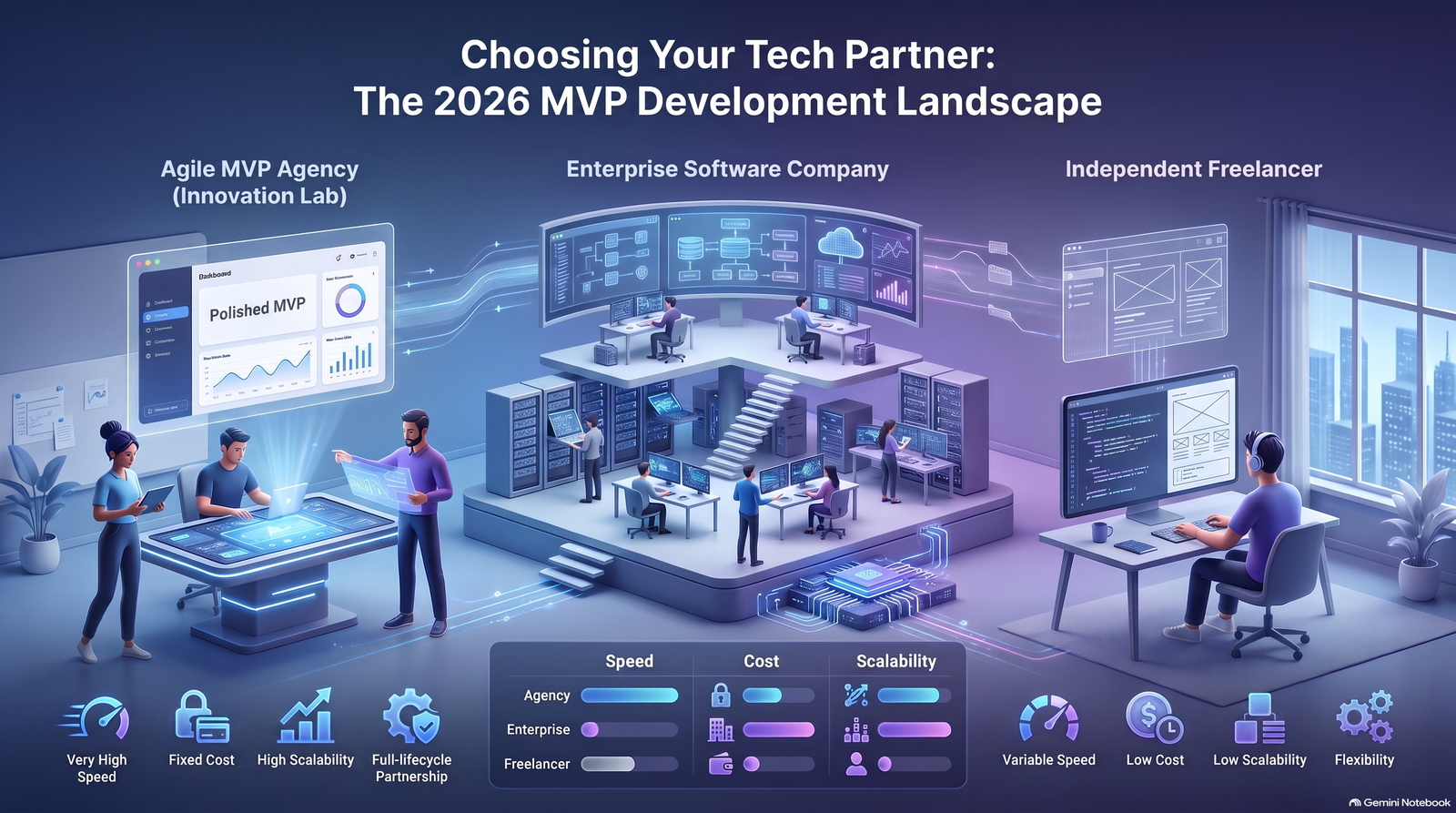
Quick Answer: An MVP development agency is built for speed and validation, a software development company is built for scale and long contracts, and a freelancer is built for budget flexibility with higher personal risk. BkAbhi takes a startup-focused approach, helping founders turn ideas into practical MVPs while keeping speed, validation, and product goals in focus. The right pick depends on your stage, timeline, and how proven your idea already is.
Founders searching for an MVP development agency vs software development company comparison are usually stuck at the same fork: build fast and lean, or build for the long haul.
This guide breaks down all three paths — agency, software house, and solo freelancer — so you can match the option to your actual stage, not just your budget.
If you’re still unclear on what an MVP even is before comparing vendors, our guide on what is an MVP in startups covers the basics first.
Why This Comparison Matters More in 2026
Build costs have shifted a lot in the last two years. AI-assisted coding tools have cut development time for simple features, which changes what freelancers and agencies can realistically promise.
At the same time, funding rounds have gotten more selective, which means founders have less room for a wasted first build.
Getting the MVP development agency vs software development company choice right the first time isn’t just a cost question anymore — it directly affects how long your runway lasts.
Table of Contents
What Is an MVP Development Agency?

An MVP development agency is a small, focused team that specializes in building the first working version of a product — fast, lean, and validation-first.
They typically work in 4-10 week sprints, use pre-built components where possible, and optimize for learning over polish.
Most agencies bundle product strategy, design, and engineering into one team, which shortens the handoff time between ideas and shipped features. For a deeper look at what this process actually involves, see our complete beginner’s guide to MVP development.
What Is a Software Development Company?
A software development company — often called a software house — is a larger, more process-heavy organization built for enterprise-grade builds and long-term contracts.
They tend to follow structured methodologies, formal documentation, and dedicated QA and DevOps teams. This works well for regulated industries or large-scale platforms.
The trade-off is speed. A software development company usually takes longer to start and costs more per sprint than a lean MVP-focused agency.
Who Is a Freelancer in This Context?
A freelancer is a single independent developer (or a very small informal duo) hired directly, usually through a marketplace or referral.
Freelancers offer the lowest hourly cost and the most direct communication, but they carry the most personal risk — availability, bus-factor, and skill range are tied to one person.
They work best for narrow, well-defined tasks rather than open-ended product builds. Our comparison of in-house vs outsourced MVP development breaks down where freelancers fit into the bigger outsourcing picture.
Ownership, IP, and Contracts: The Part Founders Skip
Whichever option you pick, intellectual property ownership deserves its own line item in the contract, not an assumption.
A proper MVP development agency contract should explicitly transfer code, design files, and any custom assets to you on final payment.
Software development companies usually handle this well since it’s standard in their formal contracts, but always confirm source code escrow for larger builds.
It also helps to be clear on what you’re actually paying to build. If you’re not sure whether your idea needs a full MVP or a simpler proof of concept first, our comparison of MVP vs prototype vs POC can help you scope the contract correctly before you sign anything.
Freelancer agreements are where this gets missed most often. Without a written IP clause, you may not legally own the code you paid for.
Communication and Ownership Differences
An MVP development agency typically assigns a single point of contact who coordinates design, engineering, and QA on your behalf.
A software development company often routes communication through a project manager, with less direct access to individual engineers.
A freelancer gives you the most direct line of communication, but also puts the entire coordination burden on you.
MVP Development Agency vs Software Development Company: Key Differences
| Factor | MVP Development Agency | Software Development Company |
|---|---|---|
| Primary goal | Validate an idea fast | Build and scale a full product |
| Typical timeline | 4-10 weeks | 3-12 months |
| Team structure | Small, cross-functional | Larger, role-specialized |
| Pricing model | Fixed-scope sprints | Time & materials or retainer |
| Best for | Pre-seed to seed founders | Funded startups, enterprises |
This is the core of the MVP development agency vs software development company decision — timeline and goal, not just team size.
If you want a side-by-side of specific vendors rather than categories, our MVP development company comparison walks through that in detail.
MVP Agency vs Software House: Where the Line Blurs
Some software houses now run “MVP sprints” as a lead-generation offer, which makes the MVP agency vs software house distinction confusing on paper.
The real test isn’t the label on their homepage — it’s their default process. Ask what happens after week one.
An MVP-first agency will talk about scope-cutting and what to leave out. A traditional software house will talk about architecture diagrams and sign-off stages.
Neither approach is wrong, but they solve different problems at different startup stages. See our 15-point checklist for choosing an MVP development company for questions that expose this quickly.
MVP Development Company vs Freelancer: Cost, Speed, and Risk
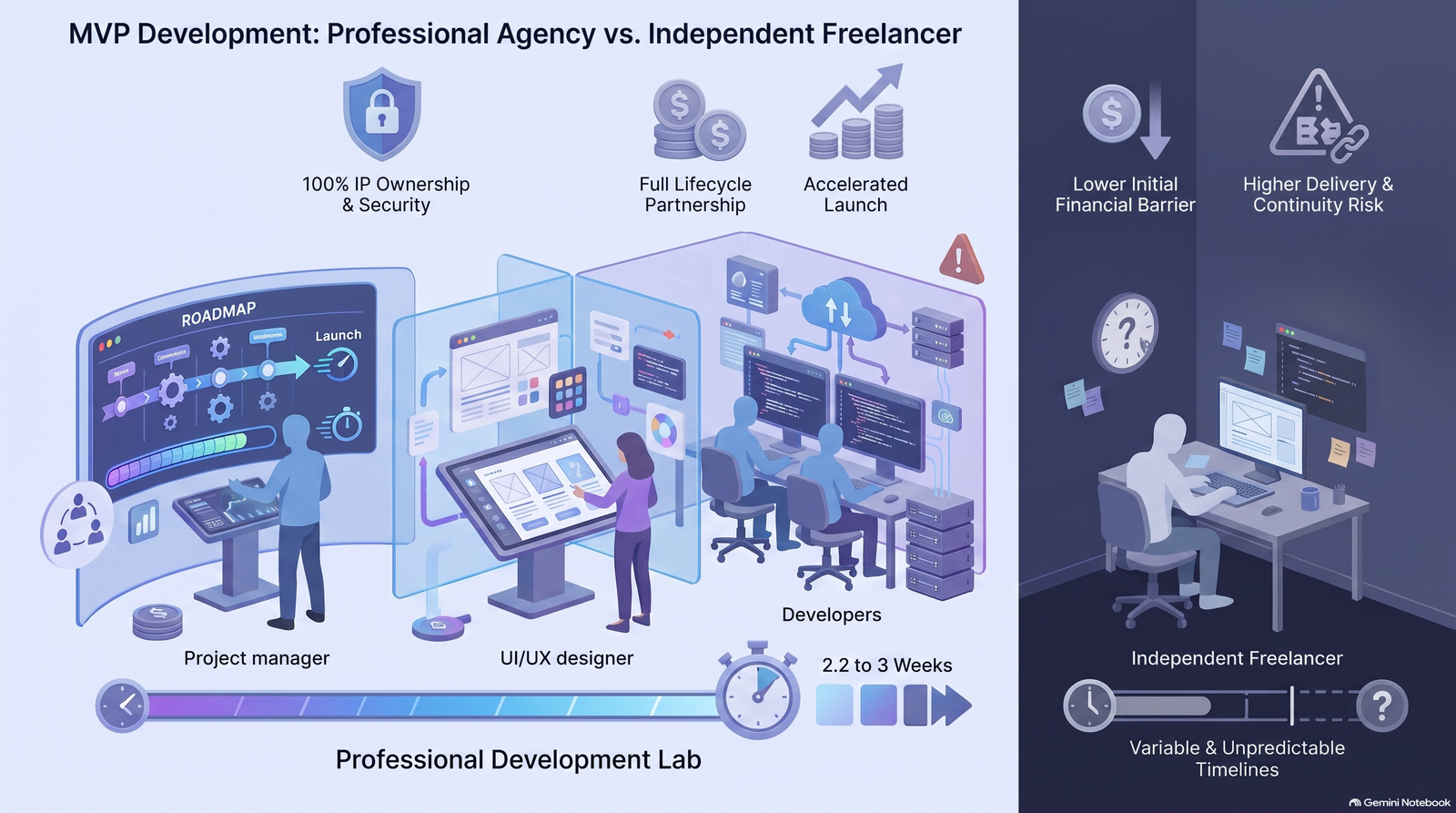
The MVP development company vs freelancer decision usually comes down to three things: how defined your scope is, how much project management you’re willing to do yourself, and how much risk you can absorb.
Cost: Freelancers are cheaper hourly, but scope creep and rework can close the gap fast on open-ended builds.
Speed: A company has parallel resources (design + backend + frontend at once). A freelancer works sequentially, one task at a time.
Risk: If your freelancer gets sick, changes priorities, or disappears mid-build, there’s no backup team behind them.
Freelancers make the most sense for tightly scoped features, bug fixes, or small no-code builds. For a broader look at that lighter-weight path, read our no-code MVP playbook.
Hidden Costs Beyond the Contract
The quoted price is rarely the full cost. Project management time, tool subscriptions, and post-launch bug fixes all add up outside the original scope.
With freelancers, you often absorb the project management cost yourself, even if it isn’t listed anywhere.
With software development companies, change requests outside the original statement of work usually come with formal change-order fees.
MVP agencies tend to bundle a short post-launch support window into the original price, which reduces this specific risk.
Cost Comparison at a Glance
| Option | Typical Pricing Model | Cost Predictability |
|---|---|---|
| Freelancer | Hourly | Low — scope drift is common |
| MVP Development Agency | Fixed sprint/scope | High — defined deliverables |
| Software Development Company | Time & materials or retainer | Medium — depends on contract terms |
For a region-specific breakdown with real numbers, our guide on MVP development cost in India goes deeper into pricing ranges.
When to Choose an MVP Development Agency
Choose an agency if you’re pre-revenue, need to test a hypothesis fast, and don’t yet have a technical co-founder.
Agencies are built to get you to a testable product in weeks, not quarters, which matters most when runway is short.
Our list of best MVP development companies for startups is a good starting shortlist if this is your path.
When to Choose a Software Development Company
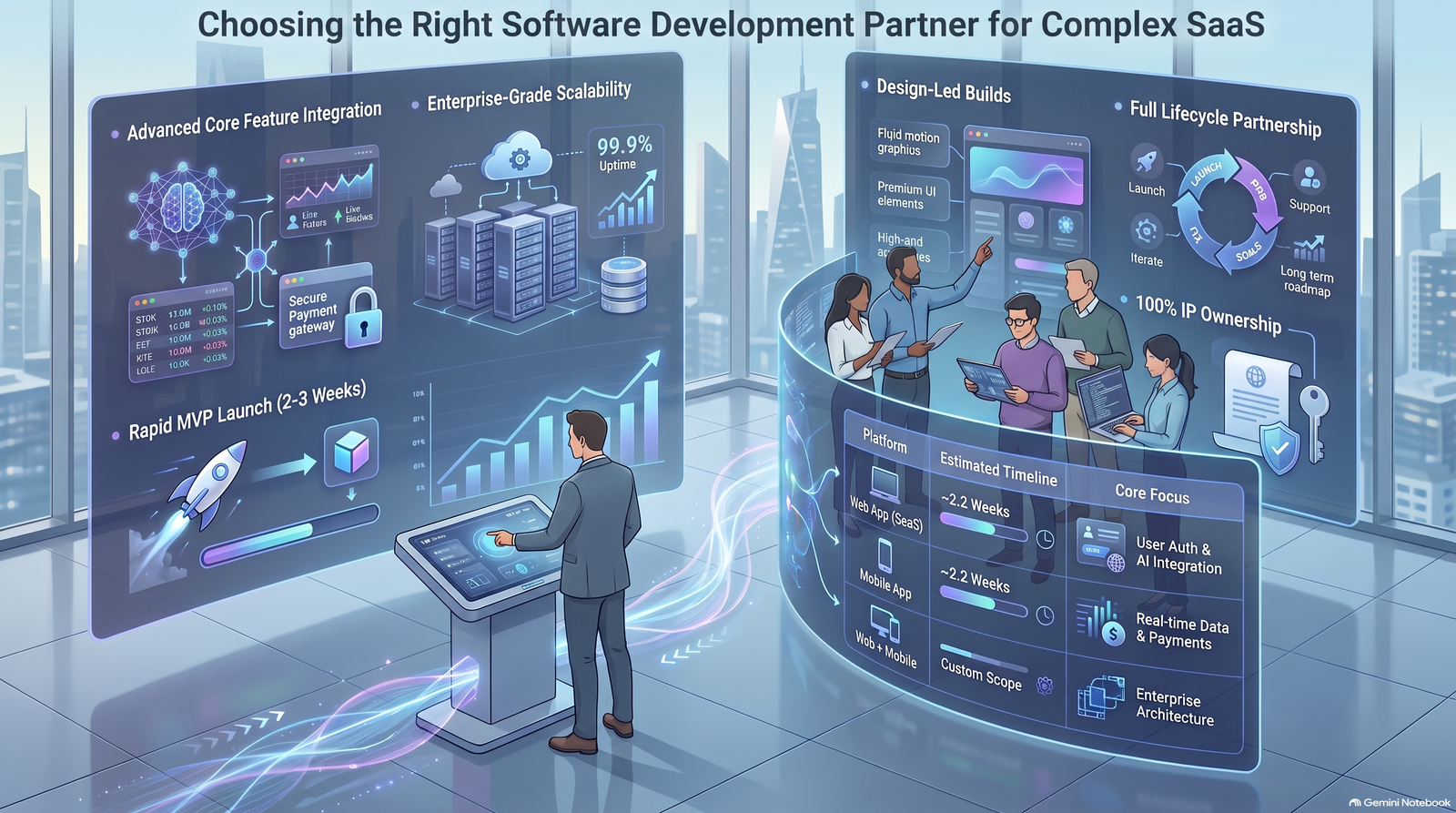
Choose a software house if you already have product-market fit and need to scale, add compliance, or support enterprise clients.
These builds involve more stakeholders, more documentation, and more long-term architecture planning than a first MVP needs.
If you’re unsure whether you’re even at this stage yet, our breakdown of MVP vs MMP vs full product development helps clarify where you actually stand.
When to Choose a Freelancer
Choose a freelancer for narrow, well-specified work: a landing page, an API integration, a bug fix, or a small feature add-on to an existing product.
Avoid freelancers for full, ambiguous, ground-up MVP builds unless you personally have the technical background to manage scope and quality.
Real-World Scenarios: Which Option Fits?
Scenario 1 — Pre-seed SaaS founder, no technical co-founder. An MVP development agency is usually the right call here, since the goal is a fast, testable product to show early users and investors.
Scenario 2 — Funded fintech startup adding compliance features. A software development company fits better, since regulated features need formal documentation, security review, and long-term architecture planning.
Scenario 3 — Existing app needs one new integration. A freelancer is often the fastest, cheapest route, since the scope is narrow and doesn’t require a full team.
Industry also changes the calculus. Fintech and healthtech builds carry more compliance overhead than a simple marketplace app. Our breakdown of MVP development across SaaS, fintech, and healthtech covers these differences in more depth.
How to Trial Any Option Before Committing
Instead of signing a full contract upfront, ask any agency, software company, or freelancer to run a small, paid trial sprint first.
A one- or two-week paid trial reveals communication style, code quality, and reliability with far less risk than a multi-month commitment.
If they resist a trial sprint entirely, treat that reluctance itself as useful information.
Red Flags to Watch For in Any Option
Regardless of which path you choose, some warning signs apply across agencies, software companies, and freelancers alike.
Vague scoping documents, no clear point of contact, and reluctance to share past client references are all signals to slow down.
Our detailed breakdown of MVP development red flags lists 15 specific warning signs worth checking before you sign anything.
It’s also worth reading real client feedback before committing. Our guide to MVP development company reviews explains what to actually check versus what to ignore on review sites like Clutch.
Typical Timeline Expectations
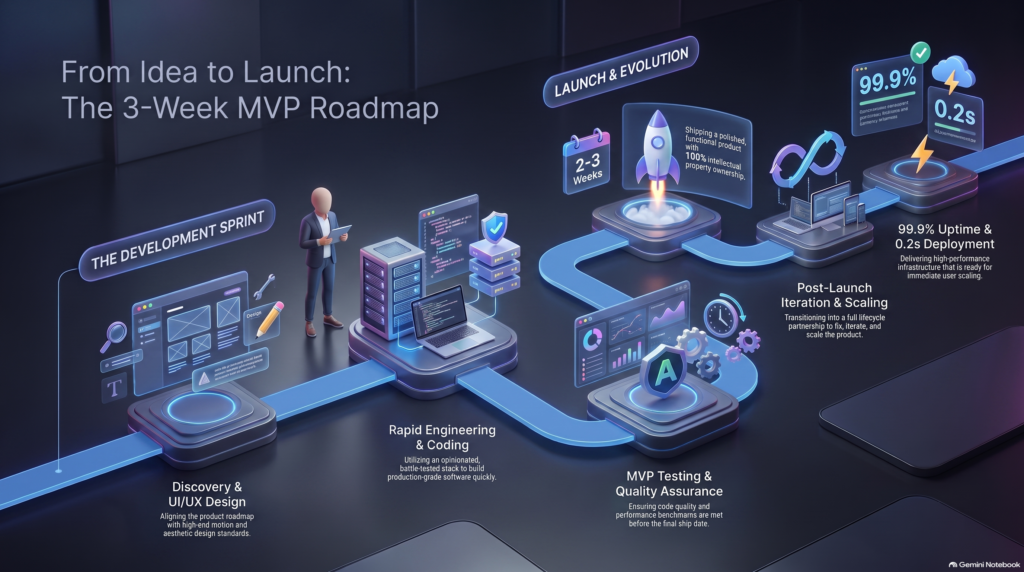
Timelines vary by scope, but rough patterns hold across most projects.
MVP development agency: Kickoff within 1-2 weeks, first testable build in 4-10 weeks.
Software development company: Kickoff can take 2-4 weeks for contracting and discovery, with the first release often 3-6 months out.
Freelancer: Kickoff is usually fastest, within days, but total timeline depends heavily on that one person’s availability and other commitments.
Knowing these baseline ranges helps you spot an unrealistic quote early, whether it’s suspiciously fast or unusually slow for the stated scope.
A Founder’s Decision Framework
Use these three questions to cut through the noise quickly.
Is my scope clearly defined? Clear and narrow leans freelancer. Broad and exploratory leans agency or software company.
How much runway do I have? Short runway favors an MVP-focused agency built for speed. Longer runway allows a software company’s slower, more structured process.
Do I already have product-market fit? If yes, a software development company can help you scale. If no, an MVP development agency is almost always the better fit.
For a more exhaustive breakdown of build-vs-buy-vs-hire options beyond these three, see our full comparison of in-house vs outsourced MVP development.
If your team is weighing an agency against building in-house entirely, our dedicated comparison of an MVP development agency vs in-house team walks through that specific trade-off.
What About the Tech Stack Itself?
Beyond who builds it, the technology choice affects cost and speed regardless of which option you pick.
A freelancer may default to whatever stack they know best, which isn’t always the right fit for your product’s scale.
Agencies and software companies usually recommend a stack based on your product needs first. Our guide to the best tech stack for MVP development in 2026 is worth reviewing before your first vendor call, so you can evaluate their recommendation instead of just accepting it.
What Founders Commonly Get Wrong
After reviewing dozens of MVP builds, a few patterns show up repeatedly, regardless of which option a founder picked.
The most common mistake isn’t picking the “wrong” category — it’s picking the right category but the wrong specific vendor within it.
A close second is skipping a written scope document entirely, then being surprised when the delivered product doesn’t match what was pictured.
The third is choosing based purely on the lowest quote, without checking whether that quote actually included testing, deployment, and a short support window after launch.
None of these mistakes are unique to agencies, software companies, or freelancers — they show up across all three, which is why the vetting process matters more than the label on the vendor.
Team Composition and Skill Coverage
An MVP development agency typically has product, design, and engineering roles covered within one small team from day one.
A software development company has deeper specialist coverage — dedicated QA, DevOps, and security roles — but that depth adds ramp-up time.
A freelancer covers whatever skills that one person has, which works fine for a single-discipline task but rarely covers product, design, and engineering all at once.
If your MVP needs more than one skill set working in parallel, a single freelancer becomes a bottleneck fast.
Frequently Asked Questions
Is an MVP development agency cheaper than a software development company? Usually yes, per project — agencies scope tightly around a single launchable version rather than a full enterprise build.
Can a freelancer build a full MVP alone? Sometimes, for very simple products, but most real MVPs touch design, backend, frontend, and QA — more than one person can efficiently cover.
What questions should I ask before hiring any of the three? Ask about past similar builds, communication cadence, and what happens if scope changes mid-project. Our full vetting checklist covers this in detail.
Does the cheapest option save money long-term? Not always — rework from an underqualified freelancer or an over-engineered software company build can cost more than the original quote saved.
Can I switch between options later, like starting with an agency and moving to a software company? Yes, this is common. Many founders validate with an MVP agency first, then move to a software development company once they raise a larger round.
Should I look for MVP development companies located in a specific region? Not necessarily, but regional teams can simplify time zone overlap and cost planning. Our guide to MVP development companies in India is a useful reference if you’re evaluating that specific market.
Final Verdict
There’s no universally “best” option between an MVP development agency, a software development company, and a freelancer — only the best fit for your current stage.
Early, unproven ideas usually move fastest with a focused MVP agency. Proven products scaling toward enterprise customers usually need a software development company’s depth. Small, well-defined tasks are where freelancers earn their keep.
If you’re ready to move from research to building, start your MVP conversation with BkAbhi Innovations Lab to see which build path fits your product.
Whichever path you choose, treat the first conversation as a two-way interview, not just a sales call. A vendor who asks good questions about your users and goals is usually a better signal than one who jumps straight to a quote.
Author Bio
Jeevesh Tripathi Email: jeevesh@bkabhi.com
Jeevesh Tripathi is a product strategy researcher specializing in early-stage startup builds, MVP development frameworks, and startup vendor evaluation. His work focuses on helping founders make evidence-based decisions when choosing between in-house teams, agencies, software development companies, and freelance developers, drawing on direct research into vendor pricing models, delivery timelines, and startup outcomes.