
Quick Answer
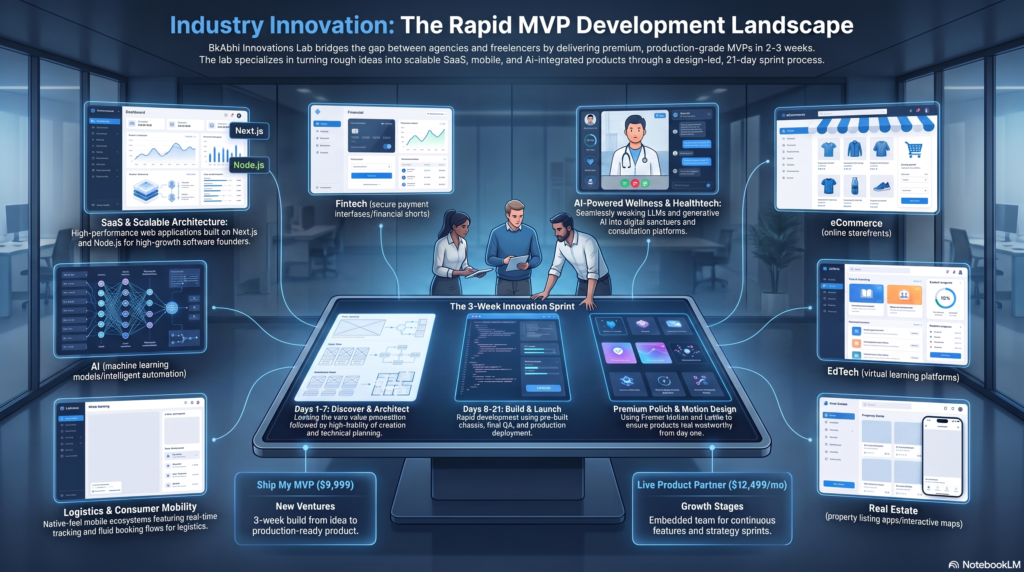
MVP development for SaaS startups looks nothing like an MVP build for a fintech or healthtech company. SaaS MVPs prioritize subscription billing and fast iteration. Fintech MVP development leans on compliance, security, and KYC checks from day one. A healthtech MVP company has to design around HIPAA before writing a line of code. Matching your MVP development company to your industry — not just your budget — is the single biggest factor in whether your build succeeds. Our pillar guide to the best MVP development companies in the USA covers the broader selection framework this article builds on.
Not every MVP is built the same way. A subscription analytics tool and a digital banking app may both be “MVPs,” but they carry completely different risks, timelines, and compliance loads.
That’s why industry-specific MVP development has become its own discipline. The company that’s great at shipping consumer apps might be the wrong fit for a fintech founder who needs SOC 2 basics in place from week one.
This guide breaks down how MVP development actually changes by industry — SaaS, fintech, healthtech, and a handful of others — so you know what to ask for before you sign with anyone.
Table of Contents
Why Industry Matters More Than Founders Realize
Most founders shop for an MVP development company the way they’d shop for a general contractor. They compare rates, portfolios, and timelines.
But a team that’s shipped a dozen consumer social apps may have never touched a payment rail or a HIPAA-covered data model. That gap doesn’t show up until week six.
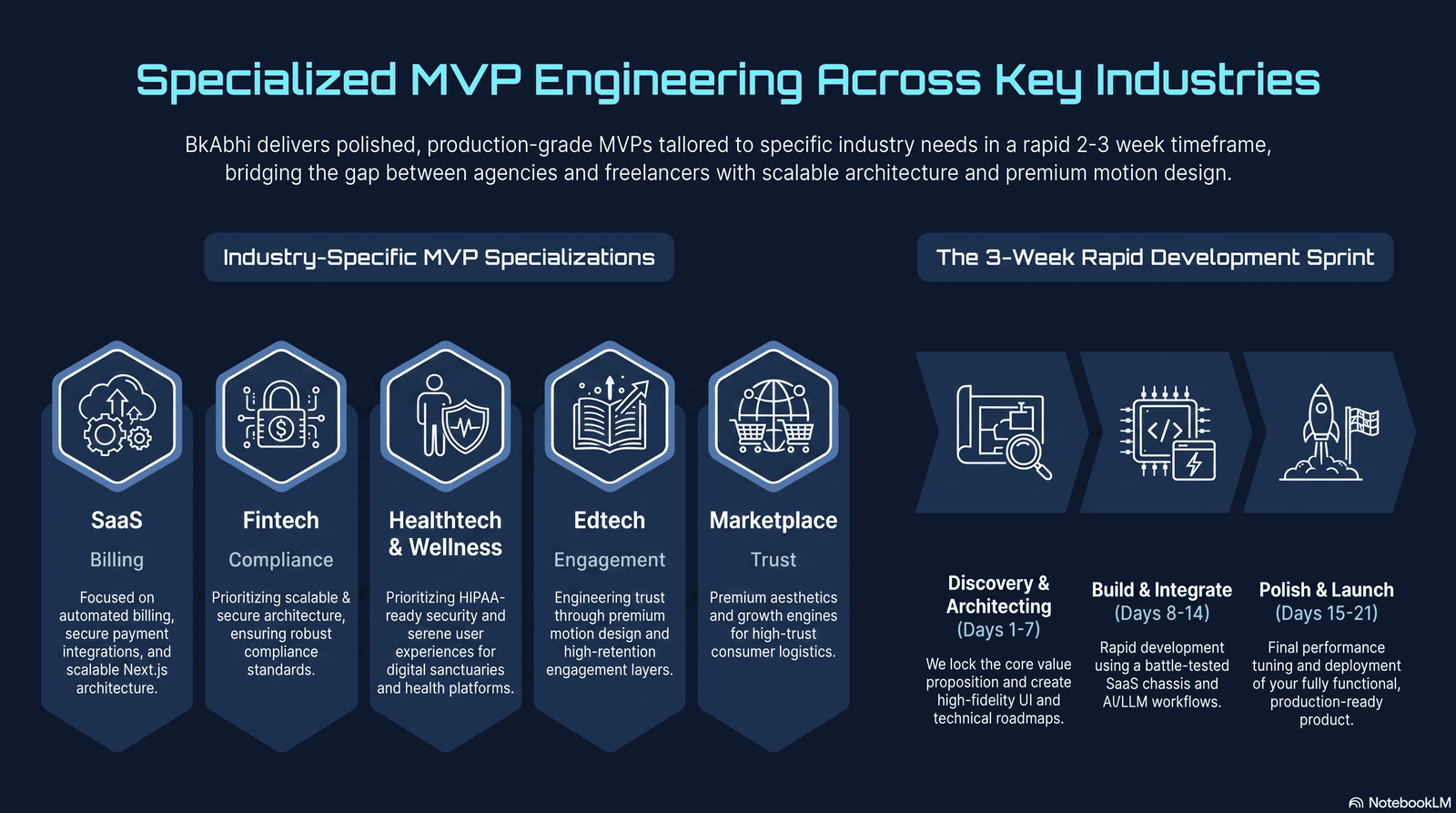
Industry experience changes three things directly: what gets built first, how compliance gets handled, and how much the MVP actually costs. Skipping this check is one of the reasons founders end up rebuilding — a pattern our MVP development process guide covers in more depth.
The sections below walk through the industries that hire MVP development companies most often, and what actually changes in each one.
| Industry | Core MVP Priority | Compliance Load |
|---|---|---|
| SaaS | Subscription billing, multi-tenancy | Low to moderate |
| Fintech | Payment security, identity checks | High |
| Healthtech | Patient data protection | High |
| EdTech | Engagement, one learning loop | Low to moderate |
| Marketplace/E-commerce | Supply-demand balance | Moderate |
| Proptech/Logistics | Real-world scheduling, documents | Moderate |
Use this table as a starting point, not a final answer. Every startup has edge cases — a B2B SaaS tool handling payroll data, for example, inherits some of fintech’s compliance weight even though it’s technically “just SaaS.”
MVP Development for SaaS Startups
SaaS is the most common category for MVP development for SaaS startups requests, and for good reason. The global SaaS market is projected to reach roughly $375 billion in 2026, according to Fortune Business Insights, with double-digit growth expected through the next decade.
That growth means more competition for every new SaaS product. A generic MVP doesn’t cut it anymore — investors and early users expect a working subscription flow, not just a landing page and a signup form.
What Makes a SaaS MVP Different
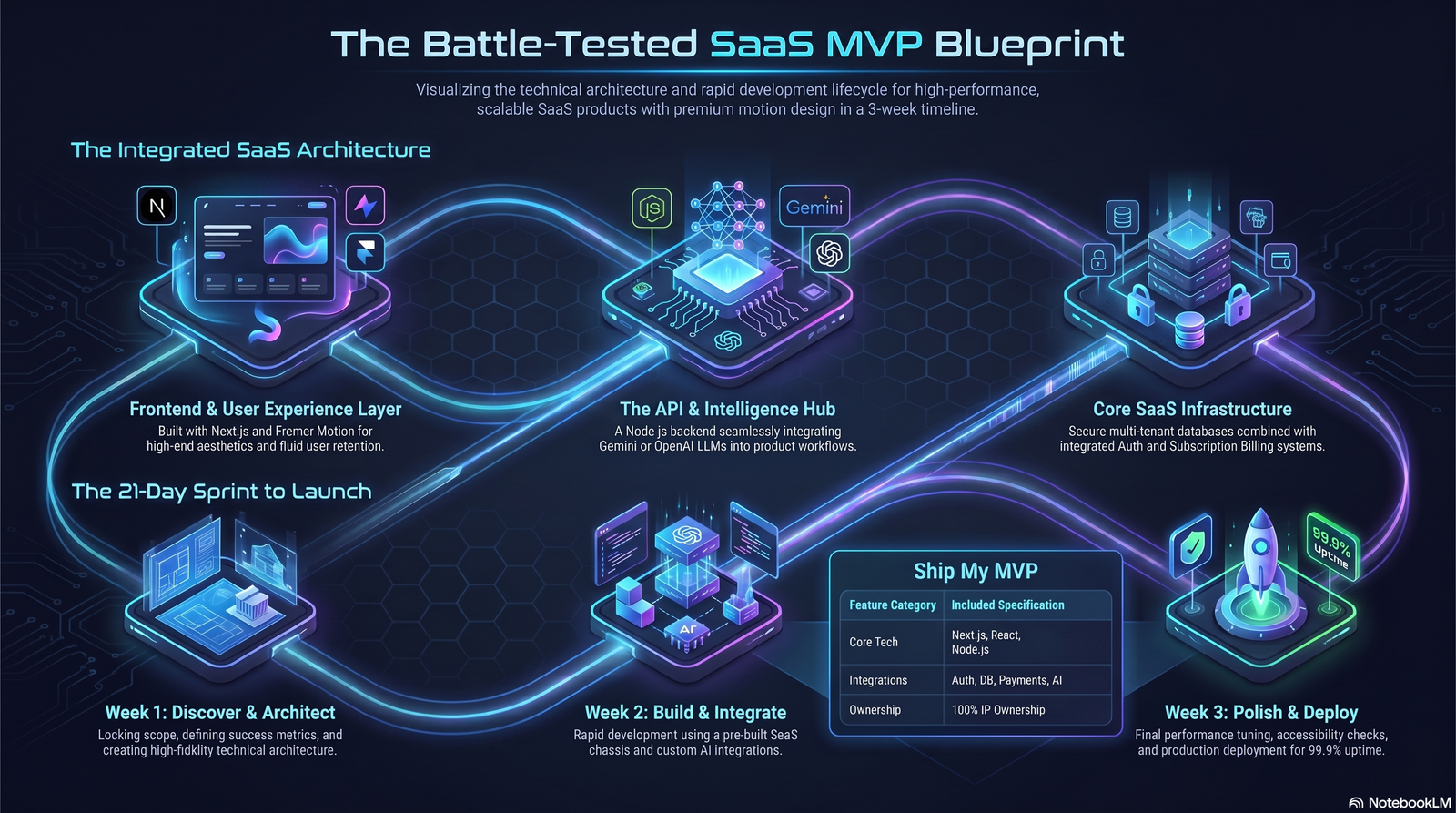
A serious mvp development for saas startups engagement needs to account for subscription billing, plan tiers, and usage limits from the very first sprint. Retrofitting Stripe billing logic after launch is far more expensive than building it in from day one.
Multi-tenant architecture is another non-negotiable. Your MVP needs to isolate each customer’s data cleanly, even if you only have five paying users at launch.
Churn tracking and basic usage analytics also belong in scope early. SaaS founders need to know which features get used and which get ignored within the first weeks of launch, not months later.
Questions to Ask an MVP Development Company for a SaaS Build
Ask directly whether the team has shipped subscription billing before, and whether they default to Stripe, Paddle, or a custom solution. Ask how they handle free-trial-to-paid conversion flows.
Our related read on rapid MVP development for SaaS startups goes deeper into how teams compress a SaaS build into a matter of weeks without cutting corners on the billing layer.
If you’re comparing multiple vendors for this kind of build, run each one through the same discovery call questions so the answers are actually comparable side by side.
Fintech MVP Development
Fintech MVP development carries a compliance load that most other categories simply don’t have. Global fintech venture funding hit roughly $28.6 billion in the first half of 2026 alone, according to Crunchbase data, and investors are increasingly selective about who they back.
That selectiveness extends to technical due diligence. A fintech MVP that ignores security basics won’t survive an investor’s engineering review, let alone a bank partnership.
Compliance Can’t Be a Phase Two Decision
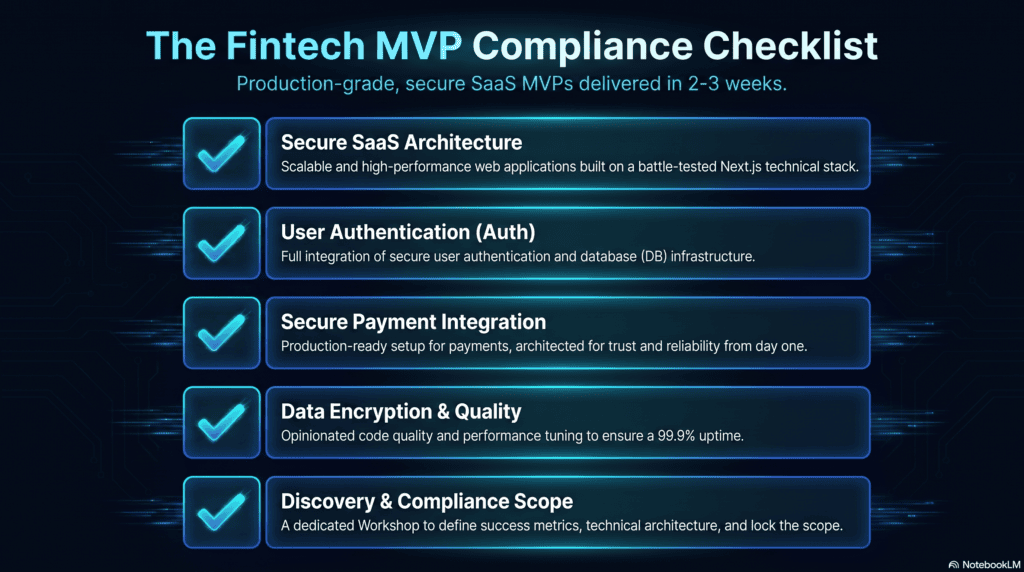
PCI-DSS considerations matter the moment your MVP touches card data, even indirectly through a payment processor. KYC and AML checks matter the moment you onboard a real user with real money.
A development partner unfamiliar with these requirements will either over-build (adding enterprise-grade security nobody asked for) or under-build (skipping checks that get you flagged during a partnership review).
The right approach treats compliance as part of the MVP scope, not a bolt-on after traction. That usually means encrypted data at rest, audit logging, and a documented approach to identity verification from the first release.
What Good Fintech MVP Development Looks Like
Ask any shortlisted agency whether they’ve integrated with providers like Plaid, Stripe Treasury, or a KYC vendor before. Ask how they’d handle a sudden regulatory question from a banking partner.
If budget is the deciding factor between vendors, our MVP development cost breakdown for the USA shows how compliance-heavy builds typically land in a higher price band than a standard consumer app.
Founders weighing whether to build this in-house or bring in outside help should also read our comparison of an MVP development agency vs. an in-house team, since fintech compliance often tips that decision one way or the other.
Healthtech MVP Company Builds
A healthtech MVP company is solving a different problem entirely: how do you move fast while still protecting patient data on day one?
The global digital health market is projected between roughly $420 and $492 billion in 2026 across major analyst estimates, and U.S. digital health startups raised over $14 billion in 2025 alone. Investors are watching this category closely.
HIPAA Isn’t Optional, Even at MVP Stage
Any MVP that touches protected health information needs HIPAA-aligned data handling from the start — not after a compliance officer flags it during due diligence. That includes access controls, encryption, and business associate agreements with any vendor touching that data.
This is one reason a generalist team can struggle here. A healthtech MVP company needs comfort with interoperability standards, secure messaging, and audit trails, even in a lean first release.
Remote patient monitoring, telehealth scheduling, and patient intake tools are common first MVPs in this space. Each one carries its own data-handling nuance worth confirming with any partner upfront.
Evaluating a Healthtech-Ready Partner
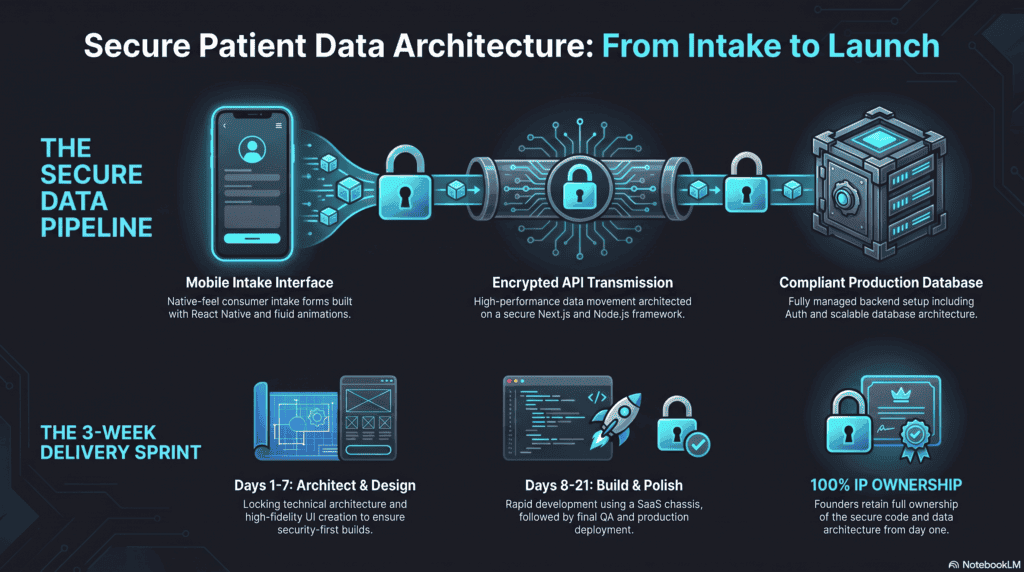
Ask a shortlisted team directly whether they’ve built anything requiring a signed business associate agreement before. Ask how they’d structure data storage for a feature involving patient records.
If you’re still deciding whether an outside partner is the right call versus building this internally, our guide on choosing an MVP development company covers the vetting steps that matter most for regulated industries specifically.
You can also verify HIPAA fundamentals directly through the U.S. Department of Health and Human Services HIPAA resources before your first vendor call, so you know what to ask for.
EdTech MVP Development
EdTech MVPs sit closer to SaaS in structure but add a different engagement problem: keeping students or learners coming back without heavy gamification budgets.
A lean EdTech MVP usually starts with one core learning loop — a single course, a single skill path, or a single cohort — rather than a full curriculum platform.
Data privacy still matters here too, especially for products touching minors, where FERPA-style considerations shape how student data gets stored and shared.
Founders in this category benefit from the same industry-specific mvp development thinking as SaaS founders: prioritize the one feature that proves the learning outcome works before building anything else.
Marketplace and E-Commerce MVPs
Two-sided marketplaces are notoriously hard to validate as an MVP, because you need both supply and demand working at once.
Most experienced teams recommend starting with a simple directory or curated list before building a full transaction layer. It proves demand without the complexity of payments, ratings, and dispute handling on day one.
E-commerce MVPs face a related challenge: inventory, shipping logistics, and payment processing all need to work reliably even in a scrappy first version, since a broken checkout kills trust instantly.
A development partner experienced in this category will usually suggest testing demand with a smaller, manually-managed process before automating the whole marketplace.
Vertical marketplaces — freelance design, local services, niche B2B supply — tend to validate faster than broad, general ones. A narrower audience is easier to reach for that first hundred users, and easier to reason about when something breaks.
Payment splitting between buyers and sellers is one area worth scoping carefully. Escrow-style flows and payout timing decisions made at MVP stage are expensive to change once real transactions are flowing through the platform.
Proptech and Logistics MVPs
Property technology and logistics MVPs often involve real-world operational complexity that pure software categories don’t — scheduling, routing, or physical inventory tracking.
These MVPs benefit from tight integration with mapping and routing APIs early, since a logistics tool that gets ETAs wrong loses user trust fast.
Proptech MVPs frequently need to handle document workflows (leases, applications, inspections), which means basic e-signature and document storage should be in scope from the first release, not added later.
Across every one of these categories, the underlying lesson repeats: industry-specific mvp development isn’t a nice-to-have. It’s the difference between an MVP that tests the right hypothesis and one that quietly builds the wrong product well.
How Industry Changes Your Cost and Timeline
Industry compliance load directly affects both budget and schedule, and founders are often surprised by how much.
A standard consumer SaaS MVP might run 8-12 weeks and land in the $50,000-$90,000 range for a small, senior team. A fintech or healthtech MVP with compliance work baked in often adds two to four extra weeks and a meaningfully higher budget.
That extra cost isn’t padding — it covers the encryption, access-control design, and documentation that a compliance review will eventually ask about anyway.
For an itemized look at what different budget tiers actually buy across industries, our MVP development cost guide for the USA breaks down pricing by scope, team size, and feature complexity.
If your timeline is the bigger constraint, the MVP development process guide maps out how each stage — validation, wireframing, build, testing — stretches or compresses depending on your industry’s compliance requirements.
Choosing an Industry-Fit MVP Development Company
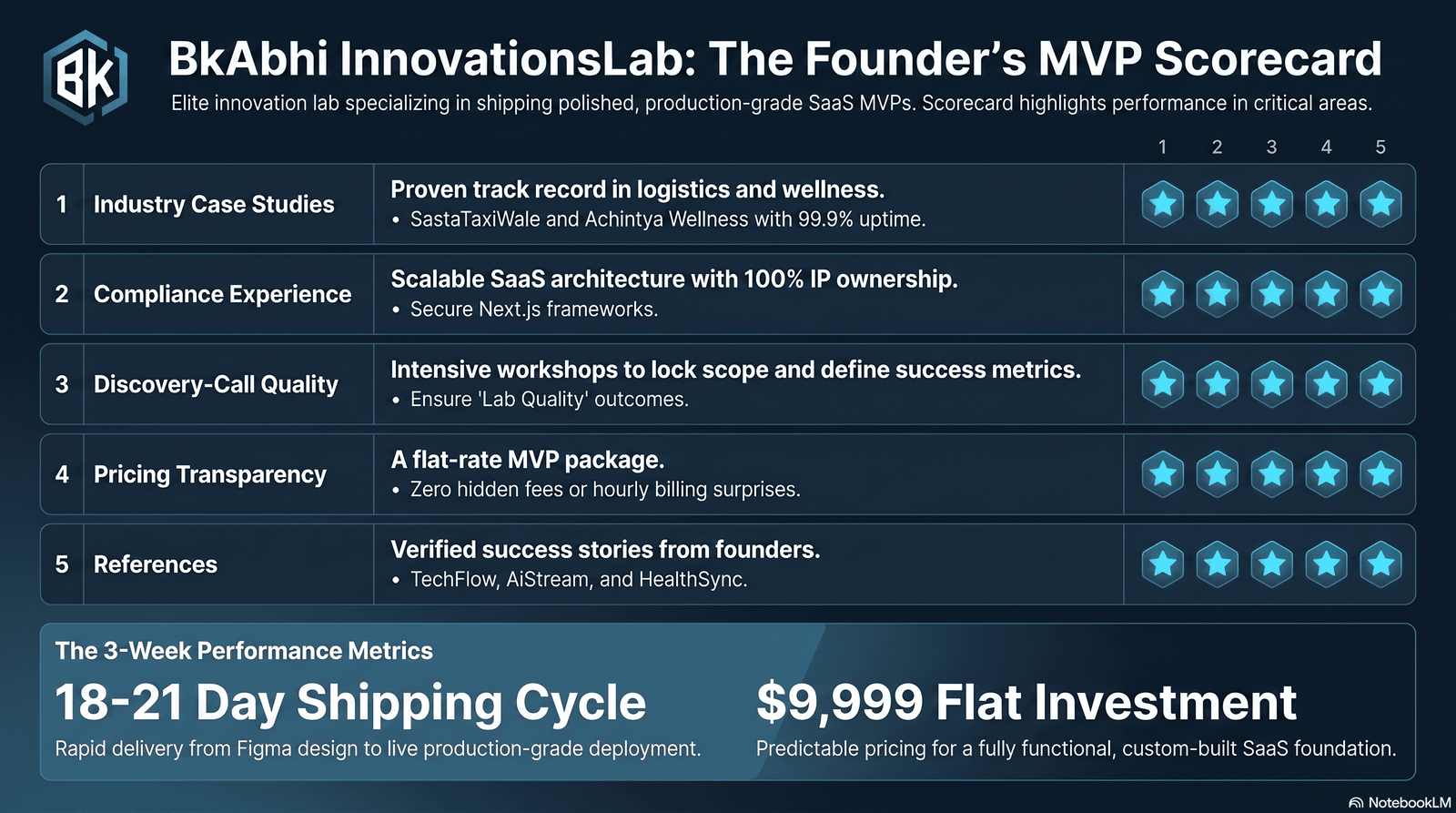
Once you know your industry’s specific demands, evaluating a development partner gets much easier. You’re no longer asking “are they good,” you’re asking “are they good at this.”
Ask for case studies from your specific category, not just their general portfolio. A team with three fintech MVP development launches under their belt will spot compliance gaps a generalist team might miss entirely.
Ask how they’d staff your project. Regulated industries often need a senior developer who’s dealt with compliance reviews before, not just anyone available that month.
Our full framework on how to choose an MVP development company walks through the complete vetting process, including discovery-call scripts and contract red flags worth checking regardless of industry.
If you’re still deciding between hiring an agency and building a small internal team for your first release, our agency vs. in-house team comparison breaks down when each option actually makes financial sense.
And before signing anything, cross-check the vendor against real feedback rather than a polished portfolio page — our guide to vetting MVP development company rankings explains what those directory scores actually measure.
A Quick Industry Checklist
Use this as a fast gut-check before your first discovery call, regardless of which category your startup falls into.
SaaS: Confirm subscription billing, multi-tenant architecture, and churn analytics are in MVP scope from the start.
Fintech: Confirm KYC/AML handling, PCI-DSS awareness, and encrypted data storage are part of the build, not phase two.
Healthtech: Confirm HIPAA-aligned data handling and a business associate agreement process before any patient data gets touched.
EdTech: Confirm the single learning loop is clearly defined, and that student data handling matches your target age group’s requirements.
Marketplace/E-commerce: Confirm the team recommends validating demand before building a full transaction layer.
Proptech/Logistics: Confirm mapping, routing, or document-workflow integrations are scoped early, not bolted on later.
Frequently Asked Questions
Is MVP development for SaaS startups more expensive than other industries? Not necessarily. SaaS MVPs are often cheaper than fintech or healthtech builds because they carry less compliance overhead, though pricing still depends heavily on feature scope.
Does fintech MVP development always require a licensed compliance officer? Not at MVP stage for most non-custodial products, but you should still budget for legal review of your data handling and KYC/AML approach before launch.
Can a general software agency handle a healthtech MVP company project? Some can, but ask specifically about HIPAA experience and business associate agreements. A team without this experience will likely underestimate the compliance work involved.
Should industry-specific MVP development cost more upfront? Often yes, particularly for fintech and healthtech, where compliance and security work adds real hours to the build. That upfront cost is usually cheaper than retrofitting compliance after launch.
What industry sees the most demand for MVP development companies right now? SaaS remains the largest category by volume, given the size of the global SaaS market, but fintech and healthtech are growing quickly due to strong 2026 venture funding in both sectors.
How do I know if my startup needs an industry specialist versus a generalist team? If your product touches regulated data (financial or health records) or requires specific compliance frameworks, prioritize industry experience. For most consumer or productivity SaaS products, a strong generalist team is usually sufficient.
Do marketplace MVPs need both sides of supply and demand built at launch? Not always. Many successful marketplaces start as a curated directory or manually-matched service, then automate the transaction layer once demand is proven.
Is offshore development a good fit for regulated industries like fintech or healthtech? It can be, provided the team has direct compliance experience and clear documentation practices. Our offshore vs. onshore MVP development comparison covers where the cost savings hold up and where they don’t.
Bringing It Together
MVP development for SaaS startups, fintech MVP development, and a healthtech MVP company build are not interchangeable services, even though they all get labeled “MVP development.”
The industry you’re building in should shape your shortlist before price does. A cheap quote from a team with zero relevant experience usually costs more once compliance gaps or missing features surface after launch.
Match your development partner to your industry’s actual requirements, ask for category-specific case studies, and read the full framework for choosing an MVP development company before you sign anything.
Ready to talk through your specific industry’s requirements? Book an MVP consultation with BkAbhi, or explore the complete BkAbhi MVP resource hub for more founder-first guides on cost, process, and vetting development partners.
Author Bio
Jeevesh Tripathi 📧 Contact: jeevesh@bkabhi.com
Jeevesh Tripathi is a researcher and content strategist at BkAbhi Innovations Lab, focused on how startups across SaaS, fintech, and healthtech evaluate and work with MVP development partners. His work draws on direct founder interviews, agency discovery calls, and hands-on evaluation of development engagements across regulated and unregulated industries alike, translated into practical, jargon-free guidance for non-technical founders.
This guide is part of BkAbhi’s MVP development resource hub. For more founder-focused guides on cost, process, and vetting development partners, visit the BkAbhi blog.