
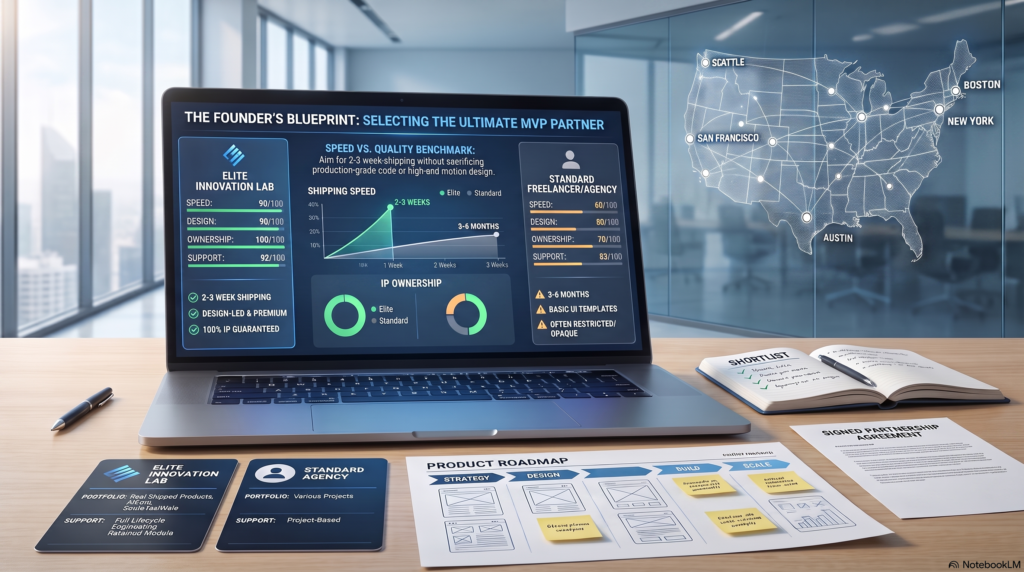
Searching for the best MVP development companies USA usually means one thing: you have an idea, a deadline, and a budget you can’t afford to waste. This guide is built to help you compare options the right way, not just hand you a list of logos.
Instead of ranking agencies you can’t verify, we’ll walk through how experienced founders actually evaluate the best MVP development companies USA — the criteria that matter, the pricing you should expect, and the red flags that separate a real product partner from an order-taking vendor.
If you’re earlier in the process and still deciding whether to build at all, it helps to first read why startups need MVP development services before scaling further, since that shapes how you’ll shortlist a partner later.
Table of Contents
What “Best” Actually Means in MVP Development
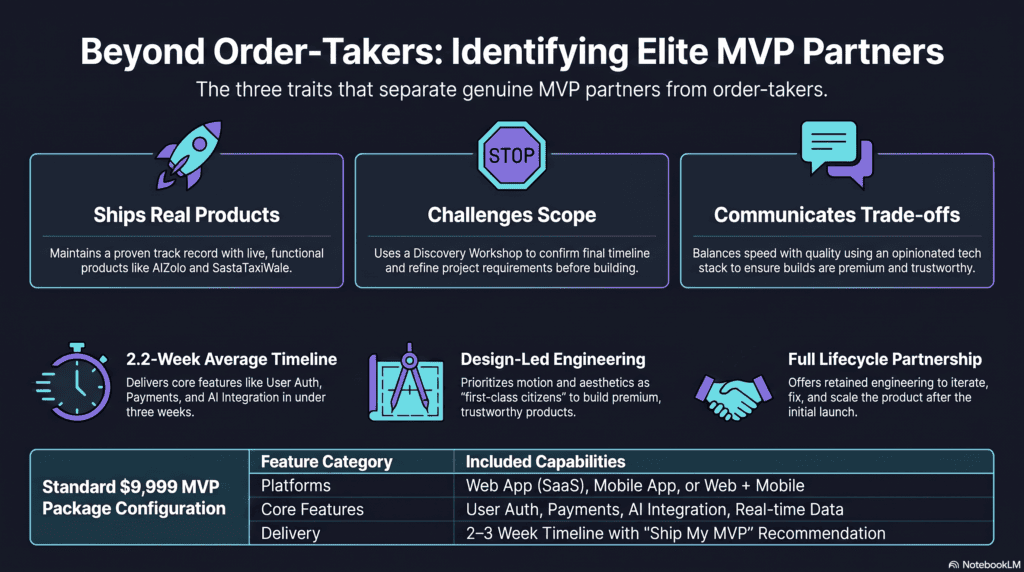
There’s no single Best MVP development companies USA choice for every founder. A fintech startup needing compliance-aware architecture has different needs than a solo founder validating a niche marketplace idea, which is why the Best MVP development companies USA depend on your product, budget, and growth stage.
The best MVP development companies USA share three traits regardless of size: they’ve shipped real products that got real users, they push back on unnecessary features, and they communicate trade-offs instead of just saying yes.
Everything else — team size, hourly rate, office location — is secondary to those three things.
How to Evaluate the Best MVP Development Companies USA
Before you get on a discovery call, know what you’re actually testing for. Most founders ask about tech stack and pricing first — that’s backwards.
1. Proven MVP-to-launch track record. Ask for three MVPs built in the last 18 months that are still active, not portfolio pieces that quietly died after launch.
2. Genuine lean-startup thinking. A strong partner will suggest cutting features from your list, not adding more to pad the invoice.
3. A repeatable, documented process. If they can’t explain their discovery-to-launch timeline in concrete weeks, they’re likely improvising on your budget.
4. User-first conversations. Notice whether they ask about your target users before pitching a technology stack.
5. Willingness to say no. The best MVP development companies USA will tell you when an idea, feature, or timeline doesn’t make sense — even if it costs them the deal.
We cover this evaluation framework in much more depth, including a printable discovery-call script, in our dedicated guide on how to choose an MVP development company.
5 Questions to Ask on Your First Call
Use these five questions on every discovery call to quickly separate the best MVP development companies USA has to offer from teams that just sound good on paper.
- “What would you cut from my current feature list?” A confident answer signals real product thinking, not just execution capacity.
- “Who exactly will be on my project team?” Get names and seniority, not just a generic “our team of experts.”
- “Can I speak with two founders you worked with in the last year?” Hesitation here is a meaningful red flag.
- “How do you handle scope changes mid-project?” MVPs evolve constantly, so rigid change-order policies rarely serve founders well.
- “What happens if we need to pivot after launch?” The answer reveals whether they see themselves as a one-time vendor or a longer-term partner.
Write down the answers. When you compare notes across three or four companies later, patterns become obvious fast.
Signs You’re Ready to Hire an MVP Development Company
Not every idea is ready for a paid engagement yet, and jumping in too early is one of the most common reasons founders overspend.
You’re likely ready to evaluate the Best MVP development companies USA if you’ve already validated basic demand—through customer interviews, a waitlist, or early pre-sales—and now need working software to move your startup forward.
You’re probably not ready yet if you haven’t spoken to a single potential user, or if your feature list is still changing weekly. In that case, a lightweight validation exercise, like the one in our guide on how to validate a SaaS idea, will save you money before you ever get on a sales call.
The Four Types of MVP Development Companies in the USA
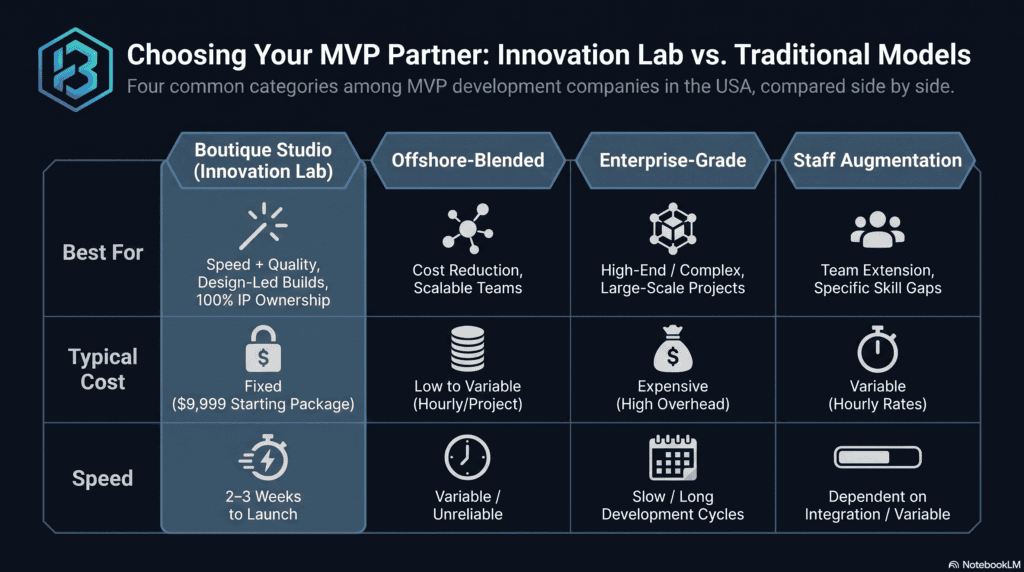
Rather than naming specific vendors (portfolios and pricing change constantly, and a “top 10” list goes stale fast), it’s more useful to understand the categories the best MVP development companies USA typically fall into.
1. Boutique MVP-First Studios
Small, senior-heavy teams behind the Best MVP development companies USA often specialize exclusively in early-stage builds. They tend to move fast, offer fixed-scope pricing, and turn away projects that aren’t a good fit.
This is usually the sweet spot for pre-seed and seed-stage founders who need speed without enterprise overhead.
2. Offshore-Blended Agencies
US-registered companies that manage sales locally but staff delivery teams overseas. This isn’t inherently bad — some are excellent — but timezone gaps and indirect communication can slow decision-making.
Always ask directly where the development team is based before signing anything.
3. Enterprise-Grade Development Firms
Agencies that have worked with recognizable brands and bring enterprise engineering discipline: microservices, extensive documentation, formal QA cycles.
Powerful for well-funded startups or corporate innovation teams, but often overkill — and overpriced — for a first validation build.
4. Staff-Augmentation Partners
Instead of owning the whole build, these companies embed senior developers into your existing team. This works well for technical founders who need extra hands, not full ownership.
None of these categories are inherently “better” than the others — the best MVP development companies USA within each category simply match their model to the right client.
Mismatches happen when founders choose the Best MVP development companies USA based on reputation alone instead of fit—for example, hiring an enterprise firm for a scrappy validation build or a boutique studio for a compliance-heavy healthtech product it isn’t equipped to handle.
What the Best MVP Development Companies USA Actually Charge
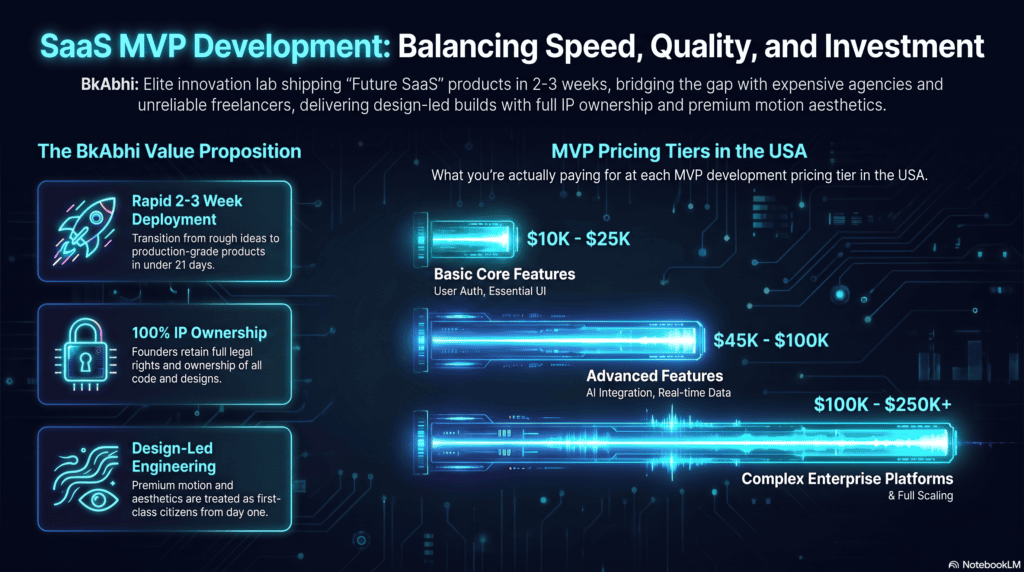
Pricing is where most founders get blindsided, mainly because quotes for “the same thing” can range from $10,000 to $250,000+.
$10K–$25K range: Often junior teams, heavily templated builds, or offshore shops underbidding to win the deal, then adding change-order fees later.
$45K–$100K range: Where most genuine startup-focused firms operate — a small senior team, 8–12 weeks of focused work, and real user testing built into the process.
$100K–$250K+ range: Enterprise-grade delivery with full documentation and compliance readiness, generally suited to funded startups or corporate labs, not early validation.
For a full breakdown by project type, team structure, and region, see our detailed MVP development cost USA guide, which walks through what drives pricing up or down.
Does Your Industry Change What “Best” Means?
Yes, more than most founders expect. The best MVP development companies USA for a consumer social app aren’t necessarily equipped for a regulated healthtech or fintech product.
Fintech and healthtech: Look for prior experience with compliance frameworks (SOC 2, HIPAA) even at MVP stage — retrofitting compliance later is expensive and slow.
Marketplaces: Two-sided marketplaces need partners who understand supply-demand sequencing, not just standard CRUD app development.
Consumer apps: If you’re evaluating the Best MVP development companies USA, speed and design polish typically matter more than deep backend architecture, since user acquisition costs punish slow, clunky first impressions.
B2B SaaS: Prioritize partners with experience in subscription billing, admin tooling, and onboarding flows — covered in more detail in our SaaS-specific MVP guide.
Ask any shortlisted company directly whether they’ve shipped something in your exact industry. General software experience doesn’t always transfer cleanly.
What Working With a Top MVP Partner Actually Looks Like
The best MVP development companies USA rarely jump straight into coding. A credible process usually follows a pattern like discovery and validation, then core build, then testing, then a structured launch.
Weekly demos, not monthly status reports, are a strong signal you’re working with a team that values transparency over surprises at the end.
We break down each phase — including what deliverables to expect at every stage — in our full MVP development process walkthrough.
If your priority right now is simply shipping fast without cutting corners on quality, this piece on the fastest way to launch a SaaS product pairs well with the process breakdown.
Agency vs. In-House Team: Which Fits Your Stage?
Not every founder needs to hire the best MVP development companies USA has to offer — sometimes an in-house hire, or a hybrid of both, is the smarter call.
Choose an agency when you need to move in weeks, not months, and don’t yet have the runway to hire and manage a full-time technical team.
Choose in-house when your product is technical enough to need long-term ownership from day one, and you have the budget to hire and retain senior engineers.
Many funded startups land somewhere in between — an agency for the initial build, then an internal hire once product-market fit is closer. Our dedicated comparison of MVP development agency vs. in-house team breaks down the cost and control trade-offs of each path in detail.
MVP Development for SaaS Startups: A Different Set of Priorities
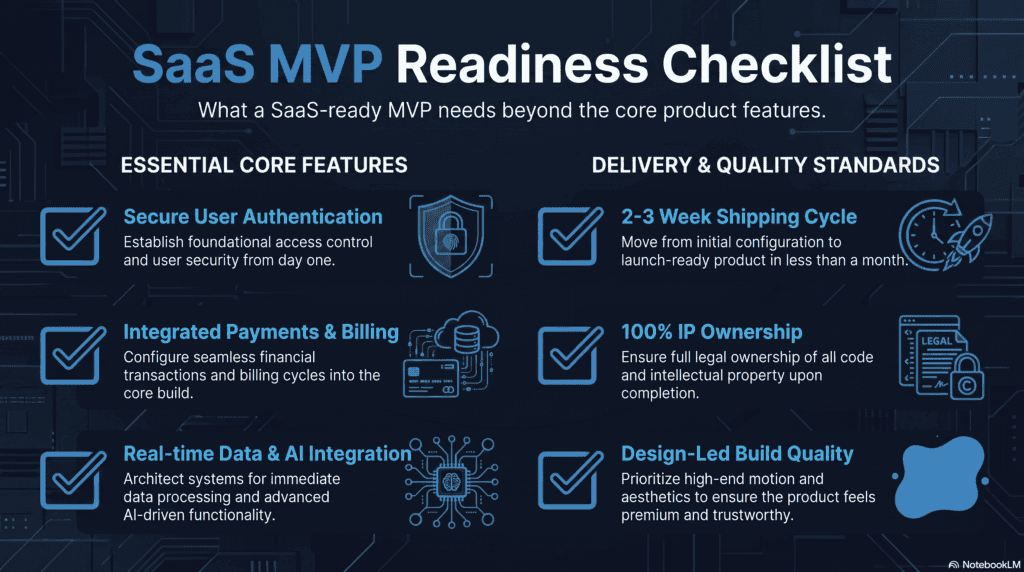
If you’re building a SaaS product specifically, the criteria for choosing among the best MVP development companies USA shift slightly. Subscription billing, multi-tenant architecture, and onboarding flows matter more than they would for a simple mobile app.
Look for a partner who has shipped recurring-revenue products before, not just one-time-purchase apps — the technical and UX considerations are meaningfully different.
We cover SaaS-specific MVP considerations, including tech stack choices and churn-aware onboarding design, in our guide to MVP development for SaaS startups.
For UI/UX-heavy SaaS products specifically, it’s also worth reading how expert UI/UX design shapes MVP outcomes before you finalize your shortlist.
Red Flags to Watch For, Even Among Well-Reviewed Companies
A polished website and a strong Clutch rating don’t guarantee a good fit. Watch for these warning signs during your first two calls.
They agree to everything. No pushback on scope, budget, or timeline usually means they’re optimizing for the signature, not your outcome.
They can’t name real outcomes. “We can’t share details due to NDAs” for every single project is a common excuse for a thin portfolio.
They require full payment upfront. Reputable firms typically use milestone-based payments (commonly split across phases), not 100% upfront.
They avoid discussing where the team sits. Vague answers about delivery location often signal a bait-and-switch on seniority or timezone.
If you’re validating a broader product concept before locking in a vendor, our framework on how to validate a SaaS idea is a useful gut-check to run first.
Green Flags Worth Weighing Just as Heavily
It’s easy to focus only on what to avoid, but positive signals matter too when comparing the best MVP development companies USA side by side.
They ask about your runway. A partner who factors in your funding timeline is thinking about your business, not just the invoice.
They show you unfinished work. Willingness to share in-progress dashboards or rough wireframes signals confidence in their actual process, not just polished case studies.
They give ranges, not false precision. A team that says “typically $50K–$70K depending on scope” is usually more honest than one that quotes an oddly exact number on the first call.
How Long Should MVP Development Actually Take?
Timelines are one of the most common areas where expectations and reality drift apart. Most of the best MVP development companies USA quote 8–12 weeks for a focused MVP, assuming a reasonably clear feature scope going in.
Timelines stretch when discovery is rushed, when founders keep adding features mid-build, or when feedback cycles slow down because stakeholders aren’t available for weekly reviews.
If a company promises a fully custom MVP in two weeks, treat that as a warning sign rather than a selling point — either the scope is trivial, or corners are being cut somewhere you can’t yet see.
Where BkAbhi Fits Into This Picture
We’re not going to pretend BkAbhi is the right fit for every founder reading this — that would defeat the purpose of an honest guide.
We work best with early-stage and seed-funded startups who want a fixed-scope, milestone-based build with weekly demos, not a black-box engagement. You can see how we approach discovery, build, and iteration on our services page.
If you’re not sure whether you need a full build or just a sounding board first, booking an MVP consultation is a lower-commitment way to figure that out. For founders further along who need to hire MVP developers for an early product launch, that guide walks through staffing options beyond a full agency engagement.
We’ve also written about full-cycle MVP development services and scalable MVP development for founders planning past the first launch. Our homepage outlines current service packages and pricing structure if you want the full picture.
Frequently Asked Questions
How much does it cost to hire one of the best MVP development companies USA? Most legitimate startup-focused firms charge between $45,000 and $100,000 for a full MVP build over 8–12 weeks, though pricing varies by scope and complexity.
How long does MVP development usually take? A focused MVP typically takes 8–12 weeks from discovery to launch, assuming a clearly scoped feature set and a responsive founder.
Should I choose a US-based or offshore MVP development company? Either can work well — what matters more is transparency about where the actual development team sits and how communication is structured.
What’s the difference between an MVP and a prototype? A prototype demonstrates an idea visually; an MVP is a functioning product that real users can actually use and pay for.
Do the best MVP development companies USA offer post-launch support? Most do, typically as a separate ongoing engagement — confirm this during your discovery call rather than assuming it’s included.
Can I switch from an agency to an in-house team later? Yes, and it’s common. Ask upfront whether the company documents code well enough for a future internal team to take over smoothly.
Is a cheaper MVP development company ever the right choice? Sometimes, especially for very simple, low-risk validation builds — but confirm exactly what’s excluded from the lower price before assuming it’s a good deal.
How many companies should I actually talk to before deciding? Three to five discovery calls is usually enough to spot patterns without dragging out your decision timeline unnecessarily.
What Happens After You Launch
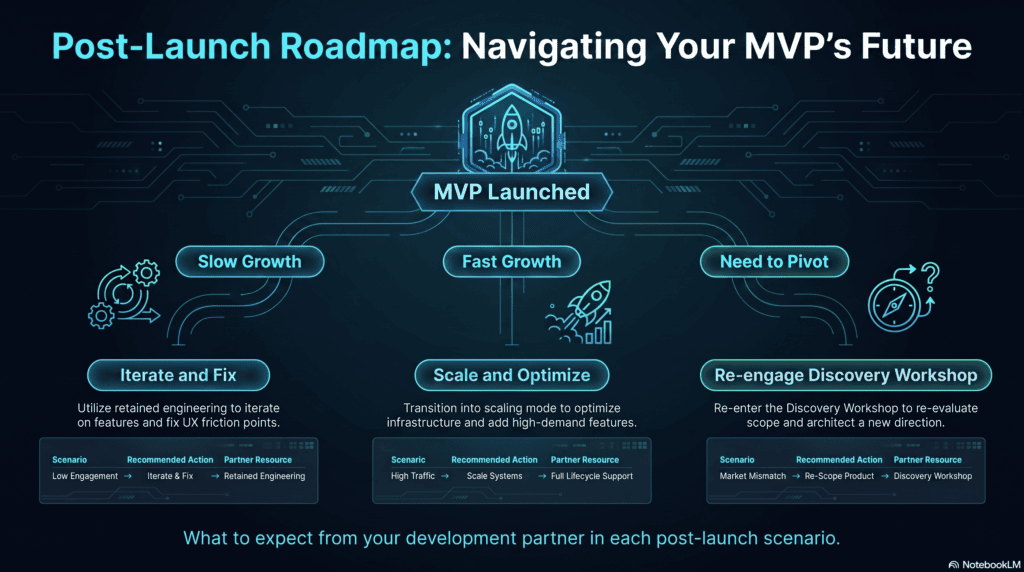
Choosing among the best MVP development companies USA doesn’t end when the product goes live — in many ways, the real test starts there.
If growth is slow: A good partner stays available for rapid iteration based on early user feedback, rather than treating launch day as the end of the relationship.
If growth is fast: You’ll want a codebase built well enough to scale, and documentation thorough enough that new developers can step in without starting over.
If you need to pivot: The right partner helps you figure out what parts of the existing build can be reused, instead of pushing you toward a full rebuild at full price.
Ask directly during your discovery calls how each company handles these three scenarios. The answer often says more about their long-term intentions than anything on their homepage.
Final Thoughts on Choosing the Right Partner
There isn’t a universal “best” on this list — there’s a best fit for your stage, budget, and product complexity. Use the evaluation criteria above as your filter, not a company’s homepage claims.
Talk to at least three teams before deciding. Ask the uncomfortable questions early, and pay close attention to how they respond when you push back.
The right partner among the best MVP development companies USA won’t just build what you ask for — they’ll help you figure out what’s actually worth building first.
Author Bio
Jeevesh Tripathi is a startup technology researcher and founder-side advisor who has spent years evaluating and working alongside MVP development teams across fintech, SaaS, and marketplace products in the US market. He writes at BkAbhi to help non-technical and first-time founders make informed, low-regret decisions when choosing a development partner.
Have a question about your specific project or want a second opinion on a proposal you’ve received? Reach out directly at jeevesh@bkabhi.com.