
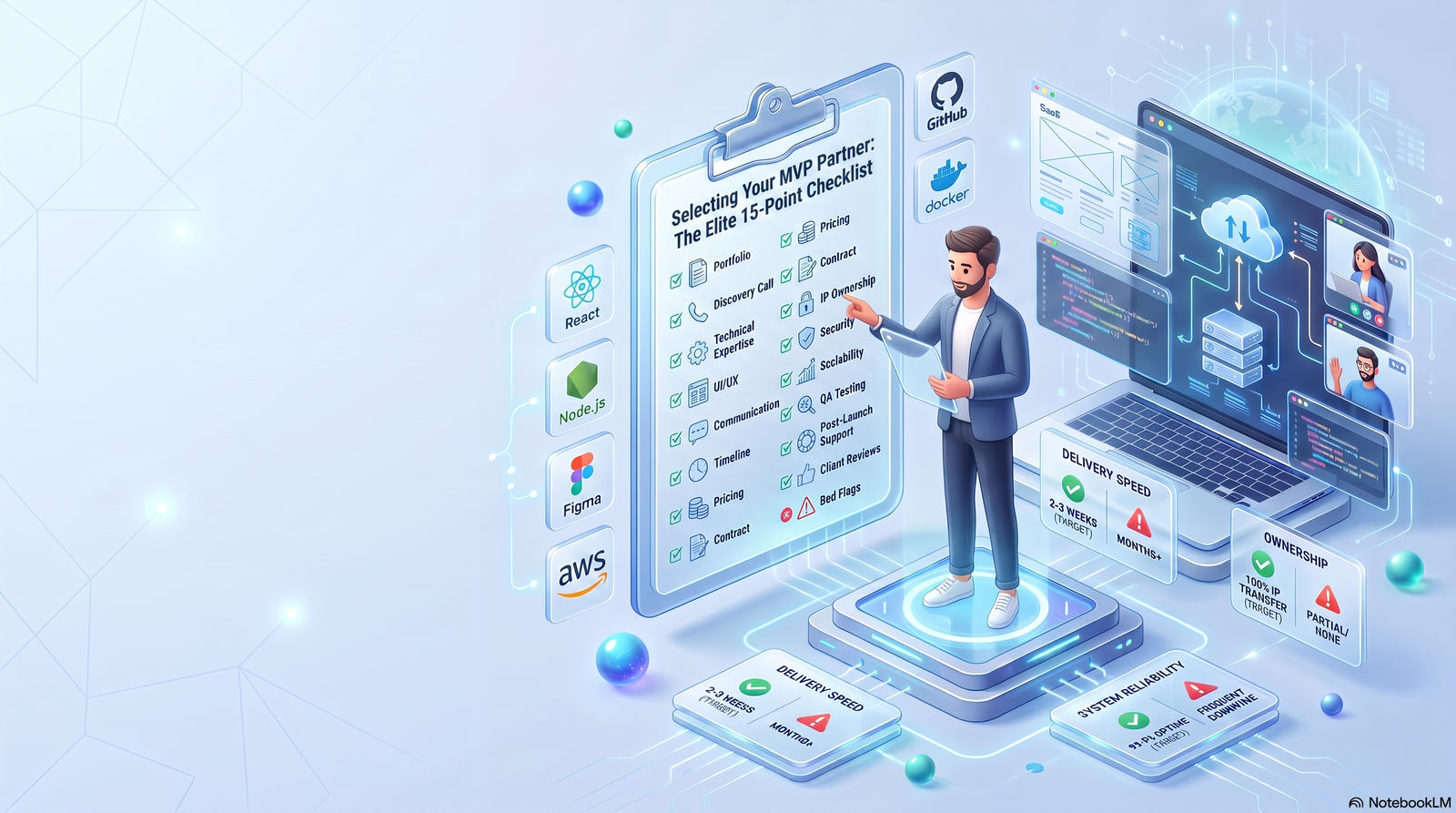
Quick Answer: This MVP development company checklist breaks the decision into 15 checks across four groups — proof of work, process fit, money and paperwork, and trust signals. Score each shortlisted vendor from 1 to 5 on every point, add up the totals, and let the numbers (not the pitch deck) decide. BkAbhi built this scorecard from real founder discovery calls, so you can run it on your very next vendor conversation.
You already know why picking the right partner matters. What you need right now is a fast way to compare five agencies without losing track of who said what.
That’s exactly what this page is for. It isn’t another long framework you’ll read once and forget—it’s a practical checklist you can print, score, and take into every discovery call.
If you’re wondering how to choose MVP development company, this checklist gives you a simple, repeatable way to evaluate every vendor fairly.
Instead of relying on promises, you’ll compare portfolios, technical expertise, communication, pricing, contracts, and post-launch support using the same criteria.
This structured approach helps you identify strengths, uncover hidden risks, and avoid expensive mistakes before signing an agreement.
Whether you’re a first-time founder or an experienced entrepreneur, knowing how to choose MVP development company with a proven checklist leads to smarter, more confident hiring decisions.
Use it to compare vendors side by side, ask consistent questions, identify red flags, and make confident decisions based on facts rather than sales pitches.
If you want the full story behind each step — why case studies matter more than portfolios, or how to run a discovery call — our companion guide on how to choose an MVP development company walks through the reasoning in depth. This page is the scorecard version you actually use while you’re vetting.
Think of it as the difference between reading a cookbook and having the recipe card taped to your fridge. You’ve probably already read enough about vendor selection — this is the version you actually use on the call.
Table of Contents
Why a Checklist Beats a Gut-Feel Decision
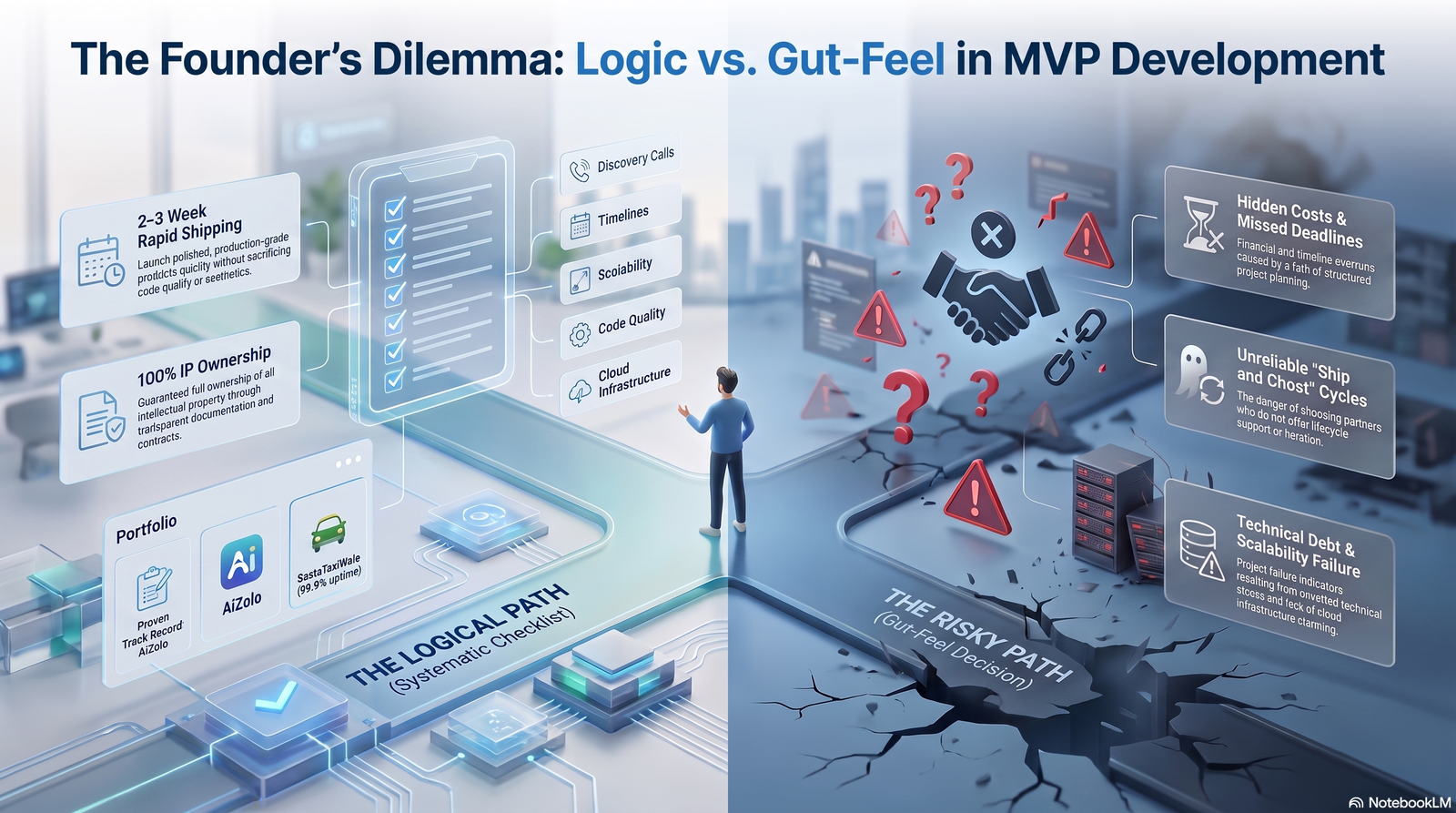
Every MVP development company sounds confident on a sales call. That’s the job of a sales call, and it makes every pitch start to blur together after the third or fourth conversation.
The real challenge isn’t finding a team that can talk well—it’s learning how to choose MVP development company based on proven experience, technical expertise, and transparent processes.
A structured evaluation helps you compare vendors objectively instead of relying on polished presentations.
By reviewing portfolios, asking the right discovery questions, checking client references, and understanding pricing models, you can separate genuine product partners from agencies that simply market themselves well.
Following a clear checklist makes how to choose MVP development company far less confusing and significantly reduces the risk of costly mistakes.
A checklist forces you to compare the same 15 answers across every vendor, instead of remembering which one “felt right.” Feelings are a terrible way to allocate $20,000–$60,000 of runway.
Founders who score vendors on paper consistently report catching mismatches — a vague pricing answer, a dodged reference request — that got lost in the excitement of an otherwise smooth call.
Why Choosing the Right MVP Development Company Actually Matters
Most founders treat this decision like hiring a vendor. It isn’t. Your MVP development company shapes your product’s architecture, your timeline, and often your first impression with investors.
A wrong pick doesn’t just cost money — it costs months you can’t get back. Our detailed breakdown on what actually separates good agencies from bad ones goes deeper into this if you want the full picture.
The good news: the difference between a strong partner and a weak one shows up early, if you know what to look for.
Step 1: Get Clear on What You’re Actually Hiring For
Before you contact a single MVP development company, define your own scope. Vague briefs attract vague quotes — and vague quotes turn into scope creep later.
Ask yourself three questions: What’s the one core hypothesis this MVP needs to test? What’s your realistic budget range? What’s your hard launch deadline, if any?
Founders who skip this step end up comparing apples to oranges. One quote assumes 5 features, another assumes 15 — and you won’t know why the prices differ so wildly.
If you’re unsure what a realistic build actually costs, review a full MVP development cost breakdown for the USA market before you start collecting quotes. It’ll help you spot lowball bids instantly.
Step 2: Shortlist Based on Shipped Work, Not Portfolio Slides
Anyone can put a polished mockup on a website. What you need is proof that the MVP development company has shipped real products that real users touched.
When you’re learning how to choose an MVP development company, this is the single highest-signal filter. Ask for three MVPs launched in the last 18 months that are still active.
Push for specifics: How many users did it get? Did it raise funding? What broke after launch, and how did the team respond?

Step 3: Run a Structured Discovery Call
The discovery call is where you learn more from how an MVP development company answers than what they answer.
A company that understands the MVP development process will spend more time asking about your users than pitching their tech stack. That’s the tell.
We’ve published a full list of discovery call questions and follow-ups you can bring into every call to keep vendors honest and comparable.
Watch for agencies that agree to everything instantly. “Yes, we can build that” to every request, regardless of your budget or timeline, is rarely a good sign.
Step 4: Compare Pricing Models, Not Just Numbers
Quotes for the same MVP idea can range from $10,000 to $250,000. The number alone tells you almost nothing.
What matters is what’s included: how many developers, how many weeks, what QA and testing looks like, and whether design is bundled in or billed separately.
A detailed MVP development cost guide breaks down what each price tier realistically buys, so you can judge whether a quote is fair or a red flag.
Also ask about payment structure. A healthy standard is a milestone-based split — never pay 100% upfront to any MVP development company, however confident they sound.
Step 5: Decide Between an Agency, Freelancers, or an In-House Team
Choosing an MVP development company isn’t your only option, and it’s worth pausing here before you commit.
A freelancer is cheaper but riskier if they disappear mid-project. An in-house hire gives you control but takes months to recruit and costs more in salary and equity long-term.
An agency sits in the middle: faster to start than hiring, more accountable than a solo freelancer, and structured enough to hit milestones. Our comparison of MVP development agency vs. in-house team walks through this trade-off in detail, including when each option makes financial sense.
Step 6: Vet Rankings and Reviews Carefully
Directories like Clutch and GoodFirms are a starting point, not a verdict. Rankings there are influenced by paid placements and review volume, not always by actual delivery quality.
Our guide on how to vet MVP development company rankings explains exactly what to check before trusting a “Top 10” list.
Cross-check any shortlisted company on Clutch directly, but also ask them for two references you can call yourself — ideally one from a project that hit a rough patch, not just a smooth success story.
Step 7: Read the Contract Before You Read the Pitch Deck Again
A great sales call means nothing if the contract doesn’t protect you. This is where founders get burned most often, and quietly.
At minimum, confirm the contract covers IP ownership, milestone payments, a defined change-order process, and a clear exit clause if things don’t work out.
Our detailed MVP development contract checklist covers all twelve clauses worth reviewing line by line before you sign.
Step 8: Check How the Company Handles SaaS-Specific Requirements
If you’re building a SaaS product, general web development experience isn’t quite enough. You need a partner familiar with subscription billing, multi-tenant architecture, and usage-based analytics from day one.
Ask directly whether they’ve built subscription management, payment gateway integration, or multi-tenant systems before — these aren’t optional add-ons for SaaS founders, they’re core plumbing.
Our guide on MVP development for SaaS startu
When to Run This Checklist
Use this scorecard right after you’ve written your own project brief and before you take a single sales call. Walking in without a defined scope makes every answer harder to judge fairly.
If you’re researching how to choose MVP development company, having a clear project brief gives you a solid baseline for comparing every vendor. It allows you to evaluate recommendations, timelines, and pricing against the same requirements instead of inconsistent assumptions.
As each company responds, score their answers objectively rather than relying on confidence or persuasive sales tactics.
This process makes it much easier to spot unrealistic promises, hidden risks, and gaps in technical understanding.
By following this structured approach, how to choose MVP development company becomes a data-driven decision that helps you select the right long-term development partner.
Run it live during the discovery call itself, not from memory afterward. Details fade fast once you’re on to the next vendor conversation an hour later.
Revisit the completed scorecards once more before signing anything — a strong first impression sometimes looks weaker once it’s sitting next to four other completed sheets.
How to Use This Checklist
Print or copy this list before your first discovery call. Score every shortlisted MVP development agency from 1 (poor) to 5 (excellent) on each item as you talk to them.
Don’t rely on memory across five different calls. Write the score down immediately, while the answer is still fresh.
A vendor scoring below 3 on more than two items is usually a pass, regardless of how confident their pitch sounded.
The scorecard exists precisely to override that gut-feel bias and keep your decision focused on measurable criteria.
If you’re learning how to choose MVP development company, objective scoring is far more reliable than trusting impressive presentations alone. Evaluate each vendor consistently across technical expertise, communication, pricing, portfolio quality, contracts, and post-launch support.
A structured comparison makes it easier to identify hidden weaknesses that sales conversations often overlook.
Rather than choosing the agency with the most convincing pitch, you’ll select the one that delivers the strongest overall value.
Following this approach makes how to choose MVP development company a smarter, evidence-based process that reduces hiring risks and improves your chances of a successful MVP launch.
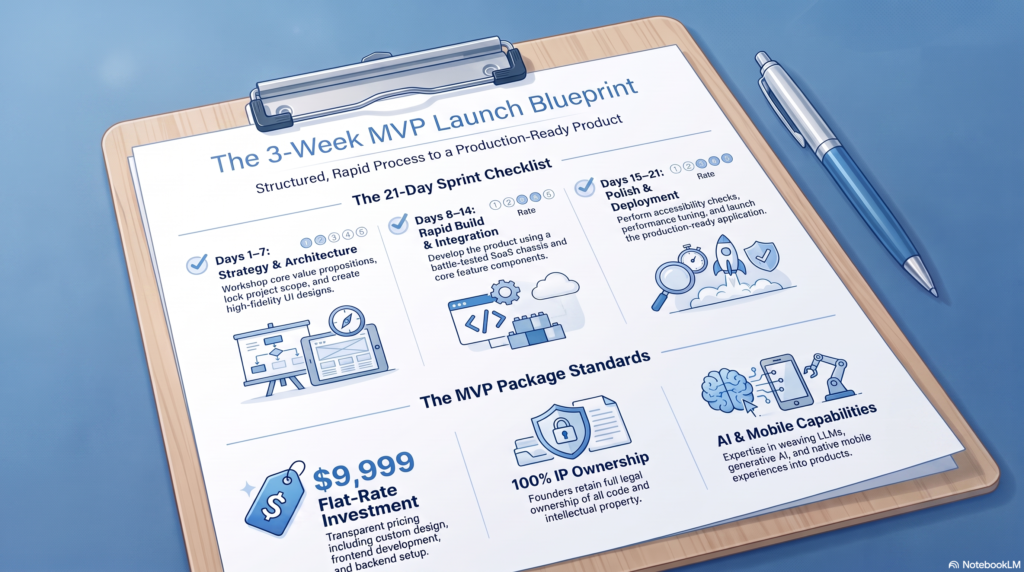
The MVP Development Company Checklist: 15 Things to Verify
Group A — Proof of Work
1. Shipped case studies from the last 18 months. Ask for three live products, not mockups. A real MVP development company can point to a live URL, an App Store link, or a production dashboard and explain honestly what broke after launch and how the team resolved those issues.
If you’re researching how to choose MVP development company, recent case studies provide far more value than polished presentations or outdated portfolios.
Look for products that are still active, receiving updates, and serving real users. Ask about the business goals, technical challenges, launch timeline, and measurable outcomes achieved for each project.
This level of transparency demonstrates real-world product experience instead of theoretical expertise. Using recent case studies as part of how to choose MVP development company helps you identify partners with proven execution rather than impressive marketing alone.
2. Relevant industry or domain fit. A team that has shipped in your category — SaaS, fintech, healthtech, marketplace — already knows the pitfalls specific to it. General web experience alone isn’t a substitute, especially once compliance or two-sided user flows enter the picture.
Group B — Process and People
3. A structured discovery process. The first call should be full of questions about your users, not a rushed quote. Bring a copy of our MVP discovery call questions script so every vendor answers the same set.
4. Team composition and seniority. Ask exactly who touches your project: a senior engineer, a junior dev, a project manager juggling six other clients? Get names and seniority in writing, not “a dedicated team.”
5. A clearly articulated development methodology. A credible partner can walk you through their process week by week, not just in buzzwords like “agile.” Compare what they describe against our MVP development process guide to spot gaps fast.
6. Tech stack fit for your product type. The right stack depends on what you’re building, not what the agency happens to know best. Our breakdown of the tech stack for MVP development explains which combinations actually fit which product categories.
Group C — Money and Paperwork
7. Transparent, itemized pricing. A trustworthy quote breaks down discovery, design, development, QA, and deployment separately. Our MVP development cost in India guide shows what each stage typically costs, so you can sanity-check any number you’re handed.
8. Milestone-based payment terms. Never pay 100% upfront to any MVP development company, no matter how confident the sales call felt. Three or four milestones tied to deliverables is the healthy standard.
9. IP ownership and contract clauses in writing. Confirm you own 100% of the code and IP the moment final payment clears. Our MVP development contract checklist lists every clause worth reading twice before you sign.
Group D — Trust Signals
10. References you can call yourself. Ask for two, ideally one from a project that hit a rough patch rather than only a smooth success story. A vendor who hesitates here is telling you something.
11. Rankings and reviews checked properly. Directory rankings on Clutch or GoodFirms can be influenced by paid placement, not just delivery quality. Our guide on vetting MVP development company rankings explains what to check before trusting a “Top 10” list.
12. Communication cadence and tooling. Weekly demos, a shared Slack or Discord channel, and access to a live project board are reasonable baseline expectations. Be cautious of any team offering only email updates.
Group E — Risk and Fit
13. Offshore or onshore fit for your timezone. Cost savings only hold up if communication actually works across the gap. Our offshore vs onshore MVP development comparison covers when the tradeoff is worth it.
14. Post-launch support terms. Ask what happens if a critical bug shows up in week one after launch, and get the answer written into the contract, not left as a verbal promise.
15. Responsiveness and tone in early conversations. How quickly they reply to emails and how honestly they answer hard questions during vetting tends to predict how they’ll behave once you’ve signed.
The Printable MVP Development Company Scorecard
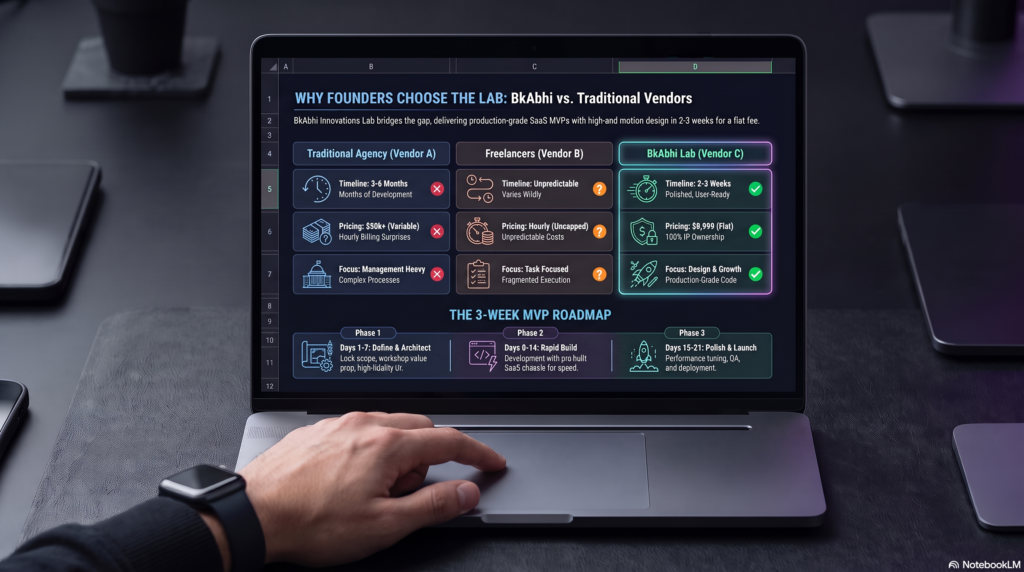
Copy this table into a spreadsheet and fill it in during every discovery call. It turns 15 fuzzy impressions into one comparable number per vendor.
| # | Checklist Item | Weight | Score (1–5) | Notes |
|---|---|---|---|---|
| 1 | Shipped case studies | High | ||
| 2 | Industry/domain fit | Medium | ||
| 3 | Structured discovery call | High | ||
| 4 | Team composition & seniority | Medium | ||
| 5 | Development methodology | Medium | ||
| 6 | Tech stack fit | Medium | ||
| 7 | Pricing transparency | High | ||
| 8 | Milestone payment terms | High | ||
| 9 | IP ownership & contract | High | ||
| 10 | Verifiable references | High | ||
| 11 | Rankings/reviews vetted | Low | ||
| 12 | Communication & tooling | Medium | ||
| 13 | Offshore/onshore fit | Medium | ||
| 14 | Post-launch support terms | Medium | ||
| 15 | Responsiveness & tone | Low |
Weight your own totals if a category matters more to your project — a regulated fintech founder, for example, should weight contract terms and references even higher than the defaults above.
Red Flags: Instant Disqualifiers
Any single item here is worth a follow-up question. Two or more on one call is usually reason enough to move to the next name on your list.
- Refuses to share references or specific past outcomes
- Pushes for a large payment before any discovery work begins
- Answers every request with “yes, we can build that,” regardless of budget or timeline
- Can’t describe their development process in concrete, week-by-week terms
- No written process for handling scope changes mid-project
Green Flags: Signs of a Strong Partner
These traits show up consistently in the vendor relationships founders describe as actually working.
- Asks more questions about your users than about your tech preferences
- Suggests cutting features rather than adding them
- Names specific past MVPs and describes honestly what happened after launch
- Admits openly what they don’t specialize in, instead of claiming to do everything well
Where This Checklist Fits Into a Bigger Decision
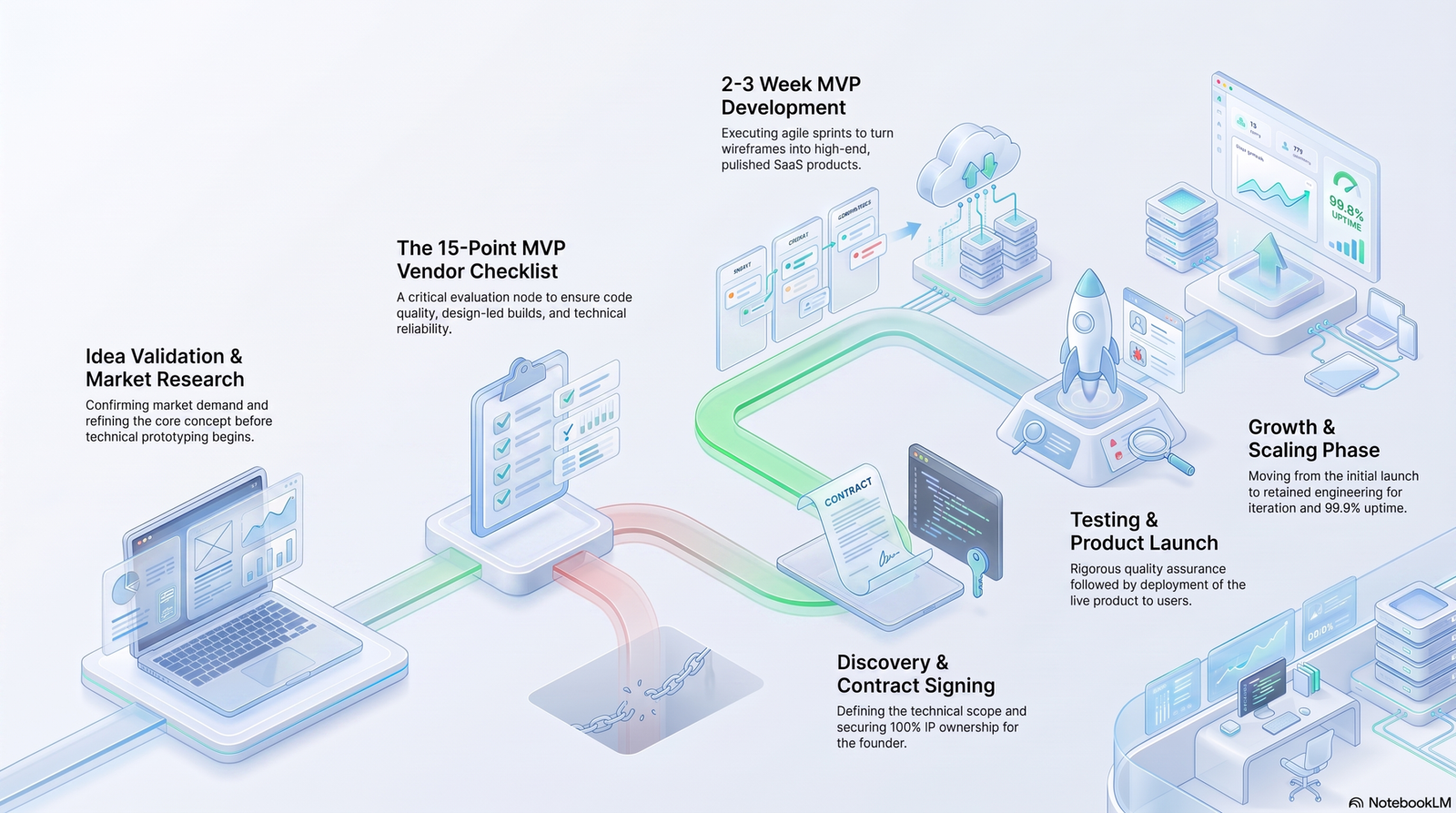
This scorecard assumes you’ve already decided to hire an agency rather than build in-house or go solo with a freelancer. If you’re still weighing that call, our MVP development agency vs. in-house team comparison walks through the tradeoffs first.
And if you’re comparing partners specifically in the Indian outsourcing market, our pillar guide on choosing an MVP development company in India covers cost, process, and tech stack together in one place.
Once you’ve narrowed your list to two or three finalists, revisit our deeper how to choose an MVP development company framework — it’s worth reading in full before you sign, even after this checklist has done its job of narrowing the field.
Frequently Asked Questions
How many MVP development companies should I score before deciding? The ideal approach is to run this checklist against three to five shortlisted agencies.
If you’re learning how to choose MVP development company, this range gives you enough data to compare capabilities without making the decision overwhelming.
Evaluating fewer than three companies leaves you with little context for pricing, technical expertise, or delivery quality.
Comparing more than five often leads to analysis paralysis and can delay your product launch by several weeks.
Use the same scorecard and evaluation criteria for every vendor so your comparisons remain fair and consistent.
This structured process helps you identify the strongest partner based on evidence rather than sales presentations.
Following this method makes how to choose MVP development company faster, more objective, and far more likely to result in a successful MVP partnership.
What’s the single most important item on this checklist? Shipped case studies and IP ownership terms carry the highest risk if they’re overlooked, which is why both are weighted “High” in the scorecard.
If you’re researching how to choose MVP development company, these two factors can reveal whether a vendor has genuine product experience and whether you’ll fully own the software after development. Always ask for recent live projects, verify their results, and review contract clauses covering intellectual property before signing.
A strong portfolio proves execution, while clear IP ownership protects your long-term business interests. Ignoring either can lead to costly legal disputes or working with an agency that lacks real-world delivery experience.
By prioritizing these areas, how to choose MVP development company becomes a more secure, informed, and low-risk decision for your startup.
Should I disqualify a vendor for one low score? Not usually. One weak score deserves a follow-up question. Two or more weak scores across the 15 items is a stronger signal to move on.
Is a lower price ever worth a lower checklist score? Rarely. A low bid combined with a vague process or no references almost always shows up later as rework, delay, or a rebuild — costing more than the savings were worth.
Can I use this checklist for a freelancer instead of an agency? Yes, with adjustments. Team composition (#4) and communication tooling (#12) matter even more for a solo freelancer, since there’s no backup if they’re unavailable.
Do I need a technical co-founder to use this scorecard? No. Every item on this checklist is written to be answerable by a non-technical founder — it’s designed around process clarity and paper trail, not code review.
Author Bio
Jeevesh Tripathi is a product and startup technology researcher specializing in MVP development, vendor evaluation, and early-stage product strategy. His work focuses on turning founder discovery calls and hands-on vendor evaluations into practical, reusable frameworks like this checklist.
📧 Contact: jeevesh@bkabhi.com
This checklist is part of BkAbhi’s MVP development resource hub. For the deeper reasoning behind each step, read our full how to choose an MVP development company guide, or browse more founder-focused resources on the BkAbhi blog.