
Quick Answer
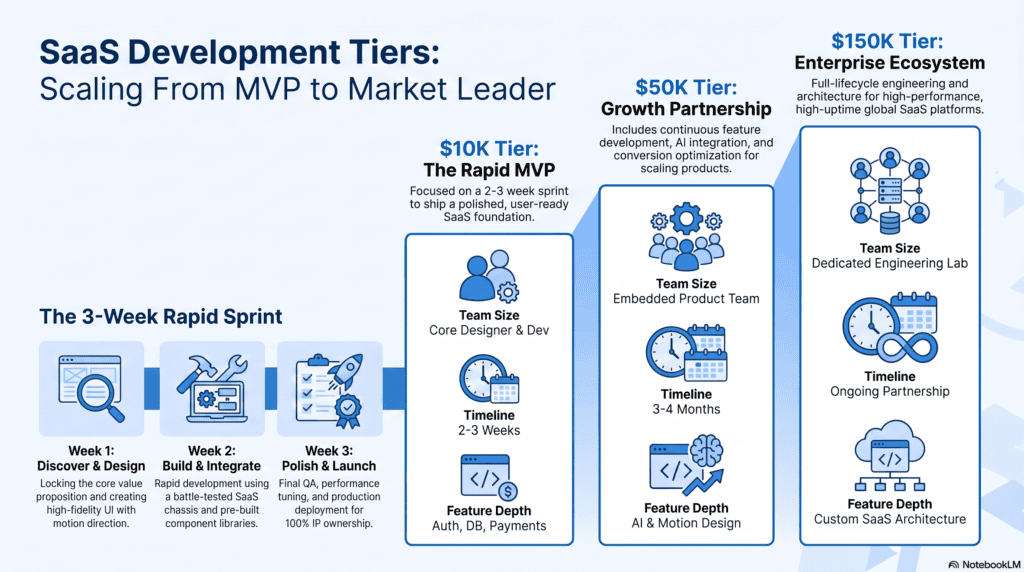
MVP development cost typically falls into three bands: $10K–$25K buys a bare-bones prototype or single-feature test, $50K–$100K buys a properly built product with a small senior team, and $150K+ buys enterprise-grade delivery with compliance and scale in mind. The right tier depends on your validation stage, not your ambition. BkAbhi helps startups choose the most cost-effective MVP approach, ensuring they invest only in the features needed to validate their idea and accelerate product-market fit.
Ravi got three quotes for the same app idea. One agency said $12,000. Another said $58,000. A third said $145,000.
He picked the cheapest one, assuming an MVP is an MVP no matter who builds it. Four months later, he was still waiting on a login screen that crashed every third attempt.
The problem wasn’t that his agency lied about the price. It’s that nobody explained what each MVP development cost tier actually includes.
This guide breaks that down honestly, so you can match your budget to what you actually need before you sign anything.
Table of Contents
Why the Same MVP Gets Three Different Quotes
Ask ten agencies “how much does MVP development cost” and you’ll get ten different numbers for what sounds like the same project.
That’s because “MVP” isn’t a fixed spec. It’s a label three different vendors apply to three very different deliverables.
A $10K quote and a $150K quote might both promise “a working app with login and payments.” Only one of them will survive real user traffic.
Before comparing numbers, it helps to understand what actually separates the tiers, which is exactly what our best MVP development company guide walks through from a vendor-selection angle.
What Actually Drives MVP Development Pricing
MVP development pricing isn’t random. Five variables explain almost the entire gap between a $10K quote and a $150K one.
Team seniority. A junior freelancer and a senior full-stack engineer can write the same feature—one will need three times longer and generate more bugs doing it.
Testing and QA depth. Cheap builds skip structured QA entirely. Expensive builds budget 15-20% of total time just for testing edge cases.
Documentation and handoff. A $150K build hands you clean documentation. A $10K build often hands you a codebase nobody, including the original developer, can explain six months later.
Compliance requirements. Fintech and healthtech MVPs need security and regulatory groundwork that consumer apps simply don’t, which pushes cost up regardless of feature count.
Region and engagement model. A senior engineer in Eastern Europe or South Asia can cost half of a comparable US-based hire, without necessarily sacrificing quality.
The $10K MVP: What You Get and What You Give Up
At $10,000-$25,000, you’re typically paying for a solo freelancer or a very junior offshore team, not a full agency engagement.
What you get: a single core feature built and functional, basic UI, and a working demo you can show investors or early users.
What you don’t get: structured QA, scalable architecture, or documentation. If the developer disappears, you may not be able to hire anyone else to pick up the code.
This tier makes sense for one specific situation: testing whether anyone wants your product before you’ve raised a dollar. Our piece on why startups need MVP development services first covers several founders who learned this the hard way.
It rarely makes sense once you have funding, a real user base, or any compliance exposure, because rework at that point usually costs more than starting at $50K would have.
The $50K MVP: The Sweet Spot for Funded Founders
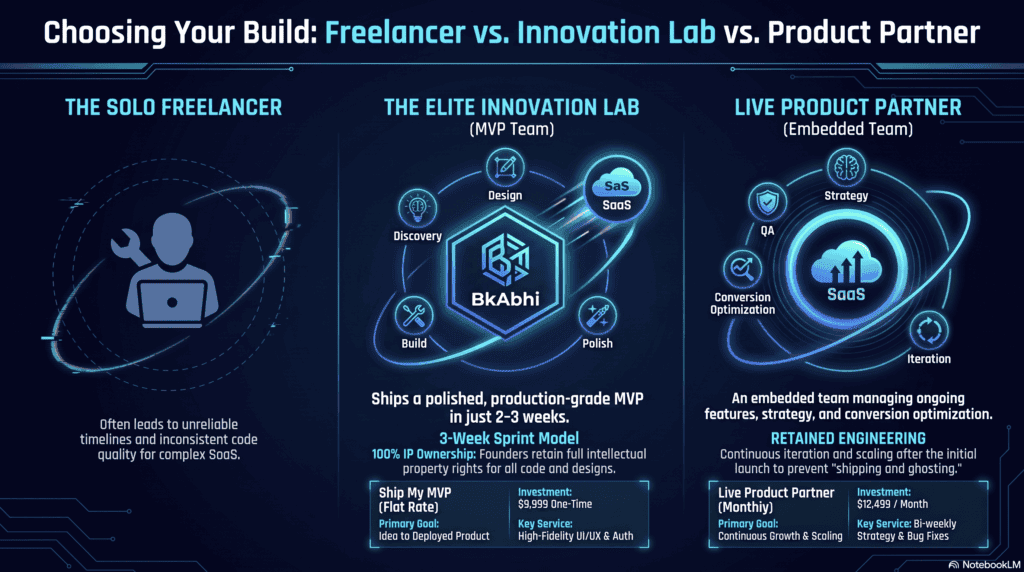
Most genuinely startup-focused agencies price a serious MVP between $50,000 and $100,000, and this is where MVP development cost conversations get most interesting.
What you get: a small senior-led team (2-4 people), authentication and payments built properly, structured QA, and weekly demos tied to milestones.
What you get, continued: a 10-12 week timeline is typical, along with basic documentation that lets a future in-house hire actually understand the codebase.
What you still don’t get: deep compliance audits, extensive load testing for scale, or a large bench of engineers if someone leaves mid-project.
This is the tier most seed-funded founders land in, largely because it balances speed, quality, and runway. Our guide on how to hire MVP developers for an early product launch breaks down exactly what to look for at this budget.
The $150K MVP: Enterprise-Grade From Day One
At $150,000 and above, you’re paying for redundancy, compliance, and a build that can survive technical due diligence.
What you get: a cross-functional team including dedicated QA, security review, and often a project manager separate from the engineering lead.
What you get, continued: load testing for real scale, documentation thorough enough to pass an investor’s technical audit, and 60-90 days of post-launch support baked into the contract.
Who actually needs this: corporate innovation teams, fintech or healthtech products with real compliance exposure, and Series A companies preparing for rapid scale immediately after launch.
For most early-stage consumer startups, this tier is overkill. You’re paying for insurance against problems you haven’t earned yet. Our article on expert UI/UX design for startup MVP projects explains why design maturity alone doesn’t justify jumping straight to this budget.
Side-by-Side Comparison
| What You’re Paying For | $10K-$25K | $50K-$100K | $150K+ |
|---|---|---|---|
| Team | Solo freelancer or junior team | 2-4 senior engineers | Cross-functional team + QA/PM |
| Timeline | 4-8 weeks | 10-12 weeks | 4-6 months |
| QA/testing | Minimal or none | Structured, milestone-based | Full QA + load testing |
| Documentation | Rare | Basic handoff docs | Audit-ready documentation |
| Compliance readiness | None | Basic security hygiene | HIPAA/PCI-DSS aware |
| Post-launch support | Rare | 30 days common | 60-90 days common |
| Best fit | Pre-funding validation | Seed-stage funded founders | Compliance-heavy or Series A |
MVP Budget by Stage: What Investors Expect You to Spend
MVP budget by stage isn’t just a founder preference—investors and advisors expect spending patterns to match your funding stage.
Pre-seed, self-funded: Spending $50K here without user validation is the single most common early-stage mistake we see. Start closer to the $10K-$25K range, or even lower with no-code tools.
Seed-stage, funded: This is where the $50K-$100K band earns its reputation as the sweet spot, since it balances runway conservation with build quality investors expect at your next raise.
Series A, scaling fast: Budgets often move toward $150K+ because you’re no longer validating—you’re building for load, compliance, and a growing team that needs clean documentation to build on top of.
Our pillar guide on the best MVP development company goes deeper into how these stage-based needs should shape vendor selection, not just budget.
How Industry and Platform Choice Change the Price
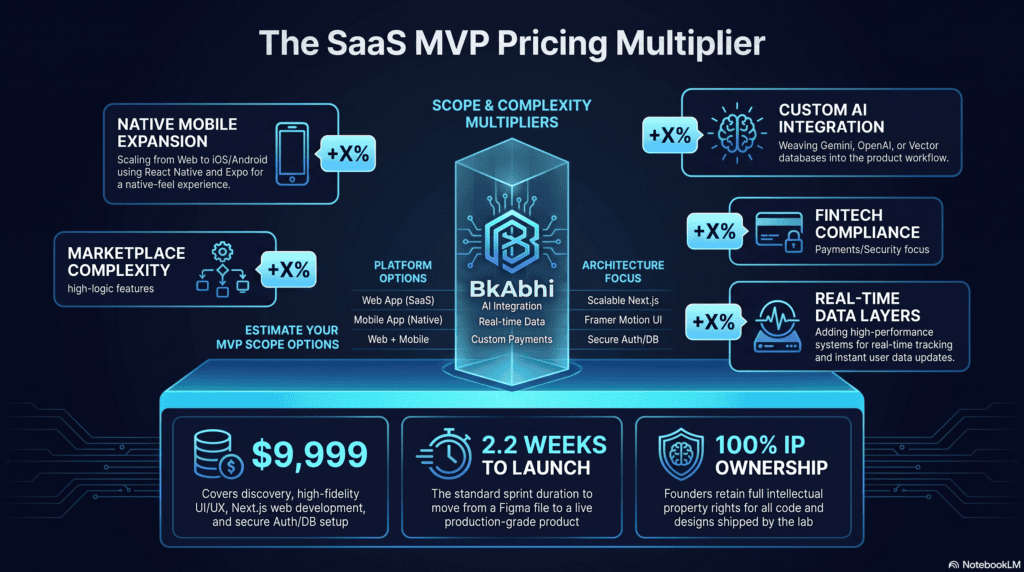
Two founders with identical feature lists can still get very different MVP development cost quotes once industry and platform enter the conversation.
Fintech and healthtech products carry compliance overhead that consumer apps don’t. Even a basic HIPAA or PCI-DSS-aware build adds weeks of engineering time nobody sees in the feature list itself.
Marketplace and two-sided platforms cost more than single-user apps because matching logic, trust signals, and dual onboarding flows all need separate design and QA attention.
Native mobile apps (iOS and Android built separately) typically cost 30-40% more than a single cross-platform build using React Native or Flutter, for comparable functionality.
AI-powered features split into two very different cost buckets: integrating an existing API is relatively cheap, while training or fine-tuning a custom model can push a project well past the $150K tier on its own.
None of this means every founder needs the expensive version. It means the feature list alone can’t tell you your real MVP development pricing—industry and platform context matter just as much.
Red Flags at Every Price Point
Every MVP development cost tier has its own version of a red flag, and founders often miss the one relevant to their budget.
At $10K-$25K: watch for developers who can’t explain their own architecture decisions, or who disappear for days without updates. At this price, communication gaps are the biggest risk, not the code itself.
At $50K-$100K: watch for agencies that quote this range but staff the project with junior engineers supervised remotely by a senior lead who rarely joins calls.
At $150K+: watch for scope creep dressed up as “best practice.” Enterprise-grade agencies sometimes pad timelines with processes your actual stage doesn’t need yet.
Across every tier, the same rule holds: a price that sounds too good relative to the promised scope almost always means something is being cut you haven’t been told about.
Hidden Costs Nobody Budgets For
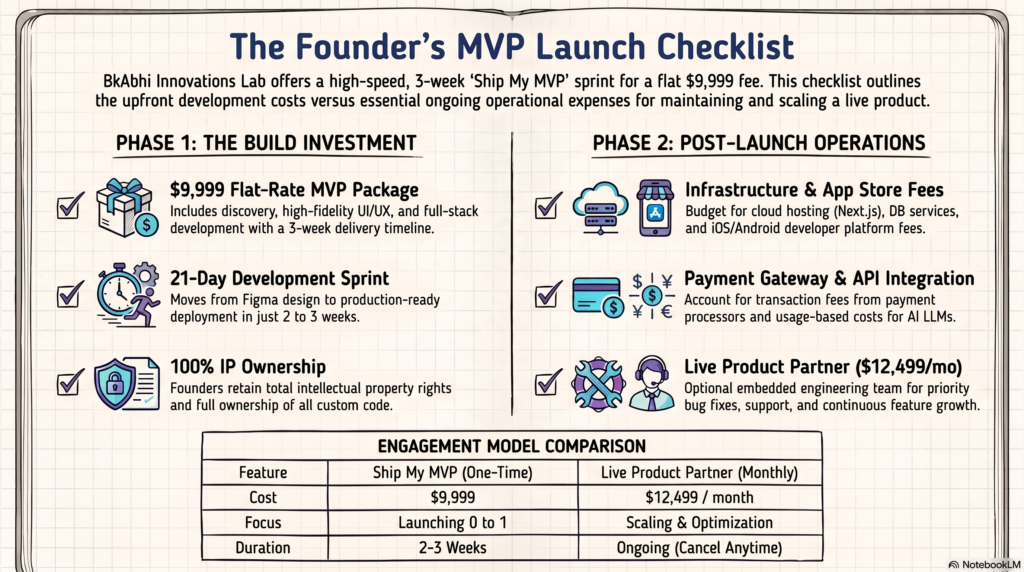
Every tier above hides a second invoice founders rarely see coming, and it changes the real MVP development cost significantly.
Third-party services. Payment gateways, SMS verification, cloud hosting, and analytics tools all carry monthly fees separate from the build itself.
Post-launch bug fixes. Even well-built MVPs surface issues in the first 30 days that fall outside the original contract scope.
App store and compliance fees. Apple and Google developer accounts, SSL certificates, and basic legal review for terms of service all add up quietly.
Change orders. Every “just one more feature” request outside the agreed scope typically gets billed separately, and these add up faster than founders expect.
Budgeting an extra 15-20% on top of your quoted MVP development cost is a realistic buffer, regardless of which tier you choose.
Offshore vs. Local Pricing: The Real Difference
Offshore teams routinely deliver 30-50% cost savings compared to US-based agencies, which is why so many founders explore offshore MVP development before committing to a full budget.
The savings are real, but they come with trade-offs worth naming honestly. Timezone overlap shrinks, and English fluency plus project management maturity matter more than the hourly rate itself.
Hybrid models—local strategy leads paired with distributed engineering—have become the practical middle ground for founders who want offshore pricing without offshore risk.
The cheapest offshore quote and the cheapest domestic quote share the same warning sign: if nobody can explain why the price is so low, that’s the question to ask before you sign.
How the Contract Protects (or Exposes) Your Budget
The number on the quote means very little if the MVP development contract behind it doesn’t protect your spending.
Payment structure should follow a milestone split, typically 30/40/30, rather than a lump sum paid entirely upfront.
Scope-change pricing needs to be defined in writing, so a reasonable feature request doesn’t quietly become a 20% budget overrun.
IP ownership clauses confirm you actually own the code you’re paying for once final payment clears—surprisingly often missing from cheap contracts.
A vague contract at a low price frequently ends up costing more than a clear contract at a higher one, once change orders and rework are factored in.
Why Rankings and Review Sites Don’t Show You Real Pricing
Public MVP development company rankings on directories like Clutch or GoodFirms rank agencies by reviews and marketing spend, not by transparent pricing.
Two agencies ranked next to each other on the same list can differ by $80,000 for comparable scope, because rankings rarely account for team seniority or region.
Treat these lists as a starting point for names to research, not as a proxy for what you’ll actually be quoted once you’re on a call.
Questions That Reveal the Real Price on a Discovery Call
The quoted number only makes sense once you understand what’s included, which is exactly what good MVP discovery call questions are designed to surface.
Ask directly: “What’s included in this price, and what typically gets billed as a change order?” Vague answers here are a reliable red flag.
Ask also: “What does your post-launch support window look like, and is it included in this quote or billed separately?”
These two questions alone often reveal a 20-30% gap between the headline number and the real MVP development cost you’ll actually pay.
Case Snapshot: Same Idea, Three Different Budgets
Three founders pitched near-identical marketplace apps within the same quarter, each choosing a different budget tier.
Founder A spent $15,000 with a solo freelancer, launched in six weeks, and rebuilt the entire backend eight months later once user volume grew past what the code could handle.
Founder B spent $72,000 with a small senior team, launched in eleven weeks, and used the same codebase to raise a seed round four months later.
Founder C spent $180,000 preparing for enterprise clients from day one, which delayed launch by five months but let them pass a security audit their first client required.
None of the three choices was universally “right”—each matched a different stage of validation and a different set of constraints.
How BkAbhi Prices MVP Projects
At BkAbhi, we quote fixed-scope, fixed-timeline packages rather than open-ended hourly billing, because founders deserve to know their real MVP development cost before signing anything.
Every engagement starts with a discovery sprint that defines exactly what’s in scope and what’s explicitly excluded, so change orders don’t quietly inflate your budget later.
Milestone-based payments—typically a 30/40/30 split—keep our incentives aligned with your actual progress, not just hours logged.
If you want to see how this pricing philosophy plays out across a full engagement, our minimum viable product developer guide walks through it in detail, or you can explore our service offerings directly.
Frequently Asked Questions
How much does MVP development cost for a simple app? A single-feature MVP with a freelancer or junior team typically runs $10,000-$25,000, though quality and reliability vary significantly at this tier.
What is a realistic MVP development pricing range for a funded startup? Most seed-stage founders should budget $50,000-$100,000 for a properly-built MVP with a senior-led team and structured QA.
Why do MVP development cost quotes vary so much between agencies? Team seniority, testing depth, documentation quality, and region explain almost the entire gap between low and high quotes for the same scope.
Does a higher MVP development cost guarantee a better product? No. It generally buys more risk mitigation—better testing, documentation, and support—but discipline in scope still matters more than budget size alone.
Should I include a buffer beyond my quoted MVP budget? Yes, an additional 15-20% for hosting, third-party services, and post-launch fixes is a realistic and common buffer across all budget tiers.
Is offshore MVP development actually cheaper for the same quality? Often, yes—30-50% savings are common—provided you vet for English fluency, project management maturity, and not just the hourly rate.
Final Thoughts on Choosing Your Budget
There’s no universally “right” MVP development cost—only the right cost for your current stage of validation.
Spending $150K to test an unproven idea is often as risky as spending $10K to build something meant to handle real scale.
Match your budget to what you actually need to learn next, read your contract closely, and ask the questions that reveal what’s really included before you commit.
Ready to figure out where your project actually fits? You can book an MVP consultation with our team, or explore more founder guides on our homepage.
Author Bio
Jeevesh Tripathi Email: jeevesh@bkabhi.com
Jeevesh Tripathi is a startup technology researcher and MVP strategy consultant at BkAbhi Innovations Lab, where he has advised founders across fintech, EdTech, and marketplace platforms on budgeting and vendor selection. His work focuses on translating real founder pricing conversations into practical, jargon-free guidance for early-stage teams. This article reflects hands-on research into agency quotes, contract structures, and founder interviews conducted throughout 2026.