
Quick Answer
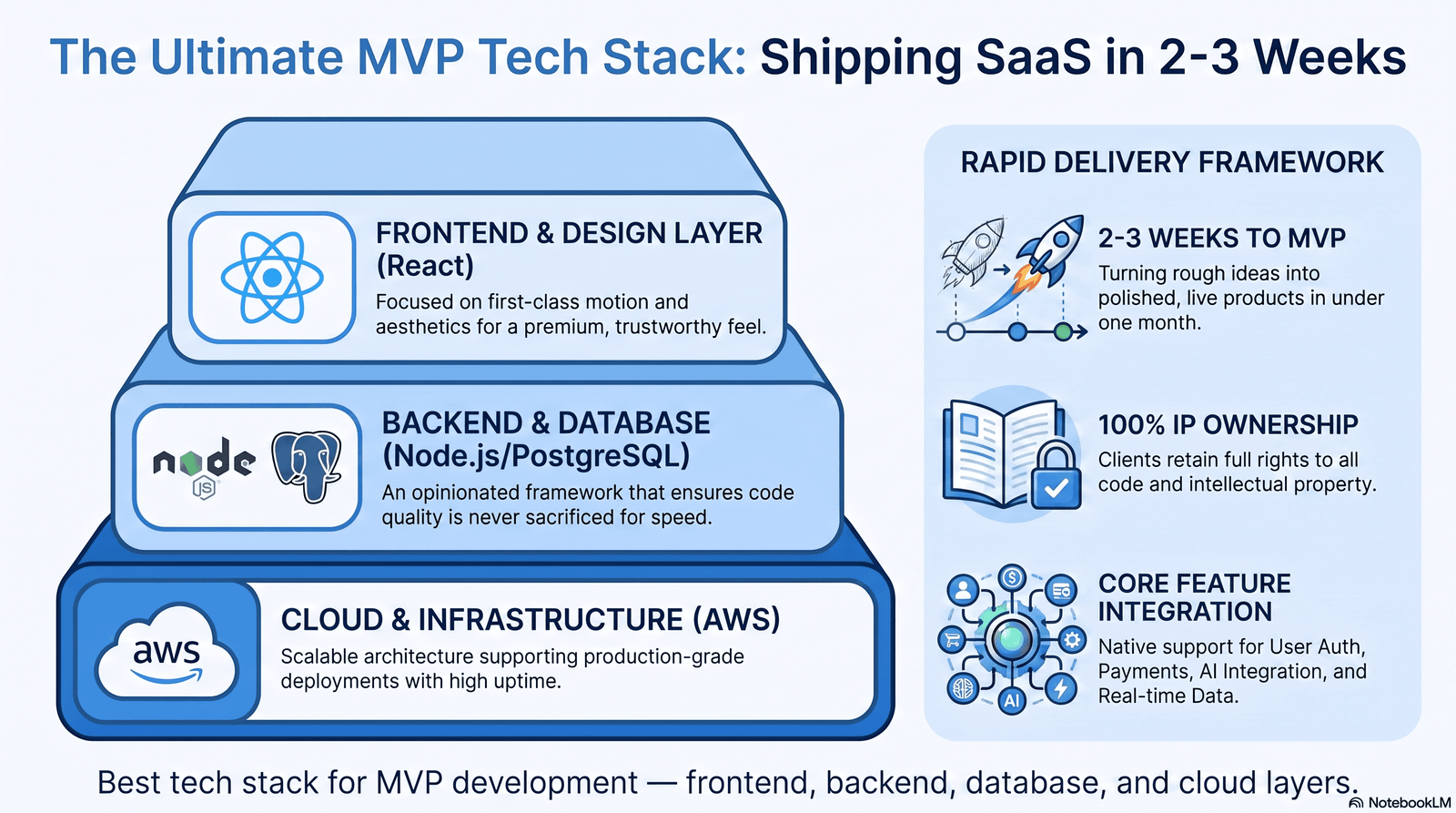
The best tech stack for MVP development in 2026 is usually React or Next.js on the frontend, Node.js with TypeScript on the backend, and PostgreSQL or MongoDB for the database, deployed on a cloud-native platform like AWS or Vercel. There is no single “best” MVP app technology stack — the right choice depends on your product type, team skill, and timeline. This guide breaks down the best programming language for MVP builds by use case, compares frontend, backend, database, and mobile options, and shows how stack choice affects cost and speed to launch. If you’re also comparing vendors, our complete guide to MVP development companies in India covers the full selection process alongside stack and cost.
Table of Contents
Why Your Tech Stack Choice Matters This Much
Founders spend weeks debating logos and taglines, then pick their tech stack for MVP development in a single afternoon call with a developer friend.
That’s backwards. Your stack decides how fast you ship, how much a bug costs to fix, and how easily you can hire help later.
The wrong stack doesn’t usually kill an MVP outright—it just quietly taxes every sprint with slower builds, harder hiring, and rework nobody budgeted for. That’s why understanding MVP vs prototype before choosing your technology stack can save significant time, cost, and future development effort.
This guide walks through how to pick the right MVP app technology stack for your specific product, without over-engineering for scale you don’t have yet.
What Is a Tech Stack, and Why MVP Stacks Are Different
A tech stack is simply the combination of programming languages, frameworks, databases, and hosting tools used to build a product.
An MVP tech stack has one job that’s different from a scale-stage stack: get a working product in front of real users as fast as possible, without locking you into decisions you can’t undo cheaply.
A scale-stage company optimizes for handling millions of users. An early-stage founder optimizes for iteration speed and developer availability.
Confusing the two is where most tech stack for MVP development mistakes start — teams build for a scale problem they don’t have yet, and burn runway before they’ve proven anyone wants the product at all.
How to Choose the Right Tech Stack for MVP Development
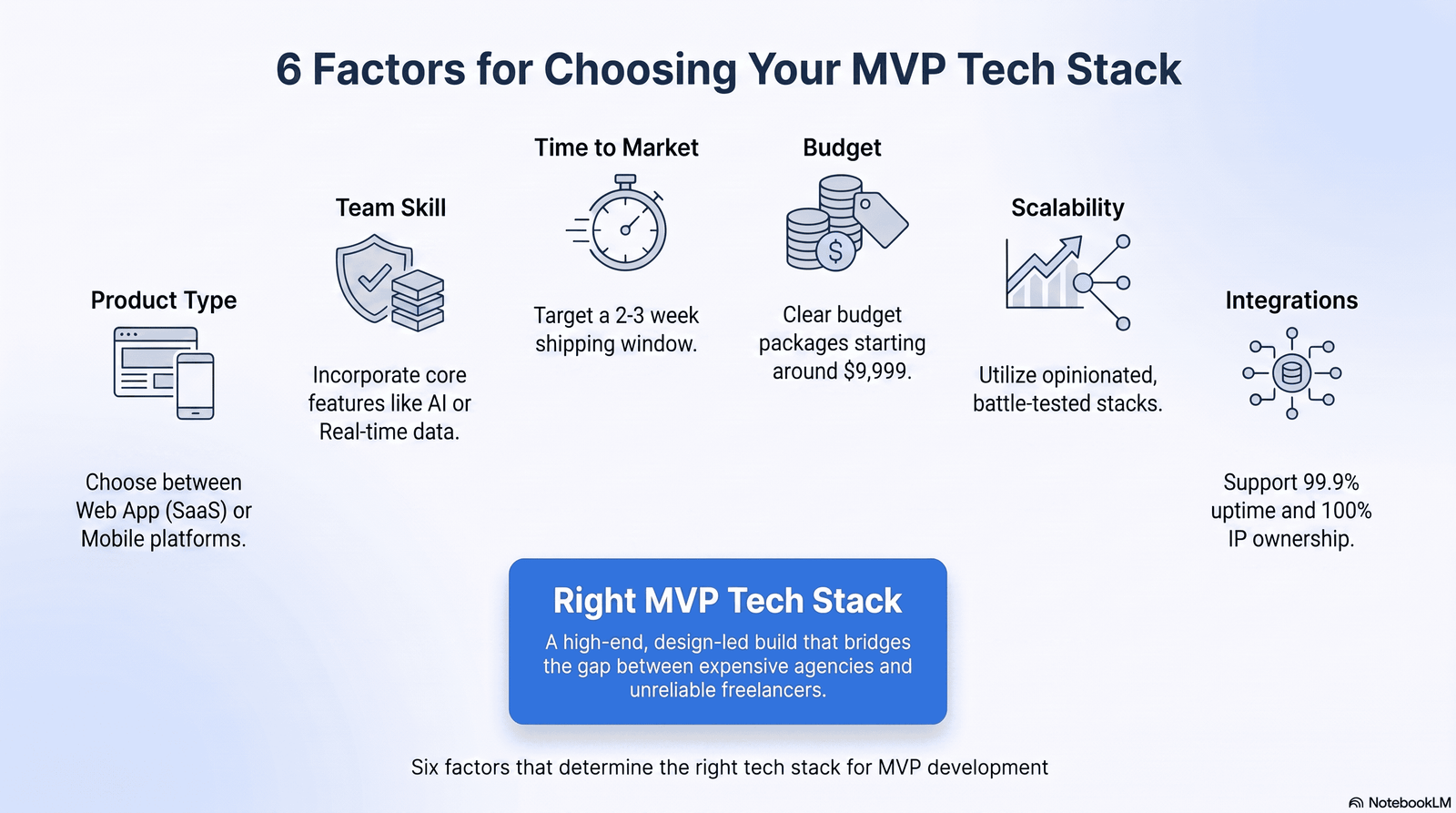
There’s no universal “best” stack — only the right stack for your product, timeline, and team. A few factors should drive the decision every time.
Product type: A content-heavy marketplace has different needs than a real-time chat app or a data-heavy fintech dashboard.
Team and hiring pool: A stack with a deep talent pool is easier to staff and cheaper to maintain than a niche or exotic one.
Time to market: Frameworks with strong scaffolding and pre-built libraries get you to launch faster than building everything from scratch.
Budget: Some frameworks reduce development hours meaningfully; others add complexity an early MVP doesn’t need yet. Our MVP development cost breakdown shows exactly how stack choice moves the final number.
Future scalability: You don’t need to over-build for scale on day one, but a stack that can grow with you avoids a painful rewrite at 10,000 users.
Third-party integrations: Payment gateways, AI APIs, and analytics tools are easier to bolt onto some stacks than others.
Best Programming Language for MVP Development
Founders often ask which single language to bet on. The honest answer: it depends on what you’re building, but a few options dominate for good reason.
According to Stack Overflow’s 2025 Developer Survey, JavaScript remains the most-used language among developers at 66%, followed by HTML/CSS and SQL, which is exactly why it anchors most modern MVP stacks.
Python’s adoption has accelerated sharply too, growing by 7 percentage points from 2024 to 2025, largely driven by AI features and data-heavy backends.
| Language | Best For | Why It Works for an MVP |
|---|---|---|
| JavaScript / TypeScript | Web apps, SaaS, real-time features | One language across frontend and backend, huge talent pool |
| Python | AI-powered apps, data-heavy products | Fast prototyping, strong AI/ML libraries |
| Ruby | Content platforms, marketplaces | Rails ships CRUD apps quickly with less boilerplate |
| PHP | Simple web apps, CMS-based products | Cheap hosting, mature ecosystem, fast for basic builds |
| Go | High-performance backends | Lightweight, fast, good for APIs under heavy load |
For most first-time founders building a web or SaaS MVP, the best programming language for MVP development is JavaScript or TypeScript — it lets one small team cover both frontend and backend without context-switching between languages.
If your product leans heavily on AI features, recommendation engines, or data pipelines, Python is usually the stronger starting point instead.
Frontend Tech Stack Options
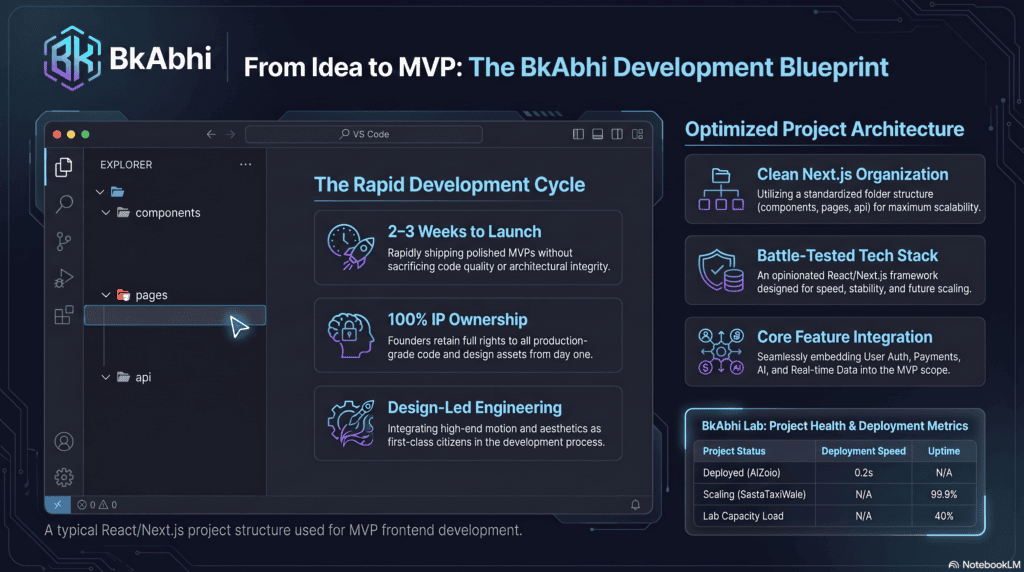
The frontend is what users actually touch, so speed of iteration matters more here than almost anywhere else in your MVP app technology stack.
React.js: The safest default for most MVPs — the largest component ecosystem, the deepest hiring pool, and flexibility for almost any product type.
Next.js: React with built-in routing, server-side rendering, and SEO benefits baked in — a strong pick if organic search matters to your product from day one.
Vue.js: A gentler learning curve than React, popular with smaller teams that want speed without a steep ramp-up.
Plain HTML/CSS/JS: Occasionally still the right call for extremely simple landing-page-style MVPs meant purely to validate demand before any real build starts.
Backend Tech Stack Options
The backend handles your logic, data, and integrations — and it’s usually where the biggest tech stack for MVP development decision gets made.
Node.js (with Express or NestJS): The most common MVP backend choice because it pairs naturally with a React or Next.js frontend using one shared language.
Python (Django or FastAPI): Django ships CRUD-heavy apps fast with an admin panel included; FastAPI is lighter and popular for AI-integrated APIs.
Ruby on Rails: Still a strong, fast option for content platforms and marketplaces, with conventions that reduce decision fatigue for small teams.
Firebase / Supabase (Backend-as-a-Service): Skips custom backend code entirely for very early MVPs — good for speed, less flexible once you need custom logic.
A Node.js and TypeScript pairing remains the most common combination for MVPs that need speed and type safety without switching languages between frontend and backend.
Database Choices: SQL vs NoSQL for an MVP
Your database choice shapes how easily your product evolves after launch, so it deserves more thought than founders usually give it.
Stack Overflow’s 2025 data backs this up directly — PostgreSQL has ranked as the most popular database technology developers want to use for the third year in a row.
PostgreSQL: The default choice when your data has clear relationships — users, orders, subscriptions — and you value data integrity.
MongoDB: A better fit when your data model is still evolving fast, or your product has flexible, document-style content.
Firebase Firestore: Useful for MVPs that need real-time syncing across devices with minimal backend setup.
| Database | Type | Best For MVPs That Need |
|---|---|---|
| PostgreSQL | Relational (SQL) | Structured data, payments, strong consistency |
| MongoDB | Document (NoSQL) | Flexible schemas, fast-changing data models |
| Firebase Firestore | Document (NoSQL) | Real-time sync, minimal backend setup |
Mobile App Tech Stack for MVPs
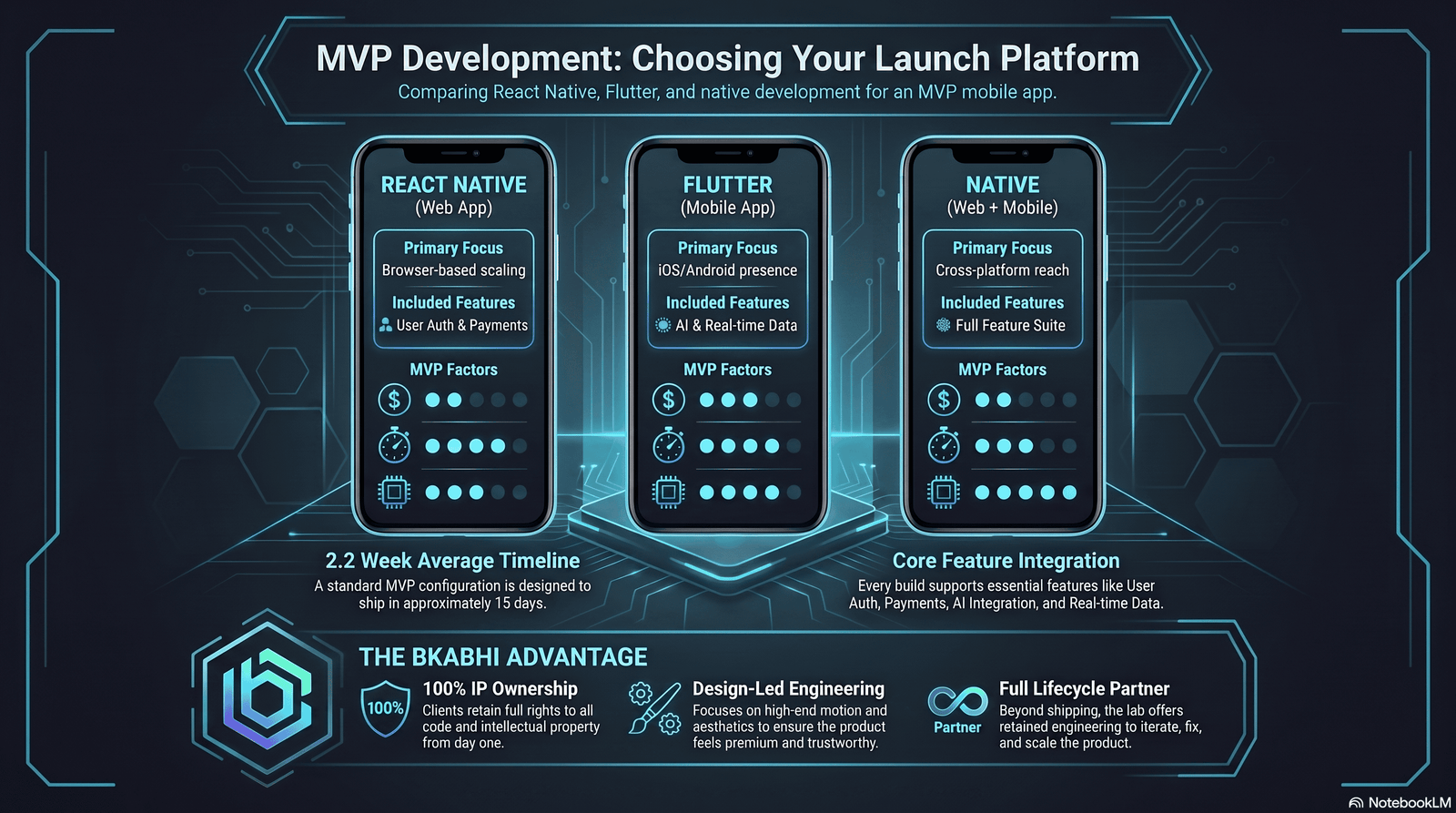
If your MVP needs a mobile app, platform choice affects both cost and timeline more than almost any other stack decision.
React Native: The most common cross-platform pick — one codebase for iOS and Android, and it reuses React skills your web team may already have.
Flutter: A strong alternative with excellent performance and a single codebase, though it uses Dart, a less common hiring pool than JavaScript.
Native (Swift for iOS, Kotlin for Android): The best performance and platform-specific feel, but effectively doubles your development cost and timeline.
For most budget-conscious MVPs, cross-platform frameworks are the more practical starting point — our MVP development cost guide breaks down exactly how much native builds add to your budget by comparison.
Cloud, Hosting, and DevOps for MVPs
Where and how you deploy your MVP matters almost as much as what you build it with, especially once real users start hitting it.
Docker usage among developers jumped 17 percentage points to reach 71% adoption in the 2025 survey, and containerized deployment has become close to a default expectation for modern web apps.
AWS: The most widely adopted cloud platform, with the deepest service catalog — a safe long-term choice if you expect to scale significantly.
Vercel / Netlify: Ideal for Next.js and static frontend deployment — near-instant setup and generous free tiers for early-stage MVPs.
Google Cloud / Firebase: Strong if you’re already using Firebase for your backend or need tight integration with Google’s AI tools.
Docker: Containerizing your app early, even for an MVP, makes it far easier to move between hosting providers or scale later without a rebuild.
Cloud-native deployment from day one avoids a costly re-architecture later, which is why it’s worth setting up correctly even for a scrappy first version of your product.
Popular MVP Tech Stack Combinations by Product Type
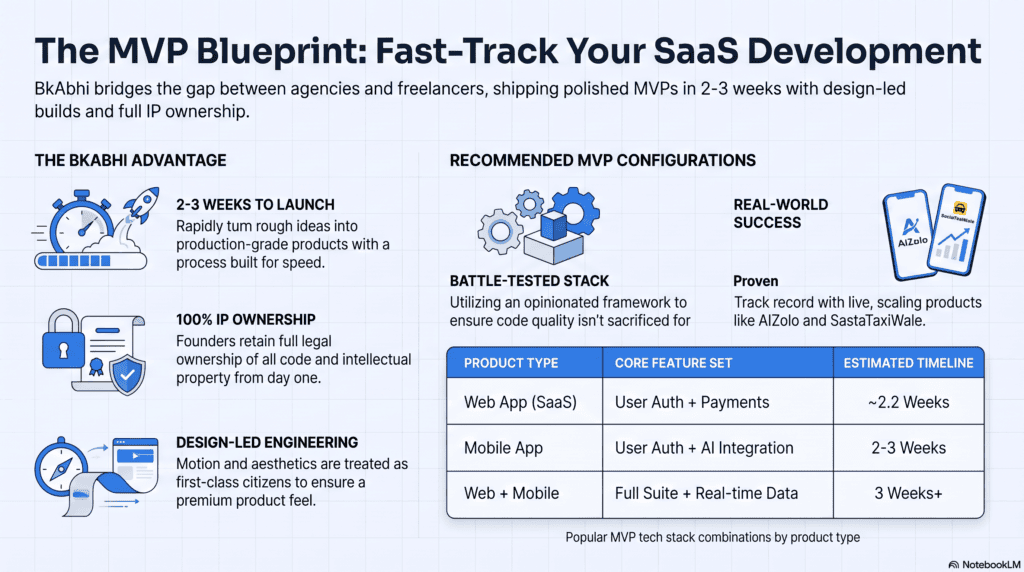
Instead of picking pieces individually, it helps to see how experienced teams bundle a full MVP app technology stack by product category.
| Product Type | Frontend | Backend | Database | Notes |
|---|---|---|---|---|
| B2B SaaS | Next.js | Node.js (NestJS) | PostgreSQL | Needs auth, billing, and a dashboard early |
| Marketplace | React.js | Node.js or Ruby on Rails | PostgreSQL | Two-sided flows add backend complexity |
| Fintech | Next.js | Node.js or Python (Django) | PostgreSQL | Security and compliance shape stack choices |
| AI-Powered App | React.js | Python (FastAPI) | PostgreSQL + Vector DB | Needs Python for ML/AI library support |
| Content Platform | Next.js | Ruby on Rails or Node.js | PostgreSQL or MongoDB | SEO and content structure matter most |
These combinations aren’t rigid rules — they’re starting points that experienced teams reach for because they’ve been battle-tested across hundreds of MVP builds.
Industry also shapes more than just the stack. Our SaaS, fintech, and healthtech MVP breakdown covers how compliance and feature priorities shift by sector.
No-Code vs Custom Code: Which Fits Your MVP?
Not every MVP needs custom code on day one — sometimes the fastest validation path skips a traditional tech stack for MVP development entirely.
No-code tools (Bubble, Webflow, Glide): Fastest and cheapest way to test raw demand before writing a single line of code.
Low-code platforms: A middle ground — faster than custom development, more flexible than pure no-code, but often hit a ceiling once logic gets complex.
Custom code: The right call once you need real scalability, complex integrations, or a product that’s genuinely hard to replicate on a no-code platform.
A common, sensible pattern: validate with no-code first, then rebuild in a custom stack once you have real users and know your feature set won’t keep shifting weekly.
Common Tech Stack Mistakes Founders Make
A handful of patterns show up again and again across MVP builds, whether founders build solo or hire a team.
Over-engineering for scale you don’t have. Choosing a stack built for millions of users before you’ve validated demand from your first hundred wastes both time and budget.
Chasing the newest framework. A trendy, less-mature framework often means a smaller talent pool and fewer answered questions when something breaks at 2 a.m.
Ignoring hiring availability. A stack with no local or remote talent pool becomes a bottleneck the moment you need to scale your team.
Skipping cloud setup until later. Deploying to a single server with no containerization creates migration pain that’s far more expensive to fix after launch.
Letting the tech stack drive the roadmap. The stack should serve your product decisions, not the other way around — a pattern worth avoiding across every stage of the MVP development process.
How Tech Stack Choice Affects MVP Development Cost
Your stack decision doesn’t just affect timelines — it directly moves your final invoice, sometimes by tens of thousands of dollars.
A well-supported, mainstream stack like React and Node.js is generally cheaper to build with because more developers know it, which keeps hourly rates and ramp-up time down.
Niche or exotic frameworks can raise cost simply because fewer engineers are available, and the ones who are tend to charge a premium.
Third-party services baked into your stack — payment gateways, AI APIs, real-time infrastructure — usually carry their own monthly fees on top of development cost.
Our detailed MVP development cost in India guide breaks down exactly how stack, platform, and feature choices combine to shape your final budget.
Where Tech Stack Selection Fits in the MVP Development Process
Tech stack decisions don’t happen in isolation — they’re one specific stage inside a much longer build process.
Stack selection typically comes after wireframing and before core development begins, once your feature list is locked and your team understands what they’re actually building.
Making this decision too early, before your feature list is settled, often means re-architecting mid-build once real requirements surface.
Our full MVP development process guide walks through every stage in sequence, including exactly where and how stack selection should happen relative to wireframing and development sprints.
Questions to Ask Your Development Company About Tech Stack
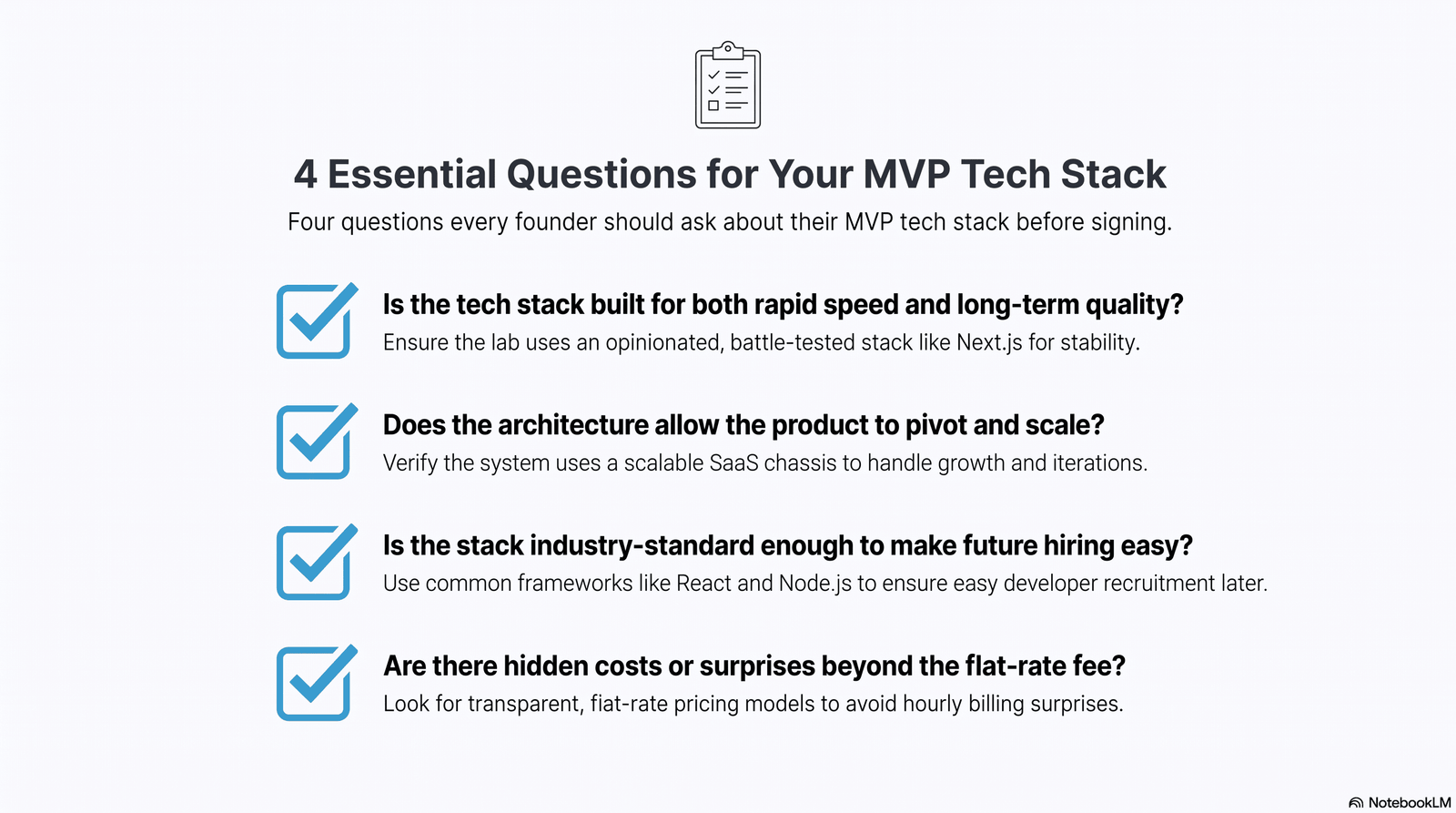
Before signing with any partner, a short list of questions protects you from a stack decision made for the vendor’s convenience, not your product’s needs.
Ask why they’re recommending this specific stack for your product type, not just their team’s default.
Ask how easy it would be to hire additional developers on this stack if you need to scale your team later.
Ask what happens if you need to pivot — how much of the existing code would survive a significant feature change.
Ask whether the proposed stack has hidden monthly costs, like managed database fees or AI API usage charges, beyond the initial build.
Our MVP discovery call questions script has the complete list to walk into every vendor conversation with, and our guide on how to choose an MVP development company covers the rest of the vetting process beyond just tech stack.
Frequently Asked Questions
What is the best tech stack for MVP development in 2026? For most web and SaaS MVPs, React or Next.js on the frontend, Node.js with TypeScript on the backend, and PostgreSQL for the database remains the most reliable, well-supported combination.
What is the best programming language for MVP development? JavaScript/TypeScript works best for most web-based MVPs because it covers both frontend and backend. Python is the stronger choice if your product relies heavily on AI or data processing.
Should I use no-code tools for my first MVP? Yes, for very early validation. No-code tools are cheaper and faster upfront but usually need a rebuild in custom code once you have real users and a stable feature set.
Does tech stack choice affect MVP development cost? Significantly. Mainstream, well-supported stacks are generally cheaper to build and maintain because more developers are available at competitive rates.
Is React Native or Flutter better for an MVP mobile app? Both work well. React Native fits teams that already know React; Flutter offers strong performance with a smaller hiring pool since it uses Dart.
Should I choose SQL or NoSQL for my MVP database? Choose PostgreSQL (SQL) if your data has clear relationships, like users and orders. Choose MongoDB (NoSQL) if your data model is still evolving and needs flexibility.
Can I change my tech stack after launching my MVP? Yes, but it’s expensive. Choosing a mainstream, scalable stack from the start avoids a costly rewrite once you’ve validated demand and need to grow.
Final Thoughts
There’s no single best tech stack for MVP development — only the right combination for your product type, budget, and timeline.
For most first-time founders, a mainstream stack like React or Next.js, Node.js, and PostgreSQL offers the best balance of speed, hiring availability, and room to grow.
Resist the urge to over-engineer for scale you haven’t earned yet — the goal of an MVP is validation, not a production system built for a million users on day one.
For the full picture on choosing a development partner who can execute on the right stack, revisit our MVP development company India guide, or explore BkAbhi’s approach to MVP builds directly.
About the Author
Jeevesh Tripathi Email: jeevesh@bkabhi.com
Jeevesh Tripathi is a product and startup technology researcher specializing in MVP development, software architecture decisions, and early-stage product strategy. His work focuses on helping founders make evidence-based technology choices, drawing on hands-on experience evaluating web, mobile, and SaaS product builds across multiple industries. Jeevesh writes to help founders pick a tech stack that fits their actual product stage, not the one that sounds most impressive on a pitch deck.
This guide is part of BkAbhi’s MVP development resource hub. For more founder-focused guides on cost, process, and vetting development partners, visit the BkAbhi blog.