
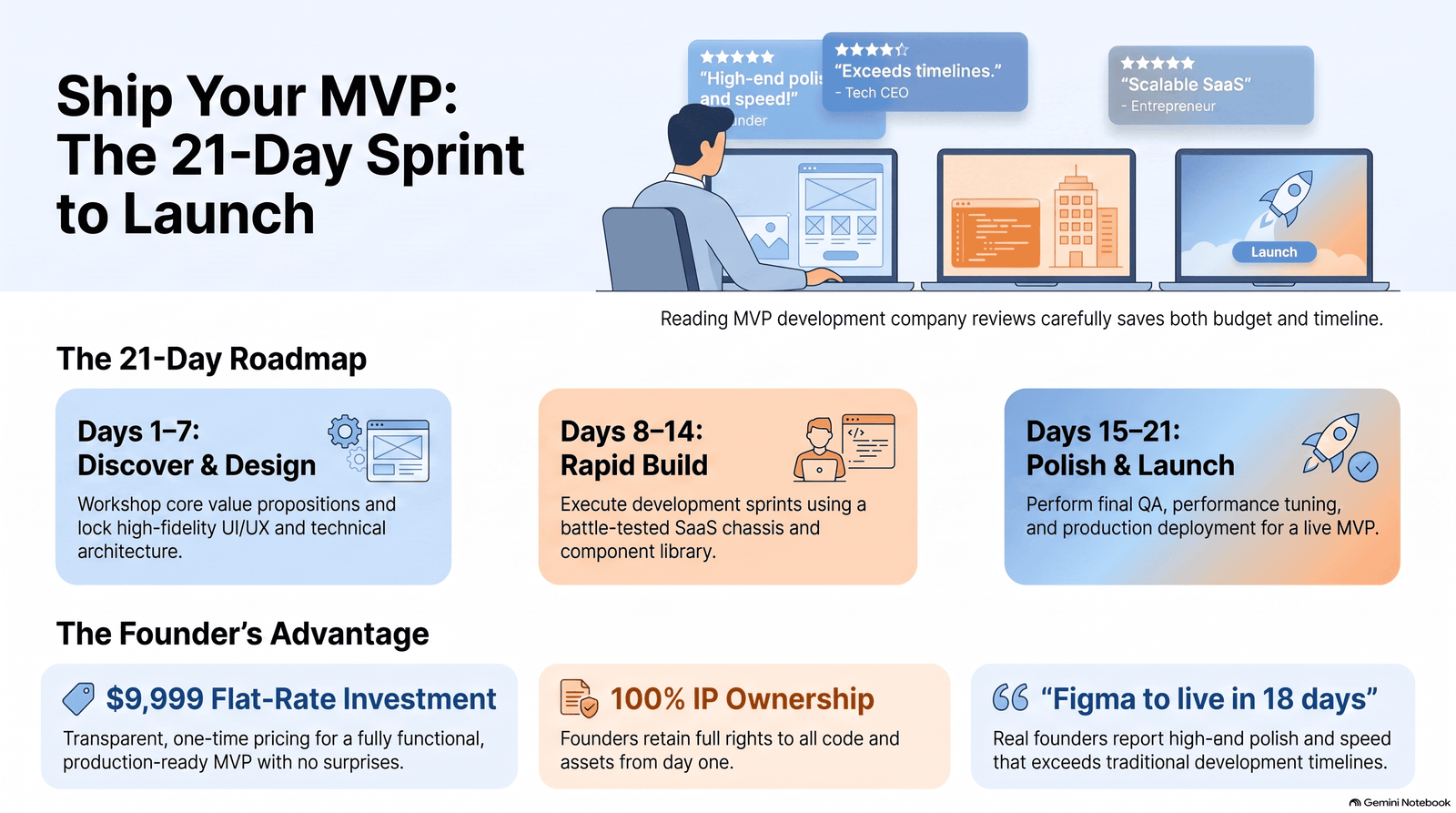
Picking a build partner off a shiny homepage is how most founders lose their first funding round’s runway. MVP development company reviews exist to stop that mistake before it happens.
This guide breaks down how to read MVP development company reviews properly, where to find honest feedback, and what separates a real signal from a paid testimonial. Bkabhi also recommends evaluating client case studies, communication, and delivery consistency instead of relying on ratings alone. By the end, you’ll have a repeatable way to shortlist vendors with confidence instead of guessing.
Every section below links to a deeper resource, so treat this as the map and the linked guides as the detailed routes.
Table of Contents
Why MVP Development Company Reviews Matter More Than Portfolios
A polished case study shows the best day a vendor ever had. Reviews show the average day, which is what your project will actually feel like.
Genuine MVP development company reviews reveal communication habits, timeline honesty, and how a team handles scope creep. That’s information no portfolio page will volunteer on its own.
Founders under funding pressure often skip this step entirely and pick whoever responds fastest to a cold email. That shortcut is exactly how mismatched partnerships happen, and reviews are the cheapest insurance against it.
If you’re still narrowing down your shortlist before diving into review platforms, this checklist on how to choose an MVP development company is a useful starting filter before you even open a review site.
The Different Types of MVP Development Company Reviews
Not all reviews carry the same weight. Understanding the source tells you how much to trust the content.
Verified third-party reviews come from platforms that confirm the reviewer actually worked with the vendor, usually through invoice or contact verification. These carry the most credibility.
Testimonials on the vendor’s own site are curated by definition. They’re not fake, but they’re selected to show the best outcomes, so treat them as marketing copy rather than research.
Case studies go deeper than a testimonial quote but are still vendor-authored. Useful for understanding process and deliverables, less useful for judging honesty about problems.
Social proof mentions on LinkedIn, X, or founder communities like Indie Hackers tend to be the most candid, since there’s no formal relationship obligating politeness.
Reading across all four types of MVP development company reviews, rather than relying on just one, gives a far more complete picture than any single source ever could.
How to Read MVP Development Company Reviews the Right Way
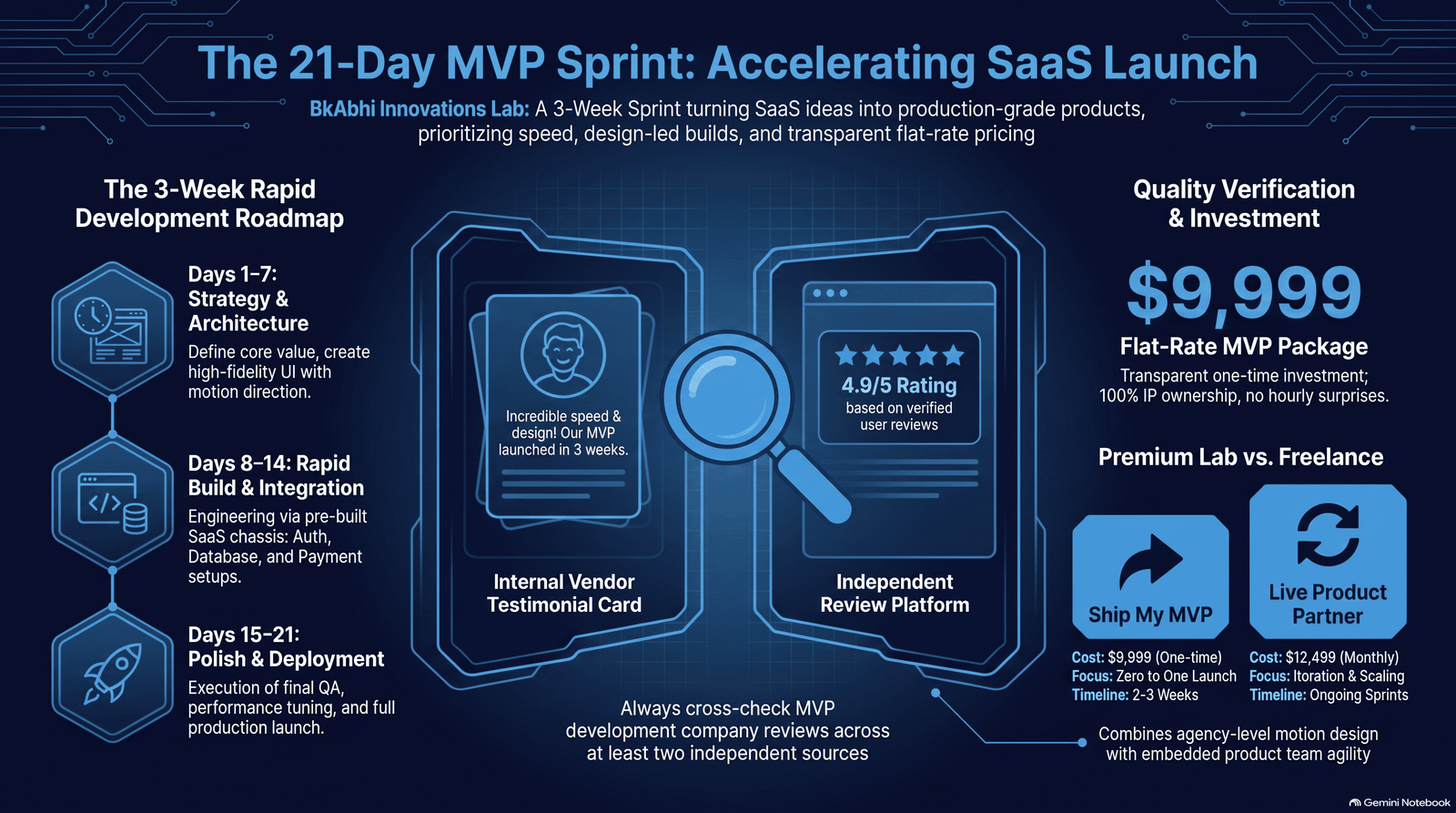
Not every five-star rating deserves your trust. Some are incentivized, some are outdated, and some describe a completely different type of project than yours.
Check review recency. A glowing review from three years ago says little about the team working on your MVP today, since staff and processes change fast.
Look for specificity. Vague praise like “great team” is weaker than a review describing a missed deadline that was handled transparently. Detail signals authenticity in MVP development company reviews.
Cross-reference across platforms. A company with only five-star reviews on its own site but mixed scores on Clutch or GoodFirms is worth a closer look before you sign anything.
Weight recent volume over lifetime average. A vendor with fifty reviews from three years ago and five recent ones tells a different story than the aggregate score suggests.
What to Look for in MVP Development Company Reviews
A useful review answers questions a sales call won’t. Here’s what separates a helpful review from filler text.
Communication cadence. Startups that mention weekly demos or async standups in their reviews are describing a process, not just an outcome.
Post-launch support. Reviews mentioning bug fixes or handoff documentation after go-live tell you the relationship didn’t end at delivery.
Pricing transparency. Reviewers who note “no surprise invoices” or “fixed milestones” are flagging something budget owners specifically care about.
Team consistency. Look for mentions of the same developers staying on the project start to finish. High turnover mid-project is a recurring complaint worth taking seriously.
Scope handling. Reviews describing how a vendor pushed back on unnecessary features, rather than just saying yes to everything, usually indicate a more mature partner.
Before your first call with any shortlisted vendor, it also helps to prepare using this list of questions to ask an MVP development company, so you can compare their answers against what reviewers already reported.
Best Platforms to Find Trustworthy MVP Development Company Reviews
Third-party platforms reduce bias because vendors can’t fully control what gets posted. A few worth checking regularly:
- Clutch verifies reviewers through phone interviews, which filters out most fake submissions and adds real detail to each entry.
- GoodFirms ranks agencies using a mix of client feedback and internal research scoring, useful for a second data point.
- G2 leans more toward software products but occasionally covers dev shops that also ship SaaS offerings of their own.
- Google Business Profile reviews are useful for local sentiment, though they’re easier to game with volume than niche B2B platforms.
Reading MVP development company reviews across two or three of these platforms, rather than just one, gives a far more balanced picture than any single source, and it takes less than an hour per shortlisted vendor.
Red Flags Reviews Often Reveal Before You Notice Them
Some warning signs only surface once you start reading between the lines of client feedback rather than the star count itself.
Watch for repeated mentions of scope changes mid-project without documentation, since that pattern tends to repeat with every new client, not just an unlucky one.
Reviews mentioning unclear ownership of code or design files after project completion are another signal worth taking seriously, especially for a first-time founder without in-house legal support.
Also watch for a sudden gap in review dates followed by a wave of very similar five-star entries. That pattern often points to an incentivized review push rather than organic client feedback.
For a full breakdown of what to watch for before signing a contract, this piece on MVP development red flags covers fifteen warning signs in detail, several of which show up directly inside client reviews.
Cost Signals Hidden Inside MVP Development Company Reviews
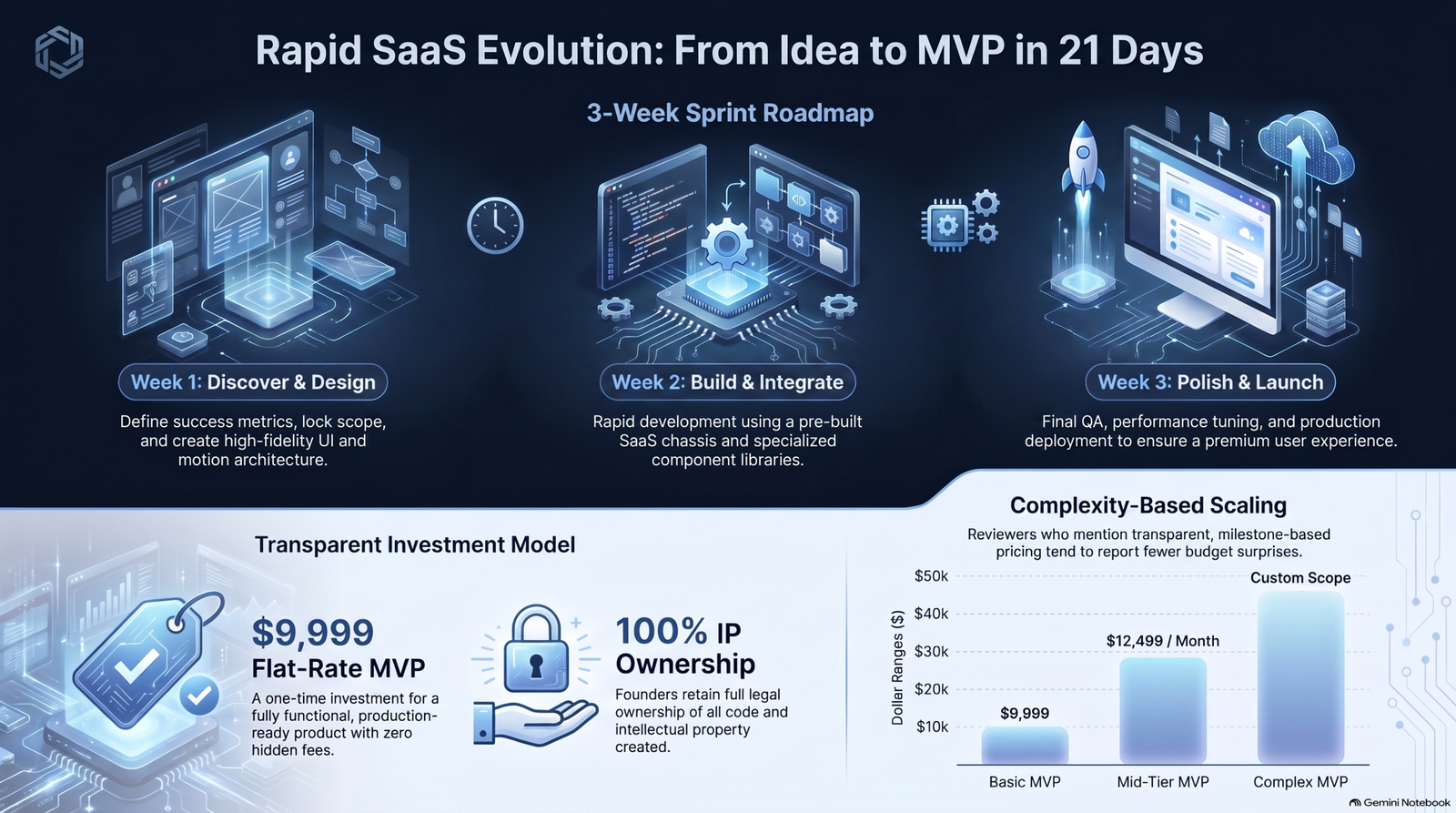
Reviews rarely list exact invoices, but they do reveal pricing behavior. Phrases like “stayed within budget” or “billed extra without warning” are direct signals about how a vendor actually operates versus how they pitch.
Startups comparing quotes side by side should also read a dedicated breakdown of MVP development cost expectations, so a suspiciously low quote in a glowing review doesn’t look normal when it’s actually a red flag.
Pricing model matters too. Reviewers who mention milestone-based payments tend to report smoother experiences than those billed purely hourly with no cap on total spend.
If you’re evaluating vendors closer to US market rates rather than offshore pricing, this guide to the best MVP development companies USA breaks down budget tiers reviewers frequently reference.
In-House vs Outsourced: What Reviews Reveal About Each Path
Reviews of outsourced MVP teams often highlight speed and specialized tooling, while in-house hiring stories tend to emphasize long-term product ownership and slower ramp-up.
Neither path is universally better. It depends on funding stage, timeline pressure, and how much of the tech stack decision-making the founder wants to retain in-house.
Founders who outsource and later regret it usually mention losing visibility into technical decisions, a pattern that shows up repeatedly across independent MVP development company reviews.
For a deeper side-by-side, this comparison of outsourced MVP development vs in-house teams breaks down the trade-offs founders repeatedly mention in their own post-project reviews.
Best MVP Development Companies for Startups, According to Reviews
Reviewers tend to rank vendors highly not just for code quality but for how well the team adapted to a moving target, since early-stage requirements shift constantly.
Startups with tight runway generally favor teams that offer fixed-scope packages and weekly demo cadences, both of which show up repeatedly in positive reviews across platforms like Clutch and GoodFirms.
If you want a ranked shortlist to start from, this list of the best MVP development companies for startups organizes vendors by budget tier and industry focus, which pairs well with the review-reading habits covered above.
It’s also worth reading a broader MVP development company comparison if you’re weighing more than two or three finalists, since side-by-side scoring on pricing model and support tends to catch details single reviews miss.
Industry-Specific Considerations in MVP Reviews
A review that’s glowing for an e-commerce MVP may not translate to a fintech or healthtech build, where compliance and data security weigh far more heavily.
For regulated industries, look specifically for reviews mentioning HIPAA, PCI-DSS, or GDPR handling experience, since generalist teams without that background often underestimate the timeline cost of compliance work.
For consumer or marketplace apps, prioritize reviews that mention iteration speed and user testing support instead, since those products live or die on how fast you can test assumptions post-launch.
If you’re still deciding what stage of build you actually need, this explainer on MVP vs prototype vs POC clarifies the distinction before you start requesting quotes from vendors.
A Quick Example: Reading Between the Lines
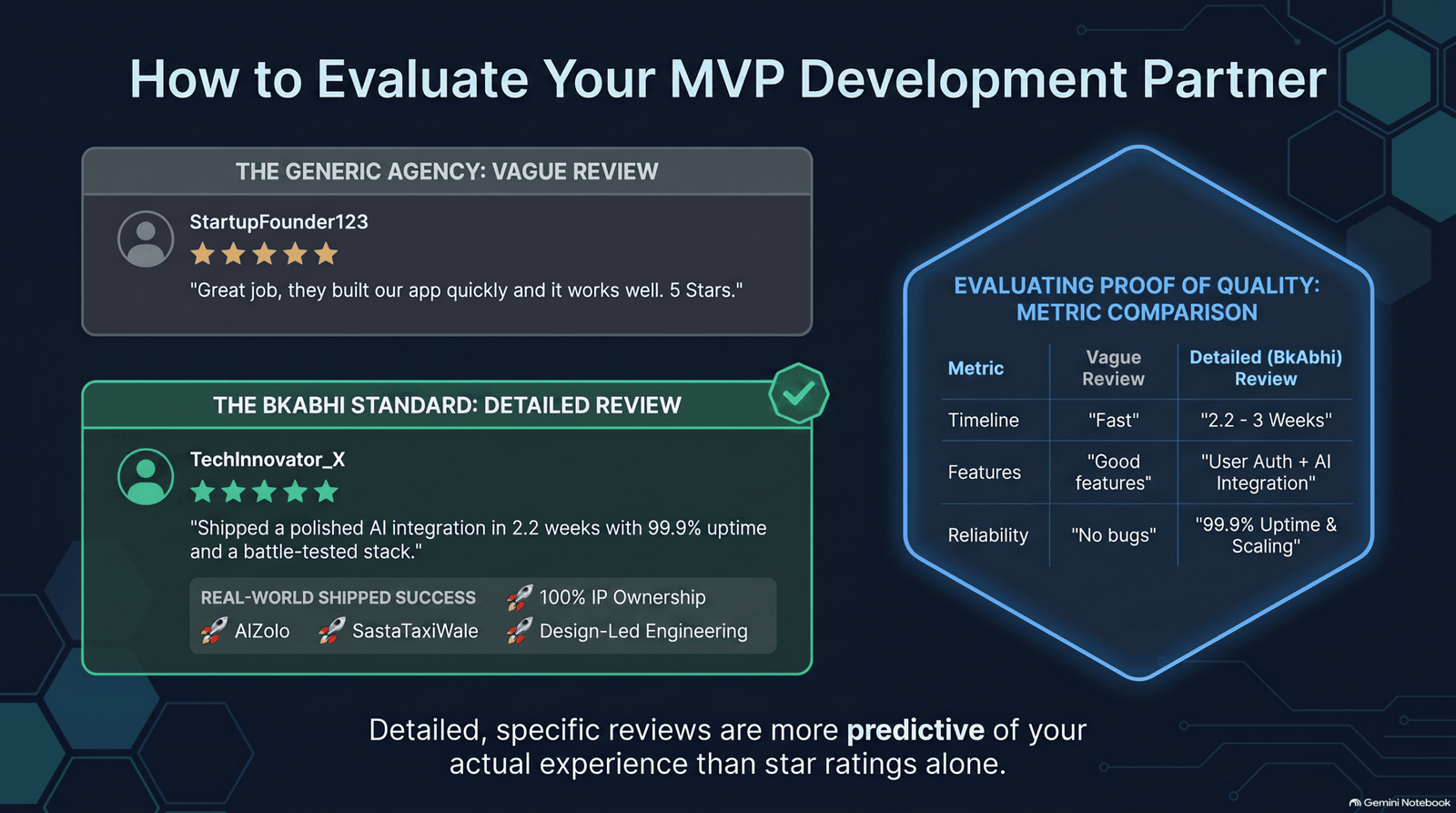
Consider two reviews for the same hypothetical vendor. One says “amazing team, five stars.” The other says “delivered our MVP in 10 weeks, flagged scope risks early, and gave us clean documentation at handoff.”
The second review, even without a perfect star rating attached, tells you far more about whether this team fits your project. Specificity beats star count almost every time when evaluating MVP development company reviews.
This is also why reading the full text of a review matters more than skimming the aggregate score at the top of a listing page.
Common Mistakes Founders Make When Reading Reviews
Trusting aggregate scores alone. A 4.8-star average can hide a cluster of recent one-star reviews that got outvoted by older, glowing ones.
Ignoring the reviewer’s project size. A five-star review from a six-figure enterprise engagement may not predict how the same vendor handles a scrappy $15,000 MVP sprint.
Skipping the response section. How a vendor replies to a critical review, calmly and specifically versus defensively, often says more than the original complaint itself.
Reading only the top three reviews. Platforms often surface the most recent or most upvoted entries first, so scrolling further usually surfaces a more balanced sample.
How to Use Reviews to Build Your Shortlist
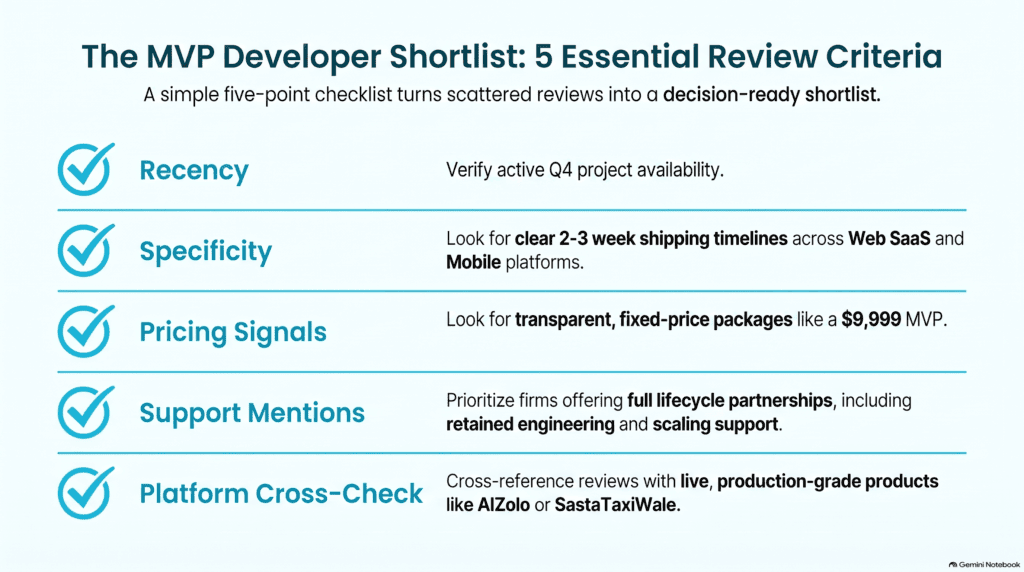
Once you’ve gathered reviews from two or three platforms, the next step is turning that research into an actual shortlist rather than an open-ended list of names.
Start by eliminating any vendor with unresolved complaints about IP ownership or missed core deliverables, since those issues tend to repeat regardless of price point or project size.
Then rank the remaining candidates by how well their reviewed strengths match your stage: speed for pre-seed, process maturity for funded rounds with investor reporting requirements.
Finally, take your top two or three into discovery calls armed with specific questions pulled directly from what reviewers flagged, whether that’s pricing transparency, tech stack fit, or post-launch support.
If tech choices are part of your evaluation criteria, this guide on the best tech stack for MVP development helps you judge whether a vendor’s default stack recommendation actually fits your product.
And if speed to market is your top priority right now, this piece on the fastest way to launch a SaaS MVP is worth reading alongside your review research before you finalize timelines.
How BkAbhi Approaches Transparency in Its Own Reviews
As a team that builds MVPs for early-stage founders, we know firsthand how much weight reviews carry in a founder’s decision, which is why we encourage every client to leave honest feedback, positive or not.
Our own approach favors fixed-scope, milestone-based engagements with weekly demos, the same qualities this guide recommends founders look for in other vendors’ reviews too.
If you’re curious what that process actually looks like, our guide for minimum viable product developer for hire walks through how we structure engagements from kickoff to handoff.
Frequently Asked Questions
Are MVP development company reviews on a vendor’s own website reliable? They can be a starting point, but they’re curated by the vendor. Cross-check against independent platforms like Clutch or GoodFirms before trusting them fully.
How many reviews should I read before shortlisting a company? Aim for at least five to eight recent reviews per vendor, spread across two platforms, to avoid basing a decision on one unusually good or bad experience.
Do negative reviews always mean a company should be avoided? Not necessarily. Look at how the company responded and whether the issue was a one-time miscommunication or a recurring pattern across multiple reviewers.
Should I trust reviews that don’t mention pricing at all? Treat them as incomplete. Pricing behavior is one of the clearest signals reviews can offer, so its absence is worth asking about directly on your discovery call.
What’s the difference between MVP development company reviews and general software agency reviews? MVP-focused reviews usually emphasize speed, scope discipline, and iteration, while general agency reviews often focus more on long-term maintenance and enterprise-scale delivery.
Can I request references directly instead of relying only on published reviews? Yes, and you should. A vendor confident in their reviews will usually connect you with a past client directly for a short call, which adds a layer published reviews can’t.
How much should reviews influence my final decision versus a discovery call? Treat reviews as a filtering tool to build your shortlist, and the discovery call as the deciding factor once you’ve narrowed to two or three strong candidates.
Final Thoughts
Reading MVP development company reviews carefully, across multiple platforms and with an eye for specific detail, is one of the highest-leverage things a founder can do before committing budget. It costs an afternoon and can save months of rework.
Pair your review research with the supporting checklists linked throughout this guide, and you’ll walk into vendor calls better prepared than most founders ever are.
If you’d like an experienced team to talk through your specific MVP scope, you can explore BkAbhi’s approach to shipping MVPs directly, or browse the full blog archive for more founder-focused research like this guide.
Author Bio
Jeevesh Tripathi is an expert researcher specializing in startup product strategy and MVP development vendor evaluation. He writes in-depth, experience-based guides to help founders make informed build decisions, following an Experience, Expertise, Authoritativeness, and Trustworthiness (E-E-A-T) approach to research and content.