
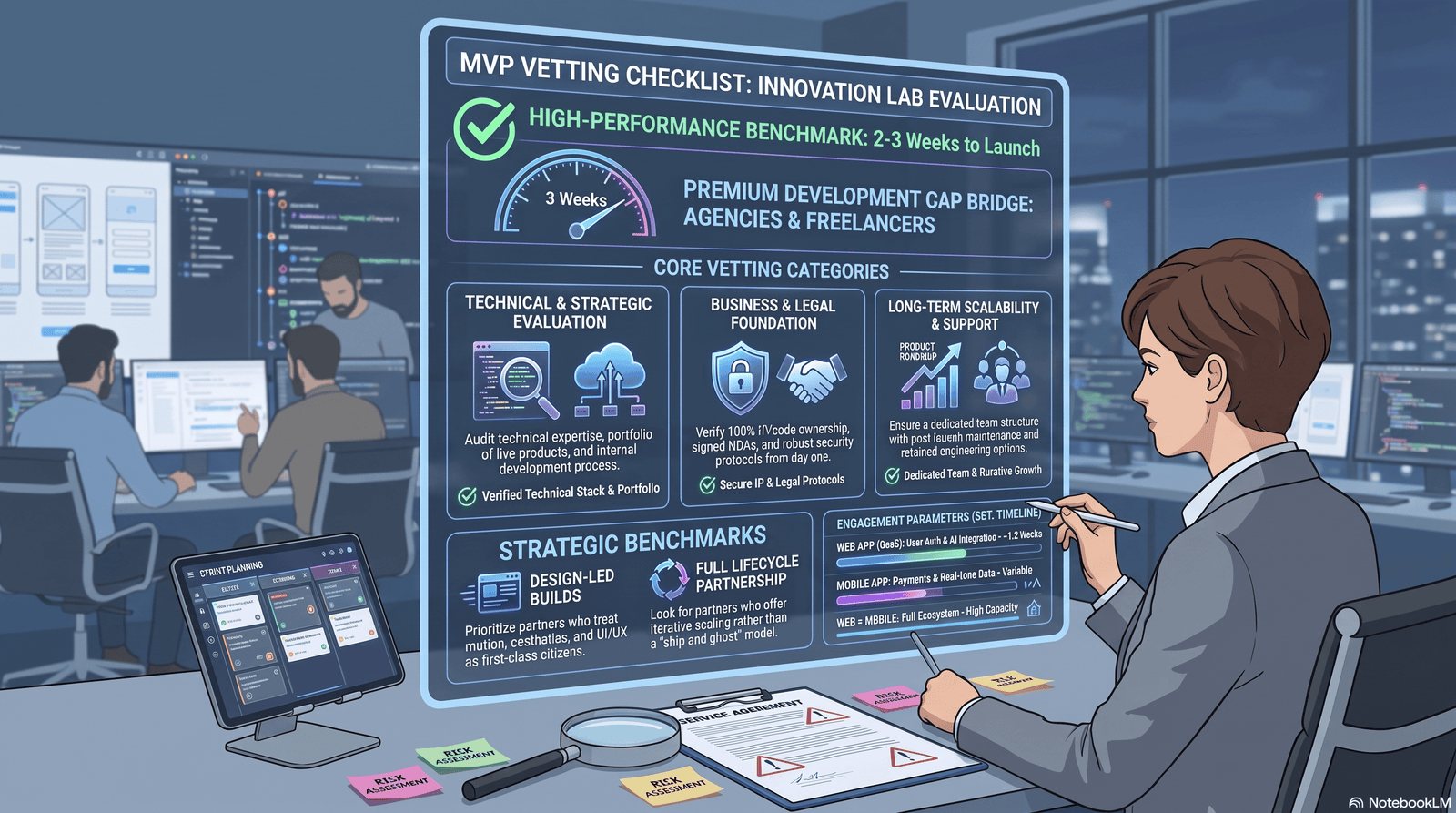
Quick Answer: The right questions to ask an MVP development company fall into five stages — background research, the sales call, technical vetting, contract review, and post-launch support. Founders who work through this hiring checklist for MVP agencies stage by stage, instead of relying on one good phone call, catch the gaps that turn into missed deadlines and budget overruns. For the full comparison framework this checklist supports, see our pillar guide on comparing MVP development companies.
Most founders ask two or three questions on a sales call, like the answers, and sign. That’s not vetting — that’s hoping.
A proper hiring checklist for an MVP agency starts well before the first call and doesn’t end until you’ve reviewed the contract’s exit clause.
One of the smartest steps in the evaluation process is preparing the right questions to ask MVP development company teams before making a commitment.
These questions should cover their technical expertise, development process, pricing model, communication practices, code ownership, project timelines, and post-launch support.
By asking the right questions to ask MVP development company representatives, founders can avoid costly mistakes, reduce project risks, and confidently choose a partner that aligns with their startup’s long-term goals.
This guide isn’t a script to read verbatim during a call. If you want that, our complete MVP discovery call questions guide has the exact fifteen questions and follow-ups. This is the broader checklist: what to check before you ever pick up the phone, what to ask during the call, and what to confirm before you wire a deposit.
Work through it once, and you’ll have a repeatable process for vetting MVP developers on every future project, not just this one.
Table of Contents
Why a Staged Hiring Checklist Beats a Single Good Call
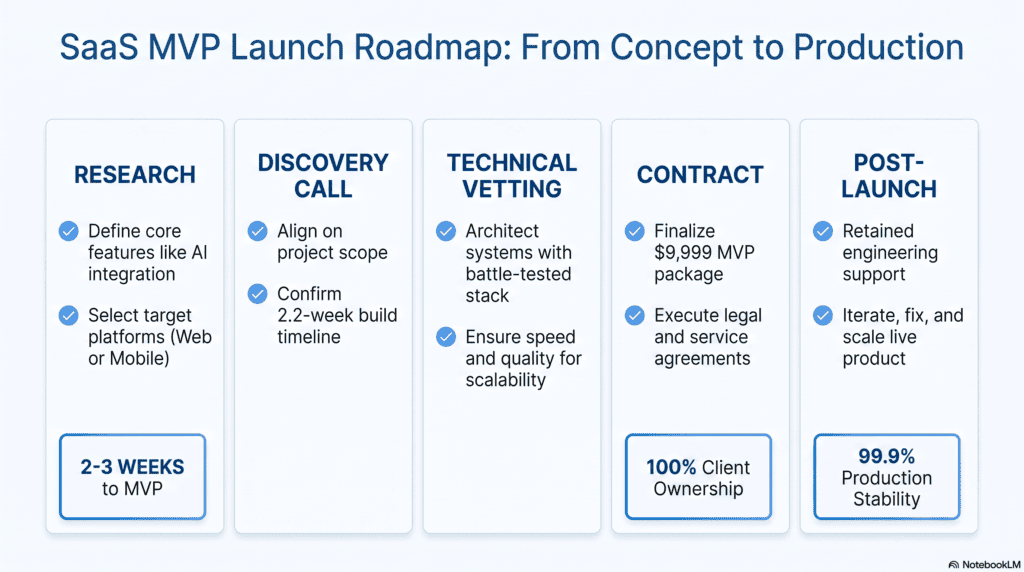
A confident sales call tells you how a company sells. It tells you almost nothing about how they build.
The gap between those two things is where most MVP budgets quietly go over. A structured hiring checklist for an MVP agency exists to close that gap before money changes hands.
Our pillar guide on MVP development company comparison covers the five-factor framework for judging vendors side by side. This checklist is the practical, question-by-question version you actually use while you’re doing that comparison.
Treat it as a sequence, not a menu. Skipping a stage because an earlier one went well is exactly how founders end up surprised in week six.
Stage 1: Questions to Answer Before You Reach Out
Vetting starts with homework you do alone, before any agency knows you exist.
“Can I describe my MVP’s core problem in three sentences?” If you can’t, no vendor will be able to scope it accurately, and every question after this one gets vaguer answers.
“What are my three non-negotiable features?” Everything else is negotiable scope you should be ready to cut if a vendor pushes back on it.
“What’s my realistic budget range, and where did that number come from?” Our MVP development cost breakdown is worth reading here, so your range reflects the market, not a guess.
“Have I looked past a company’s rank on Clutch or GoodFirms?” Directory position is influenced by paid placement and review volume. Our guide on vetting MVP development company rankings explains exactly how those lists can mislead a shortlist.
Answering these four questions honestly before outreach is what makes every question in the next four stages actually comparable across vendors.
Stage 2: Questions to Ask on the Sales or Discovery Call
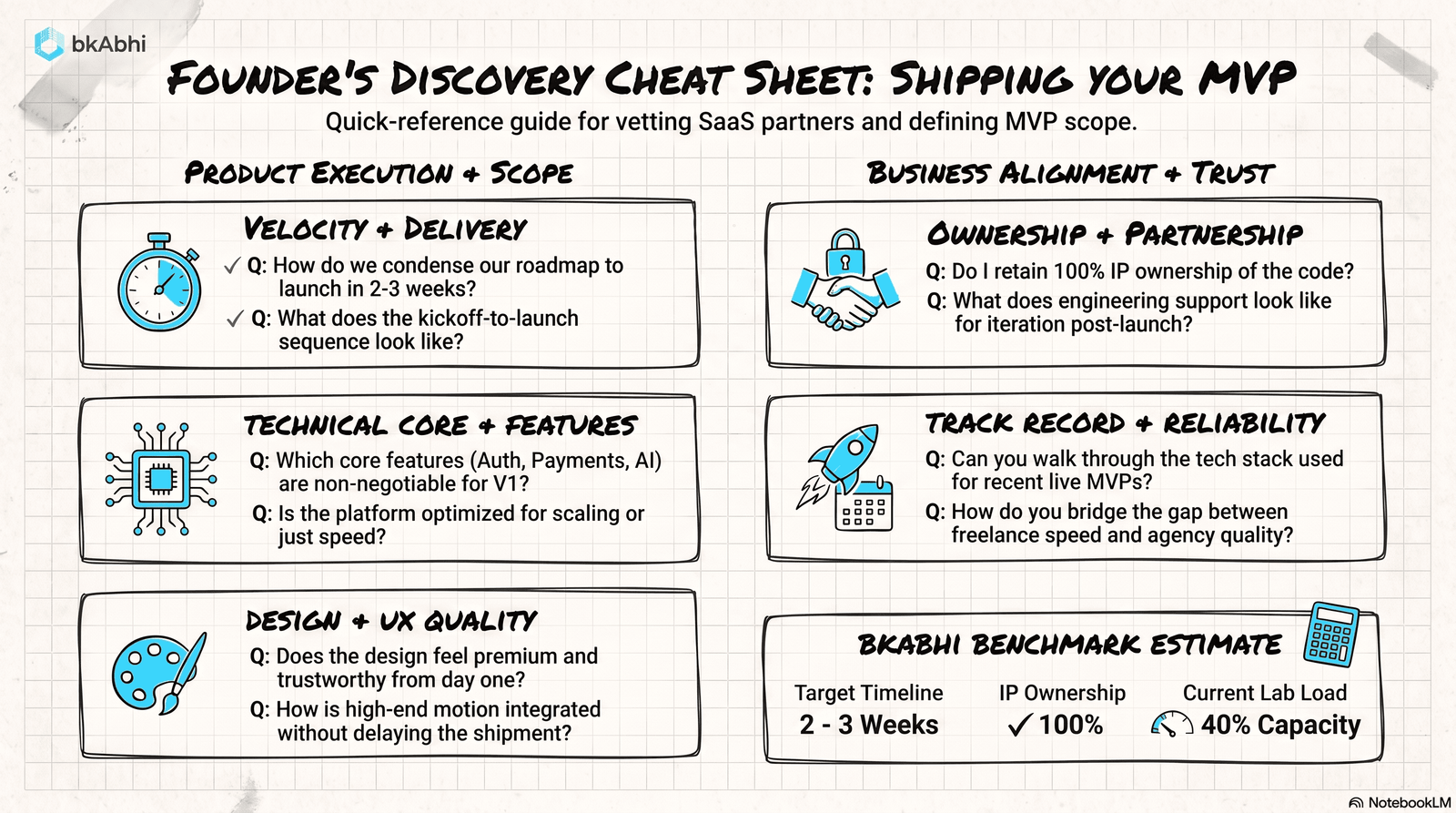
This is the stage most founders think of as “the whole process.” It’s really just one of five.
“Who exactly will work on my project, by name?” A confident “our senior team” without names is the single most common soft dodge on a first call.
“Can you walk me through three MVPs you’ve shipped in the last 18 months, including what happened after launch?” Portfolio slides show what got built, not whether it worked.
“How do you structure a typical engagement from discovery through handoff?” Listen for a documented process, not an improvised one.
For the full fifteen-question script, including technical, pricing, and red-flag-detection questions built specifically for this call, our MVP discovery call questions guide is the deeper resource this checklist points to.
Stage 3: Technical Vetting Questions
Sales reps run the pitch. Engineers reveal whether the pitch is real.
“Who makes the final architecture decisions, and can I speak with them directly?” Reluctance to connect you with an actual engineer before signing is worth pressing on.
“What tech stack would you recommend for this, and why that one over the alternatives?” A strong answer ties the choice to your product, not the vendor’s internal comfort.
“What’s your approach to technical debt on a compressed MVP timeline?” Every MVP cuts a corner somewhere. The honest answer names which one.
“How do you approach UI/UX for an MVP build?” A rushed answer here is a real signal, since weak design is one of the fastest ways to sink an otherwise solid build.
If a vendor’s answers here feel evasive, it’s worth checking whether that pattern shows up elsewhere too — our MVP development red flags checklist documents the warning signs that tend to cluster together.
Stage 4: Pricing, Contract, and IP Questions
This is the stage most founders rush, and it’s the one that matters most if something goes wrong later.
“What’s included in this quote, and what triggers a change order?” Vague scope boundaries are where “one more feature” quietly becomes a budget overrun.
“Can you break milestone payments down by deliverable, not just by date?” Date-based milestones can slip without consequence; deliverable-based ones give you real leverage.
“What happens to the IP and codebase if I switch vendors mid-project?” The real answer lives in the paperwork, not the call. Our MVP development contract checklist covers the twelve clauses that should back up whatever you’re told here.
“Where does this quote fall against typical pricing for similar scope?” Compare it against our USA-specific MVP pricing breakdown so you’re pushing back with real numbers.
A vendor who won’t put pricing in writing before a deposit is telling you something, even if they never say it directly.
Stage 5: Post-Launch and Support Questions
An MVP that launches and then has nobody available for the first production bug is a liability, not a finished product.
“What happens in week one after launch?” A specific answer beats a reassuring one every time.
“Is documentation and codebase handoff included by default, or billed separately?” This determines how painful a future transition to an in-house team will be.
“What does your support window actually cover, and for how long?” Get the boundary in writing, not as a verbal assumption you’ll only test during an outage.
Founders planning to bring development in-house eventually should weight this stage even more heavily than the technical one — clean documentation is what makes that transition survivable.
Questions About Team Composition
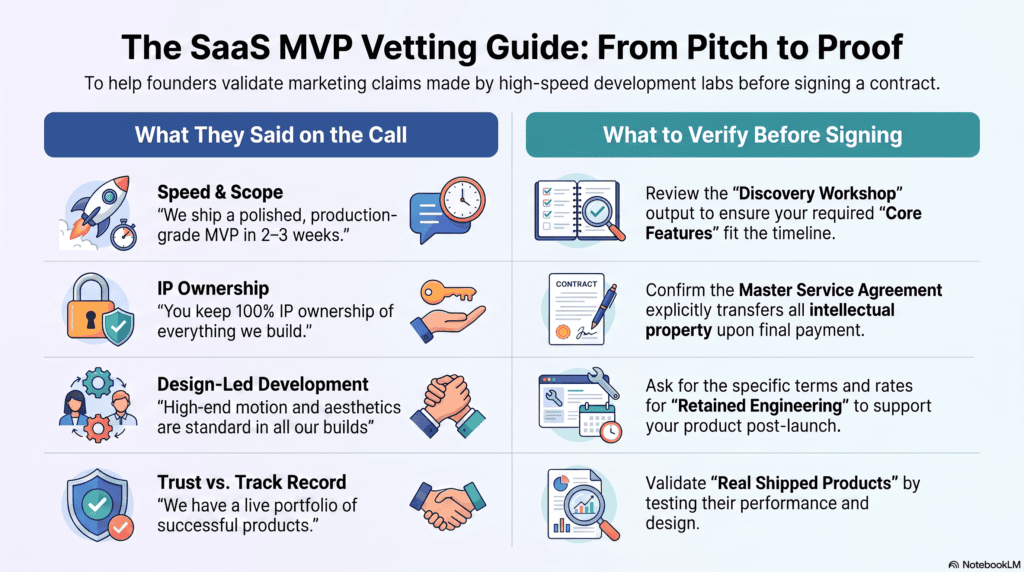
Team questions deserve their own pass because they get glossed over more than any other category.
“Are the people on my project full-time employees or subcontractors brought on for this engagement?” Both can work well, but you should know which one you’re getting.
“If my main point of contact leaves mid-project, what’s the actual plan?” Small teams especially need a real answer, not a reassurance that it “won’t happen.”
“Who specifically will attend the kickoff call if I move forward?” Named individuals, not job titles, confirm whether the senior team on the sales call is the team you’ll actually get.
Questions About Portfolio and Case Studies
A large portfolio means little if none of it matches your industry or complexity.
“Can you show two or three case studies specifically in my vertical?” A fintech MVP has compliance needs a marketplace app simply doesn’t.
“What went wrong on at least one of these projects?” Agencies that only show wins are hiding the part you actually need to hear before hiring anyone.
If you’re still building your shortlist, our rankings of top MVP development companies by budget and industry and our framework for finding the best MVP development company for your specific stage are both useful starting points before you run this checklist against real candidates.
In-House or Outsourced: A Question Worth Answering First
Before any of the questions above matter, it’s worth confirming outsourcing is even the right call for your stage.
Building an internal team changes your timeline, your monthly burn, and which vendor category even applies to your search. Our comparison of MVP development agency versus in-house team walks through the runway math for both paths.
Most pre-Series-A founders land on outsourcing simply because assembling an in-house team takes longer than most runway allows. If that’s not your situation, this entire checklist still applies — just to a smaller, more targeted shortlist.
Industry-Specific Questions Worth Adding
Generic vetting questions cover most founders. A few verticals need one or two sharper additions.
Fintech and healthtech founders should ask: “Have you built anything requiring PCI-DSS or HIPAA awareness, even informally?” Retrofitting compliance later costs far more than building with it in mind from day one.
Marketplace founders should ask: “Have you built two-sided matching logic before, and what broke the first time?” Single-user app experience doesn’t automatically transfer.
SaaS founders should confirm multi-tenant architecture experience specifically, since billing and auth mistakes at MVP stage are expensive to unwind later. Our breakdown of MVP development across SaaS, fintech, and healthtech covers how the build itself changes by sector.
Founders leaning offshore should also ask about daily working-hour overlap specifically — our offshore versus onshore comparison breaks down exactly where that trade-off shows up in practice.
Red Flags That Should Change Your Answers
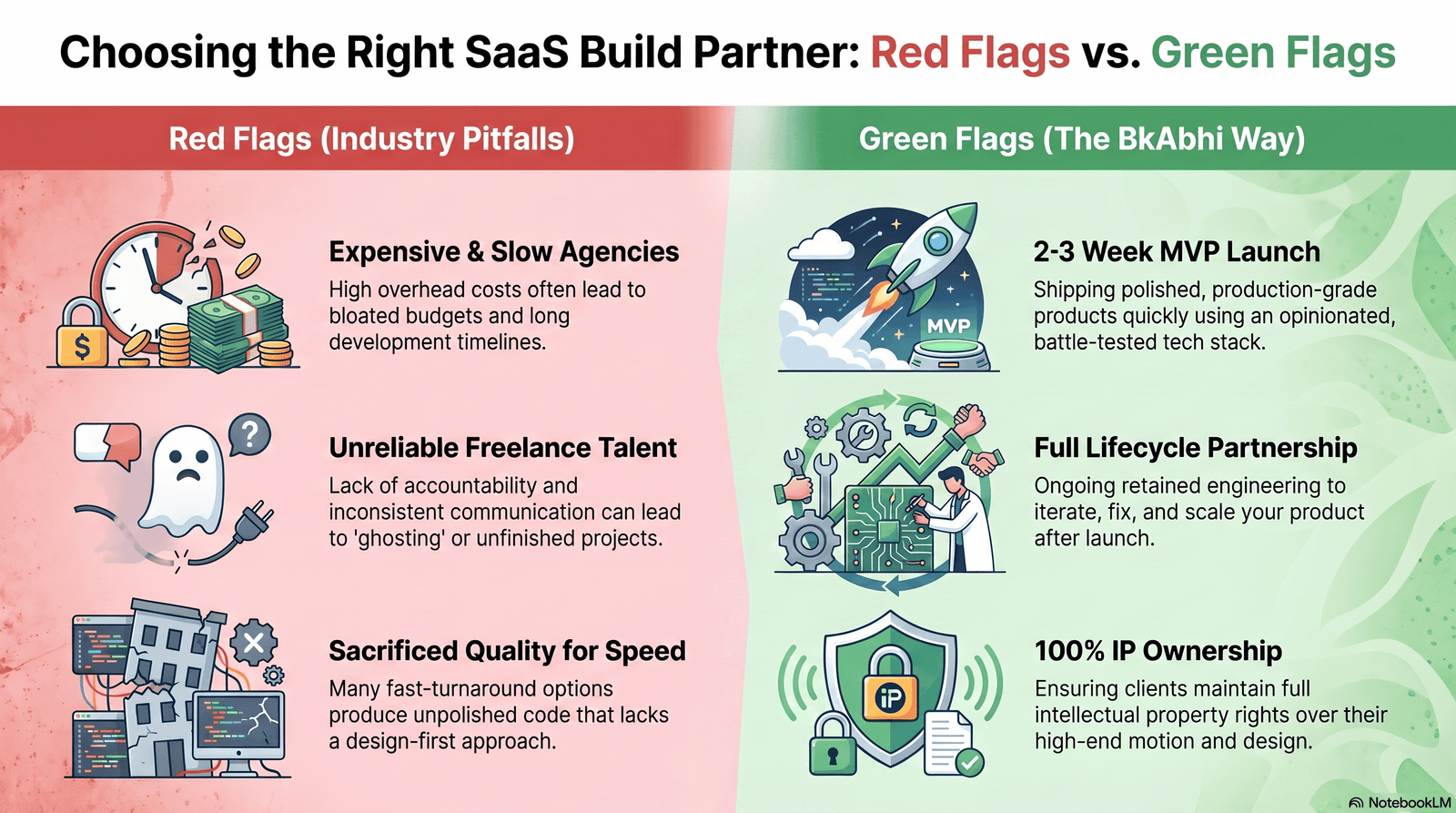
Some responses during this checklist should stop the process entirely, not just lower a score.
Refusing to name the engineer who’ll actually build your product before you sign is one of the clearest signals available. Confidence on a sales call doesn’t substitute for a name.
Pressuring you to sign within 48 hours of the first call treats urgency as leverage. Treat that urgency itself as a data point, not a reason to skip steps.
Agreeing to every feature you propose regardless of budget or timeline is optimizing for the signature, not your outcome. A partner worth hiring pushes back at least once.
Our full MVP development red flags checklist goes deeper into the specific warning signs worth screening for at every stage of this process, not just the sales call.
A Simple Hiring Checklist Scorecard
Scoring each candidate numerically removes gut-feeling bias from the final decision.
| Checklist Stage | Weight | What a “5” Looks Like |
|---|---|---|
| Background research fit | Medium | Vendor matches your budget range and industry |
| Discovery call answers | High | Named team members, specific past outcomes |
| Technical vetting | High | Engineer accessible, honest about trade-offs |
| Contract and IP terms | High | Clear milestones, written IP transfer terms |
| Post-launch support | Medium | Defined support window, included documentation |
Score every shortlisted company 1-5 per row right after each conversation, while details are still fresh. A vendor scoring below 15 out of 25 rarely turns into a smooth engagement.
Common Mistakes Founders Make While Vetting
Treating the discovery call as the entire vetting process. It’s one of five stages, and often the least reliable one, since it’s the most rehearsed.
Skipping the technical interview entirely. Sales calls are run by sales people. Ask to speak with whoever will actually build your product before signing anything.
Reading the contract after the deposit clears, not before. IP ownership and exit clauses matter most exactly when it’s hardest to renegotiate them.
Comparing quotes without comparing scope. A lower number often means fewer features included, not better efficiency.
Not checking references the agency didn’t proactively offer. Ask for one anyway, and pay attention to any hesitation in the response.
Frequently Asked Questions
What’s the single most important question to ask an MVP development company? Who exactly will work on the project, by name, and whether they’re full-time staff or contractors brought on for this engagement specifically.
How many stages of this hiring checklist should I actually complete before signing? All five. Skipping the contract-review stage is the most common shortcut, and it’s the one that tends to matter most if the relationship goes wrong.
Is a hiring checklist for an MVP agency different from a discovery call script? Yes. A discovery call script is one input into a broader hiring checklist that also covers research, technical vetting, contract terms, and post-launch support.
How long should the full vetting process take? Most founders complete a thorough vetting process, across all five stages, in two to three weeks without losing momentum.
Should I use the exact same questions for every vendor? Yes. Identical questions across every conversation are what make separate calls genuinely comparable instead of five different impressions.
Do these questions still apply when vetting a solo freelancer instead of an agency? Mostly yes, though team-composition questions matter less and reference checks matter more, since a solo freelancer has no bench to fall back on.
What if a vendor answers most questions well but dodges one repeatedly? Note the pattern and move on rather than pushing indefinitely. A single dodged question across an otherwise strong process is worth flagging, not disqualifying, on its own.
Should pricing questions come before or after technical vetting? After. Pricing without a clear technical picture invites vague quotes that shift once real scope gets discussed.
Final Thoughts
The right questions to ask an MVP development company aren’t a single clever question that catches a vendor off guard. They’re a repeatable, five-stage checklist you run identically across every shortlisted candidate.
Do the research before you reach out, run a real discovery call, get a technical person on the phone, read the contract line by line, and confirm what happens after launch. Vendors who hold up across all five stages are the ones worth trusting with your runway.
If you’re ready to compare shortlisted vendors side by side using this exact framework, our pillar guide on MVP development company comparison is the right next stop, or you can book an MVP consultation directly with the BkAbhi team.
Author Bio
Jeevesh Tripathi is a startup product researcher at BkAbhi Innovations Lab who has spent years evaluating software vendors, build partners, and MVP delivery models for early-stage founders. His work focuses on turning real vendor evaluation patterns into practical, jargon-free checklists non-technical founders can run themselves.
Contact: jeevesh@bkabhi.com
This article is reviewed for accuracy and updated periodically to reflect current vendor practices and industry standards, in line with Google’s guidance on producing helpful, people-first content.