
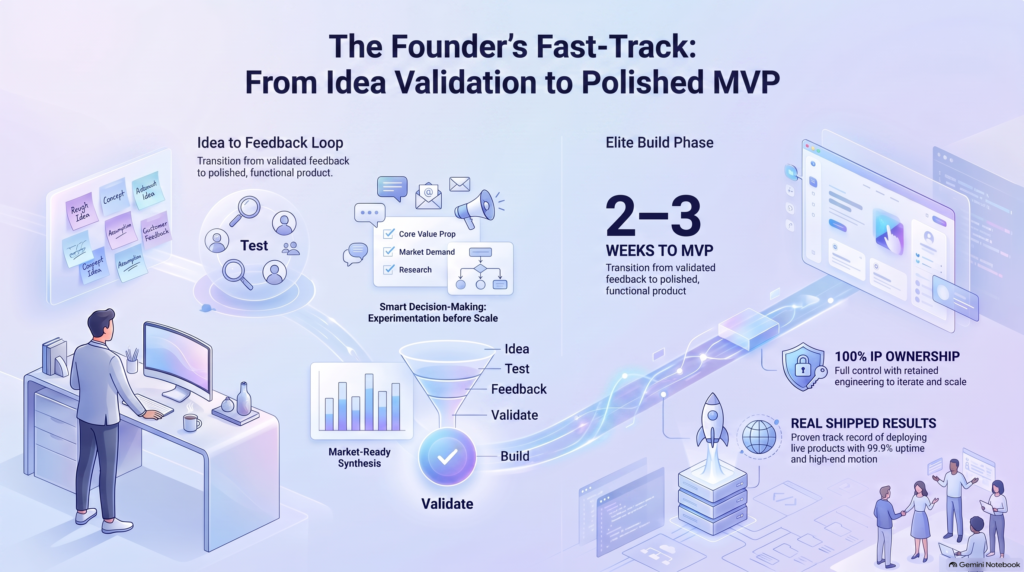
Quick Answer: An idea validation framework for founders is a repeatable set of steps — problem interviews, a smoke test, a landing page test, and a small paid pilot — used to check real demand before writing production code. BkAbhi helps founders turn these insights into actionable product decisions. It replaces guesswork with evidence, and it usually takes two to four weeks.
Most first-time founders don’t fail because they built the wrong features. They fail because they built something before checking if anyone wanted it.
This guide breaks down a validation framework you can run in under a month. No spreadsheets full of jargon, no 40-page business plan.
Just a clear, testable business idea, and a way to know if it holds up before you spend real money on it.
Table of Contents
Why Idea Validation Matters More Than the Idea Itself
Founders fall in love with their solution long before they understand the problem.
That’s the trap. A validation framework forces you to separate the two, and test the problem first.
BkAbhi Innovations Lab has worked with founders on product strategy consulting and MVP development. A common pattern appears again and again: teams that skip validation often spend months building features nobody asked for.
Early validation helps founders understand whether a problem is worth solving before investing heavily in development. It also provides valuable insights into customer needs, expectations, and willingness to pay.
Simple experiments can reveal what resonates with the target audience and what needs to change. This approach reduces unnecessary development costs and helps teams prioritize the right features.
By validating assumptions early, founders can move into MVP development with greater clarity and confidence. BkAbhi Innovations Lab helps startups turn validated ideas into practical, market-ready digital products.
A structured process for testing a business idea fixes this before it becomes expensive.
Why First-Time Founders Skip Validation
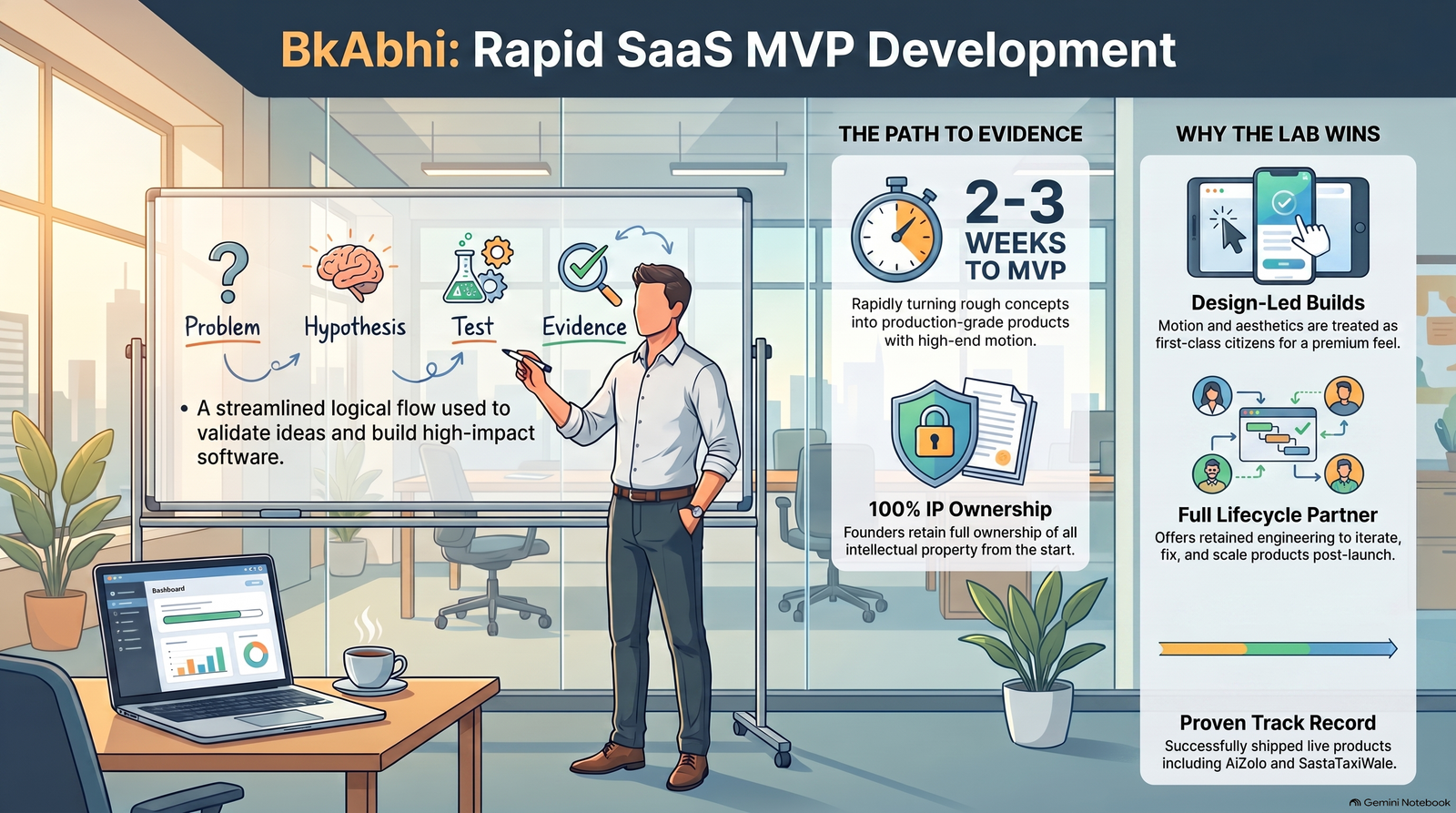
Validation feels slow when you’re excited to build. That excitement is exactly why so many founders skip it.
There’s also a confidence problem. First-time founders often assume their own experience with a problem is proof enough that others share it.
Sometimes it’s fear — founders worry that testing an idea publicly means someone will steal it, or that early feedback will kill their motivation.
None of these reasons hold up once you look at the cost of skipping validation. A few weeks of interviews and a smoke test cost far less than three months of unused code.
Founders who treat a validation framework as a starting discipline, not an optional extra, consistently spend their early runway more efficiently.
What Is an Idea Validation Framework?
A validation framework is simply an ordered checklist of experiments.
Each step answers one question: does this evidence support building further, or should you pivot?
It is not a business plan, and it is not market research in the traditional sense. It’s closer to a lab process — small, cheap, and fast.
Founders who use a validation framework for founders consistently spend less on development because they only build what evidence supports.
How This Differs From Traditional Market Research
Traditional market research often relies on surveys, industry reports, and broad demographic data collected before a product exists.
A founder-focused validation framework is narrower and faster. It uses direct interviews, live experiments, and real behavior from a small, specific group.
Market research tells you what a category of people might say. Idea validation tells you what actual prospects do when asked to commit.
For an early-stage team with limited time and budget, that difference matters more than most founders expect going in.
What You Need Before You Start Validating
You don’t need a business plan, a logo, or a working product to begin. A validation framework starts much smaller than that.
A written problem hypothesis. One or two sentences describing who has the problem and why it matters to them.
A short list of prospects. Even 20–30 names — from your network, online communities, or relevant social groups — is enough to start interviews.
A basic way to capture data. A simple spreadsheet works fine for tracking interview notes, click-through rates, and conversion numbers.
A small budget for ads or tools. Most smoke tests and landing page tests can run on $50–$200 in ad spend, plus a free or low-cost landing page builder.
That’s the entire starting kit. Everything else in this validation framework builds on these four basics.
The 7 Startup Idea Validation Steps
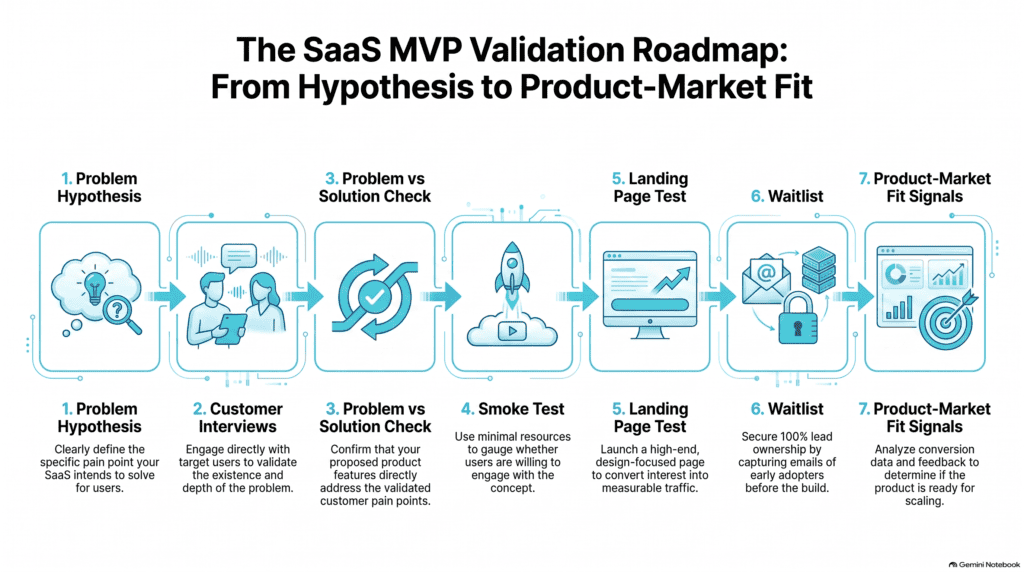
Here are the startup idea validation steps, in the order most founders should run them.
Step 1: Write Down Your Problem Hypothesis
Before anything else, write one sentence describing the problem — not the product.
Example: “Freelance designers lose track of unpaid invoices across multiple clients.”
If you can’t state the problem without mentioning your solution, you’re not ready to test yet.
Step 2: Talk to People Who Actually Have the Problem
This is customer discovery, and it’s the most skipped step in any validation framework.
You’re not pitching. You’re listening for pain, frequency, and current workarounds.
A structured set of customer discovery interview questions makes these conversations far more useful than casual chats — see 30 customer discovery questions to ask before you build anything for a ready-made script.
Aim for 15–20 conversations before drawing conclusions.
Step 3: Separate Problem Validation From Solution Validation
Many founders test their solution before confirming the problem is real. That order is backwards.
Problem validation asks “does this pain exist and matter?” Solution validation asks “does my specific fix solve it?”
Running these out of order is the single biggest cause of wasted MVP budgets. This breakdown of problem validation vs solution validation walks through which to test first and why.
Step 4: Run a Smoke Test
A smoke test measures intent before you build anything functional — usually through a fake-door ad or a simple sign-up page.
It tells you whether strangers, not just friends, will act on your offer.
For a step-by-step walkthrough, see the smoke test guide for validating startup demand.
Step 5: Publish a Landing Page Test
A landing page test goes one level deeper than a smoke test. It describes your actual offer and asks for a real commitment — an email, a deposit, or a waitlist signup.
This step is where testing a business idea starts producing numbers you can actually compare against a target conversion rate.
Here’s a full walkthrough on how to test demand with a landing page before you build.
Step 6: Build a Pre-Launch Waitlist
If your landing page test performs well, convert that interest into a waitlist.
A waitlist does two things: it proves ongoing demand, and it gives you a warm list of first users for launch day.
This guide on building a pre-launch waitlist that converts covers the offer structure that keeps signups from going cold.
Step 7: Watch for Product-Market Fit Signals Early
Validation doesn’t stop once you launch a minimum viable product. It continues by watching for early product-market fit signals — retention curves, repeat usage, and organic referrals.
This piece on how to know you’ve actually hit product-market fit explains which metrics matter at each stage.
How Long Should Validation Actually Take?
Most of this validation framework can run in two to four weeks, depending on how fast you can reach your target audience.
Interviews and a smoke test usually take one week. A landing page test needs another one to two weeks to gather a meaningful sample.
If you’re still validating after two months, the framework isn’t the problem — the target audience or channel probably is.
How to Measure Validation Results
Numbers make validation objective instead of emotional. Here are rough, widely-used benchmarks founders can compare their own results against.
| Test | What to Track | Reasonable Early Signal |
|---|---|---|
| Customer interviews | % describing the problem unprompted | 6+ out of 15–20 mention it without being asked |
| Smoke test | Click-through or sign-up rate | Above your platform’s typical baseline for cold traffic |
| Landing page test | Email or deposit conversion rate | A noticeably higher rate than casual browsing traffic |
| Waitlist | Week-over-week growth without paid ads | Steady growth from referrals or organic shares |
These aren’t universal thresholds — they vary by industry and price point. Treat them as a starting comparison, not a pass-or-fail rule.
The goal of a validation framework isn’t a perfect score. It’s a clear enough signal to justify — or stop — the next investment of time and money.
Red Flags That Mean You Should Pivot
Not every validation framework ends with a green light to build. Some of the most valuable outcomes are the ones that stop a founder from wasting months.
Low urgency in interviews. If prospects describe the problem as mildly annoying rather than actively costly, demand may not be strong enough to sustain a product.
No one pays, even a small deposit. Interest without any financial commitment, even a small one, is a weak signal on its own.
A shrinking or unclear target audience. If you can’t describe exactly who has this problem, your next test won’t reach the right people.
Existing solutions people already tolerate. If prospects have a workaround they’re not actively trying to replace, switching costs may be too high.
Treat any of these as useful data, not failure. A validation framework’s real job is to save you from building the wrong thing.
Common Mistakes Founders Make During Validation
A few patterns show up again and again when founders try testing a business idea for the first time.
Asking leading questions. “Would you use an app that saves you time?” always gets a yes. Ask about current behavior instead.
Confusing compliments with commitment. Friends saying “I’d totally use this” is not evidence. A credit card number or a waitlist signup is.
Skipping the smoke test and jumping straight to building. This is the single most expensive shortcut in early-stage product development.
Testing too many ideas at once. Pick one problem hypothesis and validate it fully before branching out.
Ignoring negative signals. If ten interviews show mild interest and low urgency, that’s data — not a reason to keep pushing.
Tools That Support a Validation Framework
You don’t need an engineering team to run most of these tests.
- Landing page builders (Carrd, Framer, Webflow) for smoke tests and landing page tests
- Scheduling tools (Calendly) for booking customer discovery calls
- Survey tools (Typeform, Google Forms) for structured follow-up
- Waitlist tools (built-in email capture, or lightweight waitlist plugins) for pre-launch lists
- Analytics (simple pageview and conversion tracking) to measure landing page test performance
None of these require code. That’s the point — a validation framework should cost you time, not capital.
When Validation Signals Point Toward Building
Once your problem hypothesis holds up, your smoke test converts, and your landing page test shows real commitment, it’s time to move toward a minimum viable product.
At this stage, many founders bring in outside help to move faster without overbuilding. If you’re weighing that decision, this guide on choosing a startup software development partner covers what to look for.
Founders who’d rather scope a small, fixed engagement can also review how to hire an MVP development team without overpaying.
Frameworks popularized in the broader startup community, including the build-measure-learn loop from the Lean Startup methodology, and the founder resources published by Y Combinator’s Startup School, cover similar validation principles in more depth if you want to go further.
A Simple Weekly Breakdown
If you want a rough calendar to follow, this is a reasonable pace for most first-time founders.
Week 1: Write your problem hypothesis and complete 10–15 customer discovery interviews.
Week 2: Launch a smoke test and start tracking click-through and sign-up rates.
Week 3: Publish a landing page test with a clear, specific offer.
Week 4: Review results, decide whether to build a waitlist, pivot the hypothesis, or move toward a minimum viable product.
This pace keeps momentum without rushing past the evidence-gathering that makes a validation framework useful in the first place.
Frequently Asked Questions
What is an idea validation framework for founders? It’s a structured sequence of low-cost experiments — interviews, a smoke test, and a landing page test — used to confirm real demand before building a product.
What are the basic startup idea validation steps? Define the problem, interview real prospects, separate problem from solution validation, run a smoke test, publish a landing page test, build a waitlist, and watch for product-market fit signals.
How do I start testing a business idea with no budget? Start with customer discovery interviews, which cost nothing but time, followed by a free-tier landing page builder for your smoke test.
How many customer interviews are enough for validation? Most founders see repeating patterns after 15–20 structured conversations with people who actually have the problem.
Should I build an MVP before or after validation? After. A minimum viable product should be built in response to validated demand, not as a way to discover it.
What’s the difference between a smoke test and a landing page test? A smoke test measures raw interest, often through a simple ad or button. A landing page test goes further, asking for a real commitment like an email or deposit against a specific offer.
Can validation work for a B2B idea, not just consumer products? Yes. B2B founders often get even clearer signals, since interviews with a handful of target buyers can reveal budget, urgency, and decision-making authority directly.
Final Thoughts
A validation framework for founders isn’t about proving your idea is right. It’s about finding out fast, before the cost of being wrong gets expensive.
Run the interviews. Run the smoke test. Publish the landing page. Let the evidence decide the next step.
If the signals hold up, you’ll walk into MVP development with a much clearer, cheaper, and faster path forward.
Author Bio
Jeevesh Tripathi Email: jeevesh@bkabhi.com
Jeevesh Tripathi is a researcher and product strategist focused on early-stage startup validation, MVP development, and go-to-market testing. His work centers on helping first-time founders replace assumptions with evidence before committing engineering budget to a new product. Jeevesh writes from direct experience running discovery interviews, smoke tests, and landing page experiments with early-stage teams, and reviews each framework against current, real-world founder outcomes rather than theory alone.
Internal resources referenced in this guide: customer discovery interview questions, problem validation vs solution validation, smoke test for a startup idea, landing page test before building, pre-launch waitlist strategy, product-market fit signals, startup software development partner, hire an MVP development team.