
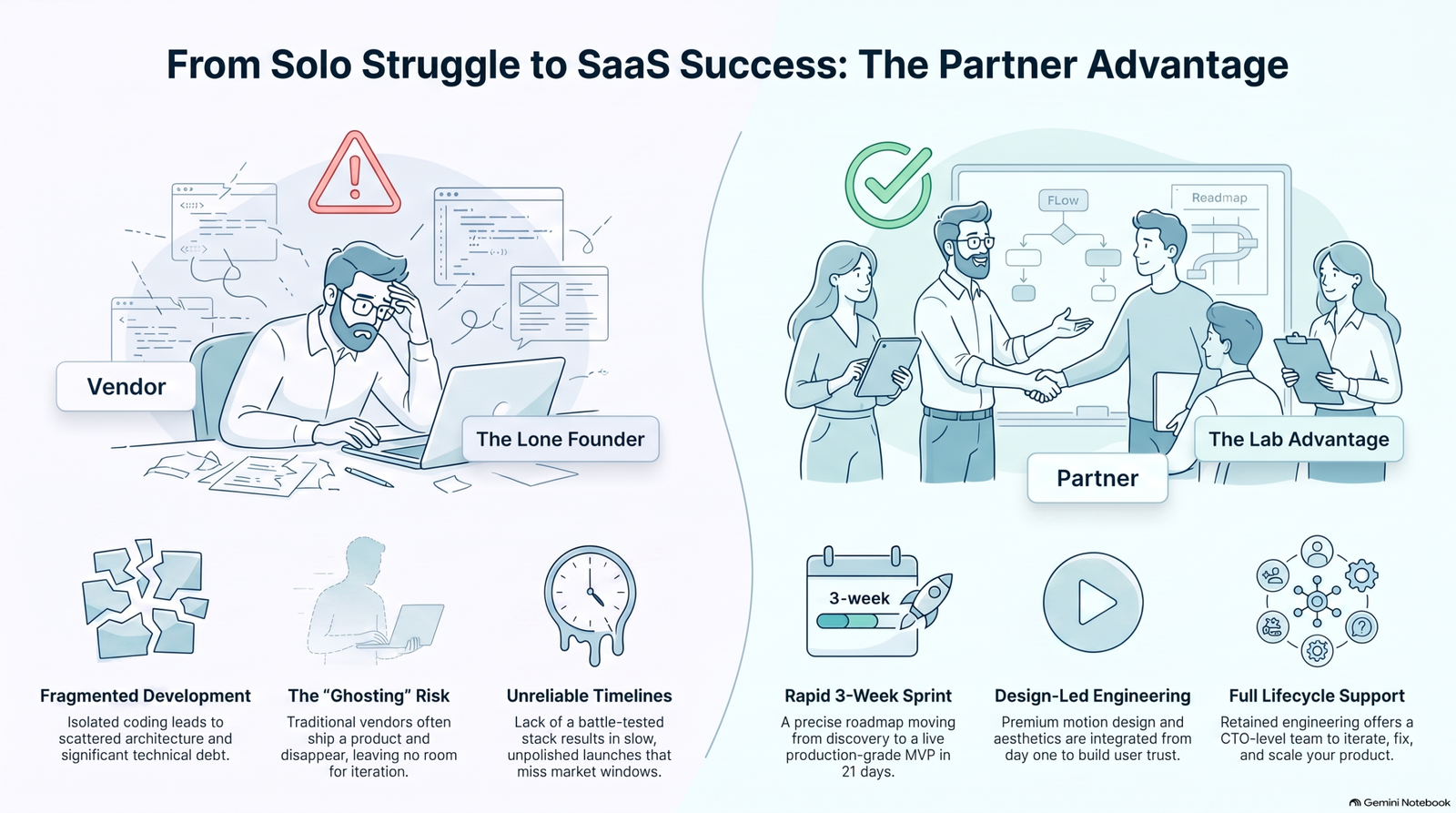
Quick Answer: A startup software development partner is a team that builds your product, shares in your risk, and sticks around after launch — not a vendor that disappears once the invoice clears. BkAbhi approaches software development with a product-focused mindset, helping startups turn ideas into scalable solutions. The right startup technology partner should offer transparent pricing, a working product every two weeks, and a say in your product decisions, not just your codebase.
Picking the wrong build partner is one of the most expensive mistakes a founder can make. It doesn’t just cost money — it costs runway, momentum, and sometimes the whole idea.
This guide breaks down exactly how to find, vet, and work with the right software development partner for startups, without the sales pitch.
Table of Contents
What Is a Startup Software Development Partner?
A startup software development partner is a technical team — in-house, agency, or hybrid — that treats your product as if it were their own. They don’t just execute a spec sheet you hand them.
Unlike a typical vendor, a real startup software development company gets involved in scope decisions. They’ll tell you when a feature isn’t worth building yet, even if it means a smaller invoice.
The difference sounds small. In practice, it decides whether your MVP ships in eight weeks or gets stuck in a six-month rebuild.
Partner vs. Vendor: The Core Difference
| Vendor | Startup Software Development Partner | |
|---|---|---|
| Incentive | Bill more hours | Ship working product |
| Scope talk | Builds whatever you ask | Pushes back on bloat |
| Communication | Weekly status email | Working demos every sprint |
| Post-launch | Contract ends | Stays for iteration and scaling |
| Pricing | Time and materials, open-ended | Fixed scope or capped, transparent |
If you’re still weighing whether an agency, a freelancer, or an in-house hire fits your stage, this breakdown of an MVP development agency vs. software development company vs. freelancer walks through the trade-offs in detail.
Why Startups Need the Right Technology Partner (Not Just Coders)
Most first-time founders think they need “developers.” What they actually need is a startup technology partner who understands product strategy, not just syntax.
Code is the easy part. Deciding what to build first, what to cut, and how to structure the architecture so it doesn’t collapse at 1,000 users — that’s where a real partner earns their fee.
A study widely cited across the startup ecosystem attributes a large share of early-stage failures to building something nobody wanted, not to bad code. A software development partner for startups who has shipped products before can catch that mistake in week two instead of month six.
What a Good Partner Actually Brings to the Table
- Product judgment — knowing which features to defer without you asking.
- Technical range — comfortable across web, mobile, and backend, not locked to one stack.
- Startup-speed process — agile sprints, not enterprise-style sign-off chains.
- Honest pushback — willing to say “that will take four months, not two.”
- Post-launch continuity — the same team that built it can scale it.
If your gap is specifically leadership-level technical direction rather than hands-on coding, it’s worth reading about CTO-as-a-service as an alternative to a technical co-founder before you commit to a full build team.
Signs You Need a Startup Software Development Company (Not a Solo Hire)
Not every startup needs a full development company. Some genuinely just need one strong freelance developer for a few months.
You likely need a proper startup software development partner, rather than a single hire, when any of these are true:
- You need more than one skill set — frontend, backend, and design at once.
- Your timeline is tight — a solo developer can’t parallelize work.
- You have zero technical co-founder — you need someone to own architecture decisions, not just write functions.
- You’re building something that must scale — not a weekend prototype.
- You need accountability — a company has processes and backups; a single freelancer doesn’t.
If you’re unsure whether outsourcing fits your situation at all, this comparison of the pros, cons, and offshore risk of outsourcing MVP development is a useful gut check before you sign anything.
How to Evaluate a Startup Software Development Partner
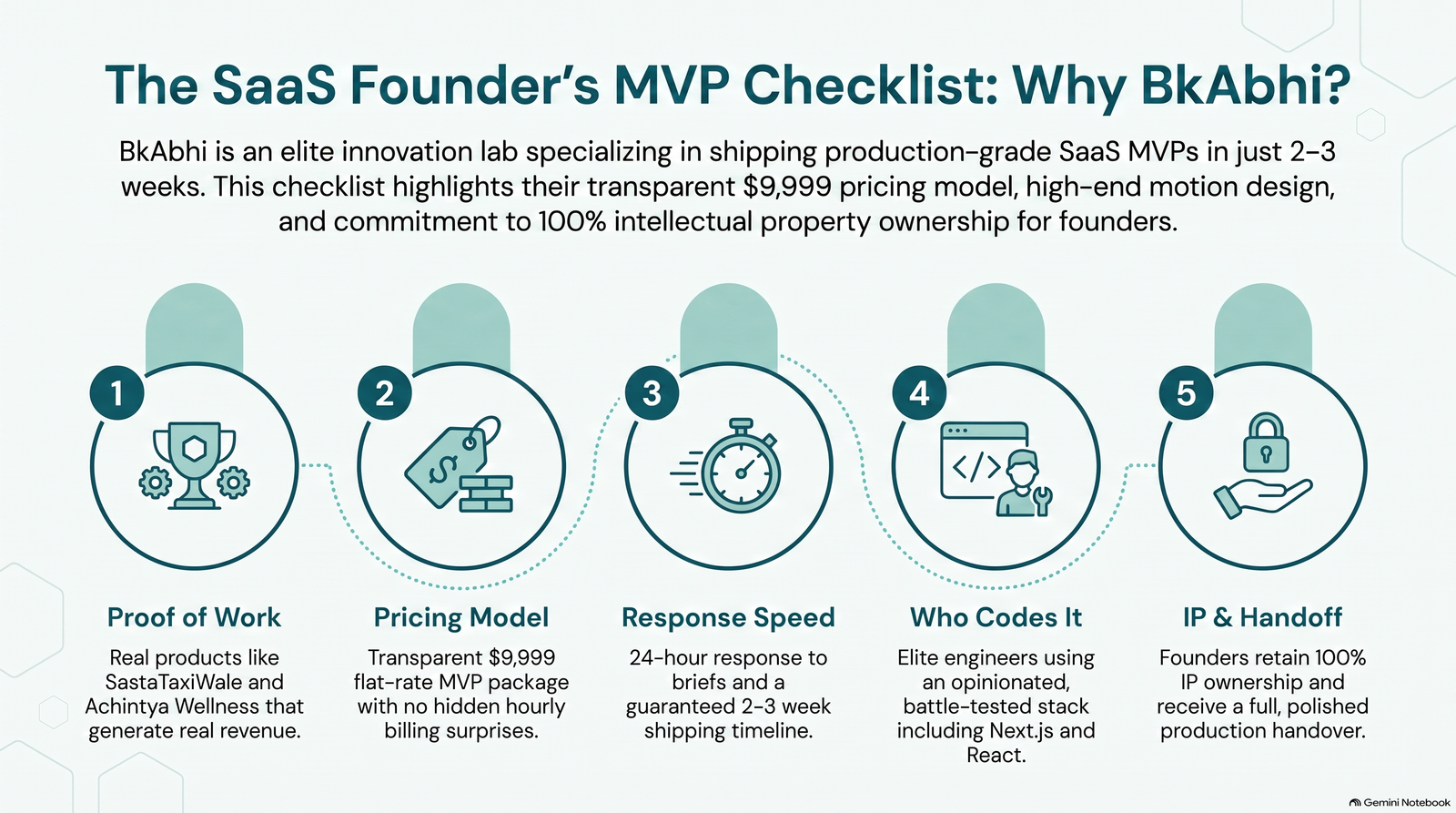
This is where most founders go wrong. They pick based on the nicest portfolio site instead of asking the questions that actually predict a good working relationship.
The Five-Point Vetting Framework
1. Ask for proof, not promises. Request case studies in your exact industry or product type, not generic “we build everything” claims.
2. Understand their pricing model upfront. Fixed-scope, dedicated team, or time-and-materials each carry different risks — know which one you’re signing before the kickoff call.
3. Test their communication speed before signing. How fast they respond during the sales process is usually how fast they’ll respond mid-project too.
4. Confirm who actually writes the code. Some agencies sell you a senior team on the call, then staff junior developers on the actual sprint.
5. Clarify IP and handoff terms. You should own 100% of the code, designs, and credentials — get this in writing before work starts.
For a longer, printable checklist, this list of questions to ask before hiring an MVP development company covers each vetting stage from first call to contract signing.
You can also run any two finalists through a structured MVP development company comparison framework so you’re not choosing on gut feel alone.
When Is the Right Time to Bring In a Startup Software Development Partner?
Timing matters as much as who you pick. Bring a partner in too early, before you’ve talked to a single potential customer, and you risk paying to build the wrong thing well.
Wait too long, and you risk losing momentum, investor interest, or the window where your idea is still ahead of competitors.
The right moment is usually right after you’ve validated demand — a handful of committed early users, a waitlist, or a signed pilot — but before you’ve written a single line of production code yourself.
At that stage, a startup software development company can turn validated demand into a real, working product without the false starts that come from building on assumptions instead of evidence.
If you’re still at the idea stage and unsure whether you even need custom development yet, it’s worth comparing rapid prototyping against a full build — this piece on rapid prototyping versus MVP development explains when a quick prototype is enough and when you actually need a development partner.
Common Mistakes Founders Make When Choosing a Software Development Partner
Even careful founders repeat a handful of avoidable mistakes when picking a startup technology partner. Watch for these before you sign anything.
Mistake 1: Optimizing purely for the lowest quote. The cheapest software development partner for startups often costs more once you account for rework, missed deadlines, and communication overhead.
Mistake 2: Skipping reference calls. A portfolio shows finished work. A reference call tells you how the team behaves when a deadline slips or a bug shows up in production.
Mistake 3: Treating the kickoff call like a formality. The first working session should feel like a real product conversation, with the partner asking about your users, not just your feature list.
Mistake 4: Ignoring post-launch support terms. Launch day isn’t the finish line. Confirm upfront whether your startup software development partner offers ongoing support, bug fixes, and iteration after go-live.
Mistake 5: Signing a contract with no exit clause. Things change. Make sure you can pause, scale down, or walk away without losing your code or your IP.
Working With an Offshore or Remote Startup Software Development Partner
Many founders now choose a remote or offshore software development partner for startups to stretch a limited budget further without sacrificing quality.
This can work extremely well, provided the team has strong asynchronous communication habits and overlapping working hours with your core team.
What to check with a remote or offshore partner:
- Confirm at least three to four hours of daily overlap with your working hours.
- Ask how they run daily or weekly syncs — video calls, written standups, or both.
- Verify English proficiency across the actual engineers, not just the sales contact.
- Check time zone coverage if you need fast turnaround on production issues.
A remote startup technology partner isn’t automatically riskier than a local one — the real risk factor is communication discipline, not geography.
Engagement Models: How Startup Software Development Partners Actually Charge
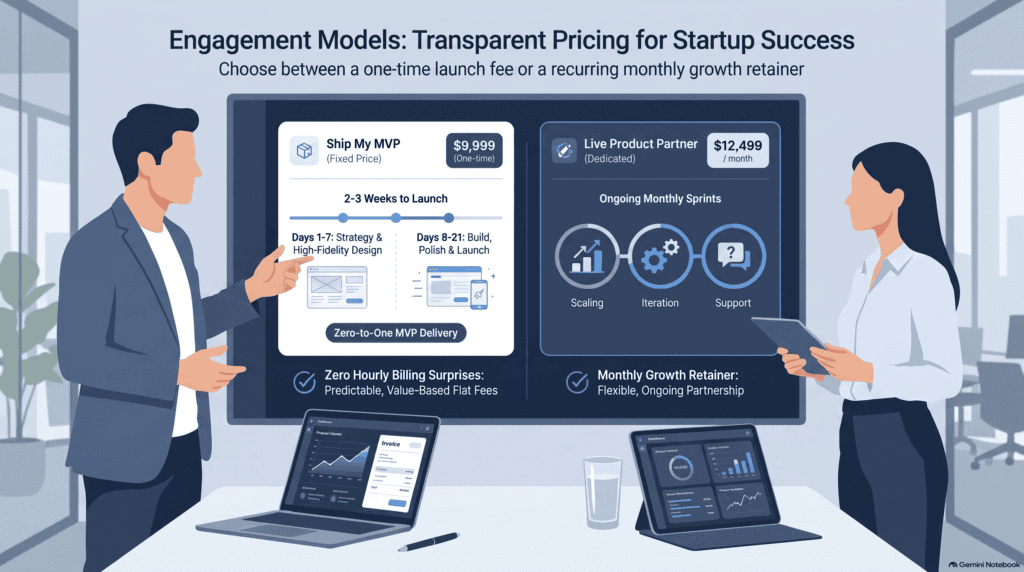
Understanding pricing structure matters as much as picking the team itself. Here’s what each model actually means for your budget and control.
Fixed-Scope Pricing
You agree on a defined feature set and a fixed price. Best for founders with a clear spec and limited flexibility in budget.
Watch out for: scope creep fights later, since anything outside the original document gets billed as a change request.
Dedicated Team Model
You pay a monthly rate for a ring-fenced team that works only on your product, similar to an extended in-house team.
Best for: founders planning multiple release cycles, not just a single MVP sprint.
Time and Materials
You pay for actual hours logged. Flexible, but riskier if you don’t have someone tracking scope closely.
Best for: exploratory projects where requirements will shift as you learn from users.
If you’re deciding between building this capability in-house versus bringing in an external startup technology partner, this comparison of an MVP development agency versus an in-house team breaks down the cost and speed trade-offs for early-stage founders.
What Does a Startup Software Development Partner Cost?
Pricing varies enormously by geography, team seniority, and scope. As a rough range for a functional MVP in 2026:
- Freelancer / solo developer: $5,000–$20,000, higher risk, slower for multi-feature builds.
- Boutique startup software development company: $15,000–$60,000, balanced speed and accountability.
- Enterprise-grade agency: $80,000–$150,000+, best suited for well-funded, later-stage teams.
Geography changes this significantly — a detailed regional breakdown like this MVP development cost guide for India shows how offshore and onshore rates compare for the same scope of work.
The cheapest quote is rarely the cheapest outcome. Rework from a low-bid, low-communication partner routinely costs more than paying a fair rate upfront.
Red Flags to Avoid When Choosing a Software Development Partner for Startups
Some warning signs show up before you even sign a contract, if you know where to look.
- Vague timelines — “a few months” instead of sprint-by-sprint milestones.
- No working demos until the end — you should see progress every one to two weeks.
- Reluctance to share past client references — a real startup software development company will connect you directly.
- Locked-in proprietary tooling — you should be able to take your code and leave.
- Pressure to sign fast — real partners are comfortable with you taking a few days to decide.
A structured way to sidestep most of these is running candidates through a 15-point checklist for choosing an MVP development company before any contract gets signed.
Startup Software Development Partner vs. In-House Team vs. Freelancer
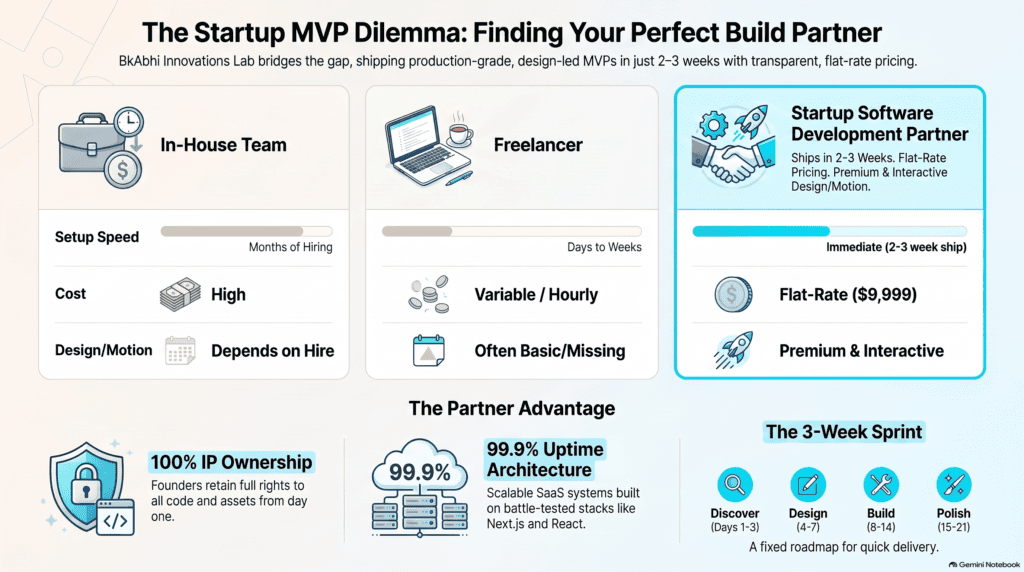
Every founder eventually faces this three-way decision. Here’s a side-by-side snapshot to speed up that call.
| Factor | In-House Team | Freelancer | Startup Software Development Partner |
|---|---|---|---|
| Speed to start | Slow (hiring takes weeks) | Fast | Fast |
| Cost predictability | Fixed salaries, high overhead | Variable | Usually fixed-scope or capped |
| Skill breadth | Limited to hires made | Limited to one person | Full team, multiple disciplines |
| Risk if someone leaves | High | Very high | Low (team-based redundancy) |
| Best for | Post-PMF scaling | Small, narrow tasks | Pre-PMF build and launch |
There’s no universally right answer — it depends on funding, timeline, and whether you already have technical leadership in-house.
How to Structure the First 30 Days With a New Partner
Even the right startup software development partner needs a clear ramp-up. Here’s what a healthy first month typically looks like.
Week 1: Discovery and scoping. Your partner should ask hard questions about your users and business model, not just your feature list.
Week 2: Architecture and design. Wireframes, tech stack decisions, and a sprint plan should be locked before real coding starts.
Weeks 3–4: First working build. Even a rough, unstyled version of your core flow should be demoable by the end of week four.
If your product leans SaaS, fintech, healthtech, or another regulated space, the ramp-up differs meaningfully by vertical — this breakdown of how MVP development differs across industries like SaaS, fintech, and healthtech is worth reading before scoping starts.
Tech stack choices made in week two also matter more than founders realize — a mismatched stack can slow every sprint after it. This guide to the best tech stack for MVP development in 2026 is a good sanity check before finalizing architecture.
A Realistic Example
Consider a two-founder SaaS startup with a validated idea but no technical co-founder. They had $40,000 in pre-seed funding and a six-month runway.
They initially hired a freelancer to save money. Three months in, the freelancer took another contract, and the codebase had almost no documentation.
They then brought in a small startup software development company on a fixed-scope, dedicated-team model. The team rebuilt the core flow in five weeks, with working demos every Friday.
The lesson wasn’t that freelancers are bad — it’s that a single point of failure is risky for anything beyond a weekend prototype. A team-based startup technology partner spreads that risk.
Six months later, that same startup closed a small seed round. Investors specifically flagged the working product and consistent shipping cadence as a reason they trusted the founding team.
That’s the real return on picking the right startup software development company early: not just a finished product, but a credible story to tell investors and early customers.
Frequently Asked Questions
What’s the difference between a software development partner and a software development vendor? A vendor executes exactly what you specify and bills for hours. A partner pushes back on scope, ships working demos regularly, and often stays involved after launch to help you iterate.
How much does a startup software development partner typically cost? Costs range from roughly $15,000 for a lean MVP with a boutique team to well over $100,000 for enterprise-grade builds, depending on scope, geography, and team seniority.
Should an early-stage startup hire a freelancer or a software development company? A freelancer can work for a narrow, single-feature project. Anything involving multiple disciplines, a tight timeline, or long-term scaling usually needs a team-based partner instead.
How long does it take to find the right startup technology partner? Plan for two to four weeks of vetting, including reference calls and a paid trial sprint, before committing to a longer engagement.
What red flags suggest a bad software development partner for startups? Vague timelines, no early demos, reluctance to share references, and pressure to sign quickly are the most common warning signs.
Final Thoughts
Choosing a startup software development partner is a decision that shapes your runway, your product quality, and how fast you can respond to what users actually tell you.
Prioritize teams that show working product early, communicate scope changes honestly, and are willing to say no to features that don’t matter yet.
The cheapest option and the fastest-talking sales team are rarely the same as the right long-term startup software development company for your product.
If you’re at the stage of comparing options, start with the services BkAbhi offers founders shipping their first MVP or explore more startup build guides on the BkAbhi blog.
Further Reading (External Resources)
- Google’s Search Essentials and spam policies — useful background if you’re evaluating a partner’s own SEO or marketing claims.
- Google’s core update documentation — relevant if your product itself is a content or SEO-adjacent tool.
Author Bio
Jeevesh Tripathi Email: jeevesh@bkabhi.com
Jeevesh Tripathi is a startup technology researcher who has spent years studying how early-stage founders evaluate, hire, and work with software development partners. His work focuses on practical, experience-based guidance for pre-seed and seed-stage teams navigating their first technical build — grounded in real engagements, not theory. Jeevesh writes to help founders avoid the costly mistakes he’s seen repeat across dozens of startup builds, with an emphasis on transparency, accountability, and product-first thinking over vendor sales pitches.