
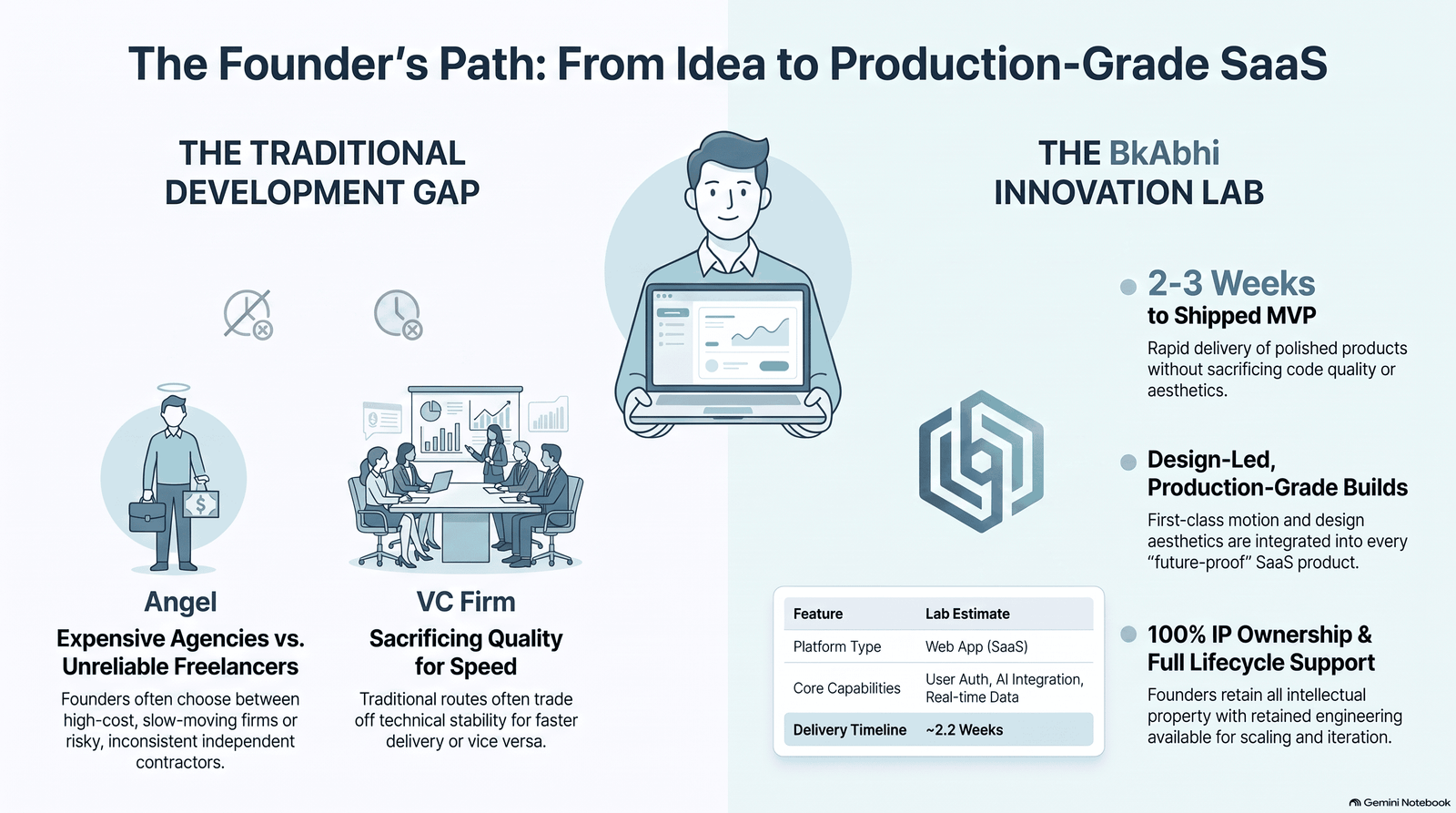
Quick Answer: For an early MVP, angel investors are usually the better fit. They write smaller checks ($10K–$150K), move faster, and accept more risk than institutional funds. BkAbhi can help founders build and validate their MVP before seeking VC funding. VC funding fits once you have traction, a repeatable growth model, and need $500K or more to scale.
You built an MVP. Now you need cash to keep going.
Two paths show up first: angel investors and VC funding. They sound similar. They are not.
Picking the wrong one can cost you months of fundraising and equity you didn’t need to give up. This guide breaks down angel investors vs VC funding so you pick the right early-stage funding source for where you actually are.
Table of Contents
What Is an Angel Investor?
An angel investor is a person, not a fund. Usually a wealthy individual investing their own money into a startup they believe in.
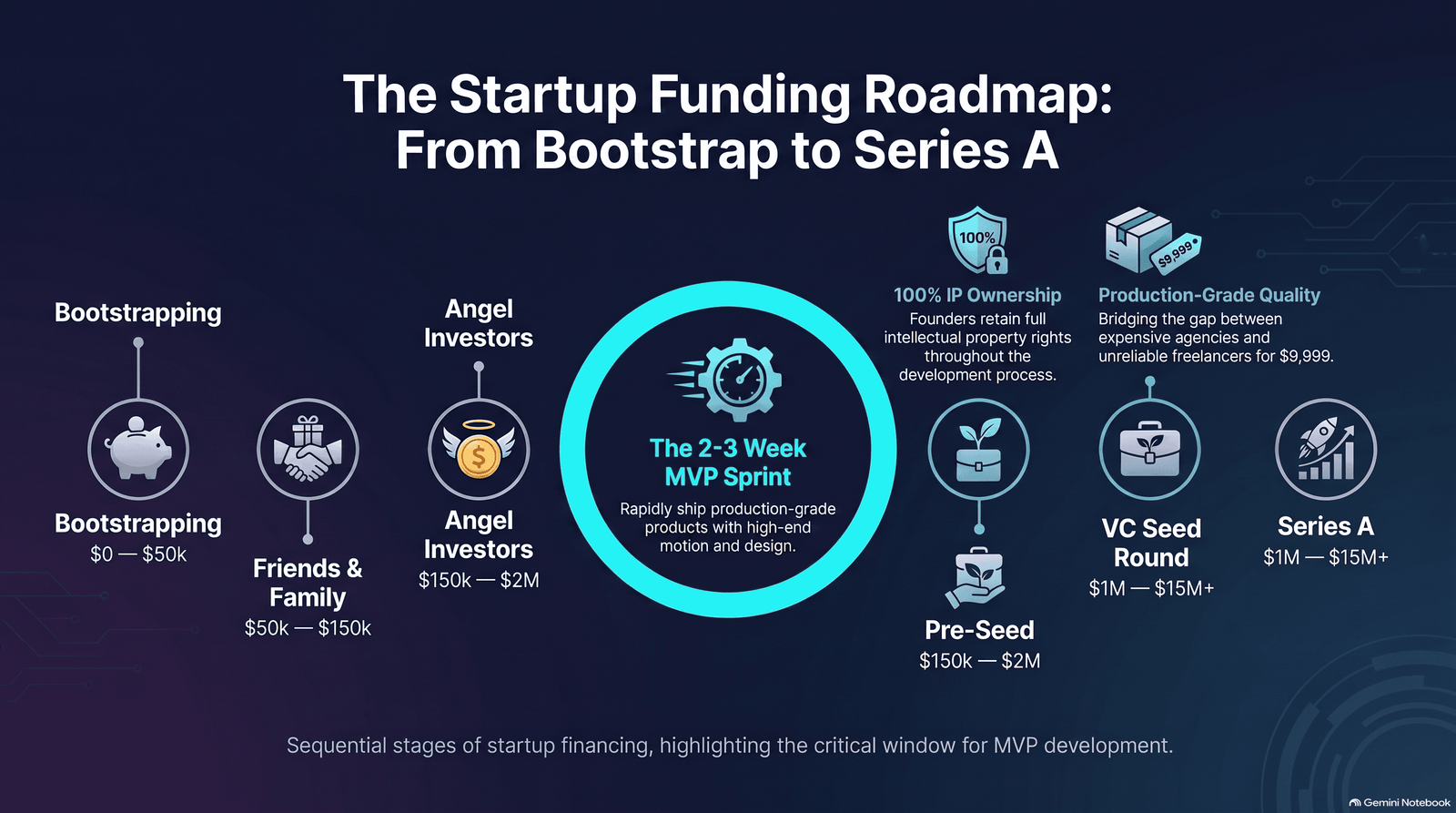
Angels write smaller checks, often between $10,000 and $150,000, making them a popular choice for early-stage startups.
When comparing angel investors vs VC funding, angels typically invest earlier than most venture capital funds.
They may invest before a startup has any revenue or proven business model.
Angel investors often provide valuable mentorship, industry connections, and founder-friendly guidance.
VC firms usually invest larger amounts once a startup shows traction and strong growth potential.
For founders building an early MVP, angels can offer more flexibility and faster funding decisions.
Choosing between angel investors vs VC funding ultimately depends on your startup’s stage, funding needs, and growth goals.
Many angels are former founders themselves. They bring hands-on mentorship, not just capital.
If you’re still validating your idea before writing a line of code, an idea validation framework will help you walk into angel conversations with actual proof, not just a pitch.
What Is VC Funding?
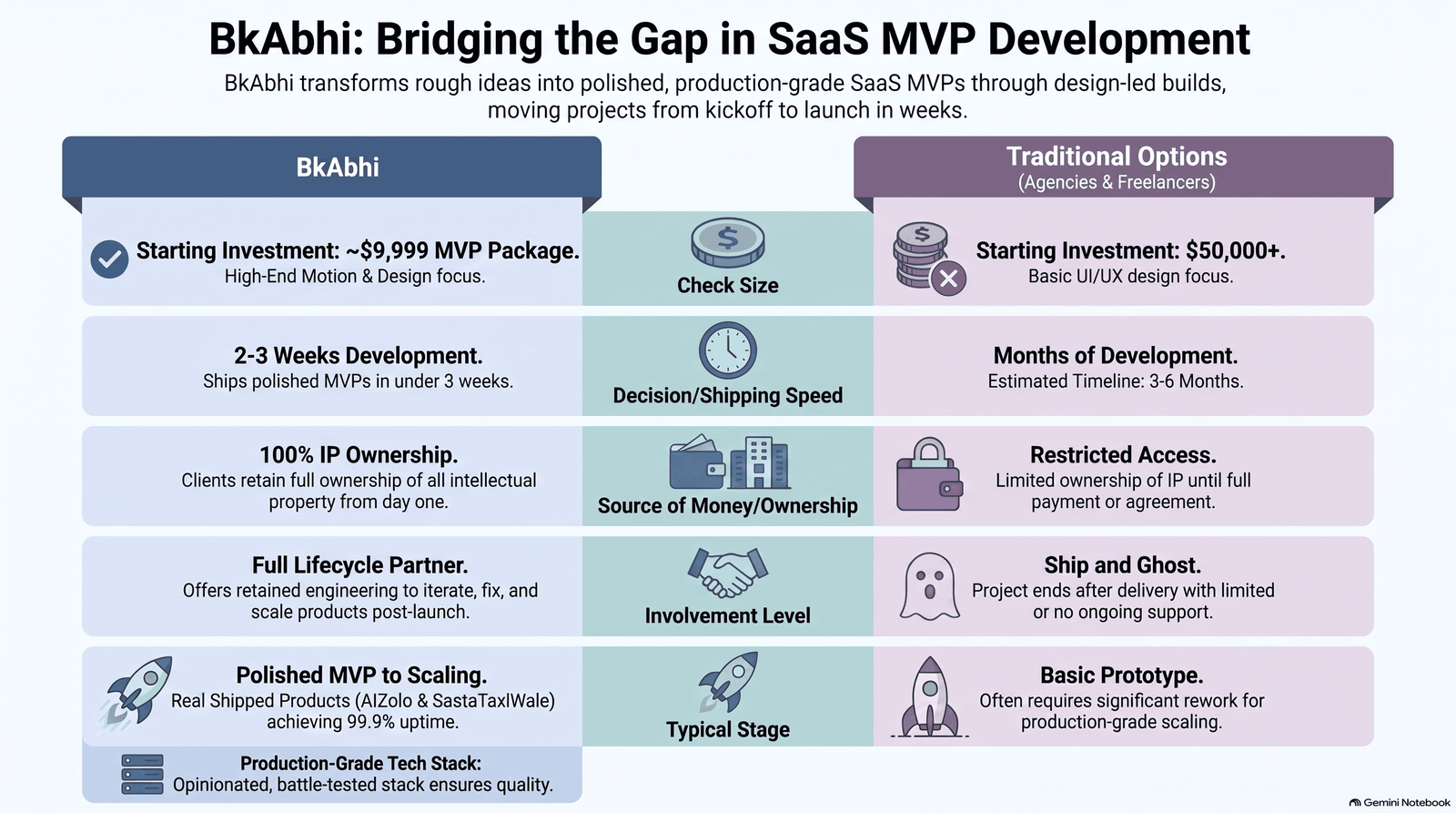
Venture capital (VC) funding comes from a professionally managed fund rather than an individual investor. VC firms pool money from institutions, pension funds, and wealthy limited partners (LPs), then invest that capital into startups with strong growth potential.
VC checks are bigger. Seed rounds commonly run from $500,000 to $3 million or more, depending on the market and traction.
VC funding comes with structure: a board seat, formal governance, reporting expectations, and a clear path toward the next round.
Because VCs are investing other people’s money, they answer to LPs. That changes how they evaluate risk compared to an angel writing a personal check.
Angel Investors vs VC Funding: The Core Differences
Here’s where angel investors vs VC funding really splits apart. The differences aren’t cosmetic — they change how your startup is run.
| Factor | Angel Investors | VC Funding |
|---|---|---|
| Source of money | Personal funds | Pooled fund (LPs) |
| Typical check size | $10K – $150K | $500K – $10M+ |
| Decision speed | Days to weeks | Weeks to months |
| Stage they enter | Idea to early MVP | Traction to growth |
| Board involvement | Rare, informal advice | Common, formal board seat |
| Due diligence | Lighter | Extensive, legal-heavy |
| Risk appetite | Higher | Lower, needs signals |
| Follow-on funding | Limited | Often reserves capital |
An angel is betting on you as a person. A VC is betting on a scalable, venture-sized outcome for their fund.
That single difference explains almost every other item on this table.
Angel Investment Pros and Cons
Before you chase angel checks, weigh the trade-offs honestly.
Angel Investment Pros
Faster decisions. An angel can commit in a single meeting. No investment committee, no multi-week partner debate.
Lower bar for traction. Many angels invest on the strength of the founder and idea alone, before a working MVP proves demand.
Flexible terms. Angels are often open to SAFEs or convertible notes with simpler terms than a priced VC round.
Mentorship. A former operator-turned-angel can open doors and shortcut mistakes that would otherwise cost months.
Angel Investment Cons
Smaller checks. One angel rarely funds an entire runway. You’ll likely need several to reach a meaningful round.
Less follow-on capital. Most angels don’t reserve money for future rounds the way funds do.
Variable involvement. Some angels vanish after wiring funds. Others over-involve themselves without adding real value.
Cap table clutter. Too many small angel checks can create a messy cap table that later VCs scrutinize closely.
VC Funding Pros and Cons

VC funding solves different problems — and creates different ones.
VC Funding Pros
Larger runway. A single VC check can fund 18–24 months of growth instead of a few months.
Signal for future rounds. A known VC’s name on your cap table makes the next raise easier.
Structured support. Many VC firms offer recruiting help, PR introductions, and follow-on investment.
Reserved capital. Good VCs plan to double down in your next round if you hit milestones.
VC Funding Cons
Slower process. Partner meetings, due diligence, and legal review can take 6–12 weeks or longer.
Higher expectations. VCs need venture-scale outcomes — a $50M business may not interest a fund chasing 100x returns.
More dilution and control. Board seats and preferred terms mean giving up more say in how you run the company.
Traction requirement. Most VCs want evidence: users, revenue, or strong growth signals before writing a check.
Which Fits an Early MVP Stage?
This is the real question behind angel investors vs VC funding: what actually fits where you are right now?
Why Angels Fit Early MVPs Better
At the MVP stage, you likely don’t have the metrics VCs require. No steady revenue curve, no large user base, maybe just early signups or a working prototype.
Angels are comfortable with that gap. They’re investing in founder conviction and early proof, not a fully de-risked business.
If you’ve run a smoke test or built a pre-launch waitlist showing real demand, that’s often enough evidence for an angel — even without a VC-ready growth chart.
Why VCs Usually Wait
VC funding is built for scale, and scale needs proof. Most funds want to see product-market signals before committing institutional money.
That doesn’t mean VCs never fund pre-seed MVPs — some do, especially specialized pre-seed funds. But the bar for evidence is higher than what most early founders have at MVP stage.
If you’re preparing to raise from either, work through an investor readiness checklist first. It forces you to gather the proof both angels and VCs will ask for.
A Simple Rule of Thumb
- Pure idea or early prototype, need under $150K → Angel investors
- Working MVP with early users, need $150K–$500K → Angel syndicate or pre-seed fund
- Proven traction, need $500K+ → VC funding
Many founders raise from angels first, then use that momentum to approach VCs later. This is exactly how a pre-seed round typically comes together — angels first, institutional money after proof.
Early-Stage Funding Sources Beyond Angels and VCs
Angel investors vs VC funding isn’t the only choice. A few other early-stage funding sources are worth knowing before you commit to either path.
Bootstrapping. Self-funding keeps full control but limits speed. Works well if your MVP is cheap to build and test.
Accelerators. Programs like Y Combinator or Techstars offer small checks plus mentorship and a fast fundraising network afterward.
Revenue-based financing. If you already have revenue, some lenders offer capital repaid as a percentage of monthly income instead of equity.
Friends and family. Often the very first round, though it should be handled with the same formal documentation as any other investment.
Choosing between these and angel investors vs VC funding depends on how much control you’re willing to trade for speed.
Common Mistakes Founders Make When Choosing
Chasing VCs too early. Pitching funds before you have proof wastes time and can burn a first impression you don’t get back.
Taking angel money with no structure. Handshake deals without proper SAFE or note documentation create legal headaches later.
Ignoring investor fit. An angel with no domain experience in your space adds less value than one who’s built something similar.
Over-optimizing for valuation. A high valuation from the wrong investor can make your next round harder, not easier.
Before you approach either type of investor, make sure your pitch deck tells a clear story backed by real validation — not just projections.
How to Prepare Before Approaching Either
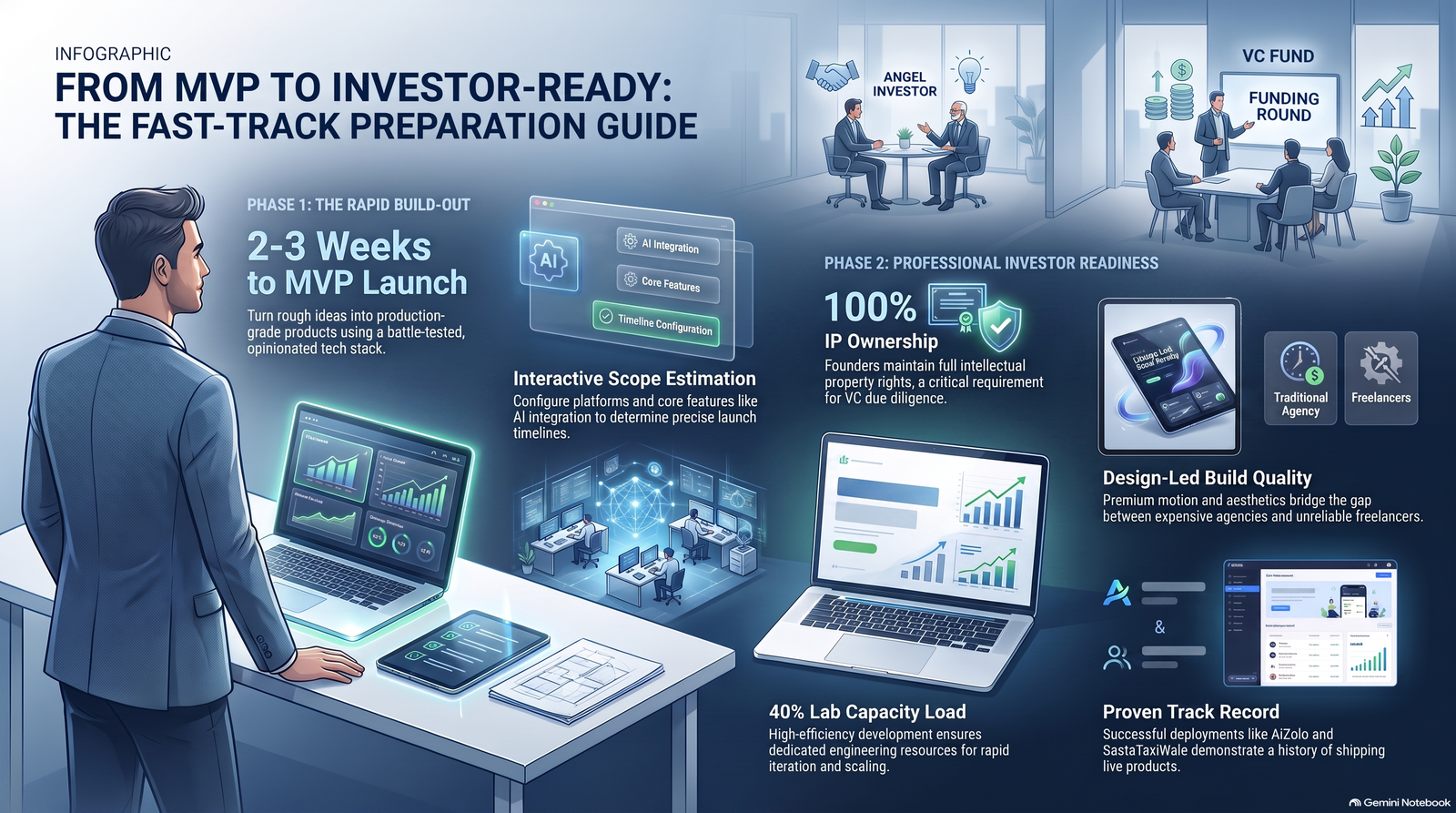
Regardless of which early-stage funding source you target, preparation looks similar.
- Validate the problem, not just the solution — problem validation vs solution validation is a useful place to start.
- Test demand cheaply. A landing page test can show real intent before you spend months building.
- Ship a working MVP. Investors trust something they can click through more than a slide deck alone.
- Know your numbers. Even rough ones — cost to acquire a user, early conversion rate, retention signals.
- Get the story straight. Investors back founders as much as ideas. Your founder-market fit matters more than most founders assume.
If building that MVP is the bottleneck, working with an experienced MVP development partner can compress months of build time into weeks — which matters when investor conversations are time-sensitive.
Angel Investors vs VC Funding: FAQs
Can a startup raise from angels and VCs at the same time? Yes. Many rounds blend angel checks with a lead VC or pre-seed fund in the same round, especially once a startup has some early proof.
Do angel investors take a board seat? Rarely at the early stage. Most angels prefer an advisory role or no formal involvement at all.
Is angel investing riskier than VC funding for the startup? Not inherently. The risk profile differs — angels demand less proof but usually add less structured support than a fund.
How much equity do angels typically take for an MVP-stage check? It varies widely, but early SAFE-based angel rounds often land between 5% and 15% combined, depending on valuation cap and check size.
What’s the biggest EEAT-style signal investors look for? Evidence of real user demand — a smoke test, waitlist, or working MVP — combined with a founder who clearly understands the problem firsthand.
Final Thoughts
Angel investors vs VC funding isn’t really a competition — it’s a sequence. Most founders start with angels, prove enough to reduce risk, and move to VC funding once the numbers justify it.
Match the funding source to your actual stage, not your ambition. An MVP with early signals fits an angel check far better than a VC pitch deck full of projections.
Do the validation work first. The funding conversation gets easier once you have proof, regardless of which door you knock on.
Author Bio
Jeevesh Tripathi Startup Funding Researcher, BkAbhi Innovations Lab
Jeevesh Tripathi researches early-stage funding trends, founder decision-making, and MVP strategy for first-time founders. His work focuses on translating investor behavior — from angel syndicates to institutional VC funds — into practical, stage-appropriate guidance for pre-seed startups.
Contact: jeevesh@bkabhi.com