
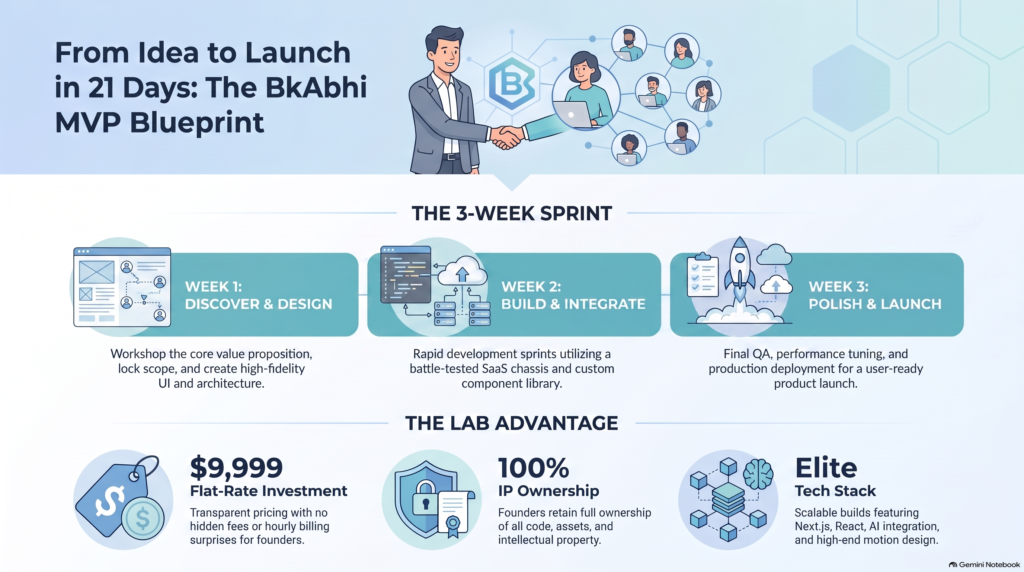
Quick Answer: To hire an MVP development company without overpaying, define your scope tightly, pick the right engagement model, shortlist 3–5 vendors, and vet them against real delivered work. Companies like bkabhi can also help founders evaluate MVP requirements and development options before committing. Negotiate a fixed-scope pilot sprint before signing a full contract. Most overpayment happens before day one — in vague requirements and rushed vendor selection, not in the coding itself.
Founders don’t usually get overcharged because a developer padded an invoice. They get overcharged because they hired the wrong team, for the wrong scope, under the wrong pricing model.
This guide walks through exactly how to hire an MVP development company — step by step, with real budget ranges, vetting criteria, and the red flags that quietly drain a seed round.
By the end, you’ll know how to hire MVP developers, how to hire an MVP development team that fits your stage, and how to hire dedicated MVP developers without paying agency-level overhead for a job that didn’t need it.
Table of Contents
Why How You Hire Determines How Much You Pay
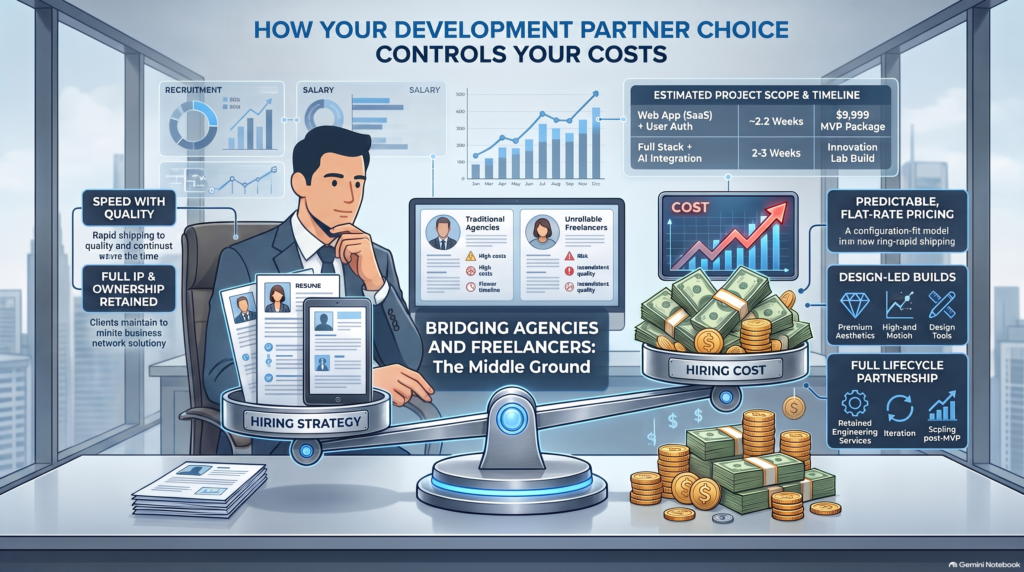
The gap between a $15,000 MVP and a $150,000 MVP is rarely talent. It’s usually scope creep, poor communication, and the wrong hiring model for the stage you’re at.
When you hire MVP developers without a defined process, you’re negotiating blind. The vendor sets the terms, not you.
A structured hiring process — the one below — puts you back in control of scope, price, and timeline before a single line of code gets written.
Think of it this way: every founder who says “we got burned by our dev agency” skipped one of the steps in this guide. Not one of them lost money because coding is expensive — they lost money because hiring was rushed.
The right MVP development company doesn’t just build faster. It also asks better questions before it quotes a number, which is exactly what protects your budget from the start.
Who Actually Needs to Hire an MVP Development Company
Not every founder should hire an MVP development team on day one. If you’re pre-idea-validation, a no-code prototype or a handful of customer interviews might answer your question for free.
You’re ready to hire MVP builders once you’ve validated demand qualitatively — through interviews, a waitlist, or a landing page test — and now need working software to prove the rest.
You’re also a good fit if you lack in-house engineering, need to launch on a fixed investor deadline, or want to test a feature that’s technically too complex to fake with no-code tools.
On the other hand, if your idea can be tested with Typeform, Airtable, or a simple landing page, hiring a full development team this early is one of the fastest ways to overpay for validation you didn’t need yet.
Hire MVP Development Company: Team Models Compared
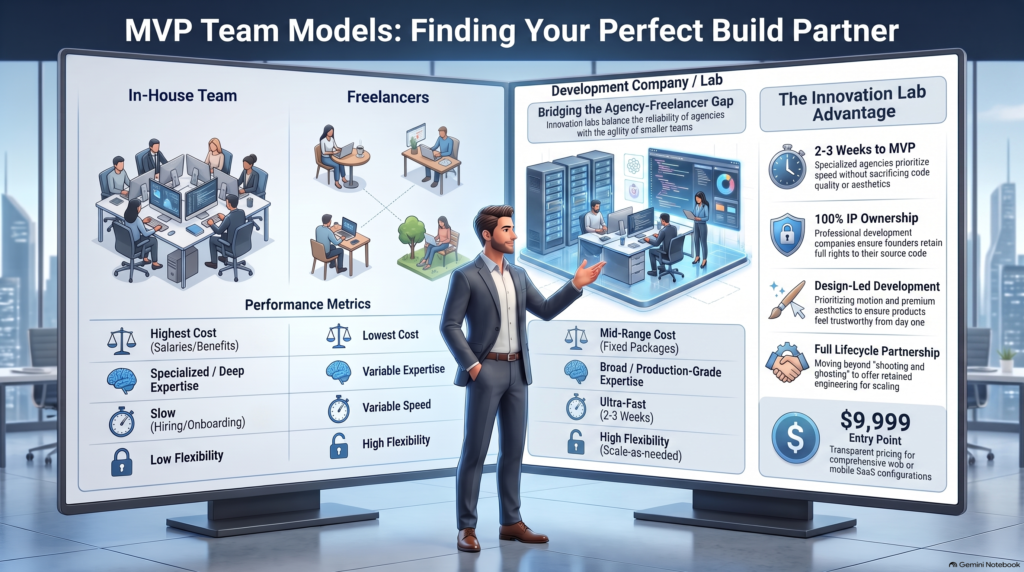
Before you hire an MVP development team, you need to know which structure actually fits your stage. There isn’t one right answer — there’s one right answer for your budget and timeline.
Freelancers. Cheapest hourly rate, highest coordination risk. Works for a single, narrow feature — not a full product build, and rarely includes design or QA.
Dedicated MVP developers (staff augmentation). You hire dedicated MVP developers who plug directly into your process and tools. Good when you already have a technical lead managing day-to-day decisions.
MVP development agency. You hire an MVP development team with a project manager, designer, and engineers bundled together. Best when you have zero in-house technical oversight and need a single point of accountability.
In-house hire. Full control, full cost — salary, benefits, equipment, and months of ramp-up before anyone ships production code.
Each model shifts risk differently, and each shifts cost differently too. A freelancer looks cheap per hour but often costs more once you factor in the founder-hours spent managing them.
Our breakdown of in-house vs outsourced MVP development covers every variation, including offshore shops and staff-augmentation hybrids, in more depth than we can fit here.
Pricing Models: Fixed Price vs Time & Material vs Dedicated Team
Once you’ve picked a hiring model, you’ll still need to choose how you pay for it. This decision affects your overpaying risk almost as much as the vendor you choose.
Fixed price. You agree on a scope and a total cost upfront. Best for a well-defined MVP where requirements won’t shift much — protects your budget but punishes scope changes.
Time & material. You pay for actual hours worked, with more flexibility to adjust scope mid-build. Higher overpaying risk if there’s no cap or milestone structure attached.
Dedicated team model. You pay a monthly rate for a committed team capacity, similar to hiring in-house but without the overhead. Works well for MVPs that will keep evolving post-launch.
Most seed-stage founders do best with a hybrid: fixed price for the initial MVP scope, converting to a dedicated team or time & material model once you’re iterating post-launch.
Step-by-Step: How to Hire an MVP Development Company
This is the exact sequence that keeps a hiring decision from turning into an overpriced mess.
Step 1: Define Scope Before You Contact Anyone
Write down the three to five features that actually validate your idea. Nothing else belongs in version one.
Vague briefs are the single biggest reason MVP budgets balloon. Vendors quote high when they can’t pin down what “done” looks like, because uncertainty gets priced in as risk.
Put your scope in writing — even a one-page document — before your first vendor call. It turns a vague conversation into a real quote.
If you’re unclear on what counts as core versus nice-to-have, our guide on what is an MVP in startups walks through scoping a first version properly.
Step 2: Set a Realistic Budget Band
Get familiar with market rates before you talk to a single vendor. In India, a lean MVP typically runs $5,000–$60,000 depending on complexity — see the full MVP development cost in India breakdown for a feature-by-feature estimate.
Knowing the real range stops you from anchoring to either extreme — a suspiciously cheap quote or an inflated enterprise-agency number.
A budget band also gives you leverage in negotiation. Vendors quote differently when they know you’ve done your homework versus when they know you haven’t.
Step 3: Build a Shortlist of 3–5 Vendors
Cast a wide net, then narrow fast. Search directories, ask founder communities, and check who’s actually shipped MVPs in your industry before you hire an MVP development company blindly off a Google search.
Our list of the best MVP development companies for startups is a solid starting point if you want vetted names instead of a cold search.
Don’t stop at generic listings — cross-check candidates against a platform like Clutch for verified client reviews and delivered project history.
Three to five is the sweet spot. Fewer, and you have no real comparison; more, and vetting eats the time you should be spending building.
Step 4: Vet Dedicated MVP Developers Properly
This is where most founders rush. A polished homepage tells you nothing about how a team handles a missed deadline or a scope change mid-build.
Ask for a portfolio of shipped — not just designed — MVPs. Ask who specifically will work on your build, not just who’s on the sales call.
Look for evidence of process: how they handle standups, how they report progress, and what happens when a feature turns out harder than expected.
Use a structured checklist rather than winging it — our full set of questions to ask before hiring an MVP development company covers background checks, sales-call red flags, and contract clauses in one place.
Step 5: Compare Proposals Apples-to-Apples
Line up every quote against the same scope document. A $12,000 quote and a $40,000 quote for “the same MVP” usually aren’t actually scoped the same way.
Ask each vendor to break the number into design, backend, frontend, QA, and post-launch support. Hidden line items are where overpaying starts.
If a vendor won’t itemize their quote, treat that as information — a team confident in its pricing usually explains it without hesitation.
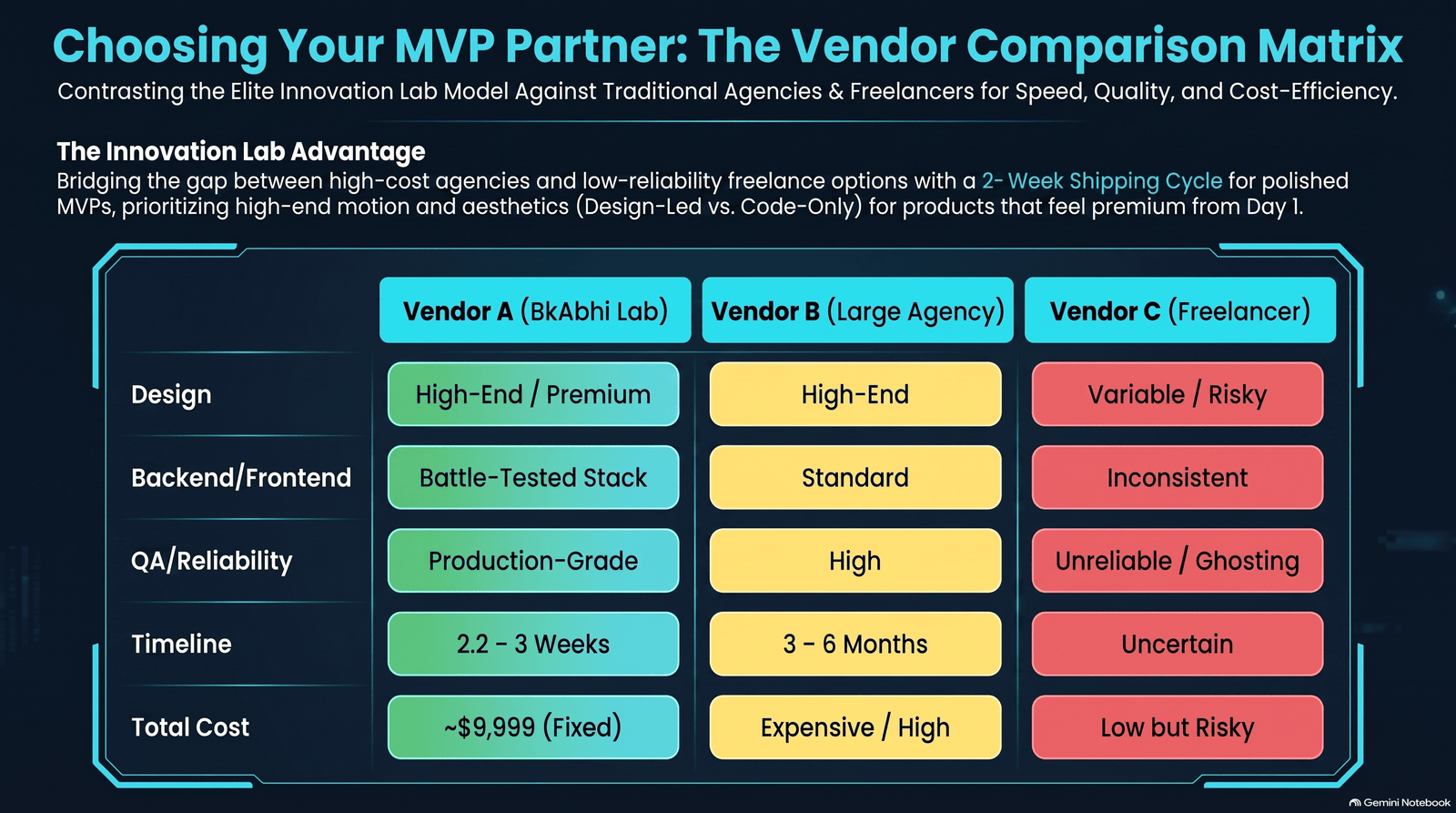
If you want a side-by-side framework, this MVP development company comparison guide breaks down exactly what to weigh beyond price.
Step 6: Negotiate Milestones, Not Just Price
Push for milestone-based payments tied to working deliverables, not calendar time. Never pay more than 30–40% upfront, regardless of how small the vendor is.
Lock the scope document into the contract itself, with a defined process for handling change requests and their cost. This is what actually prevents overpaying mid-project.
Also confirm IP ownership terms in writing — you should own the code, designs, and any accounts created on your behalf, no exceptions.
Step 7: Start With a Paid Pilot Sprint
Before committing to a full build, run a one- to two-week paid pilot on a small, contained feature. It reveals communication style, code quality, and pace — cheaply.
If the pilot goes badly, you’ve lost a small sprint fee, not your entire seed round. If it goes well, you move into the full engagement with real confidence instead of a sales pitch.
Regional Cost Comparison
Where a team is based changes the number significantly, though not always in the direction founders assume. Location affects overhead, not necessarily quality.
| Region | Typical Hourly Rate | Typical MVP Range |
|---|---|---|
| United States | $100–$200/hr | $80,000–$150,000+ |
| Western Europe | $70–$150/hr | $60,000–$120,000 |
| Eastern Europe | $40–$80/hr | $30,000–$70,000 |
| India | $20–$50/hr | $5,000–$60,000 |
| Latin America | $35–$70/hr | $25,000–$65,000 |
These ranges shift with complexity, so treat them as a starting reference, not a quote. A simple single-platform MVP will sit near the low end of any region’s range.
For a deeper look at vendor expectations and pricing specific to one of the most cost-efficient regions, our MVP development company India guide breaks it down further.
What Overpaying Actually Looks Like
Overpaying rarely shows up as a shocking single invoice. It shows up as scope creep billed at agency rates, rework from unclear specs, and a team that bills hours instead of milestones.
| Where the Money Leaks | Why It Happens | How to Prevent It |
|---|---|---|
| Scope creep | No locked feature list | Freeze scope before signing |
| Miscommunication rework | No single point of contact | Require one dedicated PM |
| Hourly billing drift | No milestone structure | Negotiate fixed-scope sprints |
| Over-engineered architecture | Team over-builds for “scale” you don’t need yet | Ask why each tech choice is necessary |
| No post-launch plan | Support treated as a separate, surprise cost | Confirm 30–90 days of support upfront |
Choosing the right tech stack also affects cost directly — an over-engineered stack inflates both build time and long-term maintenance. Our best tech stack for MVP development guide explains what’s actually necessary at MVP stage versus later.
Red Flags That Signal You’re About to Overpay
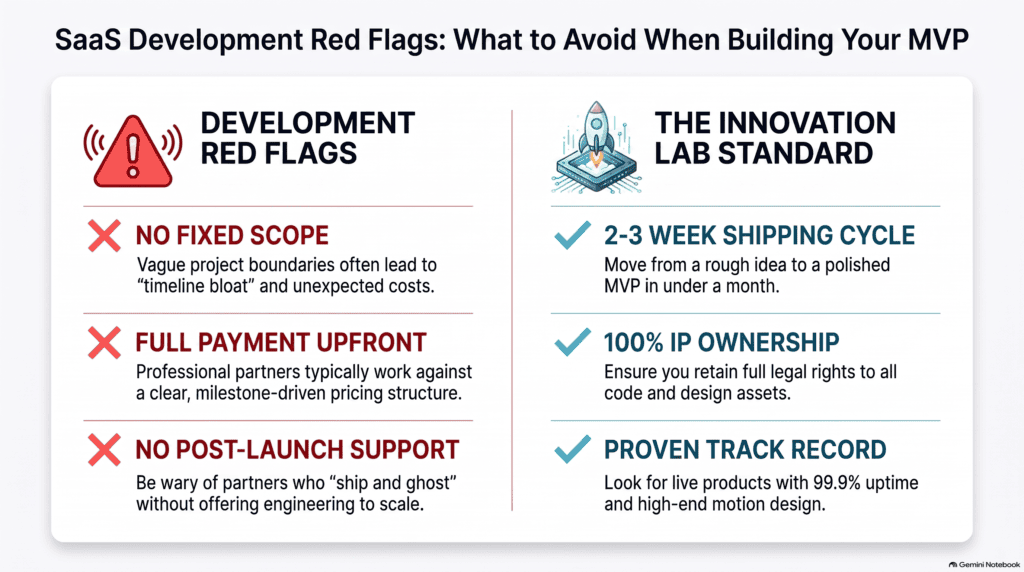
Watch for vendors who won’t commit to a fixed scope, refuse milestone payments, or dodge questions about who’s actually coding your product.
A quote that’s dramatically lower than every competitor is rarely a bargain — it’s usually a sign of hidden change-order fees later, or junior developers swapped in after the sales call.
Be equally cautious of vendors who oversell “enterprise scale” for a product that hasn’t found a single paying customer yet. That’s a sign they’re pricing for their comfort, not your stage.
We’ve catalogued the full list in 15 MVP development red flags to watch for before you sign — worth a read before any contract goes out.
Where to Hire MVP Builders, Ranked by Budget
Under $10K. Freelance platforms or a single skilled dedicated developer, best for a razor-thin single-feature MVP with an already-technical founder overseeing it.
$10K–$40K. A specialized MVP development agency working fixed-scope, fixed-timeline packages — the sweet spot for most seed-stage founders hiring their first team.
$40K–$100K+. Established agencies with heavier process, security review, and QA — worth it once you’re handling real user data or payments.
$100K+. Enterprise development shops or a growing in-house team, typically appropriate only past product-market fit, when reliability matters more than speed.
If you’re weighing this decision alongside building in-house versus with an agency long-term, our MVP development agency vs. in-house team comparison is worth reading before you commit either way.
How BkAbhi Approaches Hiring an MVP Development Team
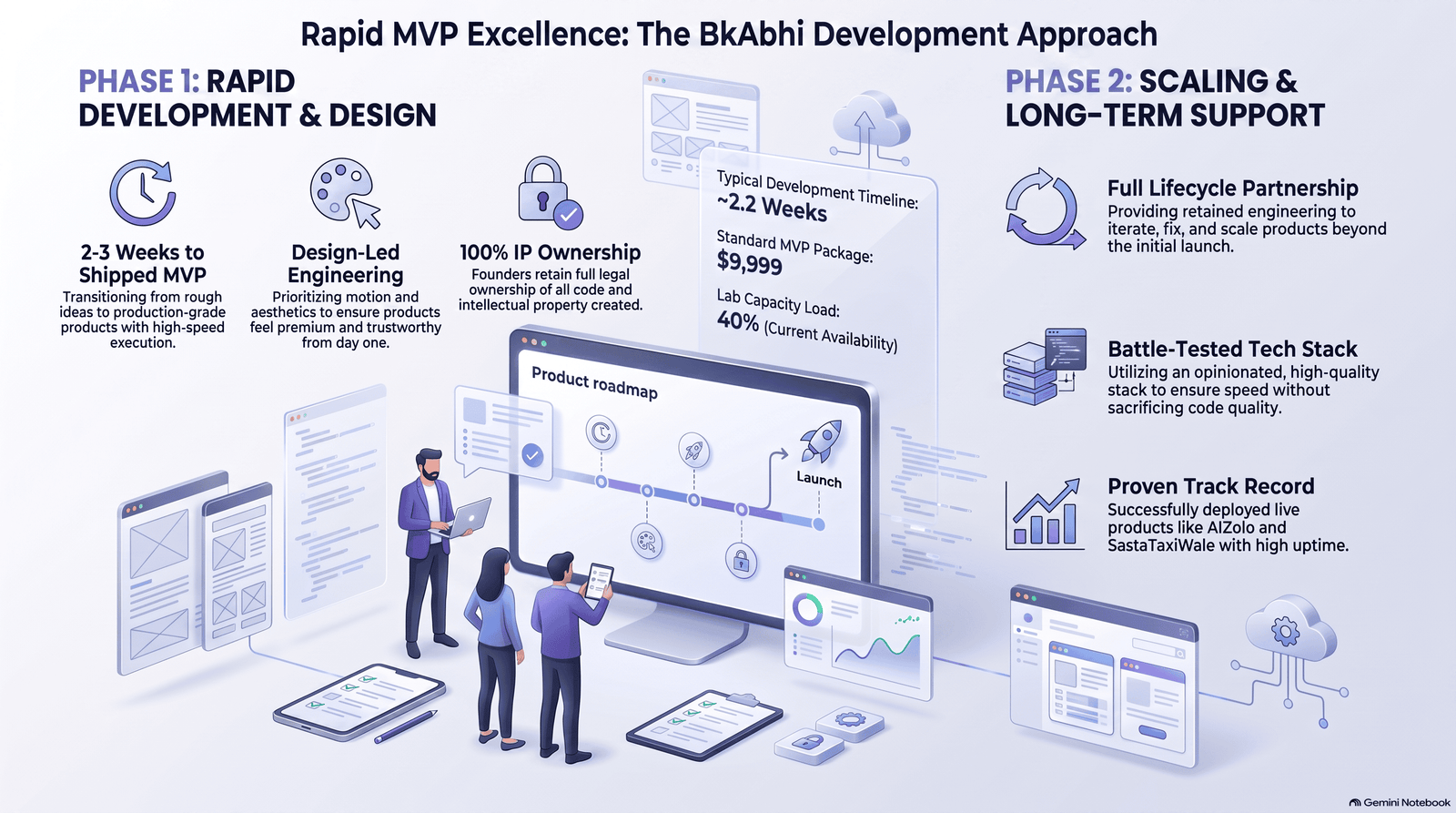
At BkAbhi, the pricing model is built around the exact overpaying risks covered above: fixed-scope, fixed-timeline engagements with milestone-based payments instead of open-ended hourly billing.
Every build runs on weekly progress demos, so you see working software instead of status update emails. Packages are startup-optimized rather than repurposed enterprise pricing, and post-launch support is included instead of billed as a surprise later.
You can see the current feature set and packages on the BkAbhi homepage, including the latest additions to how projects are scoped and delivered.
Frequently Asked Questions
How much does it cost to hire an MVP development company? Most lean MVPs run $5,000–$60,000 depending on feature count, platform, and vendor location, with $15,000–$40,000 being typical for a seed-stage founder’s first build.
Should I hire dedicated MVP developers or a full agency? Hire dedicated MVP developers if you already have technical leadership in-house; hire a full MVP development team (agency) if you need project management and design bundled in too.
How do I avoid overpaying an MVP development company? Lock scope before signing, insist on milestone-based payments, run a small paid pilot first, and compare at least three vendor quotes broken down line-by-line.
How long does it take to hire an MVP development team? A structured process — shortlisting, vetting, and running a pilot sprint — typically takes two to four weeks before a full contract is signed.
Is the cheapest MVP development company usually the best deal? Rarely. Unusually low quotes often hide change-order fees, skipped QA, or junior developers assigned after the sales call — verify scope depth before comparing price alone.
What questions should I ask before hiring MVP builders? Ask who specifically works on your build, how change requests are billed, what post-launch support is included, and for examples of shipped — not just designed — products.
Can I hire an MVP development team on a fixed budget with no flexibility? Yes, but be explicit about it upfront. A fixed-price, fixed-scope engagement is the safest structure for a hard budget cap, as long as the scope document is locked before signing.
What’s the biggest mistake founders make when they hire an MVP development company? Choosing a vendor before defining scope. Every other mistake on this list — scope creep, hourly billing drift, hidden fees — traces back to that first rushed decision.
Final Thoughts
Hiring an MVP development company doesn’t have to feel like a gamble. A locked scope, a realistic budget band, a short vendor shortlist, and a paid pilot sprint remove almost all the guesswork.
The founders who overpay aren’t the ones with bad luck — they’re the ones who skipped the process above. Follow it, and the price you agree to when you hire your MVP development team is the price you actually pay.
Author Bio
Jeevesh Tripathi is a researcher and writer specializing in startup product development, MVP strategy, and software vendor evaluation. His work focuses on helping early-stage founders make evidence-based hiring and budgeting decisions rather than relying on agency sales pitches.
Contact: jeevesh@bkabhi.com