
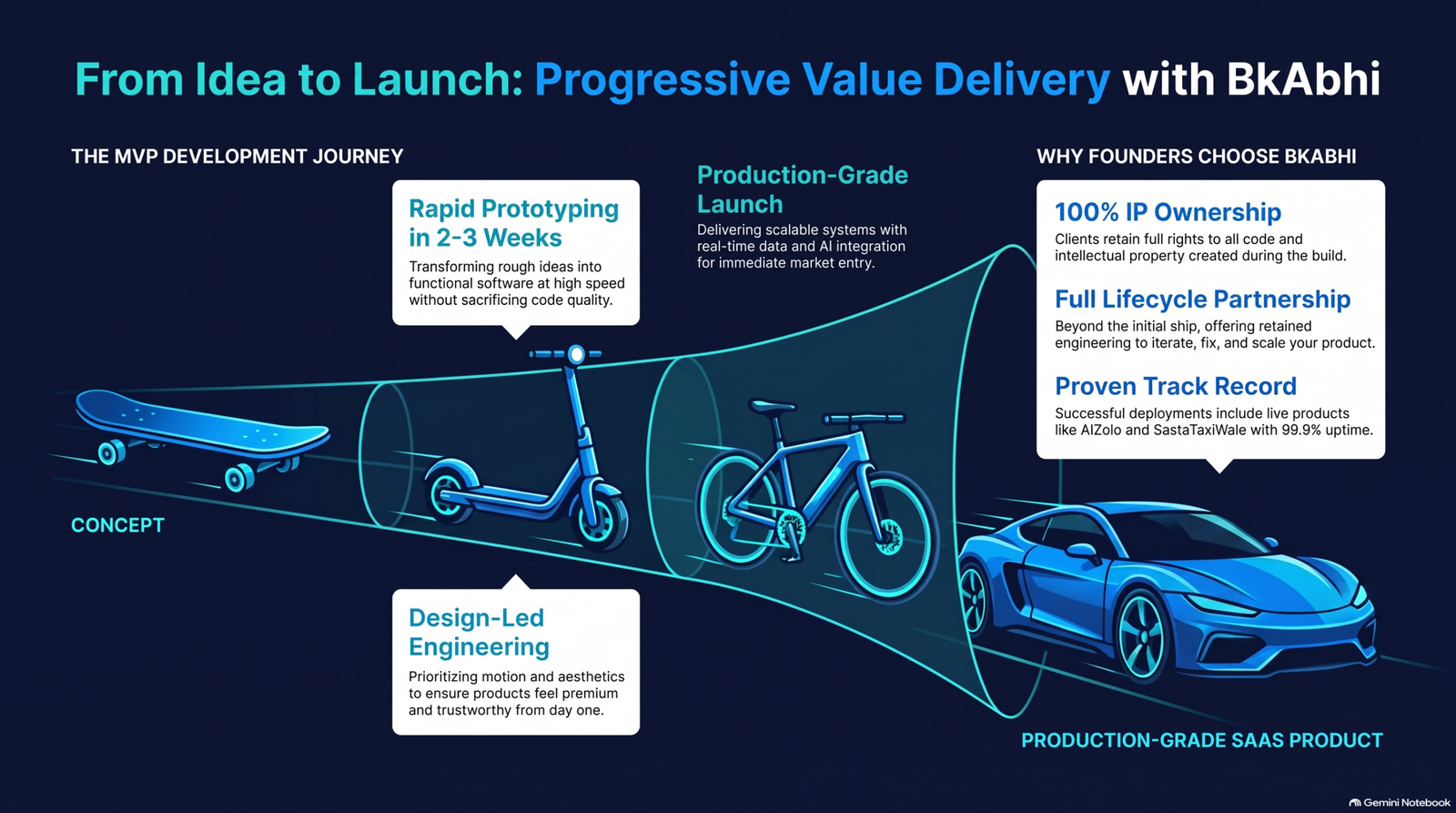
Quick Answer: The MVP vs full product development decision comes down to risk. If you haven’t proven anyone wants your product, build an MVP. If you have early traction and need to look credible to paying customers, build an MMP. Only move to a full product once you have repeatable revenue and a validated roadmap. BkAbhi can help startups take this step-by-step approach, focusing on validating the product before investing heavily in full-scale development.
Most founders skip straight to imagining a polished app with every feature they can think of. That instinct is expensive, and it’s usually the wrong first move.
This guide breaks down MVP vs MMP vs full product in plain terms, and gives you a practical framework for deciding when to build full product vs MVP for your own startup.
Table of Contents
What Is an MVP?
An MVP, or minimum viable product, is the smallest version of your idea that still solves one real problem for one real user group. It exists to test a hypothesis, not to impress anyone.
Product leader Marty Cagan of the Silicon Valley Product Group has long pointed out that MVP definitions range from a tiny experiment testing one hypothesis all the way to a near-complete realization of the product vision, which is exactly why so many teams get confused about scope.
In practice, a good MVP has three qualities: it works, it’s narrow, and it produces a clear signal. If people won’t use it or pay for it, you’ve learned something valuable before spending six figures.
We cover this in more depth in our guide on what an MVP actually means for early-stage startups, including how it differs from a prototype or proof of concept.
What Is an MMP?
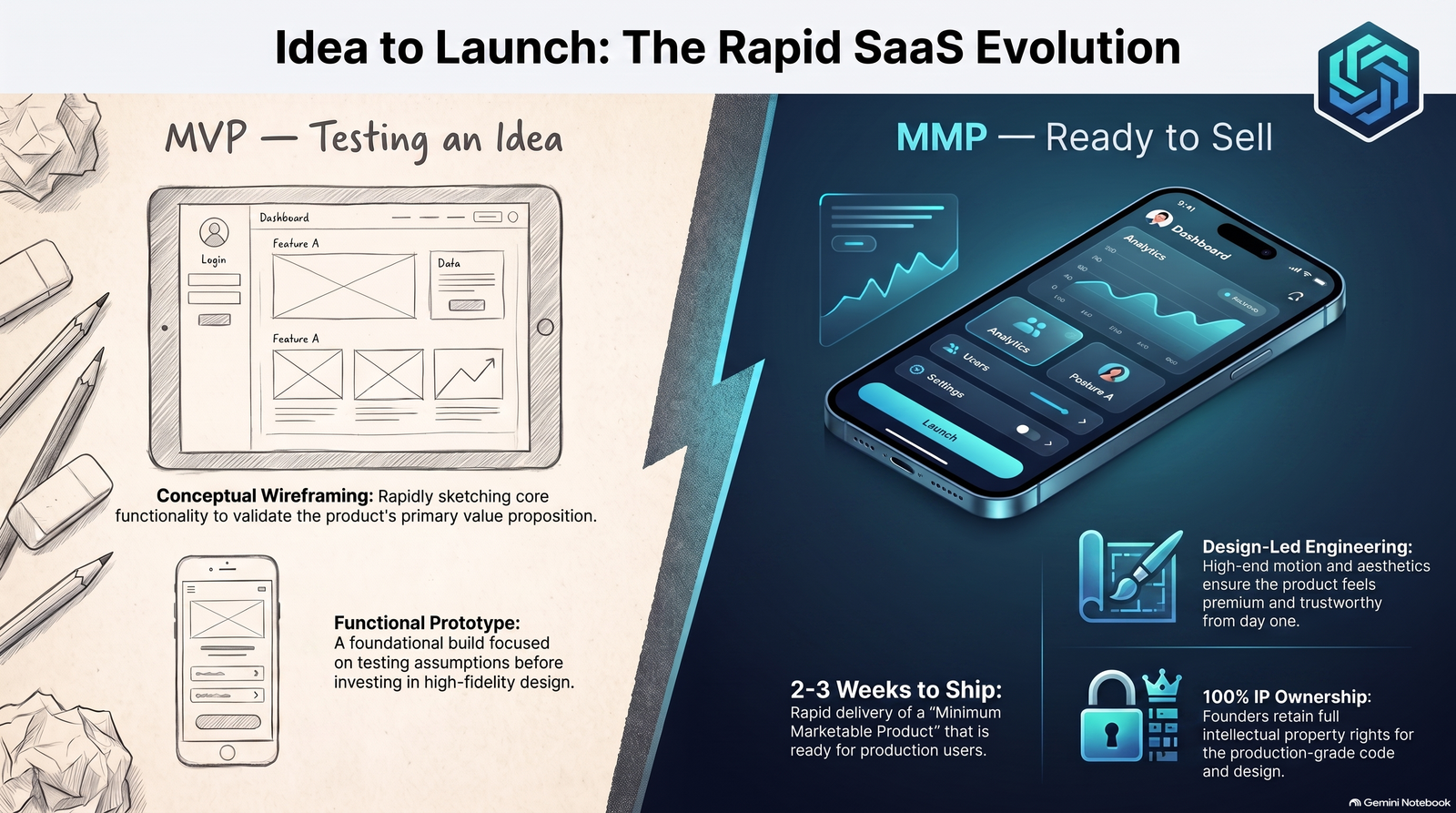
A minimum marketable product, or MMP, sits between an MVP and a full product. It’s the first version that’s actually ready to sell, not just ready to test.
Where an MVP validates whether users want something, an MMP validates whether the market will pay for it at scale. It needs a usable interface, dependable performance, and enough features that a stranger — not just an early adopter who forgives rough edges — would choose it.
Think of Dropbox’s early file-sync release or Trello’s original card-and-board system. Neither had every feature they have today, but both were polished enough to be sold and marketed to a general audience.
If you’re still comparing this stage to a prototype or proof of concept, our breakdown of MVP vs prototype vs POC walks through where each one fits in the build order.
What Is a Full Product?
A full product is the complete, mature version of your offering — the one with the feature depth, integrations, admin tooling, and edge-case handling that a scaled business needs.
This is where you build the settings panel nobody asked for in month one, the enterprise SSO login, the analytics dashboard, and every “nice to have” that got cut earlier. It’s expensive, and that’s exactly why it should come last.
Jumping straight to a full product before validating demand is one of the most common reasons early-stage budgets run out before product-market fit is found. Our piece on MVP development red flags covers how this overbuild trap usually starts.
MVP vs MMP vs Full Product: Side-by-Side Comparison
| Factor | MVP | MMP | Full Product |
|---|---|---|---|
| Goal | Validate the idea | Validate the market | Scale the business |
| Audience | Early adopters | General early customers | Mass market / enterprise |
| Feature set | Bare minimum, one core loop | Core value + polish | Complete, feature-rich |
| Typical cost (India) | $5,000–$20,000 | $20,000–$60,000 | $60,000–$150,000+ |
| Timeline | 4–8 weeks | 2–4 months | 6–12+ months |
| Risk if skipped | You build blind | You launch unsellable | You never launch at all |
For a deeper cost breakdown specific to region and team structure, see our guide on MVP development cost in India or MVP development cost in the USA.
Key Differences That Actually Matter
The MVP vs MMP vs full product comparison isn’t really about feature count. It’s about what question each stage is trying to answer.
An MVP asks: does this problem matter enough for someone to try a rough solution? An MMP asks: will a stranger pay for this without me convincing them personally?
A full product asks a different question entirely: can this business support the complexity, support tickets, and edge cases of scale? Skipping straight to that question without answering the first two is how founders burn runway building features nobody uses.
Research from LogRocket’s product management team makes the same point a different way: an MVP validates assumptions about users, while an MMP validates assumptions about the market — a distinction worth sitting with before you scope your next sprint.
When to Build an MVP
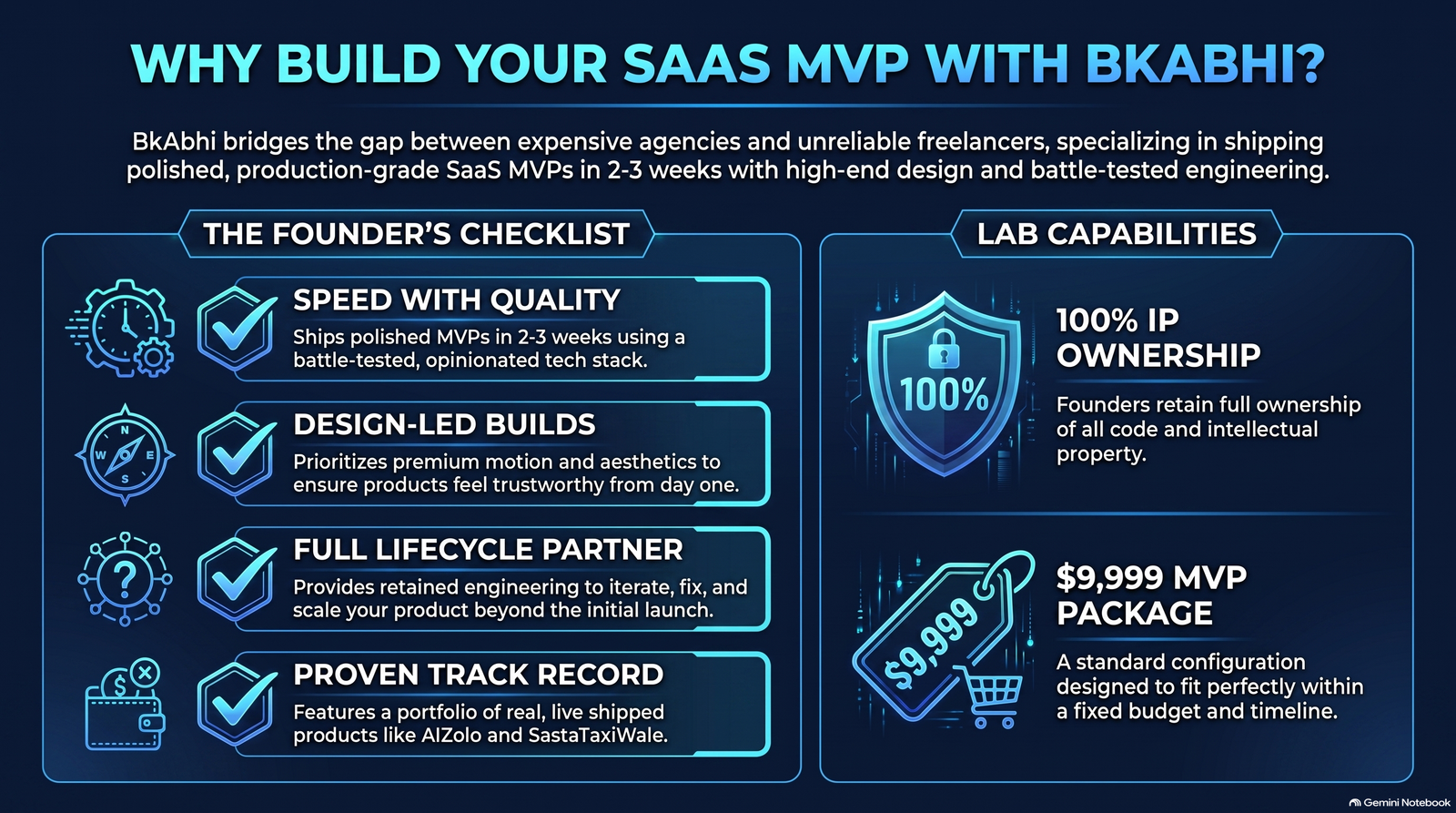
Build an MVP when you genuinely don’t know if people want what you’re proposing. This applies almost every time, regardless of how confident you feel about the idea.
Signs it’s the right stage for you:
- You have a hypothesis but zero paying users
- You’re pre-seed, bootstrapped, or protecting limited runway
- You need investor traction data, not investor-ready polish
- Your biggest risk is “will anyone use this,” not “can we scale this”
No-code and low-code tools have made this stage faster than ever. Our guide on no-code MVP development explains exactly when skipping custom code makes sense — and when it doesn’t.
When to Build an MMP
Build an MMP once your MVP has produced a real signal — people are returning, referring others, or asking to pay. Now the question shifts from “does this work” to “can I sell this.”
Signs it’s the right stage for you:
- Your MVP has active repeat users, even a small number
- You’re preparing for a public launch, Product Hunt, or paid acquisition
- Early users are asking for a version they can recommend to colleagues
- You need something demo-ready for a seed or Series A raise
This is usually where founders start weighing in-house vs outsourced MVP development, since the team and skill set needed to polish a product for market differs from the team that built the first rough version.
When to Build a Full Product
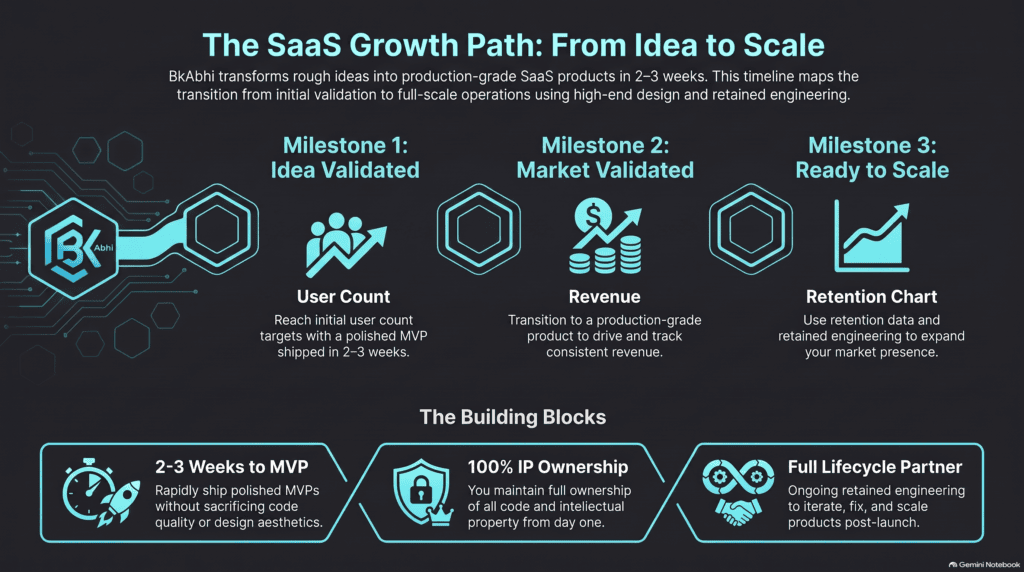
Build a full product only once you have consistent, repeatable demand and a roadmap validated by real usage data — not assumptions.
Signs it’s the right stage for you:
- You have paying customers and predictable retention
- Support requests are pointing to specific, recurring feature gaps
- You’re closing enterprise deals that require compliance, SSO, or uptime guarantees
- Your unit economics justify the investment in scale infrastructure
If you’re not sure whether your current build path fits this stage, our MVP development process guide explains how each phase should feed into the next one instead of jumping stages.
Team and Resourcing Needs at Each Stage
The team you need changes as much as the product does. Trying to staff a full-product team for an MVP wastes money you haven’t earned back yet.
MVP stage: One or two full-stack developers, a founder acting as product owner, and occasionally a designer for the core flow. Speed matters more than specialization here.
MMP stage: Add a dedicated UI/UX designer, a QA function (even part-time), and someone thinking about onboarding and activation. This is where the product starts feeling like a real business, not an experiment.
Full product stage: Dedicated engineering pods, a product manager, customer success, DevOps for reliability, and often a data or analytics function to guide the roadmap with real usage patterns.
This is also usually the point where founders start asking questions to ask before hiring an MVP development company, since the vetting criteria for a fast MVP partner differ from what you’d want in a long-term, full-product engineering team.
Comparing a few vendors side by side helps here too — see our MVP development company comparison for a framework on evaluating pricing models, delivery speed, and post-launch support.
How Long Should Each Stage Realistically Take?
Timelines get abused constantly in this industry, so it’s worth being blunt about what’s realistic.
A focused MVP should take four to eight weeks with a small, dedicated team. If it’s taking three months, scope has probably crept beyond what “minimum” was supposed to mean.
An MMP typically runs two to four months, since it needs real design polish, basic QA cycles, and usually a payment or onboarding flow that didn’t exist in the MVP.
A full product build is open-ended by nature — six to twelve months for a first mature release is common, with continuous development after that as the roadmap evolves based on usage data.
If your current build is dragging past these windows, it’s worth revisiting our full breakdown of the MVP development process to see where scope might be quietly expanding.
Real-World Examples of the Progression
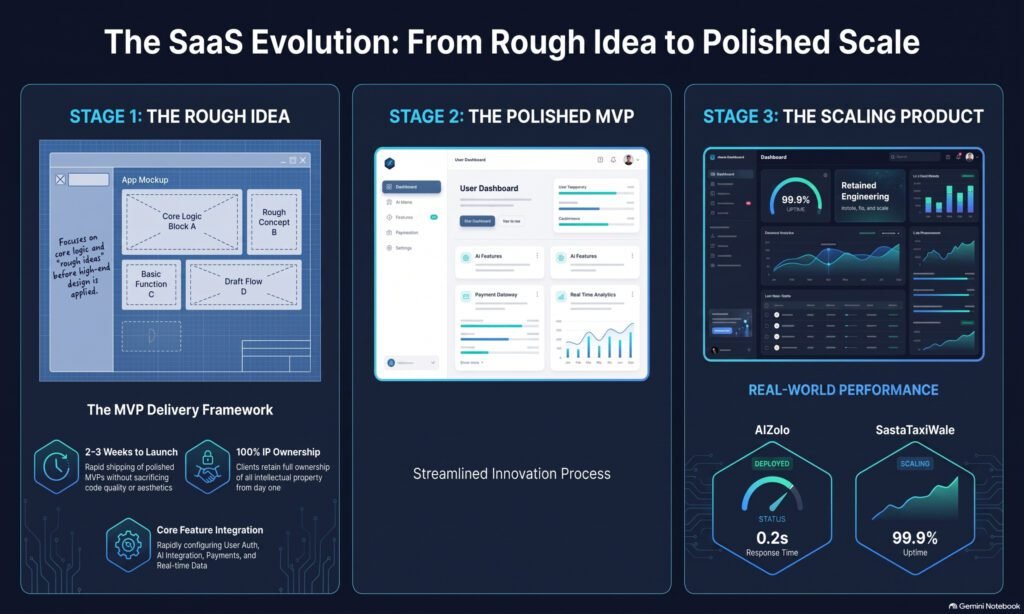
Airbnb’s earliest version was two founders renting air mattresses on their apartment floor with a basic listing page — a true MVP with no polish, just a test of demand.
Instagram’s MMP stage stripped a bloated check-in app called Burbn down to just photo sharing and filters, the one feature people actually used, before it ever tried to be a full social network.
Slack began as an internal tool inside a gaming company before becoming the full-featured, enterprise-ready platform it is today — a multi-year evolution, not a single launch.
Common Mistakes Founders Make at Each Stage
The most common mistake is treating “MVP” as a synonym for “cheap full product.” Cutting corners on a full feature set isn’t the same as building a focused, validated MVP.
The second mistake is staying in MVP mode too long. If you’ve validated demand but keep polishing instead of monetizing, you’re delaying the MMP stage out of fear, not strategy.
The third is jumping from MVP straight to full product, skipping the MMP stage entirely. This usually happens when founders confuse investor pressure with market readiness. Our guide on MVP development company reviews covers how to vet a build partner who understands this staged approach rather than pushing you toward the biggest possible scope.
Content cannibalization is a related trap worth mentioning for teams publishing on this topic: don’t create five near-duplicate articles targeting the same “MVP vs full product” intent across your blog. Consolidate the comparison into one authoritative page, like this one, and link out to deeper dives on cost, process, or tech stack instead of repeating them.
A Simple Decision Framework
Ask three questions before you write a single line of scope for your next build phase.
Have I proven demand exists? If no, stay in MVP mode regardless of how much funding you have.
Can strangers use this without me explaining it? If no, you’re not ready for an MMP launch yet — the product still needs guided hand-holding.
Do I have data telling me exactly what to build next? If no, you’re not ready for a full product. Guessing at scale is far more expensive than guessing at MVP stage.
Choosing the right tech stack for MVP development early also matters here — a stack that’s easy to extend saves you from a costly rebuild when you move from MVP to MMP to full product.
How BkAbhi Approaches This With Founders
At BkAbhi, the starting conversation with any founder is never “what features do you want” — it’s “what are you trying to prove right now.” That single question decides whether the right build is an MVP, an MMP, or a scoped full product release.
The team works in fixed-scope, milestone-based sprints so you’re not paying for full-product complexity when what you actually need is a fast, testable MVP. You can see how this plays out across real engagements on the BkAbhi homepage, including current service offerings and delivery approach.
If you’re specifically weighing whether to hire in-house or bring in a specialized partner for this stage, our comparison of MVP development agency vs in-house team lays out the trade-offs by founder situation.
Frequently Asked Questions
Is an MMP always required between MVP and full product? Not always. Some products with obvious, immediate value (a simple utility app, for instance) can move from MVP straight to a scoped-down full product. But for most software with a learning curve or ongoing switching costs, the MMP stage reduces risk significantly.
How do I know if my MVP has “proven” the idea? Look for behavior, not opinions. Repeat usage, unprompted referrals, or people offering to pay are far stronger signals than survey responses saying they “would” use it.
Does MVP vs full product development apply to non-software products? Yes. Physical products, services, and marketplaces all follow the same logic — Airbnb’s earliest MVP wasn’t software at all, it was two air mattresses and a listing page.
What’s the biggest cost risk in skipping straight to a full product? Building features based on assumptions instead of usage data. You end up paying full-product prices for a product that still needs MVP-stage validation, which is the most expensive way to learn you built the wrong thing.
Can I reuse my MVP codebase for the MMP and full product? Sometimes, but not always — it depends on whether your MVP was built with scalable architecture in mind or was a disposable test. This is why choosing your initial tech stack carefully matters, even at the MVP stage.
Who should decide when to move from one stage to the next? Ideally, this is a joint call between founders and whoever is building the product, based on defined success metrics agreed on before development starts — not a gut feeling made mid-sprint.
Should I outsource the MVP stage or hire in-house from day one? For most pre-seed founders, outsourcing to a specialized MVP partner is faster and cheaper than hiring in-house, since you avoid the overhead of full-time salaries before you’ve validated demand. Our comparison of in-house vs outsourced MVP development breaks down every option, including freelancers, agencies, and offshore teams.
Does the MVP vs MMP vs full product framework differ by industry? The stages stay the same, but the depth required at each one shifts. A fintech or healthtech MVP often needs more compliance groundwork even at the earliest stage, while a simple SaaS tool can move faster. Our guide on MVP development for SaaS, fintech, and healthtech startups covers these industry-specific differences in detail.
Final Thoughts
The MVP vs full product development question isn’t about which one is “better.” It’s about matching your build investment to how much you’ve actually proven.
Start small enough to be wrong cheaply. Scale only once the market has told you, through real behavior, that scaling is worth the cost.
If you’d like a second opinion on which stage your idea is actually at, our team walks founders through this exact framework before writing a single line of code — you can explore current MVP and product strategy services on BkAbhi.
Author Bio
Jeevesh Tripathi is a product strategy researcher and startup consultant specializing in MVP development, lean product methodology, and early-stage go-to-market decisions. He has advised founders across SaaS, fintech, and healthtech on how to sequence product builds to conserve runway and reach validated learning faster.
📧 Contact: jeevesh@bkabhi.com