
Artificial Intelligence is much more than simply adding an API to your application. You’ll need a dependable software foundation, an appropriate AI model, safe data, user management and integration for testing and sustainable business model.
An AI SaaS development company will help you plan, design, build, integrate and maintain products using artificial intelligence.
Not all SaaS development companies will have the engineering experience to develop live AI applications, and AI model companies may lack the knowledge of building a full subscription based software platform.
By analysing the features and capabilities of a development company you can ensure you pick the correct one.
In this guide we’ll look at what AI SaaS development is, compare your options for development partners, look at key technologies and provide a practical way to assess companies.
Table of Contents
What Is an AI SaaS Development Company?
An AI SaaS development company is a software engineering provider that builds Software-as-a-Service products incorporating artificial intelligence capabilities.
Applications are typically deployed in the cloud. This means the customers can use the application via a web browser, mobile app or API.
AI powered SaaS applications can leverage Machine Learning, Large Language Models, Natural Language Processing, Predictive Analytics and automation to complete more complex tasks than typical SaaS products that use business rules.
For example, consider a customer support SaaS platform.
A traditional ticketing system could help your business manage, assign and keep track of conversations. With AI technology you can summarise conversations, provide suggested replies, categorise tickets and search for information within your company’s knowledge base.
The underlying SaaS platform still handles authentication, permissions, subscriptions, customer records, and reporting. AI adds another capability to the existing product.
What Does an AI SaaS Development Company Actually Build?
The scope depends on the product and its requirements. Common development responsibilities include:
- SaaS product strategy and technical planning.
- Web application and mobile application development.
- AI model and API integration.
- LLM-powered applications and assistants.
- Retrieval-augmented generation (RAG).
- AI chatbot and conversational interfaces.
- AI agent and workflow automation.
- Database and cloud infrastructure.
- Multi-tenant SaaS architecture.
- Subscription and usage-based billing.
- Application security and monitoring.
- AI evaluation and ongoing maintenance.
A development partner should not recommend every technology for every project. The architecture should follow the actual business problem.
AI SaaS Development vs Traditional SaaS Development

The biggest difference is how the application processes information and produces results.
Traditional SaaS applications generally use predefined application logic, database queries, and business rules. AI SaaS products introduce models that can interpret information, generate content, identify patterns, or recommend actions.
| Comparison factor | Traditional SaaS | AI-powered SaaS |
| Application logic | Predefined rules | Rules combined with AI models |
| Data processing | Structured queries and workflows | Structured and unstructured data |
| User interaction | Forms, dashboards and commands | May include natural-language interaction |
| Output | Usually predictable | Can vary between requests |
| Testing | Functional and integration tests | Functional tests plus AI evaluations |
| Operating costs | Infrastructure and application usage | Infrastructure plus model and AI service usage |
| Security | Application and database security | Additional AI-specific security concerns |
| Maintenance | Software updates and infrastructure | Software, models, prompts and data pipelines |
These are general differences, not absolute rules. Traditional SaaS can process unstructured data, and AI applications still need deterministic business logic.
An AI model may suggest that a customer should be placed on a subscription plan, however the application should perform its own checks on the permissions of the customer and calculate what they should be charged.
This is important so that AI outputs do not control critical business processes.
Types of AI SaaS Products Development Companies Build
AI can support different product categories depending on the problem being addressed.
1. AI Chatbot and Customer Support SaaS
These applications help businesses manage customer conversations and support operations.
Typical capabilities include:
- Automated responses to common questions.
- Knowledge-base search.
- Conversation summaries.
- Ticket categorization.
- Suggested customer support responses.
- Integration with CRM and helpdesk platforms.
Chatbots can become much more effective if they can access accurate data from vetted business documents.
2. AI Content Generation SaaS
Content-generation applications help users create or transform written material.
Examples include:
- Marketing copy generators.
- Product description generators.
- Email writing applications.
- Social media content tools.
- Document summarization platforms.
- AI-powered editing applications.
These products need to be monitored to ensure high quality outputs, user controls, version control, restrictions and model costs.
3. AI Analytics and Business Intelligence SaaS
AI analytics products help users understand business information and identify patterns.
Possible features include:
- Natural-language data queries.
- Automated report summaries.
- Trend identification.
- Forecasting.
- Anomaly detection.
- Business performance insights.
There should be controls set up within the application to ensure that data is restricted before being sent to the AI model. Insights should never be provided to users based on data that they do not have permission to access.
4. AI Workflow Automation SaaS
Workflow automation platforms use AI to interpret information and assist with business processes.
An application may extract data, help to categorise requests and prepare tasks for employees to approve.
More complex applications can integrate with other tools. When dealing with payments, account modifications and sensitive records it is important that there are clear processes and permissions for who can do what.
5. AI Knowledge Management SaaS
These applications help organizations search, organize, and retrieve internal information.
Common use cases include:
- Internal company knowledge assistants.
- Document search platforms.
- Policy and procedure assistants.
- Research tools.
- Enterprise knowledge bases.
RAG is particularly suitable if the application needs to access information from private or frequently changing documents.
Core Technologies Used in AI SaaS Development
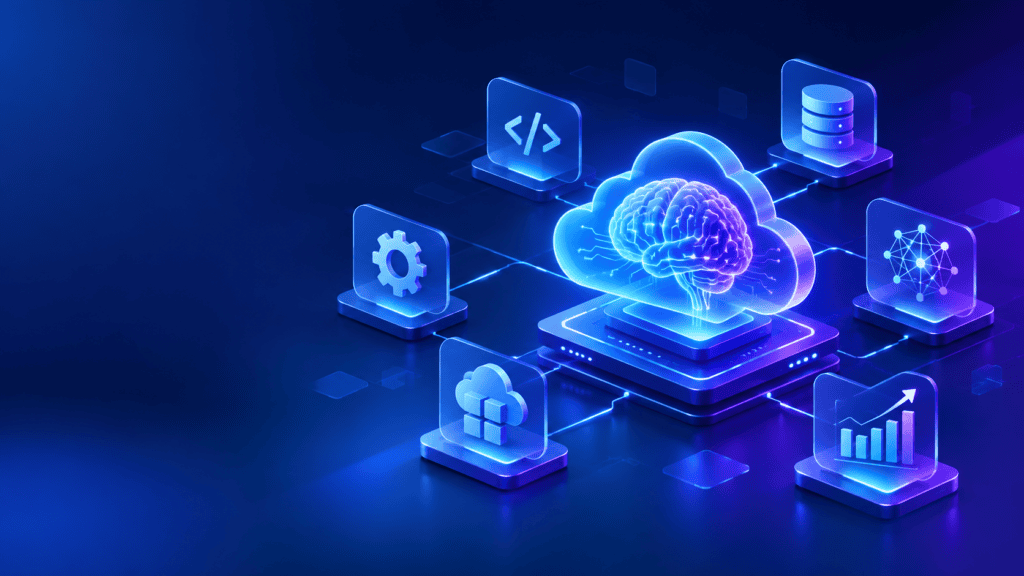
A development company should select its technology stack according to the product’s functionality, expected workload, data requirements, and maintenance needs.
Large Language Models (LLMs)
Large language models process and generate natural-language responses.
They can support chat interfaces, summarization, classification, information extraction, and content generation.
A development team may integrate a model through a hosted API or use an appropriately deployed model within its own infrastructure.
Model selection should consider:
- Response quality.
- Context requirements.
- Latency.
- Cost per request.
- Data processing policies.
- Available integration features.
- Model availability and portability.
Using a more capable model for every request is not automatically the best architecture. Simple models and standard application logic can be used to perform some functions.
Retrieval-Augmented Generation (RAG)
Retrieval-augmented generation combines information retrieval with language-model generation.
Instead of asking a model to answer entirely from its existing knowledge, the application retrieves relevant information from an external knowledge source and includes it in the model’s context.
A simplified RAG workflow looks like this:
- A business uploads documents or connects a data source.
- The application extracts and processes the information.
- Documents are divided into searchable sections.
- User question is used to find relevant data.
- Context is passed to language model.
- Application returns an answer (with references where possible).
RAG is useful for private knowledge bases, internal documentation, product documentation, and customer support systems.
However, a vector database alone does not create a reliable RAG system. Data ingestion, search quality, metadata, access control, source recency and assessment are important.
AI Agents
AI agents combine model reasoning with access to defined tools or external systems.
An example of this would be an agent in a business operations application to get a customer’s order, compose a reply and create a support task.
Agents are able to interact with the systems.
That creates additional engineering requirements, including:
- Tool permissions.
- Input validation.
- Action limits.
- Error handling.
- Audit logs.
- Human approval.
- Recovery and rollback procedures.
Only the specific permissions needed should be provided.
AI APIs and Third-Party Integrations
AI SaaS applications frequently depend on external APIs for model access, document processing, communication, payments, and other services.
For example, an application might combine:
- An AI model API.
- A payment gateway.
- A CRM integration.
- Cloud storage.
- Authentication services.
- Analytics and monitoring tools.
The application should be able to deal with issues such as API errors, timeouts, rate limiting, secure credentials and changes to the providers requirements.
Cloud Infrastructure and Databases
AI SaaS products need infrastructure for application hosting, data storage, background processing, and model communication.
A typical technology stack may include:
| Layer | Possible technologies |
| Frontend | React, Next.js |
| Backend | Node.js, Python |
| Database | PostgreSQL, MongoDB |
| AI integration | Model provider APIs |
| Vector search | pgvector or dedicated vector databases |
| Infrastructure | AWS, Azure, Google Cloud |
| Background processing | Queues and asynchronous workers |
| Monitoring | Application logs, metrics and tracing |
These are examples rather than a mandatory stack. The company should explain how their proposed technologies will work within the project.
How AI SaaS Development Works: From Concept to Deployment.
Following a well thought-out development process ensures you have a minimum of wastage and choose the right AI architecture.
Step 1: Validate Your Business Problem
Define the problem your product is going to solve.
Determine:
- Who will use the application?
- What problem do they experience?
- How do they solve it today?
- Why would they pay for another solution?
- What can you really use this for?
For example, if you want an invoice processor using AI then before building it find out how many invoices your customers process, what information they want and where they are running into problems.
Ensure that there is a specific problem you want to solve.
Step 2: Define the MVP Scope
An AI SaaS MVP should include enough functionality to test whether customers find the product useful.
A document-processing MVP might include:
- User registration.
- Document uploads.
- AI-based information extraction.
- Results review.
- Basic usage tracking.
- Subscription or payment functionality, if required for the test.
You can add features like advanced team permissions, complex analytics and multiple integrations when you have validated demand for these features.
Step 3: Select the AI Architecture
The engineering team should decide whether the application requires:
- A hosted language model API.
- A custom machine-learning model.
- RAG.
- An AI agent.
- Traditional automation.
- A combination of these approaches.
Use your data, processes, accuracy and constraints to make an informed decision.
For a practical explanation of early-stage software planning, see BkAbhi’s guide to MVP development companies for startups.
Step 4: Design the SaaS Architecture
Your application will need a solid foundation.
Important components include:
- User authentication.
- Organization and account management.
- Tenant-level permissions.
- Database design.
- API architecture.
- Subscription management.
- Background jobs.
- Cloud deployment.
- Logging and monitoring.
Multi-tenancy requires that customer data stays isolated in accordance to the applications security model.
AWS provides a number of options for database isolation including separate infrastructure, separate schemata and shared structure with row level isolation. All have varying costs and complexities. AWS multi-tenant architecture guidance.
Step 5: Develop the Application and Integrate AI
Developers will build the front-end, back-end, database and integrations.
AI functionality is then connected to the relevant application workflows.
An example might be an AI support tool that pulls up customer support history, searches through approved documents and generates a suggested response.
The application should control which information reaches the model and which actions the model can request.
Step 6: Test AI and Application Functionality
AI functionality requires testing beyond whether an API returns a response.
Testing should examine:
- Response relevance.
- Factual accuracy.
- Retrieval quality.
- Unsupported answers.
- Incorrect document retrieval.
- Prompt injection.
- Sensitive information exposure.
- API failures.
- Response latency.
- Usage and cost limits.
Create representative test cases from actual product workflows. Re-run them when changing prompts, models, retrieval settings, or application logic.
Step 7: Deploy, Monitor and Improve
After testing, deploy the product to its production environment.
Post-launch responsibilities may include:
- Monitoring application errors.
- Tracking AI usage and cost.
- Evaluating output quality.
- Updating data sources.
- Managing model changes.
- Improving prompts.
- Fixing security issues.
- Collecting customer feedback.
AI SaaS development is an ongoing engineering process, not simply a one-time integration.
How to Choose an AI SaaS Development Company

Choosing a development partner requires more than comparing portfolios or hourly rates.
A company may have experience building AI prototypes but limited experience developing subscription-based software. Another person may know about SaaS engineering principles but not much about assessing outputs produced by AI.
Evaluate both sides.
1. Check Complete Product Engineering Experience
Ask whether the company can handle frontend development, backend systems, databases, APIs, authentication, deployment, and ongoing maintenance.
AI is only one part of a complete SaaS product.
2. Verify Relevant AI Experience
Ask for examples of projects involving the same type of AI functionality you need.
Experience with a chatbot does not automatically establish experience with RAG, AI agents, predictive models, or document-processing systems.
3. Evaluate Architecture Knowledge
Ask the team to explain:
- How customer data will be stored.
- How tenant isolation will work.
- How AI models will access information.
- How API failures will be handled.
- How usage will be measured.
- How the application will scale.
A great technical conversation will cover the design of the architecture.
4. Examine Security and Privacy Practices
Understand what happens to customer data, who it’s sent to & how access control is applied.
Check how authentication, encryption, access control, logging, retention & incident response is handled.
The OWASP Top 10 for Large Language Model Applications is a great source to learn about risks such as prompt injection, unsafe outputs, information disclosure & overstepping.
5. Understand Testing and Evaluation
Ask how the company measures whether an AI feature is performing correctly.
Process that is ready for production with test cases, metrics, regression testing and monitoring.
6. Confirm Ownership and Documentation
Your agreement should clarify ownership of:
- Application source code.
- Custom integrations.
- Database structures.
- Designs.
- Documentation.
- Deployment credentials.
- Project-specific intellectual property.
Third party licences and any limitations from outside AI services
7. Review Post-Launch Support
Clarify who will maintain the application after deployment.
Bug fixing, security patches, model changes, infrastructure monitoring, response rates and extra development costs. A good development partner will be able to tell you what happens after deployment.
AI SaaS Development Companies: Comparing Different Development Partners
There are several ways to build an AI-powered SaaS product. The right choice depends on your internal capabilities, project complexity, budget, and long-term requirements.
| Development option | Main advantage | Main limitation | Suitable for |
| AI specialist company | Deep AI and model expertise | May need additional SaaS engineering support | Complex AI functionality |
| Full-stack SaaS development company | Complete application engineering | AI expertise must be independently verified | End-to-end SaaS products |
| AI-focused product engineering agency | Combines product and AI development | Capabilities vary by agency | AI-first software products |
| Freelance developers | Flexible individual contributions | Requires coordination across disciplines | Small, clearly defined tasks |
| In-house development team | Direct product control | Recruitment and management overhead | Long-term product organizations |
| No-code or low-code platforms | Faster experimentation | Platform and customization limitations | Simple prototypes and workflow validation |
There is no universally best option.
For example, a founder building a document summarization SaaS product may benefit from a full-stack engineering partner with proven API integration experience.
A company developing a complex proprietary machine-learning system may require a specialized AI research and engineering team.
The important consideration is whether the partner can deliver the complete system your product requires.
How Much Does AI SaaS Development Cost?
There is no reliable universal price for developing an AI SaaS application.
This will depend on the complexity of your product, how many integrations you need, security requirements, development team, AI architecture and ongoing costs.
A basic AI feature integrated into an existing SaaS platform is very different from building a new multi-tenant AI platform from the ground up.
Things to consider when budgeting
1. Product complexity
The number of screens, workflows, user roles, integrations, and application features affects development effort.
2. AI architecture
A simple API integration generally involves different engineering requirements from a RAG application or an agent connected to multiple business systems.
3. Data Preparation
Processing, cleaning, ingesting, managing metadata and retrieving data can be a large amount of work.
4. SaaS architecture
Multi-tenancy, subscription billing, usage limits, permissions, and administrative dashboards require additional engineering.
5. Security requirements
If your application requires handling sensitive or regulated data, there may be additional security requirements to consider.
6. Post-launch maintenance
Model usage, cloud hosting, storage, monitoring, and ongoing development contribute to the total cost of ownership.
Development Costs vs AI Operating Costs
One important distinction is the difference between building the application and operating it.
| Development investment | Ongoing operating expense |
| UI/UX design | Cloud hosting |
| Frontend and backend engineering | Model API usage |
| Database architecture | Database and storage |
| AI integration | Vector search and retrieval |
| Testing and deployment | Monitoring and evaluation |
| Security implementation | Maintenance and updates |
For example, an AI writing platform may have relatively straightforward application functionality but high model usage if customers generate large volumes of content.
They should calculate the running costs realistically based on assumptions around users, query volumes, data inputs, outputs and models.
Never accept a price that does not include the cost of running your AI.
For more detail, you can see our planned companion article on AI application development costs which will include more detail on scoping, pricings and running costs.
Common Challenges in AI SaaS Development
AI functionality introduces risks that conventional software projects may not encounter in the same way.
Incorrect Answers
Models can provide responses that appear accurate but have incorrect information.
This can be mitigated by only using approved data sources, validating structured outputs, being aware of confidence levels, providing source referencing and where required a human can review.
Data Privacy and Tenant Isolation
A multi-tenant application must prevent one customer’s information from becoming available to another customer.
Databases, document stores, vector indexes, caching, logging, AI retrieval pipelines.
Application infrastructure should control access based on tenant permissions.
Prompt Injection
Prompt injection is when instructions injected into an AI model will cause it to behave incorrectly.
A user could inject prompts into a document processing assistant to try to get them to share information outside of their permissions. Applications should always treat documents provided by users and external data as unsafe, ensuring authorisation is done outside the model. Limit tool and sensitive data access.
Unpredictable Operating Costs
High request volumes, large context windows, multiple model calls and inefficient processes can cause your costs to rise.
Track model usage per customer, feature and process. Implement rate limiting and quotas.
Model Dependency
Having a heavy reliance on one model can pose risks if there are price changes, availability issues or changes to the API.
Where possible ensure you have designed your integration to allow for different models to be used without having to change the whole business logic of your application.
Questions to Ask Before Hiring an AI SaaS Development Company

Use these questions during initial discussions with potential development partners.
- Have you developed complete SaaS applications with AI functionality?
- Can you show relevant production projects?
- Which AI architecture would you recommend for my use case, and why?
- How will you ensure data security between customers?
- How will the application handle inaccurate AI responses?
- How will you test RAG or AI-generated outputs?
- How will you monitor model usage and operating costs?
- Who will own the source code and project-specific intellectual property?
- What documentation and deployment access will I receive?
- What support will be available after launch?
Ask for evidence where possible. A detailed architecture proposal, test plan, example documentation and clearly defined contract terms are much more useful than general statements about your experience of AI.
When Should You Hire an AI SaaS Development Company?
Hiring an external development partner can make sense when you have a validated business problem but lack the engineering resources to build the product.
You may benefit from a development partner when:
- You need to build an AI-powered SaaS MVP.
- Your existing software needs AI integration.
- You need an LLM-powered application or knowledge assistant.
- Your internal team lacks specialist AI engineering skills.
- You need to develop a multi-tenant software platform.
- You need additional engineering capacity for a product launch.
However, hiring a company is not always the first step.
If you have not validated the problem, start with customer discovery and a small proof of concept. Avoid investing in complex AI architecture before confirming that customers actually need the functionality.
BkAbhi’s startup software development partner guide provides additional guidance on evaluating an external engineering team.
Frequently Asked Questions
What does an AI SaaS development company do?
An AI SaaS development company designs and builds software-as-a-service products that incorporate artificial intelligence. Application development, AI model integration, RAG, AI agents, cloud infrastructure development, subscription management, testing, and maintenance.
How is AI SaaS development different from traditional SaaS development?
Traditional SaaS applications operate by having set application logic. AI SaaS applications additionally use machine learning or language models for tasks such as content generation, data interpretation, recommendations, and automation. Both still need robust software architecture, security, and maintenance.
How long does it take to build an AI SaaS product?
This will depend on the scope of your product, integrations, AI design, data availability and testing requirements. However, an MVP can be significantly smaller than a fully production ready enterprise platform. It is important to have a clear feature set and technical discovery to give a realistic estimate.
Do I need a custom AI model for my SaaS application?
Not necessarily. Many applications can use existing model APIs. You might want to develop a custom model if you need special behaviour, private training data, or something that can’t be achieved with standard models.
What is the difference between RAG and fine-tuning?
RAG retrieves relevant external information and provides it to a model when generating a response. Fine-tuning will alter the behaviour of your model. RAG is often useful for situations where you need to access dynamic or private data, whereas fine-tuning could be considered for specific behaviour or task needs. They are solving different problems but can sometimes be used together.
Can an existing SaaS product integrate AI features?
Yes. AI can be easily implemented into existing applications via APIs, search systems or bespoke models depending on your architecture, data, security needs and user experience goals.
What should I look for in AI SaaS development services?
We will review your full stack SaaS development, experience in implementing AI solutions, data security, architecture, testing, integration, clear project definition, IP ownership and ongoing support.
How do AI SaaS applications make money?
Popular business models are subscription (monthly/yearly), pay per use, tiered and enterprise contracts. You should consider your cost of infrastructure plus using AI models.
Is AI SaaS development suitable for startups?
Yes. Startups can use AI SaaS development to build products around specific customer problems. Start with a small MVP scope to validate the demand before building more complex AI features or infrastructure.
Conclusion
Choosing an AI SaaS development company requires evaluating more than its ability to connect an application to an AI model.
A reliable development process provides a solid foundation for your product including the development of your SaaS solution, AI, securing data, testing and maintaining.
Before working with a partner, define the problem you are trying to solve, what AI function you need, research any engineering evidence and establish who will own and be responsible for after launch.
A great development process will meet your product requirements and allow for logical enhancements as customers increase demand.
If you want an AI powered SaaS solution then start by defining what use case you need and how realistic your MVP may be. Develop the required functionality and track how it’s being used. Then enhance the AI functions based on evidence.
About the Author
Jeevesh Tripathi is a research-based technology writer at BkAbhi Innovations Lab. His writing focuses on software development, artificial intelligence, SaaS products, and digital tools. He aims to explain technical concepts through practical comparisons, clear research, and evidence-based information for founders and technology professionals.