

Launching a SaaS product is only the beginning. In addition, one has to reach the right customers, educate them on the product’s value, convince them to choose the company over the competitors, and analyze the results of a product launch.
A go-to-market strategy for a new SaaS product ties together these strategies into a coherent plan that allows a founder to prioritize, organize these activities into a sequence, determine the target audience, product, selling approach, channels of outreach to test, and what data to collect to demonstrate to investors that the strategy works.
For an early-stage startup, the goal isn’t to use every marketing channel. It’s to find a focused way to reach customers, deliver value, and learn whether the business can grow sustainably.
Table of Contents
What Is a Go-to-Market Strategy for SaaS ?

A go-to-market (GTM) strategy is a strategy for introducing a product to a defined market and capturing value for the firm in terms of adoption and revenue.
For a SaaS business, it typically covers:
- Target customers: Who experiences the problem you’re solving?
- Positioning: Why should customers buy from you now?
- Pricing: How will the value be turned into money?
- Distribution: How will potential customers learn about the product?
- Sales: How will interested prospects become customers?
- Customer experience: How will users reach value, receive support, and continue using the product?
- Measurement: How will you determine whether the strategy is working?
A marketing plan usually concentrates on promotional activities. A GTM strategy connects those activities to the product, target customer, pricing, sales process, and post-sale experience.
For example, a SaaS product targeting accounting firms may require direct outreach, demos, and onboarding assistance A simple self-service tool for individual creators may be better suited to educational content, product-led acquisition, and a free trial.
The right approach depends on who buys the product, what problem the product solves, product complexity, and how the customers like to buy software.
Step 1: Define Your Initial Target Customer
One of the first decisions is determining who should receive your initial offer.
A broad target such as “small businesses” is rarely good enough for positioning a product and targeting the most receptive customers. Businesses of different sizes have different spending power and buying motives.
Start by defining an ideal customer profile (ICP).
Consider:
- Industry or business category
- Company size or customer segment
- The person’s role in the buying decision
- The problem they experience
- How frequently the problem occurs
- Their current workaround
- Their willingness and ability to pay
- What triggers them to seek a solution
Suppose you’re developing a SaaS tool that automates client reporting.
Your first target could be small marketing agencies that do recurring reports manually for many clients and get caught up in miscommunication and mistakes as a result. That segment gives you a clearer starting point for customer interviews, product messaging, and prospect research than targeting every business that produces reports.
Interview potential customers
Ask about actual behavior instead of pitching your idea.
Useful questions include:
- How do you currently handle this task?
- What takes the most time?
- What keeps them from switching to a solution like yours?
- Which tools have you tried?
- Have you paid for a solution or attempted to build one?
- Who decides whether to purchase a new tool?
Existing spending and alternatives, recurring problems, and concrete objections are all better indicators of a genuine need than positive feedback in general.
For a deeper validation process, see BkAbhi’s guide to validating a startup idea with an MVP.
Step 2: Validate the Problem Before Scaling the Launch

A GTM strategy cannot compensate for a product that solves an unimportant problem.
Before you invest significantly in marketing or development, test your idea with a simple landing page that targets the same audience of small agencies and highlights the problem and your proposed solution. Check if they’re willing to engage further by filling out a form.
You can do this in stages.
First, conduct customer discovery. Speak with people who fit your intended customer profile. After you’ve identified what need customers have, ensure your solution is a good fit by addressing what concerns they may have.
Finally, test how much they’re willing to pay for what you’re offering, depending on the product and industry. It might take the form of a paid pilot, a request for a detailed quote, or a conversation about their requirements.
Fourth, test the product experience. Let a small group of appropriate users try the core workflow. Observe whether they can achieve the intended outcome.
Each experiment has a different goal. Interviews help you learn about pain points, a landing page can test a value proposition and interest, purchase commitment helps you secure a stronger commercial signal, and product usage helps you understand if people are actually getting value out of your solution.
A waitlist can be a good signal that people are interested, but it’s a weak signal for activation, retention, and willingness to pay.
Step 3: Analyze Competitors and Define Your Positioning
Your target customers already have alternatives. These alternatives can be anything from other SaaS, Excel, doing it manually, or nothing at all.
Identify the options customers currently use and understand why they choose them.
Compare your alternatives based on factors such as
- core functionality,
- ease of adoption,
- price and payment terms,
- integrations,
- workflows,
- support,
- limitations,
- Switching costs
Avoid competing based on being cheaper or having a superior offering. Explain the specific customer problem you address differently.
A good value proposition is:
“For [target audience], our offering provides [value proposition] by [approach] compared to [competing offering].”
For instance, a fictional reporting tool’s positioning could be: “for small agencies, our reporting tool automates the creation of monthly client reports from integrated data sources, eliminating the need to consolidate spreadsheets.”
Your positioning is likely to accomplish more if you understand your target audience and have done competitive analysis. You’ll find that a differentiator that seems appealing to you may not be a compelling buying reason for your prospects.
Step 4: Decide What Must Be Ready Before Launch

A product doesn’t need every planned feature before entering the market. It does need to deliver the core value promised in its marketing.
For a new SaaS product, launch readiness may include:
- A reliable primary workflow
- Account creation and access controls
- A usable onboarding process
- Necessary integrations
- A working payment flow, if charging at launch
- Basic product analytics
- Clear support and contact information
- Appropriate security and privacy measures
- A process for handling bugs and customer feedback
Prioritize features according to the outcome customers need, not the size of the feature list.
Imagine you’re launching a tool that helps agencies generate client reports. The first iteration of an MVP can take a form of connecting some data sources, presenting this information in an easily digestible format, and distributing it to the users. The complicated permissions dashboard and the powerful customization menu may be moved to the later sprints if there are no requests from the customers.
This is where product strategy and GTM planning intersect. Otherwise, if the described product will not suit the users, the more extensive marketing campaign will lead to attracting more clients to a negative experience. BkAbhi’s MVP development process guide can also help while discussing planning, building, testing, and launching the MVP.
Step 5: Choose Pricing and a Sales Model
The software’s pricing should be based on the value that a customer can expect to get, how they are likely to use the product, and their preferred buying model.
Common SaaS pricing approaches include:
- Flat-rate pricing: One price for a defined offering.
- Tiered pricing: Different packages for different needs.
- Per-seat pricing is based on the number of users.
- Usage-based pricing is based on a specific consumption unit.
- Freemium: A free product tier with optional paid upgrades.
These models aren’t interchangeable. Stripe’s SaaS pricing and packaging guide provides more information on creating value metrics, pricing models, and packages of features and functions.
Stripe’s SaaS pricing and packaging guide explains how value metrics, pricing, and feature packages work together.
Select the right buying experience
Your sales model should match the product and customer.
| Sales model | Consider it when |
| Self-service | Customers can understand, purchase, and use the product with little assistance |
| Sales-assisted | Customers need a demonstration, consultation, or help evaluating the offer |
| Enterprise sales | Purchasing involves multiple stakeholders, security reviews, procurement, or implementation planning |
Offering a free trial is appropriate if customers need to experience the value during a limited evaluation. A demo might be a better option if the product has a complex set of features or requires explanations. A paid pilot can be considered if a customer needs extensive evaluation before buying the product, while there is still commercial interest in it.
Don’t choose a model simply because competing SaaS companies use it. Test whether it fits your product and buyer.
Step 6: Pick One Acquisition Channel as Primary

A frequent mistake among startups at their first growth stage is trying to acquire customers through SEO, ads, social media, cold emails, partnerships, and several other channels at once.
Start with the channel that offers a practical way to reach your target customers and learn from them.
Founder-led outreach
Direct outreach can work well when your customer segment is identifiable and your product requires explanation. Besides, this approach creates a possibility to analyze what attracts people to your offer and what repels them. It is essential to count not only the number of distributed letters or received applications but also arrange meetings, show your product, receive a prospect’s feedback, and complete a money-converting request.
Content marketing and SEO
Content can help when prospective customers actively research their problems, available solutions, and purchasing options.
Create content around genuine customer questions, comparison criteria, implementation challenges, and product use cases.In addition, each piece of content should have a following action. For instance, an article should promote a link to schedule a call or provide a trial.
SEO usually requires sustained work and should not be treated as a guaranteed source of immediate customers.
Paid advertising
Paid acquisition can test a defined audience, offer, and message more quickly than some organic channels. However, clicks and impressions don’t establish that the channel can produce profitable customers.
Moreover, try to spend some money on the promotion campaign to measure the cost-efficiency of your marketing efforts. A small budget is enough for you to identify whether your advertising can attract new users. You will get a clear picture of how your ads perform by analyzing the acquired leads or customers.
Partnerships and referrals
Partnerships can help you reach customers through businesses that already serve the intended audience. Finally, if your existing customers are not eager to refer your product, it is not the right moment to offer them big discounts or gifts.
Practical recommendation: Choose one primary acquisition channel and, if resources permit, one secondary experiment. Expand only when you have evidence that the initial approach is worth continuing.
Step 7: Build a Launch Funnel and Onboarding Experience
Getting a prospect to visit your website is only one part of the GTM process.
Map out the journey from first contact to a repeating customer
- Discovery: Potential customers learn about you through your content, outreach efforts, referrals, or advertising.
- Evaluation: They become familiar with the product, its use cases, cost, and limitations.
- Conversion: They sign up, request a demo, start a trial, or purchase.
- Activation: They complete the action that demonstrates the product’s core value.
- Retention: They return and continue using the product.
- Expansion or referral: Satisfied customers upgrade, add users, or recommend the product when appropriate.
Define the important action at each stage.
For a reporting SaaS product, activation may be signing up for a data source and obtaining the first client report. Simply creating an account is not an activation.
Consider looking at where the users drop off. If many users are signing up, and very few are completing the activation, then you need to look at the onboarding process, overall usability, integration problems, and the discrepancy between promised and actual features.
Don’t assume every drop-off is a marketing problem.
Step 8: Prepare the Launch and Customer Support Process
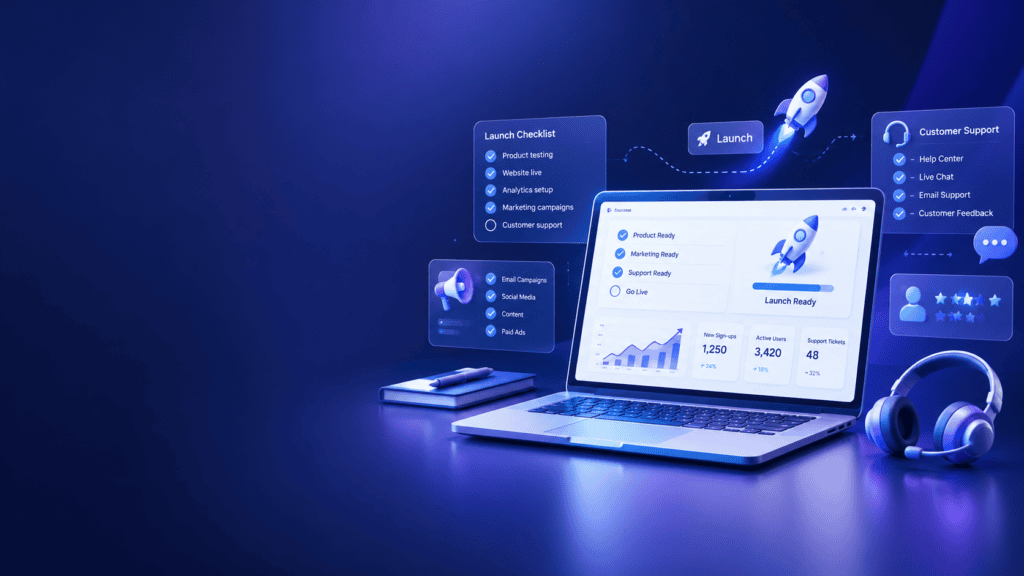
Before promoting the product widely, test the experience from a customer’s perspective.
Check the following:
- Does the landing page explain the product and its intended customer?
- Are pricing, trial terms, restrictions clear?
- Can users complete the primary workflow?
- Do signup, payment, and account recovery work?
- Are analytics events being recorded correctly?
- Do customers have access to support, in case of failure?
- Is someone available to collect and prioritize feedback?
Prepare a small set of launch communications: a product announcement, a clear explanation of the problem solved, a demonstration or walkthrough, and a follow-up for interested prospects.
Use the channels your intended customers actually visit. Global publishing is not a substitute for targeting the right audiences.
Decide also how the team will respond to initial feedback. Gather, organize, and prioritize feature requests and separate them from bug reports.
Step 9: Measure Results and Improve the Strategy
Your first launch provides evidence, not a final verdict on the business.
Track a small group of metrics that correspond to the customer journey.
| Metric | What it helps you understand |
| Qualified visitors or leads | Whether your channel reaches the intended audience |
| Visitor-to-signup conversion | Whether the offer and landing page encourage action |
| Activation rate | Whether users reach the product’s core value |
| Trial-to-paid conversion | Whether trial users become paying customers |
| Customer retention | Whether customers continue receiving value |
| Monthly recurring revenue (MRR) | How subscription revenue changes over time |
| Customer acquisition cost (CAC) | How much you spend to acquire customers under your chosen calculation |
| Churn | How many customers or how much recurring revenue you lose |
Define each metric precisely. For example, customer acquisition cost depends on which acquisition expenses and customers are included in the calculation. Comparing different cost categories that do not allow fair conclusions or applying different periods for the same cost category may create false impressions.
- Make sure not to draw erroneous conclusions based on a single metric.
- If traffic is low, take measures to increase your reach and engagement.
- If traffic is high, but there are few leads, check the targeting and value proposition.
- If there is a high number of sign-ups, but low activation, analyze the onboarding process and product-market fit.
- If activation is high, but there are few paying users or customers, research the pricing strategy, product value, purchase friction, and target audience.
- If users buy your products but do not return, look into the product quality, client support, and retention strategies.
Remember that these are examples, and there may be other factors involved. Always conduct further research and product analysis before making a final conclusion and altering the marketing strategy.
A Practical 30/60/90-Day SaaS GTM Roadmap

A calendar is useful when it creates clear priorities. Here is one possible set of prioritized initiatives. It is not meant to suggest that every SaaS product has a 90% chance of finding product-market fit within 90 days of its launch.
Days 1–30: Research and validate
Primary goal: Establish a credible understanding of the target customer and problem.
Actions:
- Define an initial customer segment.
- Interview potential users.
- Document competitors and existing workarounds.
- Test the value proposition.
- Illustrative planning framework
- Define what evidence would justify proceeding.
Expected outcomes: A target-customer profile, a positioning statement, a list of major assumptions, and a validation plan.
Days 31–60: Prepare the offer and the acquisition process
Main objective: Get the offer, its supporting resources, and the acquisition process itself ready for launch.
Actions:
- Prioritize the essential product workflow.
- Prepare a landing page and pricing offer.
- Set up onboarding and product analytics.
- Select a primary acquisition channel.
- Create launch communications.
- Test signup, payment, and support processes.
Expected outcomes: A launch-ready product offer, a developed customer journey, an acquisition experiment, and specific measurement criteria.
Days 61–90: Launch, learn, and refine
Main objective: Test if the offer attracts the right customers and delivers on expectations.
Actions:
- Launch to a focused audience.
- Conduct customer demonstrations or onboarding sessions where appropriate.
- Monitor activation and conversion.
- Interview new users and people who abandon the process.
- Fix recurring product issues.
- Review channel costs and customer retention.
- Decide what to perpetuate, adjust, or altogether abandon.
Expected outputs: Evidence about acquisition, product usage, customer objections, and the next set of product or GTM priorities.
If the customer profile is unclear, prolong the validation period instead of launching blindly.
Common GTM Mistakes SaaS Founders Should Avoid

Targeting too many customer segments. A broad message is less likely to resonate with any single group, so start with a specific group and then broaden out when the data suggests it.
Building before understanding the problem. Product development is an investment. Measure signups rather than outcomes.
Copying competitors’ pricing. While signups are a critical metric, activation, paid conversion, and retention tell more about how your product is doing
Launching on every channel. More channels create more work and can make it harder to identify what is actually working.
Disregard in–market engineering:Bugs, integrations, onboarding, and customer feedback all impact adoption, so consider how you will continue to iterate on the product post-launch
Continued measurement is required to demonstrate sustainable acquisition and value to the customer.
Treating a launch date as proof of success. A product going live is an operational milestone. Sustainable acquisition and customer value require continued measurement.
FAQs
What is a go-to-market strategy for a new SaaS product?
A go-to-market strategy is a plan that details how a seller will reach his target customers, establish a presence in the market, raise awareness of the product, convert prospects into paying customers, and retain them. It should tie together the company’s product, positioning, pricing, marketing mix, sales, and customer success strategy.
How do you create a SaaS go-to-market strategy?
First of all, it is necessary to validate the problem that the customer will solve, describe the ideal customer profile, and develop a value proposition. Then, it is possible to determine prices, choose marketing channels, organize onboarding and support, and track activation, conversion, acquisition cost, and retention.
How long does it take to launch a SaaS product?
The timeline for launch depends on the complexity of the product, technical readiness, implementation, testing, and the buying process. If the product is already built, then it can enter limited release before another product which is not yet developed. A 30/60/90-day GTM roadmap can help you structure your efforts, but it should not be considered a guarantee of delivery.
How much does a SaaS go-to-market strategy cost?
There is no standard amount for this, since it is based on the organization’s specific capabilities (team, product readiness, paid promotion, content production, sales, software tools, customer support). The costs are estimated separately for each activity, and one-time launch costs are separated from the ongoing ones.
Which marketing channels are best for a new SaaS product?
The best channels depend on where target customers look for solutions, how they make purchasing decisions, and how much customer acquisition the business can afford. SEO, content marketing, direct outreach, paid advertising, partnerships, and referrals are possible starting points. Test a few relevant channels before scaling it up.
What are the critical metrics that every SaaS company should monitor and optimize after launch?
Qualified leads, activation, trial-to-paid conversion, where relevant, customer acquisition cost, recurring revenue, retention, and churn. The company must evaluate its business model and stage to determine which performance metrics to prioritize. The company should also consider other product-market fit metrics, such as sign-ups and website traffic, but they are less reliable.
Should a SaaS startup use a freemium or paid-trial model?
Freemium lets users try the product for free, whereas a paid trial helps in determining if the customer is willing to pay more for getting additional features. It is also a great option when the customer would need some time before adopting the product.Choose the model based on how quickly users experience value, the cost of serving them, and the complexity of the buying decision.
How can a non-technical founder prepare a SaaS product for launch?
A non-technical founder may validate the problem by talking to the prospective customers, position the product and launch the landing page, prioritize the product’s key workflows, and set the product launch metrics. They might also prepare a document outlining the scope of work, ownership, and expectations after the application is launched if they decide to hire someone to develop the application.
When should a SaaS company change its go-to-market strategy?
Consider making a change if multiple data points indicate an issue such as a poor activation rate or conversion of qualified leads, pricing objections, or retention problems. Diagnose the situation and only then make a change—product, audience, message, channels, or sales process.
Does a SaaS startup need a product-market fit before launch?
A start-up should validate the opportunity and the demand before scaling up. And PMF is not measured by how great the product is and how much it fits the market: it should emerge through the process of continuous learning about the domain and its customers. It is not enough to build a great product that the target market “needs”; one must understand the domain through firsthand research and experience.
Final Thoughts
In my opinion, a go-to-market strategy for a new SaaS product should be developed by designing a customer-centric approach that unifies product development, positioning, pricing, acquisition, and retention strategies. It should begin with defining a specific customer and the problem they need to be solved. Next, these hypotheses should be tested, a channel for customer acquisition should be selected, the value provision chain should be prioritized, and customer behavior should be measured.
Then use the evidence to decide what to improve next.
For founders whose product still needs to be built or refined, development is one part of that process. BkAbhi Innovations Lab’s publicly listed capabilities include MVP development, SaaS architecture, mobile experiences, AI integration, and motion design. Its current offerings can be reviewed on the official BkAbhi website.
The right next step, however, depends on the evidence your business has gathered—not simply on the desire to launch quickly.
Author Bio
Jeevesh Tripathi
Email: jeevesh@bkabhi.com
Jeevesh Tripathi writes research-based content about technology, AI, software, SaaS, and digital business tools. His work focuses on practical comparisons, evidence-based evaluation, and clear explanations that help founders and businesses understand their options without unnecessary technical jargon.