
You have an idea. You need to know two things fast: does it work, and will anyone pay for it.
That’s where founders get stuck between two paths — rapid prototyping and MVP development. They sound similar, but they’re not the same investment. BkAbhi helps founders understand the difference and choose the right path for their product.
Picking the wrong one wastes months and burns runway you don’t have. This guide breaks down what each path actually delivers, what it costs, and how to choose between them.
Table of Contents
What Is Rapid Prototyping?
Rapid prototyping is the fast, low-cost creation of a mock version of your product. It shows how something looks and behaves — not how it performs at scale.
A prototype isn’t built to be sold. It’s built to be tested, questioned, and thrown away if it doesn’t work. A rapid prototyping company can help create clickable wireframes, Figma flows, or rough interactive demos to validate an idea quickly.
The goal is speed. A rapid prototyping company can usually turn around a working demo in one to three weeks, because none of the backend logic, database, or infrastructure needs to be real.
This matters most when you’re still validating an idea, pitching investors, or testing a user flow before writing a single line of production code.
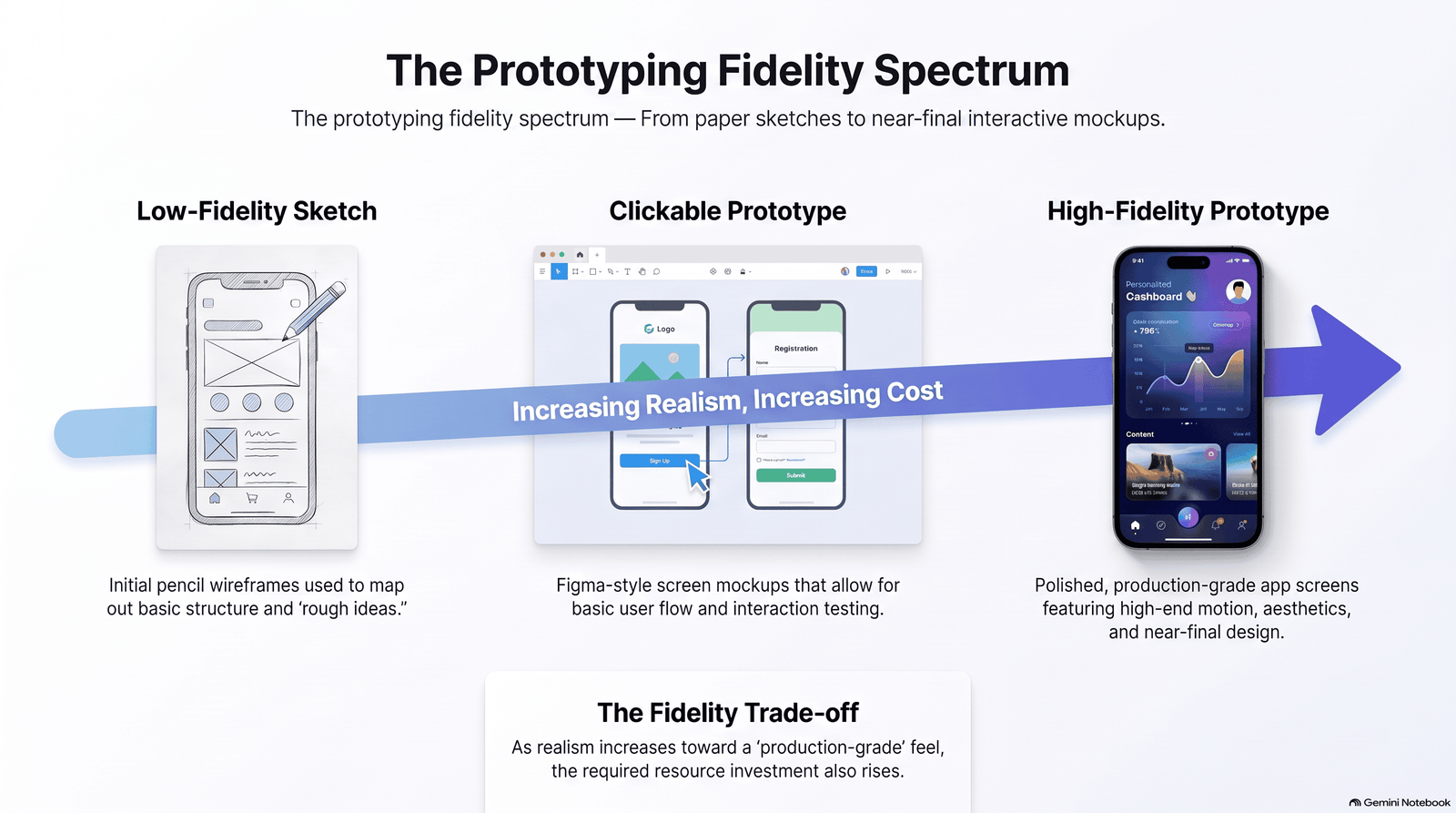
According to usability research from the Nielsen Norman Group, a prototype is best understood as a testable hypothesis about a design problem, not a finished product — and how closely it matches the final look and feel (its “fidelity”) is what determines how it should be tested. That single idea is why rapid prototyping stays deliberately rough — realism is added only once it’s earned.
Types of Rapid Prototypes
Not every prototype looks the same. Most rapid prototyping companies work across three broad fidelity levels, each suited to a different stage of validation.
Low-fidelity prototypes are sketches or simple wireframes. They’re fast to produce and ideal for very early idea testing, before you’ve committed to a visual direction.
Mid-fidelity prototypes add structure and basic interactivity — think grayscale screens with working navigation. These are common for internal reviews and early user testing.
High-fidelity prototypes look and feel almost like the finished product, with real branding, color, and polished interactions. These are usually reserved for investor pitches or final-stage user testing, since they take longer to build.
Picking the right fidelity level matters as much as picking the right team. A rapid prototyping company should recommend the lowest fidelity that still answers your specific question — not the flashiest one.
What Is MVP Development?
An MVP, or minimum viable product, is a real, working piece of software. It has actual code, a working database, and enough functionality that a real user can use it and pay for it if it delivers value.
Where a prototype simulates the experience, an MVP delivers it. If you want the full breakdown of what qualifies as an MVP, our guide on what MVP development actually involves covers the build process end to end.
MVP development typically takes six to sixteen weeks, depending on scope. While a rapid prototyping company can help validate the concept quickly, MVP development requires developers, not just designers, because the product must run in production and hold up under real usage.
The purpose isn’t just validation — it’s proof. An MVP proves people will use your product, return to it, and ideally pay for it, which is the evidence investors and early customers actually trust.
If you’re still unclear on how an MVP differs from a full product build, we’ve mapped that out separately in MVP vs full product development.
Rapid Prototyping vs MVP Development: The Core Differences
| Factor | Rapid Prototyping | MVP Development |
|---|---|---|
| Purpose | Test look, feel, and flow | Prove real-world demand |
| Built with | Design tools, mockup software | Actual code, working backend |
| Timeline | 1–3 weeks | 6–16 weeks |
| Cost | Low (design hours only) | Higher (dev + design + QA) |
| Can users pay for it? | No | Often, yes |
| Best for | Pitching, early validation | Launching, gathering real usage data |
| Risk if wrong | Low — cheap to redo | Moderate — rework costs more |
This is the practical split most founders miss: a prototype answers “does this make sense,” while an MVP answers “does this work in the real world.” A rapid prototyping company can help validate the first question, but confusing the two is how budgets disappear on the wrong deliverable.
For a deeper look at how prototypes, proof-of-concepts, and MVPs differ conceptually, our earlier piece on MVP vs Prototype vs POC is a useful companion read alongside this one.
Timeline: How Fast Is Each Path, Really?
Rapid prototyping earns its name. A fast prototype development agency can often deliver a clickable demo within five to fifteen business days.
MVP development moves on a different clock. Even a lean MVP needs sprints for backend setup, core feature builds, integrations, and QA testing before it’s usable.
If your fundraising deadline is three weeks away, a prototype is realistically your only option. If you’re six months from launch, an MVP timeline fits.
Cost: What Founders Actually Pay
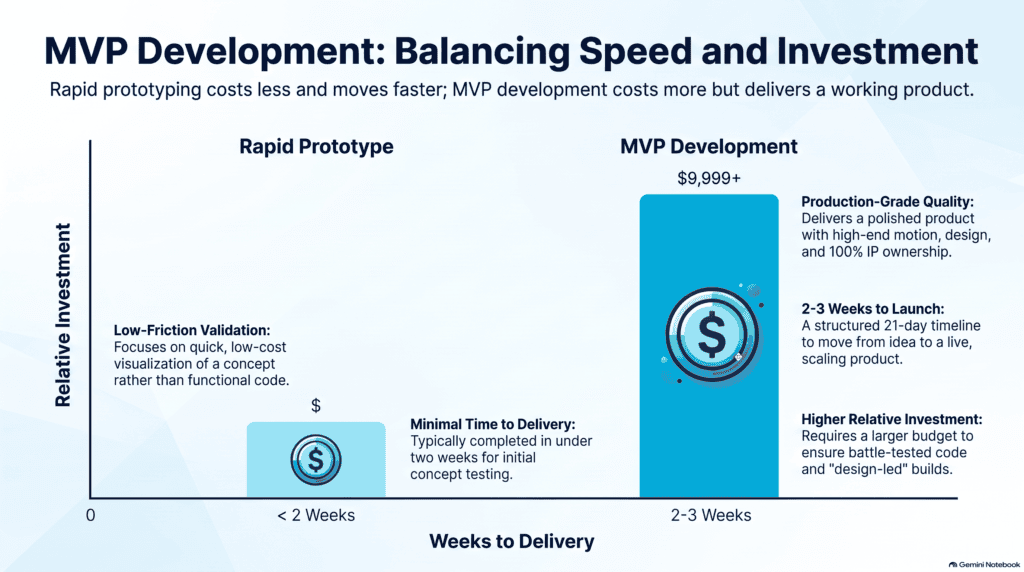
Rapid prototyping services for startups are priced by design hours, not engineering hours. Most prototypes cost a fraction of what an MVP build runs.
MVP development costs scale with features, platforms, and integrations. We’ve broken down real 2026 pricing bands in our guide to MVP development cost in India, which is a useful benchmark even outside India given how many teams now build there.
The mistake to avoid: paying MVP-level rates for what should have been a two-week prototype. A good rapid prototyping company will tell you upfront when a prototype is all you need.
When to Choose Rapid Prototyping
Rapid prototyping is the right call in a handful of specific situations.
- You need something to show investors before your next pitch meeting
- You’re testing whether users understand a new flow or feature
- You want internal buy-in before committing engineering budget
- You’re comparing two design directions and need to see both
In each case, you’re paying for clarity, not code. That’s exactly what rapid prototyping services for startups are built to deliver quickly and cheaply.
When MVP Development Makes More Sense
MVP development earns its higher cost once validation questions are already answered.
- You’ve tested the concept and users responded well
- You need to onboard real, paying early customers
- Investors are asking for usage data, not mockups
- You need a product that can scale past a demo
If you’re weighing whether to build this in-house or bring in outside help, our comparison of MVP development agency vs in-house team walks through that decision in detail.
Which Industries Lean Harder on Each Approach
The right choice also shifts depending on your industry. Consumer apps with simple flows can often validate with a prototype alone before writing production code.
Fintech and healthtech products, on the other hand, tend to move to MVP development sooner, since compliance, security, and data-handling questions can’t be answered by a mockup. If you’re building in one of these spaces, our breakdown of MVP development across SaaS, fintech, and healthtech is worth reading before you scope either stage.
Marketplaces and two-sided platforms usually need both stages back to back, since you’re validating two different user experiences — buyers and sellers — before either side sees a working product. A rapid prototyping company can help test both experiences early, before investing in full MVP development.
The Smarter Path: Prototype First, Then MVP
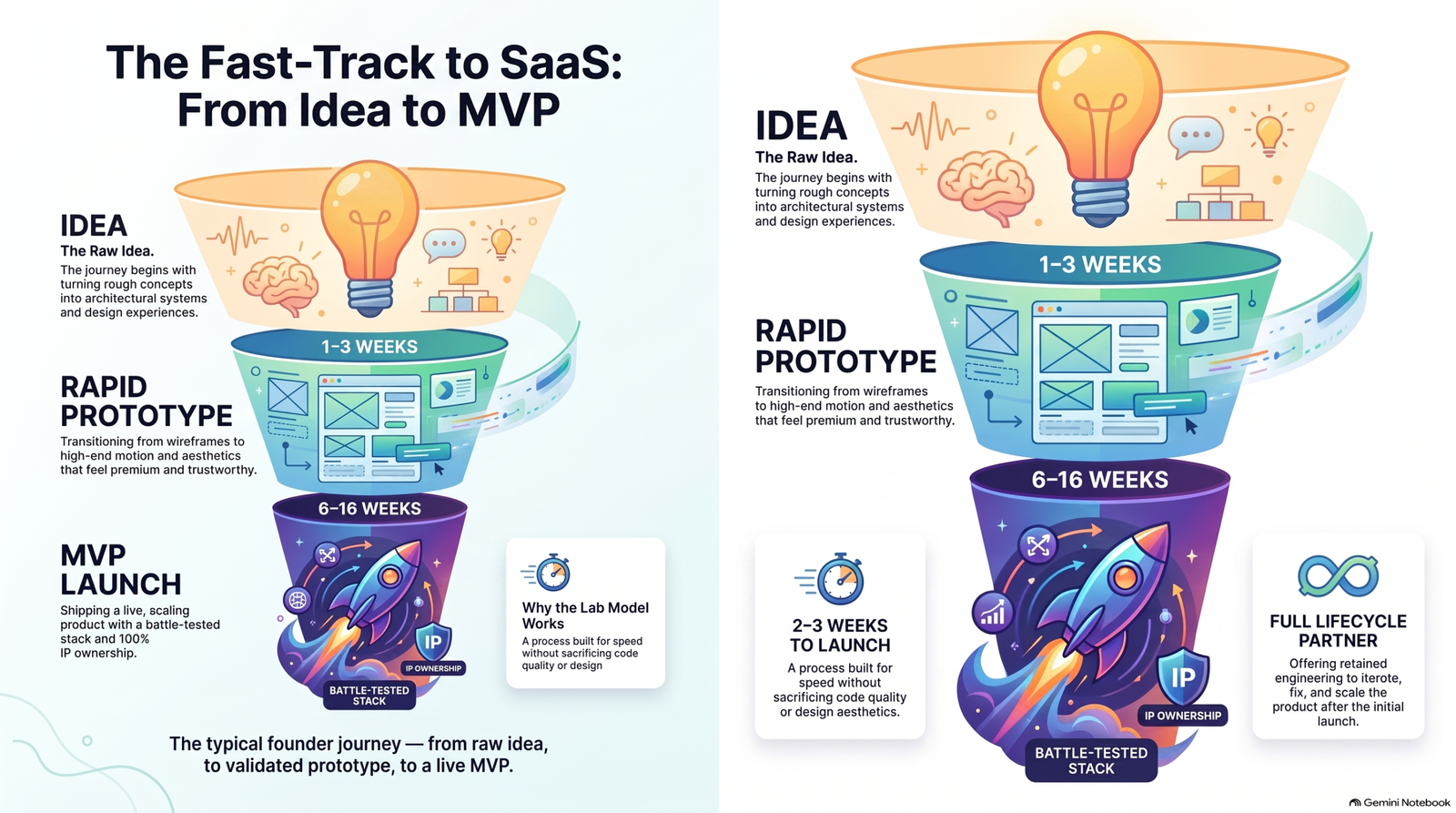
Most experienced founders don’t pick one path — they sequence both.
Start with a rapid prototype to validate the idea cheaply. Use it to pitch, test with real users, and catch flawed assumptions before a developer writes production code.
Once the prototype proves the concept, move into MVP development with a much clearer, lower-risk spec. Working with a rapid prototyping company can help resolve guesswork at the cheaper stage, typically cutting MVP rework by a wide margin before development begins.
How a Rapid Prototyping Company Adds Value Beyond Speed
A capable rapid prototyping company does more than move fast — it protects you from building the wrong thing entirely.
Experienced teams, including a rapid prototyping company, push back on scope creep in the prototype stage, where a change costs an afternoon instead of a sprint. They also structure the prototype so it can hand off cleanly into MVP development, rather than becoming throwaway work.
That handoff matters more than founders expect. A prototype built without an eye toward the eventual build often has to be redone from scratch once real development starts, which erases the time and cost savings it was supposed to create.
This is also where a rapid prototyping company earns its fee: by knowing which parts of the prototype are worth carrying forward and which were only ever meant to answer a single question.
What to Look for in a Fast Prototype Development Agency
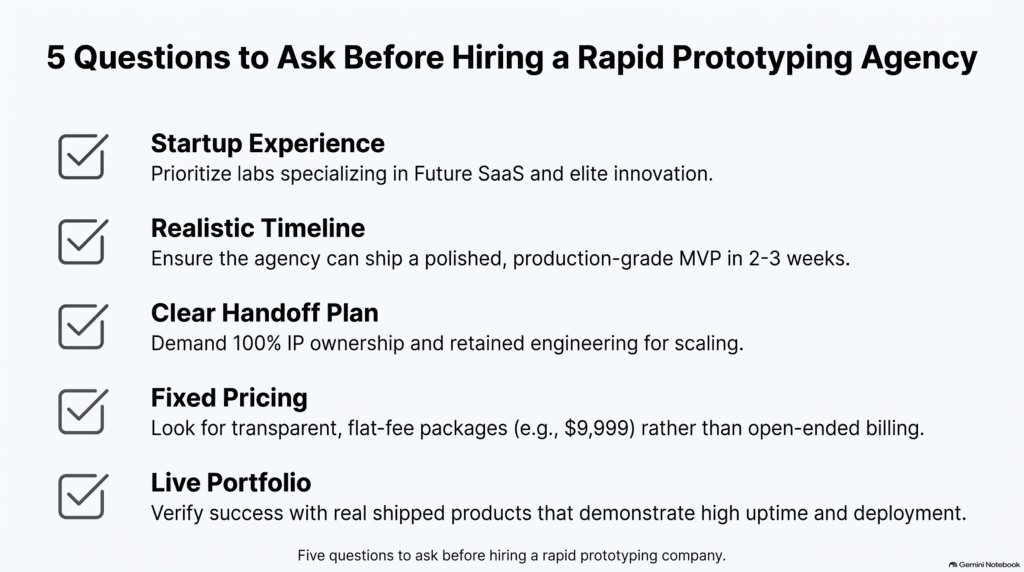
Not every design shop that offers “prototyping” is set up to support a startup’s pace or budget. A rapid prototyping company should have the experience, process, and flexibility needed to deliver effective prototypes without unnecessary costs.
Startup-specific experience. Ask for prototypes they’ve built for early-stage founders, not enterprise redesign projects — the constraints are completely different.
Realistic timelines. A fast prototype development agency should quote days or a couple of weeks, not months, for a standard clickable prototype.
Clear handoff process. Ask a rapid prototyping company what happens to the prototype once you’re ready to build. Good agencies design with the future MVP in mind.
Transparent pricing. You should get a fixed quote for a defined scope, not an open-ended hourly estimate.
Portfolio you can actually test. Ask to click through a live prototype they built for someone else, not just screenshots in a deck.
If you’re vetting a broader development partner rather than just a prototyping team, our checklist for choosing an MVP development company covers the same due diligence in more depth.
The ROI of Getting the Sequence Right
Founders often treat prototyping as an extra step that delays the “real” work. In practice, it’s usually the cheapest insurance a startup can buy.
A prototype that surfaces a broken flow costs a design revision. The same flaw discovered after MVP development means rewriting working code, re-testing integrations, and pushing back your launch date.
This is why experienced product teams frame the prototype’s cost as a small, fixed fee against a much larger, avoidable risk — not as an extra expense layered on top of the build.
The founders who skip this step aren’t usually being reckless. They’re often just unaware that a rapid prototyping company can move fast enough to not delay anything meaningful.
How to Brief a Prototyping or MVP Team
Whichever stage you’re entering, the brief you hand over shapes everything that follows. A few essentials apply either way.
- State the one question you need answered. “Will users understand this signup flow” is a prototype brief. “Will users pay for this” is an MVP brief.
- Share any existing research. Even rough user interviews or competitor notes save the team from guessing.
- Set a hard timeline. Agencies scope differently when they know your actual deadline versus a vague “soon.”
- Name your must-have features only. Everything else can wait for the next stage, whichever one that is.
A tight brief is often the difference between a two-week prototype and a six-week one that quietly turned into an MVP nobody scoped for.
Common Mistakes Startups Make Between the Two
Skipping the prototype entirely. Jumping straight to MVP development without testing the flow first often means paying developers to build features that get scrapped after the first user test.
Over-investing in the prototype. Some founders keep polishing a prototype for months, chasing pixel-perfect visuals for something that was only ever meant to test an idea.
Treating a prototype as a launch-ready product. Prototypes aren’t secure, scalable, or built to hold real user data — shipping one to real customers creates problems fast.
Hiring one team for both stages without checking fit. Not every agency is equally strong at fast, throwaway design work and structured production engineering. Ask directly.
If any of these sound familiar, our list of MVP development red flags is worth a read before signing with any build partner.
Tools and Tech Stack: What Powers Each Stage
The tooling behind a prototype and an MVP is worlds apart, and understanding the difference helps explain the cost gap.
Rapid prototyping relies on design software — tools like Figma, Framer, or InVision — that simulate interactivity without any real backend. Nothing here is production code, which is exactly why it’s fast and cheap to change.
MVP development runs on an actual engineering stack: a frontend framework, a backend, a database, hosting, and often third-party integrations for payments, authentication, or analytics. Our guide to the best tech stack for MVP development in 2026 breaks down what a typical build actually involves.
Some founders also explore no-code tools to bridge the gap between the two — fast enough to feel like a prototype, but functional enough to take real signups. If that route interests you, our no-code MVP playbook covers when that shortcut works and when it doesn’t.
Quick Decision Framework
Use this as a fast gut-check before reaching out to any team.
- Do you have committed budget for development yet? No → prototype first.
- Is your next milestone a pitch, not a launch? Yes → prototype.
- Have real users already responded well to the concept? Yes → MVP.
- Do you need to collect payments or real usage data? Yes → MVP.
If you land on “prototype” today, that doesn’t mean MVP development is off the table — it just means it isn’t the next step yet.
Frequently Asked Questions
Is rapid prototyping cheaper than MVP development? Yes, almost always. Rapid prototyping only requires design effort, while MVP development requires engineering, QA, and infrastructure on top of design.
Can a rapid prototyping company also build my MVP? Many can, but it’s worth confirming directly. Some studios focus purely on design and hand off the build to a separate engineering team.
How long does a typical startup prototype take? Most clickable prototypes are ready in one to three weeks, depending on how many screens and flows are involved.
Do investors accept a prototype instead of an MVP? For early pitch meetings, often yes. For later-stage rounds, investors usually expect usage data, which only an MVP can provide.
What happens to the prototype once MVP development starts? A well-built prototype becomes the reference design for the MVP. A poorly scoped one is usually discarded and rebuilt.
Should a startup skip prototyping and go straight to MVP? Only if the concept is already validated through other research. Otherwise, skipping the prototype stage is the most common way startups overspend on features nobody wanted.
How do I compare quotes from different prototyping or MVP teams? Line up scope, timeline, and what happens to the deliverable afterward, not just the headline price. Our guide to comparing MVP development companies walks through the same framework, which applies equally well to prototyping quotes.
Is it worth reading reviews before hiring a build partner? Yes, but read them critically. Our piece on what to actually check in MVP development company reviews explains which red flags matter and which ones are noise.
Final Thoughts
Rapid prototyping and MVP development aren’t competing options — they’re two different tools for two different questions.
Use a prototype to find out if your idea makes sense. Use an MVP to find out if the market agrees. Getting that sequence right is what separates a resourceful build from a wasted budget.
If you’re deciding which stage your startup is actually in, browsing BkAbhi’s product development approach alongside this guide can help you scope the right first step before you talk to any agency.
About the Author
Jeevesh Tripathi is a product development researcher specializing in startup build strategy, MVP validation, and early-stage prototyping. He writes on behalf of BkAbhi Innovations Lab, where he researches how early-stage founders can validate ideas faster and avoid costly rebuilds.
Contact: jeevesh@bkabhi.com