
Quick Answer
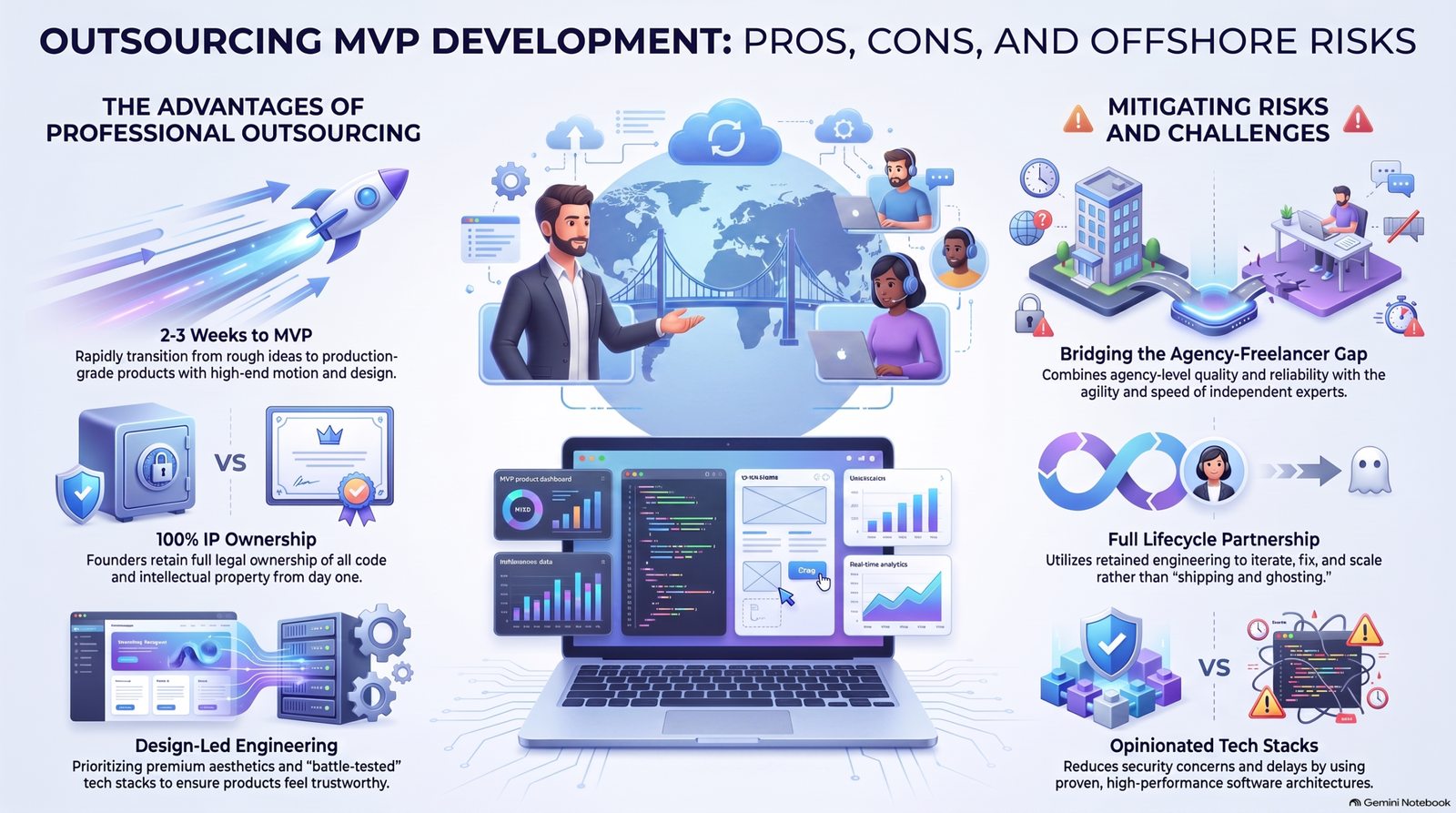
Outsourcing MVP development pros and cons come down to one trade: speed and cost against control and communication overhead. Most pre-seed founders save 40-70% on build cost by outsourcing rather than hiring in-house, but offshore engagements add time-zone friction and IP risk that domestic or nearshore partners avoid. The right call depends on your budget, timeline, and how much oversight you can realistically provide — a decision this guide breaks down step by step, alongside our deeper in-house vs outsourced MVP development comparison.
A founder in Austin signed with a build partner in Eastern Europe last year. Her MVP shipped in nine weeks, at roughly half what a local agency quoted.
Another founder, three states over, signed with an offshore team on a rock-bottom rate. Four months later, she was still waiting on a working login screen.
Same decision — outsourcing MVP development — two completely different outcomes. The gap wasn’t luck. It was how each founder weighed the pros, the cons, and the offshore risk before signing anything.
Table of Contents
What Outsourcing MVP Development Actually Means
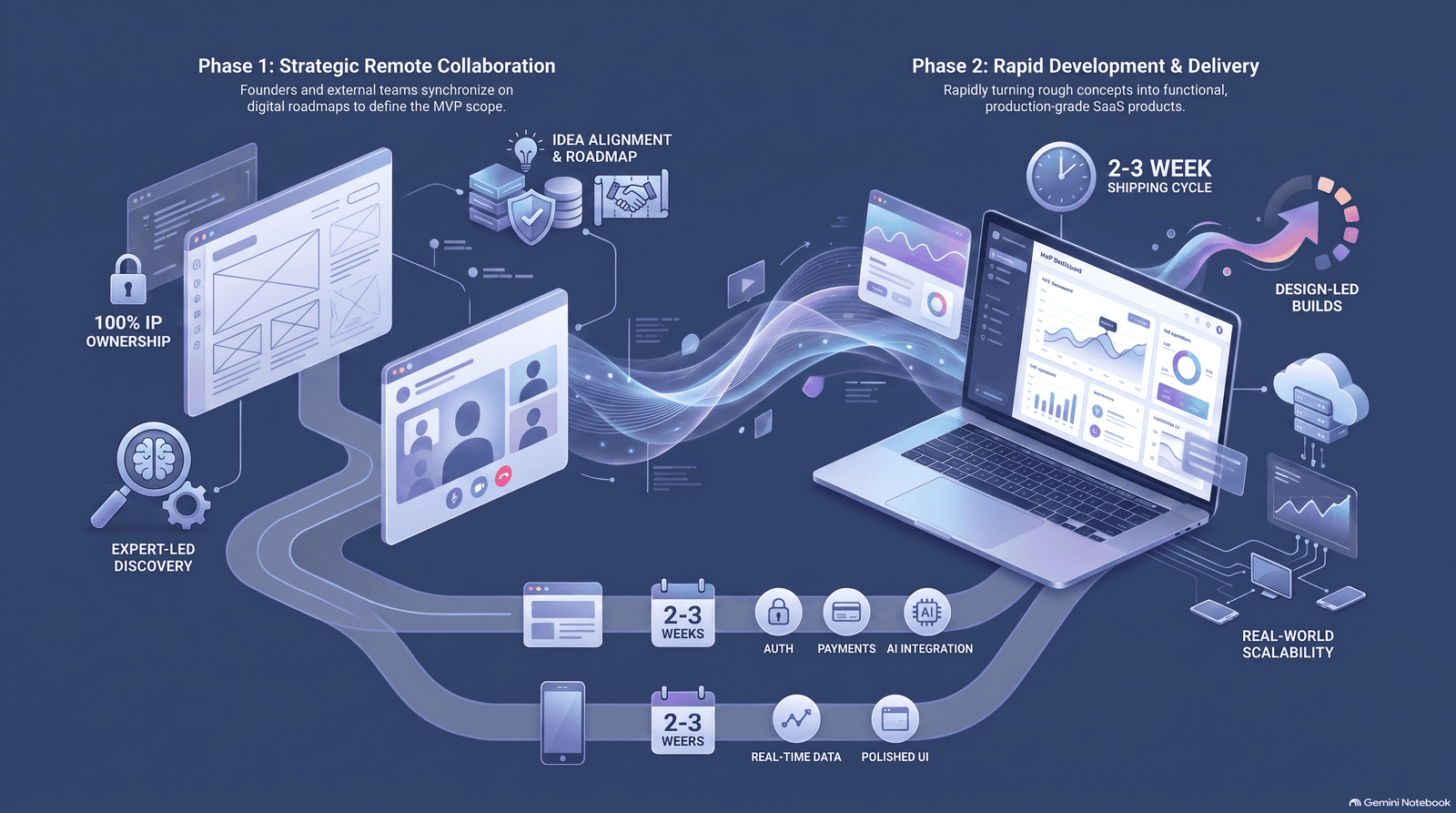
Outsourcing MVP development simply means handing your build to a team outside your own company.
That team could be a freelancer, a structured agency, an offshore shop, or a staff-augmentation partner working inside your existing workflow.
Each model carries its own version of the same pros and cons list, which is why “should I outsource” and “should I go offshore” are actually two separate questions.
This guide answers both. For a full breakdown of outsourcing against building an internal team, our in-house vs outsourced MVP development guide covers that decision layer in more depth.
A freelancer is a single contractor, hired directly for a defined scope. It’s the cheapest entry point, but there’s no backup if that one person gets pulled onto another project.
An agency is a structured team with a repeatable process — project managers, designers, and developers working together under one contract and one point of accountability.
An offshore team is either a freelancer or an agency based in a different country, usually chosen for lower hourly rates and access to a wider talent pool.
Staff augmentation blends the two: outside developers plug directly into your existing workflow, while you keep architecture and product decisions in-house.
Understanding which of these four you’re actually comparing matters, because “outsourcing” as a single word hides very different cost, risk, and control profiles underneath it.
Pros of Outsourcing MVP Development
Weighed fairly, outsourcing solves real, specific problems most early-stage founders actually have.
Faster Time to a Working Product
An outsourced team already exists. There’s no job posting, no interview loop, no six-week wait before code gets written.
Most structured partners can start a discovery sprint within one to two weeks of signing, compared to six-plus weeks to hire a single in-house engineer.
Lower Upfront Cost
Deloitte’s Global Business Services research found that roughly half of organizations achieve over 20% in cost savings from outsourced delivery models, and offshore labor arbitrage can push savings even higher on specific technical functions.
For a founder self-funding a first build, that gap is often the difference between shipping and not shipping at all.
Access to Specialized Skills On Demand
A pre-seed founder rarely needs a full-time DevOps engineer or a senior mobile developer for twelve straight months.
Outsourcing MVP development lets you rent that specific skill for exactly as long as the build needs it, then let it go.
No Long-Term Headcount Commitment
Employees come with severance, benefits, and morale considerations if the roadmap changes. A vendor contract doesn’t carry the same weight.
If your MVP pivots hard after user testing, winding down an outsourced engagement is a conversation, not a layoff.
A Repeatable, Tested Process
A team that has shipped dozens of MVPs brings a process your first hire can’t replicate — sprint cadence, QA checkpoints, and a build framework already stress-tested elsewhere.
Our guide on what to expect from the MVP development process walks through what that structure typically looks like end to end.
Cons of Outsourcing MVP Development
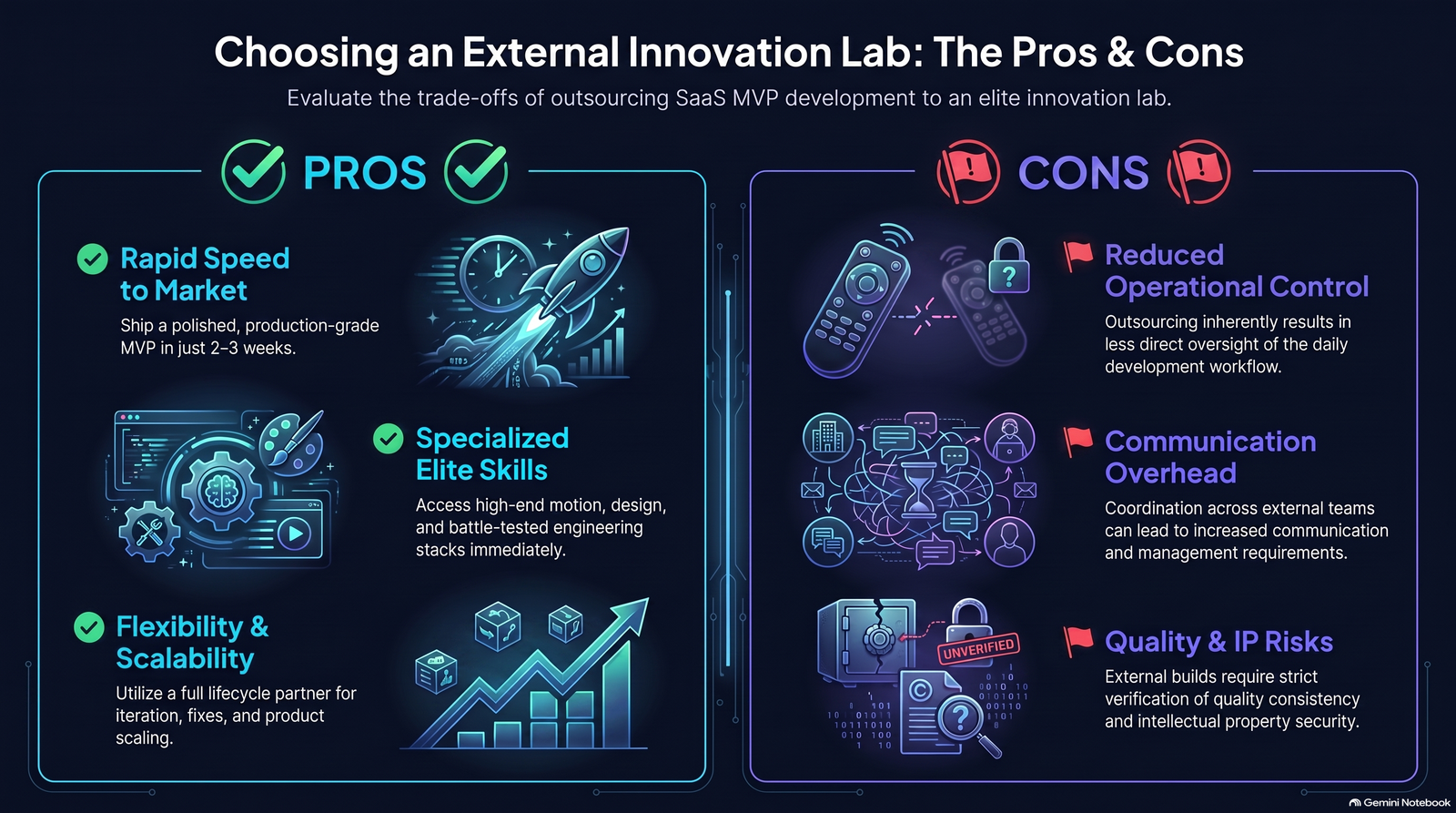
None of the above comes free. Here’s what founders give up.
Less Day-to-Day Control
An outsourced team isn’t sitting next to you. Decisions that would take a hallway conversation in-house now go through a call, a ticket, or a status update.
For founders who want to steer architecture choices in real time, this friction is real and worth planning around.
Communication and Documentation Overhead
Every requirement has to be written down clearly, because an outside team can’t read your mind the way a co-founder might.
Vague specs are the single biggest cause of scope drift in outsourced builds, regardless of where the team sits.
Variable Quality Across Vendors
Not every agency or freelancer delivers what their portfolio promises. A poorly vetted partner can hand your project to junior staff without telling you.
Running any shortlisted vendor through a proper vetting process — covered in our guide to questions to ask before hiring an MVP development company — catches most of this before contracts are signed.
IP and Ownership Risk if Contracts Are Loose
Source code access, IP assignment, and clean handoff documentation should be non-negotiable in any outsourcing agreement.
Our MVP development contract checklist lists exactly what to require before any work begins.
Slower Institutional Knowledge Building
An outsourced team doesn’t accumulate the same long-term product intuition an employee does simply by living in your codebase every day.
This is less of a problem for a single MVP build and more of one if you plan to keep outsourcing indefinitely rather than transitioning parts in-house later.
Offshore vs Outsource MVP Development: What’s the Difference
These two terms get used interchangeably, but they answer different questions.
Outsourcing is a who question — are you using an external team instead of employees, regardless of where that team sits?
Offshore is a where question — is that external team located in a different country, often with a meaningful time-zone gap?
You can outsource domestically (a US agency staffed with US developers) or outsource offshore (a team based in India, Eastern Europe, or Southeast Asia). Nearshoring — a partner in a nearby time zone, like Latin America for a US client — sits in between.
The pros-and-cons framework above applies to outsourcing broadly. Offshore engagements simply add a second layer of variables on top, which is exactly what the next section unpacks. For a full cost-versus-risk breakdown by region, see our dedicated offshore vs onshore MVP development comparison.
Offshore-Specific Risks Founders Should Know
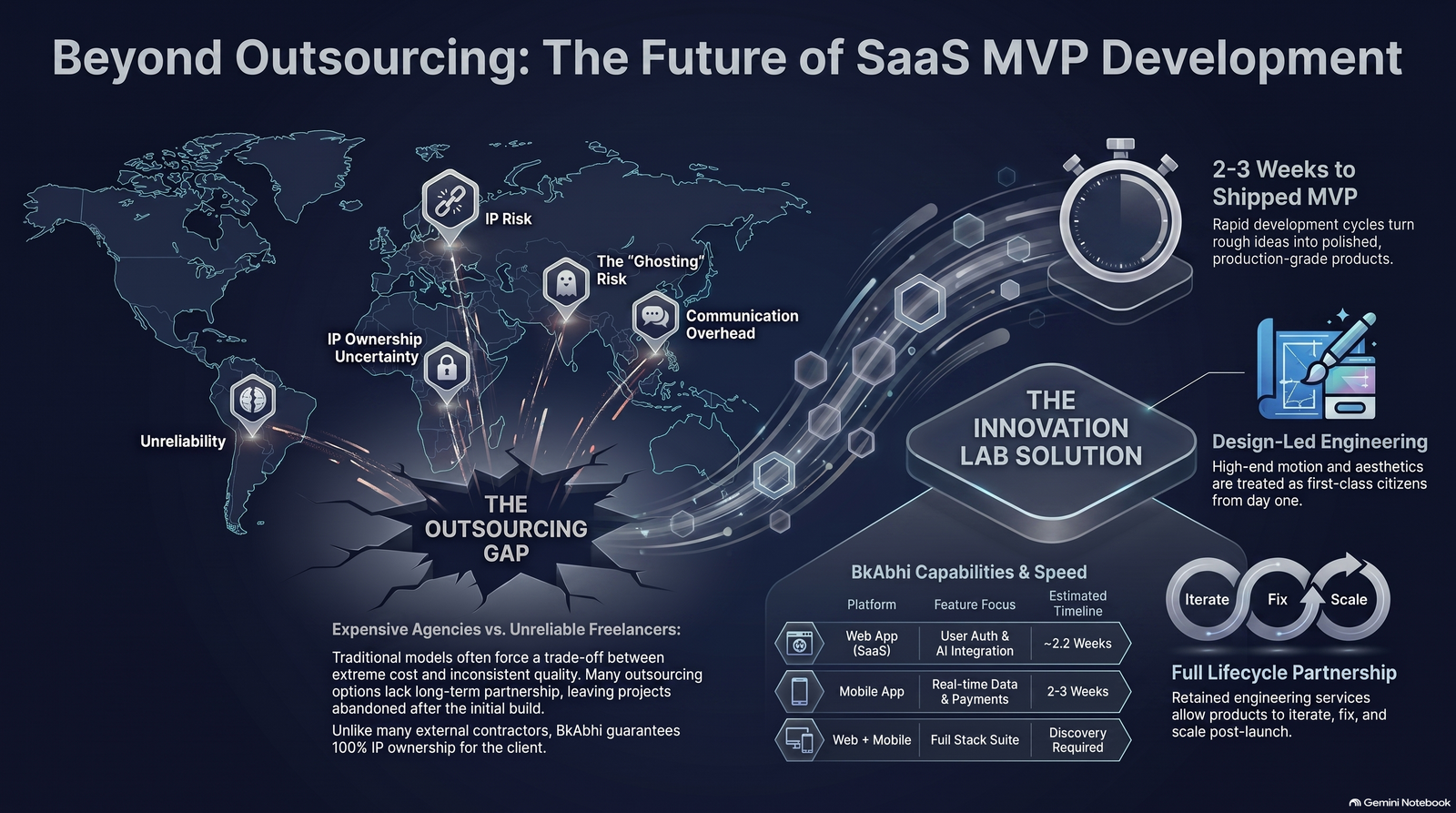
Offshore outsourcing MVP development can be the most cost-effective path available — but only if you go in aware of what makes it different from a same-country engagement.
Time-Zone and Communication Gaps
A 10-12 hour time difference means a question sent at 5 PM your time might not get answered until you’re asleep.
This isn’t fatal, but it does mean daily standups, quick clarifications, and same-day fixes move slower by default.
Harder Quality Verification From a Distance
It’s easier to spot code quality issues, missed deadlines, or corner-cutting when you can walk over and check. Remote oversight requires more deliberate process — code reviews, staging environments, and clear milestone demos.
Legal and IP Enforcement Across Borders
Enforcing an NDA or IP clause against a vendor in another country is legally more complex, and sometimes more expensive, than enforcing one domestically.
This doesn’t mean offshore contracts are unsafe — it means the contract itself needs to be tighter, not looser, than a domestic equivalent.
Hidden Costs That Erase the Savings
A low hourly rate can hide extra costs: additional QA cycles, project management overhead, or rework after miscommunication.
Founders who compare only the sticker rate — without factoring in these additions — often find the real savings are smaller than advertised.
Cultural and Process Mismatches
Different regions have different default assumptions about scope, deadlines, and what “done” means. None of these are wrong, but unaligned expectations cause friction if they’re never discussed directly.
How to Reduce Offshore Risk Before You Sign
None of the risks above are reasons to avoid offshore outsourcing. They’re reasons to structure the engagement properly.
- Overlap your working hours. Even four shared hours a day makes daily communication dramatically smoother than zero overlap.
- Require milestone-based payments, not a single lump sum, so quality gets verified before more money moves.
- Put IP assignment and source code access in writing, effective from day one of the contract — not at final handoff.
- Ask for a paid trial sprint before committing to the full build, so you can evaluate real output, not just a sales pitch.
- Check independent reviews, not just testimonials on the vendor’s own site — our guide on vetting MVP development company rankings explains what to look for and what to ignore.
- Watch for the same red flags that apply everywhere. Vague answers about who’s actually on your project are a warning sign regardless of geography — our MVP development red flags guide lists the most common ones founders miss.
Followed consistently, this checklist closes most of the gap between offshore outsourcing done carelessly and offshore outsourcing done well.
Outsourcing Models Compared at a Glance
| Model | Typical Cost | Control Level | Best For |
|---|---|---|---|
| Freelancer | $ | Low-Medium | Tiny, single-feature builds |
| Domestic Agency | $$$ | Medium-High | Founders wanting close oversight |
| Offshore Agency | $$ | Medium | Budget-conscious founders, well-defined scope |
| Nearshore Team | $$-$$$ | Medium-High | Real-time collaboration, moderate savings |
| Staff Augmentation | $$-$$$ | High | Technical founders extending existing capacity |
No row here is the universal winner. The right fit depends on your budget ceiling and how much hands-on oversight you can realistically give the project.
When Outsourcing Makes Sense (And When It Doesn’t)
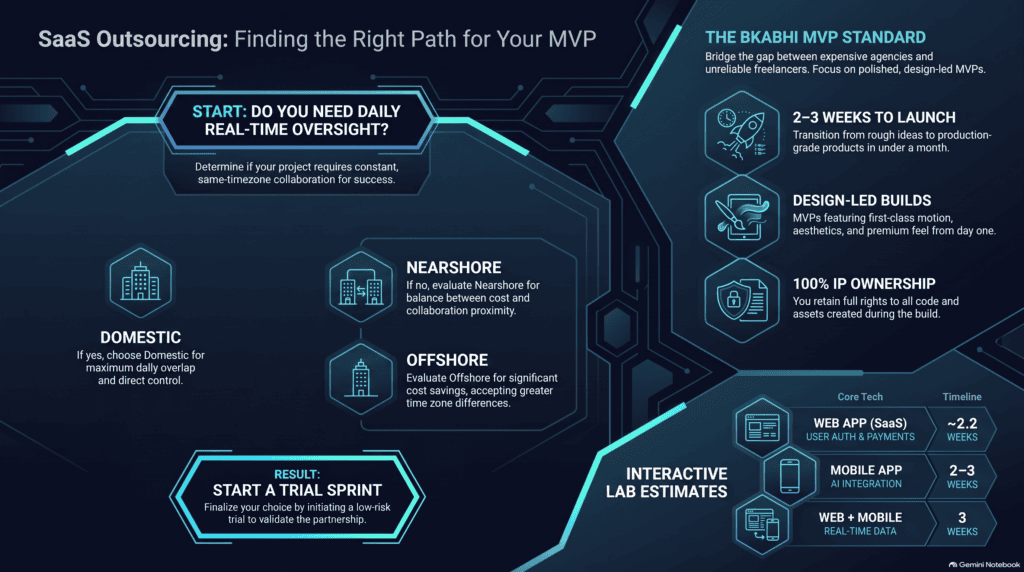
Outsourcing makes sense when you need to validate an idea fast, your budget can’t support full-time salaries yet, or the skill you need is temporary rather than ongoing.
Outsourcing offshore specifically makes sense when your scope is well-documented, your timeline has some flexibility, and cost savings matter more than daily real-time collaboration.
It makes less sense when your product involves sensitive regulated data with strict compliance needs, or when you need someone in the room for fast, ambiguous, evolving decisions every single day.
Founders weighing this against building a team internally should also read our MVP development agency vs. in-house team comparison, which breaks the decision down by startup stage.
How BkAbhi Approaches Outsourced MVP Builds
We treat outsourcing MVP development as a partnership decision, not a transaction — because founders are trusting us with a version of their company that doesn’t exist yet.
Every engagement starts with a scoped discovery phase, so you know the plan and the cost before full development begins.
We’re upfront about exactly who is working on your build and where, so there’s no ambiguity about team composition mid-project — a standard we believe every outsourced MVP partner should meet.
You can explore how we structure engagements on our homepage, or browse more founder guides on cost, process, and vendor vetting across our full blog library.
Common Myths About Outsourcing MVP Development
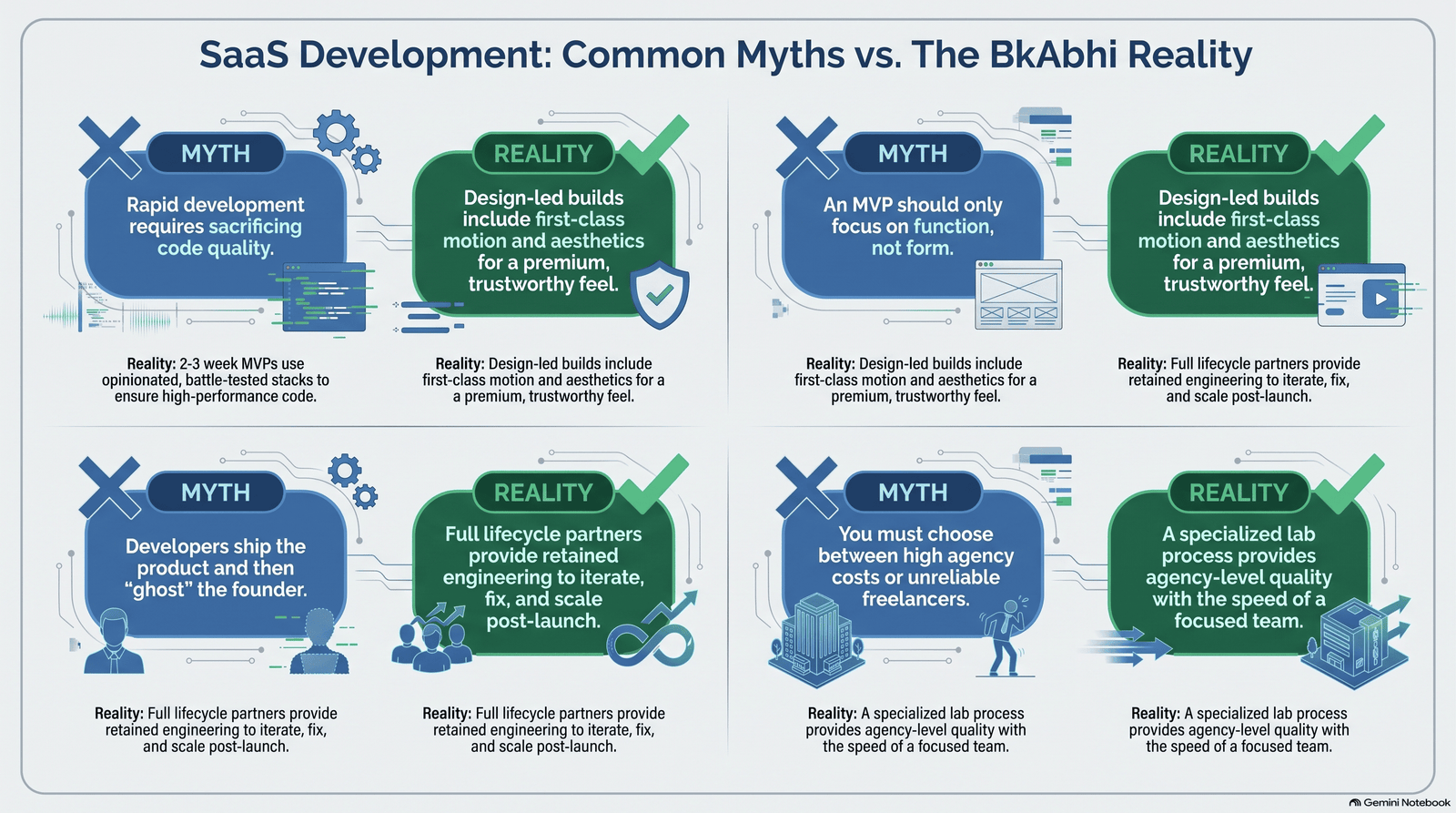
A few myths keep founders from making a clear-eyed decision. Worth clearing up before you sign anything.
Myth: Outsourcing always means offshore. Not true. You can outsource to a domestic agency, a nearshore team, or a freelancer down the street. Offshore is only one option inside a much bigger category.
Myth: Cheaper always means worse quality. Rate and quality are related, but not perfectly. A well-run offshore team with a mature process can outperform an overpriced domestic freelancer with no accountability structure.
Myth: You lose all control once you outsource. Control is a function of your contract and your process, not your vendor’s location. Milestone check-ins, staging environments, and clear specs keep oversight intact regardless of where the team sits.
Myth: Outsourcing means giving up your idea’s ownership. IP ownership is a contract term, not an automatic consequence of outsourcing. Any reputable partner assigns full IP to you in writing before work begins.
Frequently Asked Questions
Is outsourcing MVP development cheaper than hiring in-house? Almost always, for a first build. Fully-loaded in-house cost typically runs well above an outsourced project’s fixed price once salary, benefits, and recruiting time are included.
What’s the real difference between offshore and outsource MVP development? Outsourcing is about who builds it — an external team versus your own employees. Offshore is about where that external team is located, which adds time-zone and legal considerations on top of the outsourcing decision itself.
Is offshore MVP development safe for protecting my idea? It can be, with the right contract. Require a signed NDA and full IP assignment in writing before sharing detailed specifications with any outside team, offshore or otherwise.
How do I avoid the most common offshore outsourcing mistakes? Overlap working hours where possible, pay in milestones rather than lump sums, and start with a small paid trial sprint before committing to the full build.
Should a non-technical founder outsource their MVP? Yes, this is one of the most common and successful outsourcing scenarios — provided the vendor is properly vetted and the contract is clear on scope, cost, and ownership from day one.
Can I start offshore and bring development in-house later? Yes. Many founders validate with an outsourced or offshore team first, then transition core ownership in-house once the product has traction and funding to support full-time hires.
Final Thoughts
There’s no single right answer buried in outsourcing MVP development pros and cons — only the answer that fits your budget, your timeline, and how much daily control you actually need.
Offshore outsourcing widens the cost savings further, but only pays off when the contract, communication rhythm, and vetting process are built around its specific risks.
Get the structure right, and outsourcing — offshore or otherwise — remains one of the fastest, lowest-risk ways for a founder to turn an idea into a working, testable product.
Ready to see this framework applied to your own build? Explore BkAbhi’s approach or read our best MVP development companies guide for help shortlisting a partner.
Author Bio
Jeevesh Tripathi Email: jeevesh@bkabhi.com
Jeevesh Tripathi is a startup technology researcher and MVP strategy consultant at BkAbhi Innovations Lab, where he has advised founders across fintech, SaaS, and marketplace platforms on build strategy, vendor selection, and offshore engagement structuring. His work focuses on translating real founder decisions — outsourcing trade-offs, contract terms, and offshore risk management — into practical, jargon-free guidance for early-stage teams. This article draws on 2026 outsourcing industry benchmark data, agency engagement patterns, and direct founder interviews conducted throughout the year.
This guide is part of BkAbhi’s MVP development resource hub. For more founder-focused guides on cost, process, and vetting development partners, visit the BkAbhi blog.