
Quick Answer
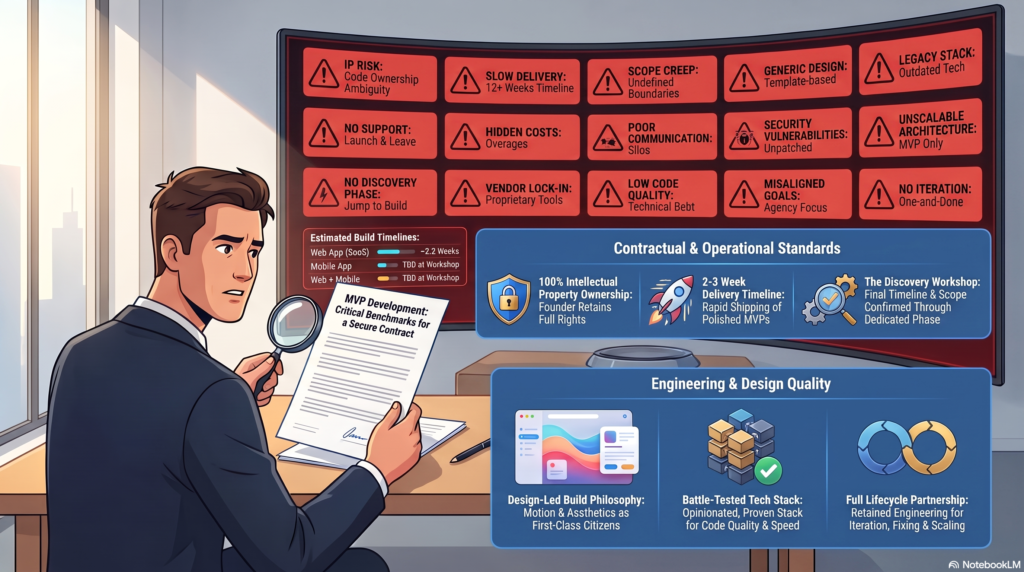
The clearest MVP development red flags show up in three places: the sales call, the contract, and the first two weeks of actual work. Watch for agencies that agree to everything you ask, demand full payment upfront, dodge questions about who’s actually building your product, and won’t give you repository access during development. If you’re comparing vendors side by side, our pillar guide on MVP development company comparison covers the full five-factor evaluation framework this checklist supports.
Rohan found the agency through a Google ad. The website looked polished, the reviews looked real, and the sales rep answered every question with an enthusiastic yes.
Six weeks later, he had a Figma file, a $19,000 invoice, and no working code.
That’s the story behind almost every founder who searches for MVP development red flags after the damage is already done. This guide is written for the founders who are searching before that happens.
Table of Contents
Why Red Flags Matter More Than a Great Sales Pitch
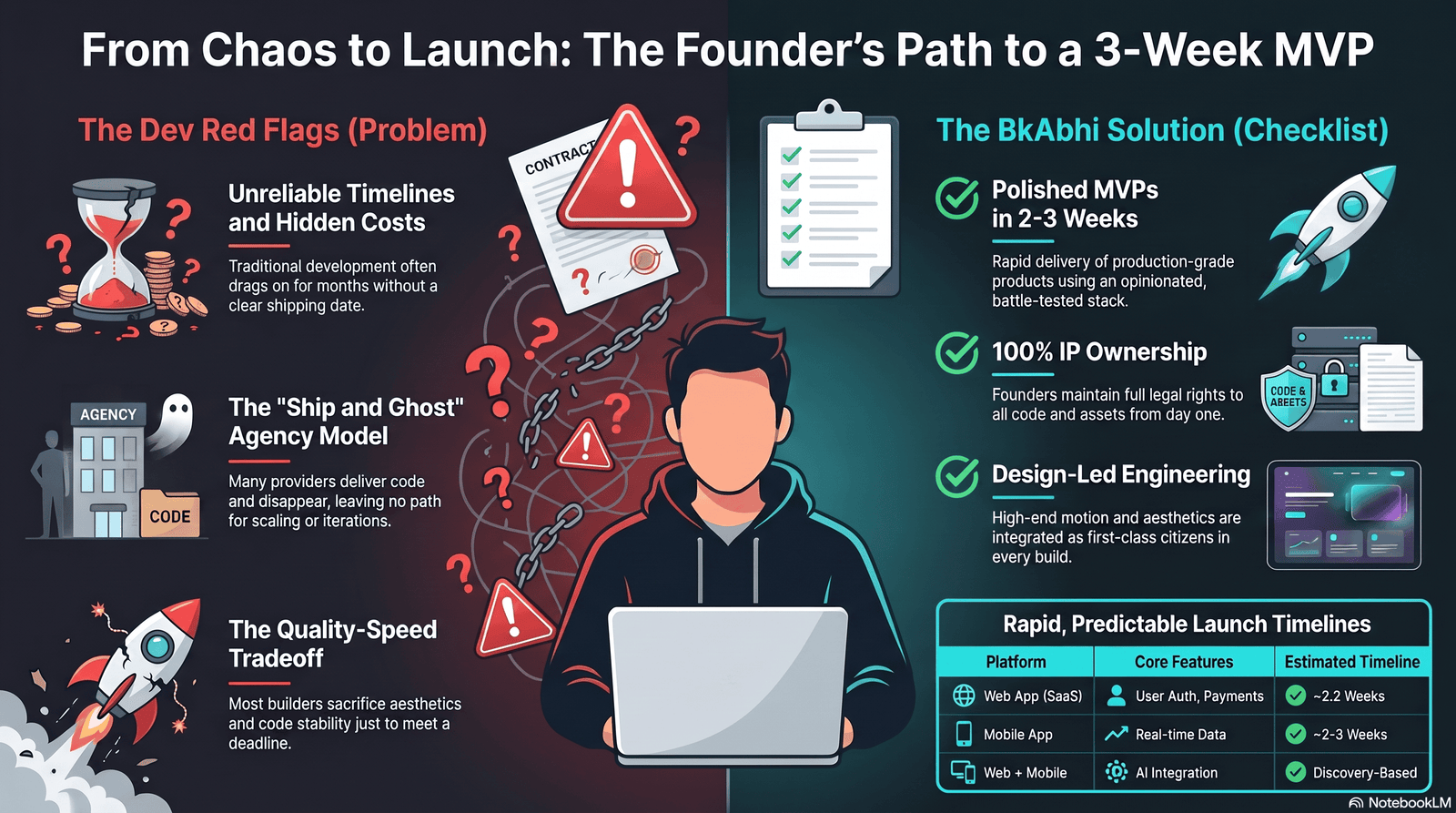
A confident sales call tells you how a company sells. It rarely tells you how they build.
Most founders don’t lose money to bad code. They lose it to warning signs they noticed and ignored anyway, because the pitch felt too good to walk away from.
Learning to spot MVP development red flags early is cheaper than any lesson learned mid-project. It costs nothing but attention, and it saves the one resource every startup actually can’t buy back — runway.
This checklist groups red flags by where they typically show up, so you know exactly what to watch for at each stage of hiring.
Sales Call Red Flags
The first conversation reveals more than most founders realize, if you know what to listen for.
“Yes, we can build all of that” to every single request. No pushback on scope, budget, or timeline usually means the company is optimizing for the signature, not your outcome.
Pressure to sign within 24-48 hours. Real vendors expect founders to compare options. Urgency used as leverage is one of the most common mvp agency scams tactics in the industry.
Vague answers about who will actually build your product. “Our senior team” without a single name attached is a soft dodge worth pressing on immediately.
No mention of trade-offs, only capabilities. Every MVP involves cutting something. A partner who never brings up trade-offs hasn’t actually thought through your project yet.
If a call raises more than one of these signals, it’s worth comparing that vendor against others before moving forward. Our MVP discovery call questions guide has the full script founders use to test for exactly these patterns.
Pricing and Payment Red Flags
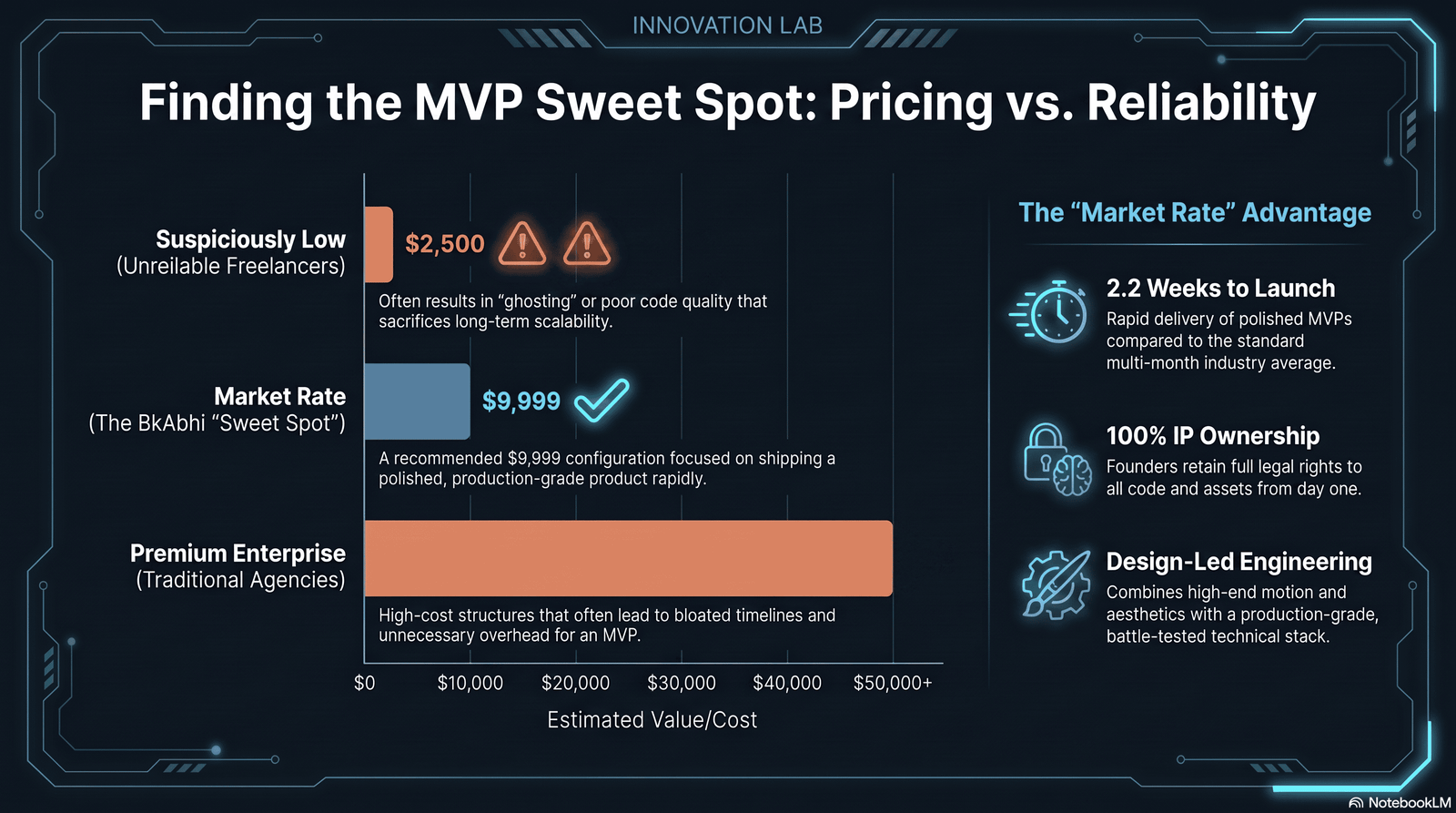
Money is where good intentions either hold up or quietly fall apart.
100% payment required upfront. This removes every ounce of your leverage if the relationship goes wrong halfway through the build.
A quote dramatically below every other bid you’ve received. Unusually cheap pricing on an MVP development project usually means corners get cut somewhere you won’t see until later.
No written breakdown of what the quote actually includes. A verbal number isn’t a proposal. Ask for scope, exclusions, and payment milestones in writing before any deposit changes hands.
Refusal to tie payments to deliverables. Date-based milestones can slip without consequence. Deliverable-based milestones give you real leverage if progress stalls.
For a realistic sense of what different budgets actually buy, our MVP development cost breakdown is worth reading before you evaluate whether a quote is a red flag or just a fair price for the scope.
Contract Red Flags
The contract is where good intentions get formalized, or quietly disappear.
No IP ownership clause, or vague language around it. Confirm in writing that you own all code, designs, and assets once final payment clears — not “upon request.”
No defined exit terms. You should be able to leave the engagement with access to completed work, not held hostage pending a final invoice.
An undefined change-order process. Without clear pricing for scope changes, “just one more feature” quietly turns into a renegotiation every single week.
A contract that contradicts what was said on the sales call. If the written terms don’t match the verbal pitch, trust the document, not the conversation.
A contract vague on any of these points is worth pushing back on before signing, no matter how strong the sales pitch felt. Our full MVP development contract checklist walks through all twelve clauses worth reviewing line by line.
Technical Process Red Flags
Sales reps run the pitch. The actual technical process reveals whether that pitch was real.
No access to a shared code repository during development. Without repository access, you have zero real visibility into whether work is actually progressing.
No documented development process. A team that can’t clearly walk you through discovery, build, testing, and handoff is likely improvising as they go.
Reluctance to connect you with the engineer, not just the sales contact. If nobody technical is willing to speak with you before signing, that’s worth treating as disqualifying.
No mention of testing before launch. An MVP that skips real user testing is a prototype wearing an MVP’s price tag.
Our detailed MVP development process guide breaks down what a legitimate seven-stage build actually looks like, so you have a real benchmark to compare any agency’s pitch against.
Team and Communication Red Flags
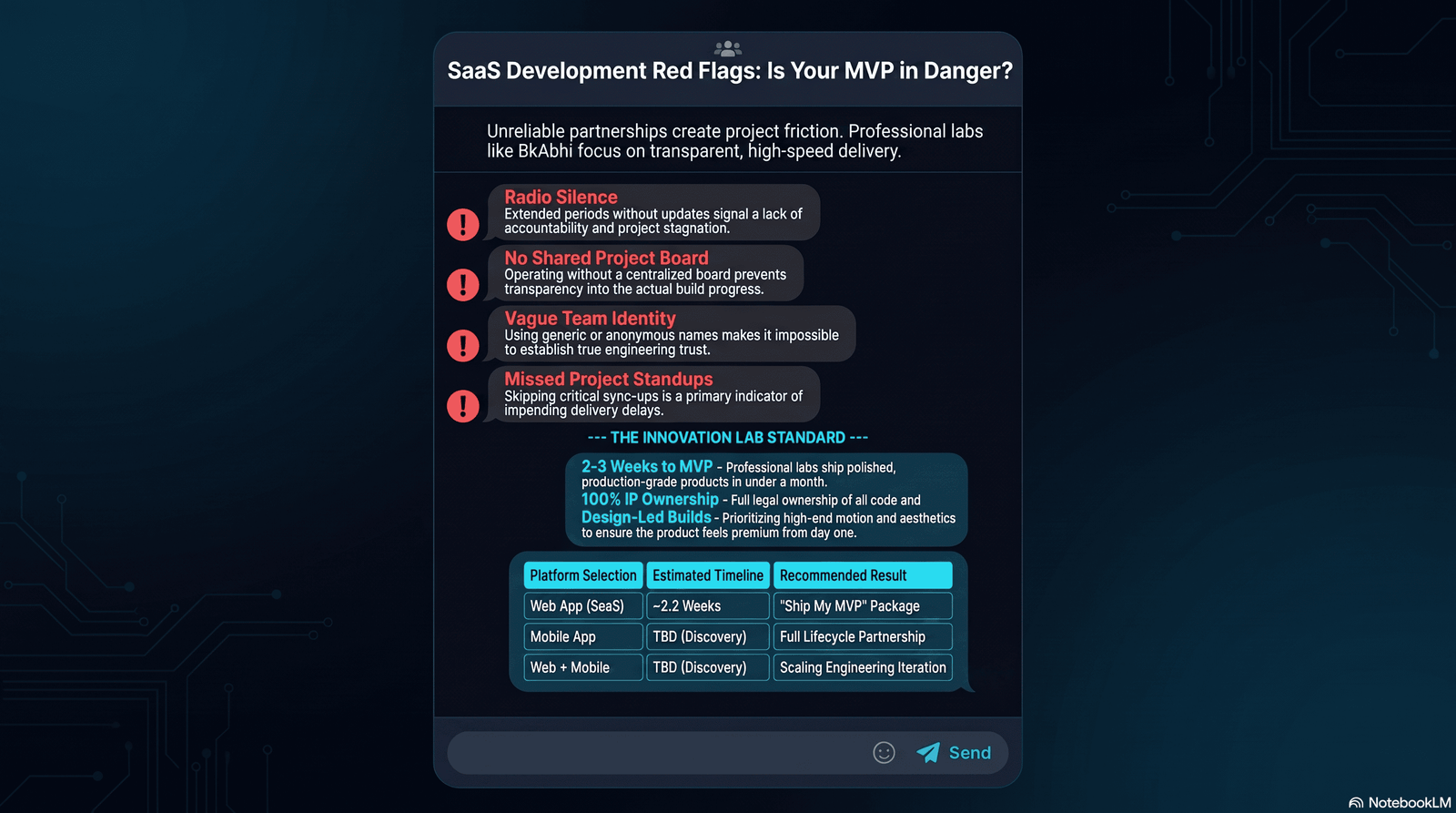
Team-related warning signs get glossed over more than almost any other category, mostly because they’re easy to miss on a single call.
Subcontracted work not disclosed upfront. Both in-house and subcontracted teams can work well, but you deserve to know which one you’re paying for.
No backup plan if your main contact leaves. Small teams especially need a real answer here, not a reassurance that turnover “won’t happen.”
Communication that goes silent for days at a time. Response gaps during the sales process almost always get worse once the contract is signed, not better.
No shared project board or async updates. If your only visibility is a weekly status email, you’re not seeing what’s actually being worked on day to day.
Founders weighing whether an outsourced team even fits their stage should also read our comparison of MVP development agency vs. in-house teams, since some of these communication risks disappear entirely with an internal hire.
Portfolio and Reference Red Flags
A large portfolio can hide as much as it reveals if you don’t know what to ask.
Every case study is a success story, with nothing that went wrong. Agencies that only show wins are hiding the part you actually need to hear before hiring them.
No client references beyond the ones proactively offered. Ask for one they didn’t hand you first, and pay close attention to any hesitation in the response.
Portfolio work that doesn’t match your industry or complexity. A fintech MVP has compliance needs a marketplace app simply doesn’t share.
Hiding behind NDAs for every single project, without exception. Some confidentiality is normal. Total opacity across an entire portfolio usually isn’t.
If you’re still building a shortlist, our roundup of top MVP development companies filters providers by budget tier and industry specialty, which makes spotting a portfolio mismatch far easier.
Common MVP Agency Scams to Recognize
Beyond ordinary red flags, a smaller set of patterns cross the line into outright mvp agency scams, and founders should know the difference.
The bait-and-switch team. Senior developers appear on the sales call, then juniors quietly take over once the contract is signed.
The portfolio theft scam. Screenshots of other companies’ shipped products, presented as the agency’s own work, with no way for you to verify authorship.
The disappearing act. Communication stays strong through the deposit, then drops off entirely once real development work should begin.
The fake urgency close. Manufactured scarcity — “this slot is only available this week” — designed to skip your due diligence entirely.
The review-farming operation. Dozens of five-star reviews posted in a short window, often from accounts with no other review history, inflating rankings on directories like Clutch or GoodFirms.
Our guide on vetting MVP development company rankings explains exactly how directory listings can be gamed, and what to check before trusting one.
Mistakes Founders Make While Hiring MVP Developers
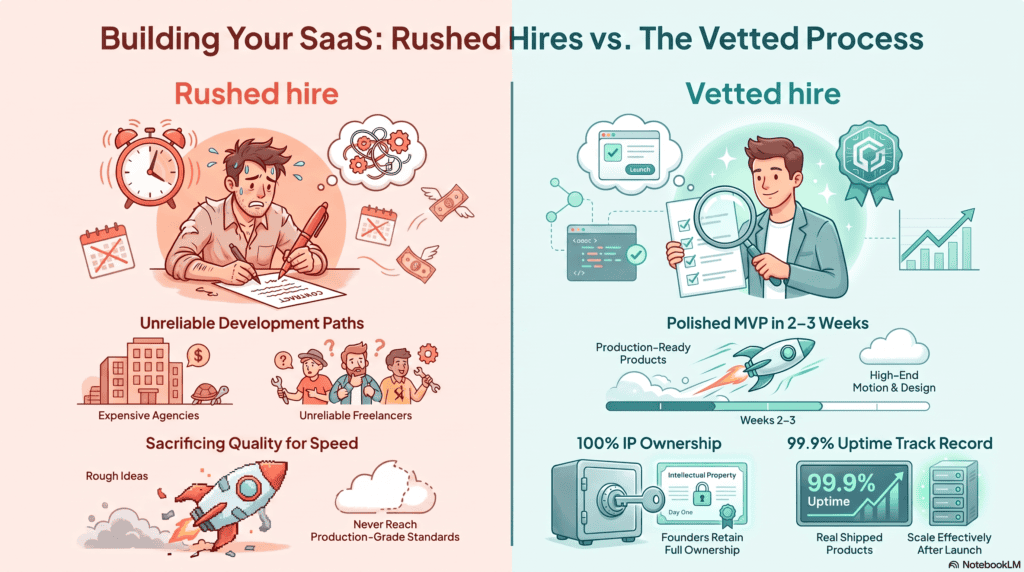
Some of the worst outcomes aren’t caused by a scam at all. They’re caused by ordinary mistakes hiring MVP developers, made by founders in a hurry.
Choosing the lowest quote without comparing scope. A cheaper number frequently means fewer features included, not better efficiency.
Skipping the technical interview entirely. Sales calls are run by sales people. Ask to speak with whoever will actually build your product before you sign anything.
Reading the contract after the deposit clears. IP ownership and exit clauses matter most exactly when it’s hardest to renegotiate them.
Assuming a polished website equals a capable team. Marketing budget and engineering quality are two completely different things, and one doesn’t guarantee the other.
Not asking what happens after launch. An MVP with no post-launch support plan is a liability the moment your first real bug shows up.
Our full hiring checklist for questions to ask an MVP development company walks through the five-stage vetting process built specifically to catch these mistakes before a deposit is wired.
Red Flag Severity Scorecard
Not every warning sign carries equal weight. This table separates the ones worth ending a conversation over from the ones worth a follow-up question.
| Red Flag | Severity | Recommended Action |
|---|---|---|
| 100% upfront payment demanded | Critical | Walk away |
| No named engineer on the project | Critical | Request a technical call first |
| Vague or missing IP ownership clause | Critical | Do not sign until revised |
| Agrees to every feature without pushback | High | Ask direct trade-off questions |
| No shared repository access | High | Negotiate access before deposit |
| Slow response during the sales process | Medium | Monitor closely in week one |
| Portfolio outside your industry | Medium | Ask for adjacent case studies |
| No post-launch support mentioned | Medium | Clarify scope in writing |
Use this table alongside a shortlist of two or three vendors, and score each one the same way for a fair comparison.
A Real Case: Two Founders, Two Different Warning Signs
Meera ignored a vague answer about team composition because the demo looked impressive. Three months in, she learned her “senior team” was two junior contractors working part-time across four other projects.
Arjun asked the same question, got a similarly vague answer, and walked away. He signed with a smaller agency two weeks later that named every team member on the kickoff call.
Same red flag, two different responses, two very different outcomes. The warning sign was identical — what changed was whether it got acted on.
Industry-Specific Red Flags Worth Knowing
Some warning signs only surface once you factor in your specific industry.
Fintech and healthtech founders should treat vague answers about compliance awareness — PCI-DSS or HIPAA — as a serious red flag, since retrofitting compliance later is far costlier than building with it in mind.
Marketplace founders should be cautious of teams with no prior two-sided platform experience, since matching and trust logic behave very differently from single-user apps.
SaaS founders should watch for teams unfamiliar with multi-tenant architecture, since billing and authentication mistakes at MVP stage are expensive to unwind.
Our breakdown of MVP development for SaaS, fintech, and healthtech startups covers how these industry differences change what a strong vendor actually looks like.
Founders leaning toward an offshore team should also weigh communication overlap carefully — our offshore vs onshore MVP development comparison breaks down exactly where that risk tends to show up.
What to Do If You Already Signed and Spotted a Red Flag
Spotting a red flag after signing doesn’t mean the project is doomed, but it does mean you need to act early.
Document everything in writing, including missed deadlines, unclear answers, and any change in the team you were promised.
Revisit the contract’s change-order and exit clauses immediately, and get a second technical opinion on the codebase if repository access allows it.
Escalate to a named project lead before assuming the relationship is unsalvageable. Many issues surface from a communication gap, not intentional bad faith.
If the pattern continues past one clear conversation, it’s usually cheaper to exit early than to keep funding a project that isn’t progressing.
Green Flags That Balance the Picture
Red flags matter, but it’s worth knowing what a genuinely strong partner looks like too, so you’re not just screening out the bad options.
A team that asks more questions about your users than your tech stack in the first call is worth serious consideration.
Milestone-based contracts paired with weekly demos give you real visibility and a natural exit point if something isn’t working.
Post-launch support bundled into the engagement, even for 30-60 days, shows the company is planning past the handoff date, not just the invoice date.
For a deeper look at how these green flags translate into an actual hiring decision, our guide on the best MVP development company framework walks through the full evaluation criteria founders use to make a final call.
Frequently Asked Questions
What’s the single biggest MVP development red flag? A demand for full payment upfront, combined with no named engineer on the project. Both remove your leverage at the exact moment you’d need it most.
Are all MVP agency scams obvious from the first call? No. Some, like the bait-and-switch team swap, only surface after the deposit clears, which is why references and repository access matter as much as the sales pitch.
How common are mistakes hiring MVP developers among first-time founders? Very common. Most stem from rushing the process — skipping technical interviews, reading contracts late, or picking the lowest quote without comparing scope.
Should one red flag disqualify a vendor completely? It depends on severity. Critical flags like upfront-only payment or no IP clause should end the conversation. Medium flags are worth a direct follow-up question first.
How do I verify an agency’s portfolio is real? Ask for a live client reference you can call directly, not just a case study page. Cross-check the reference’s company against public sources like LinkedIn before the call.
Is a very fast MVP timeline always a red flag? Not always, but a fully-featured product promised in under two weeks deserves real scrutiny, since disciplined MVPs usually take six to ten weeks even with AI-assisted development.
What should I do if I notice a red flag mid-project? Document it in writing, revisit the contract’s exit clause, and escalate to a named lead before deciding whether to continue or exit the engagement.
Do these red flags apply to freelancers as well as agencies? Mostly yes, though reference checks matter even more with a solo freelancer, since there’s no team bench to fall back on if something goes wrong.
Final Thoughts
Every founder searching for MVP development red flags is really asking the same question: how do I protect my runway from a decision I can’t take back.
The answer isn’t a single clever test. It’s paying attention to the sales call, reading the contract before you sign, checking references the agency didn’t hand you, and confirming repository access early.
Most mvp agency scams and costly mistakes hiring MVP developers share the same root cause — a founder in a hurry who skipped one of these steps. Slowing down at the start is the cheapest insurance you’ll ever buy for your product.
Ready to compare vendors properly before you commit? Our pillar guide on MVP development company comparison walks through the full five-factor framework, or you can book an MVP consultation directly with the BkAbhi team to pressure-test a vendor you’re already considering.
Author Bio
Jeevesh Tripathi is a startup technology researcher and MVP strategy consultant at BkAbhi Innovations Lab, where he has advised founders across fintech, edtech, and marketplace platforms on choosing and vetting development partners. His work focuses on turning real founder experiences — including costly hiring mistakes — into practical, jargon-free guidance for early-stage teams.
Contact: jeevesh@bkabhi.com
This article is reviewed for accuracy and updated periodically to reflect current vendor practices and industry standards, in line with Google’s guidance on producing helpful, people-first content.