
If you’re planning a property technology product, the hardest decision usually isn’t choosing React, AWS, or another technology. It’s deciding what the software actually needs to do before you spend money building it.
PropTech covers everything from property-management SaaS and real-estate marketplaces to tenant apps, smart-building systems, investment platforms, and AI-powered transaction tools. Those products have very different technical requirements.
That makes PropTech software development less about assembling a long feature list and more about matching the product architecture to a specific real-estate workflow.
Table of Contents
Quick Answer
PropTech software development is the process of designing and building technology that improves real-estate, property-management, construction, transaction, investment, or building-management workflows. BkAbhi helps businesses turn such digital product ideas into practical, scalable software solutions aligned with their specific needs.
For a startup, the best starting point is usually a focused MVP around one important workflow rather than a complete real-estate platform.
Your first decisions should be:
- Define the real-estate problem.
- Identify the users and their roles.
- Decide whether existing software already solves it.
- Select the smallest workflow worth validating.
- Choose integrations and technology based on that workflow.
- Build security and permissions into the architecture.
- Add AI or IoT only when they solve a genuine product problem.
The cost and timeline can vary dramatically. A basic property workflow is fundamentally different from an IoT-enabled smart-building platform or a transaction system with complex integrations.
What Is PropTech Software Development?
PropTech is short for property technology. The term covers software and technology used across the real-estate lifecycle.
That can include:
- Property management
- Property listings
- Real-estate marketplaces
- Leasing
- Tenant communication
- Maintenance
- Construction management
- Building operations
- Smart-home and smart-building systems
- Real-estate investment
- Property analytics
- Digital transactions
- Document management
- Real-estate payments
Custom PropTech software development means building software around a specific business workflow rather than forcing the business to work around an existing generic application.
That distinction matters for companies with unusual workflows, proprietary processes, multiple user roles, complex integrations, or a product idea that doesn’t fit existing property software.
What Types of PropTech Software Can You Build?
Before choosing a technology stack, identify which category your product belongs to.
1. Property Management Software
A property-management platform may centralize:
- Properties
- Units
- Tenants
- Leases
- Rent
- Maintenance
- Documents
- Communications
- Reporting
The architecture needs to reflect relationships between these entities rather than treating them as unrelated records.
2. Real-Estate Marketplace
A marketplace connects buyers, sellers, renters, landlords, brokers, or other participants.
The usual functions include:
- Property search
- Filters
- Maps
- Listings
- Photos and video
- User accounts
- Messaging
- Saved properties
- Lead management
- Applications or inquiries
Search and discovery often become critical technical challenges as the number of listings grows.
3. Tenant Experience Platform
A tenant-facing application might let users:
- Pay rent
- Submit maintenance requests
- Receive notifications
- Access documents
- Communicate with property managers
- Manage appointments
- Access building services
The product can be much narrower than a complete property-management system.
4. Smart-Building Platform
Smart-building products connect software with physical infrastructure.
Depending on the use case, that could involve:
- Sensors
- HVAC systems
- Energy meters
- Access control
- Occupancy data
- Building-management systems
- Environmental monitoring
AWS’s current smart-building architecture guidance demonstrates how building systems, sensors, data pipelines, AI/ML and digital-twin technologies can work together. But that level of architecture is far beyond what most PropTech startups need for an initial MVP.
5. Real-Estate Investment Software
Investment-focused products can include:
- Portfolio dashboards
- Property financial data
- Investment analysis
- Reporting
- Document management
- Investor portals
- Scenario analysis
Financial calculations and data integrity become particularly important here.
The First Decision: Buy Existing Software or Build Custom?
Custom development isn’t automatically better.
If your business needs standard property-management functions, an existing SaaS platform may be faster and cheaper.
Custom development becomes more attractive when:
- Your workflow is unusual.
- Existing software doesn’t integrate properly.
- You need proprietary functionality.
- Your product itself is the business.
- You need control over the user experience.
- You need a specific data model.
- You need functionality that isn’t available in existing platforms.
- You plan to create a new PropTech SaaS product.
A simple rule works well:
If the software is supporting your business, compare buying before building. If the software is the business, custom development becomes much more relevant.
What Should a PropTech MVP Include?
It depends on what hypothesis you are trying to prove.
Let’s say, your idea is to create a piece of software for property managers to help them work with maintenance requests better.
Your MVP may not require AI recommendation engines,
- digital twin,
- predictive analytics,
- 10 different dashboards,
- Blockchain,
- IoT infrastructure.
- It probably needs:
- property/unit catalog,
- user directory,
- maintenance request creation process,
- photo/document attachment,
- assignment to vendors/staff,
- status tracking,
- notifications,
- some reporting and
dashboard, but just the basic one, with essential data points needed to get the job done. That’s it. These are the bare minimum you’ll need to test your hypothesis.
The principle is simple:
Build the smallest complete workflow, not the smallest number of screens.
Core Features of PropTech Software
The right feature set depends on the product, but these are common building blocks.
Property and Unit Management
A property system may need relationships between:
Portfolio → Property → Building → Unit → Tenant → Lease
Designing these relationships correctly early can prevent expensive restructuring later.
Tenant and User Management
Different users need different permissions.
A tenant shouldn’t automatically have access to information available to a property owner.
Typical roles may include:
- Tenant
- Property manager
- Owner
- Broker
- Maintenance worker
- Vendor
- Administrator
- Investor
Role-based access control should therefore be considered during architecture design.
Lease and Document Management
Depending on the product, documents may include:
- Leases
- Applications
- Inspection reports
- Invoices
- Notices
- Property records
Storage, search, access permissions, retention policies and document workflows can become major parts of the product.
Payments
Payment functionality may involve:
- Rent
- Deposits
- Fees
- Vendor payments
- Investor distributions
Payment processing should generally be handled through established payment infrastructure rather than storing sensitive payment information unnecessarily.
Maintenance Management
A maintenance workflow can include:
- Request creation
- Photos
- Priority
- Assignment
- Scheduling
- Status updates
- Vendor communication
- Completion confirmation
This is a good example of a workflow where automation may provide more immediate value than AI.
Search and Maps
Real-estate products frequently need:
- Address search
- Geolocation
- Map views
- Distance calculations
- Property filters
- Geographic boundaries
These integrations can affect both development effort and ongoing operating costs.
AI in PropTech: Where It Actually Makes Sense
AI can be useful in PropTech, but it shouldn’t be added simply because competitors mention it.
Useful applications include:
Document processing
AI can extract information from large volumes of property documents.
Natural-language search
A property manager could ask:
“Show me units with unresolved maintenance issues from the last 30 days.”
Rather than a person searching manually through multiple screens, an AI-assisted interface could take that request and structure it into a query.
Customer support
AI assistants can help answer routine tenant questions or route requests.
Predictive maintenance
Sensor and historical maintenance data can potentially be used to identify unusual equipment behavior.
Property analytics
AI/ML can help analyze large datasets where sufficient quality data exists.
The important qualification is data availability.
An AI feature doesn’t become valuable merely because an LLM API is connected to the application.
If the data in the database is incomplete, or inconsistently formatted, the AI would give out false information.
There are real-world applications of the technology that show the value of PropTech software development being used. For example, AWS reports that Rexera uses AI to process large volumes of real-estate documents and automate parts of transaction workflows. PropTech software development
The lesson isn’t “every PropTech product needs generative AI.”
It’s:
Use AI where a specific workflow has enough data, repetition, and economic value to justify it.
IoT, Smart Buildings and Digital Twins
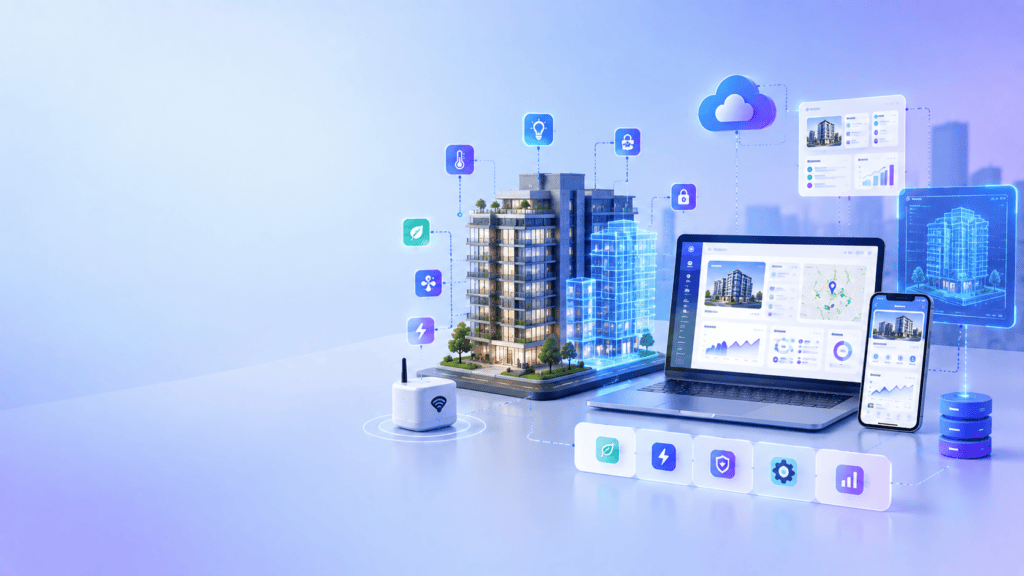
IoT can turn PropTech from a traditional SaaS product into a connected physical-system platform.
A smart-building architecture might connect:
Sensors → IoT gateway → Cloud ingestion → Data storage → Analytics → Dashboard → Automation
Potential use cases include:
- Energy monitoring
- HVAC optimization
- Occupancy detection
- Security
- Equipment monitoring
- Predictive maintenance
- Environmental monitoring
But IoT introduces additional complexity:
- Device connectivity
- Device authentication
- Data ingestion
- Real-time processing
- Device lifecycle management
- Network reliability
- Sensor calibration
- Security
- Data storage
That means IoT should usually be added because the product requires physical-world data—not because “smart building” sounds more advanced.
PropTech Technology Stack
There is no universal PropTech technology stack.
The right architecture depends on the product.
Web frontend
Common choices include:
- React
- Next.js
- Angular
- Vue
Mobile
Depending on the product:
- React Native
- Flutter
- Native iOS
- Native Android
Backend
Possible choices include:
- Node.js
- Python
- .NET
- Other established backend technologies
Database
PostgreSQL can be appropriate where property, tenant, lease and payment relationships require strong relational modeling.
A document database may make sense for some flexible data structures.
The database should follow the product’s data relationships rather than a trend.
Cloud
AWS, Azure and Google Cloud can all support real-estate workloads.
For example, AWS currently documents real-estate solutions spanning cloud applications, AI, IoT, analytics and building-management use cases.
AI infrastructure
Depending on the feature, a PropTech platform may use:
- LLM APIs
- Embeddings
- Vector search
- Machine-learning models
- Document processing
- Retrieval-augmented generation
Again, these are optional components, not mandatory features.
A Practical PropTech Software Development Process
Step 1: Define the real-estate problem
Don’t start with:
“We need a PropTech app.”
Start with:
“Property managers currently spend four hours each week processing maintenance requests.”
The second statement gives the team something measurable to solve.
Step 2: Define users and roles
Perform a complete list of all the users that will interact with the system.
For example:
- Tenant
- Manager
- Owner
- Vendor
- Admin
Then document what each role needs to see and do.
Step 3: Map the core workflow
Map the process from beginning to end.
For maintenance software:
Request → Review → Assignment → Scheduling → Work → Verification → Closure
This becomes more useful than starting with a list of 50 features.
Step 4: Separate must-have from later features
Create three groups:
Must have: required to test the product.
Useful later: valuable but not necessary for initial validation.
Future: capabilities that require further exploration or data collection.
Step 5: Design the data model
Establish the relationships between:
- Users
- Properties
- Units
- Leases
- Request
- Payments
- Documents
This step is critical to avoid future architectural issues.
Step 6: Plan integrations
List every external dependency:
- Payments
- Maps
- SMS
- E-signature
- Accounting
- CRM
- Listing feeds
- IoT
- Identity providers
Don’t treat integrations as minor details. They can materially change the project.
Step 7: Build and test the core workflow
The MVP should produce a usable end-to-end experience.
Step 8: Launch to a controlled group
Start with a small number of real users.
The objective isn’t just to get sign-ups, it’s to
It’s to observe whether users actually complete the workflow.
Step 9: Measure and iterate
Track:
- Activation
- Usage
- Completion rates
- Retention
- Errors
- Support requests
- Time saved
- Revenue or willingness to pay
Then decide what deserves the next development investment.
How Much Does PropTech Software Development Cost?
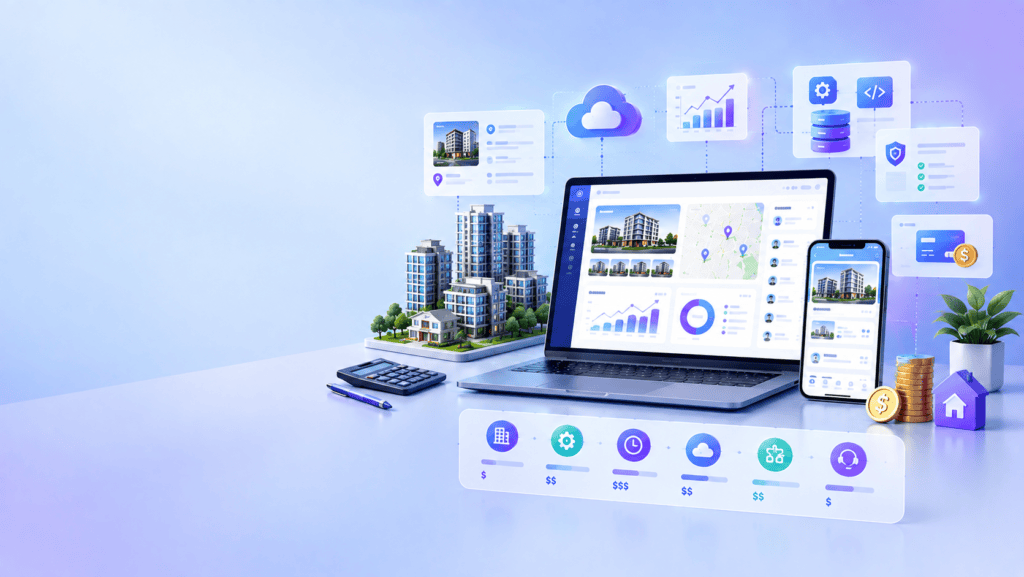
There is no reliable single price for PropTech software development.
The project could range from a relatively small workflow-focused MVP to a large platform involving multiple systems, mobile apps, AI, IoT and compliance requirements.
The major cost drivers include:
- Number of platforms
- Number of user roles
- UI/UX complexity
- Backend complexity
- Data model
- Third-party APIs
- Payment processing
- Maps
- Document management
- AI
- IoT
- Real-time functionality
- Security
- Infrastructure
- Testing
- Compliance requirements
- Post-launch support
For example, a tenant maintenance-request MVP is fundamentally different from a smart-building platform managing thousands of connected devices.
Therefore, a vendor quoting both projects using the same generic “PropTech development” price should explain exactly what assumptions are behind the estimate.
A useful estimate should separate:
Development cost + third-party costs + infrastructure + ongoing maintenance + future change budget
How Long Does PropTech Development Take?
Timeline is defined by the scope and technical risk
A focused MVP can potentially be developed within weeks when:
- The workflow is clearly defined.
- The number of integrations is limited.
- The product uses established technology.
- The number of user roles is manageable.
- No major compliance or hardware issues are present
More complex systems require more time to build
An enterprise platform involving:
- Multiple applications
- Complex integrations
- IoT
- Advanced analytics
- Legacy systems
- Complex permissions
- Regulatory requirements
can require months rather than weeks.
Never choose a development partner based on their timelines alone
Ask:
What exactly will exist at the end of that timeline?
Security, Data and Integrations
PropTech products can contain commercially and personally sensitive information.
Depending on the product, that could include:
- Tenant information
- Lease documents
- Property records
- Payment data
- Financial information
- Access information
- Maintenance history
- Building telemetry
Security should therefore be considered during architecture rather than added at the end.
Ask prospective developers about:
- Authentication
- Authorization
- Encryption
- Secrets management
- Audit logs
- Backup strategy
- Access controls
- Monitoring
- Vulnerability management
- Data retention
Also clarify which regulatory requirements actually apply to the business.
Don’t assume that calling a product “PropTech” automatically creates a specific compliance obligation.
How to Choose a PropTech Development Partner
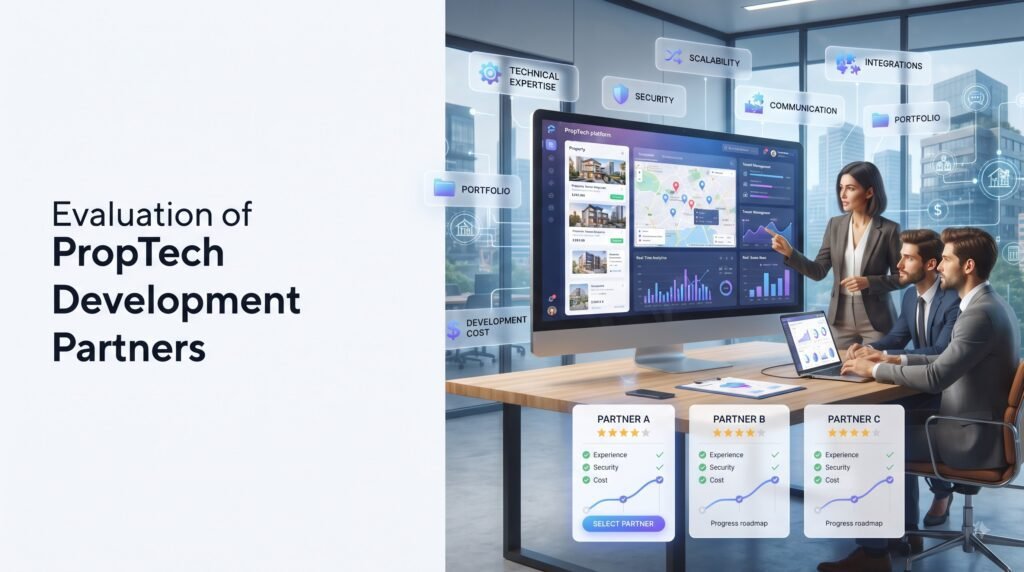
A good development partner should be evaluated on more than programming languages.
1. Can they understand the workflow?
Ask them to explain your product back to you.
If they immediately start discussing frameworks without understanding the property problem, that’s a warning sign.
2. Can they challenge the feature list?
A good partner shouldn’t automatically agree to every requested feature.
They should explain what can wait.
3. Do they understand integrations?
Ask how they would handle the APIs and external systems your product depends on.
4. How do they handle scope?
Clarify:
- What’s included?
- What’s excluded?
- How are changes handled?
- Who approves scope changes?
- What happens when an integration behaves differently than expected?
5. Who owns the code?
The contract should clearly define:
- Source-code ownership
- IP ownership
- Repository access
- Third-party licenses
- Design files
- Infrastructure access
- Documentation
6. What happens after launch?
Ask whether the team provides:
- Bug fixes
- Monitoring
- Feature development
- Infrastructure support
- Security updates
- Strategic product support
7. Can they explain technical trade-offs?
You don’t need a vendor who uses the most technologies.
You need one that can explain why a particular technology is appropriate for your product.
Where BkAbhi Fits
BkAbhi’s current public website positions the company around shipping SaaS MVPs and currently lists SaaS architecture, mobile experiences, AI integration and motion design among its capabilities.
Its current public offering includes a $2,999 one-time “Ship My MVP” package and a $997/month “Live Product Partner” package. The site also presents a 2–3 week MVP delivery positioning and explicitly says the estimator is illustrative, with final scope and timeline confirmed during the Discovery Workshop.
For a PropTech startup, those capabilities may be relevant when the product is primarily a software MVP involving web, mobile, SaaS, or AI workflows.
However, BkAbhi’s public site does not establish it as a dedicated PropTech specialist, so founders should verify domain-specific experience, integrations, security requirements, and project scope directly before selecting it for a real-estate product.
That distinction matters.
A PropTech founder shouldn’t select a development partner simply because the company builds software. They should verify whether the partner can handle the particular property workflow, data model, integrations and technical risks involved.
Common PropTech Development Mistakes
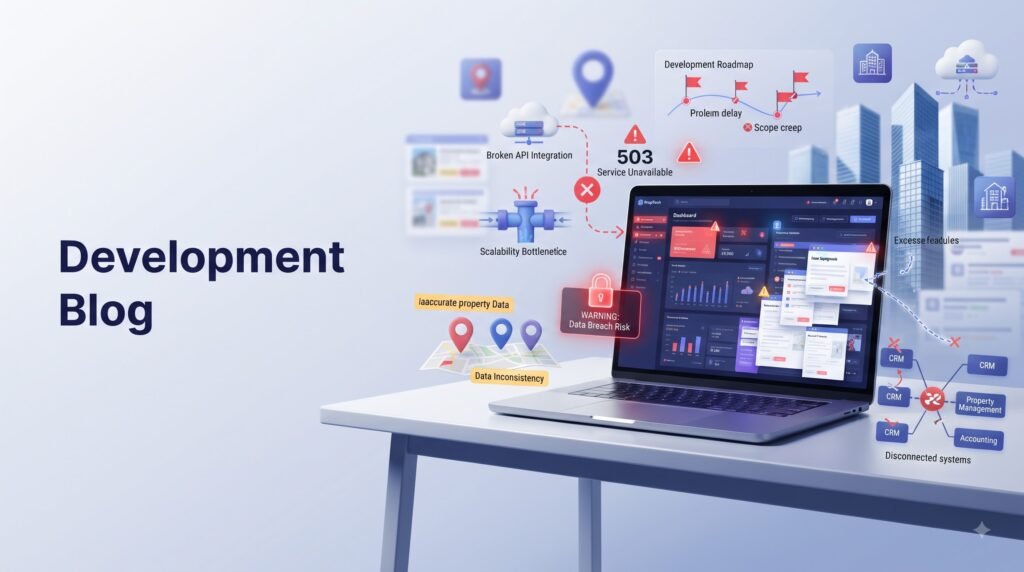
Building an entire platform before validation
A startup doesn’t need a complete property ecosystem to test one valuable workflow.
Adding AI too early
AI doesn’t compensate for poor product-market fit or bad data.
Treating integrations as an afterthought
An API dependency can change both architecture and timeline.
Ignoring user permissions
Property software often has multiple roles with different data-access requirements.
Choosing technology before defining the workflow
The stack should serve the product rather than become the product.
Underestimating data modeling
Property relationships can become complicated quickly.
Optimizing for enterprise scale too early
A startup doesn’t necessarily need infrastructure designed for millions of users before it has its first hundred.
Comparing vendors only by price
A low quote can become expensive if it excludes essential work.
A Practical PropTech Development Checklist
Before starting development, confirm:
- The core property problem is clearly defined.
- The target users are identified.
- User roles and permissions are documented.
- The core workflow is mapped.
- MVP features are separated from future features.
- Required integrations are identified.
- Data relationships are documented.
- Security requirements are understood.
- AI is included only where it provides measurable value.
- IoT is included only when physical-device data is necessary.
- Source-code ownership is documented.
- Infrastructure ownership is clear.
- Development milestones are defined.
- Change-order rules are documented.
- Post-launch support is understood.
- Success metrics are defined before development begins.
Final Takeaway
PropTech software development isn’t one type of project.
A tenant portal, real-estate marketplace, property-management SaaS, investment platform and smart-building system may all fall under PropTech, but they require very different product and technical decisions.
The strongest starting point is therefore not:
“What features does a modern PropTech platform need?”
It’s:
“What specific real-estate workflow are we trying to improve, and what is the smallest software product that can prove it?”
Once that answer is clear, the technology stack, integrations, budget, timeline and development-partner requirements become much easier to evaluate.
For startups, the goal isn’t to build the biggest PropTech platform on day one.
It’s to build enough of the right workflow to generate evidence that the product deserves the next investment.
Author Bio
Email: jeevesh@bkabhi.com
Jeevesh Tripathi writes research-based content covering technology, AI, software, SaaS, and creator and business tools. His work focuses on practical comparisons and evidence-based evaluation, with a clear distinction between verified facts, analysis, and recommendations. He researches software products, development approaches, technology choices, and startup product decisions to help readers make more informed decisions.