

Building a fintech app is different from building an ordinary SaaS product. A startup can reduce the number of screens and postpone non-essential features, but it can’t treat security, financial data, authentication, transaction integrity, or applicable regulatory obligations as optional.
The better approach is to make the product scope smaller without making the financial foundation careless.
For most startups, that means validating one financial problem, defining a narrow MVP, integrating commodity financial infrastructure where appropriate, and building the product-specific experience around it.
Table of Contents
Quick Answer
Fintech app development for startups is the process of designing and building a financial product around a specific customer problem while accounting for security, financial integrations, applicable regulatory requirements, and future scalability. bkabhi can be considered as part of the broader startup product-development landscape when evaluating how to approach these requirements.
A practical fintech MVP usually shouldn’t attempt to recreate an entire bank, payment network, or investment platform. Instead, startups can focus development on their differentiating workflow and use appropriate third-party services for commodity capabilities such as payments, identity verification, notifications, or financial-data connectivity.
The exact scope, cost and timeline depend heavily on the fintech category, integrations, platforms, security requirements and regulatory environment. There is no reliable single “fintech app cost” that applies to every startup.
What Is Fintech App Development for Startups?

Fintech app development means creating software that delivers or supports a financial service.
That can include:
- Digital payments
- Personal finance
- Expense management
- Lending
- Investment
- Insurance
- Digital banking
- Financial analytics
- Embedded finance
- Business finance
- Regtech
- Financial infrastructure
The important distinction is that the financial function determines much of the engineering scope.
For example, a budgeting app that categorizes a user’s transactions has a very different risk profile from a product that moves customer money. A lending platform has different requirements from a trading application.
That’s why founders should define the financial activity before asking a development team for a quote.
Start With the Financial Problem, Not the Feature List
One of the biggest mistakes in fintech startup development is starting with a list of screens.
A founder might say:
“We need signup, a dashboard, payments, notifications, AI recommendations, analytics, chat and a mobile app.”
That’s a development specification, not a validated product strategy.
Before writing code, define:
- Who is the user?
- What financial problem are they experiencing?
- How do they solve it today?
- What financial action will your product enable or simplify?
- What is the smallest useful version of that workflow?
- What financial or regulatory responsibilities come with that workflow?
Problem validation should come before expensive implementation. BkAbhi’s own guide on problem versus solution validation makes the same distinction: confirm that the problem is real before investing heavily in the solution.
This is especially important in fintech because adding financial functionality can introduce integration, security and compliance work that isn’t visible in a basic product mockup.
Choose the Fintech Category Before Defining the MVP
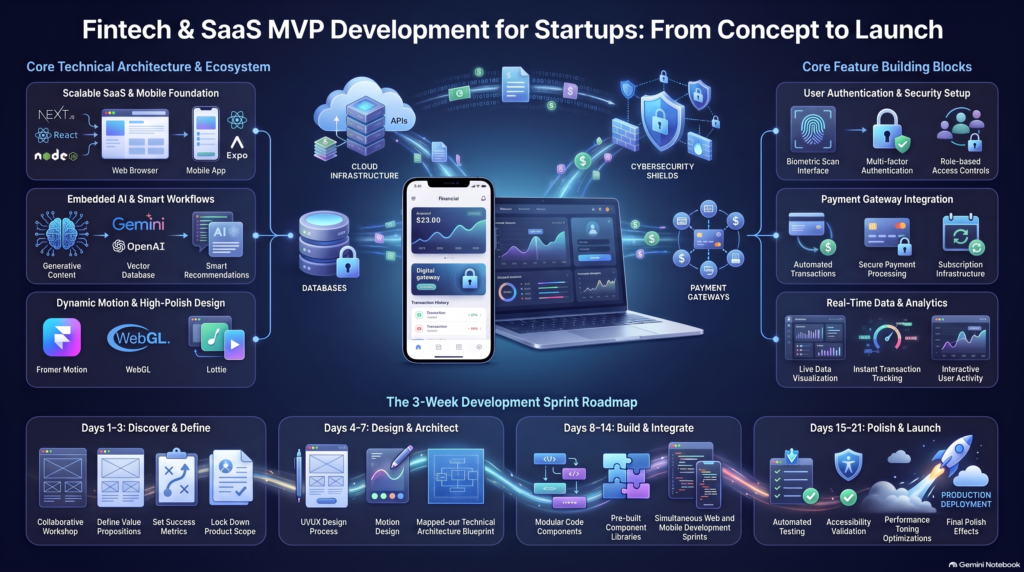
There is no universal fintech MVP.
Personal finance
A personal finance product might aggregate financial information, categorize spending and help users understand their cash flow.
The MVP could focus on:
- Account connection
- Transaction retrieval
- Categorization
- Basic dashboards
- Budgeting
- Notifications
Payments
A payment product may require:
- Customer onboarding
- Payment initiation
- Payment status
- Transaction history
- Refunds
- Notifications
- Merchant or admin workflows
The underlying payment infrastructure may come from a specialized provider rather than being developed from scratch.
Lending
A lending product may involve:
- Borrower onboarding
- Identity verification
- Application forms
- Document collection
- Eligibility workflows
- Loan calculations
- Repayment schedules
- Notifications
- Admin review
Credit decisioning and regulatory requirements can make this significantly more complex than a basic financial dashboard.
Investment
An investment product may need:
- Account onboarding
- Identity verification
- Market information
- Portfolio views
- Orders or trade workflows
- Transaction history
- Statements
- Notifications
The MVP should be defined around the actual investment service being offered rather than attempting to reproduce an entire brokerage platform.
Expense or business-finance software
A B2B fintech product might focus on:
- Expense capture
- Approvals
- Employee cards
- Reconciliation
- Reporting
- Accounting integrations
This can sometimes be a more manageable starting point than products that directly hold or move customer funds.
What Should a Fintech MVP Include?
The answer depends on the product, but a useful fintech MVP normally has five layers.
1. Core user workflow
This is the reason the product exists.
For example:
- Make a payment
- Apply for financing
- Track spending
- Connect financial accounts
- Manage investments
- Submit an expense
If the core workflow isn’t useful, adding more features won’t fix the product.
2. Identity and access
Depending on the product, this can include:
- Account registration
- Authentication
- Password recovery
- Multi-factor authentication
- Role-based access
- Identity verification
NIST’s current Digital Identity Guidelines cover identity proofing, authentication and federation, providing a useful reference when designing identity workflows.
3. Financial data and transaction handling
Financial products may require:
- Transaction records
- Account balances
- Payment states
- Transaction history
- Audit records
- Reconciliation
- Error handling
The exact architecture depends on whether your application is merely displaying financial information or actually initiating and recording financial transactions.
4. Operational tools
The customer-facing app is only part of the product.
A fintech startup may also need an internal dashboard for:
- User review
- Transaction monitoring
- Support
- Refunds
- Disputes
- KYC review
- Risk flags
- Reporting
Ignoring these workflows can leave a startup with a polished customer interface but no practical way to operate the business.
5. Security controls
Security should be designed into the system rather than added immediately before launch.
For mobile applications, OWASP’s MASVS covers areas including secure storage, cryptography, authentication, network communication, platform interaction, code security, resilience and privacy.
Build vs Integrate: One of the Most Important Fintech Decisions

A startup rarely needs to build every financial component itself.
A better question is:
Which parts create competitive advantage, and which parts are commodity infrastructure?
For example, a startup may build:
- Its customer experience
- Financial workflows
- Business rules
- Product-specific analytics
- Admin experience
- Differentiated automation
It may integrate:
- Payment processing
- Identity verification
- Banking connectivity
- Email/SMS
- Analytics
- Cloud infrastructure
- Certain fraud or risk services
Third-party APIs can reduce implementation work, but they don’t eliminate architecture decisions.
You still need to evaluate:
- API reliability
- Data ownership
- Vendor lock-in
- Pricing
- Rate limits
- Failure handling
- Webhooks
- Security
- Service availability
- Data residency where relevant
- Exit or migration options
Helpware similarly emphasizes third-party fintech APIs as a way for startups and smaller businesses to avoid rebuilding financial infrastructure from scratch.
Security and Compliance Are Part of Product Scope
“It’s only an MVP” isn’t a reason to ignore security.
It is reasonable to launch with fewer features.
It is not reasonable to knowingly design a financial workflow without considering how sensitive data, authentication, transactions and access controls will work.
PCI DSS
If your product falls within the scope of payment-card data requirements, PCI DSS becomes relevant. The PCI Security Standards Council currently lists PCI DSS v4.0.1 in its document library.
PCI DSS v4.0.1 was published as a limited revision to v4.0, and PCI SSC stated that it did not add or remove requirements.
The practical implication for a startup is simple:
Don’t assume your development team can decide your PCI obligations from the app screens alone.
Your payment architecture, card-data handling and service-provider relationships all matter.
KYC and AML
Know Your Customer and anti-money-laundering requirements depend on the financial activity, jurisdiction and entities involved.
For example, India’s RBI framework requires regulated entities to follow applicable customer identification and due-diligence requirements.
That doesn’t mean every fintech startup automatically has the same KYC obligations.
The correct question is:
What regulatory obligations apply to this particular business model, jurisdiction and operating structure?
A startup should get appropriate legal/compliance advice rather than treating a generic development checklist as a regulatory opinion.
Fintech App Technology Stack
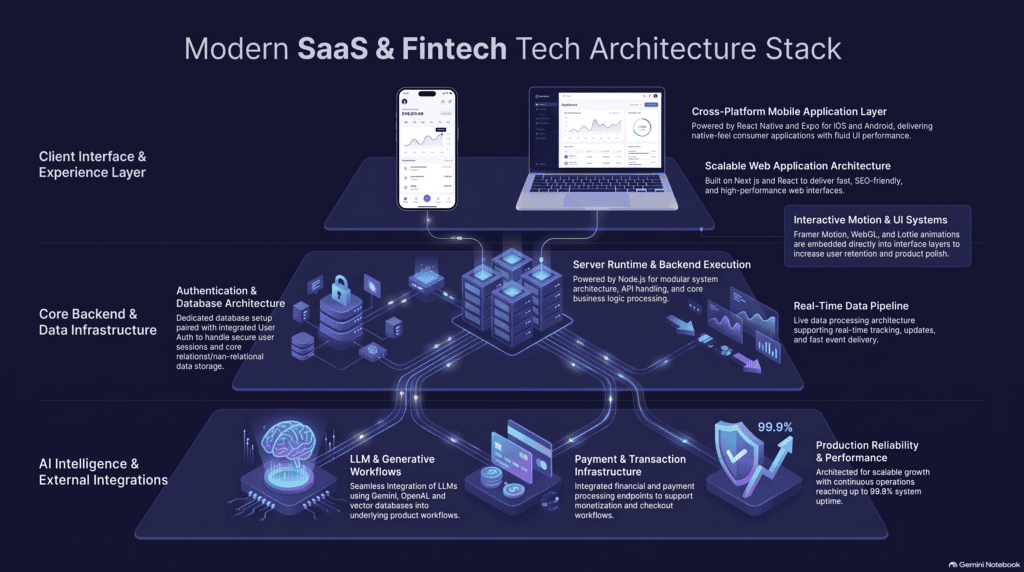
There is no single technology stack that every fintech startup should use.
The correct choice depends on:
- Web vs mobile
- Real-time requirements
- Data structure
- Integration requirements
- Security requirements
- Team expertise
- Product complexity
- Expected growth
- Regulatory requirements
A common architecture may include:
Frontend
React or another modern web framework can be appropriate for web applications.
Mobile
Cross-platform development can be useful when the startup needs iOS and Android while controlling initial engineering scope.
Native development may make more sense when the product depends heavily on platform-specific capabilities or performance.
Backend
Node.js, Python, Java and other backend technologies can all support financial applications when properly architected and secured.
The important question isn’t:
“Which language is the best?”
It’s:
“Which architecture gives this product reliable security, maintainability and reasonable development speed?”
Database
Relational databases can be particularly useful when financial records require structured relationships and transaction consistency.
PostgreSQL is one possible choice, but the database decision should follow the product’s data and transaction requirements rather than a generic technology trend.
Cloud infrastructure
Cloud infrastructure can provide managed databases, monitoring, networking, backups and deployment tooling.
However, “hosted in the cloud” isn’t synonymous with “secure.”
Security depends on configuration, access controls, secrets management, network design, logging, application security and operational practices.
AI in Fintech MVPs: Useful, but Not Automatically Necessary
AI can be valuable in fintech, but startups shouldn’t add it simply because it is fashionable.
Potential applications include:
- Customer support automation
- Extracting information from documents
- Classifying transactions
- Summarizing financial information
- Detecting anomalies
- Internal management processes
- Personalized information
- Workflow automation
The risk is particularly high if the systems are used for making financially consequential decisions.
If an AI model is used for credit, fraud, investment or other sensitive decisions, the startup needs to consider:
- Data quality
- Model performance
- Explainability
- Human oversight
- Bias
- Monitoring
- Security
- Regulatory obligations
For an early MVP, AI is usually more defensible when it improves a workflow without becoming the sole authority for a high-risk financial decision.
A Practical Fintech App Development Process
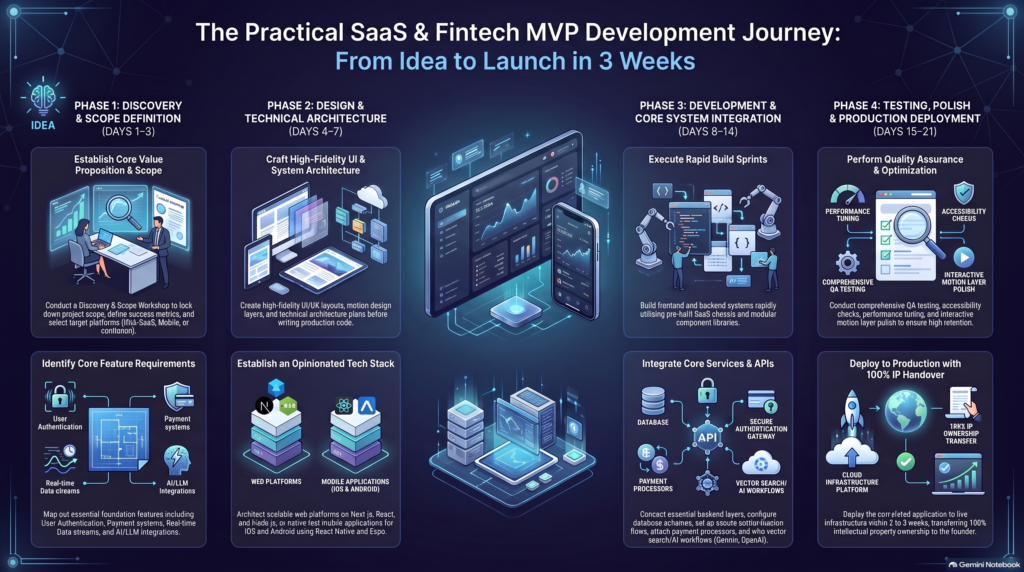
Step 1: Validate the problem
Talk to prospective users before building.
Find out:
- What they currently do
- What frustrates them
- What they pay for
- What they avoid
- What financial outcome they want
Step 2: Define the financial workflow
Map the complete journey.
For example,
user → onboarding → identity verification → account connection → financial action → transaction status → notification → support
This way, extra requirements might come up on the discovery phase.
Step 3: Identify regulatory and security requirements
Determine:
- Applicable jurisdictions
- Financial activities
- Licensing questions
- KYC/AML obligations
- Payment requirements
- Data-protection obligations
- Security expectations
Don’t wait until development is nearly finished.
Step 4: Decide what to build and integrate
Separate proprietary product logic from commodity infrastructure.
This can dramatically change the MVP’s scope.
Step 5: Design the user experience
Fintech interfaces need clarity.
A user should understand:
- What action they’re taking
- How much money is involved
- What will happen next
- Whether the transaction succeeded
- What happens if something fails
Trust is part of the UX.
Step 6: Architect the MVP
Define:
- Application architecture
- Database
- APIs
- Authentication
- Permissions
- Financial integrations
- Logging
- Deployment
- Monitoring
- Backup strategy
Step 7: Build in milestones
A startup should be able to inspect working software throughout the project.
Moreover,
deliverables tied to specific project milestones are an excellent way to ensure that the product scope does not blow out the budget before launch.
Step 8: Test security and financial workflows
Testing shouldn’t stop at “the button works.”
- Test:
- Authentication
- Authorization
- Invalid transactions
- Duplicate requests
- API failures
- Webhook failures
- Network interruptions
- Permission boundaries
- Sensitive data exposure
- Transaction consistency
- Mobile security
Step 9: Stages of Fintech Product Development Lifecycle Final
A fintech MVP does not have to target the entire customer base at once.
Start with:
- One user type
- One core problem
- One geography where appropriate
- One primary workflow
- A limited number of integrations
Then learn from real usage.
Step 10: Iterate
It is important to understand that post-launch data will define what further steps to take.
Don’t automatically build the original roadmap if users are showing you something different.
How Much Does Fintech App Development Cost?
There is no reliable universal fintech app development price.
Current market estimates vary widely, and even BkAbhi’s broader MVP research notes that industry, platform, security requirements, integrations and complexity can materially change an MVP budget.
For fintech specifically, the biggest cost drivers are usually not the number of screens.
They include:
- Financial integrations
- KYC/identity workflows
- Payment processing
- Transaction logic
- Reconciliation
- Security testing
- Fraud controls
- Multiple platforms
- Admin tooling
- Real-time requirements
- Data complexity
- Compliance requirements
- Third-party service fees
- Post-launch support
A useful way to think about the budget is:
Product scope + financial infrastructure + security + integrations + testing + operations
rather than:
Number of app screens × development rate
BkAbhi pricing
BkAbhi’s current website publicly lists a $2,999 one-time “Ship My MVP” package and a $997/month “Live Product Partner” package. For broader context on the technical considerations involved in fintech app development, see this guide from Helpware. The site also says the MVP package is designed around a 2–3 week delivery window and notes that the estimator is illustrative, with final scope and timeline confirmed during the Discovery Workshop.
These are BkAbhi’s publicly listed general MVP offerings, not a verified quote for a fintech application.
A fintech product requiring substantial financial integrations, security controls, regulated-provider dependencies or specialized workflows should therefore not be assumed to fit the advertised general MVP package.
How Long Does a Fintech MVP Take?
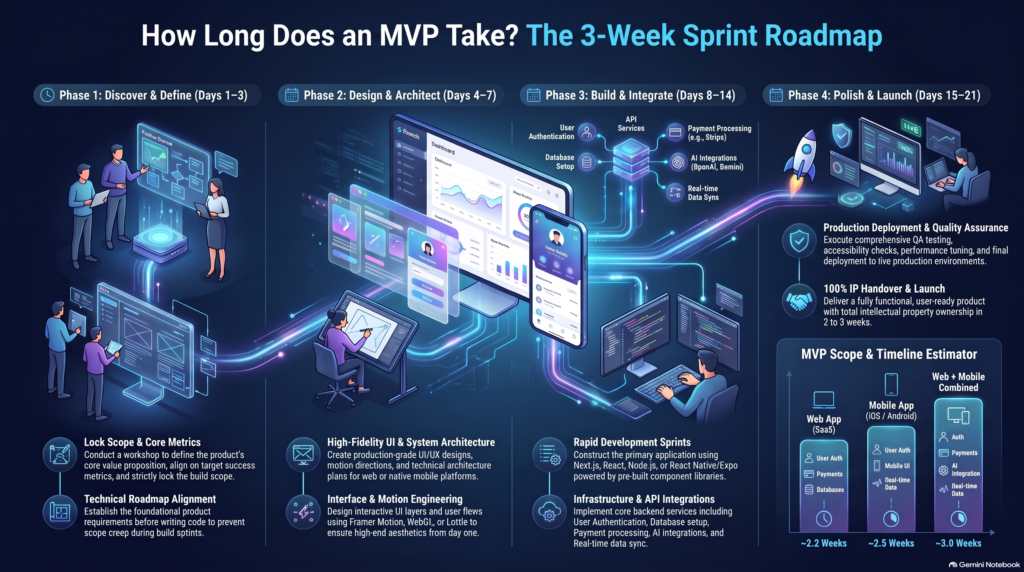
Again, there is no universal timeline.
A simple financial workflow with limited integrations may be substantially faster than a product involving:
- Payments
- KYC
- Multiple financial institutions
- Complex transaction states
- Mobile and web applications
- Admin operations
- Reconciliation
- Fraud monitoring
The fastest route is usually to reduce scope, not to skip engineering discipline.
For example, a startup might initially launch:
One customer segment + one financial workflow + one platform + one integration
rather than:
Three customer segments + web + iOS + Android + five integrations + ten financial workflows.
The first approach creates a smaller learning loop.
Freelancer vs Agency vs In-House vs No-Code
Freelancer
Consider it when:
- The scope is narrow.
- You already have technical leadership.
- The product doesn’t require many disciplines.
Watch for:
- Single-person dependency
- Limited security expertise
- Limited QA
- Availability after launch
Boutique development team
Consider it when:
- You need product, design and engineering together.
- You have a defined MVP.
- You don’t have a technical co-founder.
Watch for:
- Actual engineering team vs sales team
- Security process
- Integration experience
- Contract terms
- IP ownership
Large agency
Consider it when:
- The project is highly complex.
- Multiple teams are required.
- Enterprise processes are important.
Watch for:
- Minimum engagement sizes
- Overhead
- Layers of project management
- Whether the team is appropriate for an early-stage product
In-house
Consider it when:
- You expect long-term engineering needs.
- Product development is a core organizational capability.
- You have the budget and leadership to manage the team.
Watch for:
- Hiring time
- Recruitment cost
- Management overhead
- Early-stage overstaffing
No-code/low-code
No-code can be useful for validating certain workflows.
But founders should be careful when the MVP involves:
- Complex financial transactions
- Advanced permissions
- High-volume data
- Deep integrations
- Specialized security
- Complex financial calculations
The goal isn’t to avoid code at all costs. The goal is to avoid spending heavily before the product hypothesis is validated.
How BkAbhi Fits Into the Startup Decision
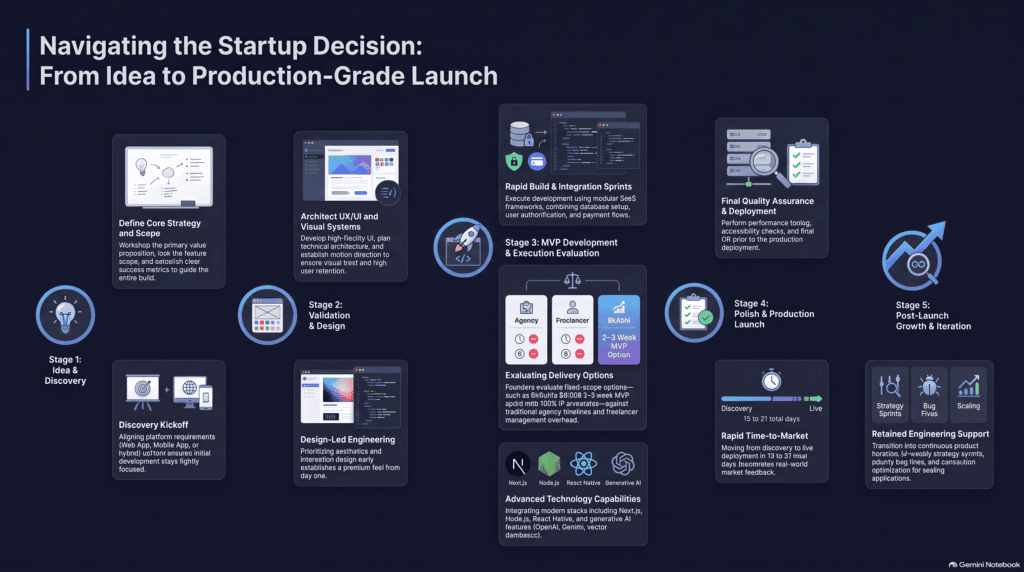
BkAbhi’s current public positioning is centered on shipping MVPs, with documented capabilities in SaaS architecture, mobile experiences, AI integration and product/design work. Its site also describes API integrations, backend/cloud infrastructure and SaaS development.
That makes BkAbhi potentially relevant when a fintech founder needs a custom product layer around a validated financial workflow.
For example, a founder may need:
- A fintech SaaS interface
- A mobile customer experience
- A financial dashboard
- API integrations
- AI-assisted workflows
- A backend and admin interface
- An MVP that can be tested with early users
But there is an important distinction.
Verified fact: BkAbhi publicly lists MVP, SaaS, mobile, AI, API and backend/cloud capabilities.
Not publicly verified: that BkAbhi itself provides regulated financial services, holds a banking/payment licence, or independently guarantees compliance with every fintech regulation.
A founder should therefore clarify the regulatory structure and financial-service providers involved before development begins.
For broader vendor-selection criteria, BkAbhi’s guide to choosing a startup software development partner covers pricing models, IP, communication, team structure and post-launch support.
What to Ask a Fintech Development Partner Before Signing
Don’t ask only:
“How much will the app cost?”
Ask:
Product
- What do you think should be in version one?
- Which features would you remove?
- What assumptions should we validate first?
Architecture
- How will financial data flow through the system?
- Where will transaction state be stored?
- How will failed API calls be handled?
- How will duplicate transactions be prevented?
Security
- How do you handle secrets?
- How is sensitive data stored?
- What security testing is included?
- How are permissions managed?
Integrations
- Which third-party providers will be used?
- Who owns those accounts?
- What happens if the provider changes its API?
- How will webhooks and failures be handled?
Ownership
- Who owns the source code?
- Who owns the cloud account?
- Who owns the API accounts?
- Who owns the designs?
- How will credentials be transferred?
Operations
- What happens after launch?
- Who fixes production issues?
- What monitoring is included?
- How are future changes priced?
A low development quote can become expensive if these questions are ignored.
Common Fintech MVP Mistakes
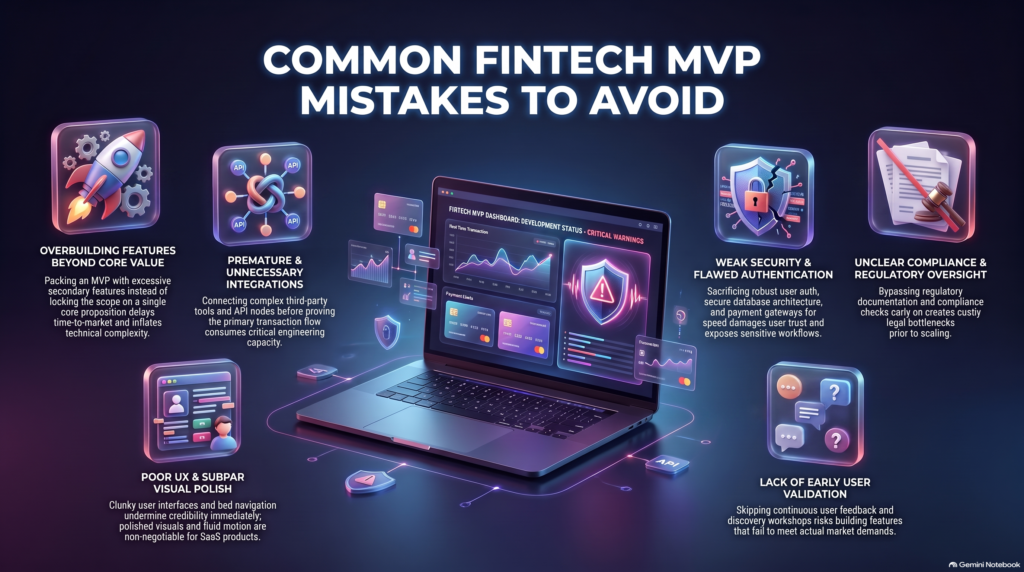
1. Building a full bank before validating demand
A startup doesn’t need every possible banking feature to test one financial problem.
2. Treating compliance as a final checklist
Regulatory and security requirements can influence architecture from the beginning.
3. Building financial infrastructure unnecessarily
If a regulated or specialized provider can handle a commodity function, rebuilding it may create unnecessary complexity.
4. Adding AI before the core workflow works
AI can’t compensate for a broken financial product.
5. Ignoring internal operations
Customer-facing screens are only one part of a fintech product.
6. Choosing technology before defining the problem
Technology should serve the workflow.
7. Comparing vendors only by hourly rate
A cheaper developer isn’t necessarily cheaper if the project requires extensive rework.
8. Forgetting ownership
Make sure the startup controls the source code, repositories, cloud accounts, domains, third-party integrations and other critical assets.
How to Choose the Right Fintech Development Approach
Use this decision framework.
Choose a lean custom MVP when:
- The financial problem is validated.
- Your differentiation is primarily in the product experience or workflow.
- You need a working product for early customers or investors.
- Existing infrastructure can handle commodity financial functions.
Choose a larger specialist team when:
- Multiple regulated workflows are involved.
- The product has significant transaction volume.
- Complex integrations are central to the business.
- You need specialized security or compliance expertise.
Consider no-code when:
- You’re testing a simple workflow.
- The product doesn’t require complex financial infrastructure.
- The goal is early validation rather than production-scale operation.
Consider in-house when:
- Engineering is a permanent strategic capability.
- You expect continuous product development.
- You have the budget and technical leadership to manage the team.
There is no universally best approach.
The correct choice depends on what your startup needs to prove next.
Final Comparison Summary
The biggest difference between ordinary app development and fintech app development is not the interface.
It’s the combination of:
financial workflows + sensitive data + integrations + security + operational controls + applicable regulation.
For startups, the strongest approach is usually to narrow the product rather than blindly reduce engineering quality.
Start with one validated financial problem.
Define one core workflow.
Identify the regulatory and security requirements.
Decide what should be built versus integrated.
Then choose the development team and technology architecture around those requirements.
That’s a much safer way to control fintech MVP cost than simply asking developers to remove features from a large specification.
And if the reader never hires BkAbhi, the framework should still help them make a better fintech development decision. That’s the standard worth applying to any startup technology guide.
About the Author
Jeevesh Tripathi
Email: jeevesh@bkabhi.com
Jeevesh Tripathi researches and writes about technology, AI, software, SaaS, and creator/business tools. His work focuses on practical comparisons, evidence-based evaluation, and research that helps founders and businesses make better technology decisions. His approach separates verified information from analysis and recommendations rather than presenting assumptions as facts.