
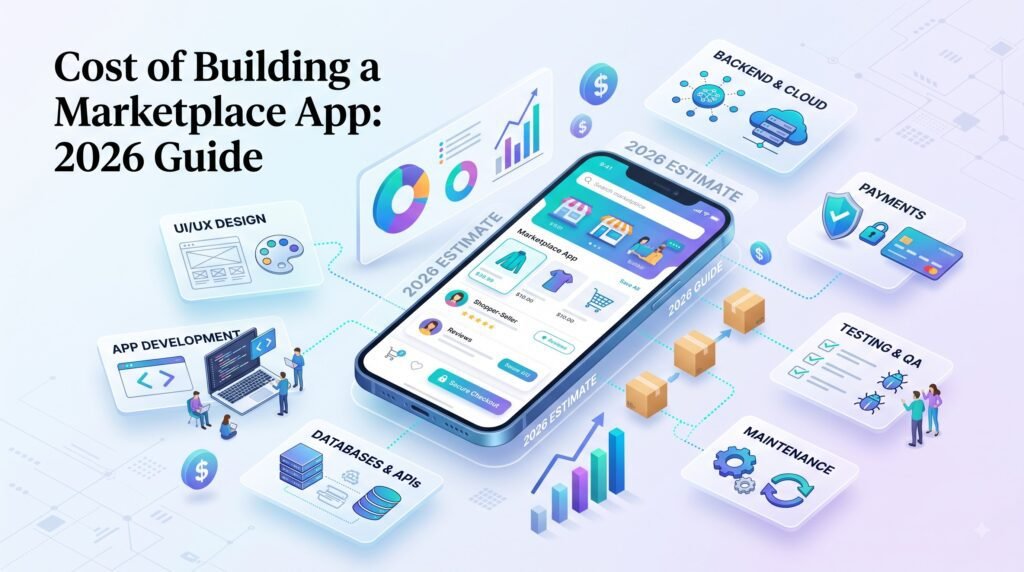
If you’re planning a marketplace app, the first budget question is not how much it costs to build something like Amazon. It’s how much you need to build the smallest version that lets buyers and sellers complete the transaction your business depends on.
The cost of building a marketplace app depends on the number of user roles, features, platforms, integrations, payment workflows, and quality requirements. A curated directory that connects customers with providers is a different project from a marketplace that processes payments, calculates commissions, manages refunds, and distributes money to sellers.
The practical approach is to define the business model first, estimate the minimum scope, and then add the features that evidence shows you need.
Table of Contents
Quick Answer: How Much Does It Cost to Build a Marketplace App?
There is no universal marketplace development price. For initial planning, the following are illustrative budgeting ranges, not verified industry averages or vendor quotes.
| Marketplace scope | Illustrative development budget | Typical scope |
|---|---|---|
| Lean validation product | $5,000–$15,000 | Landing page, curated listings, inquiry forms, and some manual operations |
| Focused marketplace MVP | $15,000–$50,000 | Core buyer and seller journeys, basic administration, and a limited set of integrations |
| More complete custom marketplace | $50,000–$120,000 | More complex workflows, automated transactions, richer dashboards, and structured QA |
| Advanced multi-platform marketplace | $120,000–$300,000+ | Multiple applications, sophisticated payouts, real-time features, complex integrations, or demanding security requirements |
These ranges are intended to help you start a budgeting conversation. Actual quotes can fall outside them, particularly when the project is a simple directory, uses an existing platform, involves regulated transactions, or requires extensive custom engineering.
The key distinction is what each budget includes. One quote might cover a responsive web app and basic administration, while another includes buyer and seller mobile apps, automated payouts, advanced reporting, and post-launch support.
Before comparing quotes, confirm the deliverables, exclusions, acceptance criteria, and ongoing costs.
What Determines the Cost of Building a Marketplace App?
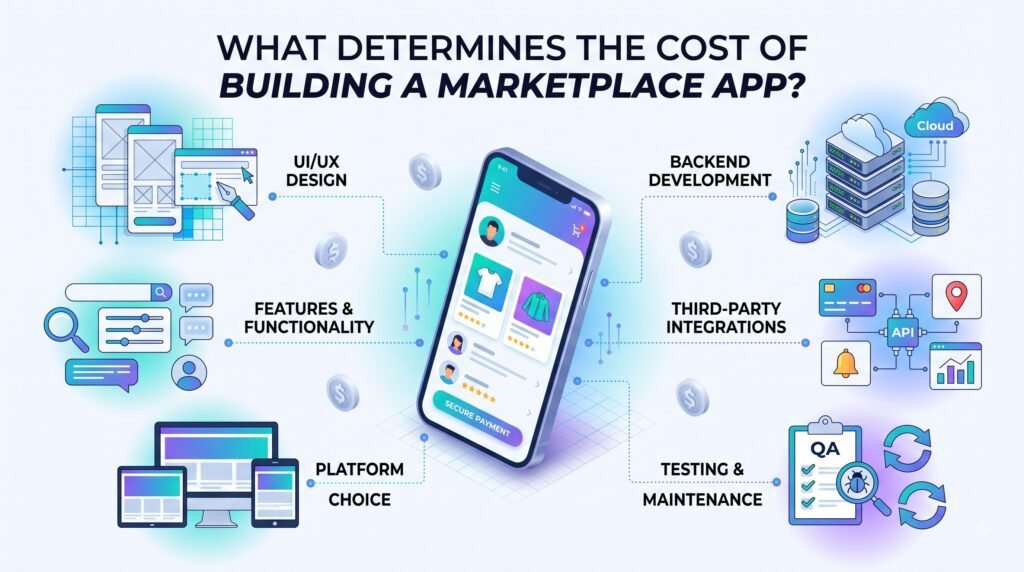
A marketplace has to support the interaction between multiple parties. That creates more work than a simple application with one type of user.
For example, a service marketplace may need customers to search for providers, providers to publish services, and administrators to review accounts, resolve disputes, and monitor activity.
The major cost drivers are:
Number of user roles
Each user role introduces its own screens, permissions, and workflows.
- Buyers or customers: Search, browse, compare, save listings, book or purchase, and track orders.
- Sellers or service providers: Create listings, manage availability or inventory, respond to requests, and view transactions.
- Administrators: Approve accounts, moderate listings, manage commissions, review reports, and resolve problems.
A first version may not need a sophisticated dashboard for every role. But it does need a clear plan for how each essential task will be completed.
Feature complexity
A basic listing and inquiry flow is less involved than a system with recommendations, real-time chat, automated matching, and advanced analytics.
The main question is not how many features you can add. It’s which features must work reliably for the marketplace to deliver its core value.
Platform choice
A responsive web application may be sufficient for initial validation. Adding mobile applications introduces additional interface work, testing, release management, and maintenance.
Payment and third-party integrations
Payment collection, commission calculation, refunds, seller onboarding, and payouts can add substantial complexity. Email, SMS, maps, shipping, identity verification, and analytics integrations may also require configuration, testing, and recurring fees.
Quality, security, and reliability
Authentication, access controls, input validation, data protection, backups, testing, and error monitoring are part of a responsible production plan. Their depth should match the product’s risks and business requirements.
Marketplace Features and Their Impact on Cost
A feature list is more useful when it explains the work behind each feature.
| Feature | What it involves | Cost implication |
|---|---|---|
| User registration | Sign-up, login, password recovery, permissions | Basic functionality, but security matters |
| Listings and search | Listing creation, categories, filters, search results | Grows with complex filtering and large catalogs |
| Seller onboarding | Profiles, verification steps, listing approval | More work when checks or approvals are automated |
| Orders or bookings | Availability, order status, cancellation rules | Depends on the business model |
| Payments | Checkout, payment status, refunds | Depends on the provider and transaction flow |
| Seller commissions and payouts | Fee calculation, reconciliation, transfers | Adds financial workflow and failure handling |
| Admin dashboard | Account management, moderation, reports | Often underestimated in initial estimates |
| Notifications | Email, SMS, or push alerts | Requires event handling and provider integration |
| Reviews and ratings | Review eligibility, moderation, reporting | Needs rules to limit abuse |
| Real-time messaging or tracking | Live updates, messaging, or location data | Adds infrastructure and testing requirements |
| Analytics | Funnels, transactions, seller performance | Depends on the questions the business needs to answer |
Not every marketplace needs all these features at launch. A property-listing directory, a freelance marketplace, a B2B supplier platform, and an on-demand service app have different requirements.
Start by identifying the smallest set of workflows that must succeed for a customer to receive value.
A Practical Budget Example for a Marketplace MVP
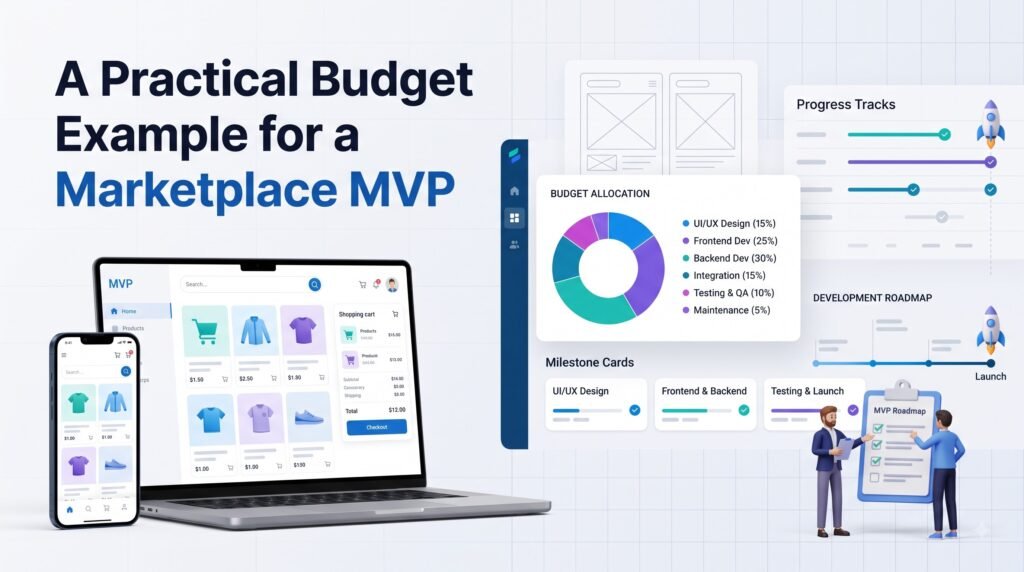
Consider a hypothetical startup building a marketplace that connects local customers with independent home-service providers.
The initial goal is to validate whether customers will request services and whether providers will respond. The company does not yet need automated dispatch, complex loyalty programs, or native mobile apps.
The first version includes:
- A responsive website with customer registration.
- Provider profiles and service listings.
- Search by category and location.
- Inquiry or booking requests.
- A basic provider dashboard.
- An administrative interface for approving listings.
- Email notifications.
- Basic analytics and quality assurance.
The founder initially handles some provider onboarding and customer support manually.
For planning purposes, suppose the founder receives a custom-development quote of $25,000 for the agreed scope. This is a hypothetical quote, not a published market price or a real customer project.
A sample allocation could look like this:
| Workstream | Illustrative allocation |
|---|---|
| Discovery and requirements | $2,500 |
| UI/UX design | $3,500 |
| Frontend and backend development | $11,000 |
| Integrations | $2,000 |
| Testing and launch | $3,000 |
| Project coordination and handover | $3,000 |
| Total | $25,000 |
These allocations are an example of how a quote might be organized. They are not independently measured rates or a recommended universal percentage split.
The important detail is what the project deliberately excludes: automated seller payouts, advanced matching, native mobile apps, and complex dispute automation.
Those features may become necessary later, but they do not have to be included merely because mature marketplaces offer them.
What if the business needs online payments from day one?
The scope changes if customers must pay through the platform and providers must receive their share automatically.
The team then needs to define payment collection, transaction records, commissions, refunds, payout timing, failure handling, and the responsibilities of the marketplace operator. A provider such as Stripe Connect offers payment flows designed for platforms and marketplaces, but availability and suitability depend on the business model and countries involved.
Official reference: https://docs.stripe.com/connect/separate-charges-and-transfers
The founder should request a revised quote based on the exact payment flow instead of adding an arbitrary flat fee to the original estimate.
Web App vs. Mobile Marketplace: Which Costs Less?
Choosing the right platform can make a meaningful difference to the initial budget.
Responsive web marketplace
A responsive website lets users access the marketplace through a browser on desktop or mobile. It can be a practical starting point when discovery, listings, and booking are the core activities.
Advantages
- One primary web experience to develop and maintain.
- Users can access it through a shared link.
- Useful for testing search-driven customer acquisition.
- Can avoid the need for app-store releases at the beginning.
Limitations
- Some device-specific capabilities may be less suitable.
- Frequent mobile engagement or background functionality may require a different approach.
- The experience must be designed carefully for small screens.
Cross-platform mobile marketplace
A cross-platform application can share a substantial amount of code across iOS and Android, depending on the architecture and requirements.
It may be useful when users need mobile-specific interactions, such as frequent booking updates or push notifications. It still requires platform-specific testing and release work.
Separate native iOS and Android apps
Separate native applications may make sense when the product requires platform-specific capabilities, specialized performance, or deep device integration.
However, they usually create more implementation and maintenance work than a single web application.
Recommendation: If your core hypothesis can be tested through a web experience, consider validating it there before funding multiple applications. If mobile usage is fundamental to the product, include that requirement in the initial scope instead of treating it as a minor add-on.
How the Development Team Affects the Budget
The same feature list can receive very different quotes from different teams. That difference may reflect team composition, project management, technical approach, testing depth, location, and the level of documentation provided.
Freelancer
A freelancer can be appropriate for a narrow project with clear requirements and limited coordination needs.
The trade-off is that one person may not cover product discovery, design, engineering, QA, deployment, and ongoing support equally well. You should also establish how the project will continue if the freelancer becomes unavailable.
Development agency
An agency can bring several disciplines into one engagement, potentially reducing the coordination burden on a non-technical founder.
The important questions are which team members will work on your project, how decisions are made, what is included in the quote, and whether you receive usable documentation and a clean handover.
In-house team
An in-house team can make sense when the marketplace requires continuous product development and the company can support hiring and management costs.
The initial budget must account for recruiting, compensation, management, tools, and the time needed to establish a working team—not just the cost of writing code.
No-code or low-code approach
No-code tools may be suitable for a directory, simple booking workflow, or early validation experiment. They can reduce the amount of custom engineering needed.
However, complex permissions, unusual transaction logic, data portability, platform limits, and future migration can change the total cost of ownership. Check the platform’s capabilities against the actual workflows before committing.
Hidden Costs Beyond Initial Development
The development quote is only part of the budget.
Hosting and infrastructure
The application may require a database, file storage, application hosting, monitoring, backups, and other cloud services. Costs depend on usage, architecture, storage, and provider pricing.
Payment processing
Payment providers may charge transaction or platform-related fees. Refunds, disputes, and certain payout models can also affect the economics of a marketplace.
Check the provider’s current pricing and eligibility rules rather than relying on an old estimate.
Maintenance and bug fixes
After launch, the team may need to fix defects, update dependencies, address security issues, and respond to changes in external APIs.
Clarify which bug fixes are included in the delivery contract and which requests count as new work.
Customer and seller support
Marketplace operations often require help with onboarding, cancellations, disputes, refunds, and listing quality. Some of these tasks can initially be handled manually, but they still consume time.
Legal and operational requirements
Depending on the business model and jurisdiction, you may need legal review of terms, privacy disclosures, seller agreements, tax processes, or other obligations. The exact requirements should be assessed for your specific marketplace.
Growth and new features
User feedback may reveal that customers need a different booking flow or that sellers need better inventory controls. Reserve budget for improvements after launch instead of spending the entire budget on the first release.
How to Reduce Marketplace Development Costs
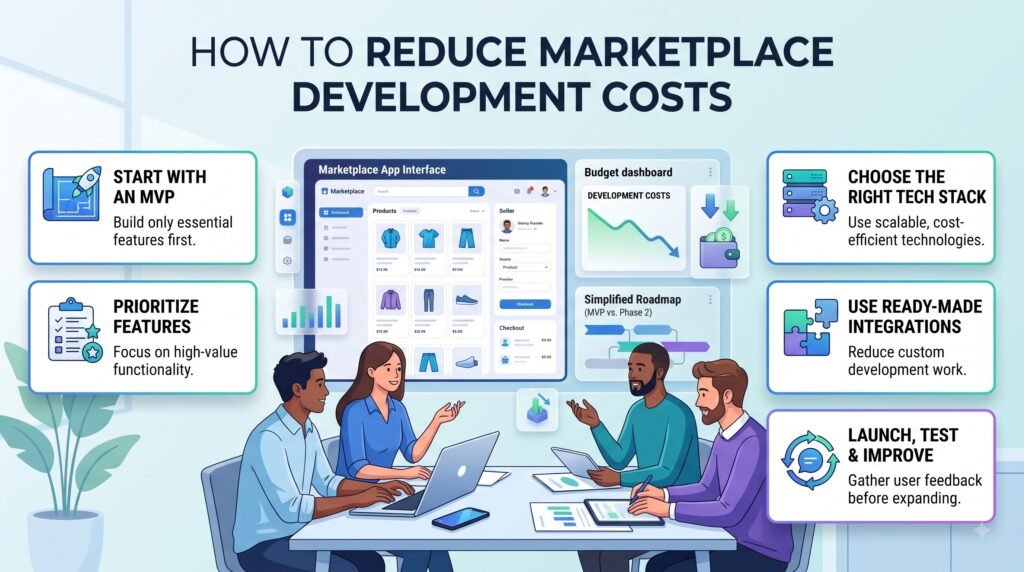
Cost reduction should come from narrowing the initial scope and avoiding unnecessary work—not from skipping security or releasing unreliable payment functionality.
Start with one market or niche
A focused marketplace is easier to define and test than a platform trying to serve every category, location, and user type.
Launch with the essential workflow
Identify the shortest path from discovering a listing to completing the marketplace’s core action. Build around that path first.
Keep manual processes where practical
During early validation, administrators may be able to approve sellers, coordinate matching, or resolve certain requests manually.
Manual operations are not free, but they can help you test demand before investing in automation. Be clear about which processes are temporary and how they will be handled safely.
Delay optional features
Advanced recommendations, loyalty systems, complex reporting, multiple payment methods, and elaborate gamification may be unnecessary before the core transaction is validated.
Use established services where appropriate
Authentication, payment processing, email delivery, and analytics may be handled by existing services rather than built from scratch. Evaluate their fees, limitations, integration effort, and data portability.
Define acceptance criteria
Specify what it means for a feature to be complete. For example, a booking workflow should define successful booking, cancellation, duplicate requests, and notification behavior.
Clear acceptance criteria reduce misunderstandings and help you compare quotes fairly.
What to Ask Before Accepting a Development Quote
A low headline price is not enough to evaluate a marketplace development proposal.
Ask every prospective vendor the same questions:
- Which buyer, seller, and administrator workflows are included?
- Is the proposal for a web app, mobile app, or both?
- Are design, testing, deployment, and handover included?
- What payment flows are included, and who is responsible for refunds and disputes?
- Which third-party subscriptions and transaction fees are excluded?
- How are changes outside the agreed scope priced?
- What source code, documentation, credentials, and intellectual property will be handed over?
- What post-launch support is included, and for how long?
- Who will maintain the application and update its dependencies?
- What assumptions could cause the estimate or timeline to change?
Request a written scope, milestone plan, list of exclusions, and acceptance criteria. Compare those documents before comparing the totals.
How BkAbhi Fits into Marketplace MVP Planning
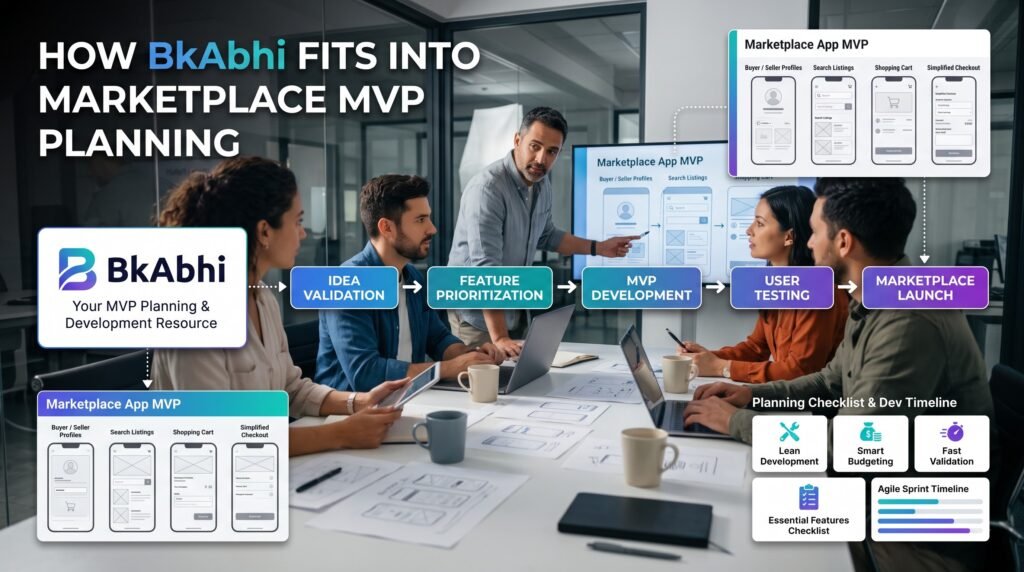
BkAbhi’s public website describes its positioning as an innovation lab focused on shipping MVPs. Its publicly described capabilities include web development, mobile applications, SaaS development, AI and automation, API integrations, and backend/cloud infrastructure.
Its currently indexed homepage lists a “Ship My MVP” package at $2,999 one time and a “Live Product Partner” package at $997 per month. The homepage describes the MVP package in terms of a 2–3-week delivery window and says the final scope and timeline are confirmed during a Discovery Workshop.
Source: https://bkabhi.com/
These are public package details, not a verified marketplace development quote. The website does not establish that a complete two-sided marketplace with automated seller payouts, dispute management, or separate mobile applications is included at that price.
If you’re evaluating BkAbhi or another development partner, provide a concise brief describing your marketplace, its user roles, core workflow, platform requirements, payment model, and target launch scope. Ask for written confirmation of what the package includes and what would require a separate estimate.
A smaller MVP engagement may be suitable for a narrow, well-defined validation product. A marketplace with complex financial workflows or substantial operational requirements may need a broader scope.
The right choice depends on your requirements, not the package label.
Final Decision: How Much Should You Budget?
Before deciding on a number, answer three questions:
First: What must the marketplace prove? If your biggest uncertainty is whether customers and providers will participate, a directory, inquiry flow, or manually coordinated service may be enough to test the idea.
Second: What must be automated from day one? If your business depends on immediate payment collection, automated payouts, inventory synchronization, or real-time dispatch, those requirements need to be included in the original estimate.
Third: What happens after launch? Budget for infrastructure, support, maintenance, and improvements. A product that launches cheaply but cannot be maintained may cost more over time.
The most useful estimate is not the largest or smallest number you find online. It’s the estimate tied to a clear scope, realistic assumptions, defined exclusions, and an operating plan.
Start with the smallest marketplace that can deliver real value, measure what users do, and expand the product when the evidence justifies the investment.
Author Bio
Author: Jeevesh Tripathi
Email: jeevesh@bkabhi.com
Jeevesh Tripathi writes research-based content on technology, AI, software, SaaS, and digital products. His work focuses on practical comparisons, evidence-based evaluation, and helping founders and technology teams understand product-development decisions without unnecessary jargon.
His approach emphasizes separating verified information from analysis, identifying relevant trade-offs, and presenting practical guidance that readers can use when evaluating software, development approaches, and technology investments.