
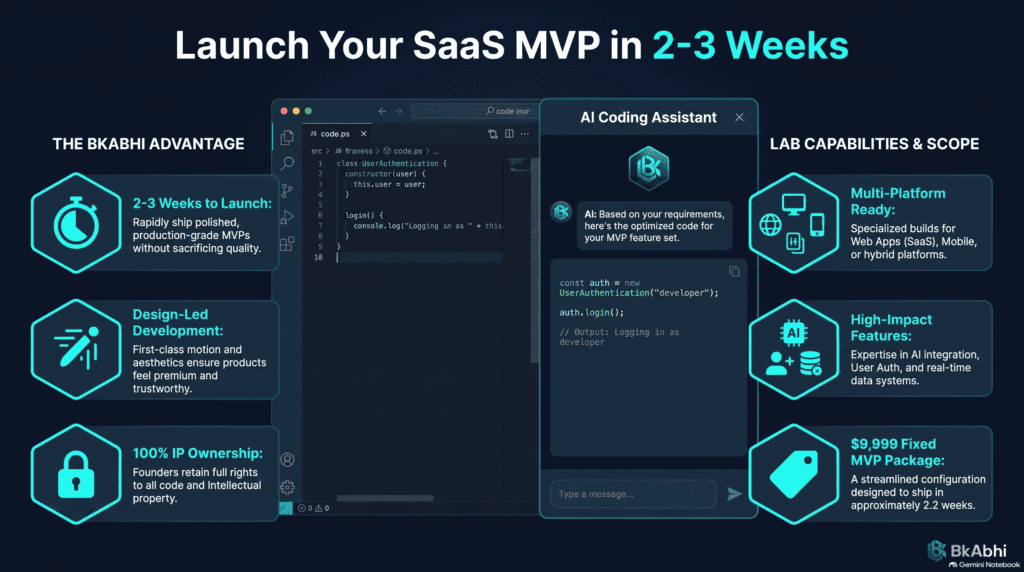
Most guides on no-code MVP development tell you that no-code is fast and cheap. Almost none tell you when it’s the wrong call.
This playbook fills that gap. At bkabhi, it’s built around one question founders actually lose sleep over: should we skip custom code entirely, or is that a decision we’ll regret in eight months?
We’ll walk through a real decision framework, the hidden costs nobody puts in a sales deck, tool choices mapped to business models, and the exact playbook for migrating off no-code when the time comes.
Table of Contents
What No-Code MVP Development Actually Solves
No-code MVP development means building a working, testable product using visual builders instead of a hand-written codebase. You configure logic, screens, and data instead of programming them line by line.
The point isn’t the tooling. The point is compressing the distance between “idea” and “real user feedback” so you’re not betting months of runway on an untested assumption.
That distinction matters, because it reframes the entire decision. You’re not choosing a tech stack — you’re choosing a learning speed.
If you’re still unclear on how an MVP differs from a prototype or a proof of concept, it’s worth getting that foundation right first, since the wrong mental model here is what leads founders to over-scope even a no-code build.
No-code MVP development has also matured well past its early “landing page and a form” reputation. Today’s visual builders handle multi-step logic, role-based permissions, and live data — which is exactly why the “when” question matters more than the “whether” question.
No-Code vs Custom Code MVP: The Real Decision Framework
Every custom code MVP comparison online lists pros and cons. Few give you a way to actually score your own project. Here’s a framework you can apply in ten minutes.
Score your MVP idea from 1 (strongly no) to 5 (strongly yes) on each of these five questions:
- Does the core hypothesis rely on standard patterns (forms, lists, dashboards, bookings, marketplaces)?
- Is your target launch window under 10 weeks?
- Is your budget for this phase under $30,000?
- Are you comfortable with moderate limits on performance and customization for now?
- Will fewer than 10,000 active users touch this product in the first 6 months?
Score 18-25: No-code MVP development is very likely your fastest, cheapest path to validated learning.
Score 10-17: A hybrid build (no-code frontend, custom backend, or vice versa) is usually the smarter middle ground.
Score below 10: You’re describing a custom-code MVP. Real-time processing, deep proprietary algorithms, hardware integration, or regulated data at scale rarely fit inside no-code constraints without significant workarounds.
This scoring isn’t about the tool. It’s about matching build method to what you’re actually trying to learn — which is the same principle that should guide how you scope any MVP from day one.
No-Code vs Custom Code MVP at a Glance
| Factor | No-Code MVP | Custom Code MVP |
|---|---|---|
| Typical timeline | 2-8 weeks | 3-6 months |
| Typical cost | $5,000-$30,000 | $50,000-$150,000+ |
| Who can build it | Founders, ops teams, designers | Software engineers |
| Best for | Validating a hypothesis fast | Proprietary logic, deep integrations |
| Customization ceiling | Moderate, platform-bound | Unlimited |
| Long-term scaling | Often needs a rebuild past a point | Built to scale from day one |
5 Signals You Should Skip Custom Code
These are the situations where reaching for a no-code MVP builder is genuinely the smarter call, not just the cheaper one.
You haven’t validated demand yet. If nobody has paid, signed up, or shown intent, building custom infrastructure is solving a problem you don’t have proof of yet.
Your product uses common UI and workflow patterns. Bookings, directories, marketplaces, dashboards, and content platforms already have mature no-code templates behind them.
You’re testing positioning, not technology. If the differentiator is your go-to-market angle rather than a technical breakthrough, the build method matters far less than speed to market.
Your team is non-technical or solo. A no-code MVP builder lets a founder iterate without waiting in a developer’s queue for every small change.
You expect to pivot more than once. No-code changes are configuration changes, not code rewrites, which makes early pivots dramatically cheaper.
5 Signals You Need Custom Code From Day One
Skipping custom code isn’t always the right move. These signals mean no-code will likely cost you more time than it saves.
- Your core value is a proprietary algorithm — recommendation engines, pricing models, or matching logic that competitors can’t easily replicate.
- You need sub-100ms performance or heavy real-time processing, such as live trading tools, multiplayer interactions, or high-frequency data streams.
- You’re handling regulated data at meaningful volume — health records, payment card data, or financial transactions where compliance architecture can’t be an afterthought.
- You need deep hardware or legacy system integration that no-code connectors simply don’t support.
- Investors or enterprise buyers will audit your codebase as part of due diligence before a funding round or contract.
If two or more of these apply, a custom-code MVP — even a lean one — will likely save you a rebuild later. A quick look at what tech stack fits your actual constraints can help you scope that build realistically.
The Hidden Costs of No-Code Nobody Mentions
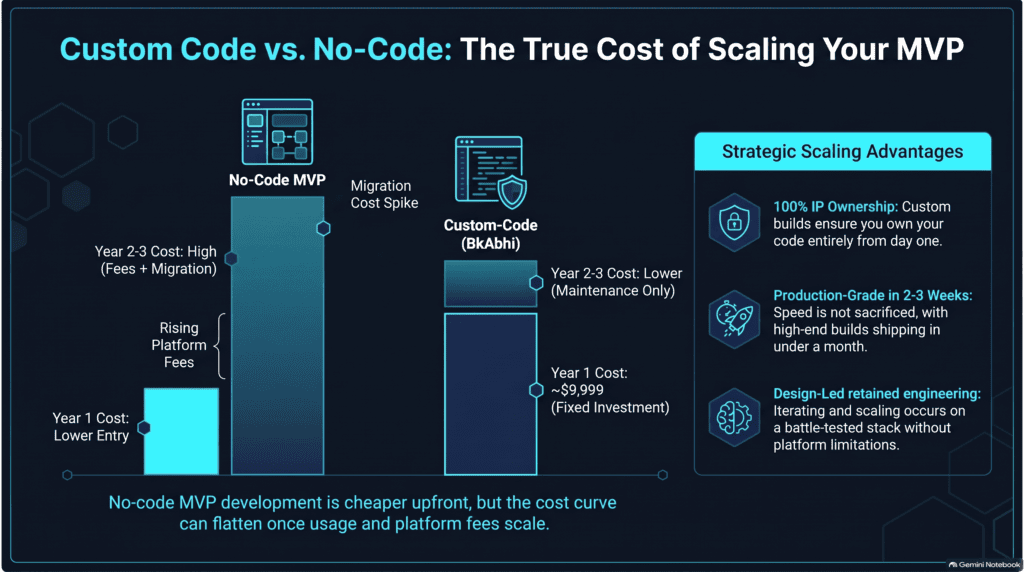
This is the part most no-code MVP development guides skip entirely, and it’s where founders get burned.
Platform lock-in migration cost. Moving off a no-code platform later isn’t a simple export. Data models, automation logic, and UI behavior often need to be rebuilt from scratch by engineers unfamiliar with the platform’s internal logic.
Per-user pricing that scales against you. Many no-code platforms charge per workflow run, per record, or per active user. A product that gets popular can see its hosting bill climb faster than a comparable custom-code app.
Technical debt disguised as convenience. Visual workflows that look clean in a demo can hide dozens of nested conditions that become unmanageable as features stack up.
Talent scarcity for advanced customization. Finding a specialist fluent in a specific no-code platform’s edge cases is often harder — and pricier per hour — than hiring a generalist software engineer.
Budget for these upfront. A no-code MVP builder should cost less than custom code in year one — that math changes if you don’t plan the exit.
Best No-Code Tools for MVP Development, Mapped to Your Business Model
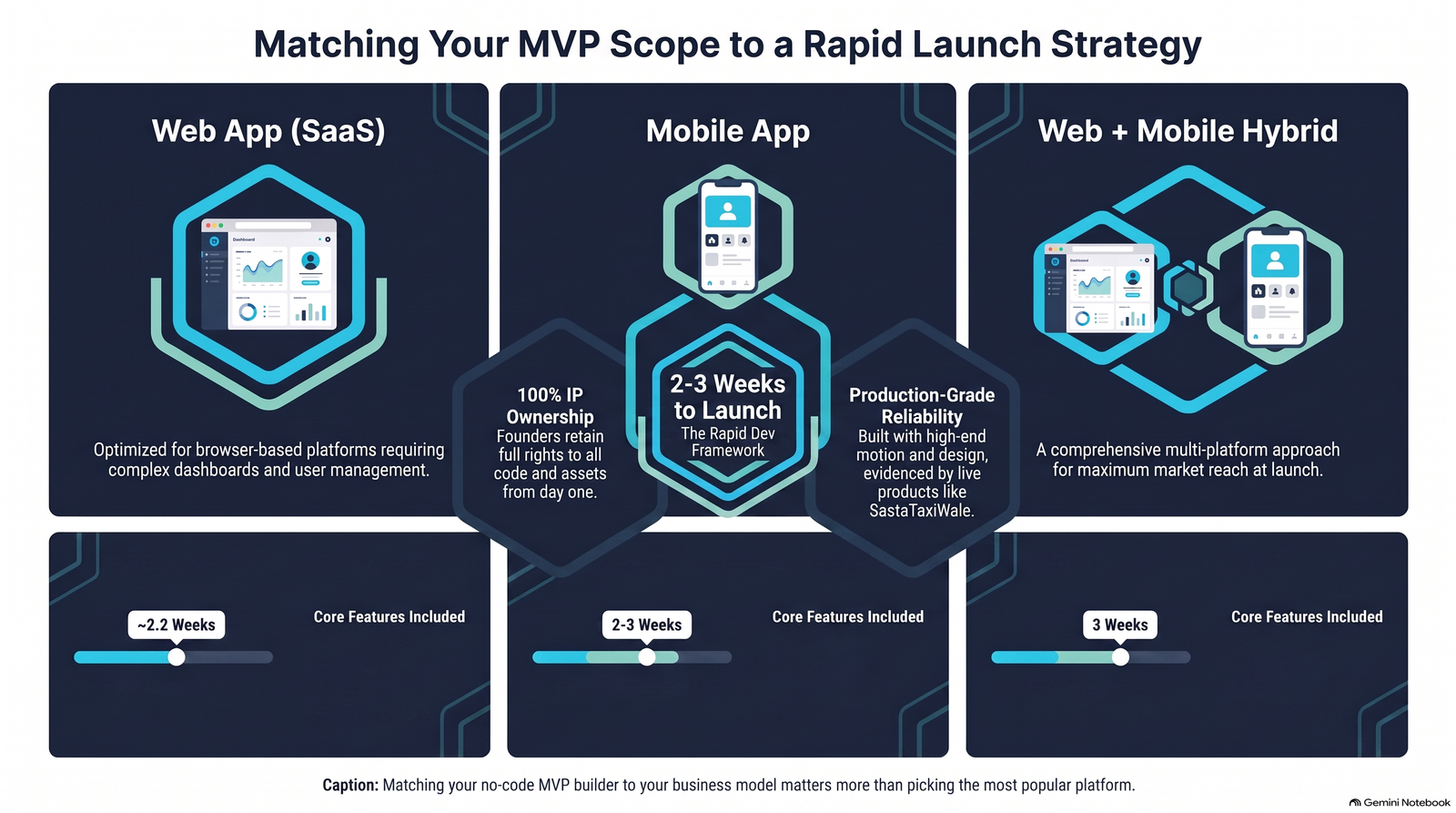
Generic tool lists rank platforms by popularity. What actually matters is which no-code MVP builder fits your specific business model.
Building a marketplace or two-sided platform? Look at Bubble or Sharetribe. Both handle multi-user roles, listings, and transactions without custom backend work.
Building a SaaS dashboard or internal tool? Bubble paired with a dedicated backend like Xano or Supabase gives you real data relationships without a spreadsheet ceiling.
Building a mobile-first service or booking app? Glide or Adalo turn structured data into usable mobile apps fastest, especially for appointment- or field-based businesses.
Building a content-led or marketing-first product? Webflow gives you design control and SEO-friendly output that generic app builders can’t match.
Building an automation-heavy internal workflow? Zapier or Make connect your existing tools without needing a standalone app at all.
The mistake most teams make is picking the most popular tool instead of the one that matches their data model. A marketplace forced into a form-builder tool will hit walls within weeks.
When people search for the best no-code tools for MVP projects, they usually want a shortlist. The better question is which no-code MVP builder matches the specific shape of your data — records and relationships, screens and states, or triggers and automations — because that’s what actually determines fit.
Compliance and Data Ownership Checklist Before You Build
This is rarely covered, and it’s where regulated or data-sensitive startups get caught off guard after launch.
Before committing to a no-code MVP builder, check:
- Where is the data physically hosted, and does that region meet your compliance obligations (GDPR, CCPA, or local data residency laws)?
- Does the platform offer a signed Business Associate Agreement (BAA) if you’re touching health data in the US?
- Can you export your full dataset and schema in a usable format if you leave the platform?
- Who owns the intellectual property of custom logic or workflows you build inside the platform?
- Does the platform support role-based access control granular enough for your team’s needs?
None of this blocks you from using no-code. It just means these checks happen before launch, not after a customer or investor asks the question you can’t answer.
The Hybrid Approach: No-Code Frontend, Custom Backend
The false choice most articles present is all-no-code versus all-custom. In practice, the strongest MVPs are often hybrids.
A common pattern: build the user-facing app in a visual builder like Bubble or Webflow, but connect it to a lightweight custom backend or a flexible backend-as-a-service layer for the parts that need real logic.
This gives you speed where it matters — the interface users actually see and test — while keeping your data model and business logic portable for when you need to scale past what a no-code MVP builder can comfortably handle.
It’s a reasonable middle path between building everything in-house and outsourcing the whole MVP, and it’s worth weighing against both options before you commit a budget.
Real Cost and Timeline Benchmarks
Numbers vary by scope, but founders consistently ask for ranges. Here’s what a reasonably scoped MVP tends to cost by build method.
| Build Method | Typical Cost | Typical Timeline |
|---|---|---|
| DIY no-code (solo founder) | $500-$5,000 (tools + time) | 3-8 weeks |
| No-code with an agency | $8,000-$30,000 | 4-8 weeks |
| Hybrid (no-code + custom backend) | $20,000-$60,000 | 8-14 weeks |
| Fully custom-coded MVP | $50,000-$150,000+ | 3-6 months |
These ranges shift by region and scope. If you’re comparing agency quotes, it’s worth cross-checking against current market benchmarks for MVP development cost in India or MVP development cost in the US before signing anything.
The No-Code to Custom-Code Migration Playbook
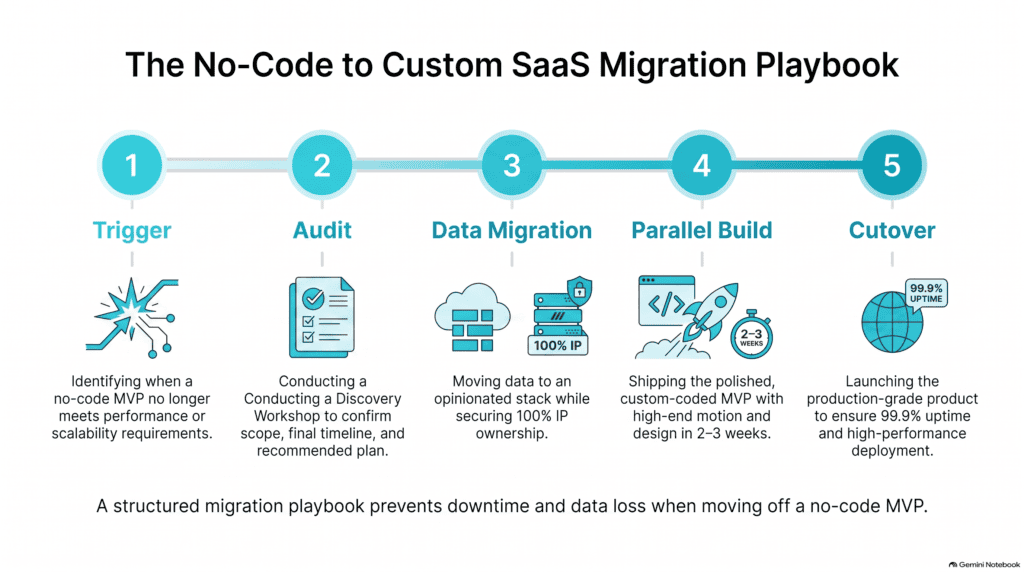
Eventually, a successful no-code MVP outgrows its platform. Here’s the playbook for making that transition without losing momentum or data.
Step 1: Define the trigger, not the timeline. Migrate when you hit a specific wall — performance limits, compliance needs, or a feature the platform genuinely can’t support — not on a pre-set calendar date.
Step 2: Audit and document your current logic. Map every workflow, data relationship, and automation rule before a single line of new code is written. This becomes your engineering spec.
Step 3: Migrate data first, in isolation. Move your dataset and schema to the new backend before touching the frontend, and validate it against production data for a full cycle.
Step 4: Rebuild in parallel, not in place. Run the custom-coded version alongside the no-code version until feature parity is confirmed, rather than cutting over blind.
Step 5: Cut over with a rollback plan. Keep the no-code version live and accessible for a defined window in case the migration surfaces issues under real load.
This is the exact point where a lot of teams either overpay an agency unfamiliar with their no-code platform’s quirks, or underestimate the engineering hours needed. Planning the migration as its own project, not an afterthought, avoids both.
Choosing a No-Code App Development Company vs Building It Yourself
If you don’t have in-house no-code skills, a no-code app development company can compress your timeline further — but the wrong partner can also lock you into decisions you didn’t fully understand.
Ask any agency you’re evaluating:
- Which specific no-code MVP builder do they specialize in, and can they show shipped products, not just mockups?
- Do they document workflows and data models as they build, so you’re not dependent on them forever?
- What’s their process for helping you migrate off no-code later, if and when you need to?
- Do they price fixed-scope or hourly, and how do they handle mid-project pivots?
These are close to the same questions worth asking any MVP development partner, no-code or otherwise, and a full vetting checklist is useful to run through before you sign anything.
If the agency can’t clearly answer how they’d hand off your project, that’s one of several MVP development red flags worth weighing seriously before committing budget.
Common Myths About No-Code MVP Development
A lot of hesitation around no-code MVP development comes from outdated assumptions. Here’s what’s actually true in 2026.
Myth: No-code MVPs look unprofessional. Modern no-code MVP builders like Webflow and Bubble produce interfaces that are visually indistinguishable from custom-coded products. Users can’t tell, and mostly don’t care, how the backend was built.
Myth: No-code means no logic or automation. Visual workflow builders now support conditional logic, API calls, scheduled jobs, and multi-step automations that rival what a junior developer would write by hand.
Myth: You can’t ever scale a no-code MVP. Plenty of products run on no-code well past their first few thousand users. The ceiling is real, but it’s higher than most founders assume, and the hybrid approach pushes it further still.
Myth: No-code MVP development is only for non-technical founders. Technical founders increasingly choose no-code for the first version specifically because it’s faster than writing throwaway code they know they’ll rebuild anyway.
Believing these myths in either direction — assuming no-code can do everything, or assuming it can do nothing — leads to the same outcome: a build method chosen on instinct instead of evidence.
Frequently Asked Questions
Is no-code MVP development good enough for a funding pitch? Yes, for pre-seed and seed rounds where investors want proof of demand, not proof of engineering depth. Series A and beyond often expect more technical maturity.
Can a no-code MVP builder handle payments securely? Most major platforms integrate with Stripe or similar processors, which keeps you out of direct card-data handling and simplifies PCI compliance for a standard MVP.
How do I know if my idea is too complex for no-code? If you can’t describe your core feature without using words like “real-time,” “proprietary algorithm,” or “custom hardware,” it’s a signal to at least consider a hybrid or custom-code approach.
Does using no-code hurt my company’s credibility with investors? Generally, no. Investors care more about validated traction than the tech stack behind an early MVP — the story changes only once you’re scaling.
How long does a typical no-code MVP development project actually take? Most well-scoped projects take four to eight weeks from kickoff to a usable version, assuming the feature list stays disciplined and doesn’t creep mid-build.
Should every startup at least consider no-code MVP development before writing custom code? It’s worth running the scoring framework above at minimum. Even teams that end up choosing custom code benefit from knowing exactly why no-code wasn’t the right fit for their specific case.
Final Word: Speed Is a Strategy, Not a Shortcut
No-code MVP development isn’t about cutting corners. It’s about spending your first dollars and weeks on learning whether your idea works, before you spend them on infrastructure you might rebuild anyway.
The founders who get burned aren’t the ones who chose no-code. They’re the ones who never scored their own project honestly, or never planned for the day they’d outgrow it.
Score your idea against the framework above, pick the no-code MVP builder that fits your business model, and plan your exit before you need it. That’s the whole playbook.
Whether you land on a fully no-code build, a hybrid, or a case for skipping straight to custom code, the goal of no-code MVP development is the same: get to a real answer from real users as fast as your budget and idea will honestly allow.
If you’re weighing a no-code MVP builder against a custom-coded build for your specific product, our team at BkAbhi has helped founders scope both paths honestly — including telling them when no-code was clearly the better call. Talk to us about your MVP before you commit a budget either way.
Author Bio
Jeevesh Tripathi is a product and technology researcher specializing in MVP development strategy, no-code architecture, and early-stage startup engineering decisions. He writes for BkAbhi Innovations Lab, where he works directly with founders evaluating build-vs-buy and no-code-vs-custom-code decisions for early-stage products. His work is grounded in hands-on project scoping rather than theory, and he regularly reviews no-code and custom-code MVP builds across SaaS, marketplace, and service-based startups.
Reach out at jeevesh@bkabhi.com with questions about your own MVP build path.