
Quick Answer
For most pre-revenue founders, an MVP development agency gets you to launch faster and cheaper in year one — typically 10-14 weeks versus 4-8 weeks just to hire an in-house team. An in-house team wins once you have funding, a clear roadmap, and need to iterate daily for 12+ months. The right call depends on your stage, budget, and how much of the process you can own yourself, which is exactly what our pillar guide to the best MVP development companies in the USA helps you evaluate.
Two founders raised nearly identical seed rounds last year. Both needed a working product in four months.
One posted job listings for a founding engineer. The other called an agency the same afternoon.
Six months later, one had a live product with paying users. The other was still interviewing candidates and burning runway on recruiting fees.
This isn’t a story about which founder was smarter. It’s about which one matched their build strategy to their actual stage — and that’s the exact decision this guide walks you through.
Table of Contents
Why This Decision Shapes Your First Year
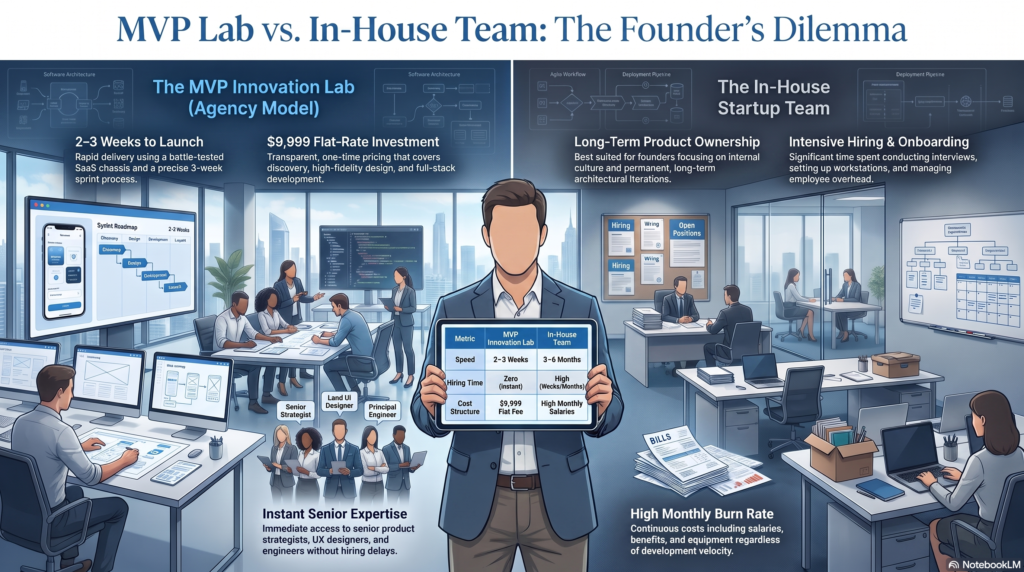
Choosing between an MVP development agency vs. in-house team isn’t a hiring question. It’s a runway question.
Every dollar and week spent building the team is a dollar and week not spent talking to users or shipping features.
Get this wrong in either direction, and the damage compounds. Hire too early in-house, and you’re paying full salaries before you’ve validated anything worth building. Outsource too long, and you never build the institutional knowledge your product needs to scale.
The good news: this decision has clear signals attached to it. Your stage, your funding, and your founder skill set point toward an answer more reliably than gut feeling does.
The Three Real Options You’re Choosing Between
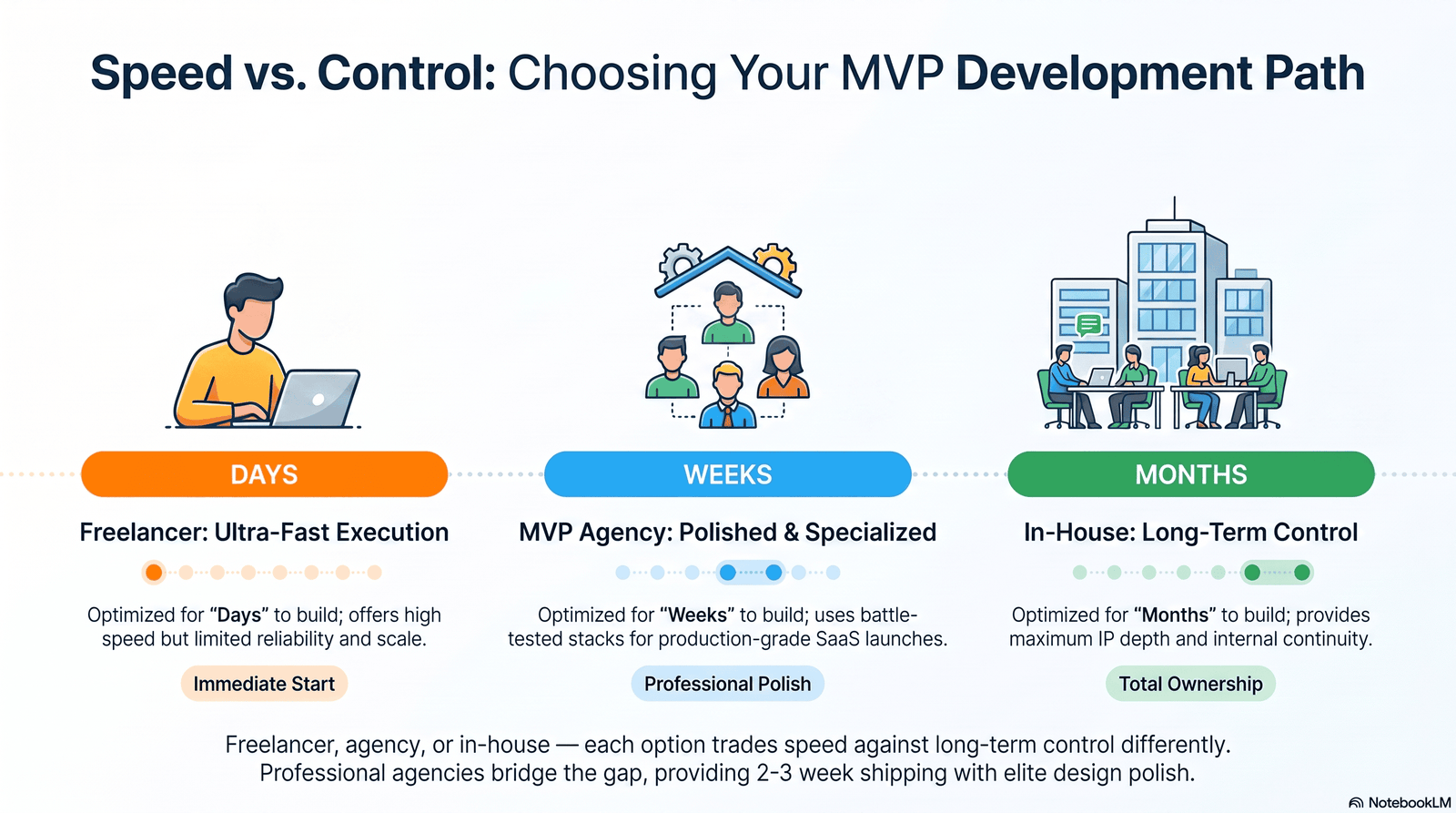
Most founders frame this as a binary — agency or in-house — but there are really three paths, and each trades speed against control differently.
A solo freelancer is the cheapest entry point. You get one person, one set of skills, and no bench if they get sick, get pulled onto another project, or simply disappear mid-build.
An MVP development agency sits in the middle. You get a small structured team, a repeatable process, and accountability a single contractor can’t offer — our breakdown of what a startup software development agency actually does covers this model in more depth.
An in-house team costs the most upfront and takes the longest to assemble, but it builds the product knowledge and long-term ownership no outside partner can fully replicate.
This guide focuses on the two options founders debate most: outsourcing MVP development to an agency, or building the team in-house from day one.
Speed to Launch: Who Actually Gets You There Faster
If your biggest constraint is time, this section matters more than any other in this guide.
An MVP development agency can typically start a discovery sprint within one to two weeks of signing, since the team already exists and simply gets allocated to your project.
Building an in-house team works on a completely different clock. Recent workforce benchmarking research puts the general U.S. hiring average around 42-44 days, but engineering roles routinely run past that — global averages for engineering hires land closer to 60 days once sourcing, interviews, and offer negotiation are counted, according to recent time-to-fill research.
That’s before your first hire has written a single line of code. Add onboarding, and a realistic in-house build timeline often starts eight to ten weeks later than an agency engagement for the exact same scope.
Demand for engineering talent isn’t slowing down either. The Bureau of Labor Statistics projects software developer employment to grow 15% through 2034, which means competition for strong candidates — and the time it takes to close them — isn’t getting any easier for a first-time founder without a recruiting team.
If you’re hiring a specific specialist rather than a generalist, that timeline can stretch further. Our guide on how founders hire a Next.js developer the smart way walks through what a focused technical search actually takes.
None of this means in-house hiring is wrong. It means the speed advantage clearly favors agencies for a first build, and that gap should be part of your decision, not an afterthought.
Cost Comparison: What Each Path Really Costs
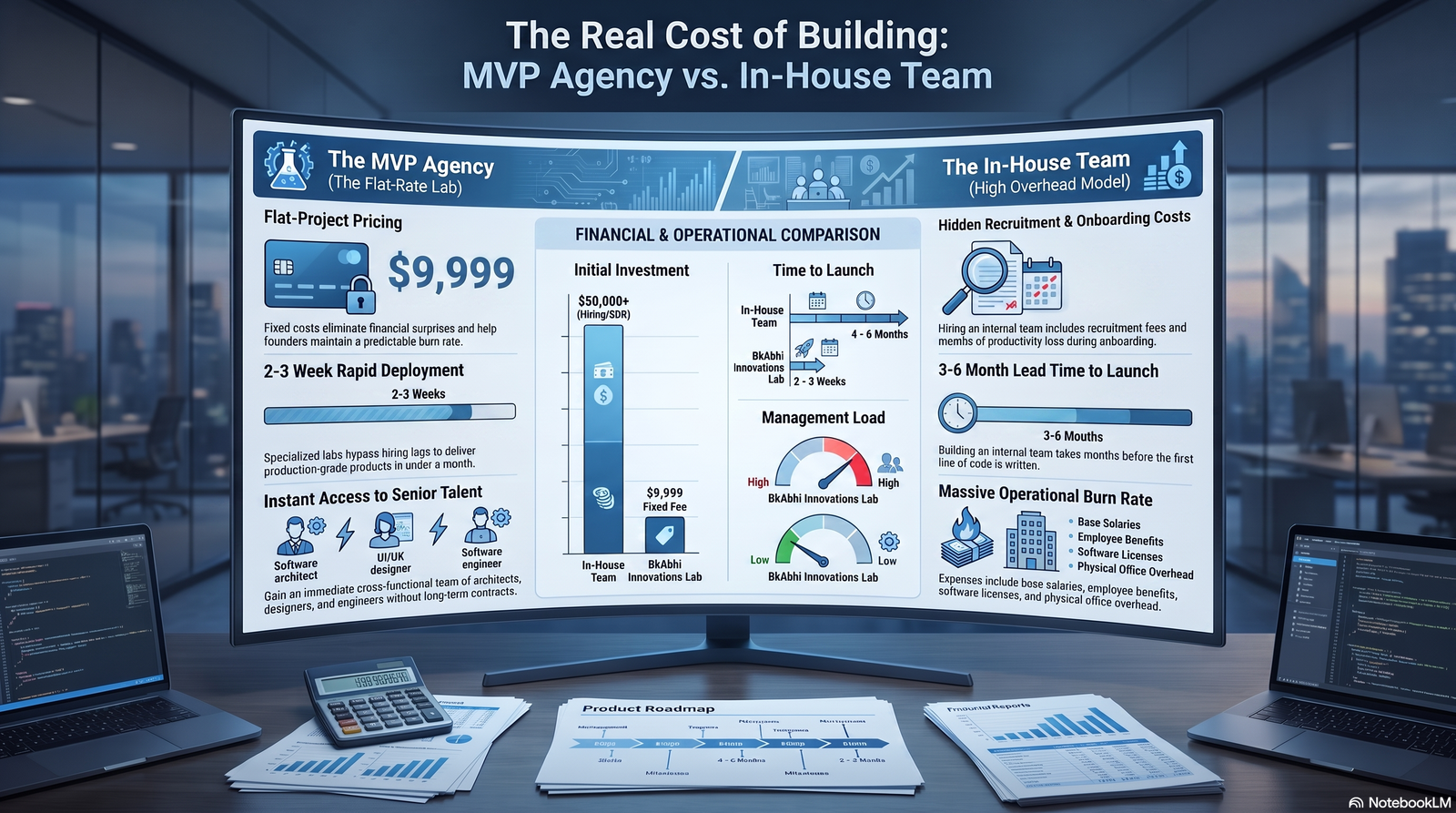
Cost is where most founders start this comparison, and it deserves a clear-eyed look rather than a single headline number.
An MVP development agency typically bills as a fixed-scope or milestone-based project, giving you a known total before development starts.
An in-house hire looks cheaper on a job posting, but the fully-loaded cost — salary, benefits, payroll tax, equipment, and recruiting — usually runs 1.5 to 1.8 times the base salary once everything is counted.
| Path | Typical First-Year Cost | What Drives the Number |
|---|---|---|
| Freelancer | $15,000-$40,000 | Hourly rate, project scope, revision rounds |
| MVP Development Agency | $60,000-$140,000 | Team size, timeline, QA depth |
| In-House Team (1-2 hires) | $150,000-$400,000+ | Salary, benefits, recruiting, equipment, ramp-up time |
These figures track closely with the detailed breakdown in our MVP development cost guide for the USA, which goes deeper into regional pricing and what each budget tier actually buys.
The real comparison isn’t agency price versus salary. It’s total first-year cost versus what you actually need in year one — a fully staffed team, or a validated product.
Most pre-seed and early seed founders find outsourcing MVP development gets them to a testable product for a fraction of what one senior in-house hire costs in year one alone.
Control and Ownership: Who Holds the Keys
This is where in-house hiring earns back some of the ground it loses on speed and cost.
An employee who lives inside your codebase daily builds institutional knowledge no outside partner accumulates in a single project engagement.
Decisions get made faster too. There’s no discovery call, no scope negotiation — just a conversation across the room and a commit an hour later.
Agencies can offset this with the right contract terms. Full IP ownership, source code access from day one, and clean documentation at handoff are non-negotiable, and our MVP development contract checklist covers exactly what to require before you sign.
The control gap narrows further if you choose an agency that treats your project as a long-term relationship rather than a one-off build, offering a smooth transition to in-house ownership once you’re ready to hire.
Risk Profile: What Actually Breaks in Each Model
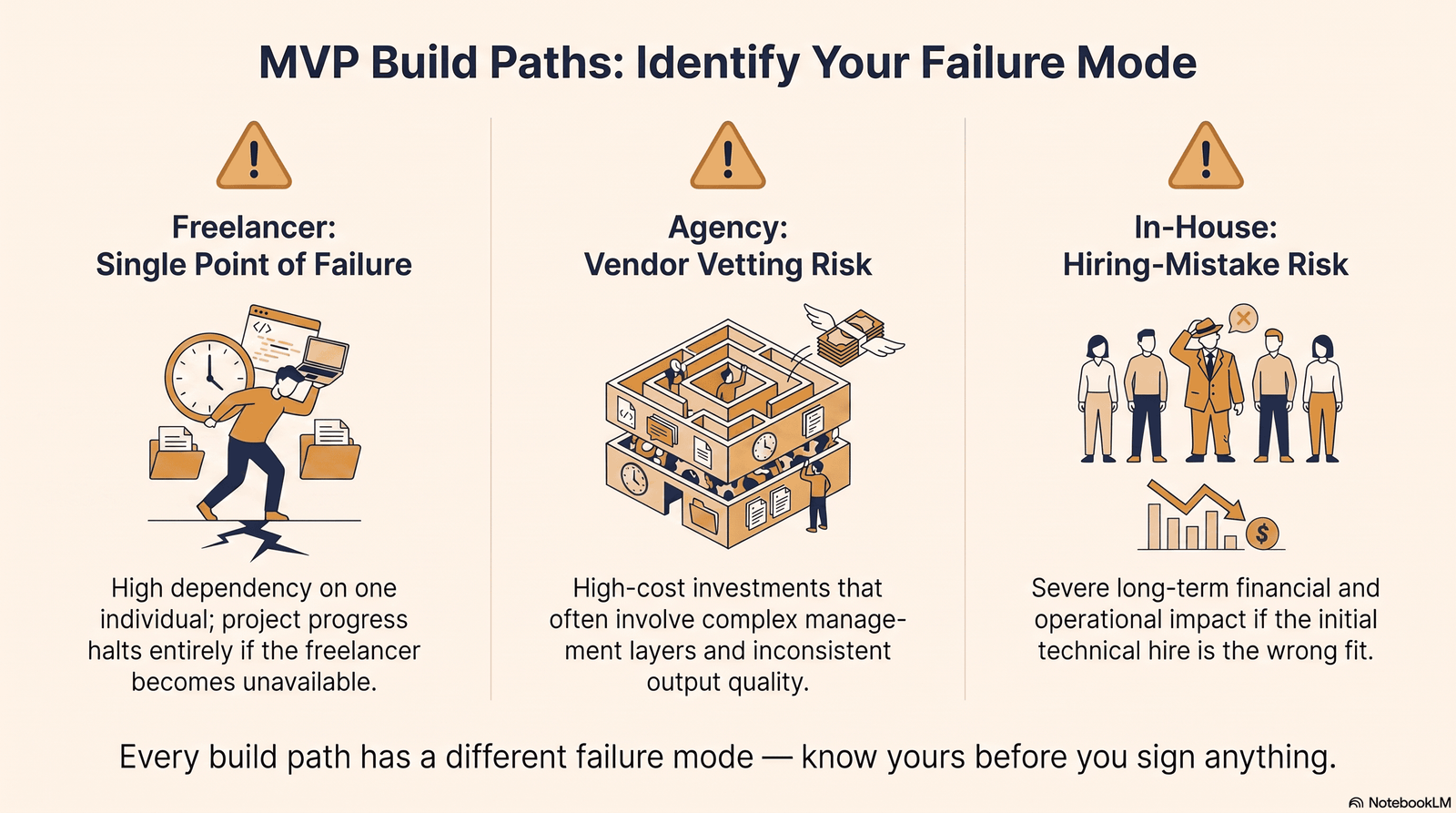
Every build path has a failure mode. Knowing yours in advance is cheaper than discovering it mid-project.
With a freelancer, the single point of failure is obvious — one person, one calendar, one health emergency away from a stalled project.
With an agency, the risk shifts to vendor selection. A poorly vetted agency can hand your project to junior staff, subcontract offshore without disclosure, or treat your MVP as a template rehash. Running any shortlisted partner through our guide to choosing an MVP development company catches most of these red flags before you sign.
With in-house hiring, the risk is different but just as real: a bad first technical hire is expensive to reverse, and a single point of failure exists here too if your one engineer leaves mid-build with no documentation behind them.
Regulatory or compliance-heavy products add another layer. Fintech and healthtech founders should weigh whether an agency’s compliance experience outweighs the control an in-house hire offers for HIPAA or PCI-DSS work specifically.
Flexibility After Launch: Scaling Up or Down
Launch day isn’t the finish line, and your team structure needs to survive what happens next.
If your MVP gets traction, an agency can typically scale a team up within one to two weeks by adding developers already on staff.
An in-house team scaling up means starting the hiring clock all over again — another 40-plus days per hire, layered on top of whatever growth pressure you’re already under.
The reverse matters too. If early traction is soft and you need to cut costs, winding down an agency engagement is a contract conversation. Winding down in-house hires means layoffs, severance, and a much harder set of decisions.
This flexibility is one reason many funded startups start with an agency, then transition to in-house once user numbers and revenue justify the fixed cost of full-time staff.
The Hybrid Path: Staff Augmentation and Blended Teams
The agency-versus-in-house framing misses a third path that’s become increasingly common among funded startups: the hybrid model.
Staff augmentation pairs your in-house product leadership with agency-provided developers who work as an extension of your team, not a separate vendor relationship.
This model keeps architecture decisions and product direction in-house while outsourcing the execution hours you don’t have the headcount to cover yet.
It also blends cost more favorably than either pure path — you’re not paying full-time salaries for every role, but you’re not fully outsourcing product judgment either.
Founders stretching a tighter budget often extend this hybrid idea geographically too, pairing US-based leadership with vetted offshore engineering. Our offshore vs. onshore MVP development comparison breaks down exactly when that trade-off pays off and when it quietly doesn’t.
Side-by-Side Comparison Table
Here’s the full picture in one place, so you can weigh every factor at once instead of one section at a time.
| Factor | Freelancer | MVP Development Agency | In-House Team |
|---|---|---|---|
| Time to start | 1-3 days | 1-2 weeks | 6-10+ weeks |
| First-year cost | $15K-$40K | $60K-$140K | $150K-$400K+ |
| Accountability | Low (single person) | Medium-High (structured team) | High (direct oversight) |
| Institutional knowledge | Low | Medium | High |
| Scaling speed | Slow | Fast | Slow |
| Best for | Tiny, single-feature builds | First MVP validation | Post-validation, ongoing product |
No row in this table is universally “best.” The right column depends entirely on where your startup actually sits today.
Decision Framework by Startup Stage
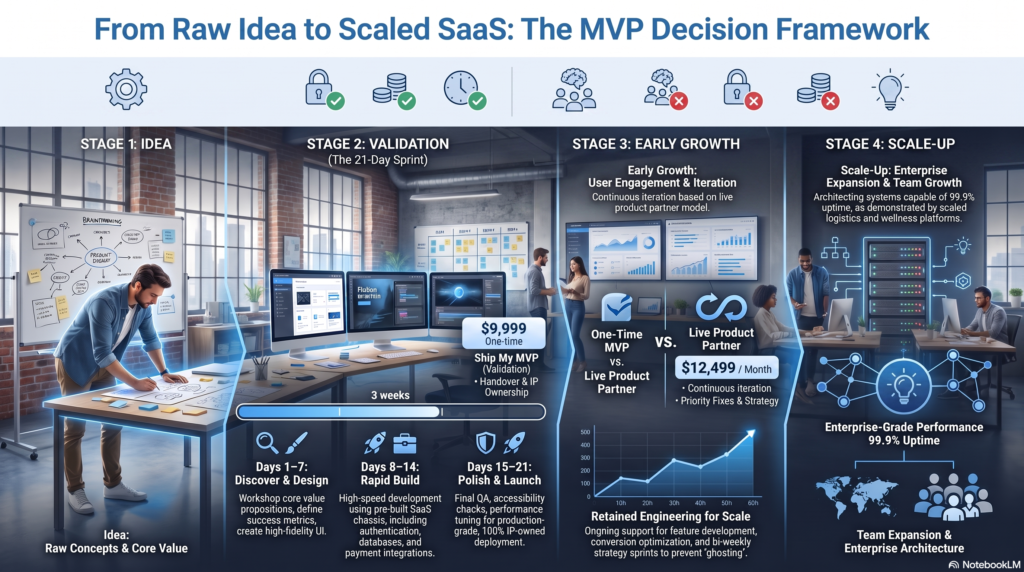
Rather than a generic recommendation, here’s how this decision typically plays out by stage, based on patterns we see across founders at BkAbhi.
Pre-seed, self-funded, non-technical founder. An agency or a strong freelancer almost always wins here. You need speed and structure more than long-term ownership, and hiring in-house before validation is the most common early-stage budget mistake.
Seed-stage, funded, no technical co-founder. An MVP development agency remains the stronger default, but this is also the stage to start hybrid conversations — agency-led build, with a plan to bring one technical hire in-house post-launch.
Technical founder who can code but is stretched thin. Staff augmentation usually beats a full agency engagement here. You keep architecture control while buying back the hours you don’t have.
Series A or already-funded with a clear roadmap. In-house hiring starts making financial sense once you’re building continuously for 12+ months rather than shipping one MVP and reassessing.
SaaS founders specifically should weigh one more variable: subscription billing and multi-tenant architecture add technical depth that not every generalist team — agency or in-house — handles well out of the gate. Our dedicated guide to MVP development for SaaS startups covers exactly what to check for either path.
Whatever stage you’re at, this decision connects directly to the process you’ll follow next — our full MVP development process guide shows exactly where “choosing who builds” fits into the broader 10-14 week roadmap.
Questions to Ask Yourself Before Deciding
Before you post a job listing or sign an agency contract, sit with these five questions honestly.
- Do I need this product live in under three months, or do I have runway to hire properly first?
- Am I validating an idea, or committing to 12+ months of continuous development?
- Can I personally evaluate technical work, or do I need a partner who won’t need hand-holding?
- Is my budget closer to $60K or closer to $250K for this first year?
- Will I need this exact team again in six months, or is this a one-time build?
If you’re leaning toward an agency after answering these, our full list of MVP discovery call questions gives you the exact script to bring into vendor conversations.
Red Flags in Each Path
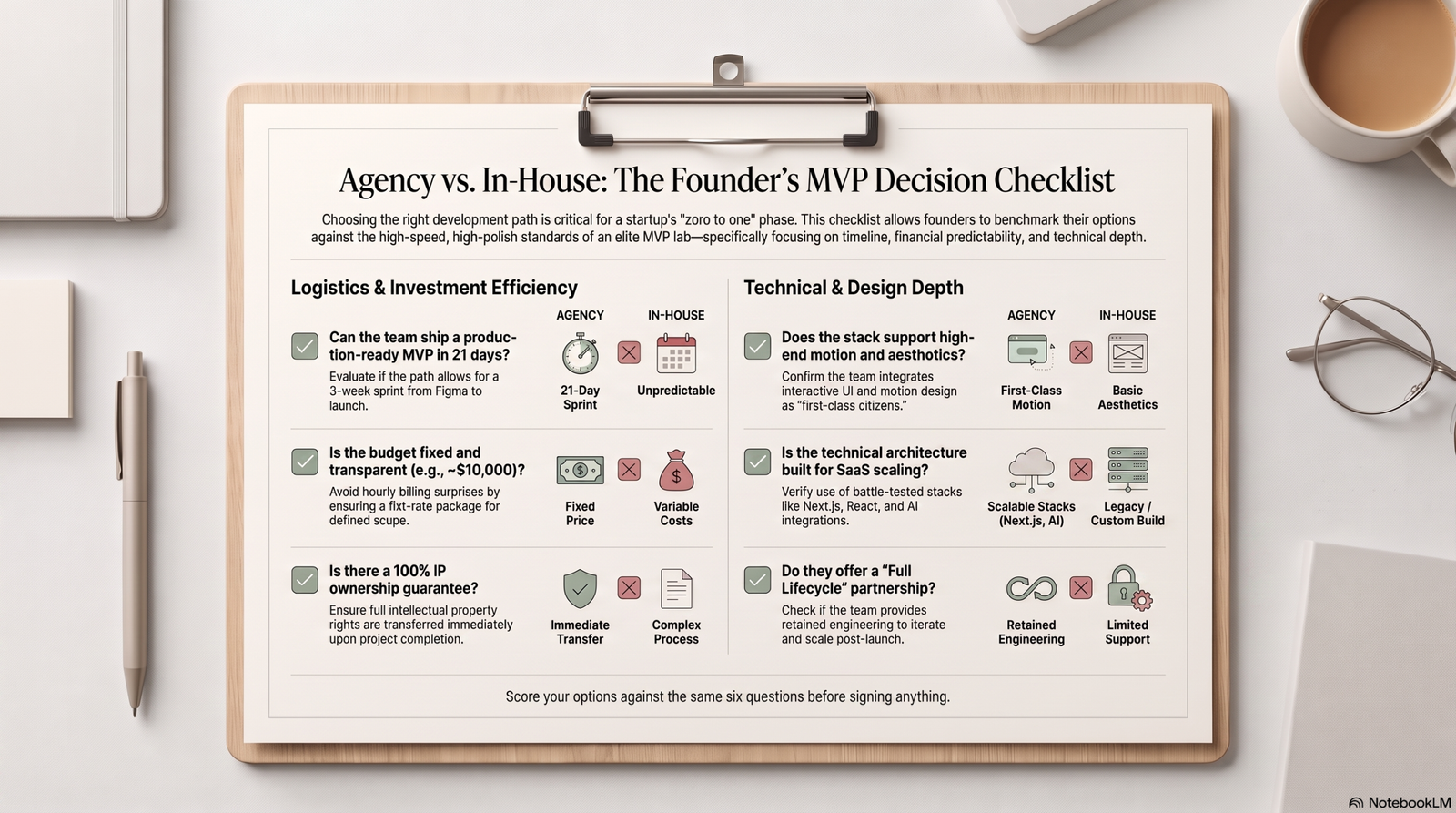
A few warning signs show up repeatedly, regardless of which path you’re leaning toward.
Freelancer red flags: No written contract, no code repository access from day one, and vague answers about availability for the full project duration.
Agency red flags: Reluctance to share references, “yes to everything” answers regardless of budget or timeline, and rankings-driven credibility — our guide on vetting MVP development company rankings explains why directory placement alone isn’t proof of quality.
In-house red flags: Hiring your first technical employee without any way to evaluate their work, and skipping a probationary or contract-to-hire period for a role this critical.
Across every path, the same rule applies: if nobody can clearly explain their process, timeline, and what happens when something goes wrong, that’s the signal to keep looking.
How BkAbhi Approaches This Decision
We don’t push every founder toward the same answer, because the honest answer changes by stage.
For early validation, we typically recommend a fixed-scope agency engagement — discovery phase first, core build second, so you’re never locked into a full budget before you’ve tested the plan.
For founders further along, we help structure a transition plan: which parts of the codebase move in-house, which stay with us, and how to hire your first technical employee without repeating our mistakes.
We’re also upfront about team composition on every engagement, including where work is performed, so there’s no surprise mid-project — a standard we think every MVP development company should hold itself to.
You can explore our full service approach or book an MVP consultation if you want this framework applied directly to your specific build.
Frequently Asked Questions
Is it cheaper to hire an MVP development agency or build in-house? For a first build, an agency is almost always cheaper in year one. Fully-loaded in-house cost typically runs 1.5-1.8x base salary once benefits and overhead are included.
How long does it take to build an in-house team versus hiring an agency? An agency can typically start within one to two weeks. In-house hiring for a single engineer often takes six to ten weeks from job posting to onboarding, longer for senior roles.
Can I switch from an agency to an in-house team later? Yes, and it’s a common path. Founders who validate with an agency often transition core ownership in-house once the product has real users and funding to support full-time salaries.
What is staff augmentation, and how is it different from hiring an agency? Staff augmentation embeds agency-provided developers directly into your existing team under your product leadership, while a full agency engagement typically owns the entire build process end to end.
Do I need a technical co-founder to work with an MVP development agency? No. A structured agency should be able to translate business requirements into technical decisions without requiring you to evaluate code yourself, though a technical advisor can still help.
Is outsourcing MVP development risky for protecting my idea? Any reputable agency will sign an NDA and assign full IP ownership to you in the contract. Verify this explicitly before sharing detailed specifications with any outside team.
Final Thoughts
There’s no universally correct answer to MVP development agency vs. in-house team — only the right answer for your specific stage, budget, and runway.
Match your build strategy to what you actually need to learn next, not to what looks more impressive in a pitch deck.
For most first-time founders validating an idea, outsourcing MVP development to a structured agency remains the faster, lower-risk starting point — with in-house hiring becoming the smarter move once your product, and your budget, are ready for it.
Ready to figure out which path fits your project? Book an MVP consultation with our team, or explore more founder guides on our homepage.
Author Bio
Jeevesh Tripathi Email: jeevesh@bkabhi.com
Jeevesh Tripathi is a startup technology researcher and MVP strategy consultant at BkAbhi Innovations Lab, where he has advised founders across fintech, EdTech, and marketplace platforms on build strategy and vendor selection. His work focuses on translating real founder decisions — hiring timelines, agency contracts, and team-scaling trade-offs — into practical, jargon-free guidance for early-stage teams. This article draws on 2026 U.S. hiring benchmark data, agency engagement patterns, and direct founder interviews conducted throughout the year.
This guide is part of BkAbhi’s MVP development resource hub. For more founder-focused guides on cost, process, and vetting development partners, visit the BkAbhi blog.