
Quick Answer
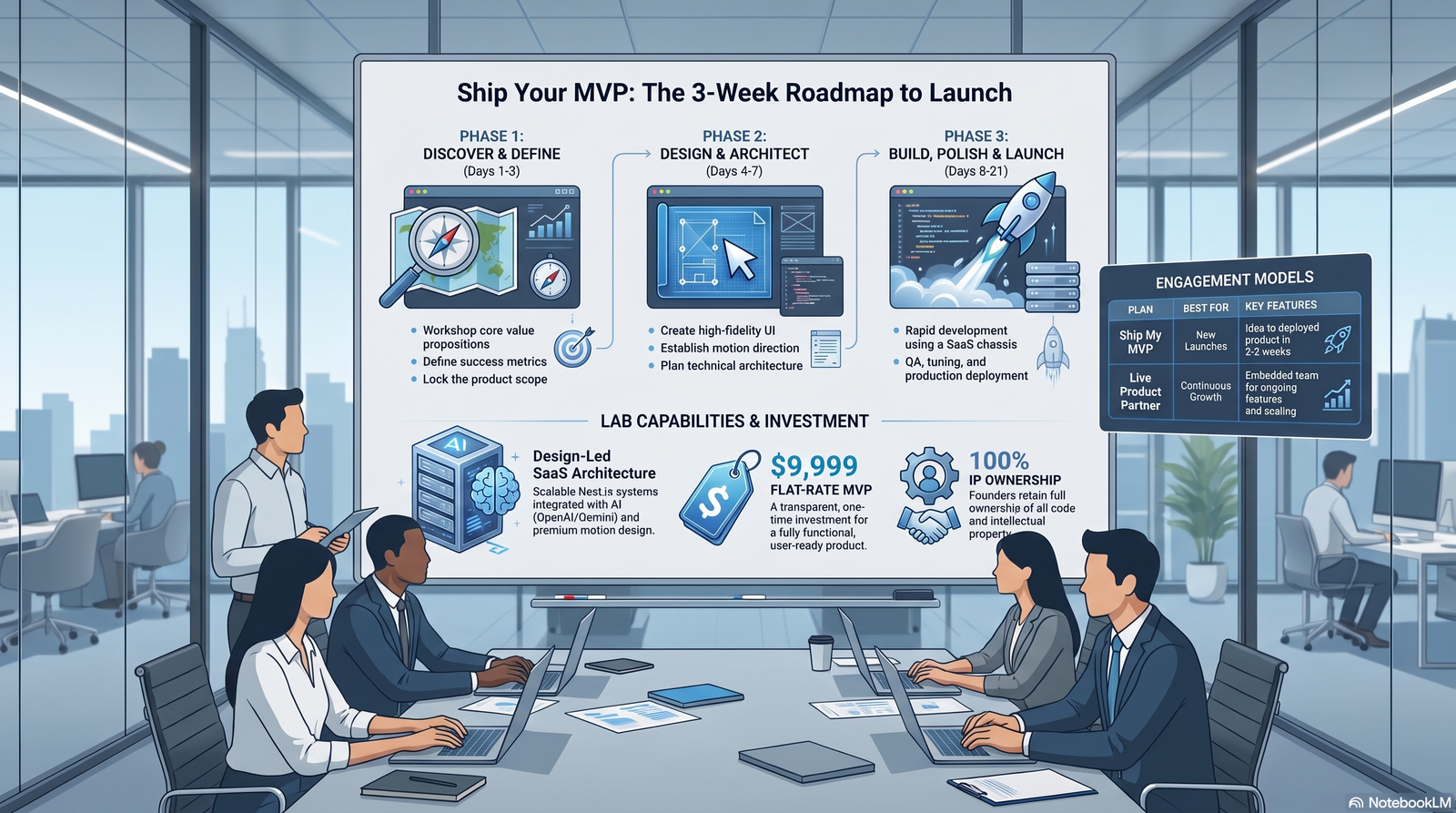
The MVP development process has seven stages: idea validation, feature prioritization, wireframing, choosing a build path, core development, testing, and launch with post-launch iteration. Most founders move through this MVP roadmap for startups in 10-14 weeks. If you’re deciding who should actually execute each stage, our pillar guide to the best MVP development companies in the USA breaks down how to pick the right partner.
Most founders don’t fail because their idea was bad. They fail because they skipped stages of the MVP development process that felt optional at the time.
They jump straight from idea to code. No validation, no prioritization, no test plan. Ten weeks later, they’ve shipped something nobody asked for.
This guide walks through how to build an MVP the right way — stage by stage, with realistic timelines and the actual decisions you’ll need to make along the way.
Table of Contents
Why Founders Get the MVP Development Process Wrong
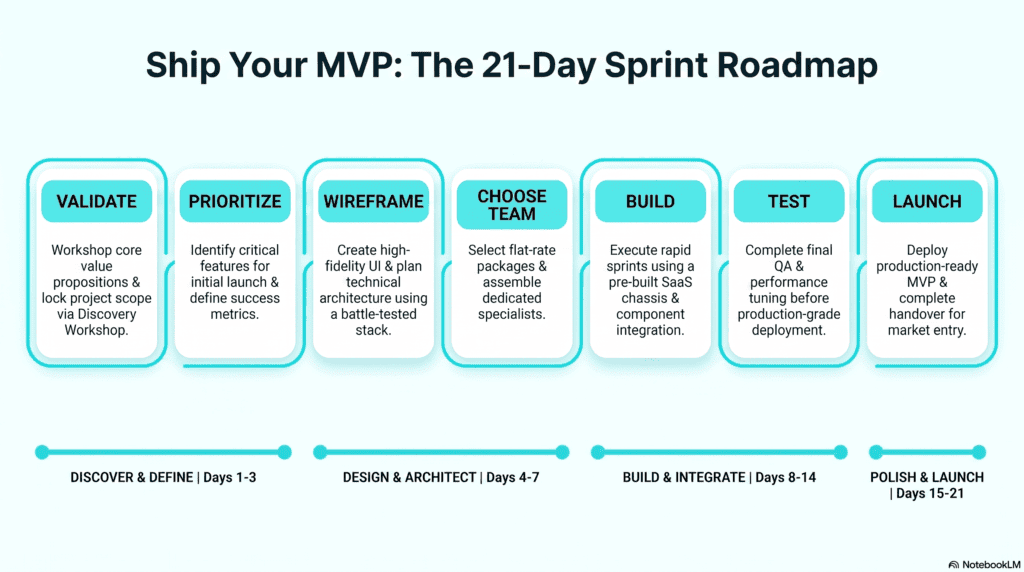
The word “minimum” in MVP is the most misunderstood part of the whole concept. Founders read it as “cheap” or “unfinished.” It actually means “just enough to test one hypothesis.”
A rushed process skips validation and goes straight to building. A rigid one tries to build every feature before testing anything. Both waste runway.
Neither extreme is really about speed or caution. Both come from skipping the same early step: writing down exactly what you’re trying to learn before anyone touches a keyboard.
The right process sits in the middle: structured enough to avoid chaos, flexible enough to change direction when real users tell you something your spreadsheet didn’t.
If you’re also evaluating outside help for any of these stages, it’s worth reading how to choose an MVP development company before you commit budget to stage four below.
Stage 1: Idea Validation and Market Research
Before a single wireframe gets drawn, validate that the problem you’re solving is real and that people will actually pay to have it solved.
This stage typically takes one to two weeks. It includes competitor research, five to ten customer interviews, and a clear one-sentence hypothesis you’re building toward.
Skip this step and every later stage inherits the risk. You’ll be polishing features nobody asked for instead of fixing what users actually flagged.
A simple landing page with an email signup form is often enough to test demand before writing any code. If fifty people won’t give you their email, fifty thousand won’t give you their credit card either.
This build-measure-learn loop is the core idea behind the Lean Startup methodology, and it’s the reason validation sits at the very top of this roadmap instead of somewhere in the middle.
Stage 2: Defining Your Core Feature Set
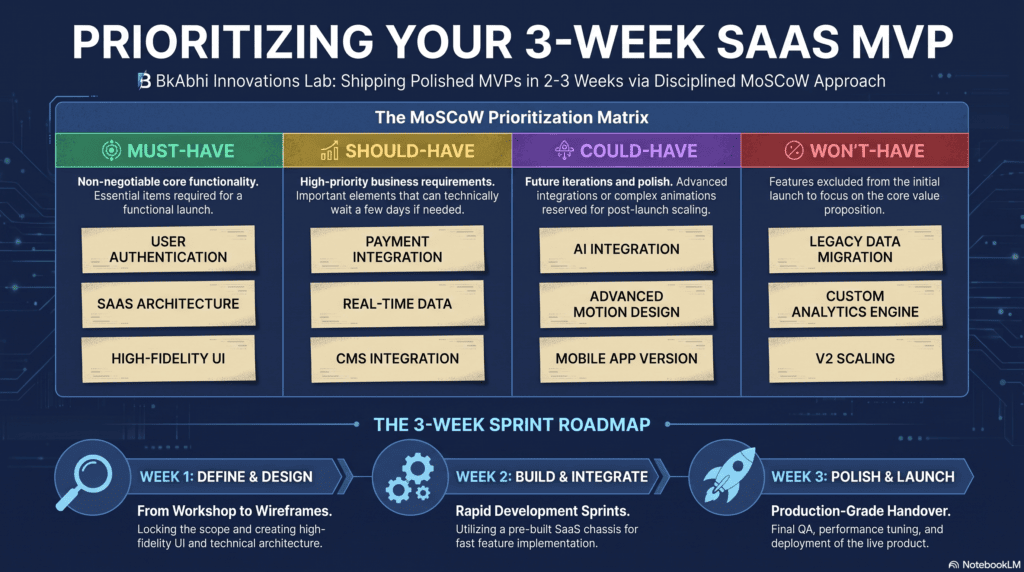
Once the problem is validated, list every feature you think you need. Then cut it down using a framework like MoSCoW — Must-have, Should-have, Could-have, Won’t-have.
Your MVP only ships the “must-have” column. Everything else waits for version two, no matter how compelling it feels in the moment.
This is usually where non-technical founders need outside judgment most. A development partner who pushes back on your feature list is worth more than one who agrees to build all thirty-seven items.
Founders comparing DIY builds against professional help at this stage often benefit from reading our agency vs. in-house team comparison, since the right structure depends on how much of this prioritization work you can do yourself.
Stage 3: Wireframing and Prototyping
With a locked feature list, sketch out the user flow before any design polish or code. Low-fidelity wireframes are enough — this stage is about structure, not visuals.
A clickable prototype in Figma lets you test navigation logic with real users before development starts. Catching a confusing flow here costs an afternoon; catching it after launch costs a rebuild.
This stage usually runs one to two weeks alongside technical architecture planning, and it’s one of the clearest signals of whether a build partner actually understands the mvp development stages ahead or is improvising as they go.
Even a handful of five-user tests at this point, a sample size usability researchers have long shown surfaces most major navigation problems, can save weeks of rework once real development starts.
Stage 4: Choosing Who Builds Your MVP
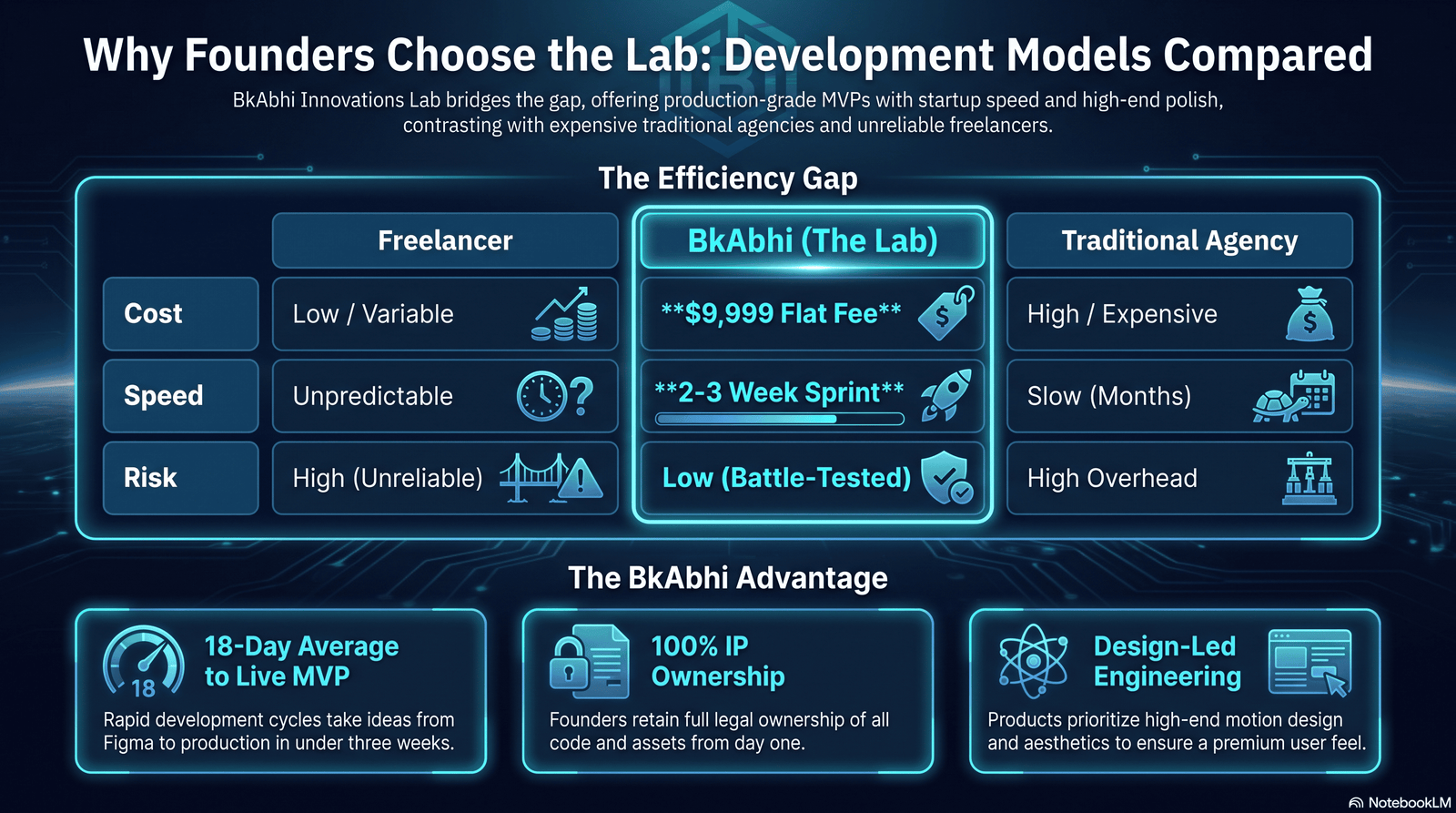
You have three real options: a solo freelancer, a development agency, or hiring in-house. Each trades speed against control differently.
A freelancer is the cheapest path but carries the most risk if they get pulled onto another project or disappear mid-build. An in-house hire gives you long-term ownership but takes months to recruit properly.
Agencies sit in the middle — faster to start than hiring, more accountable than a solo contractor, and usually built around a repeatable delivery process they can walk you through in a discovery call.
Whichever path you choose, get the scope, timeline, and payment structure in writing before Stage 5 begins. Verbal promises about “flexibility” tend to evaporate the moment a deadline slips.
Before signing with anyone, run them through a structured set of MVP discovery call questions so you’re comparing every option against the same criteria.
If budget is the deciding factor, it’s worth reading a full MVP development cost breakdown for the USA before you request quotes — it’ll help you spot a lowball bid instantly.
Stage 5: Core Development Sprint
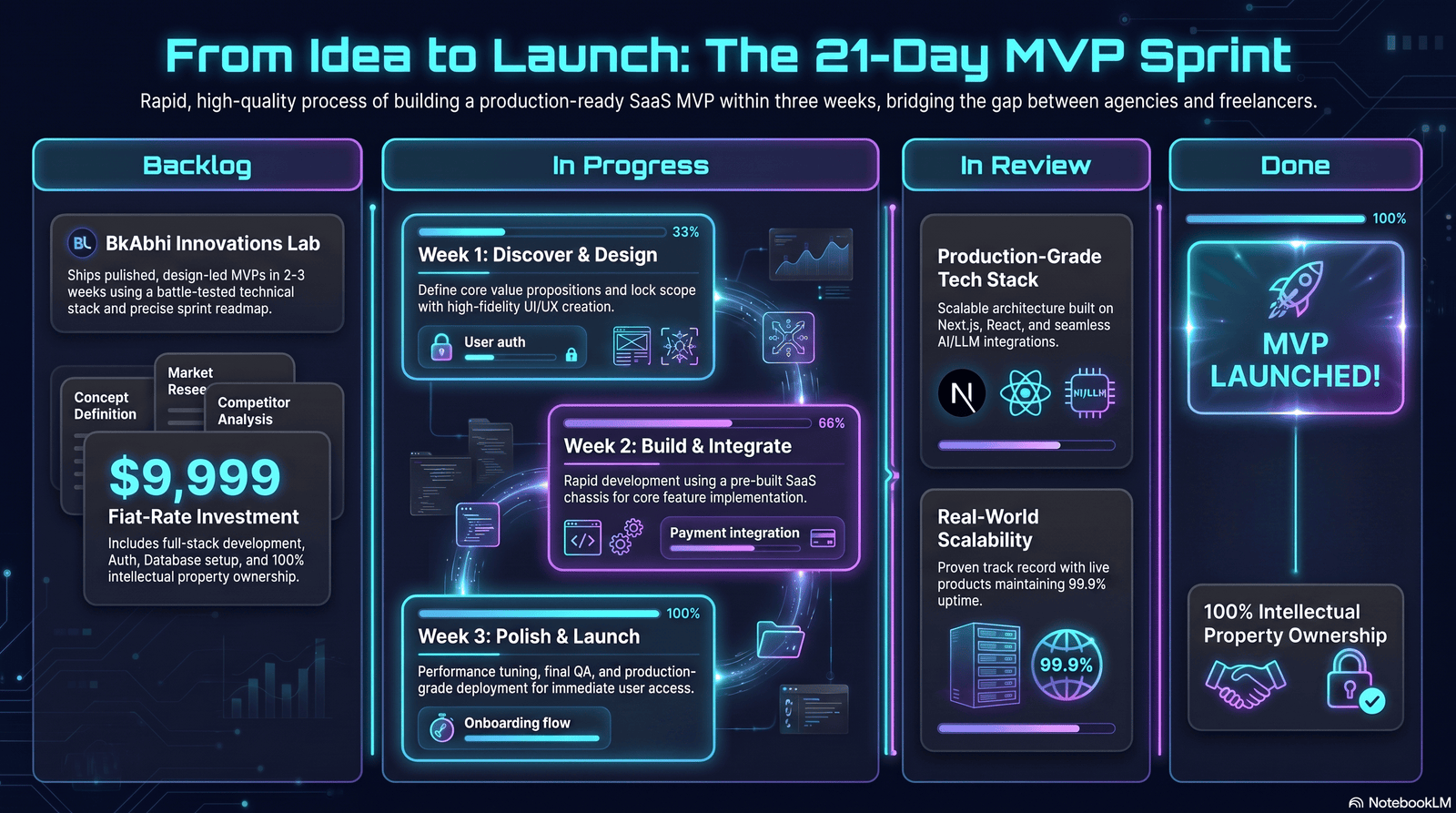
This is where most of your timeline and budget go — typically six to eight weeks for a focused, single-purpose MVP.
Development should move in short sprints with weekly demos, not a single “big reveal” at the end. You want visibility into progress, not a surprise ten weeks in.
Continuous deployment to a staging environment means you can click through real progress every week instead of waiting on status updates. This is also the stage where scope creep does the most damage to an otherwise well-planned build.
Every request outside the locked feature list should go through a documented change-order process — something worth confirming is written into your MVP development contract before development even starts.
Stage 6: Testing and Quality Assurance
Budget one to two weeks specifically for testing — not as a rushed afterthought squeezed into the final development sprint.
This stage covers functional testing, basic security checks, and usability testing with people outside the build team. Friends and family are not a substitute for target users.
A short, paid pilot or beta group of ten to twenty real users at this stage catches more usability problems than any internal QA checklist. Watch what they struggle with, not just what they say.
If your MVP touches payments, health data, or other regulated information, this is also when compliance basics — not full certification — should get a first pass.
Stage 7: Launch and Post-Launch Iteration
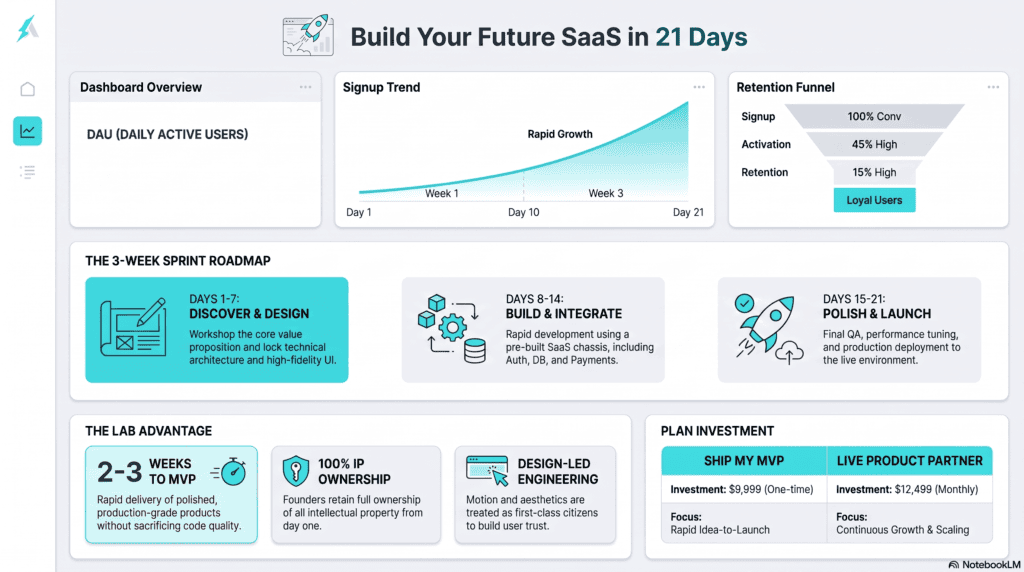
Launch is not the finish line — it’s the start of the part that actually teaches you something.
Set up analytics before launch day, not after. You need to see what users do, not just what they say they’ll do in a survey.
Expect a quiet first few weeks. Most MVPs get a trickle of signups, not a flood, and that’s normal. The real work is rapid iteration based on what the data shows.
Whether you continue with the same team, bring development in-house, or bring on a new partner depends on how the build held up under real usage — a decision our guide on vetting MVP development company rankings can help you make objectively rather than on gut feeling.
A Sample MVP Roadmap for Startups (Week by Week)
Here’s what a realistic MVP roadmap for startups looks like when every stage above is followed in sequence.
| Week | Stage | Key Output |
|---|---|---|
| 1-2 | Idea validation | Validated hypothesis, interview notes |
| 2-3 | Feature prioritization | Locked MoSCoW feature list |
| 3-4 | Wireframing & prototyping | Clickable prototype, tech architecture |
| 4 | Choosing a build partner | Signed contract, kickoff scheduled |
| 5-12 | Core development | Working MVP, weekly demos |
| 12-13 | Testing & QA | Bug-free core flows, beta feedback |
| 13-14 | Launch & iteration | Live product, analytics running |
This isn’t a rigid formula — regulated industries or complex marketplaces stretch these timelines. But it’s a realistic baseline for a single-purpose consumer or SaaS MVP.
How Much Does Following This Process Cost?
Cost tracks closely with which stages you outsource and which you do yourself. A founder who handles validation and wireframing alone spends less on the professional stages.
Most funded startups land between $60,000 and $140,000 for a fully-built MVP that includes authentication, core functionality, and basic QA, based on current 2026 US market rates.
For a complete breakdown by tier — including what a $15,000 build buys versus a $150,000 one — see our full MVP development cost guide for the USA, which maps directly onto the stages covered here.
Founders trying to stretch a tighter budget often look offshore for the development sprint specifically. Our offshore vs. onshore MVP development comparison covers when that trade-off actually pays off.
SaaS-Specific Adjustments to the MVP Development Process
If you’re building a subscription product, a few stages above need extra plumbing that a generic app doesn’t.
Feature prioritization needs to account for subscription billing and plan tiers from day one — retrofitting Stripe billing logic later is far more expensive than building it in from the start.
Core development for SaaS also needs multi-tenant architecture and usage-based analytics baked in early, not bolted on after your first ten customers sign up.
Our dedicated guide to MVP development for SaaS startups covers the full technical checklist worth adding to stages two and five if subscription software is your category.
Common Mistakes That Derail an MVP Development Process
A few patterns show up again and again across founders who’ve been through this process, whether they built solo or hired help.
Skipping validation entirely. Building for six weeks before talking to a single potential user is the single most expensive mistake on this list.
Confusing “minimum” with “unpolished.” A minimum viable product still needs to work reliably for its one core use case — buggy isn’t the same as lean.
Adding features mid-sprint. Every unplanned addition pushes your timeline and usually your budget, even when it feels small in the moment.
Treating launch as the finish line. The MVP development process doesn’t end at launch — the highest-value learning starts the week after.
Choosing a partner on price alone. The cheapest quote rarely stays the cheapest once rework and miscommunication get factored in, a pattern our best MVP development companies USA guide covers in more depth.
Independent research on software projects, including the long-running Standish Group CHAOS reports, has consistently found that unclear scope and changing requirements are among the top reasons software projects run over budget — which is exactly why locking your feature list in Stage 2 matters so much.
Ignoring the paper trail. A verbal agreement about scope, timeline, or IP ownership is not a substitute for a signed document either side can point back to later.
Who Should Own Each Stage
Even when you hire outside help, someone on your side needs to own each stage of the MVP development process — a build partner can’t validate your market for you.
Founders should own validation and final feature-cut decisions personally, since only you carry the risk of building the wrong thing. No agency can substitute for founder-led customer conversations.
A development partner should own wireframing, the technical build, and QA execution, while still reporting progress back to you on a fixed weekly cadence rather than disappearing between demos.
Post-launch, ownership usually splits: your team owns interpreting user data and deciding what to build next, while your development partner owns implementing those decisions quickly.
This division keeps accountability clear on both sides and prevents the most common failure mode — a founder who hands over the whole process and then is surprised by what gets shipped.
Glossary
A short list of terms that come up throughout this journey, so nothing catches you off guard in a proposal or contract.
MVP (Minimum Viable Product) — the smallest version of a product that lets you test a core hypothesis with real users.
MoSCoW prioritization — a framework for sorting features into Must-have, Should-have, Could-have, and Won’t-have categories.
Discovery phase — the initial one-to-two-week period where scope, wireframes, and technical architecture get defined.
Sprint — a fixed, short development period (commonly one to two weeks) that ends in a demo of working progress.
Change order — a formal request to add or modify scope after development has already started, usually billed separately.
Frequently Asked Questions
How long does the full MVP development process take? Most single-purpose MVPs take 10-14 weeks from validation to launch. Complex marketplaces or regulated products can take four to six months.
What’s the difference between an MVP and a prototype? A prototype demonstrates an idea visually, usually without working backend logic. An MVP is a functional product real users can actually use and pay for.
Can I skip the validation stage if I’m confident in my idea? You can, but it’s the riskiest shortcut on this list. Confidence isn’t the same as evidence, and validation usually takes under two weeks.
Do I need a technical co-founder to follow this MVP development process? It helps, but it isn’t required. Non-technical founders can still run this process effectively by leaning on a structured discovery call and a written development contract.
How is an MVP roadmap for startups different from a full product roadmap? An MVP roadmap covers only the stages needed to test one core hypothesis. A full product roadmap extends far beyond launch into scaling, new markets, and additional feature lines.
Should I build my MVP myself with no-code tools first? For very early validation, yes — tools like Bubble or Webflow can test demand before you invest in custom development. Once you have real users or paying customers, custom development usually becomes worth the cost.
Final Thoughts
The MVP development process isn’t complicated in theory. It’s seven stages, roughly ten to fourteen weeks, and one core hypothesis you’re trying to prove or disprove.
What makes it hard is discipline — resisting the urge to add features, skip validation, or rush testing because launch feels close enough to taste.
Follow the sequence, protect your feature list, and treat launch as the beginning of learning rather than the end of building. That’s how to build an MVP that actually earns its next round of funding.
Ready to scope your own build? Book an MVP consultation with our team, or explore the full BkAbhi resource hub for more founder-first guides on cost, contracts, and choosing a partner.
Author Bio
Jeevesh Tripathi Email: jeevesh@bkabhi.com
Jeevesh Tripathi is a startup technology researcher at BkAbhi Innovations Lab, where he studies how early-stage founders plan, budget, and execute their MVP development process across SaaS, fintech, and marketplace products. His work draws on direct founder interviews, agency discovery calls, and hands-on evaluation of development partnerships, translated into practical, jargon-free guidance for non-technical founders.
This guide is part of BkAbhi’s MVP development resource hub. For more founder-focused guides on cost, contracts, and vetting development partners, visit the BkAbhi blog.