

Applications can often connect to external services which can reduce a company’s workload, and add functionality. The price of integration will depend on various aspects including which third party service is being accessed, the complexity of the integration and the degree of personalisation required.
Whilst relatively easier to connect a site to a payment solution, it is typically much more complex to integrate a CRM, ERP and accounting system so that they all share and update customer information. Again, both of these methods are carried out using APIs, but the level of development, testing and future support can differ greatly.
What then is a reasonable business expenditure for third party API integration?
According to NexaEx, in India the approximate price for a basic integration to a transparent API is between 40,000 and 150,000 Rupees. More complex integration work can be substantially more expensive. Please note that these are just examples given by companies and are neither industry standard prices nor definitive quotes.
This article outlines what third party API integration can cost, together with the drivers behind these costs. Further expenditure areas are also discussed. Finally, advice is provided on how to effectively plan a development budget.
Table of Contents
What Is Third-Party API Integration?
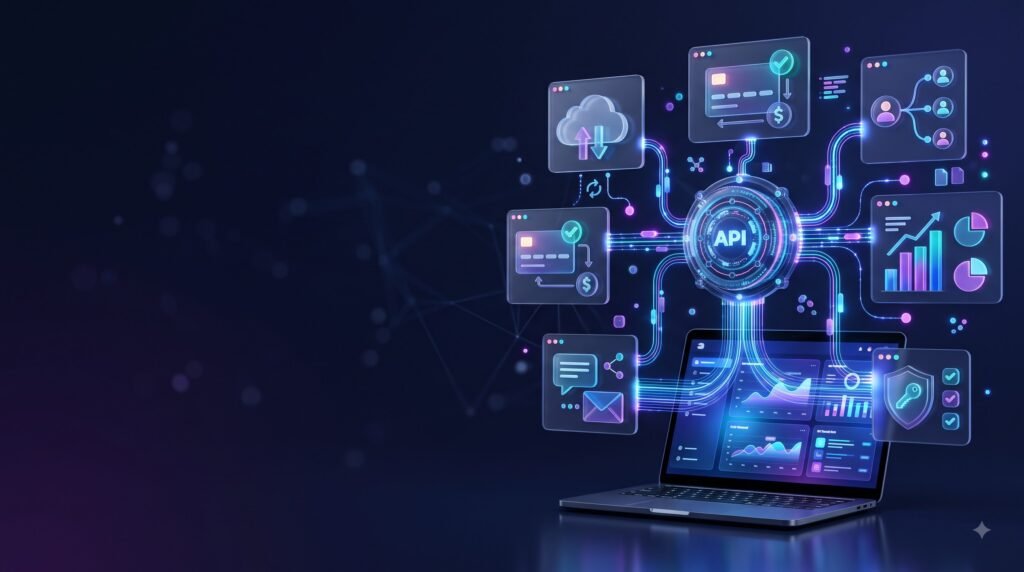
Third-party API integration is the process of connecting your application to an external software service using its Application Programming Interface (API).
An API is used to share and retrieve data between two applications. People are not required to input or extract data manually.
Applications may integrate with a range of services such as:
- Payment service – to handle payments.
- Shipping company – to print labels and manage dispatches.
- CRM – to manage customer data.
- Email service – to provide customers with order confirmation.
- Analytics service – to analyse how people engage with an application.
- Data can be shared seamlessly if these integrated services function well.
Alongside retrieving data from another service, there are other factors which must be understood when integrating with a third party API. These include: methods of logging in, data structure, API functionality, error handling and the needs of the application consuming the data.
All of these aspects affect the cost of integrating with a third party API.
How Much Does Third-Party API Integration Cost?
There is no standard cost for using a 3rd party API. Costs are affected by how many systems are integrated, the API information available, security credentials and data transfer. Testing and support will also impact upon the cost.
As a guide, NexaEx details: India-specific estimates for API-related development work:
| Integration work | Indicative cost |
|---|---|
| Single third-party integration | ₹40,000–₹1.5 lakh |
| Custom REST API development | ₹1.5–₹5 lakh |
| Multi-system integration platform | ₹4–₹12 lakh+ |
Reference: NexaEx API development and integration price list (July 2026).
These figures describe different types of work. Custom REST API development is not the same as connecting an existing third-party API, and an integration platform may involve several systems and additional infrastructure.
For global reference, Ficode states that a project can require between 1,500-5,000 APIs for basic integration and up to 50,000-100,000+ for more complex business scale. These classifications relate to more extensive projects and so cannot be directly compared to the quoted figure for one integration.
What Do Different Integration Projects Involve?
The following examples explain how project scope can affect development effort. They are complexity categories, not independently verified fixed-price quotations.
1. Basic API Integration
A basic integration connects one application to an external service using a relatively straightforward data flow.
Examples include:
- Connecting a contact form to a CRM.
- Email delivery system
- Online payment facility
- Retrieving information from a weather API.
- Connecting an application to an analytics service.
Depending on what is being integrated, application programming interface access details, requests, and responses may be needed together with simple testing.
This relates to where there is good external service information available and the application does not need extensive adaptation.
2. Moderate API Integration
Moderate integrations involve more complicated data exchange or business logic.
Examples include:
- Synchronizing inventory between an e-commerce platform and an ERP.
- Integration of a bookings app to a calendar.
- Sharing customer details between different apps.
- Automating stock and dispatch.
- Automating order processing and shipping updates.
- Integration of a subscription payment system to company accounts.
Such integrations may involve data mapping, webhooks, batch synchronisation and further validation and testing.
3. Complex API Integration
These may be complex involving a number of systems and/or processes and/or technical challenges.
Examples include:
- Connecting multiple enterprise applications.
- Synchronizing large customer databases.
- Legacy ERP system integration with new SaaS solutions.
- Financial process development.
- Integration in a secure and auditable environment.
These frequently also require extra architectural design, logging and back up functionality and inter-service management.
Whilst the number of APIs used is an element of integration complexity, it is often the function of the software which proves most influential in this area.
8 Points to Consider When Estimating Costs for API Integration

It is useful to analyse and recognise key factors which can affect costs for API integration.
1. API Documentation and Technical Complexity
Good quality API documentation will often include details of API points, user authentication, data that can be requested, how this should be structured and error messages. This supports developers in learning about and then integrating with an API.
Unfortunately, not all APIs are fully documented and there can also be a lack of good examples and/or testing facilities. Developers could therefore need to spend extra time analysing an API and experimenting to understand how it functions and what its constraints are.
Whilst it may be fairly easy to integrate with a payment API which has good quality documentation, it may be necessary to carry out further analysis when integrating with an aged enterprise API where documentation is poor.
Cost tip: Analyse an API’s documentation at an early stage so that you can determine a firm cost for development.
2. Number of Endpoints and API Operations
An API endpoint is a specific URL through which an application accesses a particular resource or performs an operation.
In addition to supporting a CRM application you may need to provide functionality to:
- Add a customer.
- View a customer.
- Change a customer.
- Remove or store a customer.
- View a customers’ history.
Further functionality will generally also have further associated development and test effort.
Whilst the quantity of APIs can be used as a guide for costing, complex APIs which involve numerous business rules can in fact take more development effort than a large number of basic view APIs.
Costing – Identify precisely which API functions are required by your application. Don’t just cost based on the number of APIs.
3. Authentication and Security Requirements
Authentication determines how your application proves its identity when communicating with an external service.
Common approaches include:
- API keys.
- OAuth 2.0.
- JSON Web Tokens (JWT).
- Signed requests.
- Client credentials.
Simple API keys can be used to authorise an integration but more complex integrations may also need to support authorisation, re-issue of tokens and control of permissions. Securing data is often key, especially if an application processes payment details, personal data and/or key business data.
Applications may need to support encryption, control of access and secure storage of sensitive information.
Establish how the third party service authenticates and what level of permissions are needed.
4. Data Mapping and Transformation
Different applications may store the same information in different formats.
For example, an e-commerce application may enter a customer’s full name in one section, whereas the associated CRM divides it into a first and surname.
This data must then be converted into something that can be recognised and used by the destination application.
Complicating matters further are differences in how systems define dates, money, codes and products, as well as their customer data.
Even greater thought is needed for synchronisation, as application programmers have to establish which application should override the other where both systems amend identical data.
Budget consideration: Prepare a data mapping document showing which fields need to move between applications and how they should be transformed.
5. Real-Time Synchronization and Webhooks
Some integrations only need to transfer information at scheduled intervals.
Many systems also need to react swiftly to external events.
For instance, an e-commerce site may wish to change an order status as soon as a delivery service has delivered stock.
Webhooks allow developers to be alerted to certain events outside of their system.
When integrating systems in real time further points to consider are:
- Webhook validation.
- Event processing.
- Duplicate event prevention.
- Failed event recovery.
- Background processing.
- Monitoring and logging.
Batch processing can be less complex to implement than an event-driven solution.
Cost – Establish if live information is essential to your business, or whether batch processing would meet the businesses’ requirements.
6. API Rate Limits and Data Volume
Third-party service providers often restrict how many API requests an application can make within a particular period.
These restrictions are called rate limits.
For example, a piece of software which imports / exports thousands of customer details may breach the external service’s rate limit if it issues a large number of requests at once.
Developers may need to implement:
- Request batching.
- Queue-based processing.
- Scheduled synchronization.
- Pagination.
- Retry mechanisms.
- Rate-limit monitoring.
Volumes of data will also influence your infrastructure and computational needs.
Cost evaluation – Calculate how many API calls and data items are likely to be required on a daily basis. Consider future expansion and review the external party’s publicly available information on their rate limits.
7. Testing and Quality Assurance
An integration that works during development may still fail when real users and production data are involved.
Issues can be highlighted using a test phase.
Tests should include:
- Good and bad user authentication.
- And good and poor data.
- Also, different responses can sometimes be returned.
- Network timeouts.
- Duplicate requests.
- API rate-limit responses.
- Expired access tokens.
- Failed webhooks.
- Unexpected response formats.
Testing should also consider how the application behaves when the external service becomes temporarily unavailable.
For business-critical integrations, developers may need staging environments, automated integration tests, and load testing.
Budget consideration: Ask whether testing, debugging, and production deployment are included in the development quotation.
8. Ongoing Maintenance and API Updates
API integration is not necessarily a one-time development expense.
Third party services can release new functionality, alter authentication protocols and update data formats. They can also cease support for legacy services.
This may require changes to an integrated application.
Ongoing maintenance may include:
- Monitoring API failures.
- Updating deprecated endpoints.
- Renewing authentication configurations.
- Correcting integration discrepancies.
- Enhancing integration efficiency.
- Updating integration information.
- Auditing security needs.
The work involved in maintaining an integration is affected by the third party service, the integration’s complexity and the significance of that integration for a business.
Costs – Who will be responsible for overseeing an integration, applying updates from a third party and investigating and solving live integration problems?
Hidden Costs Businesses Should Consider
Development is only one part of the total integration budget.
Several additional expenses may arise depending on the external service and implementation approach.
| Cost category | What it covers |
| API subscription | Paid access to the external service |
| Usage charges | Requests, transactions, messages, or records processed |
| Hosting | Servers and infrastructure required for integration |
| Monitoring | Logging, alerts, and error tracking |
| Security | Credential management and access protection |
| Maintenance | Fixes, upgrades, and compatibility updates |
| Support | Assistance when integrations fail |
API Subscription and Usage Fees
Sometimes APIs can be free to use however, alternatively they can be subject to cost relating to their usage, subscription and/or functionality.
A company may incur costs for both the external CRM service and the work undertaken to integrate this with its own application.
Hence there are multiple costs to consider.
Quotes for development work should make it clear which relate to delivery and which pertain to external suppliers.
Infrastructure and Hosting
Some integrations can run within an existing application infrastructure.
Other integrations may also need staff, batch capability, queuing, and/or specialised service.
Costs are influenced by data throughput, service required uptime and the type of environment.
Monitoring and Error Tracking
The production integration needs to be able to observe and log unsuccessful and/or atypical service interactions.
Where there is no observation capability, data flow can cease but this may not be promptly recognised by the business.
Observation can either be achieved using current application logging functionality or supplementary external logging options.
Maintenance and Support
Maintenance should be planned for within a business’ finances.
According to Ficode, yearly service maintenance is typically estimated at 15–25% of the original integration cost. However, this is general guidance from one supplier, not a fixed business rule. As explained in this guide to API development and integration costs in India, integration expenses can vary depending on project requirements and complexity. The actual maintenance cost will also depend on how many services are integrated, their update frequency, and the level of ongoing support required.
How to Calculate Your Third-Party API Integration Budget

Instead of relying entirely on generic market estimates, businesses should calculate their integration budget based on the actual requirements of the project.
Consider the following example.
Company uses a SaaS and wishes to integrate this with an external CRM.
Integration will need to:
- Create customer records.
- Update existing customer information.
- Synchronize selected customer activity.
- Handle authentication securely.
- Recover from temporary API failures.
- Monitor integration errors.
The development estimate should separate these activities into individual work areas.
| Work area | What to estimate |
| Discovery | API review and requirement analysis |
| Authentication | Credentials and authorization |
| Development | API requests and business logic |
| Data mapping | Field transformation and validation |
| Error handling | Retries and failure recovery |
| Testing | Integration and production testing |
| Deployment | Configuration and release |
| Documentation | Setup and maintenance instructions |
Depending on the hourly pay rate of an engineer, and their assessment of the work required, as well as the scale of the project – there can be differing costs involved.
Generally, the cost to develop can be calculated as follows;
Hours to develop x hourly development rate + overheads
For instance, if it is thought that 80 hours are required and the hourly rate is ₹1,500:
80 x 1500 = 1,20,000 rupees.
Please note that this is an example only and is not an actual quote, nor is it representative of average costs for a CRM integration.
Other relevant costs such as taxation, external services, facilities and (if applicable) maintenance should also be considered.
Custom API Development vs. iPaaS vs. Pre-Built Connectors
Businesses do not always need a completely custom integration.
Applications can be integrated in a number of different ways. The most suitable will depend on factors including; adaptability, application complexity, ease of administration and future needs.
1. Custom API Integration
Custom API integration involves writing code specifically for the applications and workflows involved.
It can be useful when:
- Integration should be used where;
- An integral product feature requires it.
- There is specific business functionality to implement.
- Data needs to be re-mapped.
- Higher levels of control are needed.
Primarily, your developers will be accountable for managing the integration.
2. Integration Platform as a Service (iPaaS)
iPaaS platforms provide tools for connecting applications and automating data workflows.
They also help to avoid people having to establish bespoke links.
Such as Zapier, Make and Workato.
Such tools may be appropriate where an organisation wishes to link together standard programmes using either set up links or adaptable processes.
It is important to consider an organisations subscription entitlement, workload, range of links and extent of adaptability when selecting which tool to implement.
3. Pre-Built Connectors
Some software providers offer ready-made integrations through their application marketplaces or partner ecosystems.
These connectors can be useful when the required workflow is already supported.
It can also decrease the initial build time but there may be constraints on both personalisation and problem solving.
Which Integration Approach Should You Choose?
| Requirement | Suitable approach |
| Simple connection between popular tools | Pre-built connector |
| Multiple standard business workflows | iPaaS |
| Custom product functionality | Custom API integration |
| Complex data synchronization | Custom integration or suitable middleware |
| Highly specific enterprise requirements | Architecture-led custom solution |
Whilst the most affordable starting point may not always be the most cost effective long-term solution, it is essential that you consider the set-up, subscription and ongoing management costs, along with the cost of switching suppliers.
7 Practical Ways to Reduce API Integration Costs

Reducing integration costs does not mean removing important engineering work. This refers to keeping systems simple and focussing on areas that add real business benefit.
1. Start With Essential Integrations
Determine which external systems you really need to integrate with.
Whilst a SaaS product is being developed it could be argued that payment and identity verification features are of greater importance than integration with 10 separate marketing tools.
Focus initially on processes which underpin the core offering.
2. Use Existing APIs Instead of Rebuilding Functionality
Should there already be a company which provides for example, payment, mail or identity verification, then it makes sense to utilise their API.
Developing these facilities in-house can both prolong a product’s development period and also result in extra ongoing management effort.
3. Review API Documentation Before Development
Ask developers to review the external API’s documentation before preparing the final quotation.
Such information is useful so that authentication, throttling and functionality can be defined. It also helps to avoid encountering unforeseen issues during development.
4. Standardize Data Formats
Create a consistent data structure for the information transferred between applications.
Good data field and validation definitions can also help to prevent mapping issues and ease future amendments.
5. Avoid Unnecessary Real-Time Processing
Whilst some processes do require live data synchronisation, not all are like this.
For example, an analytical report may not need to be updated in real time.
Where suitable, batch synchronisation can also help to minimise both infrastructure and development complexity.
6. Define Error Handling Early
Consider what the integration should do in the event that an external service is not accessible.
It is usually better to design in error re-try, alert and recovery features rather than having to do so following multiple live errors.
7. Plan for Maintenance From the Beginning
Note which services are being integrated along with the authentication and API version details. Identify who will be responsible for maintenance and for investigating issues. This ensures that the integration is not left as an unsupported third party item.
Checklist: What to Ask Before Hiring an API Integration Developer

Before approving a development proposal, use this checklist to understand exactly what you are paying for.
- Has the developer reviewed the external API documentation?
- Are the functions and processes defined?
- Is the authentication method identified?
- Are data mapping and transformation included?
- Are API rate limits considered?
- Are webhooks required?
- Is error handling included?
- Are retries and duplicate-request prevention addressed?
- Is integration testing included?
- Is production deployment included?
- Are monitoring and logging included?
- Is technical documentation provided?
- Are third-party subscription fees listed separately?
- Is post-launch maintenance clearly defined?
- What are the ownership, support and change requirements?
A comprehensive definition is needed of both the inclusions and exclusions together with the relevant assumptions that will influence cost.
If there are major cost differences between two development options then an evaluation of their functions should be made to establish which provides best value.
Frequently Asked Questions
1. How much does third-party API integration cost?
Various factors are considered when calculating the price such as the service, data required to be transferred and the level of security and functionality needed. An average figure for one external system integration in India is between 40,000-1.5 lakh rupees. Prices can be much higher for more complex integrations.
2. What is the cheapest way to integrate a third-party API?
If existing integration tools and/or iPaaS are available then these may allow for quicker application development due to features already being available. Alongside this, subscription charges, limitations on use and personalisation need to be analysed.
3. Do APIs need to be maintained?
Yes – production integrations can need maintenance if a third party changes their API, authentication or adds new constraints. There may also be a requirement to monitor and investigate issues.
4. What factors increase API integration costs?
Complexity, API information quality, big data, synchronisation, bespoke functionality, security and test and support can all be issues.
5. Is custom API integration better than using an integration platform?
Both can offer good solutions. Bespoke development offers a higher degree of control over processes within a system whereas iPaaS can ease integration with widely used business applications. This will often depend on how complex an integration is and what future needs may be.
6. How long does third-party API integration take?
Simple integrations can often be achieved more quickly than those which involve multiple systems requiring intricate data integration and testing. An accurate timescale can then be calculated by analysing the relevant API information, functions and current application design.
7. Are third-party API usage fees included in development costs?
In some cases yes. As well as charges for the development of the integration there may be further costs incurred for using a 3rd party API. Request that the development team identifies these.
Conclusion: Plan Your API Integration Budget Around Actual Requirements
Whilst the volume of APIs can impact the financial implications of integration, it is the nature of the integration that primarily affects costs.
Although basic integration can be relatively inexpensive, mission critical integration often involves integrating several different systems together and can also involve complicated data flow and further security measures – all of which can increase financial implications significantly.
Prior to agreeing a budget analyse relevant API information, establish necessary business processes, assess both development and testing needs and consider ongoing supplier and support related expenditure.
For start-ups and developing companies, it is typically most effective to initially integrate core systems and then progressively build out the software integration network as business needs evolve.
BkAbhi Innovations Lab’s publicly described capabilities include API development, third-party integrations, SaaS application development, and workflow automation. Companies can analyse a company’s web presence and technical expertise in order to assess their bespoke software provision.
An effective solution can then be designed which successfully meets an actual business need and can also continue to be maintained as the software develops.
About the Author
Jeevesh Tripathi
Email: jeevesh@bkabhi.com
Jeevesh Tripathi writes research-based content about software development, SaaS products, AI, and technology. His writing focuses on practical explanations, technology comparisons, and evidence-based information that helps founders and businesses make informed development decisions.