
Table of Contents
Introduction: Technical Debt in Early-Stage Startups
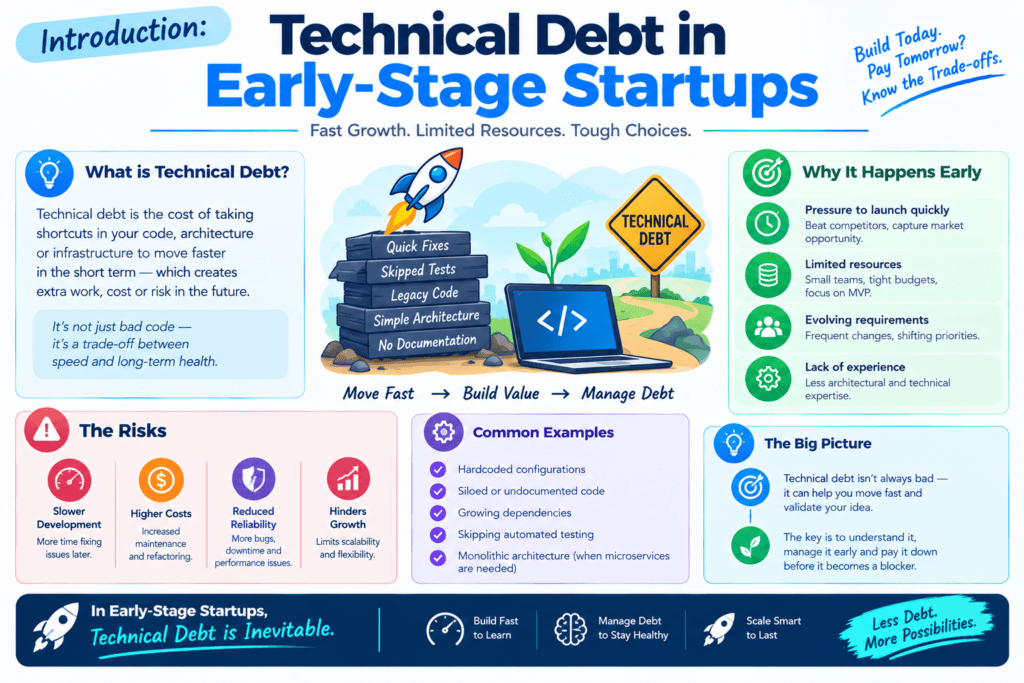
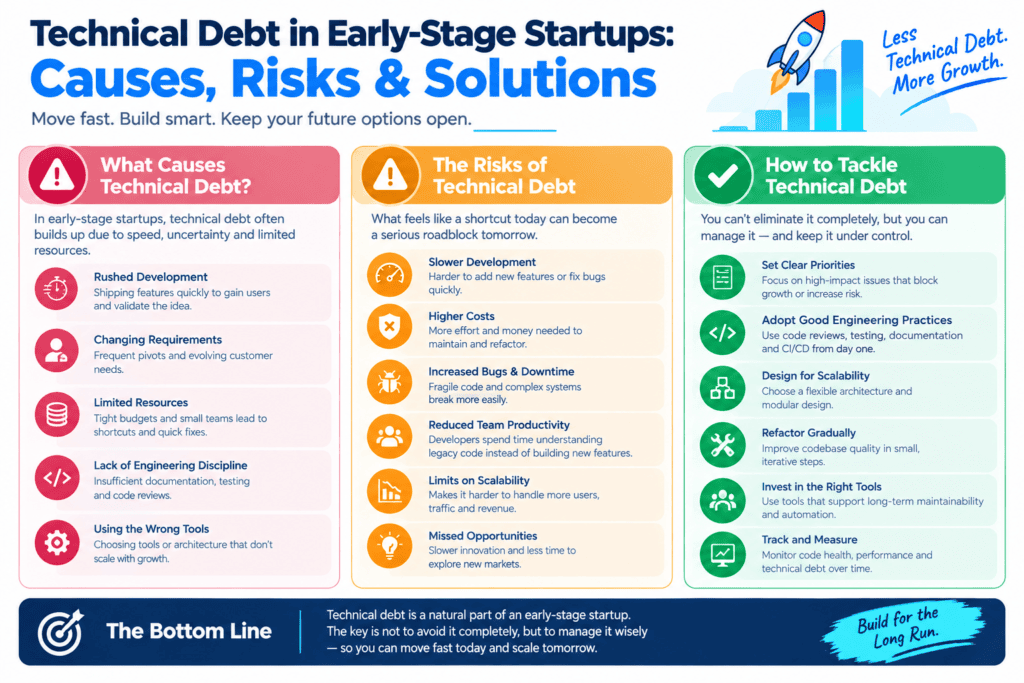
Early-stage startups are obsessed with time: how to waste less of it, how to make the most of it, how to get features to market before resources are exhausted. Compared to big established corporations, startups tend to have less capital, smaller engineering staff, and more fluid product specs.
Because of this, it’s rational for them to make “fast” technical decisions that prioritize near-term gain over long-term cost. However, this practice can incur technical debt – the expense of a “quick-and-dirty” technical fix that doesn’t scale.
Why Startups Prioritize Speed
Speed is vital during the launch phase because the product, its market, and customer base are not yet established. It is critical to carry out iterations to identify the most accurate solution, which will save time and money. A prototype can be developed and put on the market to observe the response and see which features are required.
Therefore, it is possible to say that some aspects of MVP development could be viewed as weaknesses. For instance, using a less reliable architecture, applying some external services, utilizing already existing components, or using workarounds might indicate that technical debt is purposeful in cases when the alternative would waste more time and resources.
The Importance of Reaching an MVP Quickly
A Minimum Viable Product (MVP) offers a great opportunity to test the start-up idea with the target audience. Instead of spending months developing the product, one should think about what features should be the first to solve the customers’ problems.
Reaching an MVP quickly can help startups:
- Validate product-market fit
- Get feedback from your early customers
- Prioritize features for continued development
- Save development time and money
- Show potential investors or partners that you have a product that people want
- Make product decisions based on how customers are actually using your product
The goal should not be to make the MVP as cheap or as quick to develop as possible but to make it simple enough to launch and reliable enough to serve early adopters and allow learning.
Balancing Speed With Long-Term Engineering Needs
The problem is to know which shortcuts to take, and which to avoid to prevent getting into troubles in the future. Technical debt creates risks for the product if the simplifications made during its development become permanent. Such issues as messy code, insufficient testing, security flaws, bad database schemas, and tightly coupled systems may arise and hamper the further development and additional expense.
Startups can address these challenges by first recognizing and documenting technical debt and by focusing on resolving those aspects of technical debt that have the biggest impact on security, reliability, scalability, customer experience, or development speed, while also avoiding unforced errors in engineering decisions before they become necessary for achieving product-market fit.
A good idea is to think of technical debt as a trade-off that has to be made deliberately. Balance what the business requires today with what it will need in the future.
This way early in an organization’s life-cycle, you can keep up the development tempo without sacrificing engineering decisions that will cause headaches later on.
What Causes Technical Debt in Startups?
Technical debt rarely happens by accident, but it is a natural byproduct of thriving in the environment of speed and survival. Here are some of the most common factors that lead to tech debt for startups.
1. “Good Enough for Now” Technical Decisions
Startups are all about speed to market. Founders are under pressure to get their first working prototype out the door (MVP), get the first round of users, and raise money. Time is money, the clock is ticking, and engineers are under pressure to deliver working code as soon as possible.
As a result, it is tempting to implement whatever solution allows you to move faster. It is even more tempting to promise to “refactor later” when there is always something more important to work on. But this approach will eventually come back to haunt you as it creates debt that is much harder to pay than anticipated.
2. Short-Term Solutions vs. Long-Term Requirements
Early-stage startups rarely know precisely what their product will have to do in a year or even five years – and even if they do, it’s in ways a general description can hardly capture.
So rather than future-proofing their stack they solve the problems they have now, and as a result, frequently write their architectures for the wrong use case. Something that worked when you had a handful of users can become a crippling limitation once you get into the thousands.
3. Limited Resources and Development Time
Startups are characterized by small teams, limited resources, and a need to deliver products with a high pace. That is why there is no time to write tests for production code, clean code, or even document decisions. Every second is valued, as it can be spent on developing the next feature or closing the next customer.
Together, these three factors contribute to the debt cycle in which speed leads to shortcuts, which then crystallize into assumptions that prove expensive to remove once the system (or the code) grows more complicated than when it began. Understanding the reasons why debt occurs is the first step towards managing it in a controlled way.
Would you like me to also include tips for managing or paying down this technical debt in order to make a complete post for your blog? I can provide this information in a Word file or within a Markdown block if you’d prefer to save it somewhere.
When Does Technical Debt Become a Problem?
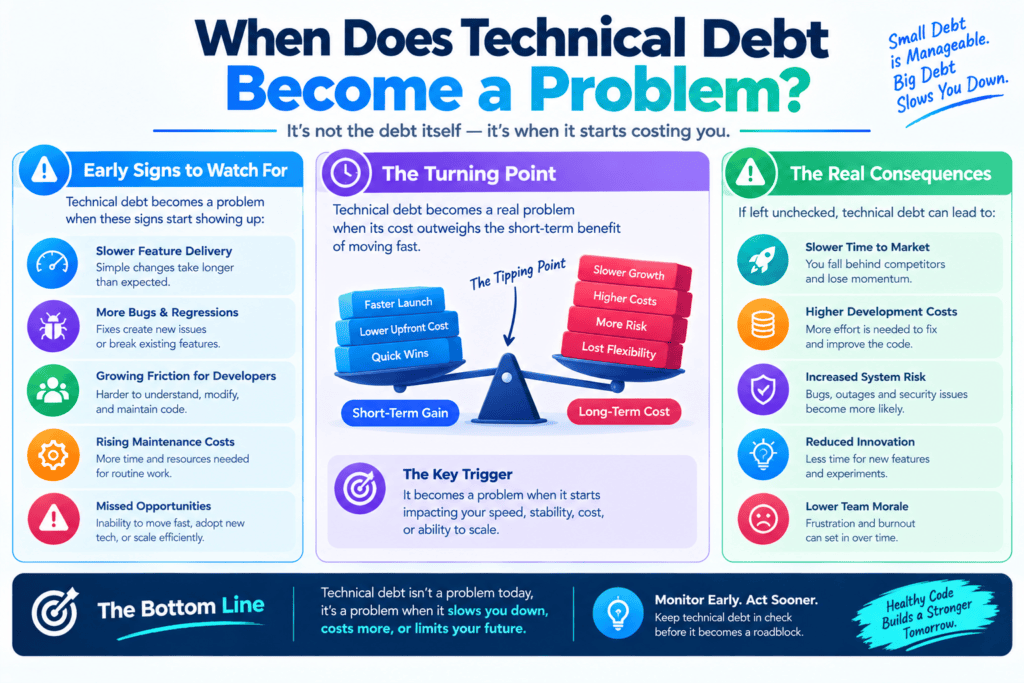
Technical debt is an amount of financial interest you pay when choosing an easy but inferior solution to get quick results. At the early stages of a start-up, when you compete for a growing market share, you can afford to have technical debt. However, as soon as you abandon your initial business goals, your technical debt becomes a vital symptom of a business crisis.
There are specific features that make any further development of technical debt impossible. According to the warning signs discussed in this module, there is the precise moment when debt transforms from a competitive advantage into a critical weakness. Below are the situations that signal the need for technical debt repayment right away.
1. Growing Workloads and Increasing Traffic Expose Structural Weaknesses
When traffic is on the decline, poorly written code, badly formed database queries, and non optimized architectures all are hidden. However, these issues magnify as the load increases and the user base grows.
- Database Bottlenecks: Missing indexes, non-scalable schema designs or lack of caching layer start causing database locks or high CPU as read/write operations multiply.
- Cascading Failures: Monolithic architectures or tightly coupled microservices that were hastily assembled start failing under pressure as a surge of traffic to one feature brings everything to a halt.
- Cost Inefficiencies: Quick and dirty cloud configurations or unoptimized background workers lead to throwing away of provisioned hardware resulting in cloud bills exploding disproportionately to business growth.
The Verdict: Technical debt is a problem when the need to exponentially increase your infrastructure spend to accommodate user-growth or the system has frequent, unpredictable outages.
2. Rising Application Latency Degrades the User Experience
Users will always demand maximum efficiency. Technical debt in your application layer will damage the performance of your tools
- Cumulative Technical Debt
Years of spaghetti code, nested loops, unnecessary API calls, and synchronous operations for resource-heavy requests add up.
- Bloatware Frontends
Unnecessary libraries, non-optimized assets, and state management issues add to the sluggishness of your frontend.
- Lack of Observability
Teams that did not invest in the proper logging and observability tools (APM) have a tough time understanding what causes their response time distributions to shift.
- The Verdict
Technical debt is a problem when it begins to impact the application’s ability to retain users and/or convert visitors into sales. But how much is too much? Let’s define healthy versus unhealthy technical debt and establish thresholds for each. d damage customer trust.
3. Difficulty Modifying and Testing the Application Kills Developer Velocity
The clearest operational symptom of technical debt is a dramatic drop in engineering speed and team morale. What used to take a afternoon to build now takes three sprints.
- The Three Ds of Technical Debt
- Fragility: Making a change that seems innocuous in some module A can cause unexpected issues in some distant module Z. Time is better spent producing value for customers and not re-writing production code.
- Not enough automated tests: If you lack sufficient automated test coverage, testing and releasing changes becomes a slow and error prone process. No one wants to do it, but everyone has to do it at some point.
- Onboarding headaces: How long does it take for a new dev to get up to speed and be productive? Too long in many cases because it’s really hard to understand systems built with bad architecture.
The Verdict: Technical debt is a problem when developers spend 80% of their time reading, debugging, and maintaining legacy code and only 20% writing new features.
4. Technical Limitations Begin Dictating the Product Roadmap
The point of no return is when your software can no longer support business ambitions. When technical limitations stop product development in its tracks, technical debt becomes an executive-level issue.
- Inability to deliver new functionality: product managers ask to implement critical features (analytics, third-party API access, multi-tenancy architecture), but engineers respond that it can only be fulfilled in the context of a rewrite.
- Inability to secure: legacy dependencies prevent you from patching the stack or conforming to industry regulations (GDPR, SOC2, HIPAA).
- Inability to compete: while you rewrite your legacy stack, agile competitors eat away at your market share.
The Verdict: Technical debt is a problem when your software is no longer driving product innovation, but actively setting the boundaries for what your business can achieve.
How to Manage Technical Debt Before It Control You
You don’t need to eliminate all technical debt—zero debt is rarely realistic or commercially smart. Instead, focus on managing it effectively:
- Track it Explicitly: Keep an engineering backlog of technical debt in addition to product features.
- Allocate Capacity: Make sure you are reserving some capacity (i.e. 15-20% per sprint) to deal with technical debt.
- Decouple / Modularize: Break monoliths into services or modules to limit blast radius of failures during testing and deployment.
- Focus on High Interest Debt: Focus your refactoring energy on the parts of your system that change the most (i.e. highest traffic) instead of the ones that haven’t been touched in 5+ years.
The Risks of Ignoring Technical Debt
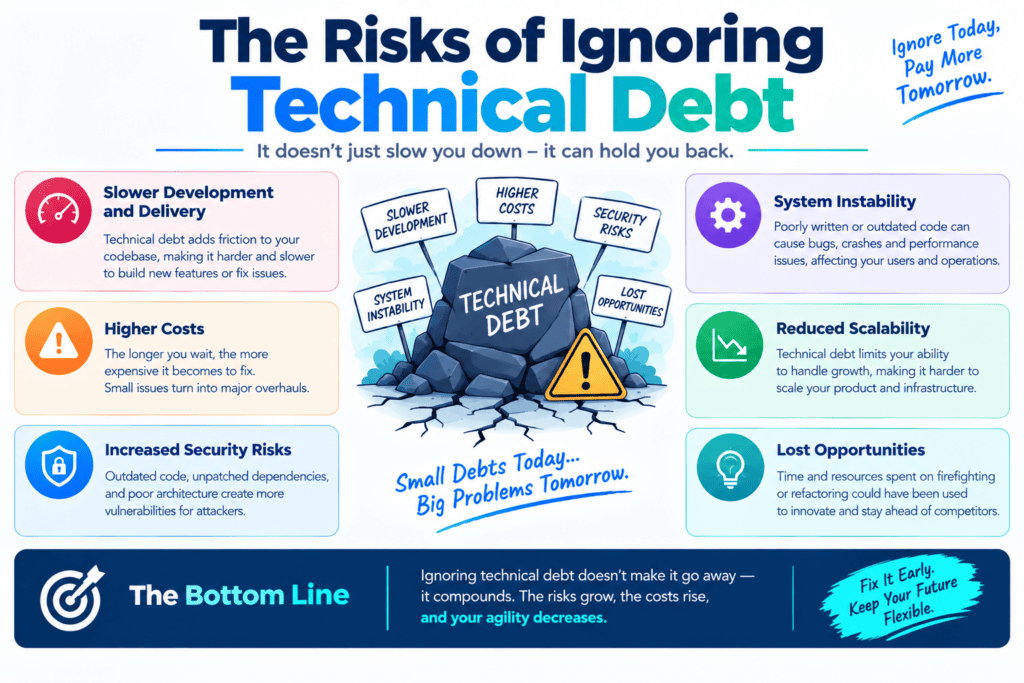
Technical debt can be an enormous blessing to a start-up, as it allows them to rapidly develop a product before pivoting.
But this debt must eventually be paid back and forgotten, or else it will begin to interfere with the daily operations of the application as well as the productivity of the engineers who maintain it. Code that worked well enough for an MVP will often prove to be a bottleneck once the product begins to scale.
Performance Bottlenecks
The accumulation of technical debt may lead to the creation of inefficient database queries, unnecessary API calls, poorly optimized code, and dependencies with obsolete libraries.
Such phenomena can lead to system-level performance issues since, when the number of users increases, the load on the system will grow significantly. The response time may increase due to the competition of different components for the same computational resources.
Scaling Challenges
A system designed for a small number of users may not be scaled up smoothly. Technological simplifications in databases, infrastructure, caching, and application design can make horizontal or vertical scaling more difficult.
It can require significant architectural improvements in projects that initially focus on iterative development; thus, increasing the time and money costs of iteration.
Poor User Experience During Traffic Spikes
Technical debt is most apparent during periods of high traffic. An application that handles normal loads smoothly may struggle to serve requests during surges.
As a result, the software may experience downtime and loss of user confidence and become unable to scale reliably as the startup grows.
Downtime
Failed API requests
Slow transactions
Impacting the user experience
Preventing consistent scale
Slower Engineering Execution
Technical debt not only affects the users but also the developers. After all, it is their code that needs to be understood, maintained, updated, and enhanced.
Cumbersome software architecture, insufficient documentation, obsolete libraries, and tightly coupled systems make it hard to implement new features and test them, requiring s lot of time and effort.
As a result, developers cannot focus on core processes and spend too much time on relatively simple tasks, and the development cycle becomes unnecessarily long.
For young organizations, technical debt is a natural consequence of validation and prototyping but should not hinder the product’s growth and innovation. That is why it is critical to prioritize and document technical debt and address the most pressing issues first.
Technical Debt During the Startup Growth Stage
Every start-up is initially focused on speed. The primary goal during the early stages is to build a product that people actually want.
While this approach is great for an MVP, it comes at the cost of technical debt which becomes due as soon as the start-up begins to scale. The shift from exploring the market to concentrating on growth is when technical debt stops being a nuisance and starts being a liability.
Here are the ways in which technical debt reveals itself at the time of an IPO, sorted according to the four forces that uncover technical debt.
1. Moving Beyond the MVP
An MVP is meant to be thrown away. Hardcoded values, no tests, one ‘huge’ component, and no CI/CD are totally OK if you are not going to maintain the product further.
The thing is that proof of concept eventually turns into production code. It’s hard to kill the product and start anew because it already has users.
But you must do it to avoid getting stuck in continuous maintenance mode. And you’ll likely get stuck if you have technical debt that needs to be paid off. Sooner or later.
- Quick hacks turn into load-bearing walls in the architecture.
- undocumented decisions turn into tribal knowledge that only the founding engineers understand.
- The lack of tests all but ensures that any change may accidentally break something undocumented and mysterious.
The solution is not to rewrite everything from scratch (a solution that is tempting, but ultimately wrong), but to identify what comprises the minimum viable product (MVP) and focus on completing and testing this MVP first. This approach leaves room for iteration and improvement in later stages while ensuring the foundational elements are robust.
2. Increasing Customers and Data
What works for 100 users often breaks (quietly, and then loudly) with 10,000. The technical debt that is never visible when the system isn’t strained is exposed when growth happens.
Common symptoms at this stage:
- Examples of Strains in a Database
- Queries that previously worked well in a small table now time out. Missing indexes, N + 1 queries, and denormalization that was not a problem for simple cases are now significant performance issues.
- Scaling assumptions made when the database was small and on a single server turn out to be wrong. Code that previously worked well in a single server or region breaks when there is more traffic or data than expected.
- Poor data quality decisions made during the “move fast and break things” era create headaches when data is used for analytics or in production by other services such as billing or machine-learning models.
This is where ‘it works on my machine’ ceases to be a joke, and starts being an incident. Investment in observability (logging, monitoring, tracing) often becomes the highest leverage debt payoff here. You can’t fix what you can’t see.
3. Hiring Larger Engineering Teams
A codebase that’s been designed for one or two founding engineers doesn’t scale to 20. It’s the single biggest source of technical debt, because now you have a coordination problem in addition to a technological one.
Signs of debt surfacing here:
- Onboarding friction: New hires take weeks to become productive because there is no documentation, patterns, or architecture that makes sense to them (other than the people who designed it).
- Merge conflicts and stepping on toes: A monolith with no clear ownership boundaries means every sprint is a game of musical chairs.
- Inconsistent standards: Without a style guide every engineer tackles every problem differently resulting in a house of cards.
At this stage, debt not only slows down the feature velocity, but also the ability to add more people to increase the velocity.
This is usually when startups invest into the things that they didn’t do before: code review guidelines, pipelines, style guides, modularizing the codebase to allow different teams to work on different areas without stepping on each other’s toes.
4. Supporting a More Feature-Rich Product
As the product matures it accumulates surface area (more features, more edge cases, more integrations, more configuration options) and each new precarious edifice built on its foundation adds interest to the debt without paying it down.
This shows up as:
- Feature interactions nobody planned for: Two features that were built in isolation have some interdependency that renders them much harder to change in the future, with little obvious connection between the two.
- Fragile extensibility: You need to change ten seemingly unrelated files to implement some new business logic that previously was covered by default or had a dedicated extension point.
- Slower shipping velocity: Your team observes that features that used to take a week to ship now take a month due to the complexity of the codebase.
This is usually the moment leadership starts asking, “Why is everything taking longer than it used to?” The honest answer is almost always: technical debt.
The Real Takeaway
Technical debt is not some inherent evil that comes with engineering. If you’re going to build stuff while you’re still learning and adapting your assumptions, it’s inevitable.
The real problem is in not addressing this debt as the company grows. What the successful startups do is that they recognize this debt and prioritize it against new features and their own growth, instead of pretending that it doesn’t exist and waiting for it to hit them like a brick wall at some point in the future.
Want me to turn this into a downloadable file (Markdown or Word), or adjust the tone/length for a specific platform (e.g., Medium, LinkedIn, company blog)?
How to Prevent Technical Debt Early
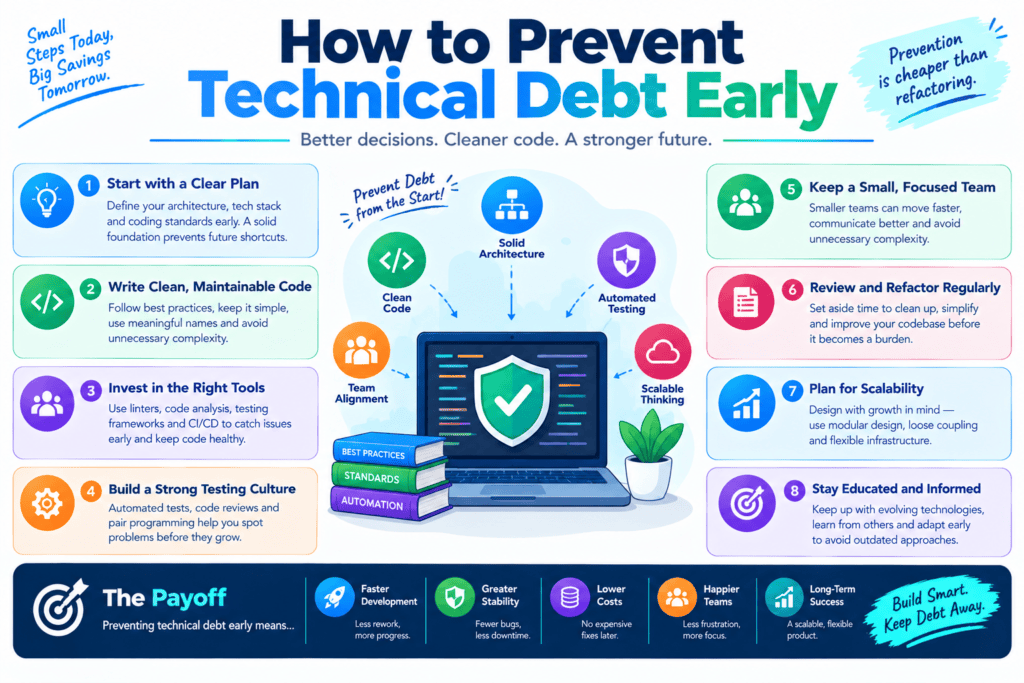
Technical debt is seen by many as an unavoidable price for expedited development. In most cases, it is not. Technical debt is the result of trade-offs made in the name of time, with little or no consideration given to long-term technical ramifications.
Early-stage startups can reduce these risks by understanding how initial technical decisions may create challenges as the product and workload grow. Several simple practices can be applied early in a project to avoid most technical debt, and these practices are largely neglected during the development process.
The following are ways to avoid technical debt.
1. Architect for Future Growth — Without Over-Building
The goal isn’t to predict every future requirement; it’s to avoid decisions that make change expensive later.
- Design Around Business Capabilities, Not the Current Features Set
- Organize your architecture around domains, not the screens and endpoints you have today. Billing, users, inventory, etc., tend to remain stable even if the actual user-facing features change.
- Boundaries Should Be Clean to Allow Internal Implementation Details to Change
- Have clean interfaces between modules or services so that you can change an implementation detail on one side without affecting the other. That’s how you realize the promise of “we’ll rework this later”.
- Design for Scale Points, Not for Global Scale
- Do not try to make everything microservices from the start. Find what components will likely become a bottleneck (typically, some storage or a business logic component) and design it for scale, leaving the rest simple and easy to change later.
The rule of thumb: build for the growth you can reasonably foresee in the next 12–18 months, and make sure your architecture doesn’t actively block the growth beyond that.
2. Make Scalable Technology Choices
Technology choices are some of the hardest things to reverse later, so they deserve more scrutiny than they usually get.
- Evaluate for the team you’ll have, not the team you have. A tool that’s easy for a 3 person team to adopt can be an enormous liability when scaled up to 30 if there’s no team conventions, tooling, or hiring pool around it.
- You should favor boring, proven technologies where you can, cutting-edge tools are great for ancillary or experimental features, but your database, auth layer, and data model should be chosen with care.
- Ask yourself about lock-in and vendor or ecosystem constraints. If the tool you’re considering vanishes tomorrow or increases costs by a factor of 10, how easy will it be to move off of? Prefer open standards where the cost of doing so is low.
- Build a spike, not a guess. If you’re thinking about adopting a new tool that could be a major pillar in your architecture, you should strive to build a proof of concept with realistic constraints around data size, volume, and concurrency before going all-in on a tool based on marketing materials or a single blog post.
3. Avoid Unnecessary Complexity
Complexity is often self-inflicted — added in anticipation of needs that never materialize.
- Follow YAGNI (“You Aren’t Gonna Need It”). Do not build configurability, abstraction layers, or frameworks for future hypothetical needs — add them when a second need actually comes up.
- Resist the impulse to abstract out similar code paths. Two similar code paths do not necessarily imply a higher-level shared abstraction; more often it will lead to an incorrect abstraction that ends up costing more to fix than it saves.
- Limit the number of external libraries (especially those with complex APIs), and only add new ones when there’s an obvious and pressing need for them. Every one is a future maintenance and security risk.
- The “obvious” solution should be the default. If it turns out to be insufficient, look elsewhere — but it wins points for simplicity and being less subject to the maintenance tax of cleverness.
4. Identify Potential Bottlenecks Early
Most costly technical debt comes from bottlenecks discovered after they’re load-bearing.
- Profile early, and not only in production. Do load-testing runs of the critical paths (auth, checkout, search) before they’re exposed to real customers. And practice with realistic data sets: a database full of dummy data is not-real.
- Closely watch your data layer. The database schema, its index setup and the shape of queries sent to it have a good chance of being a source of issues that are hard to fix once the layer gets populated with real data.
- Watch out for complexity. Use code metrics to track files with high levels of churn and complexity – these are the areas that cause the most problems and take the most effort to rework.
- Make your performance and scaling assumptions explicit. Have some documentation that states the expectations for the system under load. This way, there is an actual record of what the system was assumed to be able to handle, not just vague ideas in people’s heads.
The Underlying Principle
Preventing technical debt is not about avoiding all kinds of shortcuts, because sometimes a shortcut is exactly what one needs at a certain project stage. However, it should be implemented consciously and documented, revisited on a regular basis, instead of being introduced carelessly and forgotten about until a code review.
The teams that I have seen successfully handle technical debt have one crucial quality: they constantly revisit their architectural and technology decisions, treating them not as set once and forgotten facts, but as evolving documents.
Would you like me to put it all together in a file for you (Word or Markdown)?
Distributed Architecture as a Solution
Modern applications have to serve millions of users worldwide, process petabytes of data, and be available 24/7. Single server solutions are no longer sufficient in today’s world. This is why distributed systems are the new standard — the design principles behind them are now at the heart of nearly any large-scale application, from Netflix to Amazon to Google.
What is Distributed Architecture?
Distributed architecture refers to a design framework where the application components are organized and hosted on different physical or virtual servers rather than a centralized server. It means that a software system is split into multiple processes that run on separate nodes and utilize a network to communicate with each other and operate the application.
Each node in a distributed system typically fulfills a particular purpose; one node could be handling user authentication, another one is managing payments, and yet another one is sending out notification emails.
Nodes communicate with each other in order to complete tasks, exchange information, and create the illusion that there is just one system working on the task at hand, while in reality it is spread out across many machines (and sometimes many countries).
This is a fundamental departure from the traditional approach, where all features live in the same code base and run on the same server (or replicated set of servers) – in distributed architecture, segmentation, replication, and parallelization are embraced and encouraged.
Communicating Services and Distributed Databases
At the heart of any distributed system, there should be communication. After all, services are no longer hosted in the same process and are most often not on the same machine either.
Service Communication
Services typically communicate through:
- APIs (REST, GraphQL, gRPC): synchronous request/response communication between services
- Message queues (RabbitMQ, Kafka, SQS): asynchronous communication paradigm, where services publish and consume events decoupled from each other
- Service meshes (Istio, Linkerd): infrastructure layer providing features like retries, load balancing and other communication related features
The choice between synchronous and asynchronous communication can have a large impact on the system. Synchronous calls are easier to reason about but introduce tight coupling between services which can make the system fragile.
On the other hand asynchronous event driven communication while being more reliable introduces a number of challenges when it comes to ordering and debugging events.
Distributed Databases
Just as services are broken up into units (microservices), databases are split up (databases). A single database is a bottleneck and single point of failure at scale. It’s solved by distributing the data across some nodes in different ways. Some techniques are:
- Sharding: breaking up a big data set into smaller subsets and distributing them across different nodes
- Replication: keeping copies of the same data set on various nodes
- Consensus protocols (Raft, Paxos): algorithms that allow a cluster of nodes to agree on a certain state of the data despite failures
This introduces the classical trade-offs described by the CAP theorem: A distributed system can only simultaneously guarantee perfect Consistency, Availability, and Partition tolerance — architects must make a choice for what is most important for their use-case.
Scaling Vertically and Horizontally
Scaling is one of the primary reasons teams adopt distributed architecture in the first place. There are two fundamental approaches:
Vertical Scaling (Scaling Up)
This option refers to upgrading existing hardware, increasing the amount of CPU, RAM, and faster storage devices. This approach is rather simple to implement since there is no need in changing the architecture of the system.
However, there are significant limitations to this options since the amount of hardware resources that can be installed on one machine is rather limited. Moreover, this option usually becomes extremely costly. The failure of such an upgraded machine will bring the whole system to a halt.
Horizontal Scaling (Scaling Out)
This implies adding more devices to share the load rather than upgrading one particular device. Rather than have one server handle all requests, you spread the load out among several different servers using load balancers. Horizontal scaling is the right choice for distributed architecture because:
- It offers near-limitless scalability by just adding more nodes
- Improves fault tolerance since no single machine failure brings down the whole system
- Allows using cheaper commodity hardware rather than expensive specialized machines
The cost is complexity: horizontal scaling needs to carefully manage coordination, load balancing, data partitioning, and other aspects that single-machine systems simply do not have to worry about
Benefits and Implementation Challenges
Benefits
- Scalability — the system can be expanded by adding new resources one after another rather than designing it for a particular level of performance.
- Fault tolerance and resilience — a single point of failure is eliminated as processes can be distributed among several nodes.
- Independent deployment — an application can be updated or changed without needing an update of the whole system.
- Flexibility — different components can be built using various programming languages.
- Better performance — data can be processed and stored closer to the application and end-users, and it can be handled in parallel.
Challenges
- Increased complexity — more components to reason about, more places to make mistakes, and more challenging to debug when something goes wrong in logs and services
- Network reliability — networks are a part of any distributed system, which means unpredictable delays, timeouts, or failures for any communication between nodes
- Data consistency — distributed systems make it significantly more challenging to keep information synchronized or have it agree on values
- Monitoring — debugging and observing what’s happening in a distributed system often require inspecting the state and logs of dozens of services
- Operations overhead — running and maintaining dozens of services in production requires a significant amount of operations-related work and knowledge, usually involving Docker, Kubernetes, and related technologies
Conclusion
Distributed architecture is a complicated solution to a relatively simple problem that requires more effort from all participants. However, the ability to scale the application beyond the limits imposed by single-node limitations is an attractive feature for many software products.
Thus, it is needed to understand the shortcomings and benefits of distributed architecture and heed the requirements that arise when deciding to implement such a system.
Would you like it formatted as a document or HTML page for publishing on the web?
Scaling Infrastructure With Business Growth
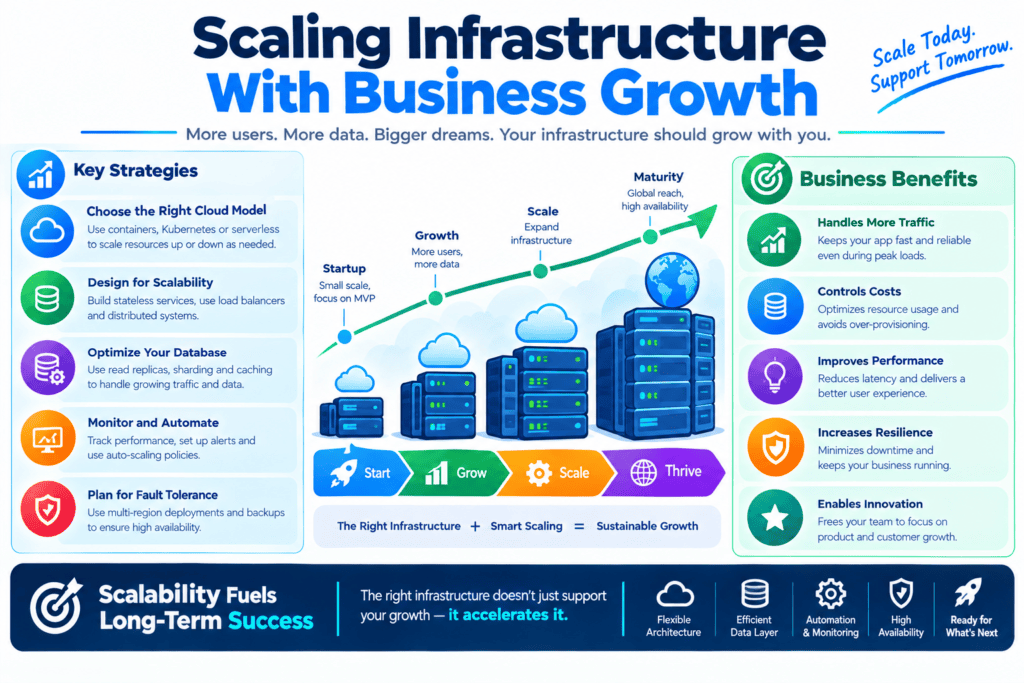
As a business grows it needs to grow its infrastructure intelligently. This intelligence is focused on ensuring that the infrastructure is able to scale with demand without breaking the bank. The following are some examples of how this type of infrastructure can be utilized.
Handling Increasing Workloads
The growing number of users, data volume, and transactions puts increased demands on the infrastructure which needs to scale to meet this growth. The first step in this process is to ensure horizontal scaling capabilities of the system through designing it in a way that allows distributing the load across multiple servers or instances rather than relying on vertical scaling which eventually reaches a point beyond which it cannot go further.
Key practices include:
- Load balancing to distribute incoming requests evenly across servers
- Caching layers (like Redis or CDNs) to reduce repeated load on databases and origin servers
- Database optimization, including read replicas, sharding, or partitioning for high-traffic datasets
- Asynchronous processing using queues (e.g., RabbitMQ, Kafka) so spikes in demand don’t bottleneck core services
Monitoring and observability tools are essential here too — you can’t handle growing workloads if you can’t see where the pressure points are forming.
Scaling Resources Based on Demand
Modern infrastructure must be able to adapt to changing demands with a minimum of human intervention. This is where auto-scaling comes in handy as it allows for the automatic provisioning of additional resources in cloud service providers such as AWS, Azure, and Google Cloud upon specific conditions being met.
Two common approaches:
- Reactive scaling is when resources scale up when demand is detected.
- Predictive scaling uses the historical patterns such as seasonal increases/decreases in sales, and daily traffic pattern to scale up in advance.
This is made possible using containerization (Docker) and orchestration (Kubernetes) which allows faster and more granular scaling than an entire application.
Scaling Down During Periods of Low Usage
Scaling isn’t just about growth — it’s equally about knowing when to pull back. Idle or over-provisioned resources are one of the biggest silent drains on a company’s cloud budget.
Effective scale-down strategies include:
- Setting auto-scaling policies that downscale instances during off-peak hours
- Using serverless architectures (AWS Lambda) for sporadic/interruption-heavy workloads with a cost/performance profile optimized for AWS’s pay-as-you-go model
- Powering down non-prod environments (staging, testing, etc.) when they aren’t actively being used
- Auditing production resources for “zombie” infrastructure that should be powered down or removed
This elasticity — scaling both up and down — is what separates a truly cloud-native architecture from one that’s just “in the cloud.”
Managing Infrastructure Costs
Growth and cost efficiency can coexist, but it takes deliberate cost governance. A few strategies that help:
- Right-sizing: regularly reviewing your instance types and sizes to ensure you’re not paying for underutilized capacity
- Reserved and Spot instances: committing to specific instance types for a certain period of time, and using cheaper, albeit non-dedicated, instances when possible
- Cost monitoring: having a clear overview of where your money goes with tools such as AWS Cost Explorer and Cost Management for Azure, or third party solutions such as CloudHealth or Spot.io
- Tagging and accountability: making teams and individuals aware of the impact of their usage by tying their spending in with their account
- Hybrid approaches or multi-cloud: in some cases it can be beneficial to spread workloads across both cloud and on-premise, or even multiple clouds
The Bigger Picture
Rescale: Rewritten Content
Scaling Infrastructure as a Sustainable Business Practice Essay
Scaling infrastructure is not a onetime event but rather a process that must be constantly managed. Ideally, businesses will design their systems so that they can effortlessly accommodate growth and scale back down when demand decreases, thus ensuring they are not needlessly spending money on resources they do not need. In my experience, companies that fail to do this usually suffer from growth being viewed as anathema to the infrastructure.
Would you like me to provide you with the file in a different format (Word or PDF) or make any changes to it?
Using PaaS and IaaS for Startup Growth
Every startup sooner or later reaches a point when the infrastructure that got it off the ground proves to be an obstacle to further development. This moment determines whether the company’s engineers will continue to refine the product at hand or spend their efforts on maintaining their own software and hardware environment.
The ability to distinguish between the needs for Infrastructure-as-a-Service (IaaS) and Platform-as-a-Service (PaaS) solutions at different stages of growth will help avoid failures at the turn of the second stage of company development.
Simplifying Distributed Infrastructure
As a company grows, the set of tools needed in order to run the product smoothly quickly evolves from one neat server with a monolith on it to a distributed system of databases, caches, load balancers, message queues, and microservices. This can be a headache to manage for a small team that has to do it all.
PaaS platforms abstract most of the complexity involved, allowing one to focus on writing the code rather than setting up the infrastructure. Heroku, Render, Railway, or Google App Engine are all examples of such services.
They hide all the complexity of the system which is required to host applications written in various programming languages, providing a simple API and/or interface for deployment. Using such platforms is a must for a young company with limited resources that needs to iterate quickly.
IaaS solutions like AWS EC2, Google Compute Engine, Azure VMs provide virtual servers with much more control and lower abstraction, requiring a system administrator to set up and configure them. These two types of solutions are complementary, and the choice of which one to use often depends on the task at hand.
For a company that wants to host multiple services on the internet, a mix of the two might be used, with PaaS hosting solutions being used for the actual products and IaaS VMs being used as database servers or for other specific tasks.
The point is not to avoid the distributed system altogether, as most real-world applications are built upon them, but rather to avoid spending time and effort on managing them directly.
Reducing Operational Complexity
Every hour an engineer spends patching servers, configuring load balancers, or debugging deployment pipelines is an hour not spent on the product that drives revenue. This is an opportunity cost that’s easy to overlook for an early-stage company.
PaaS shines by providing the operational features you’d typically need to implement a dedicated DevOps expertise for:
- Automatic scaling according to traffic without the need for manual intervention
- Built-in CI / CD pipelines for simplified push-to-deploy
- Managed databases and add-ons (cache, logging, monitoring) that would otherwise need to be installed and maintained separately
- Security patches and OS updates provided by the provider
The tradeoff is mostly cost and flexibility, as PaaS offers much higher cost per compute compared to raw IaaS, and you’re limited by what the environment offers.
However, for early stage companies (pre-Series B), it’s often much cheaper to pay the premium and save the engineering resources for actual product development rather than operations.
IaaS still has value in reducing complexity, even in cases where you have more control over the environment, such as with Infrastructure-as-Code tools (Terraform, Pulumi, CloudFormation) that allow you to manage and version infrastructure code rather than rely on ad-hoc processes.
Choosing Infrastructure That Can Grow With the Startup
The infrastructure decision, which seems optimal for 10 users, may scale poorly up to 10 thousand. Here are some ideas to avoid getting stuck in a PaaS prison:
While committing to a Platform as a Service, try to remain free from its underlying software lock. It’s better to choose a managed platform with generic components (containers, postgres/redis instances, standard runtimes) that may be relatively easily migrated away from.
Build your software in such a way that it may be deployed elsewhere. For example, if you containerize your application with Dockers, you can deploy them both on a PaaS service or a Managed Kubernetes cluster on IaaS.
Have a contingency plan for when you’ll need to start using more generic solutions. The signs that you may need to migrate some of your services to a lower-level Infrastructure as a Service may include: insufficient cost-performance efficiency for your PaaS, hard limits on the performance of your PaaS, a need for more specialized hardware (GPUs, ASICs, FPGA), or regulatory requirements for data center co-location.
Hybrid infrastructure approach may be suitable for some applications. In practice, many companies which are building cloud-native applications use a multi-cloud approach for their business-critical systems.
They maintain their customer-facing applications in PaaS for rapid development and iteration while moving their production platforms to IaaS. Some of these companies will migrate selected services to IaaS if they begin to see significant performance improvements or reduced costs due to a more optimized infrastructure.
The Bottom Line
A lot of start-ups: bet on using the PaaS early to save engineering time and accelerate the development of applications, and then move selectively into IaaS as systems mature, scale, or need more control than the PaaS allows. The debate about using PaaS or IaaS is really about the timing of adoption: what can be abstracted today, and what will need to be controlled in-house as the business grows
Let me know if you want the Word doc or Markdown version to publish on your blog CMS?
Building a Long-Term Technology Stack
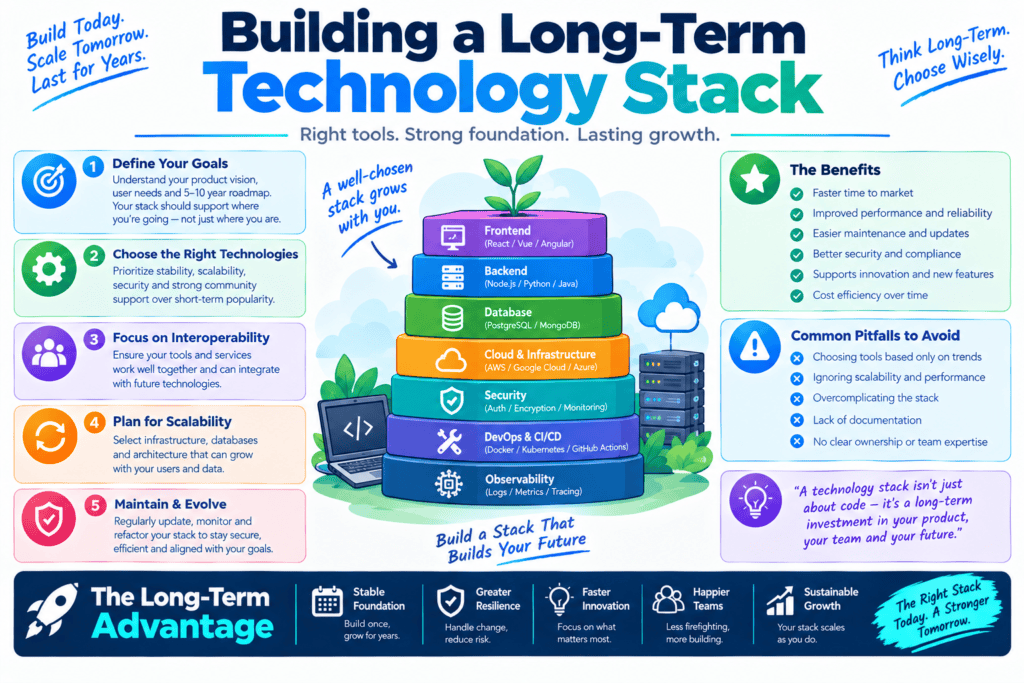
Building a technology stack is never as simple as identifying the latest frameworks and tools on GitHub. It requires understanding how to evolve your engineering practices at different stages of your product development lifecycle.
Most companies that try to over-optimize their system during the early stages or compromise on technical debt during rapid development phases fail to scale their engineering practices for years after launch. To design a technology stack that will keep your business competitive in the long run, you need to consider multiple variables and carefully evaluate your options.
One should remember that any successful technology stack focuses on balancing the mix of flexibility, data, execution environments, and state management.
1. Choosing Scalable Infrastructure
I think it’s important that the infrastructure you build scales in 3 different directions: traffic, data size, and the organization itself. A system where you need 10 engineers to deploy a simple pipeline every month isn’t scalable.
Core Architecture Patterns
- Monolith-First vs. Microservices: Starting with microservices will introduce unnecessary distributed system complexity (network latency, distributed tracing, complex deployment pipelines), whereas a well-organized, modular monolith (otherwise known as a “modulith”) is often the best option and should be the preferred starting point. Only split it into microservices when you have to due to domain boundaries, need for independent deployment cadence, or need to scale specific services that require their own compute resource isolation.
- Infrastructure as Code: Infrastructure should be treated like application code. Declarative IaC tools such as Terraform, OpenTofu, or AWS Cloud Development Kit (CDK) allow version controlled, repeatable deployments of infrastructure as well as disaster recovery scenarios.
Cloud Native & Multi-Cloud Strategy
- Cloud agnosticism vs. cloud native
- While building applications that abstract away everything specific to a cloud provider (to truly embrace the least common denominator approach) is a noble goal, it has an undesired side effect of creating more complex software. Instead, embrace the primary cloud managed services (AWS, GCP, Azure) to develop and operate applications at speed and scale, while keeping the core business logic decoupled from any particular cloud SDKs.
- Containerization
- Use industry standard tools (Docker + Kubernetes) to define standardized run-time environment specifications (or use AWS/Fargate, GCP Cloud Run). This helps you to ensure that your development and staging environments are as close as possible to production.
2. Database Considerations
Data is the hardest part of your stack to change or migrate down the road. Compute is stateless and easy to swap; data has state, gravity, and migration risks.
Choosing the Right Data Paradigm
| Paradigm | Key Characteristics | Best Use Cases | Example Technologies |
| Relational (RDBMS) | ACID compliance, structured schemas, complex JOINs | Financial transactions, core transactional data, e-commerce orders | PostgreSQL, MySQL |
| Document / NoSQL | Schema flexibility, horizontal scaling, rapid iterations | Content management, user profiles, unstructured product catalogs | MongoDB, DynamoDB |
| In-Memory Cache | Sub-millisecond latency, key-value storage, temporary state | Session management, API rate limiting, query caching | Redis, KeyDB, Dragonfly |
| Analytical (OLAP) | Columnar storage, massive read aggregation, analytical processing | Business intelligence, telemetry, historical data warehouse | Snowflake, ClickHouse, BigQuery |
Long-Term Data Strategy Guidelines
- Use PostgreSQL as default: Unless you have particular needs, assume that Postgres is your main database. It can be used for a variety of purposes with the help of extensions. It will likely handle all of your needs until you have to move to another system because of performance.
- Put your analytics in separate database: Do not run analytics directly on the production database. Set up CDC (Change Data Capture) to forward all write operations from your production database to a data warehouse.
3. Serverless Architecture
Serverless has evolved from simple event-triggered functions into an execution model where developers offload operational responsibilities—provisioning, scaling, patching, and capacity planning—to cloud providers.
       +-------------------------------------------------------+
       |                  HTTP Request / Event                 |
       +-------------------------------------------------------+
                                   |
                                   v
       +-------------------------------------------------------+
       |                  API Gateway / Ingress                |
       +-------------------------------------------------------+
                                   |
                                   v
         +-------------------------+-------------------------+
         |                                                   |
         v                                                   v
+-------------------------------+           +-------------------------------+
|     Event-Driven Workload     |           |     Long-Running Compute      |
|  (AWS Lambda / GCP Functions) |           |  (GCP Cloud Run / AWS Fargate)|
+-------------------------------+           +-------------------------------+
         |                                                   |
         v                                                   v
+-------------------------------+           +-------------------------------+
| Short, bursty execution steps |           | Continuous HTTP services &    |
| (Image processing, Webhooks)  |           | web frameworks                |
+-------------------------------+           +-------------------------------+
When Serverless Excels
- Event Driven Processing Execution
- Processing triggered by a file upload, message queue, or third party webhook
- Variable/Unpredictable Traffic
- Applications with varying or unpredictable traffic patterns benefit from scales-to-zero and instant scale-up
- Focus on Developer Velocity
- No more server maintenance or os upgrades, faster time to deploy new features.
The Trade-Offs
- Cold Starts: Latency spikes occur when a function instance that has been sitting idle receives a request. You can mitigate this by using provisioned concurrency or by using lighter-weight execution runtimes (Node.js, Go, or Rust) rather than heavier Java-based runtimes.
- Vendor Lock-in/Debugging Complexity: You might need to build and test your distributed application locally before deploying, and you’ll need to perform end-to-end distributed tracing and debugging across all the functions you’re calling in your application, so you may need to rely on tools like the OpenTelemetry project or the Serverless Framework.
- Cost Inflexion Point: If you’re running at such a consistently high level of concurrency, it can be much cheaper to run containers in a Kubernetes cluster or a managed VM service than to incur the costs of a serverless platform.
4. Distributed SQL
Standard relational databases (single-node PostgreSQL, etc.) scale vertically (upgrades of CPU/RAM) and use reads replicas. The challenges are obvious: writes and multi-region resiliency. Distributed SQL addresses those by combining the best of world of NoSQL (horizontal scaling) and relational databases (ACID compliance, schemas).
Core Architecture Characteristics
- Sharding & Consensus: Data is logically partitioned into ranges or shards and distributed across a cluster of nodes. Raft or Paxos consensus algorithms are used to maintain consistency across nodes in the face of network partitions and node failures.
- Global Distribution: Allows for low-latency multi-region configurations by partitioning data across regions to be closer to users while maintaining a single logical database.
Leading Solutions
- CockroachDB utilizes the distributed key-value store with Raft consensus algorithm for the database core and provides PostgreSQL-compatible SQL syntax. It is suitable for financial and transactional applications with a multi-region setup.
- YugabyteDB is a distributed SQL database that is compatible with PostgreSQL extensions. The database uses a distributed storage layer (DocDB) and PostgreSQL core.
- TiDB is a MySQL-compatible HTAP (Hybrid Transactional/Analytical Processing) database that is designed to handle both OLTP (Online Transactional Processing) and OLAP (Online Analytical Processing) workloads.
- Google Cloud Spanner is a fully-managed and enterprise-grade distributed SQL database that uses atomic clocks to provide consistency across all instances. The TrueTime API allows for global consistency.
When to Adopt Distributed SQL
Adopt Distributed SQL if your workload meets these conditions:
- Your write volume is too big to fit on a single high-end database server plus a couple of read replicas.
- You need zero downtime multi-region failover with ACID guarantees (think banking or payments).
- You want to avoid the complexity of application-level sharding.
If you don’t have these requirements, it’s best to stick with a traditional managed PostgreSQL or MySQL instance. Distributed SQL adds network latency between the PG nodes, and schema decisions (e.g., choice of primary keys) can cause uneven distribution of data (hotspots).
Technical Stack Blueprint
| Layer | Recommended Choices (Early Stage) | Recommended Choices (At Scale) |
| Compute Execution | Containerized Services (GCP Cloud Run, AWS ECS/App Runner) | Kubernetes (EKS/GKE) + Event-driven Serverless |
| Primary Database | Managed PostgreSQL (AWS RDS, Supabase, Neon) | Distributed SQL (CockroachDB, YugabyteDB) or Sharded Postgres |
| Caching / Queues | Managed Redis, AWS SQS | Redis Cluster, Apache Kafka / RabbitMQ |
| Infrastructure | Terraform / OpenTofu + GitHub Actions CI/CD | GitOps (ArgoCD) + Terraform / Pulumi |
| Analytics (OLAP) | Postgres Read Replica or DuckDB | Snowflake / ClickHouse / BigQuery |
Conclusion: Balancing Startup Speed and Scalability
For young companies, the importance of speed cannot be underestimated. At the same time, global experience shows that technical debt is almost inevitable in the initial stages of development.
This happens because a company’s engineers constantly try to release a minimum viable product (MVP) in order to test the market demand and collect feedback. However, even if the company finds the right product-market fit, it still has to deal with the technical debt.
To avoid being “trapped” by it, young companies should strive to create a simple architectural solution that can scale, document all important details and nuances of the project, profile and monitor the most critical systems, and optimize those parts of the system that could become a bottleneck for growth.
This way, the engineering team will always have enough time and resources to rework critical elements of the system, optimize existing solutions, and scale the company’s operations.
By following this strategy, companies can successfully balance speed and scalability. A startup does not have to create a fully scalable solution right away because doing so would significantly slow down the product development process.
The creation of a product that can scale without changing its core principles is the primary goal of such a strategy, as well as the reduction of technical debt through optimization and profiling of existing solutions.
Author Bio
Jeevesh Tripathi works at BkAbhi and concentrates on software engineering, start-ups, and technology issues. He is a content creator and technical writer, and he publishes his work concerning software development, including technical debt, technical management, and technology for start-ups.
As a technical writer, he provides his expertise on technical management, including technical debt, project scoping, and software design for engineers, managers, and start-up founders.
He offers his writings on various topics, from technical debt to software development’s organizational context, to technical writers, engineers, and managers.
Jeevesh is an expert in navigating between fast-moving product development and healthy systems-level engineering and software design to help companies develop innovative products that can scale technically and grow as companies.