
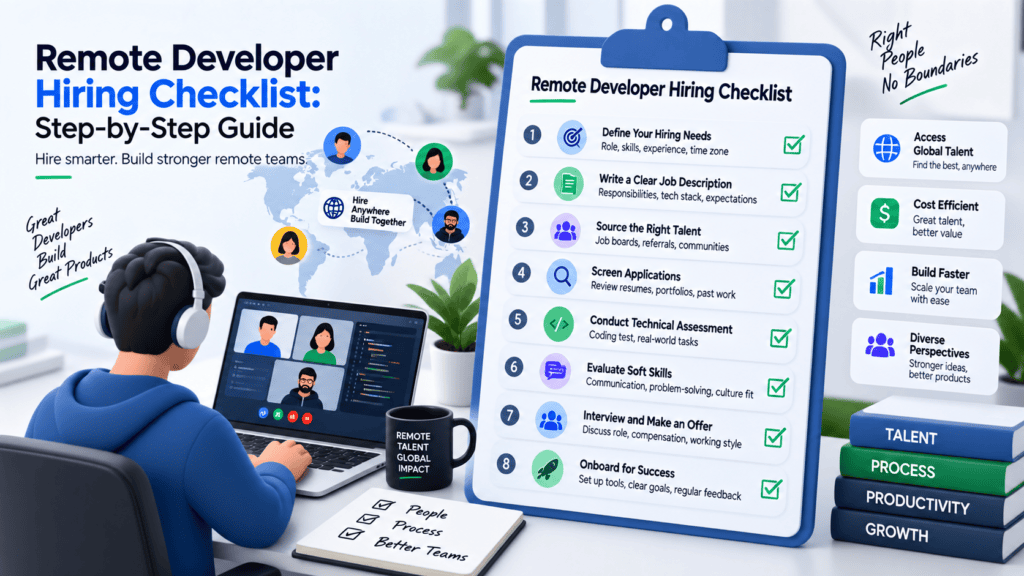
Table of Contents
How to Write a Great Remote Developer Job Description
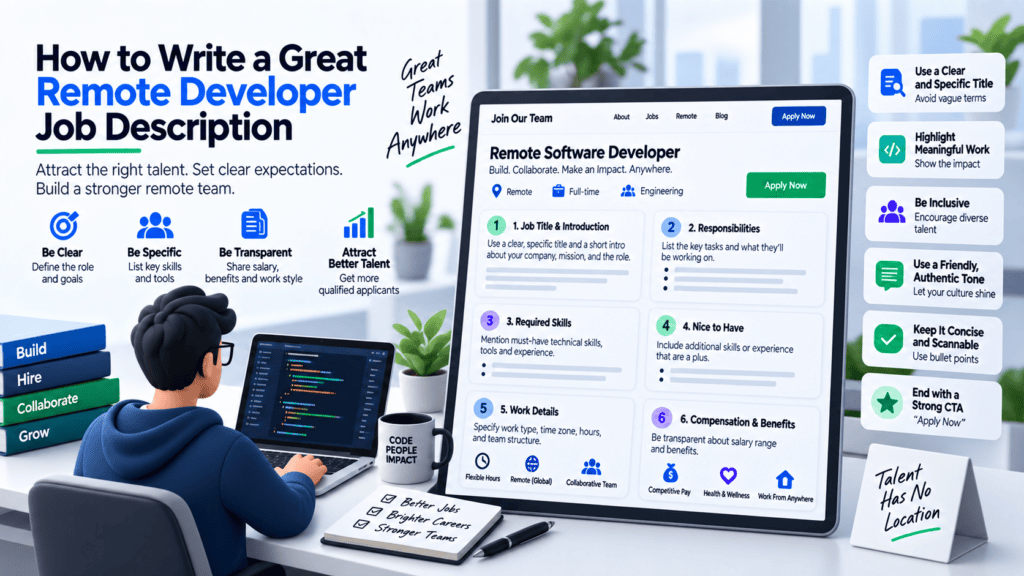
An excellent remote developer job description does more than just promote the availability of roles; in fact, it can also help skilled developers understand various aspects associated with the role at hand including desired qualifications. Moreover, good descriptions help reduce the number of those not suited for the role.
Begin With a Clear Job Title
Use descriptive and identifiable titles and avoid using ambiguous titles such as “Developer Wanted” and “IT Specialist”. Moreover, in cases where relevant, include specialization and level of experience in the title.
For example:
Remote Full Stack Developer
Senior Developer in React
Remote Developer in Node.j
s
Backend Developer in Python
Remote Developer for Mobile Application
A correct title tells applicants that the job suits their skills immediately.
2. The Purpose of a Job Posting
Provide a Short Company Introduction
Give a brief description of your company, what you offer, and the role of a developer in the operations of your organization.
Focus on the aspects of your company which are of interest to the candidate.
For example, a technology company could say that it has created an online platform for helping small businesses manage their administrative tasks and is looking for a developer who could help improve the essential functions of the application.
Describe the Role and Responsibilities
It is crucial to define what the programmer will specifically accomplish. Job seekers are supposed to have an image of their responsibilities for this part of the description.
Some of the usual activities are as follows:
Develop and support web and mobile-based software.
Develop and integrate application programming interfaces (APIs).
Perform programming of many applications.
Create functional tests.
Perform code reviews between programmers.
Fix bugs.
Work with developers, product managers, and designers.
Fix performance and security issues.
Participate in sprint planning and technical conversations.
It is better to mention only the key responsibilities as opposed to providing too long a list.
4. Separate Required and Preferred Skills
A significant part of a remote developer’s job description boils down to defining the exact skills that are needed from the optional skills.
For instance:
Required:
Minimum of 3 years of experience in software development
Proficient in JavaScript/TypeScript
Hands-on experience in React and Node.js
Familiar with REST APIs
Experience with Git and version control systems
Good communication skills while working remotely
Preferred:
Familiarity with AWS
Understanding of Docker
Knowledge of CI/CD
Experience working with AI-driven applications
Prior exposure to startups
The above distinction prevents candidates that meet the qualifications from declining the job offer just because they lack every desired competency.
5. Be Specific About the Technology Stack
Before applying their applications, developers would like to know what types of technologies they will be operating on, which will include the main programming languages, frameworks, databases, cloud platforms, and development tools.
For example:
Tech stack:
React, TypeScript, Node.js, PostgreSQL, AWS, Docker, GitHub Actions.
If the organization is open to other alternatives, it should be mentioned as well, for example, if the organization opens alternatives to React with Vue.js, it should be stated, so that it does not limit the number of potential candidates unnecessarily.
6. Clearly Define Remote Work Expectations
Each company defines the term uniquely, which renders it somewhat subjective. Describe your remote work policy, the rules it entails, etc.
Therefore, address such questions as
Are you remote (fully) or hybrid?
What are the working hours?
What time zones do you operate in?
What are the overlapping hours?
What communication tools do you use?
How often do you have team meetings?
Can one work from abroad?
When using the phrase ‘Remote working,’ specify further, such as
The role is fully remote, as the candidates can work from any of the approved regions.
The position is fully remote, which means that the applicants can work from any of the approved areas; however, they should manage their schedule so that there are at least four hours of overlap with the product and engineering teams.
This way, candidates have an adequate understanding of the opportunity as it is advertised in the job posting. idea of what their working hours will be.
7. Describe the Ideal Candidate
Explain what determines your success at the position other than your technical qualifications.
In other words, you should look for:
Ability to work independently,
communication,
ownership,
ability to prioritize without being pushed,
willingness to work asynchronously,
focus on end-users rather than code,
and the ability to find and solve technical problems.
Most importantly, this applies to working from home because remote jobs require developers to have greater discipline and writing abilities.
8. Explain How Success Will Be Measured
An effective job description should tell the candidate what success would look like in the first few months.
For example:
First 90-day expectations:
Expectations to be fulfilled in the first 90 days:
Understand the existing architecture and workflow of development
Contribute production-ready code
Finish assigned features
Participate in code reviews effectively
Help in improving testing and documentation
It helps describe the position better and allows experienced developers to understand if the role is right for them.
9. Include Compensation and Benefits
If possible, instead of asking the candidate what he / she thinks the company offers in terms of salary or wage, indicate the proposed salary or wage range.
You could also specify:
- Performance bonuses
- Stock options
- Health benefits
- Time off
- Training budget
- Flexible working hours
- Support while working at home
- Paid conferences
By indicating the compensation offer honestly, you will increase the credibility of your job offer and avoid unnecessary discussions with candidates in the job offer stage.the hiring process.
10. Keep the Application Process Simple
To finalize the process, it is necessary to set forth specific directions to the candidates concerning the application procedure.
You can request the following information from the applicants:
- resume or LinkedIn profile
- GitHub
- portfolio
- several project samples
- short description of their experience
- availability
- salary expectations
Avoid requesting an extended amount of information at the initial stage and make the application form as comprehensive yet simple as possible.
Example Structure
The remote developer’s job description might be structured as follows.
Job Title: Remote Full-Stack Developer
About the Company:
An introductory paragraph concerning the company and its services.
About the Position:
A description of the developer’s responsibilities.
Duties and Responsibilities:
5-8 bullet points featuring the responsibilities connected to the position.
Necessary Skills:
Technical and professional skills required for the job.
Desirable Skills:
Additional professional skills.
Technologies:
A list of programming languages, frameworks, databases, cloud platforms, and tools associated with the position.
Telecommuting Policies:
Responsibilities connected to the remote work setup, including the applicant’s location, time zone, hours, and communication rules.
Procedure for Payment and Perks:
The compensation structure and benefits associated with the position.
What constitutes success:
The expected outcomes during the first 30-90 days spent in the new job.
How to Fill the Application:
A set of comprehensive yet straightforward directions for filling out the application form.submitting the application.
Crafting the Perfect Tech Job Title: A Guide to Precision Hiring
The job title is often the first point of contact for an applicant with your business. Companies with generic titles, like Software Engineer , Full Stack Developer , and similar definitions in a highly competitive IT job market have an applicant pool of poor quality.
It is essential that a technical job title is precise and informative to attract the right people as fast as possible. Four elements should always appear in the job title: seniority level, type of developer, tools used by the company and the job location.
The Formula for an Effective Tech Job Title
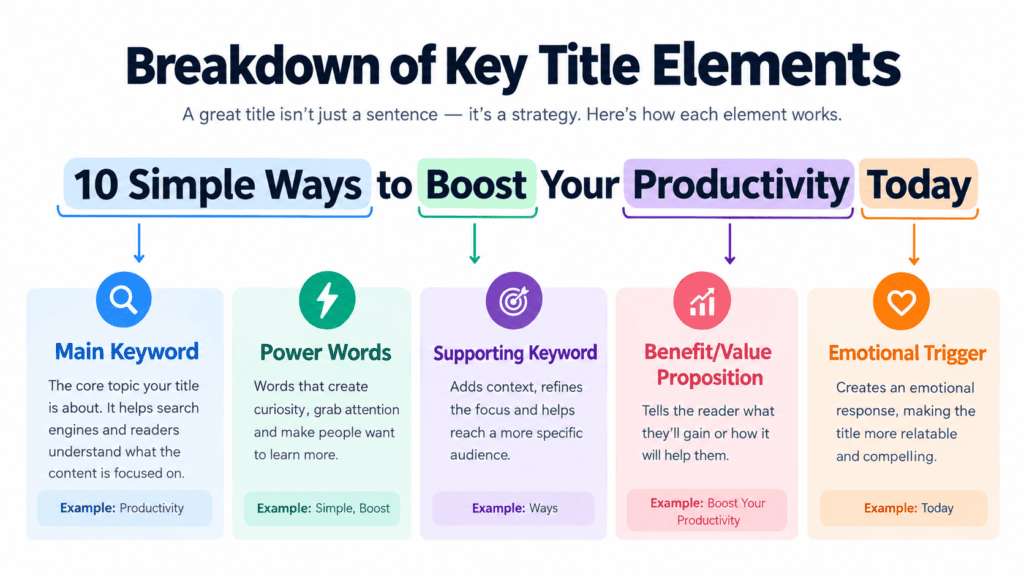
A successful tech job title consists of main building blocks of the title in a brief and search-friendly phrase:
[Seniority Level] + [Core Tech Stack/Language] + [Developer/Role Type] + [Remote Status]
Breakdown of Key Title Elements
1. Seniority Level
The level of experience is usually set at the beginning and shapes the candidate’s expectations of the amount of work and the salary before looking at the ad.
- Junior / Entry Level: 0-2 years of experience; needs help with assignments and supervision of the process.
- Mid-Level: 2-5 years of experience; able to handle project-related issues on their own.
- Senor: more than 5 years; responsible for the overall design vision of the project and advising specialists.
- Lead / Principal / Staff: 8+ years; drives system architecture, cross-team strategy, and business alignment.
2. Core Tech Stack
Including the main language/platform ensures that those without the appropriate skills do not apply and makes your ad more attractive in search results for developers.
- Frontend: React, Vue, Angular, Next.js, TypeScript
- Backend: Node.js, Python, Java, Go, Ruby on Rails, .NET
- Mobile: iOS (Swift), Android (Kotlin), Flutter, React Native
- Data/DevOps: AWS, GCP, Kubernetes, Snowflake, PySpark
3. Developer Type / Specialization
Specify the structural focus of the role so that applicants can easily understand their potential place in your engineering org.
- Frontend Engineer: User interface, client-side performance, state management.
- Backend Engineer: APIs, database management, microservices, business logic.
- Full Stack Engineer: End-to-end feature development covering both UI and server systems.
- DevOps / Infrastructure Engineer: CI/CD pipelines, cloud architecture, system reliability.
4. Remote Status
Top candidates are likely to narrow down open positions based on their preferences regarding work arrangements. Therefore, include your workplace policy right in the title of the job ad.
- For fully remote positions, specify whether they are global or regional, and give examples of preferred time zones.
- Use the following labels for hybrid positions – Hybrid – [City], [State].
- And for on-site positions – On-Site – [City], [State]
Strong vs. Weak Title Examples
| Weak / Generic Title | Strong / Specific Title | Why It Works |
| Software Developer | Senior Python/Django Backend Engineer (100% Remote – US) | Explicitly states seniority, stack, domain, and geographic remote boundaries. |
| React Expert | Mid-Level Frontend Engineer – React & TypeScript (Remote) | Clarifies experience requirements and core languages needed. |
| Full Stack Guru | Staff Full Stack Engineer (Node.js / React) – Remote (EU) | Replaces vague jargon (“Guru”) with clear staff-level seniority and stack bounds. |
Best Practices for Title Optimization
- Avoid internal jargon or playful titles: do not use terms such as “Tech Ninjas”, “Software Wizards”, or “Level 4 Engineers”: search engines and job seekers will not look for these terms.
- Keep it under 60 characters: search engines and job boards (e.g., LinkedIn and Indeed) will cut off long titles in candidate feeds.
- Specify regional constraints for remote positions: if the position is remote but requires overlapping working hours with a specific timezone, make this clear in either the title or the introduction.
How to Write an Attention-Grabbing Opening for Your Company
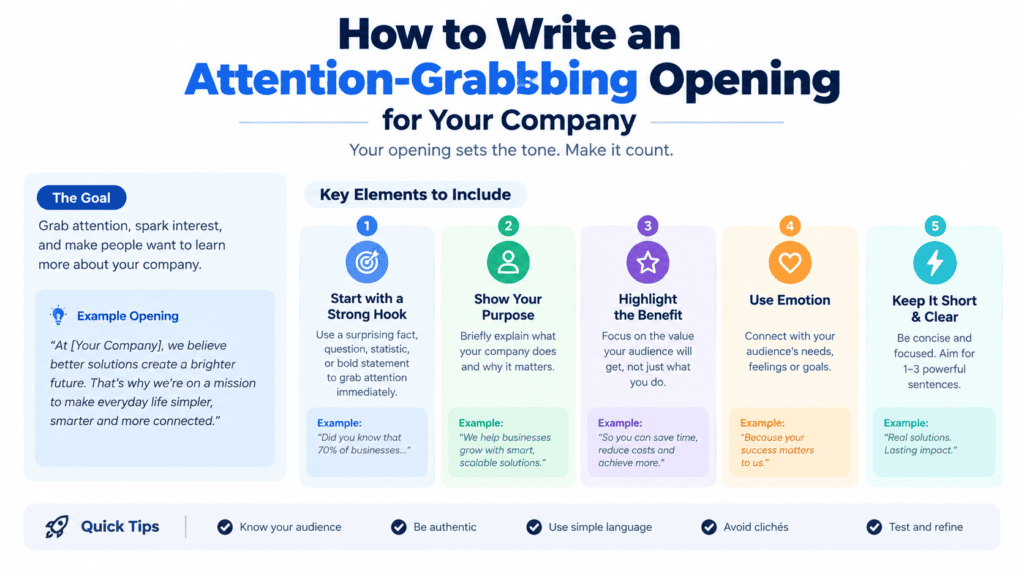
Whether you are writing the careers page, About Us section, initial slides for a pitch deck, or a company blog, you will always find that your first paragraph is your most important asset.
Your audience will make a snap decision about whether to continue reading your text based on this short section. This article will provide you with tips on how to write the hook for your company’s description. We will cover the main points that are usually included at the beginning of a description: the industry you are in, the product you are developing, your mission and values, and company culture and development. If you want to learn how to describe a remote developer job description well, you may want to read Arc’s guide to writing a remote developer job description.
You may find it helpful to use this template as a basis for writing your company’s description. The following sections will give you advice and examples of language you can include in your description.
1. Introduce Your Company and Industry
Start with who you are. In a sentence (or two), tell readers what kind of company you are and what industry you work in. This helps identify the reader before they move on to the next part.
What to put in here:
Company name
Your industry or category
A one- or two-sentence summary of what makes you unique in that space
Sample structure:
“[Company Name] is a [industry] company on a mission to [core purpose]. Founded in [year], we’ve grown from [starting point] to [current milestone], and we’re just getting started.”
Why? People read headlines before they read anything else. Naming your industry right off the bat gives readers a sense of what to expect (and whether they should invest their time further).
Pro tip: Save the industry jargon for later. If your headline makes readers pull out a thesaurus, you’ve already lost them.
2. Explain What You’re Building
This is where you transition from describing who you are to what you actually do. They want to see specifics here, not lofty generalizations. Give the reader specific information about the product/service you offer or the problem you solve.
Things to include:
The problem you solve
The product or service you offer (in simple terms)
The target audience or customer for the product/service
Example:
“We’re building [product] that helps [target audience] [accomplish something] by eliminating [problem/solution].” or “We’re building [product] that helps [target audience] [accomplish something] – today we’ve [quantifiable proof point].”
Why it’s important: Specificity breeds credibility. “We’re building software” doesn’t tell me much. “We’re building the operating system for quick service restaurants to manage inventory, staff and orders in one place” tells me a lot more. It gives me an immediate understanding of your offering and the value it provides.
Pro tip: Focus on the value to the customer, not the nuts and bolts of what you’re building. No one cares how your software works – they’ll only care about what it can do for them.body is excited about your tech stack in the first paragraph — they’re excited about what it does for them.
3. Highlight the Company Mission and Values
This is the heart of your opening, the mission and values. It’s answering the unasked question of Why should I care? This is what differentiates the companies that people talk about on a superficial level and the ones that they invest their lives and careers into.
What to include:
Your mission statement (this is the ‘why’ of your company)
2-3 core values that actually influence decision making at your company (this is not a list of aspirational buzzwords)
A short example of either how you incorporate these values into your business practices or how these values show up in your employees’ day-to-day work
Example:
“We believe [core belief about your industry or customers]. This belief guides every aspect of our operations, from [example 1] to [example 2]. In addition to guiding our decision-making, our values of [value 1], [value 2], and [value 3] also shape how we [example 3].”
Why it works:
Having a mission statement or a value that sounds like “We strive for excellence and innovation” is a great start, but it’s very generic and could apply to almost any company. A more specific and opinionated mission statement is much more compelling to potential employees because it demonstrates a real person or group of people (not just an abstract idea) who hold these values and for whom they’re important.
Tip:
Test your values by imagining if your employees didn’t have them. Would it have any impact? If you can’t think of a way that it would, then it’s probably not a real value – it’s just a buzzword.irect competitor claim this same value?” If yes, it’s too generic. Sharpen it until it’s unmistakably yours.
4. Showcase Company Culture and Growth
Close your opening by giving your readers a sense of momentum and what it is like to be part of the company. That is, if you are using it for a careers page, otherwise, it is not the place to focus on something that is moving versus something that is still.
What to include:
Indicators of growth (how much funding or headcount or revenue or customer growth or market expansion you have had)
A hint of the culture (how you work, what you value or do differently)
Forward-looking energy (where you see yourself going)
Example:
“In the last [duration], we have grown from [X] to [Y] – [funding raised / customers served / team size / markets entered]. We are a team of [brief culture description, eg ‘builders who value autonomy and directness’], working across [locations/remote] and united by [something that binds you]. And growing quickly: [something about where you are heading].”
Why it works:
Momentum is persuasive – people (customers, investors, employees) want to get on board with something that is clearly taking off, rather than something that has stalled.
Tip:
Use real numbers if you can – “we are growing quickly” is a claim, “we grew from 10 to 60 people in 18 months” is a statement of fact.
Putting It All Together: A Sample Opening
Here’s a possible way to combine all four elements into a single, cohesive opening:
“Brightpath Health is a Digital Health startup that is reimaging independent clinic operations by developing an unified platform of patient care solutions that replace the 5 disparate systems in current use by over 1200+ clinics nationwide
We were founded on the belief that better technology unlocks better health outcomes for everyone, and that philosophy drives everything we do – from our commitment to rapid, transparent development cycles to our dedication to keeping our platform intuitive and easy to use for the front line staff who use it everyday
Within the last 2 years, we’ve grown from a founding team of 4 working out of a shared co-working space to a distributed team of 70+ employees across three countries, and we’re now seeking new team members who share our commitment to building products that put patients first.”
Quick Checklist Before You Publish
- [ ] Does the opening sentence say who you are clearly and which industry you’re in?
- [ ] Can a new reader understand what you build within 10 seconds?
- [ ] Do your mission/values section makes a claim others in your niche couldn’t say?
- [ ] Have you used at least one concrete growth stat?
- [ ] Does the tone match how your team really talks versus generic corporate speak?
- [ ] Would this opening make you want to continue reading if you stumbled across it?
You can check all these boxes and get one hell of an intriguing opening that gets people to keep scrolling.
Blog Post About Developer’s Role is provided below.
The Blueprint of a Developer: Role, Responsibilities, and Path to Success
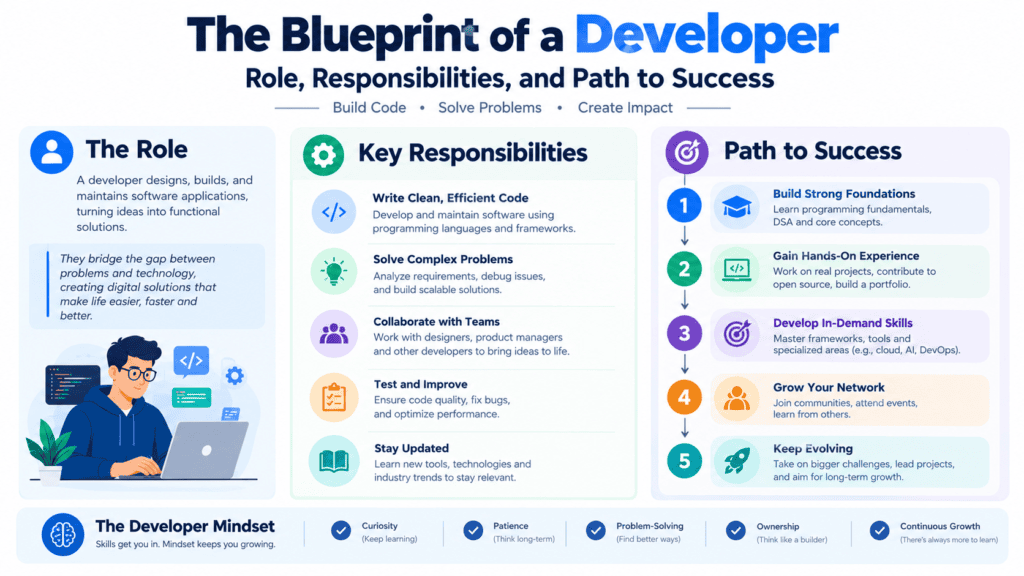
In the modern digital economy, the “Developer” is often romanticized as a lone genius typing away in a dark room. The reality is far more collaborative, strategic, and structured. Whether you are an aspiring coder, a hiring manager, or a product owner, understanding the granular details of the Developer’s role is essential for building effective teams and products.
This blog breaks down the anatomy of the Developer role, covering everything from daily tasks to the definition of success.
1. Responsibilities and Daily Tasks
A Developer’s daily work is to convert human logic into computer-readable code. However, the tasks go far beyond just writing if statements.
Core Responsibilities
Writing Clean and Scalable Code: The primary task. It is not enough that the code works correctly; one must also ensure that it is readable and well-structured.
Debugging and Troubleshooting: Searching for and eliminating bugs that may exist in the code.
System Design: Designing a system or particular functionality according to specific requirements and ensuring that it will be able to handle high loads and be safe.
Code Reviews: Holding code reviews to ensure high code quality and share knowledge between team members.
Documentation: Writing documentation for code, systems, or APIs.
The Daily Grind (A Typical Day)
- Stand-up Meeting (15 mins): A quick catch up with the team on what was done/what’s being done, what’s planned for the day, and any roadblocks.
- Deep Work / Coding (4-6 hours): The meaty part of the working day. This includes coding, technical debt, and test writing sessions.
- Collaboration (1-2 hours): Pair programming, responding to Slack/Teams messages, and meetings with Product Managers.
- Code Review (30-60 mins): Reviewing other people’s code changes.
2. Expected Impact
What does a Developer actually contribute to the business bottom line?
- Velocity: Good developers speed up the rate at which you can deliver a feature to your customers.
- Reliability: By writing automated tests and building solid code, Developers decrease downtime, which improves customer satisfaction.
- Scalability: Developers build systems that let you grow your user base from 100 to 1,000,000 users without your infrastructure crashing.
- Cost Efficiency: Writing efficient code and building systems that don’t require expensive cloud computing resources decreases costs and technical debt.
3. Seniority Level
The title “Developer” is an umbrella term in this context. The role of a developer changes drastically during the span of your experience:
- Junior Developer (0-2 years): Focuses on specific, well-defined tasks. Heavy on-boarding support is required. Their success is measured by the quality and learning rate of their code.
- Mid-Level Developer (2-5 years): Can take a feature from design to implementation. They require less guidance and are capable of contributing to architecture discussions.
- Senior Developer (5-8+ years): Focuses on entire systems, mentors junior developers, and thinks about “non-functional requirements”.
- Staff/Principal Developer (8+ years): Works at the level of the organization. They are responsible for solving technically challenging problems and setting the technical strategy of the company.
4. Reporting Structure
The reporting structure depends a lot on the company size and culture (Big Tech vs. a Startup)
Standard structure:
- Developer reports to Engineering Manager (EM) or Tech Lead
- Engineering Manager reports to Director of Engineering.
- Director reports to VP of Engineering or CTO.
People vs. Technical Management: The EM handles the careers, salary, and burnout of people in his team. Tech Lead/Staff Engineer handles the technical strategy and architecture.
5. Team Structure and Collaboration
Developers rarely work under one individual. The most common structure in which a team is organized is called a Cross-Functional Squad (popularized by Agile/Scrum).
The Squad Composition
The typical product team consists of:
Product Manager (PM): Defines what to build and why.
Product Designer (UX/UI): Defines how it can look and feel.
Developers (Frontend, Backend, Full-stack): Builds the solution.
QA/Test Engineer: Makes sure it works.
DevOps Engineer: Makes sure it is deployed correctly.
Collaboration Methods
Agile/Scrum: Working in 2 weeks’ sprints.
Pair Programming: Two developers, one computer. Great for knowledge transfer.
Cross-functional Syncs: Developers must collaborate extensively with non-technical stakeholders to understand their needs and translate them into solutions.
6. Define What Success Looks Like
Success for a developer is not just “shipping code.” It is a multi-dimensional metric.
1. Technical Success
- Code Quality: Low bug count, high test coverage, and adherence to style guides.
- Performance: The app loads fast and handles concurrent users smoothly.
- Delivery: Meeting sprint commitments and deadlines consistently.
2. Team Success
- Mentorship: How much did you help your teammates grow?
- Code Reviews: Are your reviews constructive and timely?
- Communication: Do you ask for help when stuck, and do you communicate blockers early?
3. Business Success
- User Impact: Did the feature you built actually solve a user problem?
- Business Metrics: Did your work contribute to increasing revenue, reducing churn, or improving conversion rates?
4. Personal Success
- Continuous Learning: Staying updated with new technologies (e.g., AI, new frameworks).
- Automation: Did you automate a tedious manual process, saving the team hundreds of hours?
Include the Right Technical Skills and Experience
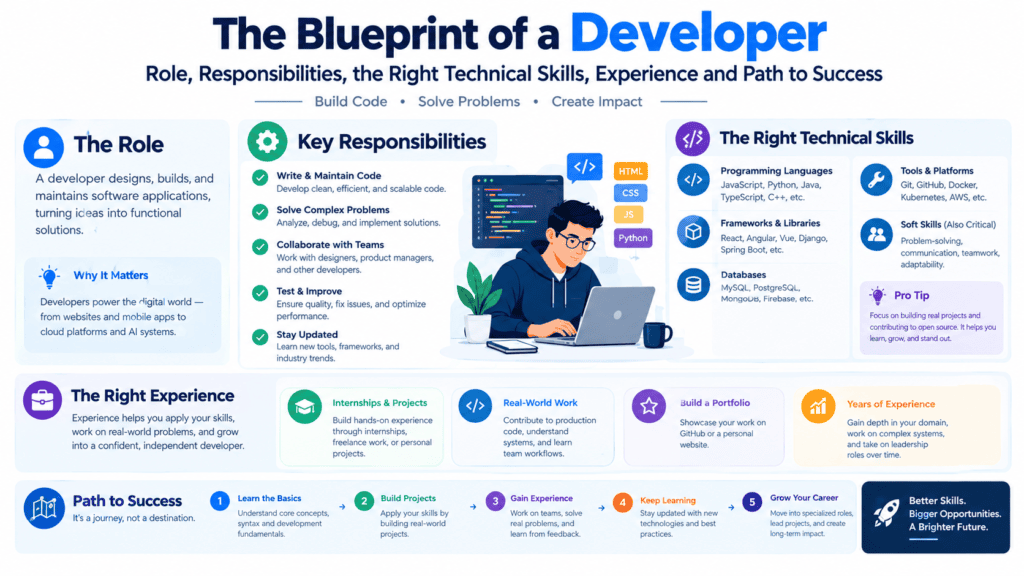
A strong remote developer job description should clearly explain the technical skills, qualifications, and experience required for the role. Avoid filling the job post with an unrealistic list of programming languages and tools. Instead, focus on the technologies the developer will actually use and the responsibilities they will own.
Required Technical Skills
Start by identifying the core technical skills that are essential for successful performance. For example, a frontend developer may need strong knowledge of HTML, CSS, JavaScript, React, and responsive design, while a backend developer might require experience with Node.js, Python, APIs, databases, and cloud services.
Separate must-have skills from nice-to-have skills. This prevents qualified candidates from avoiding the position simply because they do not match every technology listed.
For example:
- Strong JavaScript and React experience
- Experience building and consuming REST APIs
- Knowledge of SQL and database design
- Familiarity with Git and collaborative development
- Understanding of testing and debugging
- Experience working with cloud or deployment platforms
Qualifications
Developers are rarely working in isolation. The most common structure is the Cross-Functional Squad (popularized by Agile/Scrum).
The Squad Composition
- A typical product team includes the following:
- Product Manager (PM): Defines, “what to build” and “why”.
- Product Designer (UX/UI): Defines, “how does it look like?”.
- Developers (Frontend, Backend, Full-stack): The builders.
- QA/Test Engineer: Ensures the solution works as intended.
- DevOps Engineer: Ensures the solution goes live smoothly.
Collaboration Methods
Agile/Scrum: Typically 2-week sprints.
Pair Programming: Two developers and one keyboard. Great for knowledge sharing.
Cross-functional Syncs: Developers are required to do heavy coordination with non-technical counterparts to bring business objectives to technical reality.
Experience Level
Tell us whether you are looking to hire a junior, mid-level, senior, or lead developer. You should describe the required level of independence and responsibility well.
For example, a junior programmer may work under the supervision of a senior, whereas a senior developer is supposed to be able to make decisions and lead.
Instead of simply putting years of experience, describe the skills they should have gained by now.
If someone has 3–5 years of working in the field, write “3–5 years of experience in developing production-grade web applications with the ability to design, build, test, and maintain web apps.” That way, you will get relevant candidates who know what they are doing.
Relevant Technology Stack
Mention the technology stack that the candidates will work with. It refers to the programming languages, frameworks, databases, cloud platforms, development tools, and testing technologies.
For example:
Frontend: React, TypeScript, Next.js
Backend: Node.js, Express
Database: PostgreSQL
Cloud: AWS
Tools: GitHub, Docker, CI/CD
Also, if your team is open to people with experience in similar technologies, indicate it. If someone has solid experience with Vue.js, they will likely learn React on their own in a short time.
Focus on Actual Responsibilities and Results
The most effective job descriptions juxtapose hard necessities with actual duties and anticipated outcomes. Instead of stating that React expertise is required, specify what the developer is going to do with it.
Incorrect:
Experience with React is required.
Correct:
Build and maintain responsive React applications, develop reusable UI components, integrate APIs, and improve application performance.
In addition, it is possible to describe anticipated outcomes, for instance, reducing the time of a page-load process, increasing application reliability, launching new product features, or improving test coverage.
This way, there will be no confusion among applicants concerning their qualifications for the offered position. It will also help the hiring companies to attract the developers who will fill in the vacant positions with products that are relevant to the company itself.
Prioritize Communication Skills for Remote Developers
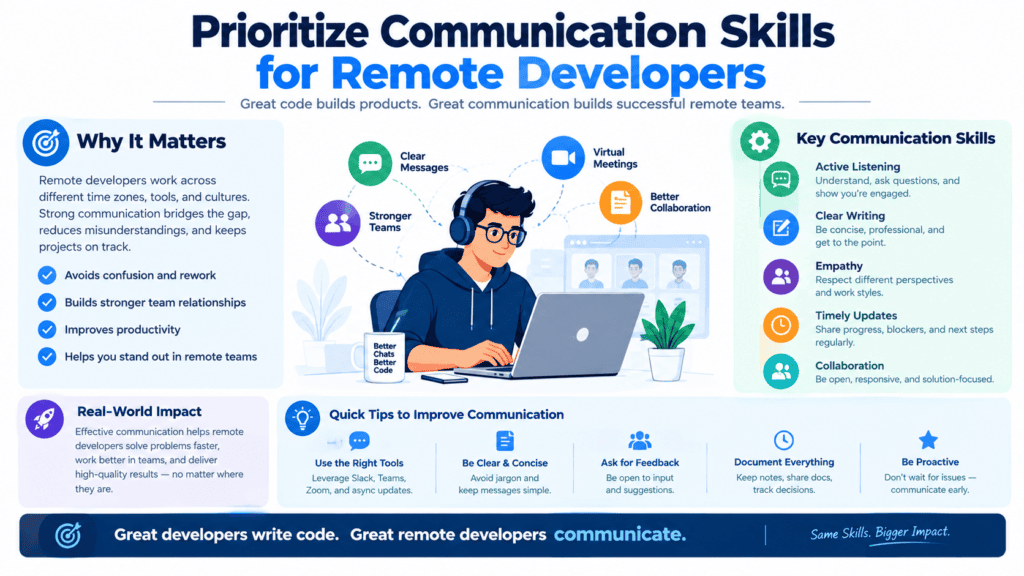
The remote development process is largely dependent on clearly defined, autonomous procedures. Here are the most critical communication skills for a remote developer job:
- Async communication: Expressed in properly written tickets, documentation, and PR comments, it ensures that the development process is smooth and not disruptive for other team members.
- Written communication: Saves time by reducing the number of necessary meetings and preventing misinterpretation through additional context that is usually present in verbal instructions.
- Ability to work independently: Enables uninterrupted, autonomous work and helps a developer avoid mistakes and unnecessary disruptions to the work process.
- Collaboration: Facilitates the necessary level of interaction between the team members and reduces the overhead of async communication.
- Problem-solving: Includes asking questions and recording the answers which help both the asker and the answerer during their development process.
Deciding Whether Remote Experience Is Required
Not all remote jobs require a candidate to have previous experience in remote work, but there are some important points to consider. First of all, I would look for someone who can manage themselves effectively. It is essential to set priorities and meet the established deadlines even if the person is not physically present.
The next attention shall be paid to video and written communication. Since there is no physical meeting, the correspondence is the basis of interaction. It is vital to ensure that the candidate can formulate thoughts correctly in written form or on video.
The ability to solve problems remotely is another quality that needs to be evaluated. One should be able to find solutions to any difficulties that may arise without the help of a manager. The candidate’s experience in working remotely is not crucial if they possess such soft skills and professional competence.
Add Bonus Skills and Standout Factors
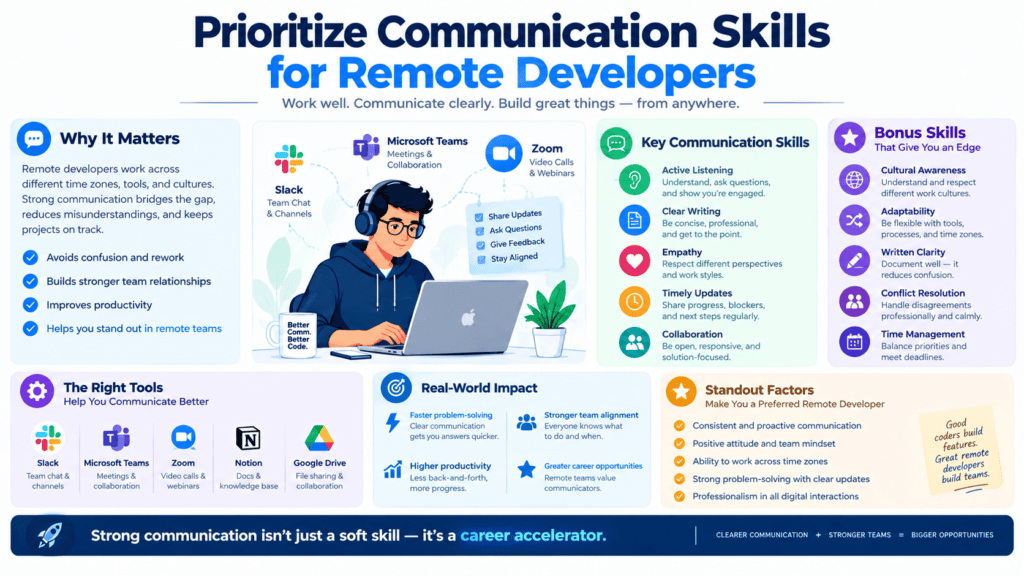
To make your resume stand out from the rest, it is essential to exceed the standard requirements. It is vital to include optional skills such as data visualization or knowledge of a foreign language to demonstrate one’s adaptability. Mentioning of additional projects will display enthusiasm about the work outside of the core responsibilities. The experience in a start-up environment is also valuable as it highlights versatility and flexibility, as well as the ability to navigate ambiguous situations.
In addition, it is critical to note the professional development and additional training that helps excel at one’s job. After all, such qualities as motivation and self-improvement are desirable in any workplace. As a result, the extra skills and competitive advantages acquired along the way should be mentioned during the application process to catch the recruiter’s attention and stand out from other applicants.
Explain the Remote Work Arrangement
Clearly describe the remote work scenario so that candidates know how and where they would have to work. Elaborate on whether the position allows for full-time remote working, hybrid, or only occasional onsite collaboration. Furthermore, specify the expected working hours and possible core working hours if applicable. If the role requires working in a specific time zone elaborate on that as well and point out any possible location restrictions (i.e. list the countries you allow applications from). Lastly, describe the expectations regarding online meetings and onsite collaboration if any.
Compensation and Benefits
We offer competitive salaries that match the market level according to the position and years of experience. In addition, employees are eligible for various rewards and performance-based bonuses for their contributions to the company’s performance. We also provide equity options that give the staff an opportunity to benefit from the company’s success directly. For new employees, we provide laptops and other equipment necessary to perform their tasks efficiently.
Our company also offers relocation allowances to our remote workers for furniture, equipment, and internet access. Moreover, we can provide medical, dental, and vision insurance options and cover the cost of learning materials for courses that our employees want to take to improve their skills. Our workers also enjoy generous vacation and personal leave policies and flexible working arrangements, including the option to work from home.
Hiring Policies and Processes
Talk of Hiring Practices Rewrite 2 Essay (Book Review)
At this company, the hiring process takes place in a fair and transparent manner. The company’s DEI statement is concerned with equal opportunity and attracting diverse candidates during the hiring process. It includes a description of the application procedure that allows one to submit the resume and cover letter through the online platform. The candidates who get shortlisted are given the coding challenge to assess their skills.
After getting past the first round of screening, the candidates are invited to technical, behavioral, and cultural interviews. They are kept informed about the status of their applications through regular updates sent to their email addresses. As such, the company conducts the interview process transparently and competently while maintaining open communication with the candidates about their progress during the hiring process.
End With a Strong Call to Action
A strong call to action (CTA) will help you encourage the most qualified developers to apply after reading your remote developer job description. Make sure to shortly outline what steps they need to take to apply for the position, for instance, which documents they need to provide or where they need to send their application.
You can also add the application deadline and the expected response time. A strong CTA can be as simple as a line telling candidates to apply now to join your remote development team. This way, you will keep the most eligible candidates interested and help them know what to do next.
Remote Developer Job Description Checklist
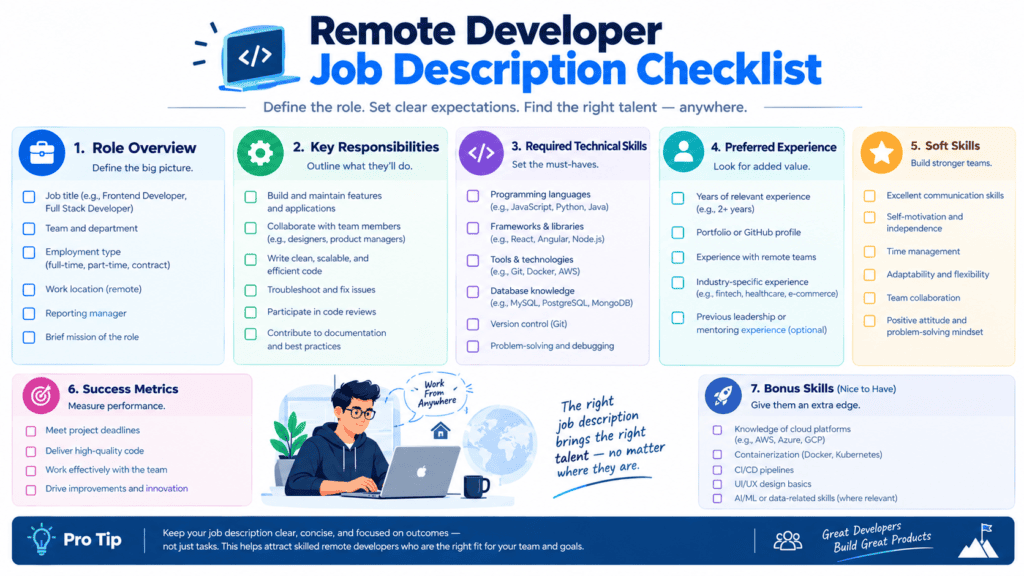
A compelling remote developer job description checklist will help you attract the right candidates and establish the expectations from the start.
Make sure to include the job title, give a short company description, and outline the position’s responsibilities and qualifications. Mention technical skills and experience required for the job, and add bonuses and additional qualifications.
Include the key details about working remotely, such as time zone, working hours, and communication tools. Describe the benefits and compensation packages, and provide information about your company policies and hiring process. Most importantly, give a CTA instruction on how to apply for the job and wait for the candidates to take action.
FAQs
What should be included in a remote developer job description?
A great remote developer job description should be precise in its technical terms while emphasizing the company culture. The remote developer job post needs to contain the following information:
Job Title with Tech Stack Information: Senior Full-Stack Engineer, ReactJS/NodeJS
Key Responsibilities and Technical Requirements, Non-negotiable Technical Skills, and Remote-Specific Soft Skills Requirements
The following information could be emphasized to attract developers’ attention:
Location and Time Zones Requirements (e.g., availability of at least 4 hours overlap with PST). Compensation and Benefits (salary range, stipends, and home office budget). Company Culture Details (remote tool usage, and asynchronous communication advice).
How do you write an effective job title for a remote developer position?
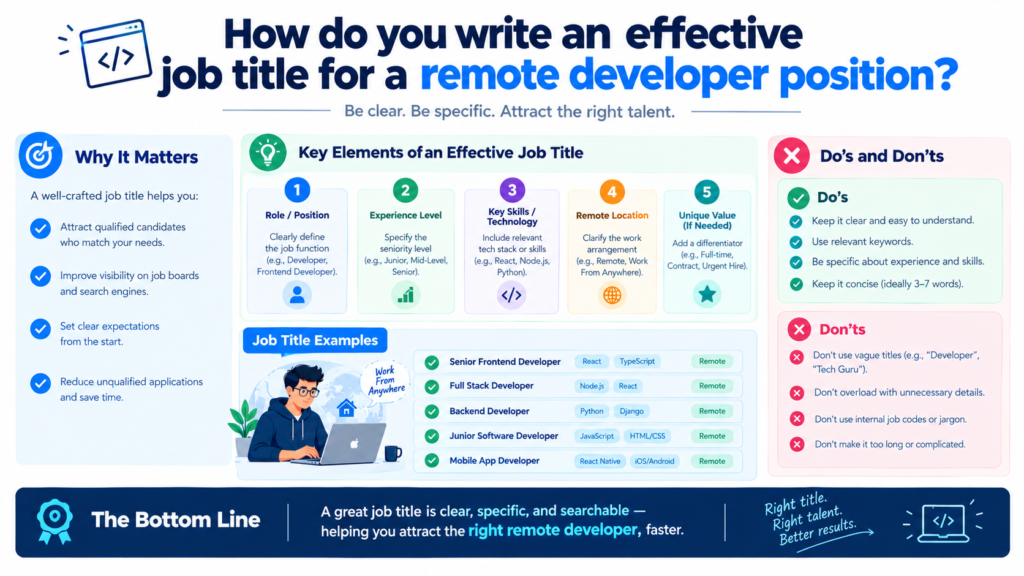
An effective remote developer job title should be specific enough to help people find the position without confusion or misinterpretation. Avoid using ambiguous and over-hyped designations such as “Code Ninja.” Instead, build a precise title using the following format:
[Seniority] + [Specialization] + [Remote/Location Note]
Consider the following examples:
Senior Remote Backend Developer (Node.js)
Remote Full-Stack Developer – React & Python
Mid-Level Frontend Developer (Remote, US-based)
Make sure to indicate the required technology stack (React, Python, Java), so that only the qualified candidates apply for the job. Note that remote developers will look for the word Remote in the job title, so it is better to #useit. Mention your preferred level of the candidate’s experience (Junior, Mid, Senior) and remember that the job title should not be longer than 60 characters. Avoid using internal designations and terms that are not common in the industry and may confuse candidates searching for remote developer jobs.
What technical skills and experience should you require from a remote developer?
When searching for a remote developer, focus on core competencies first and foremost, such as experience with programming languages, frameworks, and tools. Ask about their working experience with Git, API’s, and other technical aspects of the job. Do they have the necessary professional skills for remote work? Can they manage themselves, communicate effectively with teammates asynchronously?
A good developer will be someone who is highly-skilled in terms of problem-solving, debugging, and technical resolution. Beyond technical ability, developers must have at least three years of remote work experience.
In addition, they should have an established, reliable home office setup and be available within your time zone. Pay close attention to their security and documentation practices. Most importantly, test their skills in a live coding challenge or hire them on a trial basis. After all, competence in day-to-day affairs is often more important than theoretical knowledge typically found on a resume.
How should companies explain remote work arrangements in a job description?
Providing precise details about remote work from the get-go will help attract the best candidates and establish trust.
- What To Specify In The Job Postings
- Specify Whether The Role Is Fully Remote, Hybrid, Or Remote-First
- Outline Work Restrictions, Such As Residency, State, Or Country Requirements If Applicable
- Mention The Overlapping Hours, If Any, Or If The Job Is Entirely Schedule Flexible
- Give Details About Equipment And Stipends, Such As Hardware And Home Office Allowances
- Or Internet Stipend
- Elaborate On Any Mandatory Travel Requirements, Such As Retreats, Or On-Site Visits, If Any
Specifying these details can help avoid misunderstandings from the start.d streamlines your hiring process.
Should a remote developer job description include salary and compensation details?
Yes, job descriptions for remote developer positions should always have detailed information on the salary and compensation.
Attracts Top Talent:Tech professionals appreciate openness,and being specific about compensation creates trust and encourages applications from qualified workers
It saves time
since
disclosing this information right away will prevent either party from wasting time on interviews or work that the developer is not going to do.
plus
it can ensure compliance with legal regulations in specific regions.
Complete context on compensation, including any extra benefits such as stock options, health insurance, or stipends for special occasions,will benefit both parties in remote hiring.
For instance,
numerous jurisdictions are now considering laws that require companies to disclose compensation in job descriptions, even for remote positions that could be based there.details establishes a foundation of equity, efficiency, and professionalism.
How can companies describe their culture and mission to attract remote developers?
The companies that want to attract remote workers should define their culture more specifically and transparently, using particular examples instead of generic terms. They should showcase their flexibility (async, hours), trusting management style, and focus on outcomes as opposed to the time spent.
The companies should communicate their learning opportunities, communication norms, and collaboration styles in detail. The companies should define the connection between their employees’ daily work and the product they contribute to and impact the world with, not just generic statements such as “changing the world.”
The companies should give specific examples of their processes and tools and talk about how they operate within particular communication channels (Slack, emails, documentation). The companies can build trust with the applicants by openly discussing their remote work cultures and values. The culture can be demonstrated via the employees’ testimonials, the specific examples of compensation, and the remote work practices clearly defined.
What information should be included about working hours and time-zone requirements?
When describing working hours/time-zone requirements in a job post, be explicit about the core working hours (e.g. 9 am EST – 5 pm EST), the expected weekly time commitment, and whether the position requires synchronous, asynchronous, or a mix of both. Indicate whether flexibility is allowed for start/end times
Make clear what time-zone requirements, if any, you have for the position, for example, “must overlap with US Eastern time by at least 4 hours” or “can work independently within APAC time-zones” and whether the role involves being on-call or working weekends. Specify whether overtime or shift differentials apply
This helps job-seekers identify roles that they can realistically handle given their personal constraints and availability. It also helps set expectations for both parties and attract the right candidates who can commit to the required hours without overextending themselves.
Should remote developer job descriptions include bonus or nice-to-have skills?
Remote developer job descriptions may include optional skills, if these are presented clearly apart from hard requirements.
This is a good practice, as it sets expectations for the team’s tech stack evolution and promotes the company’s culture. Moreover, it allows to differentiate between average and excellent candidates, who will not be deterred by the prospect of having to learn new tools and technologies.
The ‘nice-to-have’ section of a remote developer job description could be used to indicate additional languages or frameworks (e.g. GraphQL, Docker), which the team is considering adopting. It may also include soft skills, which are beneficial but not critical for the position (e.g. asynchronous writing). This section should be limited to 2-4 entries, to avoid discouraging candidates with an overly long list of secondary requirements.
How can employers clearly define responsibilities and success expectations for remote developers?
The definition of responsibilities and success criteria for remote developers hinges on the transition from hours-based to outcomes-driven perspective.
Strategies:
- Documented ownership: Creation of role scorecards that explicitly define the primary technical ownership, system boundaries and code quality benchmarks
- Delivery metrics: Transition to objective software delivery-focused measurements such as deployment velocity, pull request completion rates or sprint goal achievement
- Communication expectations: Explicit documentation of communication norms including asynchronous interaction guidelines and core hours for collaboration
The combination of documented ownership and delivery metrics provides the clarity of expectations and grounds the remote work in the creation of objective, quantifiable outcomes.
What makes a remote developer job description attractive to qualified candidates?
What Makes a Remote Developer Job Description Attractive
Top candidates quickly scan through job posts, looking for the most attractive offers of employment. The most efficient way to do that is to state the required tech stack prominently, elaborate on the responsibilities (avoiding vague corporate speak), and outline the offer, including the salary range. Candidates care about remote work terms, including the time zone, communication rules, and whether the position is remote-first or remote-friendly.
Moreover, prospects will look for any mention of mentorship, budgets for learning or development, and opportunities for promotion and advancement. In addition, the candidate will be interested in benefits, such as equipment stipends and flexible working hours.
Not less important are the company’s objectives and staff size. A short and straightforward description without unnecessary jargon demonstrates to a qualified worker that the company has a healthy culture and values its employees. That is why more experienced and qualified workers take such vacancies more seriously.
Would you like me to develop this idea into a complete blog post with subheadings and examples? Or would you like me to provide a downloadable template?
Conclusion
Writing the job description for a remote developer is not as simple as it seems. To get quality applicants, you must be clear and specific about positions, tools, and expectations. A good job description will allow you to stand out from the competition and attract the best developers.
You should specify your requirements and describe the technologies you are going to use in detail. It is also essential to clarify what skills are required and what language and tools are preferred. Moreover, it is critical to indicate working hours and time zone requirements.
Mentioning such details as relevant experience and achievements in specific programming languages will help you understand your team’s level and goals. Compensating developers appropriately can also be a critical factor in attracting the right candidates. Finally, a clear job description will help attract motivated developers who do not need to waste time clarifying dull and vague tasks.
Author Bio
Jeevesh Tripathi is the tech content writer and talent acquisition strategist behind this post. He has worked in the field of technical recruitment and engineering team management for quite some time now, and this is him sharing his knowledge on how companies can find, assess, and retain the best engineering talent.
His expertise and insights come from personal experience, as well as various resources (one of which includes bkabhi). He helps companies with their tech needs and recruitment process, while also keeping up with the latest happenings in the world of remote work and developer workflow optimization, allowing remote-first companies to scale their operations accordingly.