
Table of Contents
What Is Equity Compensation?
Equity compensation is a compensation method that provides employees with a share of ownership in the firm in exchange for their labor. It is common for start-ups to offer equity as an alternative to direct payments in the form of wages. As a result, employees are highly motivated to maintain the value of the firm and its stock price since they directly benefit from increases in these factors.
In this case, instead of sharing profits in the form of cash, the company offers its employees options, restricted shares, restricted share units, or other compensation forms. The value of the given share depends on whether the firm goes public or gets acquired.
How Equity Compensation Works

There are different ways in which a company can offer its equity to employees. The mode of issuance depends on the company and the type of equity. For instance, in the case of a start-up, an employer can offer their employees stock options.
The above-mentioned options come with a vesting schedule that determines how long an employee must stay with the company before they can exercise their options. A typical start-up equity compensation has a one-year cliff and a four-year vesting period.
In this case, an employee who was promised 10000 shares would get 2500 shares upon exercising their options four years after joining the company. In the meantime, if they leave, they forfeit the shares.
The tax implications, exercise price, shareholder rights, and overall value of the given option vary depending on the type of equity, the company in question, and the country where the employee is based.
Why Startups Offer Equity
Many start-ups face the challenge of having little cash flow while requiring highly-skilled employees to develop their products. Offering equity can be a way to overcome this dilemma as illustrated by the fact that such companies offer significantly lower salaries than more established firms.
In addition, start-ups rarely offer long-term contracts. Instead, they offer stock options that limit the risk that an employee takes. For instance, if the start-up does not do well financially, the employee will not profit from the company’s stock options.
As a result, a start-up company can motivate its employees by tying the long-term value of the firm to an employee’s performance. In other words, the employee shares in the continued success of the company.
As a result, the purpose of equity compensation in a start-up scenario includes:
- Attracting talent despite limited cash flow and lower salaries;
- Long-term motivation;
- Reduced risk on the part of the employee;
- Incentive to take on additional risk;
- Making room for cash for the running of the business and development of products.
It is important to note that equity should not be viewed as a substitute for salary. Employees should carefully consider the risks, potential gains, dilution, vesting, and taxes that come with the given option before deciding whether to accept the offer.
Equity as a Long Term Incentive
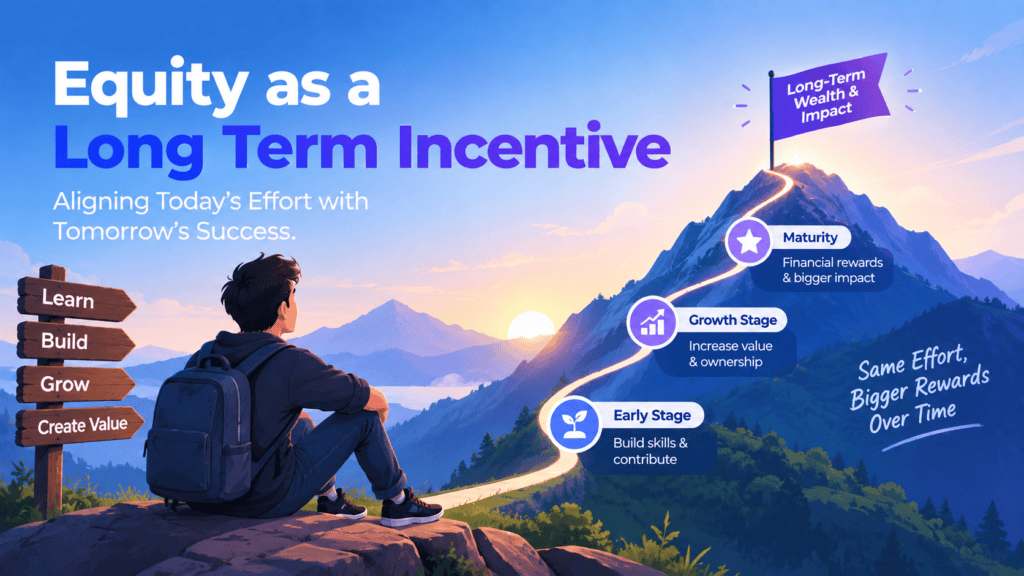
Companies offer equity to employees mainly to encourage them and motivate them towards achieving long-term goals. Unlike cash, stock options have a delaying effect and require time to gain value. In most cases, companies offer their equity to employees who are willing to stick with the company for a long time. In the meantime, the employees gain skills, which increases their overall value.
For instance, a programmer who has joined a new start-up in the tech space and has been promised stock options will continue to build their career. If and when the start-up becomes public, the given employee will make profits from their shares.
As mentioned, equity can be highly profitable to employees. However, it does not come without risks. The fact remains that a start-up company can fail at any time and never go public, eliminating the chance for any employee to profit from their shares.
In addition, the company might get acquired or go public, but the shares provided to employees might get diluted due to various factors. As a result, an employee must evaluate salary and the value of shares provided to them against other job offers as well as their personal financial situation.
In the case of a start-up, the combination of salary and stock options will be used to attract talent and enable a person to grow their career while benefiting from the potential gains of the start-up.
Understanding the tax implications of equity compensation depends on three critical milestone events: Grant (when awarded), Vest (when non-forfeitable), and Sale (when liquidating for cash).
Here is how each type is taxed at every stage under standard U.S. federal tax rules.
Tax Breakdown by Equity Type
1. Incentive Stock Options (ISOs)
- Grant: No tax.
- Vest: No tax.
- Exercise: No ordinary income tax. However, the “spread” (Fair Market Value [FMV] minus strike price) is an Alternative Minimum Tax (AMT) preference item and may trigger AMT liability in the year of exercise.
- Sale:
- Qualifying Disposition (held $\ge 2$ years from grant AND $\ge 1$ year from exercise): The entire gain (sale price minus strike price) is taxed as Long-Term Capital Gains (LTCG).
- Disqualifying Disposition: The spread at exercise is taxed as Ordinary Income; remaining growth above exercise price is taxed as Capital Gains (short-term or long-term based on holding period after exercise).
2. Non-Qualified Stock Options (NSOs)
- Grant: No tax (in standard cases).
- Vest: No tax.
- Exercise: The spread (FMV minus strike price) is taxed immediately as Ordinary Income and subject to payroll taxes (FICA, Medicare), regardless of whether you sell the shares.
- Sale: Capital gain or loss based on the difference between the sale price and the FMV at exercise (cost basis). Taxed as Short-Term Capital Gains (STCG) if held $\le 1$ year, or LTCG if held $> 1$ year.
3. Restricted Stock Units (RSUs)
- Grant: No tax.
- Vest: The full FMV of the vested shares is taxed as Ordinary Income (plus payroll taxes). Companies typically withhold a portion of shares to cover tax liabilities.
- Sale: Capital gain or loss based on the difference between the final sale price and the FMV on the vesting date (cost basis). Taxed as STCG or LTCG based on the holding period after vesting.
4. Growth Shares / Hurdle Shares
- Grant/Acquisition: Taxed as Ordinary Income on the initial value purchased. Because the share value starts at or near zero (due to the hurdle), the initial tax burden is typically nominal.
- Vest: Usually no tax if acquired upfront at grant.
- Sale: Value realized above the hurdle price is taxed as Capital Gains (LTCG if held $> 1$ year).
5. Phantom Shares / Virtual Shares
- Grant: No tax.
- Vest: Usually no tax (unless structured to pay out immediately at vest).
- Payout/Sale: Payouts are paid in cash and taxed entirely as Ordinary Income / W-2 Wages subject to standard payroll tax withholdings upon receipt. No capital gains tax treatment applies.
6. Management Incentive Plans (MIPs)
- Grant: Depends on structure (options, restricted stock, or synthetic units). Options/units carry no tax at grant.
- Vest/Exercise: Structured to defer tax until a liquidity event.
- Sale/Exit: Usually designed so that payouts at exit are treated primarily as Long-Term Capital Gains (if real equity/sweet equity) or Ordinary Income (if synthetic/cash-settled).
7. Ordinary Shares
- Grant/Purchase: If purchased at Fair Market Value, no tax. If received as a gift or at a discount, the discount below FMV is treated as Ordinary Income.
- Vest: If subject to vesting without an 83(b) election, FMV at each vesting date is taxed as ordinary income.
- Sale: Gain over cost basis is taxed as STCG or LTCG depending on holding period.
Comparative Tax Summary Table
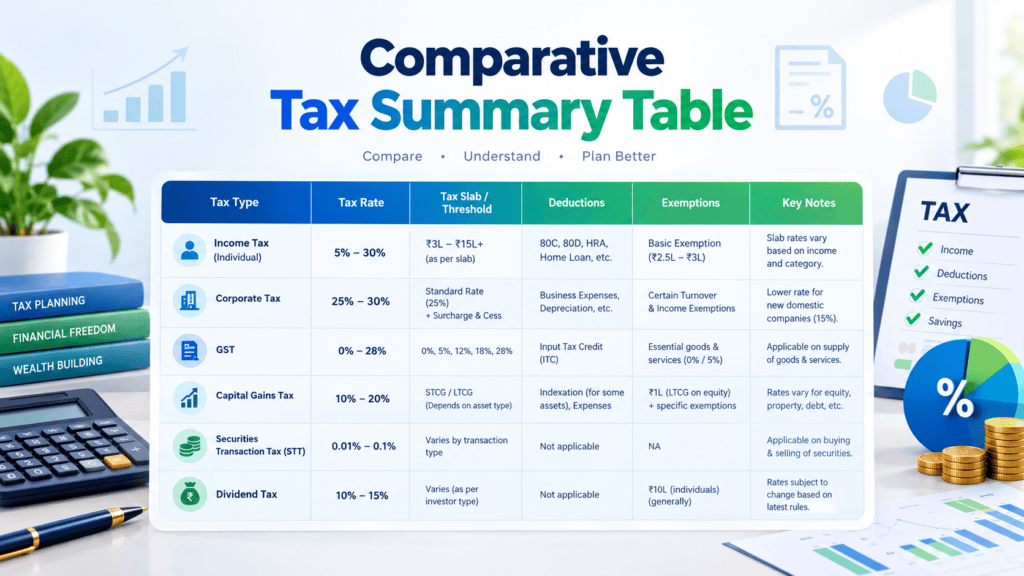
| Equity Type | Tax at Grant? | Tax at Vest? | Tax at Exercise/Payout? | Tax Treatment at Sale |
| ISOs | None | None | AMT Preference (on spread) | LTCG (if qualifying) or Mixed |
| NSOs | None | None | Ordinary Income (on spread) | Capital Gains (above FMV at exercise) |
| RSUs | None | Ordinary Income (full FMV) | N/A | Capital Gains (above FMV at vest) |
| Growth Shares | Nominal / Low | None | N/A | LTCG (on growth above hurdle) |
| Phantom Shares | None | None | Ordinary Income (full cash value) | N/A (Cash bonus) |
| MIPs | None | Varies | Defer to liquidity event | LTCG or Ordinary Income |
| Ordinary Shares | Income if discounted | Depends on 83(b) | N/A | Capital Gains (above cost basis) |
Pro-Tip: Section 83(b) Election
For early-stage equity subject to vesting (like restricted stock or early-exercised options), filing a Section 83(b) election within 30 days of grant allows you to pay ordinary income tax on the equity’s value at grant rather than at vesting.
- Why it matters: If the company’s valuation surges, paying tax early on a nominal value turns all future upside into Long-Term Capital Gains, saving significant tax dollars upon eventual sale.
Should Startups Offer Employees Equity Compensation?

Almost every startup reaches the same moment. You’ve found someone you want to hire, they’re good, and they know they’re good. The salary you can offer is well below what a larger company would pay. So you offer a piece of the company instead.
Equity compensation has become so standard in startup hiring that founders rarely stop to ask whether it’s the right call for their specific situation. It usually is — but it comes with real costs, and the version of it that works is quite different from the version that gets handed out carelessly. Here’s an honest look at both sides.
What equity compensation actually is
Equity compensation means giving employees an ownership stake in the company as part of their pay. In practice this takes a few common forms:
Stock options are the most common at early-stage companies. An employee gets the right to buy a set number of shares at a fixed price — the strike price — at some point in the future. If the company grows and the shares become more valuable, the difference is the employee’s gain. Options come in two flavours: incentive stock options (ISOs), which carry favourable tax treatment but only go to employees, and non-qualified stock options (NSOs), which are more flexible and go to contractors and advisors too. For a deeper overview of startup equity compensation and how different option types work, see Ravio’s complete guide to equity compensation for startups.
Restricted stock units (RSUs) are a promise of actual shares once certain conditions are met. They’re more common at later-stage and public companies, because they have value even if the share price doesn’t rise — which also makes them harder for an early startup to justify.
Restricted stock is real stock granted upfront, subject to a vesting schedule. It’s typically used for founders and the first few hires, when the share price is low enough that buying in costs very little.
Whichever form you choose, vesting is the mechanism that makes it work. The industry norm is four-year vesting with a one-year cliff: nothing vests until the employee has been there twelve months, then shares vest monthly or quarterly over the remaining three years.
The benefits of employee equity
Attracting and retaining talent
This is the reason most founders start here. Early-stage startups compete for engineers, designers and operators against companies that can simply pay more. Equity is how you close that gap — not by matching the cash, but by offering something the larger company can’t: meaningful exposure to a big outcome.
It filters, too. Candidates who are excited by an equity-heavy package tend to be the ones who believe in what you’re building and can tolerate risk. Candidates who want to convert the whole offer to cash are telling you something useful about how they’ll behave when the company hits a rough quarter.
Retention comes from the vesting schedule. An employee two years in has half their grant unvested, and leaving means walking away from it. That’s real holding power — though it’s worth being clear-eyed that it’s a financial handcuff, not loyalty. It buys you time to give people reasons to stay that have nothing to do with their option grant.
Managing payroll costs
For a pre-revenue or early-revenue company, cash is the binding constraint. Every rupee or dollar of salary is money not spent on infrastructure, marketing or extending runway. Equity lets you assemble a team that would otherwise be unaffordable, and defer the cost of that team to a point where the company can actually bear it.
The trade-off is that equity isn’t free — you’re paying in ownership rather than cash, and ownership is the more expensive currency if things go well. A 1% grant to an early engineer costs nothing today and could cost tens of millions at exit. That’s often a trade worth making. It just isn’t the free lunch it can feel like when you’re staring at a tight bank balance.
There’s also an accounting dimension that surprises first-time founders: equity grants create a non-cash expense on your income statement. It doesn’t touch your bank account, but it does affect how your financials read to investors and acquirers.
Aligning employees with company success
This is the argument that matters most in the long run. When employees own part of the company, the gap between “what’s good for me” and “what’s good for the business” narrows. People make different decisions when they’re owners — they push back on wasteful spending, they care about customer retention beyond their own targets, they think about whether a shortcut today creates a problem next year.
It changes the texture of how a team operates. Ownership tends to produce more candour in meetings, more willingness to work across function boundaries, and more comfort raising unpleasant news early. None of this is automatic. Alignment only happens when people understand what they hold, and that requires you to explain it plainly.
The risks and disadvantages
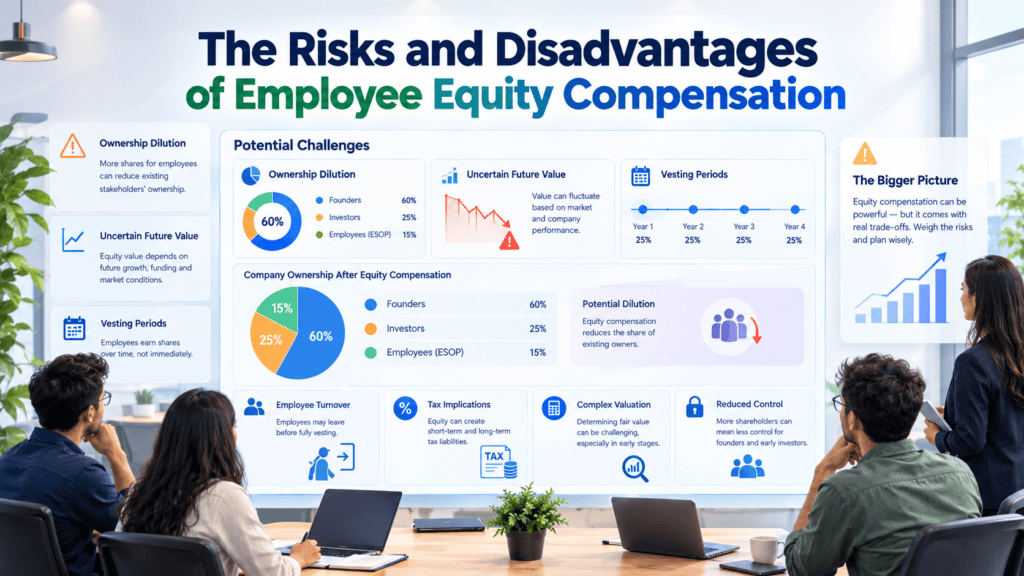
Most startups fail, and most equity is worth nothing
This is the uncomfortable centre of the whole subject. The large majority of startups never reach an exit that makes employee options meaningful. An employee who takes a significant pay cut for equity is, statistically, taking a pay cut.
That doesn’t make equity dishonest. It does make overselling it dishonest. Founders who describe a grant in terms of what it would be worth at a billion-dollar valuation, without mentioning the likelihood of that outcome, are setting up a resentment that surfaces years later.
Employees often don’t understand what they’ve been given
A surprising number of people accept an offer without knowing their strike price, the total share count, the preference stack sitting above them, or how long they have to exercise after leaving. A grant of “10,000 shares” means nothing without a denominator.
This creates two failures. Employees undervalue their equity and treat it as lottery tickets, which kills the alignment benefit entirely. Or they overvalue it, make life decisions on that basis, and feel misled when reality arrives. Both are avoidable with clear communication.
Liquidity and the exercise problem
Startup shares can’t easily be sold. Worse, an employee who leaves typically has 90 days to exercise their vested options — meaning they must pay the strike price in cash, plus potentially a large tax bill on paper gains they can’t yet realise, for stock that may never be worth anything. Plenty of employees have walked away from vested equity because they couldn’t afford to keep it.
Extended exercise windows — 5 to 10 years post-departure — solve this and are increasingly common. They cost the company something in flexibility, but they turn a grant into something an employee can actually keep.
Dilution
Every share you issue reduces everyone else’s percentage, founders included. A typical option pool runs 10–20% of the company, and it gets topped up at each funding round, which dilutes again. Over several rounds, founders who started with 50% each can end up with single digits.
Dilution isn’t inherently bad — owning a smaller slice of a much bigger pie is the entire logic of venture financing. The danger is unmanaged dilution: grants handed out reactively, early hires given outsized stakes they never grow into, and no model of what the cap table looks like three rounds from now. Build that model before you make your first grant, not after.
Legal, tax and administrative complexity

Equity compensation is a regulated area and mistakes are expensive to unwind. The main things to get right:
- A properly adopted equity incentive plan, approved by the board and shareholders, defining the pool and the terms
- A defensible valuation of your common stock (a 409A valuation in the US, or the local equivalent) to set strike prices — get this wrong and you create tax problems for your employees
- Correct tax treatment, which differs sharply by instrument and jurisdiction. In the US, an 83(b) election on restricted stock must be filed within 30 days and cannot be fixed late
- Cross-border rules, if you hire internationally. What works in one country may be tax-inefficient or unenforceable in another
- Clean cap table records, because messy equity documentation surfaces during diligence at exactly the moment you can least afford friction
This is not a place to save money on advisors. Use standard documents where they exist, and get a lawyer who has done this before.
So — should you offer it?
For most venture-track startups, yes. The talent and alignment benefits are hard to replicate any other way, and candidates in this market expect it.
But the version worth offering looks like this. A properly structured plan with a modelled option pool, standard four-year vesting, a defensible valuation behind the strike price, and ideally an extended exercise window. Grants sized by role and stage rather than by negotiation stamina. And a written explanation, given to every employee, that covers total shares outstanding, their strike price, their vesting schedule, what exercising costs and what would have to happen for it to be worth something.
If you’re bootstrapped with no exit in mind, equity may be the wrong instrument — profit sharing or cash bonuses map better to how value actually flows in that business. If you’re a two-person company, wait until you have a plan and a valuation rather than promising percentages in a chat thread.
The companies that get the most out of equity aren’t the ones that give away the most. They’re the ones whose employees actually understand what they hold.
How to Design an Employee Equity Plan: A Step-by-Step Guide
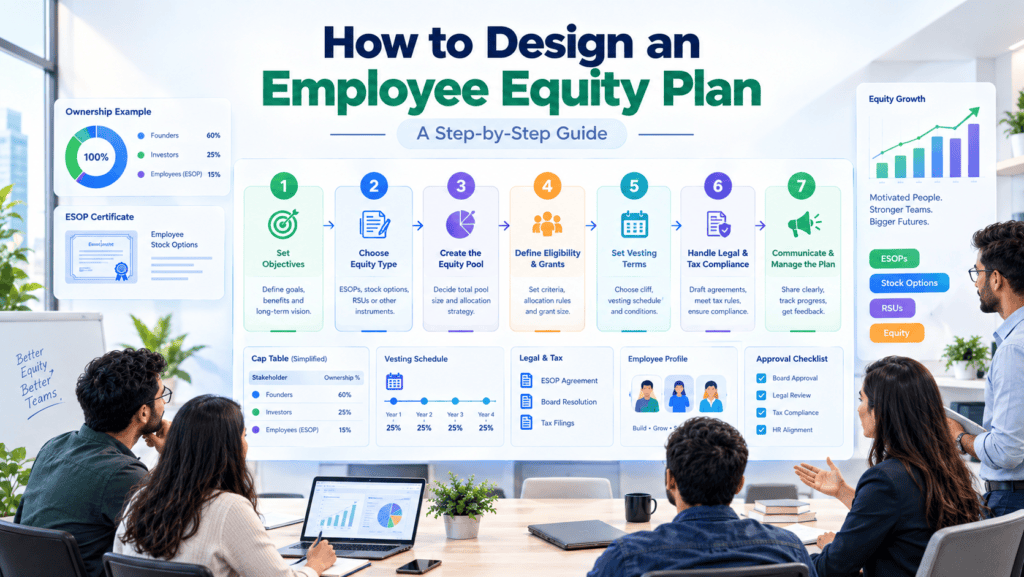
Designing an employee equity plan is one of the most consequential decisions a growing company can make. A well-structured plan attracts top talent, aligns incentives, and builds a culture of ownership. A poorly designed one creates confusion, resentment, and administrative chaos.
This guide walks through seven essential steps to build an equity plan that works for both your company and your employees.
Step 1: Define Your Compensation Philosophy
Before you decide how much equity to grant or to whom, you need to answer a more fundamental question: What are you trying to achieve? A compensation philosophy articulates how equity fits into your overall approach to rewarding employees and aligning them with the company’s strategic objectives.
Without a clear philosophy, your plan design will lack coherence. Common objectives for an equity plan include attracting and retaining talent, driving employee engagement through ownership, uniting a global workforce around common goals, or rewarding employees for a significant company milestone.
Your philosophy should also clarify how equity compares to cash compensation. Are you a startup that can’t match big-tech salaries but can offer meaningful ownership? A late-stage company using equity as a retention tool for senior leaders? The answers shape everything that follows.
Step 2: Decide Who Gets Equity
Not every employee needs equity, and granting it indiscriminately can dilute the pool without achieving strategic goals. Your philosophy from Step 1 should guide eligibility decisions.
Most companies segment employees into tiers. Senior leadership and key early hires typically receive the largest grants, as they are critical to the company’s success and are often taking a risk by joining a growing company. Broader employee populations may receive smaller grants as part of a culture of ownership, particularly in public companies where equity awards are more standardized.
Geography matters too. If you have international employees, consider whether local culture and regulations make equity meaningful in each jurisdiction. Some countries lack a strong culture of employee ownership, and employees there may not value equity as they would cash. You may need to customize your approach by region.
Step 3: Determine the Employee Option Pool
The option pool is the reserve of equity set aside for employee grants. For growth-stage companies, a typical pool ranges from 10 to 20 percent of fully diluted shares. A more common sweet spot cited by many advisors is 10 to 15 percent.
Several factors influence the right size for your company:
- Growth plans: A company planning aggressive hiring over the next 12 to 24 months needs a larger pool than one growing gradually.
- Talent profile: Recruiting experienced executives requires larger individual grants, thus a larger pool.
- Funding stage: Earlier-stage companies often allocate larger pools because equity plays a more significant role in attracting talent before cash compensation can compete.
- Retention needs: A pool that only covers initial hires leaves nothing for promotions, refresh grants, or future key hires.
The pool is not set in stone. It can be expanded with board and shareholder approval, though each increase dilutes existing shareholders. Sizing it thoughtfully upfront reduces the need for repeated expansions.
Step 4: Choose the Equity Vehicle
Different equity instruments serve different purposes. The right choice depends on your company’s structure, stage, and goals.
Stock Options give employees the right to purchase shares at a set price (the strike price) after vesting. They are most common in early-stage startups where the current valuation is low and future growth potential is high. Options have value only if the share price rises above the strike price, which aligns employees strongly with value creation.
Restricted Stock Units (RSUs) represent a promise to deliver shares upon vesting. RSUs are common in public companies or later-stage businesses where valuation is more predictable and employees value the certainty of receiving actual shares. Unlike options, RSUs have value even if the share price stays flat.
Phantom Stock and Stock Appreciation Rights (SARs) provide the economic benefit of equity without granting actual ownership. These are useful for private companies that want to reward employees without diluting ownership or navigating complex securities regulations.
For global companies, the same vehicle may not work everywhere. Tax treatment varies dramatically by jurisdiction, and some countries restrict certain plan types. Early involvement of legal, tax, and finance teams can identify these roadblocks before they derail your rollout.
Step 5: Decide Equity Grant Sizes
How much equity should each employee receive? This is where art meets science. There are three common approaches to sizing grants:
Ownership-Based (Percentage): Grants are expressed as a percentage of the company. This is intuitive for early employees at small companies—it communicates “you are a true part-owner.” However, percentages become harder to manage as the company grows and dilution compounds.
Value-Based (Dollar Amount): Grants are tied to a target dollar value, then divided by the fair market value per share. This mirrors public company practice and ensures consistency across roles. It works well for later-stage companies with reliable valuations, but early-stage 409A valuations may not reflect true market value.
Share Count: Fixed numbers of shares by role or level (e.g., “Senior Engineer: 20,000 shares”). Simple to communicate but becomes meaningless if the share price changes dramatically.
Regardless of method, establish clear guidelines by level and role. Without guidelines, you risk the “squeaky wheel” syndrome where more aggressive negotiators secure better terms than their peers, creating internal inequity. Guidelines also support more inclusive hiring by reducing unconscious bias in equity allocation.
Step 6: Design the Vesting Schedule and Exercise Window
Vesting schedules serve a critical purpose: they tie an employee’s equity to their continued contribution over time. The standard for most companies is four-year vesting with a one-year cliff. This means an employee must stay one year to vest 25% of their grant, with the remaining 75% vesting monthly or quarterly over the following three years. For RSUs, a three-year schedule with annual vesting is also common.
The cliff protects the company from granting equity to someone who leaves after a few months. The gradual vesting after the cliff incentivizes retention.
Exercise windows matter for stock options. After leaving a company, employees typically have a limited time—often 90 days—to exercise their vested options before they expire. This can be a financial burden if the employee cannot afford the strike price and tax liability. Some companies extend this window, though there are tax implications for both parties that require careful legal review.
Termination provisions also deserve attention. What happens to vested and unvested equity if someone is terminated for cause versus resigning voluntarily? Clear, written policies prevent disputes.
Step 7: Communicate Equity Clearly to Employees
An equity grant that employees don’t understand is barely a benefit at all. If employees can’t grasp what their award is worth or how it works, they won’t feel rewarded, and the motivational impact is lost.
Effective equity communication should cover several essentials:
- The basics: What is equity? How does this specific award work?
- The value: What could this be worth, and under what scenarios? Be honest about the risks and uncertainty, especially at private companies.
- Key dates: Grant date, vesting milestones, exercise windows, and expiration dates.
- Tax implications: Employees need to understand when they’ll owe taxes and how to plan for them.
- How to access: Where to find plan documents, who to contact with questions.
How you communicate matters as much as what you communicate. Different generations and geographies prefer different channels—email for some, webinars for others, printed materials for still others. Personalize where possible, and use multiple channels to reinforce key messages. A single town hall presentation won’t suffice.
For global plans, localize communications by time zone and consider whether local laws require translated documents or specific disclosures.
Putting It All Together
Designing an equity plan is not a one-time project. It requires ongoing attention as your company grows, your headcount changes, and your strategy evolves. The plan you build at 20 employees may need significant revision at 200.
The companies that get this right treat equity as a strategic tool, not an administrative burden. They design with intention, communicate with clarity, and adapt as circumstances change. The result is a workforce that thinks and acts like owners—because they are.
How Much Equity Should Employees Get?

There is no one-size-fits-all answer for how much equity an employee of a start-up should get. Factors such as the employee’s role, level, the timing of the hire, the value they will provide and the risk they will undertake by joining the company should all be considered. Start-ups should also consider its employee option pool and the company’s valuation at the time of the grant.
Equity by Role and Seniority
An employee’s equity should increase by role, level, and the degree of their responsibility and decision-making ability and the potential for value creation from their position. This means that a senior executive or technical lead with overall responsibility for one of the company’s key areas may get a bigger equity award than a junior employee in an area where their responsibilities are more tightly focused.
In broad terms, a start-up might create groups or bands within the company based on factors including seniority and the role the employee is expected to play:
Lower levels: Smaller grants with a long-term focus.
Mid-level: Moderate grants determined by experience and expectations.
Senior levels: Larger grants for increased responsibility and potential value creation.
Executives or heads of key technical areas: Potentially higher grants based on their responsibility, leadership role, and risk in joining the firm.
Again, there is no hard-and-fast rule across industries, stages of business, or sizes of companies. The correct balance depends entirely on the start-up’s needs.
Equity by “Early” Hire Considerations
Hiring at an early stage means the employee will likely have to accept more risks than someone considering a job at a later date when the potential rewards (in terms of both salary and equity grants) may be much more attractive.
At an early stage, the company may still be testing a model or a product design, identifying product-market fit, raising funds, and defining its own revenue streams and cost structure. Grants can be an attractive way of compensating early employees for the risks they will assume and the delays they may have to endure before seeing a financial return on their investment. Start-ups should consider factors such as:
- The level of seniority at which a candidate is hired.
- The employee’s skills, knowledge, and experience.
- The contribution and value expected from the role.
- The degree of responsibility and ownership for this level.
- Expected cash salary vs. industry-standard compensation.
- The company’s valuation and dilution considerations.
- The employee’s potential to increase the value of the company.
A founding engineer is likely to get a different grant compared to a developer a year or two down the line when the company has already raised millions of dollars in funding and has a sizeable engineering team.
Equity Bands and Structures
Setting ranges for the start-up’s equity bands is likely to make compensation decisions more straightforward. A four-year time-based vesting schedule with a one-year cliff is standard for most start-ups (although the actual terms could vary from company to company). In general, the structure should be determined by what the employee will receive (e.g., the number or percentage of shares/ options), vesting conditions, and/or exercising requirements, and any additional terms (such as those that apply when an employee leaves the company).
A sample equity band structure could be:
- Employee category Possible considerations
- Junior Lower responsibility; smaller equity grant
- Mid-level Independent contribution; specialization and responsibility
- Senior Significantly increased value creation potential
- Lead/Principal Technical or functional lead
- Executive Overall company responsibility
Most start-up employee equity is awarded in a stock option plan. This gives each employee a theoretical right to buy some shares at a specific point in time (usually with a price set when the option is granted).
Benchmarks for Equity Grants
Benchmarks tend to allow start-ups to set the value of a potential equity grant, but these should only be used as a guideline. Founders can compare proposed offers with those across the industry and similar sized and stage companies by leveraging compensation databases, reports, and compensation platforms, as well as recommendations from investors and comparable companies.
However, companies should use caution when using these as a reference point and apply discretion when making decisions (see below). A 0.5% equity grant from one company is unlikely to have the same value as a 0.5% equity grant from another since a company’s capitalization, dilution, option pool size, and fundraising potential, among other factors, may differ significantly.
By using a combination of the factors listed below, start-ups can begin to analyze compensation data more closely.
Similar companies comparable compensation reports and data
- Role and seniority of the employee
- Funding round and stage of the company
- Company size
- Location (country, city)
- Cash salary
- Company’s valuation
- Size of the option pool
- Dilution considerations
- Vesting terms
A comprehensive equity program should enable the start-up to be transparent with its employees about the value of what they are being offered, what they will need to do to earn it, and how its value could be impacted and change as the company evolves and grows.
Here is a detailed guide covering vesting schedules and equity exercise. I want this to be a helpful blog post for employees, founders andHR to understand their equity.
Below are all the important concepts in detail:
The Employee’s Guide to Equity: Understanding Vesting Schedules and Exercise Windows
You’ve negotiated your salary, but for many people in the startup and tech world the real riches lie in your equity compensation. Of course, this equity is rarely handed over right away- it typically vests out over time.
Understanding what this means, including the intricacies of vesting schedules, cliffs, and other concepts will help you avoid walking away with nothing due to a miscommunication or misunderstanding. Here is a detailed breakdown of how equity works.
- The Standard: Four-Year Vesting, One-Year Cliff
The standard for most startups is a 4 year vesting schedule with a one year cliff
This means that over the course of 4 years you’ll vest in 100% of your total grant.
The one year cliff means that if you leave before that one year anniversary date you don’t get any of your total grant. After the first year, it’s typical to “cliff” into 25% of your total grant.
Why do companies use a cliff?

The cliff exists to protect companies from employees who would take a signing bonus and walk after three months. It creates an additional hurdle for employees to clear before they can vest in any of their total grant. This way if someone leaves after three months of employment, the company doesn’t lose any of its equity compensation.
- Monthly vs. Quarterly Vesting
Once you clear the one year cliff, the remaining 75% will vest either monthly or quarterly, depending on the terms
Quarterly vesting (The traditional standard)
After the one year cliff you’ll vest 25% each year for the next three years: 25% at the end of year one, another 25% at the end of year 2 and so on until you reach 100%. The benefit of this method is that it’s easier to account for. But if you happened to leave right before your next vesting date, it would be like you left with nothing.
Monthly vesting (The employee friendly standard)
Instead of waiting to vest in nice round numbers every year, you would vest in 1/48th of your total grant every month.
This might seem a bit more tedious, but it does have some advantages. If you happen to leave right before your next vesting date, you can still claim the money as if you’d vested at the end of the month. In practice monthly vesting creates less “risk” at the end of your vesting schedule.
Which is better?
When negotiating compensation, monthly vesting schedules are preferable from the employee’s perspective because it reduces the “end of term” risk
- Post-Termination Exercise Periods (The “Use It or Lose It” Trap)
One of the more insidious gotchas when dealing with equity grants is the Post-Termination Exercise Period.
When you leave a company, you’ll typically have a limited amount of time (called the Post-Termination Exercise Period or PTEP) to buy your vested options. If you fail to do this within the PTEP, you’ll lose any unexercised options. This is a “gotcha” because it’s easy to vest in a bunch of options and then not exercise them within the PTEP, losing them.
The standard PTEP is 90 days, which is also the most common length in the US.
The PTEP’s biggest drawback is that it penalizes people who leave the company. When you leave most of your equity will have vested, but you’ll have little or no window to actually exercise them. This means the company’s equity gets wiped out as soon as you leave your job, resulting in a loss for everyone.
The 10 year/Extended Window
Several companies (Pinterest, Coinbase, etc.) have modified their bylaws to give terminated employees a 10 year PTEP.
This can be extremely valuable in practice because it gives you plenty of time to find a liquidity event (like a public offering or acquisition) before having to pony up for your options.
- Exercise Windows and the Tax Implications
When you “exercise” your options you end up with actual shares, which are subject to tax.
The type of options (NSO or ISO) determines the type and amount of tax you’ll owe
With NSOs, you’ll owe income tax at the fair market value (FMV) of the share at the time of exercise, less the strike price. With ISOs, your tax options are more nuanced, and will depend on things like the AMT.
The 83(B) Election
One thing worth noting when it comes to taxing options is the 83(b) election. By filling out a form within 30 days of exercising your options, you can elect to be taxed based on today’s FMV (which is usually much lower than the FMV when you finally vest). This can be a huge risk reduction move, especially for employees and founders.
- Equity Refresh Grants
One of the dangers with a 4-year vesting schedule is that once you hit year four, you’re “fully vested” and don’t receive any more equity. One of the ways companies combat this is with equity refresh grants
These are typically issued after your first year or two and are “back-ended” (vested gradually over time) using either a 4 year vesting schedule, 1 year cliff or even a 2 year vesting schedule with no cliff
Refresh grants ensure that everyone continues to have “skin in the game”, and prevents people from jumping ship solely for the purposes of renegotiating a higher compensation package.
Navigating the nuances of employee equity can be akin to reading a foreign language. Terms like ISOs and NSOs strike prices and dilution, 83(b) elections, etc. – they sound more like tax code jargon than a valuable compensation tool to your employees.
When they’re not understood by your employees, your carefully crafted compensation strategy loses all meaning, and your equity is viewed as a currency with a value of $0.
Here is a comprehensive guide for communicating equity to your employees at every career stage
Explaining Equity Value (“5,000 Stock Options”)

One of the biggest mistakes companies make is sending over a job offer that reads “5,000 Stock Options” and nothing more. 5,000 Stock Options can represent anywhere from $500,000 or $0 depending on the strike price and company performance at exit.
You Should Always Explain The % Ownership And Scenario Modeling
Always remember to explain the % ownership of a given share grant when delivering the offer, and give realistic scenarios of the valuation at exit.
Show ownership, not just shares: e.g. “10,000 shares out of 10,000,000 total issued shares represents a 0.1% ownership of the company.”
Clarify the Strike Price vs. Preferred Price: e.g. “They aren’t giving you 10,000 free shares, but they’re offering 10,000 shares at a 401(a) valuation of $X”
Provide a scenario matrix showing potential values of the shares: e.g.
Exit Valuation Per Share Value Estimated Value of 10,000 Shares Net Gain ($1/share Strike Price)
$50 Million | $5.00 $50,000 $40,000
$100 Million | $10.00 $100,000 $90,000
$250 Million | $25.00 $250,000 $240,000
Pro-Tip: Always frame equity as non-guaranteed, risk capital. Your employees should always think about the potential value of the shares, not how much cash the shares will guarantee them.
Explaining Vesting Terms (“How You Earn Your Equity”)

Vesting is designed to ensure that your employees are earning their equity in conjunction with the long-term success of the company, but the typical 4 year with 1 year cliff and the concept of acceleration can be a foreign concept to your candidates.
Explain The Standard Terms And Use Analogies
The 4 year with 1 year cliff: “Think of the 1 year cliff as your trial period. You’ll vest 25% of your total equity when you’ve been employed for 12 months, and the remaining 75% will vest on a monthly basis 1/48th of your total grant each month for the next 36 months.”
Performance-based vesting: If you’re granting performance-based equity, make sure you explain what needs to happen for them to earn their shares (reaching $10MM ARR, etc.)
Exercise windows & post-termination: Be honest about when employees will have the ability to exercise their options, and what happens when they leave the company (You should always have a 90 day exercise window post-termination at the very least; some companies offer extended exercise windows up to 5 or even 10 years)
Discussing Potential Liquidity Events
When a new hire asks “When can I sell these?” you need to temper their expectations so that they’re not let down when a liquidity event doesn’t happen on the timeline they’re hoping for.
Discuss The Concept Of Illiquidity
Simply put, your employees can’t go out and sell their shares on an exchange. You have to reach a liquidity event, and there are only a few ways to do that:
IPO: Going public. This is typically followed by an 180-day lockup period by insiders before shares can be sold on the public market
M&A: One company buying another. This can take a few forms, ranging from entirely cash deals to all-stock deals, or a mixture of the two
Secondary tender offers: This allows employees of a private company to tender all or a portion of their vested shares to a private equity buyer, typically at a higher price than the book value of the shares
Dilution: You should always explain that there’s a realistic possibility of dilution as the company raises additional funding rounds.
Education During Onboarding
Don’t hide your equity program in a 40 page employee handbook. Make it an interactive component of the onboarding experience.
Build An Onboarding Education Module
Equity 101 presentation: Run a 30 minute presentation going over ISO vs. NSO, how to exercise options, how taxes work (AMT, etc.), and vesting
Provide an equity one-pager: Give all new hires a cheat sheet that explains important concepts, dates (vesting cliff, etc.), and where they can view their portal
Grant access to equity portfolios: Make sure to get them set up with access to their equity management portal (Carta, Shareworks, Pulley, etc.) so they can visualize their equity.
Providing Continuous Communication
Once your employee has joined the company, it’s important to keep the conversation about equity going so that they realize the value in the ownership they’ve earned.
Annual Total Rewards Statements
Make sure to provide an annual summary of total rewards that not only shows your employees their cash + benefits, but the projected value of their vested and unvested equity.
Company all-hands communications: When you complete a 409A valuation or raise a round of funding, make sure to send out a company wide update explaining what the new 409A means for everyone.
Refreshes: Discuss what needs to happen for your employees to earn “equity refreshers” (annual salary reviews, promotions, retention after year two, etc.)
Tax disclaimer resources: Never provide tax or financial advice, but consider bringing in a third party financial planner or equity specialist to hold Q&As with your employees.
Startup equity is a mysterious subject, filled with exotic jargon, vague terms like “options,” and a massive salary range depending on the timing and circumstances of your joining the company.
To shed light on the subject, here is a comprehensive guide on equity compensation structures, common sizes and ranges by the company stage, and how offers vary depending on the employee level and seniority.
How Startups Compensate Their Employees With Equity

Contrary to popular belief, startup equity does not come in the form of direct stock issuance in the vast majority of cases.
Instead, startups utilize equity-based compensation vehicles, which are financial instruments that give you the right to purchase stock.
Stock Options (ISO vs. NSO): Provide a right to buy shares at a predetermined price (strike price).
Incentive Stock Options (ISO) – given to employees, favorable taxation treatment upon exercise
Non-qualified Stock Options (NSO) – given to contractors, advisors, and sometimes employees, taxed as ordinary income upon exercise
Restricted Stock Units (RSUs): Given mostly by late-stage, public companies (series D+), substitute RSUs for actual shares
Vesting Schedule & Cliff:
The default industry standard refers to a 4-year vesting schedule with a 1-year cliff.
The Cliff: To receive any compensation, you have to stay at the company for 12 months since your joining date. If you leave before month 12 – you forfeit all your equity.
Post-Cliff vesting: 1/48th of your total grant amount per month, during the following 36 months (or 1/12th per year).
Equity Offer Ranges by the Startup Stage
Depending on the stage, company valuation will increase significantly, employee headcount will grow, and your own personal grant size range will vary between ranges.
Company Stage
Typical Valuations
Employee Headcount
Equity Pool Size
Common Stock/Compensation
Comment
Pre-Seed / Seed
$2M – $15M
1 – 10 people
10% – 15%
Common Stock / ISOs
Most common compensation form for Pre-Seed / Seed, high risk, but high reward, low cash compensation
Series A
$15M – $50M
10 – 50 people
8% – 12%
Stock Options (ISOs)
Early-stage engineering, design, and product leads expect a fraction of a percent (0.01%) stock option grants
Series B
$50M – $200M
50 – 150 people
5% – 8%
Stock Options (ISOs)
Series B Valuations increase – grants are issued either in a percent range or in terms of dollar values ($x,xxx)
Series C+
$200M+
150+ people
3% – 5%
ISOs / RSUs
Lower risk, cash compensation approaches the market value
Equity Sizes by Role and Seniority
Here are some examples of real-world equity ranges in startups for Series A+, depending on the series and seniority of the employee
- Seed Stage (first 1-10 employees)
First Engineering Lead / VP: 1.0% – 3.0%
Senior Software Engineer: 0.5% – 1.0%
Mid-level engineer / Marketer: 0.25% – 0.5%
Junior Employee / Operations: 0.1% – 0.25%
- Series A (10-50 employees)
VP, C-Suite level: 0.8% – 1.5%
Director Level: 0.25% – 0.5%
Senior Engineer / Lead: 0.1% – 0.3%
Mid-level IC: 0.05% – 0.1%
- Series B & C (50+ employees)
At Series B and C, equity grants are expressed in terms of dollar value, which depends on the 409A valuation of the company (the fair value of a share of company stock).
VP, C-Suite: $500,000 – $1,500,000+ range value, issued as 4-year vesting, 1-year cliff
Director / Staff Level: $150,000 – $350,000 range value, issued either as cash or equity
Senior IC: $50,000 – $150,000 range value, issued either as cash or equity
Mid-level IC / Entry: $10,000 – $40,000 range value, issued either as cash or equity
Things to Consider When Reviewing an Offer

There are several reasons why the stated value of an equity grant might be misleading.
Fully Diluted Share Count – when considering a grant of any size, make sure to ask what is your percentage in a fully diluted share count. 10,000 shares of a hypothetical company with a 10M share count would mean that you only own 0.1% of the company
Dilution – as the company grows and reaches higher valuations, the total share count of the company increases, which reduces your percentage. However, the company is worth more at the time of a liquidity event, so the overall value of your grant might still increase
Exercise Window – the time period during which you can exercise post-termination (leaving the company, death, disability, etc.). The standard industry window is 90 days from your departure date. Some startups offer a longer exercise window (up to 7 or 10 years), at which point you can elect to not pay the strike price upon leaving
FAQs
1. What is the typical equity range for early engineering hires?
The equity for an early engineering hire will typically depend on the company’s maturity, funding, role, experience, and responsibility. For example, at the early stages, engineers are said to get between 0.1% and 1%, whereas a founding engineer or a very senior early hire should get more significant ownership. The equity is usually given as stock options or similar compensation, subject to a vesting schedule, typically with a one-year cliff. The company must consider the salary, value, timing, and dilution when determining what percentage to give. In addition, employees should look into their options’ vesting, exercising, and the company’s valuation.
2. How do early engineers balance low cash salaries with higher equity?
Early engineers typically balance lower base pay by negotiating equity structures that maximize long-term upside while managing personal financial risk. Key strategies include:
- Valuation & Vesting: Securing a 4-year vesting schedule with a 1-year cliff, ideally with early exercise options (83(b) election) to minimize future tax burdens.
- Performance Bonuses: Structuring cash or equity bonuses tied to critical product or revenue milestones.
- Pro-Rata Rights & Severance: Negotiating anti-dilution clauses or clear severance terms to hedge against extreme downside risk.
Ultimately, early engineers treat initial equity as an investment—exchanging upfront cash for a high-leverage stake in the startup’s potential growth.
3. What is a standard equity vesting schedule for early employees?
A standard equity vesting schedule for early employees contains a four-year vesting period with one year cliff. This implies that no shares will be granted during the first year, but upon reaching the 12 th month, the employee will receive 25% of the total amount. The rest is distributed every month (or quarter) during the next three years, until the point when the employee is entitled to 100% of the initial allocation.
Such a schedule is beneficial for both the company and the employees, as it prevents the latter from leaving the company before a specific period has elapsed while incentivizing the ones who stay for a long time. Some start-ups provide a possibility to accelerate vesting upon acquisition or layoff, and the founders, as well as early hires, sometimes negotiate a shorter cliff or faster vesting schedule.
4. What is the difference between ISOs, NSOs, and RSUs for early hires?
Thus, considering the particularities of ISOs, NSOs, and RSUs, it could be concluded that they are all different and should be considered separately.
Such equity compensation methods as ISOs (Incentive Stock Options) are usually granted to employees but have a great amount of tax benefits if certain conditions are met. In turn, NSOs (Non-Qualified Stock Options) could be granted to both employees and outside directors and have a particular tax basis when they are sold or purchased.
Finally, RSUs (Restricted Stock Units) do not give any rights to the holders but entitle them to receive a certain number of restricted stocks upon the vesting date. Therefore, based on the peculiarities of the equity-based compensations methods mentioned above, the appropriate choice for the early hires in the company would be made considering several circumstances: the company’s maturity, employee’s position, tax implications, and the concentration on the strike price or the stock price.
5. What is the post-termination exercise window (PTEW)?
The post-termination exercise window (PTEW) is a specific period during which a former employee can exercise his or her vested stock options after leaving the company.
Usually, it lasts for 90 days, and the ex-employee should decide whether to buy the vested shares or not. In the case of the option holder’s indecisiveness or unwillingness to make a decision, his or her unexercised options will expire. Thus, the options can only be exercised before the end of the PTEW; otherwise, they are canceled.
Although 90 days is the standard duration of a PTEW for incentive stock options (ISOs) because of the ISO tax rules, some companies now offer longer PTEWs to make their equity more accessible to former employees.
6. How does future dilution affect early engineering equity grants?
The dilution of shares in the future can affect the ownership percentage of the early engineering employee because the equity ownership is decreased when the company raises another round of financing or issues more shares. For instance, one percent (1%) ownership of the company can decline to a lesser figure depending on the number of new shares issued during a round of financing.
Nonetheless, dilution does not always indicate the decrease in the value of an employee’s equity stake. A prospective early engineer must consider the importance of distinguishing between shares and their percentage and evaluate the worth of the ownership at the future date. In this regard, it is essential to review the company’s options pool, fundraising plan, vesting schedule, and the projected dilution to understand the potential equity grant’s value.
7. Should startups offer stock option grants based on a fixed percentage or a dollar value?
There are two types of grants based on which a startus may grant an employee with options: the percentage of the firm’s stock and the dollar value of the options.
The former is typically given at earlier flames of a startup’s development and is straightforward to explain. A dollar-value grant, meanwhile, is more common in the case of more mature companies, and may be preferable because it takes into account the fluctuating value of the firms’ stock.
However, many serial startups and consultants suggest that one should use a percentage to make grants when starting a business and switch to a dollar-value method when possible to ensure that the size of a stock option grant is consistent across dif- ferent levels within the company.
Author Bio
Jeevesh Tripathi is a product strategy researcher and startup technology writer at BkAbhi Innovations Lab
.Specializing in early-stage product builds, MVP development frameworks, and startup vendor evaluation, he breaks down complex business, equity, and engineering decisions into actionable guides for founders. Drawing on deep experience across software development and tech strategy, Jeevesh crafts clear, practical insights to help entrepreneurs navigate early hiring, fundraising, and product execution with confidence.