
Table of Contents
Engineering Interview Questions: What to Expect
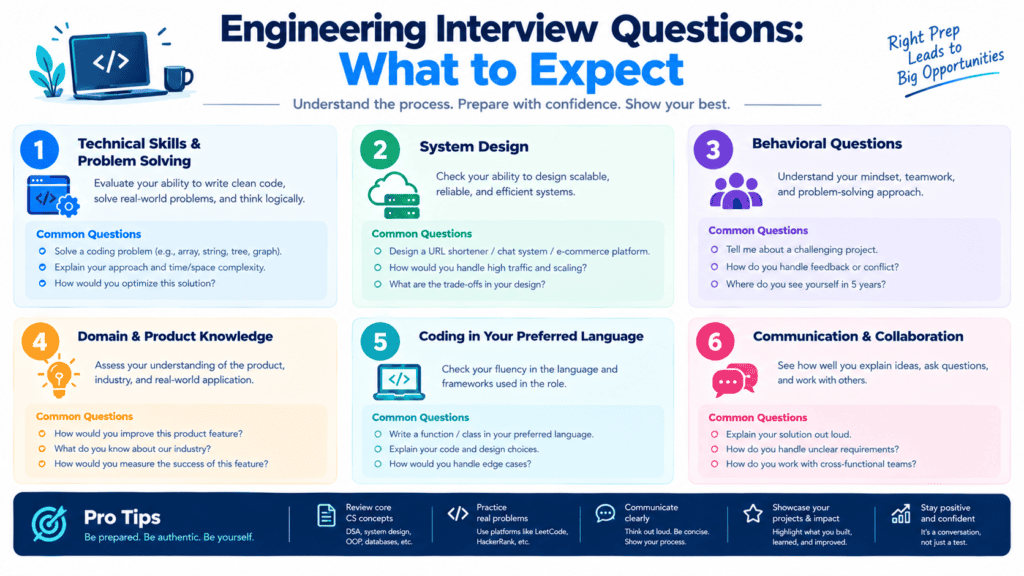
Interviews in the engineering field are meant to evaluate many factors, and not just the coding abilities. Employers seek to know how you solve problems, express technical ideas, collaborate with others, and arrive at engineering solutions.
During the interview process, there are various queries that may be presented to candidates based on the job position for which they are applying, such queries could be based on various standards such as data structures, algorithms, programming languages, software engineering, database technology, cloud technology, and process of software development.
Behavioral questions about your experiences and projects along with challenges you faced, collaboration, and your experience dealing with failure will also be brought up. Different candidates may be asked to explain on the decisions made and the results of their work according to their experience.
Before heading into your interview, be sure to go through the job description, learn about the tech environment of the company you are applying to, practice coding problems, and recall examples of past experiences that relate.
General Engineering Interview Questions

Motivation and career goals
Interviewers ask these questions in order to determine your interest in engineering and whether your future goals are compatible with the company’s development trajectory.
“Why did you choose engineering?”
Focus: Describe a situation or issue that has triggered your interest in engineering. It’s important to emphasize that you wish to respond to real-life issues and provide feasible resolutions.
I can say that my interest in complex systems has persisted throughout my life. When I was at university, I participated in a project where I was involved in the development of a small model of an automated irrigation system, and it was then that I understood that engineering makes it possible to implement abstract mathematics into real life. This combination of analytical thinking and practical activities fascinates me. For additional guidance on discussing your engineering background and experience during interviews, you can also explore Intuit’s engineering interview questions guide.
“Where do you see yourself in five years?”
Focus: Display your ambitions while remaining realistic about your future career path. Mention your ambitions to acquire comprehension in one certain engineering field.
Sample answer: I would like to become a senior engineer in five years’ time and help junior engineers. I am determined to learn how to create scalable systems and become an influential decision-maker in this engineering sphere.
Strengths and Weaknesses
The questions aim to evaluate your self-awareness, personal development, and honesty.
- “What is your greatest technical strength?”
- Focus: Anchor your strength in a specific skill backed by a concrete result.
- Sample Answer:”My greatest strength lies in my methodical approach to debugging. Rather than merely trying random methods to fix issues, I focus on isolating variables, reviewing logs, and creating reproducible tests. Thanks to this approach, I was able to decrease the downtime of critical systems by 30% in my previous job.”
- “What is your biggest weakness?”
- Focus: Discuss a genuine area for growth—not a humblebrag—and immediately explain the steps you are actively taking to improve.
- Sample Approach:“Earlier in my career, I tended to over-engineer solutions by anticipating edge cases that were unlikely to occur. I’ve since adopted a leaner iteration strategy: I focus on building modular, simple solutions first, then optimize based on performance metrics and actual user needs.”
Company and Role Fit
These questions are meant to confirm your understanding of the employer’s product, technology stack, and market positioning.
- “Why are you making an application to our organization?”
- The intention behind this is to demonstrate how your values or your technical interests align with a particular project, product feature, or technical challenge faced by the organization.
- How you could respond: “I am aware of your recent movement toward adopting microservices architecture with low latency. My experience fits well with this transition, and I want to help overcome scaling issues for such a great amount of data.”
- “What makes you a good fit for this role?”
- Focus: Align your specific technical toolkit directly with the core requirements listed in the job description.
- Sample Approach: “It’s critical to balance rapid product deliveries with strong systems reliability in this role. I have successfully led a team that developed pipelines and reviewed code, providing me with the capacity to demonstrate a balance between deployment speed and quality that suits your team’s expectations.”
Work Environment and Expectations
These questions assess your soft skills, adaptability, collaboration style, and conflict resolution mechanisms.
| Scenario | Strategic Focus | Recommended Approach |
| Handling Technical Disagreements | Data-driven decision making | Focus on benchmark data, objective trade-offs, and reaching alignment rather than winning arguments. |
| Working Under Tight Deadlines | Prioritization and communication | Highlight how you manage scope creep, communicate risks early to stakeholders, and maintain code quality. |
| Cross-Functional Collaboration | Clear, non-jargon communication | Explain how you translate complex technical concepts for product managers, designers, and business stakeholders. |
How can prioritizing tasks be done when having multiple deadlines?
- Focus: Use structured frameworks like triage or risk impact analysis.
- My Rehashed Approach: “To deal with competing priorities at the same time, I will evaluate the impact on the business while considering the impact on other tasks. I then break complex deliverables into smaller, manageable tasks. I also ensure that product managers are kept in the loop about any related developments.” Humanize Text
The following is an extensive blog post that prepares readers for answering the question “Questions About Previous Experience and Background.” This guide aims to assist job applicants and interviewees in organizing their responses, underscoring relevant previous experience, and confidently articulating their work history. To help you in your journey, you can check Intuit’s article on engineering interview questions that you may have to answer or ask while searching for a new job.
Mastering the Interview: How to Answer Questions About Your Previous Experience and Background
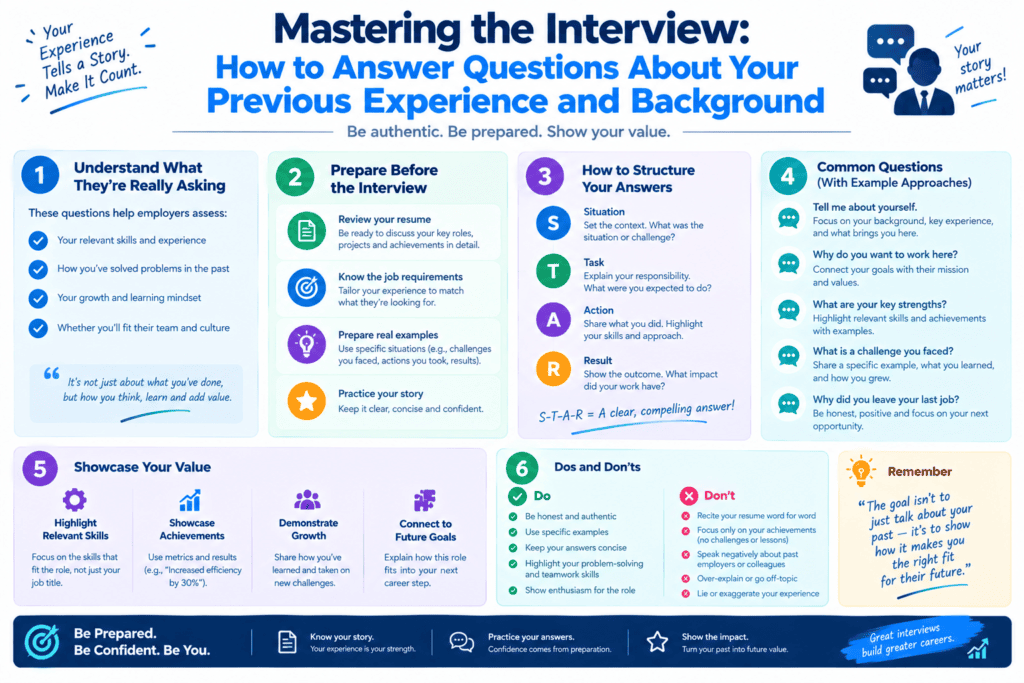
No matter if you are drafting a CV, updating your LinkedIn account, or being interviewed, the “Background and Experience” part affects your success at getting the job. It is more than just telling your life story; it is about selling your candidacy.
Employers are interested in your background because of one critical question: “Are you capable to perform your job principles and are you suitable for the company’s culture?”
To aid you in this endeavor, we provide you with essential elements of your training – Education, Technical Skills, Roles, and Achievements.
1. Education and Certifications
The Aim: To show that you possess the basic knowledge needed for the position.
Instead of just saying that you have the qualifications, you should demonstrate how your qualification has helped you in your past experiences. If the qualifications are not directly related to the target position, you should indicate the skills that might be used in any profession, such as critical thinking and research.
How to go about this:
For New Graduates: Focus on the subjects studied, your previous project work, and the grade point average (if above 3.5).
For Experienced Professionals: Handicaps, licenses, and education received after graduation. Due to rapid development of technology, a constant need for improving knowledge is a great experience to gain.
Rewritten example:
I have a Bachelor of Science in Couter Science from XYZ University. While my degree gave me the theoretical foundation, my recent certification in AWS Cloud Architecture is what has allowed me to specialize in cloud infrastructure, which is exactly what this role requires.”
2. Programming Languages and Technical Skills
The Idea: To prove your expertise and versatility.
Do not make the common error of listing every language that you have learned. Rather, consider the level of expertise (Expert, Proficient, Familiar). Be truthful, since you will be quized on anything you claim to be an expert in.
How to proceed:
Classification: arrange various skill fields according to proper classifications (for example, Languages, Frameworks, Instruments, etc.) Contextualization: avoid just saying “I know Java.” Rather mention how you used it in some previous project.
Example:
“My main stack is Django, developed with Python.”
3. Previous Roles and Responsibilities
The Goal: Show career progression and role relevance.
Here is where you provide the hiring manager with more details. They would want to know how you accomplished these things and why it matters.
Why to answer this way?
Adopt the STAR technique for explaining your role in big projects.
Context: What was ongoing in that period?
Objective: What was expected from you?
Activity: What was your role?
Success: What was the outcome of your contribution?
Example story might be:
While I was an employee at ABC Corporation in my previous position as Project Manager, I was in charge of whole procedure of product life cycle for a product from the moment it was invented till the moment it went into the market. Every day I would interact with various teams created by developers, designers and marketers. For instance, at the time when I was working on delivering a particular feature, I managed to implement Agile sprints and consequently reduced the delivery duration by 20%.”
4. Career Achievements and Projects
The objective is to set yourself apart from other job applicants.
The duties describe the things you need to do while accomplishments list the things that you have finished. It’s a very serious part of your resume.
So, here’s how to tackle this issue:
Quantify your achievement: Simply saying “Increased sales” is weak. Saying “Increased sales by 30% over the last year” is much stronger.
Mention Signature Projects: Highlight one or two key projects in which you were key.
So, here’s how to tackle this issue:
Instead of writing something like “sales grew by 30% over the last year” which is too weak.
Putting It All Together: The “Elevator Pitch”
When an interviewer asks, “What’s your background?”, you have to interconnect all these four modules to create a narrative of about two minutes. You can use the following outline:
The Hook (Present Status): “I am a Digital Marketing specialist having spent five years in the tech sector.”
The Backbone (Education and Qualifications): “I have a degree in Communications and a Google Analytics certificate.”
The Skills (Technical skills): “I specialize in SEO, content strategy and analytics using Python.”
The Proof (Achievements): “At my previous workplace, I worked on a project that contributed to a 150% increase in organic traffic in a year. I want to do something similar here.”
Technical Engineering Interview Questions: A Complete Guide
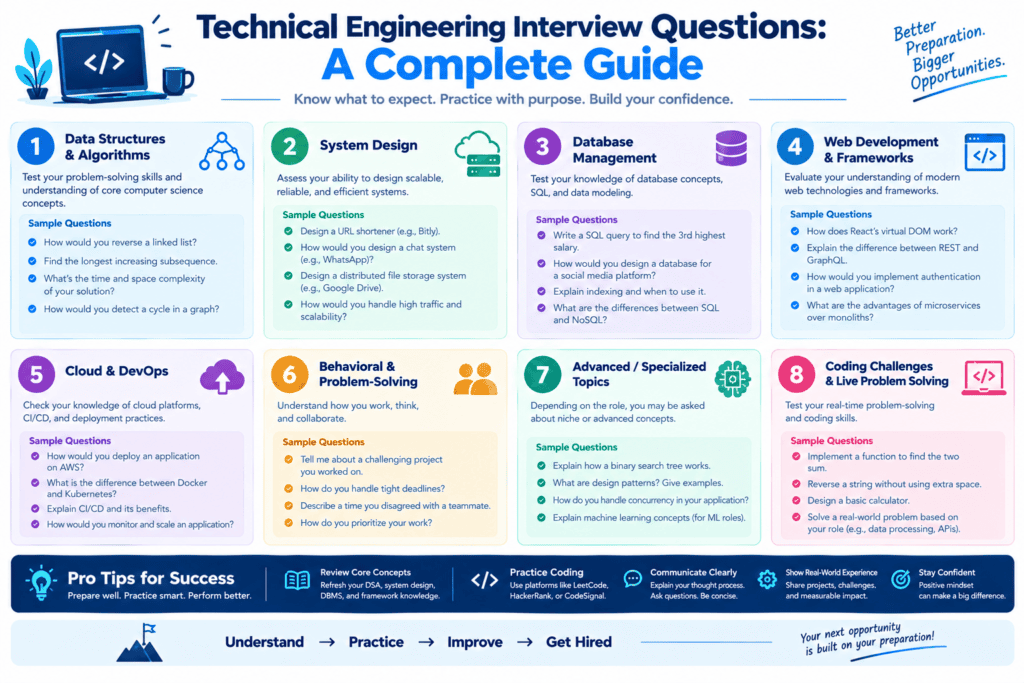
Software engineering job interviews usually test six key skills: coding and problem-solving, API and software architecture, databases and data management, cloud computing and containers, scalability and system design, and security and error handling. This article describes the typical questions employers ask and what they mean.
1. Coding and Problem-Solving
This section tests raw programming ability, algorithmic thinking, and code quality under time pressure.
Common questions:
When interviewing for a software engineering position, there are six key skill areas that the interviewer tries to assess: coding and problem solving, API and software design, database and data management, cloud computing and container usage, scalability and system architecture, and security and failure management. This article explains the kind of questions that a hiring manager typically asks and what they can mean for the candidate.
What interviewers evaluate:
- The clarity of your requirements and edge cases before writing any code.
- Your thought process with regards to time/space trade-offs.
- How easily others can read your code/naming conventions.
- Your attitude toward clues or challenges.
2. APIs and Software Architecture
This section evaluates how good is your ability to create interfaces between different systems as well as coding for the maintainability of your code.
Typical questions that eclectically validate your skills include:
- One of the requirements for every software engineer should be the knowledge of REST, GraphQL, and gRPC.
- How can APIs be versioned as not to disturb previous customers?
- Tell about idempotency and what is the reason it is important for APIs (such as payment processing)?
- What are the disadvantages of synchronous communication in comparison to asynchronous communication between services?
- These technologies can be encountered in numerous publications all over the web.
- Monolithic programming implies using a single application for system programming while microservices programming involves using microservices for building distributed systems.
- The questions remain: What is REST? What are GraphQL and gRPC? And, when should each one be used?
Here are the things that interviewers check:
- Your knowledge of design compromises instead of the only true answer.
- Understanding of backward compatibility and practical changes in APIs.
- Talent in interpreting architectural choices concerning business goals.
3. Databases and Data Management
This part talks about the relation and non-relation data modeling, query performance, and data consistency.
Some common queries include:
- When can we select a SQL database instead of a NoSQL database and the other way round?
- What does normalization mean in database theory?
- What is index theory in database management?
- What are the necessary stages to follow in the creation of the SQL statement, which would provide the second highest salary from a table?
- Mention ACID and list out its properties.
- How can you perform migration of a database on a running production system without doors having closed?
- What is database sharding and what challenges does it bring in?
The aspects that the interviewers evaluate are:
- Practical experience of constructing appropriate queries, without theoretical issues pertaining to that.
- Comprehension of concepts like fault-tolerance, robustness, and consistent operation.
- Cognitive skills in considering limitations when it comes to scalability of particular solutions.
4. Cloud Computing and Containers

This subsection assesses mastery of the current deployment technologies and infrastructure issues.
Typical questions include:
- State the distinction between container and virtual machine.
- Discuss the interrelationship between containers and different types of Docker images.
- What does Kubernetes do? Which problem would be addressed?
- What measures do you take to keep your credentials secure in the cloud?
- What are horizontal and vertical scaling principles?
- What meaning does “Infrastructure as Code” convey?
- What aspect of implementation of the relevant practices does Terraform cover?
The things that hiring managers seek out are as follows:
Direct experience with cloud-native processes.
Cost awareness, efficiency, and impact on business decision-making.
Understanding of the issues that are common during the transition (cold starts, vendor lock, complexity of the process, etc.)
5. Scalability and System Design
This section generally poses the core theme of senior-level interviews and tests whether you can design large resilient systems.
Questions typically raised in a technical interview for system design:
How would you design a URL shortener (like bit.ly)?
Design a notification system that would scale.
How would you design a system that can handle millions of concurrent users, for example, for a chat application?
Describe the CAP theorem and relate to distributed systems.
What does a load balancer do? What algorithms does this type of service typically use?
How to design fault-tolerant and always-available systems?
What are the differences between caching types such as write-through, write-back, and cache-aside?
Interviewers will assess the following aspects:
Structured thinking involves the following stages: data collection, capacity planning, high-level design, and the actual implementation process.
Making appropriate trade-offs regarding consistency, availability, latency, and cost.
The ability to find bottlenecks and suggest valid workarounds.
6. Security and Error Handling
This section aims to evaluate your attitude toward building fault-tolerant systems.
The most common questions that could be asked during an interview are:
What is the difference between Authentication and Authorization?
What are SQL injections, and how can they be prevented?
What is Cross-Site Scripting (XSS), and what are the possible ways to mitigate it?
What are the underlying principles of OAuth 2.0?
How would you design a re-try mechanism for a faulty service?
What is the difference between 4xx error and 5xx error? How would the system respond to such errors?
How would you design logging and monitoring to identify and troubleshoot issues in production?
What the interviewers are looking for:
A security-first mindset when designing and developing the system.
The practical knowledge of the vulnerabilities that every serious web application must be protected from (OWAPS Top 10).
Ability to communicate the issue clearly instead of “silent” errors.
Final Tips for Candidates
- Keep talking. Interviewers value your thinking process as much as your outcome.
- Ask for clarification before getting down to coding/designing. Often, vague expectations are a part of the evaluation process; it is essential to ask the right questions.
- Be aware of the trade-offs. There is rarely a “correct” answer in system design/architecture; it all depends on aspects such as scale, budget, and team size.
- Practice explaining instead of only finding solutions. Knowing how to teach something means you have truly understood it.
Preparing yourself in all areas — not only coding — indicates that you understand how the engineering profession works: programming is just a small part of successful software development.
Here is a comprehensive blog post that will help applicants prepare for behavioral interviews, as it covers the purpose of interviews, gives the STAR method, and provides examples of responses for each facet.
The Ultimate Guide to Soft-Skill & Behavioral Interview Questions

The knowledge of technical skills can help you land an interview, but it is the combination of technical and soft skills that will assist you in getting the job. In today’s world employers aren’t just looking for an employee who knows how to code, write, or analyze data. They are searching for someone who is capable of communicating, adjusting, leading, and resolving issues under pressure.
Behavioral interview questions are created with the idea that it is past behavior that can predict future behavior.
To answer those questions correctly one must do more than just provide generic answers. One needs a proper system when it comes to responding to such interview questions. This article will outline the main types of behavioral interview questions and provide well-structured sample answers that illustrate the main concepts.
The STAR Method: Your Secret Weapon
Before diving into the particular questions, it is essential to learn how to form a perfect answer:
Situation: Provide the context (Who, what, where, when).
Task: Describe what goal or problem needed to be solved.
Action: Describe what you did (use I, and not we).
Result: Say what the final result was, with data, if possible.
1. Teamwork and Collaboration
The aim of the interview: To assess if you will be a “culture add” rather than a “culture fit”. Can you adapt to different personalities? Does your team spirit outweigh your individuality?
The questions to ask:
“Tell me about a time when you had to work with a difficult colleague”
“Give me an example of a time when you had to work with another department on a project”
The follow-up answer example:
Question: “Can you describe a time you worked with a co-worker who was not pulling their weight?”
Situation: I was working as a Marketing Specialist, and I had to e-mail the launch of the campaign with a two-week deadline and two of my colleagues.
Conflict: One of my colleagues did not know how to work with the latest software update and could not complete his part of the work.
Action: Instead of asking our manager to speak with my colleague, I decided to figure out what the problem was on my own.
Result: It turned out that the problem was a recent update, and my colleague did not know how to work with it. I gave him some advice on how to work with the new update, and he could finish his part of the work.
What I did right: I did not escalate the issue to the manager since it could cause conflicts within the team. Instead, I tried to solve the issue on my own and helped my colleague.
What I wish I’d done differently: I wish I had asked for help from our manager in finding a solution to the issue. If he wanted to speak with my colleague, it would have been his decision, but I should have asked for assistance.d, and the campaign got launched on time.
2. Leadership and Mentoring
The purpose: You do not always need to be a “Manager” to be a leader. Interviewers are looking to hire candidates who can come up with ideas, influence others and help them develop.
Common questions:
“Give me an example of a project you have worked on as a leader.”
“Describe an experience where you were helping a novice to improve.”
Sample answer:
Question:”Tell me more about an experience you had mentoring a person with difficulties.”
Situation: We recently brought a junior developer on board who has amazing technical skills, but did not have the confidence needed to talk with clients about their questions.
Task: As the lead project manager on this project, it was important that he be able to communicate technical information to me so that I could focus on my own other pressing issues.
Action: The best way to do this was to use what is called “shadowing.” During the first two meetings that the new hire attended, I presented everything while the new hire just listened. During the second round of meetings, the new hire presented the “technical issues” with me listening.
Result: Within a month, the junior developer has led his own calls with clients and gotten great feedback from the clients in their evaluations of our team!
3. Handling Deadlines and Challenges
Objective: Can you work under pressure? Are you organized? Can you recover after failures?
Typical questions:
“Can you describe a time when you dealt with a demanding deadline?”
“Can you give an example of when a project did not go as planned and what did you do to solve it?”
Example of the right answers:
Query: Can you share your experience when you were forced to meet an almost impossible deadline?
Circumstances: We were in the middle of the project, and our chief designer abruptly left the job at three days remaining before we had to submit materials for printing.
Job function: I had to meet the deadline to ensure that the project launch would not be delayed.
Response: Instead of panicking, I took a deep breath and assessed the situation. I hastily evaluated the remaining workloads and realized that I would not be able to meet the deadline on my own. I urgently arranged a meeting with my supervisor to re-prioritize the tasks. I had to sacrifice the “good to have” trends and focus on the must-haves.
Result: In the end, we managed to finish everything in time for the printer. Although we had to cancel several design elements, we successfully launched the central product of the project a few days later. The sales of that product started to come in within the first week, which brought another $50,000 to the company. This experience also taught me that “perfect is the enemy of good enough” and that sometimes, it is better to make a living than to try to make a fortune.
4. Managing Feedback and Conflict
Objective: Emotional Intelligence. Are you able to look criticism in the face and not be resentful? How about solving disagreements?
Guiding Questions:
“When have you received tough feedback?”
“How do you respond when disagreements are raised with your superior or colleague?”
Sample Response:
Question: “Tell me about a situation when you had to hear harsh constructive criticism.”
Situation: After delivering an important presentation in front of the executive team, I was told by my supervisor that I seemed “too formal” and “difficult to reach out to” in the question and answer session.
Task: I was getting defensive since I thought I was being just authoritative and factual. However, I needed to understand how I was being seen in order to develop my leadership capabilities.
Action: I thanked my supervisor for his honesty. I asked to share specific situations in which I was being thought of as too formal. I found out that I was interrupting others when I thought they were wrong. I started to use the strategy of “active listening” in meetings – waiting for three seconds before responding and taking notes instead of interrupting.
Outcome: In my quarterly assessment, my supervisor made a positive observation on my way of communicating. A co-worker commented thatworking with me is now quite simple. I realized that any feedback, no matter how hurtful it is, serves one purpose – being a chance for evolution.
5. Quality and Problem-Solving
Objective: Are you proactive? Do you solve problems for the sake of themselves or do you invest your time and efforts in finding the root cause of the problem and eliminating it?
Frequent Inquiries:
“Give an example of problems you identified on your own and solved proactively.”
“Tell me about a time when you found a way to streamline a process.”
Sample Response: In the context of being interviewed for the position of the Customer Success Manager, you might be asked such a question as “Tell me about a time when you found a unique solution to a problem”. Here is a sample response:
Due to my experience as a Customer Success Manager, I know that we face the same problem of clients abandoning us due to their inability to use a certain reporting feature.
Duty: We didn’t want to hire more agents, at the same time, we understood that we had to limit the number of support tickets sent to us.
Initiative: I analyzed the top ten queries we got from clients and found that the documentation was too much formal and technical, therefore I decided to record a series of two minutes “How-To” videos. I placed them right where the users may experience difficulties.
Outcome: Tickets concerning this particular feature decreased by 65%.is feature decreased by 40% in the first month. Levels of client satisfaction increased and this video series became not only an onboarding tool for our client but for the video series as such.
Final Tips for Success

Be Specific: Avoid using vague phrases. Instead of saying “I’m a good team player,” give an example, such as “I arranged a lunch to facilitate communication between the Design Department and sales.”
Quantify Achievements: Numbers attract attention. Try to use percentages or even dollars.
Be Honest: Don’t make things up. The professional interviewer will notice a fake story immediately. Tell a few true stories from your life, even if they sound trivial.
Practice Pronunciation: The STAR technique is simple to think about, but it can be confusing when said out loud. The best is to practice standing in front of a mirror or with a friend.
Good luck with the interview! It is your chance to not only impress the interviewer with your skills but also to reveal your personality.
The conclusion of an engineering interview is a great opportunity to change the flow of the interview. You get to see whether the company would be suitable and there are any technical problems too. As a rule, asking general questions leads to general answers, hence, you need to focus on specific subjects while asking your questions.
Team Structure & Collaboration
Finding out the composition of a team suggests how some choices are done and how much effort will be needed on a daily basis.
“How many software engineers are present compared to product managers, designers, and QA?”
Reason: having a reduced number of software engineers than comparing to product managers implies intense feature construction and a disregard to technical debts. The absence of a QA or DevOps team would imply that you will be the one who will be testing and deploying work.
“What is the structure of the teams (for instance: product pod, functional discipline), and how is collaboration across teams performed in jobs that require to be done by many squads?”
Reason for asking: Enforces integration the cooperation between the teams’s members and the way how cross-team projects experience issues.
“What degree of independence do engineers have regarding their execution decisions after establishing the product objective?”
Reason for inquiry: It reveals whether the approach is authoritative (directing) or inspires engineers to be creative in resolving their problems.
Day-to-Day Responsibilities & Engineering Culture
The answers to these questions provide a genuine insight into what your everyday work life will be like.
“What ratio of time will you spend during a week coding versus going to meetings, preparing for meetings and doing code reviews?”
Why ask: To understand whether being a Maker vs. a Manager is a good fit for you and if it is something you will have to deal with.
How would you deal with technical debt in relation to the completion of new features during a sprint?
Why this is a good question: Every codebase acquires technical debt and good teams spend a significant amount of their sprint capacity (generally around 15-20%) on dealing with technical debt.
What do you do in case of major outages or critical bugs?
Why this is a good question: Look out for a company culture that embraces no-blame post mortem process. No blame culture concentrates on fixing the problem, while toxic culture looks for the one guilty for the issue.
Current Projects & Technical Architecture
By investigating the current projects, you can identify the certain level of technical complexity you will be exposed to from day one.
“What is the major technical challenge your team expects to tackle in the next 3-6 months?”
Reason: This will allow you to determine the problems you are likely to address on a regular basis, as well as whether your personal interests align with the innovation area your future employer is considering.
“Can you walk me through a project lifecycle of a large-scale initiative your team has recently concluded – from design to launch?”
Reason: You will be able to identify whether the organization practices technical design documentation and peer reviews before the code implementation or if you can jump to coding right away.
Tools, Infrastructure, and CI/CD Pipeline
Rationale: You will determine whether or not the organization that you are studying utilizes technical design documents and peer reviews, or whether the coding does not involve pre-implementation verification.
| Focus Area | Question to Ask | What You Want to Hear |
| Deployment | “How frequent is your deployment to production, and what is your CI/CD pipeline implemented?” | Frequent integration process that includes automated testing, deployment with feature flags, and many deployments every day/week. |
| Testing | “What is your testing approach and how assured is your team about its effectiveness?” | A high level of test coverage provided by reliable and quick integration and unit tests that are automatically executed with every merge request. |
| Environments | The ease of configuring a local development environment, and its conformity with the live environment is remarkable in view | containerized environments like Docker and automation scripts for installation that can make new employees productive in a matter of hours instead of taking weeks. |
Performance Measurement & Onboarding
The questions asked specify how success is to be measured and what timeline is expected for success.
“What is considered successful in this role at 30, 60, and 90 days?”
Purpose : It establishes a baseline as to the expectations and shows eagerness to be productive.
“How does this company evaluate performance reviews for engineers and what defines a successful engineer here?”
Reason : This ensures that you have an accurate understanding of whether the performance is being measured objectively by contributions, impact, and production of high-quality code or subjectively by lines of code and hours spent working outside of regular hours.
“Can you describe your onboarding process for engineers and how long it takes for engineers to deploy code for the first time?”
Reason: Good engineering teams tend to welcome new engineers to ship code in their first week if possible as it sets a great signal for how smoothly their onboarding process works.
Career Development & Mentorship
An ideal job should not only be based on your current abilities, but it should also help you grow your potential future skills.
“What about the career path for Individual Contributors compared to that of Engineering Managers?”
Why: It allows you to verify that there is a parallel career path for Individual Contributors (e.g Staff/Principal Engineer) and that you do not necessarily need to take management positions just for the sake of getting promoted or earning more.
“In what ways does the company encourage uninterrupted learning (e.g. money for conferences, time set aside for learning, internal discussions on technology)?”
Rationale: This reveals if the company invests in the development of engineers or see them as mere resources.
How to Prepare for an Engineering Interview

Landing your ideal engineering job begins long before the interview itself starts. If you are a new graduate or a seasoned professional looking to change jobs, having a complete preparation plan in place can help you move from rejection to an offer. Read on for a comprehensive guide.
1. Understand the Interview Format
Prior to starting any preparations, look on the Internet for different types of interviews. There are four main types in the field of engineering:
technical rounds — skills in data structures, algorithms, and problem-solving,
system design rounds — dialogues about system architecture, scalability, and compromises,
behavioral rounds — team interaction, leadership style, and previous projects,
domain interview rounds — knowledge in a specific area.
Look up the career section of the company or its page on Glassdoor, or contact its current staff through LinkedIn to find out how their interviewing process goes.
2. Strengthen Your Fundamentals
Regardless of the tips or hacks that a person may learn, it is always essential to understand the fundamental concepts behind the subject. Revise:
Core ideas relating to the engineering discipline (data structures or algorithms in the case of software engineering, thermodynamics or circuit theory in mechanical/electrical engineering, etc.)
Mathematical and logical concepts associated with the chosen profession
Common tools and technologies associated with the position you seek
A solid background in these areas will provide a solid foundation upon which to build one’s expertise.round allows you to think well in stressful situations even when confronted with unfamiliar challenges.
3. Practice Problem-Solving Regularly
Practising frequently is better than studying all at once. Plan daily or weekly practice sessions for:
- Coding problems on platforms like LeetCode, HackerRank, or Codeforces (for software jobs)
- Case studies or design tasks related to your field
- Time your practice sessions to recreate the pressure of a real job interview
- Learn from your missteps and try to avoid them in the future instead of simply proceeding to the next task.
4. Work on System Design (For Experienced Roles)
Be prepared to hear system design questions during interviews whenever you are interviewing candidates for a mid-level to senior position. To prepare yourself for these questions, practice the following:
- Design scalable systems like a chat app, ride-sharing app, or URL shortener.
- Clearly explain any trade-offs regarding the architectural decisions you make.
- Be able to communicate your thought process clearly rather than just giving results.
5. Prepare for Behavioral Questions
Having technical skills will not help you get the job; companies will also like to check how good you are at communicating with other people.
- “Tell me a moment when you faced a conflict with a colleague”
- “Tell me about a project you are proud of”
- “How do you deal with short deadlines?” is using the STAR method (situation, task, action, result).
It is wise to come up with five or six examples before facing interviews.
6. Review Your Own Projects and Resume
Often interviewers go beyond the normal interview and look into your resume projects. Being prepared means being ready to cover:
- Give details about the problem you solved and its importance
- Share the technical decisions and trade-offs made
- Discuss the challenges faced and how you solved them
- Trace your impact in numbers wherever possible
7. Mock Interviews Are Your Best Friend
Real-life simulations allow you to decrease anxiety and discover what you still need to prepare. Consider:
- Learning from a friend or a mentor
- Using websites such as Pramp or interviewing.io
- Making a video recording of yourself to analyze your speaking and body language
8. Research the Company
Interviewers are hardly impressed by answers delivered without original thought. Prepare for the interview as follows:
- Familiarize yourself with the company’s products, mission, current affairs, etc.
- Be able to explain why you want to work in this particular company
- Think of intelligent questions to put to your interviewer.
9. Take Care of the Logistics
Tiny factors can leave a huge impact:
- Make sure to check your internet connection and configuration if it is a virtual meeting.
- Have your resume, portfolio and any reference documents ready at any moment.
- Make sure to dress correctly and choose a quiet, well-lit location.
- Plan your journey or login information ahead of time to prevent stressful situations.
10. Manage Interview Day Nerves
The day of the interview:
- Make sure to sleep well before the interview
- Arrive (or log in) at least 10–15 minutes early
- Take a deep breath before you respond — it’s okay to take a moment to think
- After all, interviews are a two-way conversation. You’re trying to determine whether the company is a good fit for you.
FAQs
What are the most common engineering interview questions?
Most engineering interviews commonly assess candidates’ technical expertise, problem-solving proficiency, past work experience, and communicational skills.
Applicants may be expected to demonstrate their comprehension of programming languages, data structures, algorithms, database systems, system design, and other engineering mechanisms. A number of behavioral questions such as “What are your strengths and weaknesses?”, “Describe the most difficult task you had to deal with during your work” and “How did you check the theory?” may also be asked.
Interviewers frequently give some practical situations to test how well candidates apply their skills such as debugging, teamwork, meeting deadlines, and making decisions. Preparing real-life examples using previous work and going over essential technical concepts will help people get answers easy. It is vital to practice both technical and behavioral exam questions to succeed in an engineering interview.
What technical questions are asked in an engineering interview?
Technical engineering interview questions evaluate candidates’ problem-solving skills, understanding of fundamental engineering concepts, and familiarity with the relevant field of practice. Typically, these can include topics such as:
Fundamentals and Theory: Core concepts relevant to the sphere of practice, such as thermodynamics, electrical circuit design, data structures, or properties of materials.
System Design and Architecture: Designing scalable systems, optimizing performance, or generating circuit designs.
Coding and algorithms: Programming, analyzing time/space complexities, and debugging.
Problem-solving and troubleshooting: Learning from real-world engineering failures, reverse-engineering, and identifying the source of a problem within the system.
Project deep dives: Understanding why a given technical decision had been made, what compromise has been made, and what have been the lessons learned from the project.
Expect both theoretical questions and hands-on coding, drawing, or design exercises.
Successful technical interviews begin long before the candidate arrives at the company for the interview. Begin by describing what you want to examine for the role, for example, coding ability, system design, or problem-solving approach. Use questions that test the candidate’s abilities.
As a rule of thumb, open-ended inquiries should be used rather than short-answer ones since one needs to discover how the candidate thinks, approaches, and solves the problems in their natural state.
You should make sure to agree upon standards for the assessment of the candidates before the interview in order to find out their reaction and how they will respond to the questions accurately. Do not rush the interview and, most importantly, do not forget to document your observations right away after the interview.
What soft skills are important in an engineering interview?
In engineering job interviews, soft skills are often as essential as technical knowledge. Employers seek to hire candidates who have well-developed methods of communication, team organization skills, and a positive attitude toward resolving conflicts.
Communication skills help engineers convey their ideas and approaches to work colleagues, clients, and general stakeholders who are not necessarily well-versed in the field. Teamwork implies understanding how to negotiate and network with members of the development teams, designers, product managers, and other partners.
Problem-solving and critical thinking abilities are related to how an engineer can approach a challenge and what relevant decisions they can make. Being adaptable is yet another valuable skill that is required by employers when technical specifications or other aspects of the task change.
Many other qualities can be considered valuable in an engineer, including time management, listening to colleagues, responsibility, and emotional intelligence.
How should I answer engineering interview questions about previous experience?
Use STAR approach (Situation, Task, Action, Result) while describing your technical experience:
Situation & Task: Describe the situation and the task to be accomplished in 1-2 sentences. Explain what challenges were and what were the goals of the project.
Action: 60% of the text should be dedicated to this part. Elaborate on what technical actions you taken, what alternatives you considered, what technical tools did you used and how you resolved technical challenges. Use “I” instead of “we” to show your individual contribution.
Result: Describe the results of your actions in quantitative terms if possible (e.g. improved performance by 30%, reduced some turnaround time, reduced expenses). of the job vacancy description and show your own professional skills in solving various technical-related issues.
How can I prepare for an engineering job interview?
Technical Preparation: Go over the basics in your specialty area (software-related data structures/algorithms for software and fundamentals from other areas). Do plenty of practice problems and work on coding sites like LeetCode or within the context of a particular specialization.
Learn about the company: Learn everything you can get your hands on about their products, tech, and recent news. You should know why you want to work there.
Review your projects: Be ready to discuss your work in detail and to understand what choices you made and what challenges you had to overcome.
Prepare answers to behavioral questions: Practice your responses to questions about teamwork, conflict, and leadership using the STAR approach (situation, task, action, result).
Conduct mock interviews: Arrange practice interviews with friends and record your answers or conduct them while reviewing. This will give you an opportunity to see your progress.
Formulate questions: Be prepared to ask at least 2-3 thoughtful questions to the interviewer.
Get rest before the interview: Quality sleep is a far greater priority than quantity when it comes to preparing for quality.
Final Tips for Engineering Job Seekers

Having a strong ground in engineering knowledge is not everything that is required to land an engineering job. Make sure you have a résumé that specifically pertains to each job by incorporating important technologies, projects, and accomplishments and results in the résumé.
Prepare for the interview stage by brushing up on the fundamentals in engineering and working through some exercise problems in coding and systems design. Search for information regarding the company and job beforehand.
During interviews, communicate your thought process in addition to the final answer. Come prepared with some intelligent questions about the team, engineering culture, technologies, and opportunities for development. If you are applying for remote jobs, be ready to speak about communication, teamwork, time zone coverage, and experience working on your own.
Lastly, consider your job hunting a perpetual process. Use the feedback from interviews, improve your weaknesses, update your portfolio, and continue your projects. All these components combined will correlate with your chances of getting the engineering position you are after.
Conclusion
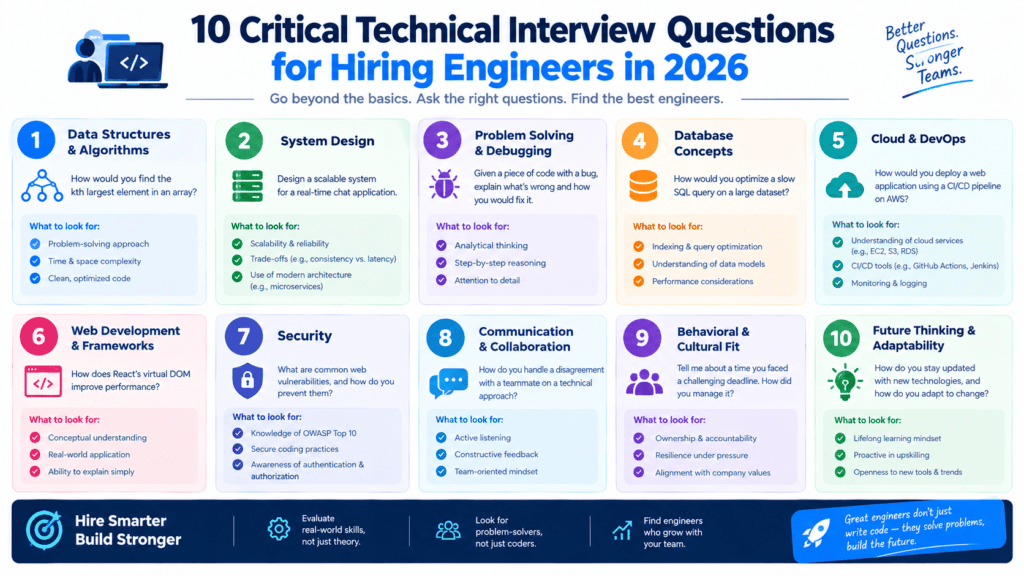
In conclusion, to succeed in conducting technical interviews in 2026, it is critical to combine the complex problem-solving process with the practical assessment of collaborative and systems-design skills. The evaluation of candidates in the core fields, including coding, cloud infrastructure, behavioral resilience, and others, will allow identifying talented engineers.
The organized interview process will help not only attract the best candidates but also build a foundation for scalable engineering culture. Therefore, it is essential to evaluate candidates’ adaptability, communication of trade-offs, and problem-solving abilities when faced with specific challenges.
Author Bio
Jeevesh Tripathi works as an enthusiastic content creator and writer, who is devoted to producing engaging stories and valuable information for the readers. As a skilled writer with a creative mind and an enormous amount of zeal for his work, he is able to create exceptional content pieces full of useful information and easy to understand. Being a part of the bkabhi blog, Jeevesh is constantly researching and writing new interesting articles. In his free time, he studies the latest trends in the field and communicates with his audience through his writing.