
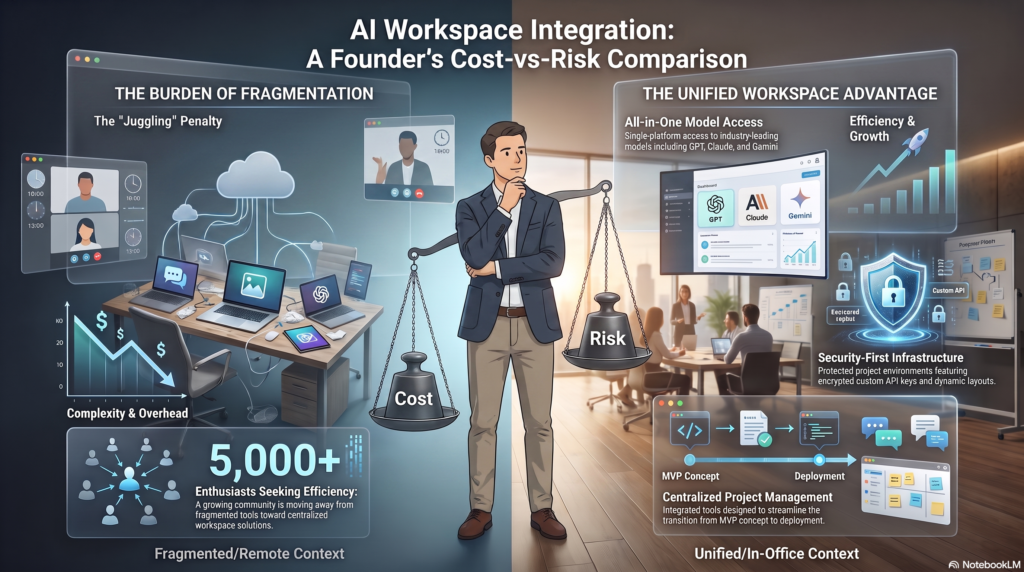
Quick Answer
Offshore MVP development typically costs 40-60% less than onshore builds, but the savings only hold up if you budget for timezone friction, communication gaps, and rework. Onshore teams cost more upfront but reduce coordination risk. A hybrid development team — local strategy lead, distributed engineering — is increasingly the middle path founders choose once they weigh cost against risk honestly. If you haven’t picked a partner yet, our best MVP development company guide is the right starting point.
Rohan had two quotes on his desk. A US-based agency wanted $95,000. A team in Eastern Europe quoted $38,000 for what looked like the same scope.
He picked the cheaper one, assumed the savings were free money, and never asked what the price difference actually bought him.
Six weeks in, he learned the hard way. This guide exists so you make that call with your eyes open, not after the invoice.
Table of Contents
What Offshore, Onshore, and Hybrid Actually Mean
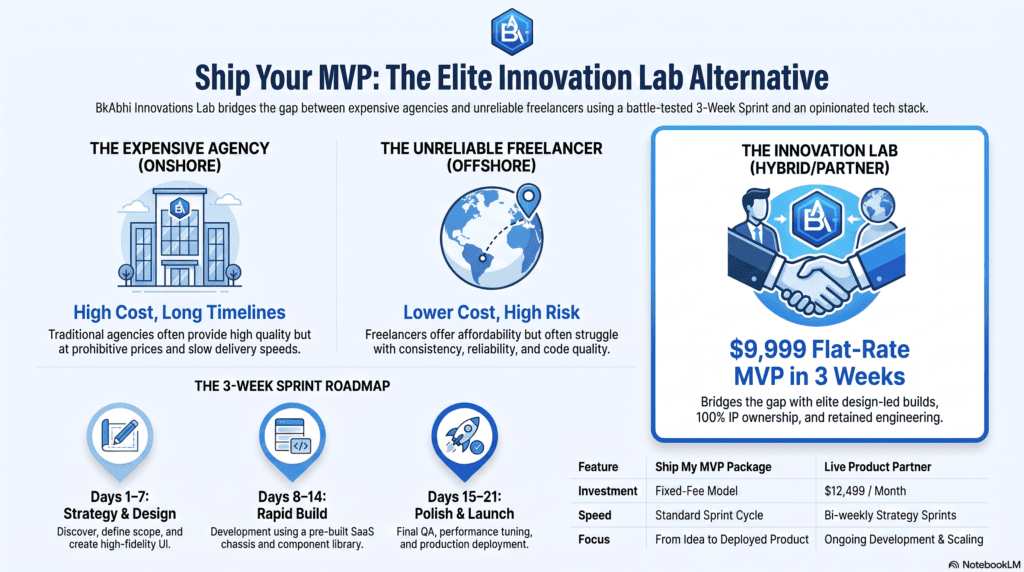
Before comparing costs, it helps to define terms founders often use loosely on discovery calls.
Onshore means your development team sits in your own country, sharing your timezone, language norms, and legal jurisdiction.
Offshore MVP development means your team is based in a different country, usually one with a lower cost of living and lower hourly rates.
Hybrid blends the two: a local strategy lead or project manager paired with a distributed engineering team abroad.
None of these models is inherently better. Each shifts the balance between cost, control, and communication overhead in a different direction.
The Real Cost Comparison
The headline number is the first thing founders compare, and it’s usually the most misleading one on its own.
Recent industry rate data puts offshore developer costs at roughly $20-$45 an hour compared to $80-$150 an hour for US-based onshore talent, a 60-73% gap on hourly rate alone.
That gap holds up broadly across regions. Analysts tracking the outsourcing market note offshore engagements still deliver 40-60% total-cost savings once hidden overhead is counted on both sides.
| Factor | Onshore | Offshore |
|---|---|---|
| Hourly rate | $80-$150 | $20-$45 |
| Timezone overlap | Full | Partial to none |
| Communication risk | Low | Moderate to high |
| Legal recourse | Straightforward | Often limited |
| Typical savings | Baseline | 40-60% |
Our detailed breakdown of MVP development cost by budget tier is worth reading alongside this table, since region is only one of five variables driving your final quote.
Hidden Costs of Offshore MVP Development Nobody Mentions
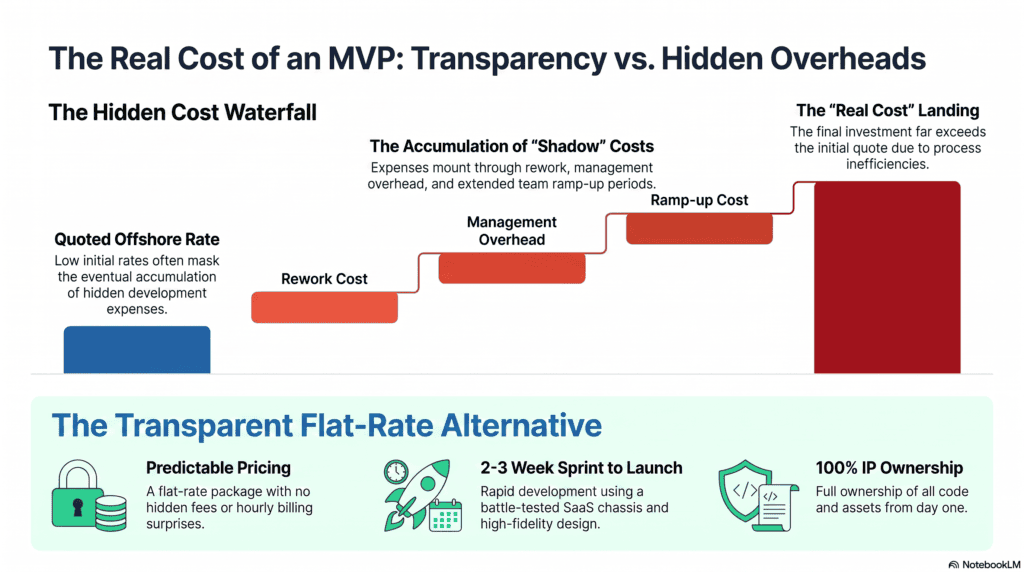
The quoted hourly rate is rarely the number you actually pay once a project is underway.
Rework from misunderstood requirements is the biggest hidden cost. Industry analysis attributes roughly 15-26% of total project hours to rework and defect correction on average, climbing to 30-50% on poorly managed offshore projects.
Management overhead adds up quietly. Someone still has to translate business context into technical specs clearly enough that nothing gets lost across the distance.
Ramp-up and ownership costs matter too. A fully loaded offshore rate typically runs 1.4 to 1.8 times the quoted hourly number once these factors are counted honestly.
Skipping proper QA to save 15-20% upfront frequently produces a 40-60% cost uplift later from post-launch fixes, which erases much of the original discount.
Time-to-Launch Comparison: Offshore vs Onshore Timelines
Cost isn’t the only variable founders compare. Timeline expectations often differ between the two models as well, and the gap surprises people.
Onshore teams typically move faster on kickoff, since there’s no multi-day lag waiting for a contract to clear across borders or a kickoff call to land in a shared working hour.
Offshore MVP development timelines can match onshore speed once a project is underway, but the ramp-up phase — aligning on specs, tools, and communication norms — usually takes 1-2 extra weeks upfront.
That extra ramp-up time is rarely a dealbreaker. It’s simply a cost founders should plan for instead of discovering mid-project when a deadline starts slipping.
Quality and Talent Depth: Is Offshore a Compromise?
A common assumption is that offshore development means compromising on engineering quality. That assumption doesn’t hold up as cleanly as it used to.
Countries like India graduate well over a million engineering students annually, giving offshore agencies a genuinely deep senior talent pool to staff from, not just a junior bench.
AI-assisted coding tools have also narrowed the practical output gap. Recent industry reporting suggests developers using modern AI coding assistants are meaningfully more productive than they were just a couple of years ago, regardless of where they’re based.
The real differentiator isn’t nationality or region. It’s whether the specific team you’re vetting has shipped comparable MVPs before, which is exactly why portfolio proof matters more than a resume line about location.
Risk Comparison: What Can Go Wrong With Each Model
Cost gets most of the attention, but risk is what actually sinks MVP timelines.
Offshore risks cluster around communication. Requirements get interpreted literally instead of intentionally, and feedback loops stretch across a full day when timezone overlap is thin.
Onshore risks cluster around budget. A local senior engineer can cost $150,000-$280,000 fully loaded per year, which burns runway fast on a lean seed budget.
Legal recourse also differs sharply. Enforcing a contract against a domestic vendor is far simpler than pursuing one across international jurisdictions if a project collapses.
Neither risk profile disqualifies a model outright. They just require different safeguards, which is exactly what a solid MVP development contract is meant to cover before you sign anything.
Communication and Timezone Overlap
Timezone overlap is the single most underrated variable in any offshore MVP development decision.
Teams in Eastern Europe or Latin America typically share 4-6 working hours with US founders. Teams in South or Southeast Asia may share only 1-2 hours, or none at all with fully async handoffs.
A thin overlap window isn’t automatically disqualifying. It does mean your discovery process, documentation habits, and written specs need to be far more precise than they would with an onshore team down the hall.
Founders who skip this step often mistake a language barrier for a competence gap, when the real issue was simply an unrealistic expectation of real-time back-and-forth.
MVP Development Company by Region
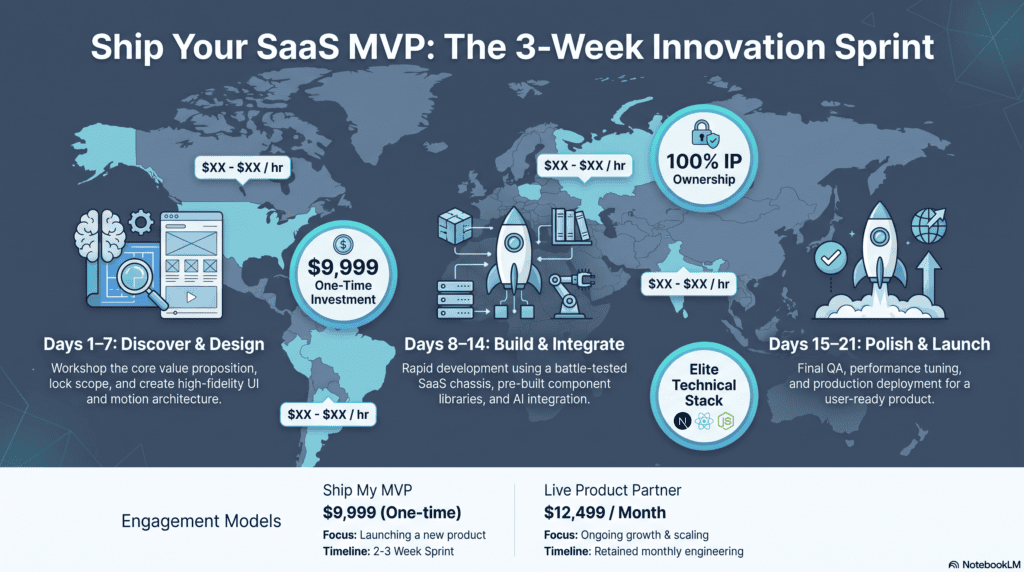
Choosing an MVP development company by region means trading off cost, overlap, and specialization differently depending on where you look.
United States and Western Europe: $80-$150+ per hour, full timezone overlap, and the easiest legal recourse if something goes wrong. Best suited to fintech and healthtech founders who need compliance-aware engineers close by. Our regional deep-dive on best MVP development companies USA covers this market in detail.
Eastern Europe: roughly $25-$45 per hour, strong English fluency, and 4-6 hours of overlap with US teams. A common pick for founders who want offshore savings without sacrificing much real-time collaboration.
South Asia: roughly $15-$35 per hour, deep engineering talent pools, but thinner overlap and more variance in project management maturity between vendors.
Latin America: roughly $25-$45 per hour with near-full US timezone alignment, making it a popular nearshore choice for founders who want offshore rates with onshore-like scheduling.
Public MVP development company rankings on directories rarely account for these regional trade-offs, which is exactly why our piece on MVP development company rankings recommends treating them as a starting point, not a verdict.
When Offshore MVP Development Makes Sense
Offshore development earns its reputation when three conditions line up together.
You’re validating cheaply. Pre-seed founders without funding benefit most from the lower cost floor offshore teams offer.
Your specs are unusually clear. Founders who can write precise, unambiguous requirements reduce the rework risk that eats offshore savings alive.
You have someone to manage the relationship. A technical advisor or in-house lead who reviews code and catches drift early makes offshore engagements far safer.
When Onshore Makes More Sense
Onshore development is worth the premium in a narrower set of situations.
Compliance-heavy products in fintech or healthtech often need engineers who understand local regulatory nuance without a lengthy explanation.
Founders without technical co-founders benefit from the easier real-time collaboration, since clarifying a vague requirement takes a phone call instead of an overnight wait.
Series A teams building for scale frequently prioritize documentation quality and legal recourse over hourly savings.
The Rise of the Hybrid Development Team
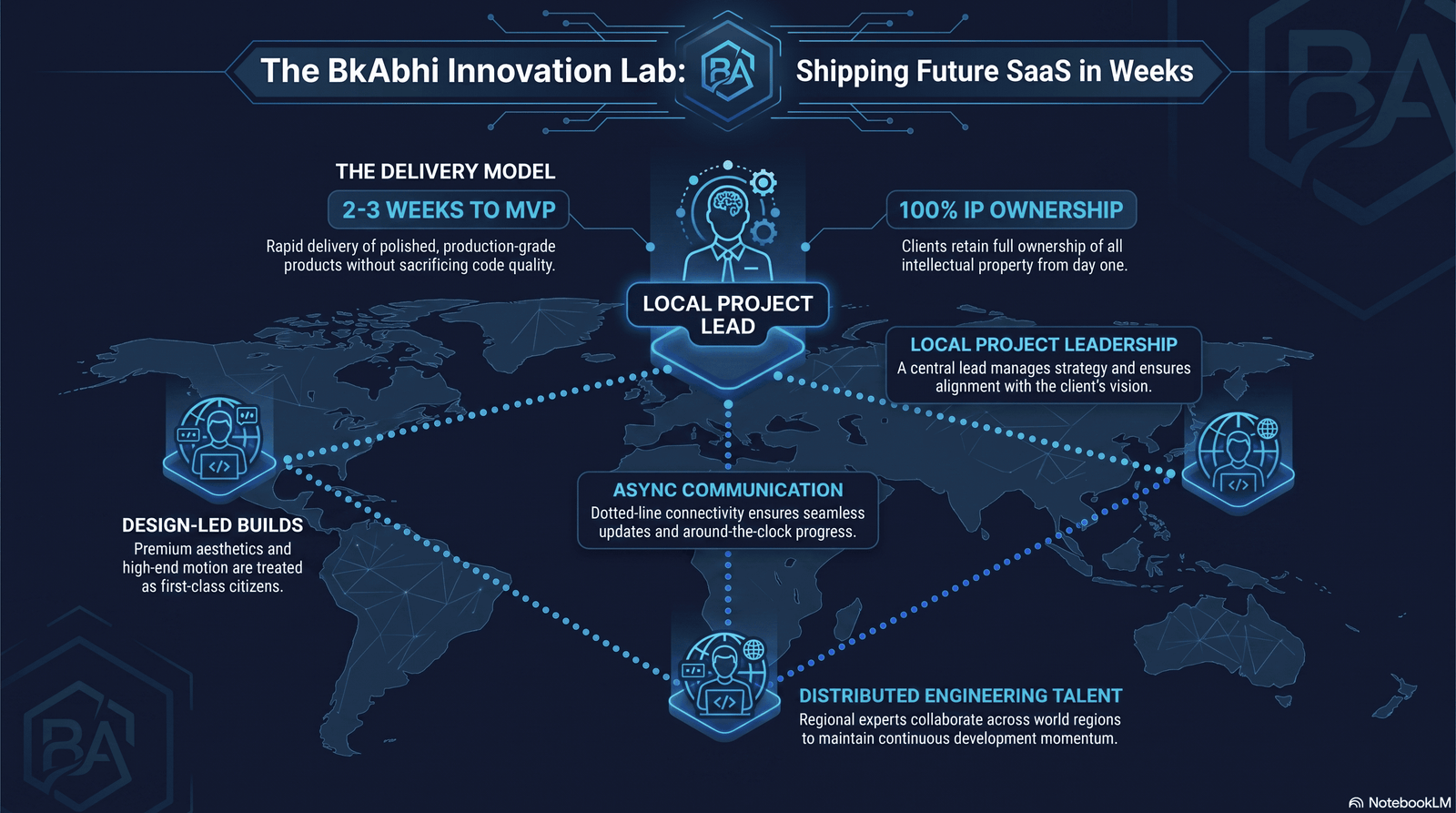
A hybrid development team has become the practical middle ground for founders who want offshore pricing without offshore risk.
The structure is simple: a local strategy lead or product manager who understands your market, paired with distributed engineers who write the code.
This setup captures most of the cost advantage while keeping a single accountable point of contact who speaks your language, literally and in terms of business context.
It also solves the biggest offshore failure mode directly. Someone local translates vague founder intent into a spec precise enough that a distant team can’t misread it.
Our guide on how to hire MVP developers for an early product launch walks through staffing options at each budget tier, including where a hybrid structure fits best.
Workflow Habits That Reduce Offshore Risk
A few process habits consistently separate offshore engagements that go smoothly from ones that end in rework.
Written specs over verbal briefs. A one-page written spec with screenshots and explicit edge cases prevents most of the “requirement interpreted literally” failures that drive offshore rework.
Shared project boards. Tools like Linear or Trello give you visibility into what’s actually being worked on daily, instead of relying on a single weekly status call.
Recorded async standups. A short daily video update lets you review progress on your own schedule without forcing a live call across a thin overlap window.
Milestone-based payments. Tying payment to shipped, tested milestones — not just hours logged — keeps incentives aligned regardless of where the team sits.
None of these habits are exclusive to offshore MVP development. They simply matter more when a phone call to clarify something isn’t available within the hour.
Contract and IP Protection by Model
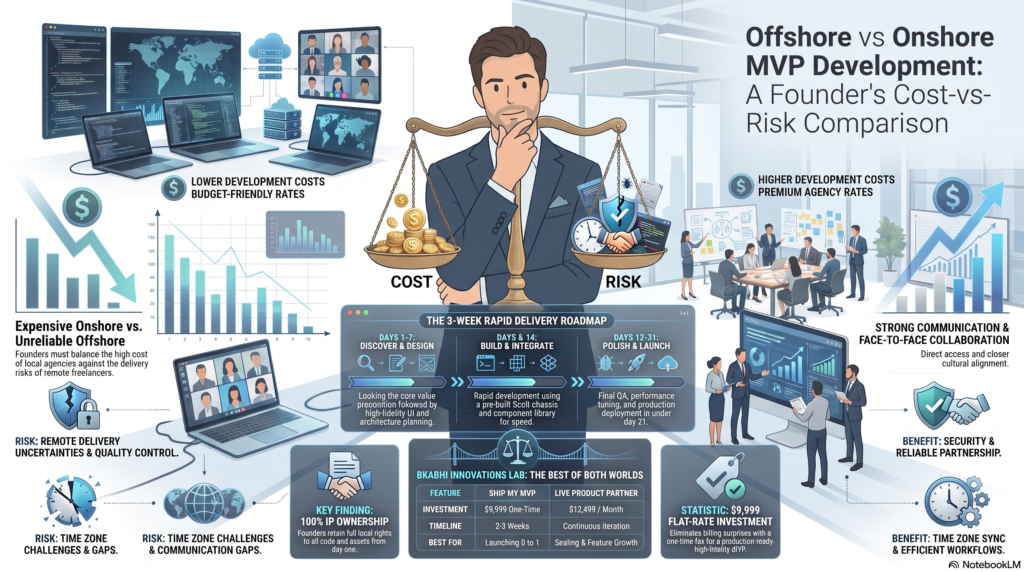
The contract matters more in an offshore engagement than in an onshore one, simply because your legal leverage is weaker if something goes wrong.
IP ownership clauses should be non-negotiable regardless of region, confirming in writing that you own all code and assets once final payment clears.
Jurisdiction clauses deserve extra scrutiny offshore. Know which country’s courts would actually hear a dispute before you sign anything.
Repository access during development is your cheapest insurance policy. A team unwilling to grant it, onshore or offshore, is a red flag on its own.
A full walkthrough of these clauses lives in our MVP development contract guide, which is worth reading before your first offshore quote turns into a signed agreement.
Case Snapshot: Two Founders, Two Models
Two founders building near-identical marketplace MVPs chose opposite paths within the same quarter.
Founder A hired a fully offshore team at $30/hour, skipped a written spec review, and spent an extra six weeks fixing features that were “technically” built but unusable.
Founder B hired a hybrid team — a local product lead managing offshore engineers — paid a modest premium for that lead, and shipped on schedule with far fewer surprises.
The gap wasn’t talent. It was whether someone local was translating intent into precise, unambiguous specs before code got written.
Discovery Call Questions for Offshore vs Onshore Teams
The questions that reveal real risk differ slightly depending on which model you’re evaluating.
For offshore teams, ask: “What hours does your team actually overlap with mine, and who’s my single point of contact?”
For onshore teams, ask: “Why does your rate justify the premium over an offshore alternative for this specific scope?”
For both, ask: “Can I see a sample of a written spec you’ve delivered to a past client?”
Our full list of MVP discovery call questions covers the complete five-question framework worth running on every shortlisted vendor.
Red Flags Specific to Offshore Engagements
Some warning signs apply everywhere. A few show up almost exclusively in offshore conversations.
A domestic-sounding sales rep who can’t answer technical questions often signals the actual engineering work happens somewhere the contract never mentions.
No shared repository access removes your only real-time visibility into whether work is happening at the pace you’re being told.
Refusal to do a live technical call with the actual engineers, not just account managers, is worth treating as disqualifying.
Our earlier piece on why startups need MVP development services first covers several founder stories where ignoring signals like these proved expensive.
How BkAbhi Approaches This Decision
At BkAbhi, we don’t push founders toward one model by default, because the right choice depends on stage, budget, and how much hands-on management a founder can realistically offer.
Our discovery process includes an honest conversation about timezone overlap, documentation habits, and how much oversight a project actually needs before we recommend a structure.
Where a hybrid setup fits — a coordinated lead paired with distributed engineering — we structure it around milestone-based payments and weekly demos, the same discipline we bring to every full cycle MVP development engagement.
You can explore our complete service offerings directly, or start with a conversation about your specific scope.
Frequently Asked Questions
Is offshore MVP development actually cheaper for comparable quality? Often yes, with 40-60% total-cost savings common, provided you budget for management overhead and vet for English fluency and documentation habits, not just the hourly rate.
What’s the biggest risk in offshore MVP development? Misread requirements causing rework, which industry data links to a large share of offshore project overruns when specs aren’t written precisely.
Is a hybrid development team more expensive than pure offshore? Slightly, since you’re paying for a local lead’s time, but the added cost is usually smaller than the rework it prevents.
How much timezone overlap do I actually need? Enough for at least one live sync a week. Fully async engagements can work, but only with unusually precise written specs.
Should first-time founders avoid offshore entirely? Not necessarily, but first-time founders without a technical background benefit most from either onshore teams or a hybrid model with a local lead managing communication.
Does a lower offshore quote always mean lower quality? No, but it does mean you should ask exactly what’s included, since the same red flags that apply to cheap onshore quotes apply offshore too.
Can I switch from offshore to onshore mid-project if it’s not working? Yes, provided your contract includes clear IP ownership and repository access clauses, which let a new team pick up the codebase without starting over.
Do offshore teams take longer to launch an MVP than onshore teams? Not usually, once the project is underway. The main difference is a 1-2 week ramp-up period upfront while both sides align on specs and tools.
Final Thoughts
There’s no universally correct answer to offshore vs onshore development — only the right fit for your stage, budget, and appetite for hands-on management.
Run the real cost math, not just the hourly rate, and weigh it honestly against the communication risk each model carries.
If you’re still comparing vendors more broadly before deciding on a delivery model, our pillar guide on the best MVP development company is the right next stop, or you can book an MVP consultation with our team directly.
Author Bio
Jeevesh Tripathi Email: jeevesh@bkabhi.com
Jeevesh Tripathi is a startup technology researcher and MVP strategy consultant at BkAbhi Innovations Lab, where he has advised founders across fintech, EdTech, and marketplace platforms on choosing between offshore, onshore, and hybrid delivery models. His work focuses on translating real founder engagements — the ones that worked and the ones that didn’t — into practical, jargon-free guidance for early-stage teams. This article reflects hands-on research into regional rate data, contract structures, and founder interviews conducted throughout 2026.