
Quick Answer
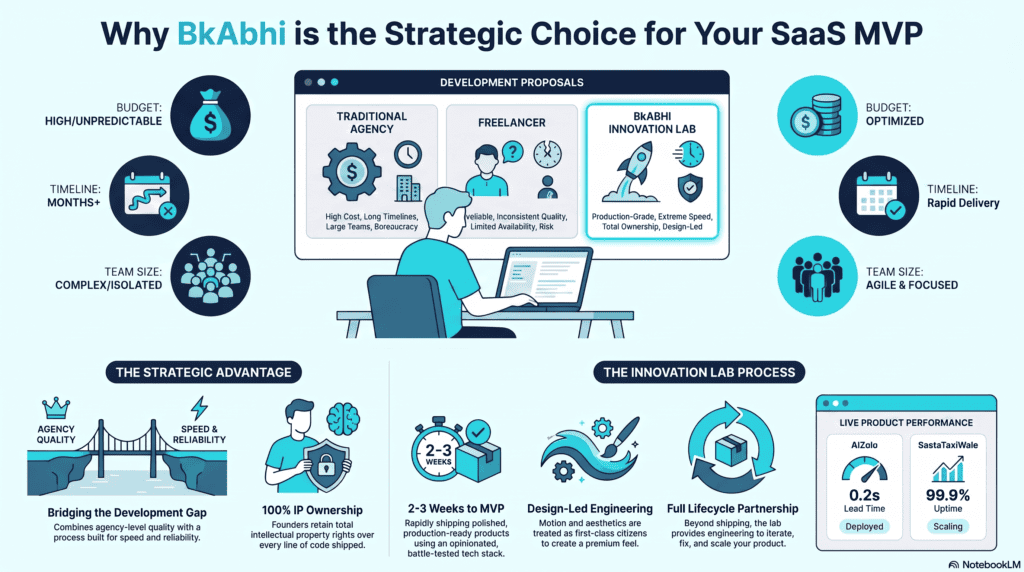
The best MVP development company for your startup is the one that matches your budget, industry, and stage—not necessarily the one with the biggest portfolio. Whether you choose BkAbhi or another provider, look for proven MVPs that raised funding, milestone-based pricing, transparent contracts, and a team that questions your feature list instead of building everything you ask for.
Priya had four term sheets ready to review with her co-founder. What she didn’t have was a working product.
She’d spent five months and $38,000 with an agency that called itself a best MVP development company on its homepage. The result? A login screen, a half-built dashboard, and a developer who’d gone quiet for three weeks straight.
This guide exists so you don’t repeat her story.
Table of Contents
Why “Best” Means Something Different for Every Startup
There’s no single best MVP development company for every founder. The right fit depends on your budget, your industry, and how much hand-holding you actually need.
A fintech founder needs compliance-aware engineers. A consumer app founder needs someone obsessed with retention. Treating this as a one-size-fits-all search is the first mistake most people make.
That’s also why generic best MVP development companies list posts rarely help. They rank agencies by size or funding, not by fit for your specific stage.
What Actually Defines a Great MVP Development Partner
Forget star ratings for a moment. The companies that consistently deliver working products share five traits.
They’ve shipped MVPs that raised follow-on funding. Not just prototypes — real products that survived contact with paying users.
They push back on your feature list. A partner who agrees to everything you ask for isn’t protecting your runway.
They explain trade-offs in plain language. No hiding behind jargon to justify a bloated scope or timeline.
They document their process clearly, from discovery through handoff, so you’re never guessing what happens next.
They’re transparent about pricing before you sign anything, with milestone-based payments instead of one lump sum upfront.
If you want a deeper breakdown of these evaluation signals region by region, our guide on the best MVP development companies USA walks through country-specific pricing and vetting questions in detail.
The Three Categories of MVP Development Companies
Most agencies fall into one of three buckets, and knowing which one you’re talking to saves weeks of wasted discovery calls.
Order takers build exactly what you specify, without questioning scope. You get precisely what you asked for — including the mistakes.
Gold-platers over-engineer everything. Impressive architecture, but overkill for a product that hasn’t found its first hundred users yet.
Strategic partners challenge assumptions before writing code. They’re the ones worth searching for when you look up leading MVP development companies in your niche.
Our detailed breakdown on full cycle MVP development services covers how strategic partners structure a project from idea to launch.
Building Your Own MVP Development Company Rankings
Public MVP development company rankings on directories like Clutch or GoodFirms are a starting point, not a verdict. Reviews can be incentivized, and rankings often favor agencies with big marketing budgets.
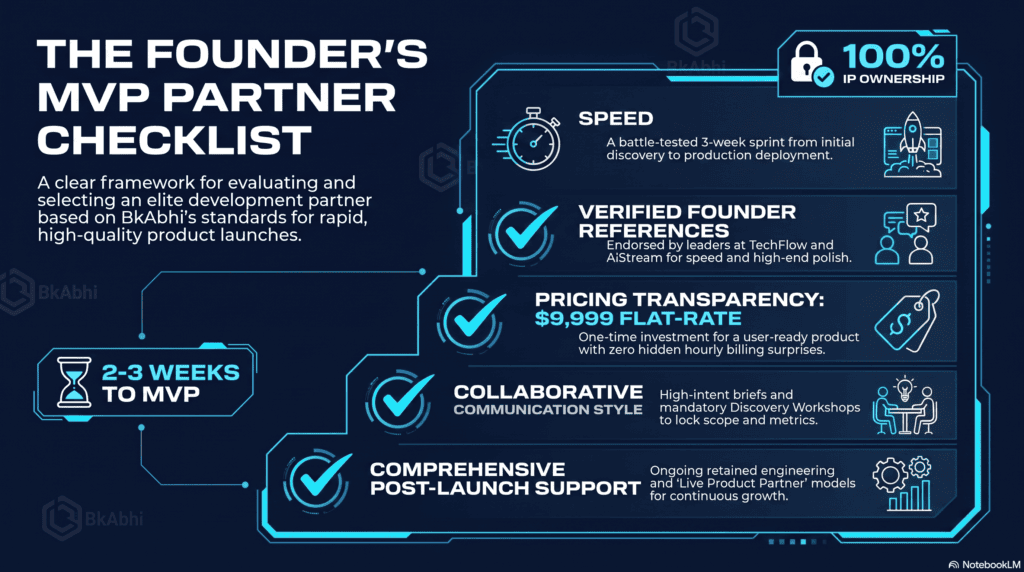
Instead, build a shortlist using three filters: portfolio relevance, client references you can actually call, and communication style during your first conversation.
Ask each shortlisted company this exact question: “Show me three MVPs you’ve shipped in the last 18 months, and tell me what happened after launch.” Vague answers are a disqualifying red flag.
Top MVP Development Companies for Startups: What Changes by Stage
The needs of a pre-seed solo founder look nothing like those of a Series A team scaling fast, so the definition of top MVP development companies for startups shifts by stage.
Pre-seed, no funding yet: You likely need a senior freelancer or an advisory call more than a full agency engagement. Validate cheaply first.
Seed-stage, funded but lean: This is where fixed-scope, fixed-timeline MVP packages matter most, since every week of delay burns runway investors are watching.
Series A, scaling fast: You need a partner who can hand off clean documentation to an in-house team you’re actively hiring.
Our guide on how to hire MVP developers for an early product launch breaks down staffing models for each of these stages in more depth.
Best MVP Development Companies 2026: What’s Different This Year
The market has shifted noticeably, and any best MVP development companies 2026 shortlist should reflect that shift, not last year’s assumptions.
AI-assisted development has compressed timelines. Agencies now ship functional MVPs in 4-6 weeks instead of 10-12, provided scope stays disciplined.
Founders are also more skeptical of offshore-only teams after widely shared horror stories, pushing demand toward hybrid teams with local project management and distributed engineering.
Security basics — authentication, data handling, and dependency hygiene — are now expected even at MVP stage, not treated as a “phase two” concern.
For a deeper look at how future-focused teams structure their tech stack decisions, see our piece on future-ready digital solutions providers.
Pricing Tiers: What You’re Actually Paying For
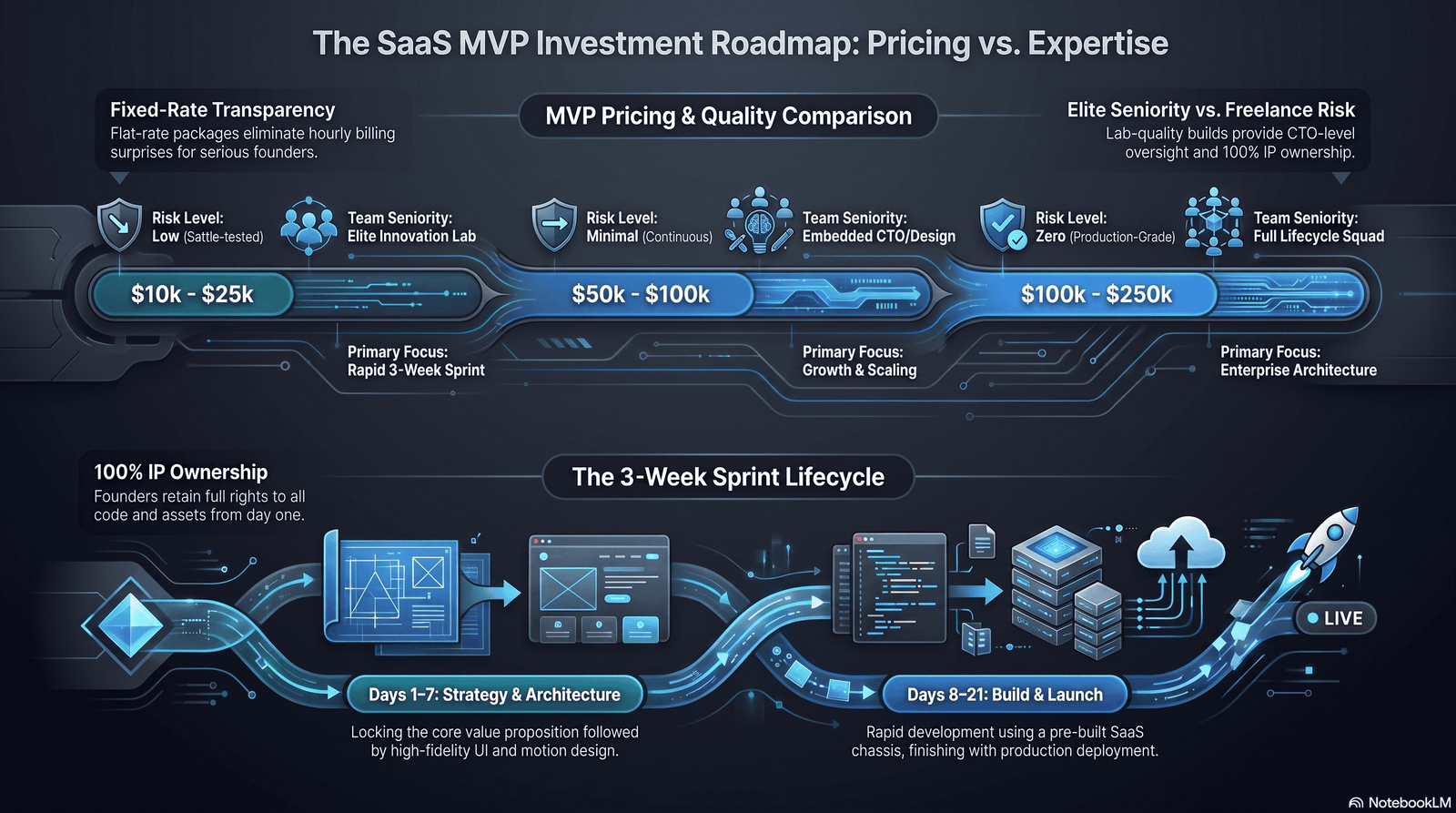
Quotes for the same “MVP” can range from $10,000 to $250,000, and the gap usually isn’t about quality alone — it’s about scope, region, and risk tolerance.
$10K-$25K range: Higher risk. Often offshore teams with a domestic sales rep, or juniors building their own portfolio on your dime.
$50K-$100K range: The sweet spot most genuinely startup-focused agencies operate in, with a senior-led small team and real user testing built into the process.
$100K-$250K+ range: Premium, enterprise-grade delivery. Usually overkill unless you’re a funded corporate innovation team with compliance requirements.
According to industry cost breakdowns, a mid-complexity MVP with authentication and payments typically lands between $50,000 and $100,000 for a 10-12 week build.
Engagement Models Compared: Agency, Freelancer, or In-House Hire
Before you even start shortlisting a best MVP development company, it’s worth comparing engagement models side by side.
| Model | Typical Cost | Best For | Biggest Risk |
|---|---|---|---|
| Solo freelancer | $5K-$25K | Very simple, single-feature MVPs | No redundancy if they disappear |
| Boutique MVP agency | $50K-$100K | Most funded seed-stage startups | Smaller team means less bench depth |
| Large enterprise firm | $100K-$250K+ | Corporate innovation teams | Overkill and slow for lean validation |
| In-house hire | $8K-$15K/month per dev | Technical founders scaling long-term | Slower to start, hiring overhead |
Most seed-stage founders land in the boutique agency row, which is why so many searches specifically target a startup-focused MVP development company rather than a generalist software vendor.
What to Check in the Contract Before You Sign Anything
The evaluation call matters, but the contract is where good intentions either get formalized or quietly disappear.
Payment structure: Look for a 30/40/30 split tied to milestones, not a lump sum due at signing.
IP ownership clause: Confirm in writing that you own all code, designs, and assets once final payment clears.
Change order process: The contract should define how scope changes get priced, so “just one more feature” doesn’t become a renegotiation every week.
Termination terms: You should be able to exit the engagement with access to all work completed to date, not held hostage pending final payment.
A contract that’s vague on any of these four points is worth pushing back on before signing, regardless of how strong the sales pitch was.
Case Snapshot: Two Founders, Two Very Different Outcomes
Consider two founders who searched for the same thing — a reliable MVP development company — within the same month.
Founder A picked the cheapest quote, paid 100% upfront, and received a product that crashed under normal load within its first week of user testing.
Founder B chose a mid-priced boutique team with milestone payments and weekly demos, caught a critical bug at week 6, and shipped on time anyway.
The difference wasn’t luck. It was a contract structure and a discovery process that surfaced problems early instead of at launch.
Top 10 MVP Development Companies: How These Lists Are Actually Built (and Why to Be Skeptical)
Search “top 10 MVP development companies” and you’ll find dozens of near-identical listicles. Most are written by the agencies themselves, or recycled from other lists with zero original vetting.
A trustworthy list discloses its methodology: how companies were sourced, whether placements are paid, and what criteria decided the order.
Before trusting any ranking, cross-check at least two of the listed companies against independent founder communities like Indie Hackers or Y Combrator’s Bookface, where real founders share unfiltered feedback.
Red Flags That Should End the Conversation Immediately
“Yes, we can definitely build that” to every single requirement, regardless of your timeline or budget, usually signals a company optimizing for the sale, not your success.
Requiring 100% payment upfront removes your leverage if the relationship sours mid-project.
No access to a shared code repository during development means you have zero visibility into actual progress.
Vague answers about past client outcomes, hiding behind NDAs for every single project, is rarely a good sign.
Our post on why startups need MVP development services first covers several real founder stories where ignoring these red flags proved costly.
Green Flags Worth Paying a Premium For
A company that asks more questions about your users than your tech stack in the first call is worth serious consideration.
Teams that suggest cutting features from your list — rather than adding more — usually understand lean product thinking, not just execution.
Milestone-based contracts with weekly demos give you real visibility and an exit ramp if things aren’t working.
Post-launch support bundled into the engagement, even 30-60 days, shows the company plans past the handoff date.
For a closer look at how strong partners approach the design side of this equation, our article on expert UI/UX design for startup MVP projects is worth reading before your first design sprint.
The Discovery Call Script: Five Questions in 30 Minutes
Save this list before your first call with any shortlisted agency.
- “What are three MVPs you’ve built in the last 18 months, and what happened after launch?”
- “What would you cut from my current feature list?”
- “How do you handle scope changes mid-project?”
- “What’s your typical MVP timeline, including discovery and testing?”
- “Can I talk to two founders you’ve worked with recently?”
Hesitation or vague answers to any of these five questions is your signal to keep looking.
Leading MVP Development Companies: Global vs. Regional Considerations
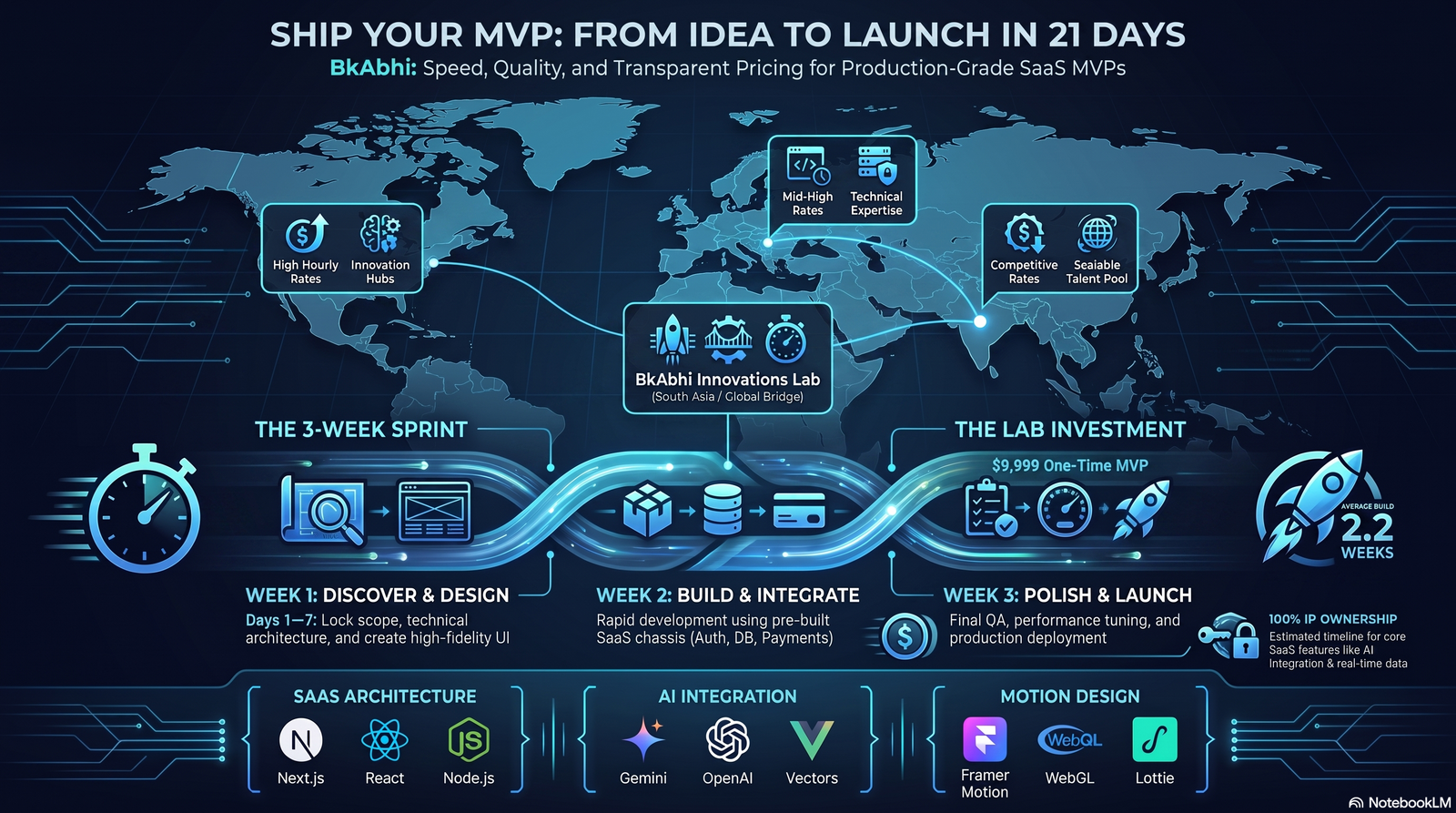
Leading MVP development companies aren’t evenly distributed by geography, and that matters for communication overlap and cost.
US and Western European agencies typically charge $50-$200/hour but offer easier timezone alignment and native-market user research.
South Asian and Eastern European teams often deliver 30-50% cost savings, provided you vet for English fluency and project management maturity, not just hourly rates.
Hybrid models — local strategy leads paired with distributed engineering teams — have become the practical middle ground most startups now choose.
Curious how these regional dynamics play out in practice? Our earlier guide on the fastest way to launch a SaaS product includes a real founder’s timeline working across a hybrid team setup.
Industry-Specific Considerations Worth Asking About
Not every MVP development company is equipped to handle every industry’s unique constraints, and it’s worth probing this directly on your first call.
Fintech and healthtech founders need a partner familiar with basic compliance frameworks like PCI-DSS or HIPAA, even at MVP stage, since retrofitting compliance later is far more expensive.
Marketplace founders should ask specifically about experience building two-sided platforms, since matching logic and trust mechanics behave differently than typical single-user apps.
Hardware-adjacent or IoT founders should confirm the team has actually shipped device-integrated software before, since this is a common gap even among strong web and mobile teams.
AI-feature founders should ask whether the team builds custom models or integrates existing APIs, since the cost and timeline differences between the two are substantial.
Any agency that claims equal expertise across all four categories without qualification is worth double-checking against their actual portfolio.
Communication Habits the Best Teams Share
Beyond contracts and pricing, day-to-day communication is often the clearest signal you’re working with a genuine MVP development company rather than an order-taking vendor.
Shared project boards (Linear, Trello, or similar) give you real-time visibility into what’s actually being worked on, not just a weekly status email.
Recorded standups or async updates mean you’re not stuck waiting for a scheduled call to learn about a blocker.
Direct repository access lets you or a technical advisor check in on code quality anytime, without asking permission.
A single point of contact who’s accountable for outcomes prevents the classic “that’s not my part of the project” runaround when something goes wrong.
Teams that resist any of these basic transparency requests are usually hiding something about how the work is actually being done — often outsourced further than they originally disclosed.
How BkAbhi Approaches MVP Development
At BkAbhi, we’ve built our process around one belief: an MVP should validate an idea, not impress a portfolio reviewer.
We start every engagement with a discovery call that challenges assumptions before a single line of code gets written — sometimes talking founders out of features entirely.
Our typical engagement runs in phases: a fixed-cost discovery sprint, a fixed-scope core build with weekly demos, and optional post-launch iteration based on real user data.
We’re equally upfront about what we don’t do — deep AI/ML research, blockchain infrastructure, or hardware-integrated IoT — and we’ll say so on the first call rather than after signing a contract.
If you want the full picture of our own pricing philosophy and phased approach, our minimum viable product developer guide breaks it down line by line. You can also explore our complete service offerings directly.
A Quick Reality Check Before You Sign Anything
Roughly 42% of startups fail due to a lack of market need rather than execution problems, according to CB Insights research on startup failure patterns. That single stat should reframe how you pick a partner.
The right MVP development company isn’t the one promising the most features fastest. It’s the one that helps you learn whether your idea works before you’ve spent your entire runway finding out.
If you’re still validating your core assumption before committing budget to development, our piece on how to validate a SaaS idea is worth reading first.
Frequently Asked Questions
How much does it cost to hire the best MVP development company? Most legitimate, startup-focused agencies charge between $50,000 and $100,000 for a 10-12 week MVP build with a senior-led team, though simpler builds can start lower.
How long does MVP development typically take? A focused MVP with a disciplined feature set usually ships in 6-10 weeks. Anything promising a fully-featured product in under 2 weeks deserves scrutiny.
Should I choose a big agency or a boutique team? Boutique teams often provide more founder access and flexibility, while larger agencies offer more redundancy if a team member leaves mid-project. Neither is universally better.
What’s the biggest mistake founders make when hiring an MVP company? Picking based on the lowest quote rather than checking references and past outcomes — cheap quotes frequently balloon into expensive rework.
Can I switch development companies mid-project if it’s not working out? Yes, provided your contract includes clear IP ownership and repository access clauses. This is exactly why those two terms matter more than almost anything else in the agreement.
Do I need a technical co-founder to evaluate an MVP development company? It helps, but it isn’t required. Asking for portfolio proof, live references, and a plain-language explanation of trade-offs lets even non-technical founders vet a partner effectively.
Final Thoughts Before You Start Reaching Out
Searching for the best MVP development company can feel overwhelming when every agency’s homepage sounds identical.
Cut through that noise with the framework above: check portfolio proof, talk to real references, read the contract closely, and watch how a team communicates before you sign anything.
The right partner won’t just build what you ask for — they’ll help you figure out what’s actually worth building first.
Ready to talk through your own MVP scope? You can book an MVP consultation with our team directly, or explore more insights on our homepage.
Author Bio
Jeevesh Tripathi Email: jeevesh@bkabhi.com
Jeevesh Tripathi is a startup technology researcher and MVP strategy consultant at BkAbhi Innovations Lab, where he’s advised founders across fintech, EdTech, and marketplace platforms on choosing the right development partners. His work focuses on translating real founder experiences — successes and costly mistakes alike — into practical, jargon-free guidance for early-stage teams. This article reflects hands-on research into agency evaluation frameworks, pricing structures, and founder interviews conducted throughout 2026.