
Table of Contents
Introduction: What Is SaaS Customer Retention?
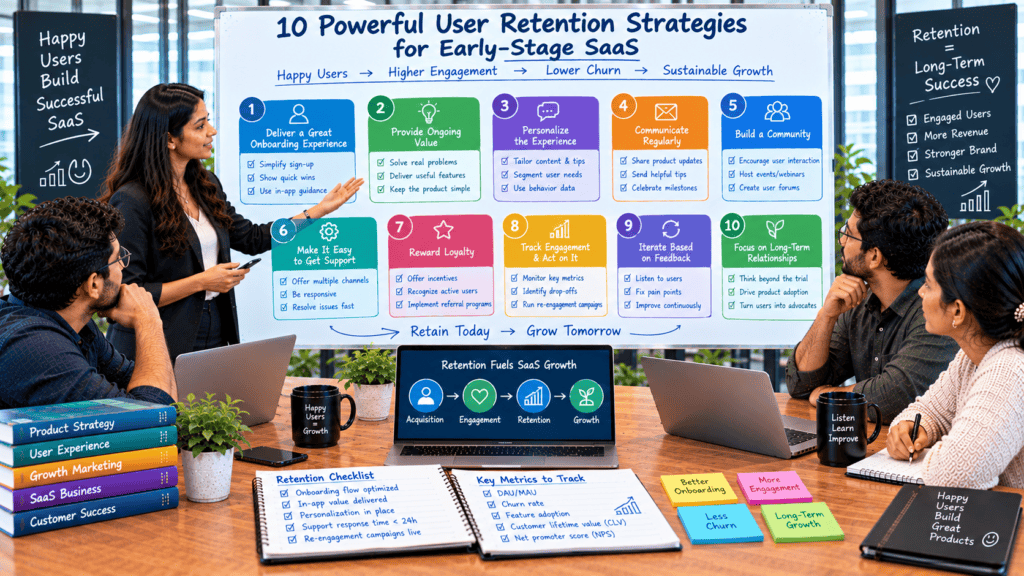
SaaS customer retention means that a company is successful at making its customers stay as users of its service. Instead of being a one-time purchase, software as a service (SaaS) relies on customers continuously using the product and contributing to recurring payments.
Therefore, it is crucial for businesses to focus on customer retention. It allows the company to ensure that its product is compelling enough to make people renew their subscriptions actively. A SaaS product retention is vital for the growth of the business because it concentrates on keeping the existing customers rather than finding new ones.
SaaS customer retention can be especially beneficial for young companies to keep the users they acquired. For instance, it can help the business provide consistent lifetime value (CLV) for the clients. In addition, it enables the company to predict future revenue more accurately and have stable recurring revenues. Finally, SaaS retention helps reduce the need for constant customer acquisition.
However, it is worth noting that not all customers will stay, so the company should strive for continuous improvements, address the reasons why clients are leaving and work on reducing these issues. The software as a service (SaaS) customer retention should focus on getting to know the clients, providing excellent products and services, and improving the onboarding experiences.
Metrics such as churn rate, customer lifetime value (CLV), retention rate, and product engagement can help in analyzing the specifics of user loss.
Why SaaS Customer Retention Deserves More Investment Than Acquisition
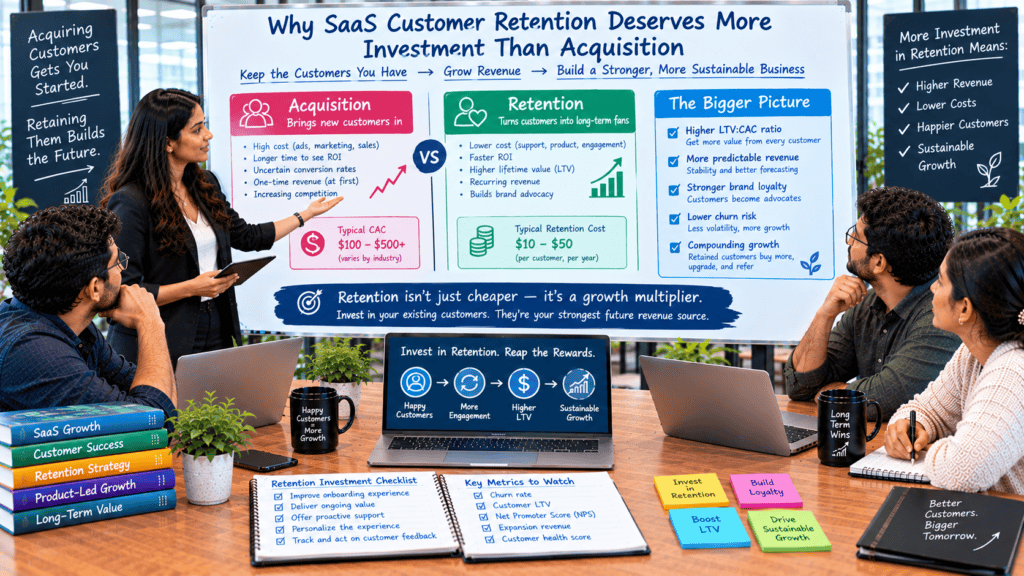
Most SaaS teams spend the majority of their budget on one question: how do we get more customers? Most of their resources go into ads, outbound sales, content, events, and free trials. All of these are meant to drive blood into the top of the funnel. But when it comes to a subscription-based service, the money is made after the sale is completed. So, it’s easy to lose customers as quickly as you gain them.
Here is why retention should be more heavily invested in.
1. SaaS Economics Are Built on Recurring Revenue
Unlike a one-time purchase, a SaaS customer brings you profit – but not immediately; you need to spend money on marketing, sales, and onboarding before being able to get any revenue yourself.
This concept is reflected in the customer acquisition cost (CAC) payback period, which essentially measures how much time does a company need to recover the money spent on obtaining a customer. If you fail at retaining a user and, thus, at keeping the revenue, you have spent resources on a lost customer.
That is why retention turns customer acquisition costs from a liability into an asset.
2. Acquiring a New Customer Costs More Than Keeping One
It is widely cited that acquiring a new customer costs several times more than retaining an existing one, and the exact multiple varies by industry and segment. The direction is consistent, though. New customers require:
- Paid marketing and lead generation
- Sales team time and long sales cycles
- Demos, trials, and onboarding support
- Discounts or incentives to close the deal
Existing customers already know your product, trust your brand, and have integrated it into their workflow. Serving them well costs far less than convincing a stranger.
3. Retention Compounds, and Churn Compounds Against You
Small changes in churn have an outsized effect over time. Compare two companies that each add 100 customers a month:
- Company A loses 5% of its customers monthly.
- Company B loses 2% monthly.
After one or two years, Company B has significantly more customers and revenue, although the acquisition was identical. Each customer retained brings additional value: every year they stay with the company, they renew and pay the company again, which adds up to the lifetime value of a customer without adding acquisition costs.
Research from Bain & Company has long been saying that even a slight improvement in retention results in a significant increase in profits. The numbers vary depending on the company’s specifics, but the trend is evident.
4. Retained Customers Grow in Value
Loyal customers do more than stay. They tend to:
- Expand: upgrade plans, add seats, or buy additional modules
- Buy more efficiently: upsells and cross-sells close faster and cheaper than new deals
- Refer others: satisfied users bring in leads with higher trust and lower CAC
- Give feedback: long-term users help you improve the product
This drives the net revenue retention (NRR). If the NRR is more than 100%, it means that the revenue from expansion is more than the churn and downgrades; therefore, even with zero new customers, the company can record an increase in revenue due to expansion. This is a good position, and investors want this.
5. High Churn Makes Growth Unsustainable
A company with high churn must keep acquiring customers just to stay level. This creates a treadmill:
- Marketing and sales costs rise as easy audiences are exhausted
- Growth slows despite heavy spending
- Cash burn increases
- Teams become reactive, always chasing new leads
Retention gives you a stable base, predictable revenue, and room to plan. It also makes forecasting far more reliable, which matters for hiring, fundraising, and product roadmaps.
6. Retention Reflects Product-Market Fit
Acquisitions can be bought, but satisfaction cannot. Traffic, leads, and even sign-ups can be purchased. However, one cannot buy genuine satisfaction.
High retention rates show that one has solved an important problem for the customer and continues to deliver on a regular basis. By contrast, low retention rates (despite high acquisition) usually indicate some form of misalignment: inadequate onboarding, targeting the wrong audience, or building something that the customers do not want to integrate into their workflow. Addressing retention issues will necessitate a change in these misalignments, which will have a positive effect on all the other areas.
7. It Improves Acquisition Too
Retention and acquisition are not opposites. Strong retention feeds new growth through:
- Case studies and testimonials
- Positive reviews on G2, Capterra, and similar sites
- Word-of-mouth and referral programs
- A stronger brand reputation
Customers who stay and succeed become your best marketing channel.
Where to Invest in Retention
If you want to shift budget toward retention, start here:
- Onboarding: drive first “aha” moments to encourage customer adoption and engagement. Early activation is the best predictor of long-term retention.
- Customer success: proactive outreach, health scoring, and regular business reviews for enterprise accounts.
- Product analytics: identify at-risk customers based on product usage patterns.
- Support: provide exceptional support to turn frustrated customers into promoters.
- Feedback collection: understand why customers are leaving via surveys, NPS, and exit interviews.
- Education: deliver product documentation, webinars, and training to drive deeper product adoption and increase customer satisfaction.
- Value-based pricing and packaging: offer flexible plans and contract terms to align with customer budgets and needs.
Metrics to Track
- Customer churn rate and revenue churn rate
- Net Revenue Retention (NRR)
- Customer Lifetime Value (LTV) and the LTV:CAC ratio
- Activation and time-to-value
- Customer health scores
A Note on Balance
This does not mean that acquisition should not be pursued. Every company needs new customers in order to grow, and many start-ups need to build a critical mass of users. The matter is one of priorities. Once one has one’s product established, then each additional dollar invested typically yields more value in terms of retained and grown customers than new customers. Plug the holes before you add more water.
Conclusion
Acquisition drives growth, but retention defines if that growth will be profitable. Retained customers cost less to serve, spend more on average, advocate more frequently, and yield the predictable, recurring revenue of a truly valuable SaaS business. For a company looking to scale in a durable, compounding way, prioritizing retention is the safest bet — but more importantly, it is the smartest.
I can also provide this in a Word doc or a Markdown file, or adapt it more generally to a specific audience, tone, or word count if you’d prefer this published on your blog.
15 SaaS Customer Retention Strategies That Work
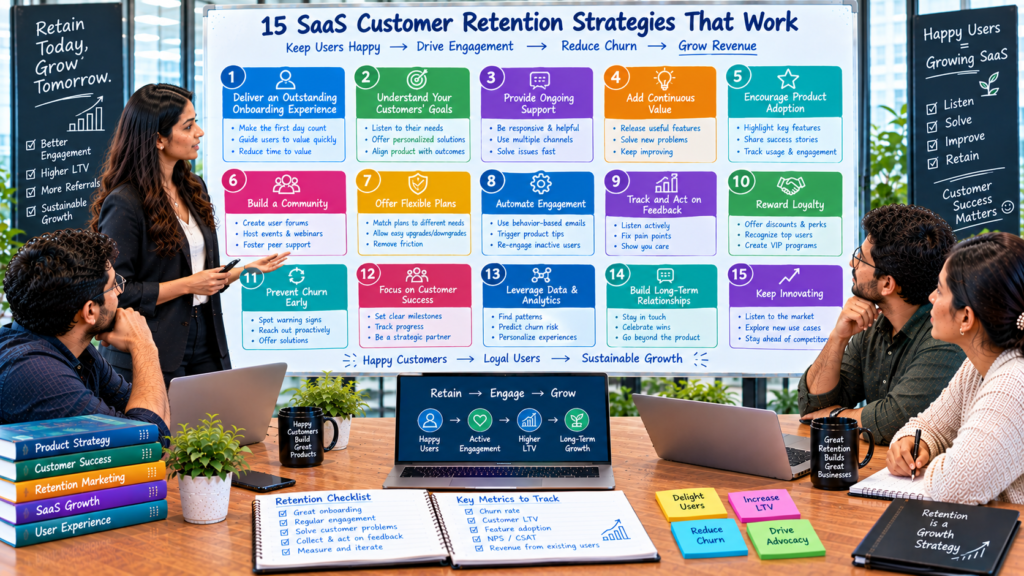
Customer churn is killing software as a service (SaaS) companies. It costs five to 25 times more to acquire a new customer than to retain an existing one, while improving customer retention rates by 5% increases profits by 25-95%.
A SaaS company cannot survive without acquiring and retaining customers consistently. So how do you improve customer retention? Below are 15 customer retention tips that will help any company increase its expansion while reducing the rate of subscribers loss.
1. Onboarding & Activation Strategies
3.1 Set a Clear Time-to-Value (TTV) Target
Time-to-Value (TTV): the amount of time it takes a user to experience an ‘Aha!’ moment. The point where a customer realizes the true value of your product.
- Why it’s important: The shorter this cycle, the less likely a customer is to cancel their trial during the onboarding process or shortly thereafter
- How to drive improvement: Define your core value metric (first email sent, first invoice created, etc.) and optimize the sign-up flow to remove any unnecessary steps before achieving this milestone. Measure average TTV and establish internal benchmarks to improve upon on a quarterly basis.
3.2 Use Progressive Onboarding
Dumping all product features on a user on Day 1 leads to cognitive overload and frustration.
- Why it works: Progressive onboarding teaches a user what they want to hear about next based on where they are in the flow.
- How to execute: Have them complete a very basic setup and only introduce secondary features (integrations, automation, etc) through progress tracking or tooltips after they’ve built out the essentials.
3.3 Trigger Human Outreach When Onboarding Stalls
Automated email sequences aren’t always enough to get accounts over the finish line.
- Why it works: Product data tells you when a user is getting stuck. Reaching out to them with human help at the precise moment can turn a high-risk account into a huge win.
- How to execute: Set up alerts in your CS tool whenever an account ceases activity before they hit important activation checkpoints (no activity for 3 consecutive days during onboarding, for example) and have a CSM send over a personalized email or Loom video with an offer to hop on a quick strategy call.
2. Adoption & Product Experience Strategies
3.4 Fix Common Product Friction
Small friction points—like a confusing button, slow load time, or multi-step configuration—accumulate into major churn risks over time.
- Why it works: Getting rid of roadblocks makes a product intuitive and easy to use every day.
- How to do it: Use tools like session recordings (Fullstory, Hotjar, etc.) and product analytics to discover where users are clicking in rage or abandoning a process. Then, treat those pain points as critical features to invest your time in.
3.5 Make Your Product Part of the Daily Workflow
If your software isn’t part of a user’s routine, it becomes a line item on the budget cutting floor.
- Why it works: High levels of habitual engagement lead to high rates of engagement (DAU/MAU) and make your product feel necessary to everyday operations.
- How to execute: Embed into the tools your users are already opening every day (think: Slack, Microsoft Teams, Gmail, Chrome). Send out alerts when something relevant happens or a daily digest email if they haven’t opened your dashboard in a while; chrome extensions that open helpful data panels are another great engagement driver for habitual use.
3.6 Ship Improvements Users Can See
Users want to know that the platform they pay for is evolving and becoming more valuable over time.
- Why it works: It shows customers that the company is doing well and that they care about the users’ needs and any problems they may have.
- How to execute: Create visual release notes, in-app changelogs, and feature demo videos. Spotlight the most requested features in your product update emails.
3.7 Invest in Accessibility and Localization
As your customer base expands globally and across diverse teams, a one-size-fits-all UI creates natural usage barriers.
- Why it works: Following the Web Content Accessibility Guidelines (WCAG) and implementing local languages, currencies, and time zones will enable your product to scale within multinational or diverse enterprise accounts.
- How to execute: Perform a WCAG conformance audit for keyboard accessibility and screen readers. Implement the languages and currencies of your highest-growth markets.
3. Account Management & Proactive Retention
3.8 Monitor Usage Drops as Early Warning Signals
Customers rarely churn out of nowhere; their activity drops off weeks or months before they actually hit “Cancel.”
- Why it’s good: Taking action at the first sign of disengagement helps you address sentiment issues before it’s too late in the renewal cycle
- How to do it: Measure engagement metrics (login frequency, depth of feature usage, seat utilization), and proactively alert your customer success team when an account falls below a certain threshold on those metrics. For example, CS teams might be notified when any of a client’s seats fall by 20%+ on average within a 14-day period
3.9 Conduct Regular Business Reviews (QBRs)
For B2B SaaS, executives deciding on contract renewals often aren’t the end-users using the software every day.
- Why it works: Quarterly Business Reviews (QBRs) demonstrate a clear ROI to decision makers, while realigning product usage to company goals
- How to execute: Focus on economic value (time saved, revenue generated, etc.) vs. usage of features, and recommend specific actions for the team to get the most value in the next quarter based on data and trends
3.10 Recover Failed Payments (Dunning Management)
Involuntary churn—when a user churns simply because their credit card expired or failed—can account for 20% to 40% of total SaaS churn.
- Why it works: Correcting the processing error keeps the paying customer instead of having to push to acquire a new one.
- How to do it: Retry cards on the best days and times, send emails about expiring cards before they expire, use in-app messages to remind customers about billings, send dunning emails and SMS messages, and automate the process with ChurnZero or ProfitWell Retain.
4. Lifecycle & Feedback Loop Strategies
3.11 Encourage Annual Contracts
Monthly subscriptions offer a low barrier to entry, but they also give customers 12 chances a year to churn.
- Why it works: Annual plans incentivize longer-term commitment, provide more runway to demonstrate ongoing value to the customer, and increase Customer Lifetime Value (LTV)
- How to do it: Provide a hefty incentive (15-20% discount) to switch from monthly to annual billing. Announce the value of committing to an annual plan in high-engagement moments (post onboarding success, post-team add).
3.12 Make Cancellation Easy (And Learn From It)
Hiding the cancellation button or forcing users through defensive phone calls creates resentment and damages brand reputation.
- Why it works: It keeps your relationship open, creates a chance for future reactivation and gives you feedback as to why users cancel
- How to execute: Create an easy-to-use offboarding/cancellation flow where the user can select what caused their departure (price, lack of feature, usage of feature). Offer alternatives to cancellation based on their selection (pause account, downgrade plan, schedule a call) before permanently cancelling.
3.13 Run Ongoing Usability Research
Product roadmap decisions should be guided by direct user observation, not internal guesswork.
- Why it works: Keeping a close eye on how your users engage with new features and updates on existing features will help you design highly effective solutions.
- How to do it: Schedule regular, 15-minute moderated usability tests with active customers. Incentivize their time by offering account credits or gift cards.
3.14 Act on NPS Detractors Quickly
Collecting Net Promoter Score (NPS) data is useless if you don’t act on the responses.
- Why it works: Detractors (scores 0-6) are at high risk of churning and speaking poorly about your business. Quick outreach can turn negative interactions into an opportunity to deliver exceptional support.
- How to execute: Share NPS feedback in a specific Slack/Teams channel and make sure that a CS lead reaches out to anyone who has scored a 6 or below within 24-48 hours to understand their concerns and offer help.
3.15 Close the Customer Feedback Loop
Nothing alienates users faster than submitting feature requests or bug reports that disappear into a black hole.
- Why it works: Closing the feedback loop makes users feel like their input actually influences the product, which encourages advocacy and retention.
- How to execute: Tag feedback in your CRM or wherever you host feedback. When that request is implemented (new feature, bug fix, etc.), send out a personalized or automated email to all users who submitted that feedback, notifying them that their request was fulfilled.
How UX Research Strengthens SaaS Customer Retention
Acquiring a new SaaS customer costs exponentially more than retaining an existing one, and the revenue from subscriptions is only compounded by the number of customers. Despite this, many teams focus on developing new features and marketing while neglecting the churn, which is solved by UX research.
UX research is a process of understanding how real users think and interact with one’s product and service. For a subscription-based business, this has a direct impact on their ability to retain customers and keep the revenue stable.
Why Retention Is a UX Problem
Customers rarely cancel because of one dramatic failure. They leave because of small, repeated frustrations:
- They failed to extract value from the product
- Difficult to see its key features
- Does not meet their workflow
- Setup takes too long, hence abandonment
- The competitor made the same process less cumbersome
Every one of these is a usability or experience problem, and UX research is how you find them before your churn numbers do.
1. Fixing Onboarding, Where Most Churn Begins
The first few days decide whether a user becomes an active customer. If people don’t reach their “aha moment” quickly, they drift away, and often never come back.
UX research helps you:
- Watch new users work through your onboarding via usability tests and session recordings and see where they get stuck or give up
- Determine which activation milestone best predicts retention
- Trim the process and replace jargon with simple instructions
A well-researched onboarding flow gets users to value faster, and users who reach value early are far more likely to stay.
2. Understanding Why Customers Leave
Analytics tell you what happened: a user stopped logging in. Research tells you why.
- Exit surveys and churn interviews identify why customers canceled versus your assumptions (what actually happened vs. what you think happened)
- Interviewing at-risk users uncovers unmet needs before they cancel
- Analyzing support tickets identifies pain points that nobody addresses
Talking to churned customers can feel uncomfortable, but it is one of the most valuable sources of insight a SaaS team has.
3. Building Features People Actually Use
Feature bloat is a silent retention killer. A crowded product overwhelms users, while a product missing what they need pushes them toward alternatives.
UX research keeps your roadmap grounded in real needs through:
- Jobs-to-be-done interviews that uncover what customers are striving to accomplish
- Prototype testing that confirms ideas before expensive development
- Feature adoption analysis that identifies what features deliver value and what languish
Building the right things, rather than more things, keeps the product relevant to customers over time.
4. Reducing Friction in Daily Workflows
The most common customers who stay with the company use its product most consistently. The slightest inconvenience during their daily use of a particular product leads to aggravation and the search for an alternative.
Not all customers will use your product in the same way and as a result, they need different things. Your solo freelancer and team lead will likely have different expectations than an enterprise admin.
Researching your personas, user segments and conducting studies will help you to create better onboarding for different types of users, introduce them to features they’re likely to care about and boost their engagement with your product overall.
5. Segmenting Users and Personalizing the Experience
Not all customers are using your product the same way. A freelancer, a team lead, and an enterprise admin may have different goals.
Research through personas, user segmentation, and behavioral studies allows you to provide the most suitable onboarding experience, product discovery, and communication to each of them. This ensures that the user feels like the product was created specifically for them, therefore increasing customer loyalty.
6. Spotting Early Warning Signs of Churn
Using qualitative research and product data together helps recognize patterns that suggest a customer is at risk of churning, like reduced usage of the product or increased requests for assistance. These signals can help businesses identify potential retention issues early and take proactive action. For more insights, explore SaaS customer retention strategies to understand how research, product usage, and customer success can work together. The insights from research enable you to understand what a customer may need help with and make your customer success team proactive rather than always reactive.
7. Creating a Continuous Feedback Loop
The best SaaS companies treat research as an ongoing habit, not a one-time project. Practical ways to do this include:
- Running in-app NPS/CSAT/CES surveys at strategic moments
- Conducting monthly customer interviews
- A/B testing of new designs before each launch
- Sharing the results of user research across product, design, engineering, and customer support
When customers see their feedback lead to real improvements, they feel heard. That sense of partnership builds trust, and trust builds retention.
How to Measure the Impact
To show that UX research improves retention, track metrics before and after changes:
- Metrics you should track if you want to measure the impact of your internal product redesign
- Churn rate and net revenue retention
- Activation rate and time to first value
- Feature adoption and task success rate
- NPS, CSAT, and customer effort score
- Support ticket volume for the areas you redesigned
According to one Bain & Company study, the increase in retention by only a percentage point can lead to a significant rise in profits; therefore, even minor changes in UX can bring considerable profit.
Getting Started: A Simple Action Plan
- Audit your churn data to find where and when customers leave
- Interview 5-10 churned and active users to compare experiences
- Test your onboarding flow with new users and see where they stumble
- Prioritize fixes by impact on activation and retention
- Ship, measure, and iterate
You don’t need a large research team to begin. Even a few conversations a month can reveal insights that transform your product.
Conclusion
Retention cannot be achieved through any discounts or last-minute cancellation fees. It is created on the basis of the global experience of helping the customer to succeed. The UX research allows getting such data to improve the onboarding process, product features, to reduce friction and increase loyalty.
It is essential to start improving the product and increasing retention by understanding the needs of the customers. This will help to find out their pain points and address them.
The final result can be presented in Word or Markdown. It is also possible to add SEO title, meta description, and keywords if needed.
Using User Research to Identify Churn Problems
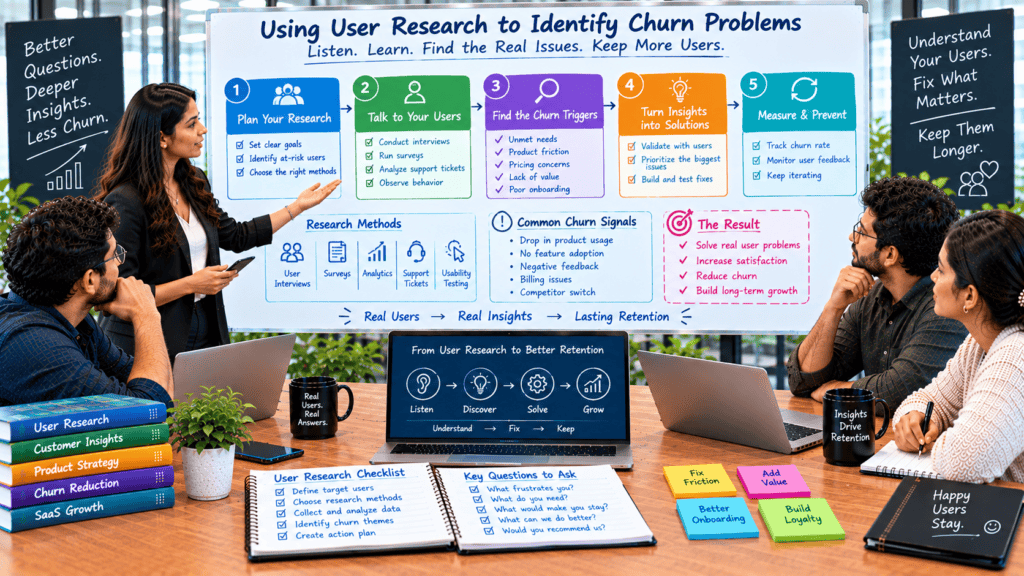
Customer churn is a silent killer of growth. While analytics will tell you what is happening (30% of users drop off in month two), they rarely tell you why.
To solve it, you need quantitative analysis and to dig into the why. Here is a practical, step-by-step framework to use user research to pinpoint and solve the root causes of customer churn.
Step 1: Combine Quantitative Data with Qualitative Signals
Before talking to users, segment your churn to target the right people.
- Look for trends in your usage data: where do users churn off?
- Is it during onboarding? Following a significant product change? Just before a renewal date?
- Segment by cohorts
- Early Churn (0–30 days) – indicates some kind of onboarding or value perception issue.
- Late Churn (6+ months) – suggests a lack of long-term value, insufficient feature adoption, or price competition.hurn type:
- Early Churn (0–30 days): Usually indicates a gap in onboarding, mismatched expectations, or a weak value proposition.
- Late Churn (6+ months): Points to a lack of long-term utility, poor feature adoption, or cheaper competitors.
Step 2: Choose the Right Research Methods
Different stages of the user journey require different research methods:
1. Offboarding & Exit Surveys
- When to use: as soon as a user cancels.
- Best practice: keep it to three questions. Ask something like What could we have done differently – using multiple choice options (price, feature, UX, no longer needed), plus an open text option.
2. Post-Churn Interviews
- When to use: 1-2 weeks after cancellation
- Most critical time to reactivate lost customers. Keep the offer simple and relevant (e.g. $25-$50 off a gift card).
- Ask these questions:
- “What problem were you trying to solve for us when you first signed up?”
- “At what point did you decide to seek an alternative solution?”
- “What product or workaround are you currently using as a replacement?”
3. Usability Testing with At-Risk Cohorts
- When to use: For users who exhibit signs of pre-churn behavior (e.g., reduced login frequency, incomplete setup).
- Best practice: Instruct users to perform a set of critical actions within your product and observe where they encounter difficulties or express frustration.
Step 3: Categorize Churn into Actionable Themes
Once you gather feedback, tag and map your findings into four primary operational buckets:
| Churn Bucket | Typical User Feedback | Root Cause | Fix Strategy |
| Expectation Gap | “It didn’t do what I thought it would.” | Overpromising in sales/marketing | Align marketing copy with actual product capabilities. |
| Onboarding Friction | “It was too hard to set up.” | High cognitive load, bad UX | Simplify setup, offer interactive walkthroughs or concierge onboarding. |
| Value Deficit | “I wasn’t using it enough to justify the price.” | Lack of sticky features or poor habit loops | Re-engage via targeted emails, lifecycle marketing, or feature prompts. |
| Feature / Quality Defect | “It lacked key integrations / crashed often.” | Product/engineering limitations | Prioritize stability or key integration roadmaps over new features. |
Step 4: Turn Insights into Action
Research is useless if it stays inside your research tool. Share insights across teams to build a system-wide defense against churn:
- For Product Teams: Surface usability bugs and critical workflows that lead users to adopt competing solutions
- For Marketing & Sales: Refine your ideal customer profiles (ICPs) and stop wasting resources trying to acquire high-churn personas that aren’t a good fit for your product
- For Customer Success: Build out trigger playbooks around friction points (if a user doesn’t complete step 3 within 48 hours, send them an explainer doc, etc.)
Key Takeaway
Analytics will show you where you are losing customers.
User research will tell you how to stop them from going.
Listening to those who have left, and those who are about to, can help you turn those losses into gains for your product.
1. Key SaaS Customer Retention Metrics
Keeping an eye on important SaaS customer retention metrics can help a company learn how much their customers are staying with the product, how well they are engaging with the service, and the overall revenue that a business can expect to gain. Metrics can help SaaS companies remain successful by demonstrating to businesses what customers feel about the product and how likely they are to continue using the service. Monitoring the performance of a business based on these indicators enables the company to spot any upcoming issues and resolve them in time.
Here are the key SaaS customer retention metrics every business should track:
Customer Retention Rate (CRR) is a metric that determines how many customers are constantly using your product for a specific period. A high CRR suggests that your SaaS product offers continuous customer value.
Customer Churn Rate is an index that shows a percentage of customers who cancelled the subscription to your service. A high churn rate often reflects issues with your business’s product, pricing, onboarding process, and customer service.
Net Revenue Retention (NRR) is a measurement that illustrates how much revenue from existing customers is recurring on a yearly basis. The ideal NRR is 100%, meaning that there is no loss of revenue from customers or revenue gains through upsells/downsell.
Gross Revenue Retention (GRR): This metric indicates how much revenue a company retains with its existing customers, excluding revenues from expansion, and therefore, provides information on the amount of canceled or downgraded seats.
Customer Lifetime Value (CLV): This metric forecasts the total amount of revenue that a business will gain from a customer throughout the customer’s buying cycle. Thus, the lifetime value of a customer should be considered when analyzing customer retention and acquisition.
Repeat Usage and Product Engagement: This metric helps track the usage of a product and engagement with its key components. As a result, a decrease in engagement scores might be a significant early indicator of customer churn.
Customer Satisfaction Score (CSAT) and Net Promoter Score (NPS): CSAT evaluates customers’ satisfaction level with your product or service, whereas NPS is the measurement of how likely your customers are to recommend your offering to someone else. Both indicators can give valuable insights into the points of growth for the business.
For SaaS companies at the early stages of their development, CSAT and NPS should be analyzed on a monthly basis, and the results should be broken down into segments (customers, subscription plans, channels). By looking at quantitative data in the context of customers’ comments, one can understand what leads to dissatisfaction and churn and how to reduce these rates.
FAQs
What Is a Good Customer Retention Rate for SaaS?
A good customer retention rate for SaaS depends on the business model, pricing, customer segment, and contract length.
Generally, a 90% or higher annual customer retention rate is considered strong for many SaaS businesses, while mature companies may target 95% or more. For monthly subscription products, retention should be evaluated through monthly churn and cohort trends rather than a single annual figure.
Enterprise SaaS companies often achieve higher retention because of longer contracts and deeper customer relationships, whereas SMB-focused products may experience more churn. Instead of focusing only on industry benchmarks, SaaS companies should consistently track retention, identify churn patterns, and improve onboarding, product value, customer support, and engagement.
How to Reduce SaaS Churn Without Cutting Prices
When customers are about to churn, the first reaction that comes to mind is giving them a discount. While it may seem like the easiest solution, it typically does more harm than good. Not only does it condition your customers to expect a discount, it will also lower your margins. What’s more, there’s a very good chance that the customer wouldn’t have cancelled anyway.
Here’s how to prevent cancellations by focussing on the value you provide instead of lowering your prices.
1. Understand Why Customers Actually Leave
You can’t fix churn you don’t understand. Before changing anything, gather data from three places:
- Cancellation surveys. Ask one question at the point of cancellation, with a short list of reasons and an option to specify.
- Exit interviews. A 15-minute call with a churned customer can be more revealing than a hundred survey responses.
- Usage data. Compare your stayers and your leavers to see what healthy usage looks like.
Also separate voluntary churn (the customer chose to leave) from involuntary churn (a payment failed). They need very different fixes.
2. Fix Your Onboarding
Most churn is decided in the first 30 to 90 days. If a new user doesn’t reach a meaningful result quickly, they rarely come back.
- Define your product’s “aha moment” (the first valuable action a user takes)
- Remove all the steps they need to take in between and before signing up.
- Help users get to their “aha moment” as soon as possible.
- Use checklists, product tours, and/or downloadable templates to help them along
- send a welcome email series that gently nudges them towards their aha moment
- and
- offer to schedule a live onboarding session for enterprise accounts
A customer who quickly sees results is far less likely to start hunting for alternatives.
3. Drive Product Adoption and Stickiness
Customers who use more of your product are harder to lose. Look for ways to embed it into their daily workflow:
- Promote features that drive retention, not just cool-sounding ones.
- Create value through tools your customers already use (every integration makes a customer significantly more likely to stay).
- Drive usage of your product by your teams: it’s far more engaging than a single user.
- Use in-app messages to highlight features.
4. Spot At-Risk Customers Early
Churn rarely comes out of nowhere. Warning signs usually appear weeks in advance:
- Logins or key actions drop off
- Support tickets get ignored or backed up
- The leading champion at the customer leaves the company
- Billing or seat count decreases
- Users stop opening your emails
Build a customer health score based on these signals and set up alerts so you can intervene before a customer decides to leave (a timely outreach can often recover an account that a last minute price reduction couldn’t).
5. Build a Proactive Customer Success Process
Don’t wait for customers to complain. Reach out with a purpose:
- Have ongoing conversations with the customer about their goals (not your goal to upsell them).
- Share ROI and usage reports so they can see the value.
- Do quarterly business reviews for big accounts.
- Celebrate their wins.
When customers can see and quantify the value they get, price objections fade.
6. Offer Flexible Plans Instead of Discounts
If cost really is the issue, you can still solve it without cutting your price:
- Downgrade options. Offer the possibility to downgrade to a cheaper plan with fewer features to retain customers instead of losing them due to high-priced subscriptions.
- Pause options. Introduce the possibility of pausing the subscription for a certain period (one to three months) to keep seasonal or stretched-out customers.
- Annual billing options. Incentivize yearly payments with additional benefits (upgrades) instead of reducing the annual fee.
- Usage-based options. Create usage-based options to help customers feel like they are paying for exactly what they need.
These keep your pricing intact while giving customers a way to stay.
7. Reduce Involuntary Churn
A surprising share of churn comes from failed payments, not unhappy customers. Fix it with:
- Automated retry logic for failed charges (often called “smart dunning”)
- Email reminders before cards expire
- Easy in-app ways to update payment details
- Multiple payment methods
This is often the fastest and cheapest churn win available.
8. Build a Strong Cancellation Flow
Don’t make cancelling impossible, since that damages trust, but do make it thoughtful:
- Ask why they are leaving
- Offer a suitable alternative based on their response, such as a pause, downgrade, training session, or a solution to the problem they mentioned.
- Make it simple to return to later.
Even if you can’t save the customer, you learn something useful and leave the door open.
9. Keep Improving the Product
Retention ultimately follows from the product quality. Listen to the user feedback, address their most common problems, and communicate about your improvements. The customers that know they can influence and be heard by the company are the most loyal to it. The best way to do it is to have a public roadmap or at least a changelog.
10. Build Community and Relationships
Customers stay longer when they feel connected to your brand and to each other:
- Host a user community, forum, or Slack group
- Run webinars and training sessions
- Publish helpful guides, templates, and best practices
- Offer responsive, human support
Final Thoughts
Discounting addresses the symptom, not the disease. To reduce churn sustainably, businesses must focus on enhancing the value delivery to customers, encouraging their more active use of the product, and increasing their perception of value for money.
The first step is understanding why customers are churned and improving the onboarding process so that they do not leave. It is also essential to pay more attention to the early warning signals and provide dissatisfied customers with alternatives to downgrades. By doing that, the company can sustainably reduce its churn rate and retain more customers at a higher price.
The text can be formatted as a Word document or a Markdown file, or it can be modified to include an SEO title, meta description, and a frequently asked questions page.
Customer Retention vs. Net Revenue Retention: What’s the Difference?
If you run a subscription or recurring-revenue business, you have probably in the same breath heard both terms used. They are similar but are not interchangeable, and you should know the difference. One measures how many customers you retain while the other tells you what the value is and how much revenue you get to keep from those retained customers.
Knowing the difference between Customer Retention vs. Revenue Retention can help give you a more realistic view of how your business is doing.
What Is Customer Retention?
Customer retention (also known as customer retention rate/logo retention) is a metric that indicates the percentage of customers who remain loyal to the company over a specific period.
In other words, it shows what proportion of the initial customer base continues to support the business at the end of a particular period.
Formula
Customer Retention Rate = ((E − N) ÷ S) × 100
- E = customers at the end of the period
- N = new customers acquired during the period
- S = customers at the start of the period
Example
You start the year with 200 customers, gain 60 new ones, and end with 230.
(230 − 60) ÷ 200 × 100 = 85%
You kept 85% of your original customers, and 15% churned.
What Is Net Revenue Retention (NRR)?
Net Revenue Retention is a metric of how much recurring revenue a company achieves on its customer base over a period of time, factoring in four elements:
- Expansion: upgrades, upsells, cross-sells
- Contraction: downgrades
- Churn: cancellations
- New customers are excluded
It answers a different question: Is the revenue from my existing customer base growing or not.r shrinking?
Formula
NRR = ((Starting MRR + Expansion − Contraction − Churn) ÷ Starting MRR) × 100
Example
You begin the month with $100,000 in MRR from existing customers.
- Expansion: +$15,000
- Contraction: −$5,000
- Churn: −$8,000
($100,000 + $15,000 − $5,000 − $8,000) ÷ $100,000 × 100 = 102%
Even though some customers left or downgraded, your NRR is above 100%, meaning your existing customers are generating more revenue than before.
Key Differences at a Glance
| Aspect | Customer Retention | Net Revenue Retention |
|---|---|---|
| What it measures | Number of customers kept | Revenue kept and grown from existing customers |
| Unit | Customer count | Revenue (MRR/ARR) |
| Accounts for upsells | No | Yes |
| Accounts for downgrades | No | Yes |
| Can exceed 100% | No | Yes |
| Treats all customers equally | Yes | No, larger accounts weigh more |
Why the Difference Matters
Not all customers are created equal.
Customer retention counts a $50/month customer the same as a $5,000/month customer. Losing ten small customers will have a much lesser impact on the revenue than losing one big customer. NRR reflects this since it is weighted based on the revenue.
NRR can be more than 100%
Customer retention cannot be more than 100% as there is no possibility to retain more customers than you have. But NRR can be more than 100% if the expansion revenue outweighs the churn and contraction. It means that even if you do not acquire any new customers, you still have a possibility to grow your revenue by expanding your existing customer base.
They can tell different stories
If you have a constant base of customers but quite a significant part of them downgrades during the period whilst the rest upgrades you will have quite a different picture than if your customers base remains the same.
For instance, you can have 20% of customers loss and yet have an increase in NRR if the remaining 80% of your customers upgraded. On the contrary, you can retain 95% of your customers but if they all downgrade the NRR will be below 100%.
- They diagnose different problems.
- Low customer retention indicates problems in onboarding, product-market fit, support, or customer satisfaction.
- On the other hand, low NRR (with healthy customer retention) suggests that there are issues with the cross-selling/up-selling motion, pricing, or that customers are not getting enough value out of the product to expand their usage.
Which Metric Should You Track?
Track both. Each shows a different side of the same story.
- Use customer retention to understand loyalty, satisfaction, and the health of your customer relationships.
- Use NRR to understand revenue quality, expansion potential, and long-term growth efficiency.
Investors and SaaS executives often use the metric since it directly ties to the financial performance of the company. As a rule of thumb, the NRR should be above 100%, and the top SaaS companies regularly report NRR between 110-120% or more. And while a high NRR is desirable, it can be misleading if the number is driven by a few big customers, while smaller ones churn away.
How to Improve Both
To improve customer retention:
- Strengthen onboarding process to drive faster time to value
- Monitor usage and health score to identify risk accounts
- Respond to support needs and feedback quickly and consistently
- Drive account engagement and community building
To improve net revenue retention:
- Introduce tiered pricing and clear upgrade paths
- Cross-sell complementary products/ add-ons
- Use customers success teams to find expansion opportunities
- Reduce downgrades by making pricing reflect the value customers are getting
Final Thoughts
Customer retention reveals who are your loyal customers. Net revenue retention shows how much value these customers bring to your business on an ongoing basis. Both of these figures are important for a company’s stability and growth – so you should track them in parallel to fully understand the situation.
On the one hand, the two metrics together provide a clear picture of customer loyalty. On the other hand, it helps evaluate if customer loyalty translates into value for the company.
Should SaaS Startups Focus on Retention or Acquisition First?
Early stage SaaS founders always face a dilemma: Do you fill the bucket (acquisition), or do you plug the holes (retention)?
The answer is retention: while building up users is important, it is retention that will allow you to build a compounding, scalable business. Acquisition before retention leads to a leaky bucket, and is a waste of resources, not to mention skewing your unit economics.
Here is an overview of why, when, and how to flip the script from retention to acquisition.
1. Why Retention Always Trumps Acquisition Early On
The “Leaky Bucket” Capital Trap
Acquiring SAAS customers takes a lot of up-front expenditure. Paid media, content marketing, outreach sales reps, and onboarding. If users churn in 30 to 90-days, you never make your CAC (Customer Acquisition Cost) back. Putting heavy acquisition spend on the table for underperforming retention is quickly bleeding your runaway dry.
High Churn + High Acquisition = Burning Cash
Low Churn + Moderate Acquisition = Compounding ARR
True Product-Market Fit (PMF) is Defined by Retention
You can’t buy Product-Market Fit. Strong performance on any acquisition metrics (sign-ups, free trial starts, demo initiation) is likely to be driven by effective marketing, undervalued product, or high supply-demand imbalance – not necessarily by a great product experience.
The ultimate proof of Product-Market Fit is a flattish retention curve: that is, a retention rate (for your chosen cohort) that has stabilized at a level significantly above zero (20%+ for many digital products, 40%+ for consumer apps).
Unit Economics Depend on LTV:CAC
Healthy SaaS businesses aim for a Lifetime Value to Customer Acquisition Cost (LTV:CAC) ratio of 3:1 or higher and a CAC Payback Period under 12 months.
- Churn eats into LTV: If monthly churn is 5%, your average customer stays for only 20 months. If it is 1%, they stay for 100 months.
- There is an even more compelling reason to reduce churn: it has a huge impact on your LTV without any additional cost in CAC, thus improving your unit economics right away.
Negative Churn is the Secret to Exponential Growth
When your existing customer base is increasing revenues faster (expansion through upsells, cross-sells, etc.) than they are reducing revenues (cancellations), you have achieved Net Negative Churn. The growth in expansion revenue from your existing customers creates compounding revenue for your business, even when your top of the funnel acquisitions slow down.
2. Strategic Benchmarks: When Are You Ready to Scale Acquisition?
Focusing only on retention first doesn’t mean you’re ignoring acquisition. You will need an initial wave of users who will provide you with qualitative feedback as well as data about product usage. However, it’s important that you scale your acquisition efforts (spend money on ads, hire a larger sales team, have a bigger marketing campaign) only after you hit certain benchmarks:
| Metric | Target Benchmark | Why It Matters |
| Gross Revenue Churn | $< 1-2\%$ per month (SMBs) / $< 0.5\%$ (Enterprise) | Confirms core product functionality is sticky. |
| Cohort Retention Curve | Flattens parallel to the x-axis after 30-90 days | Shows a baseline core user group stays indefinitely. |
| Activation Rate | $> 30-40\%$ complete “Aha!” moment in onboarding | Ensures users experience initial value quickly. |
| NPS / CSAT | Net Promoter Score $> 40-50+$ | Indicates user satisfaction and organic word-of-mouth potential. |
3. The 3-Phase Execution Roadmap for SaaS Founders
To balance retention and acquisition without getting stuck in product development loops, follow a phased approach:
Phase 1: Problem-Solution Fit & Initial Cohorts (Acquisition for Learning)
- Goal: To acquire 10-50 high-intent early adopters through a combination of targeted outreach, direct founder outreach, or through niche communities.
- To focus on manual onboarding, qualitative research interviews, customer support, and direct feedback loops from customers.
- Days to activation (also known as “Time to Value”) should be the main metric
Phase 2: Retention Stabilization & Value Optimization
- Objective: Tackle early-stage defection drivers, iterate on core feature set, and optimize the onboarding process.
- Focus area: Understanding and then influencing the behavior patterns of the most active users — your power users — and steering all new sign-ups towards these high-value behaviors.
- Key metrics: Net Revenue Retention (NRR) and 30/60/90-Day Cohort Retention.
Phase 3: Scalable Acquisition & Growth Loops
- Goal: Accelerate revenue growth with unit economics locked in.
- Focus: Paid channels, SEO, content engine, sales automation, and referral mechanics.
- Key Metric: LTV:CAC ratio and Payback Period.
Bottom Line
Acquisition is great, but retention is golden. Sooner or later, SaaS startups that over-invest in acquisition at the expense of retention trade their compounded growth for revenue already lost. Plug your leaks, build product-led retention, stabilize your cohort curves, then accelerate your acquisition efforts.
Conclusion
In early-stage SaaS companies, the retention rate becomes the growth factor. It is a critical metric that determines the success of any company because it highlights whether the company manages to keep the users engaged. The key to growth lays in the balance between the acquisition and retention rates, and the focus should be on the onboarding process, removing any obstacles to the core product utility, tracking early warnings, and emphasizing the product’s unique features. Such an approach helps to reduce the customer’s churn and spend money on the right activities to get more users in the long run.
Author Bio
Jeevesh Tripathi works as a technical content writer and strategist at BkAbhi, where he researches and writes articles about software engineering and cloud technologies. He has experience guiding developers through technical content creation and has a thorough understanding of modern software development and technical leadership within distributed organizations. Jeevesh is particularly interested in covering technical topics related to developer ecosystems and advises early-stage startups on reducing technical debt and optimizing expenditures on infrastructure and tools. In his free time, he follows the latest trends in the SaaS space.