
Table of Contents
Quick Answer
Foodtech app development cost in 2026 can range from roughly $20,000 for a focused MVP to $250,000+ for a complex multi-sided platform. The number isn’t determined by the food category alone. It depends on the product model, number of user roles, platforms, integrations, real-time features, design requirements, infrastructure and development team.
For example, a single-restaurant ordering MVP is fundamentally different from a marketplace connecting customers, restaurants and delivery partners. As bkabhi notes when evaluating MVP scope, current 2026 industry estimates for custom food delivery applications place basic products around $20,000–$40,000, mid-range platforms around $40,000–$100,000 and advanced products around $80,000–$250,000+. These are market estimates, not fixed industry prices.
The most important budgeting decision is therefore not “How many features can we afford?” but “What is the smallest foodtech product that can test the business model?”
What Does a FoodTech App Include?
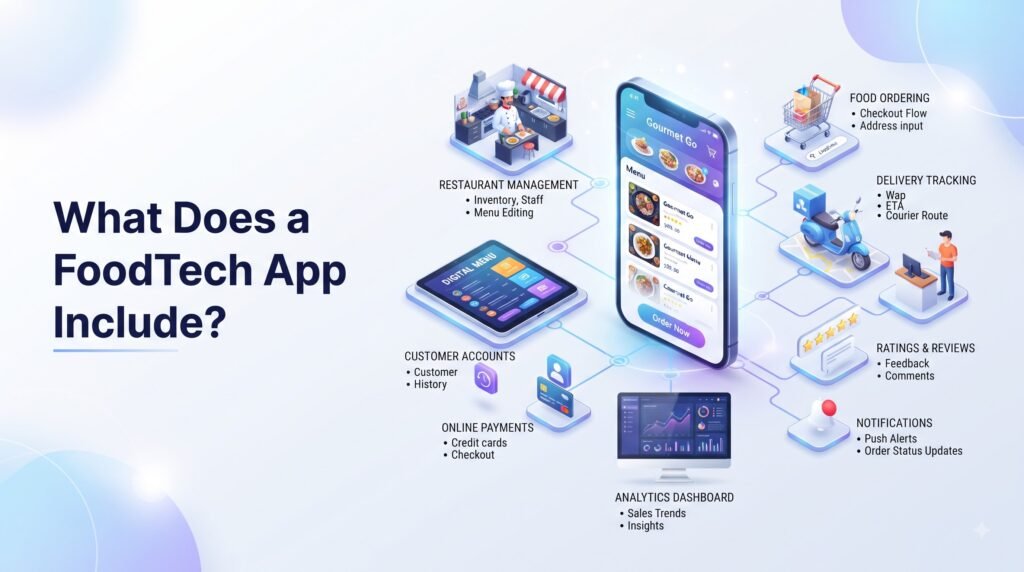
Foodtech is a broad category.
It can include software for:
- Restaurant ordering
- Food delivery
- Restaurant management
- Grocery delivery
- Cloud kitchens
- Meal subscriptions
- Catering
- Corporate food ordering
- Food marketplaces
- Inventory and supply-chain operations
- Nutrition and meal-planning products
- Food-focused SaaS platforms
That distinction matters because two products described as “foodtech apps” can have completely different development costs.
A restaurant ordering app may need a customer interface, menu management and payments.
A multi-restaurant delivery marketplace can require four connected experiences:
- Customer app
- Restaurant/vendor dashboard
- Delivery partner app
- Admin and operations platform
The second product has substantially more backend logic, permissions, real-time communication, location services and testing.
FoodTech App Development Cost in 2026
A practical way to think about the budget is by product complexity rather than by a single average.
| Product scope | Approximate development cost | Typical use |
| Focused foodtech MVP | 20K–40K | Validate one core ordering or food workflow |
| Multi-feature MVP | 40K–70K | Ordering plus vendor/admin functionality |
| Multi-restaurant platform | 50K–120K+ | Marketplace with multiple restaurants |
| Advanced delivery platform | 80K–250K+ | Driver app, live tracking, analytics, integrations |
| Large enterprise platform | $250K+ | Multi-city, advanced logistics, AI, high-scale operations |
These bands should be treated as planning estimates, not quotations. Published 2026 estimates vary considerably because providers define “basic,” “MVP,” and “advanced” differently. SoftTeco, for example, currently publishes 20K–40K for a basic food-delivery app and 80K–250K+ for an advanced platform.
A quote becomes meaningful only when the scope behind the number is clear.
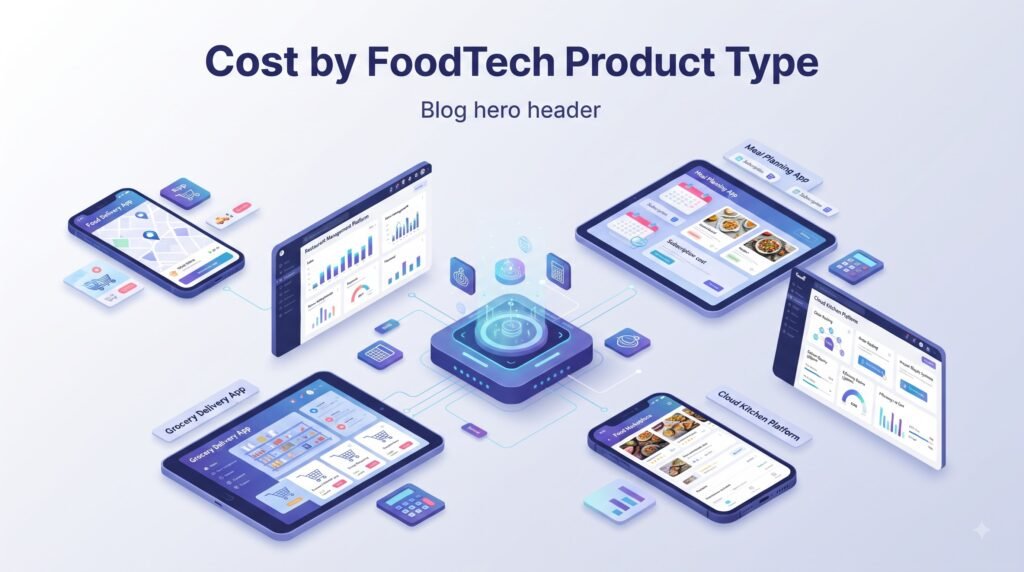
Cost by FoodTech Product Type
1. Single-Restaurant Ordering App
A restaurant that wants its own ordering channel doesn’t necessarily need a marketplace.
A lean version may include:
- Customer registration
- Menu browsing
- Cart
- Checkout
- Payment
- Order status
- Restaurant order management
- Basic administration
This is one of the simpler foodtech models because there may be only one merchant and no independent driver marketplace.
Planning range: approx $20,000-$40,000 for MVP, depending on complexity.
2. Multi-Restaurant Marketplace
The complexity increases when the product connects multiple restaurants.
Now the platform needs to manage:
- Restaurant onboarding
- Individual menus
- Restaurant availability
- Order routing
- Commission or settlement logic
- Restaurant dashboards
- Customer accounts
- Promotions
- Reviews
- Admin controls
If delivery partners are also part of the platform, the scope increases again.
Planning range: approximately 40,000–100,000+, depending on how much marketplace and logistics functionality is included.
3. Grocery or Food-Commerce Platform
Grocery products introduce another layer of complexity because the application isn’t only handling orders.
It may also need:
- Product catalogs
- Inventory
- Substitutions
- Stock availability
- Multiple stores
- Shopper workflows
- Delivery scheduling
- Location-based fulfillment
This is why grocery delivery can move far beyond the budget of a simple food-ordering MVP. Current industry benchmarks are around six figures for highly complex apps.
4. B2B Food Delivery
Corporate meal delivery and catering platforms have different requirements.
The examples of the features might include
- company accounts
- employee accounts,
- bulk orders,
- approval processes,
- scheduled deliveries,
- invoicing,
- recurring orders,
- reporting,
and others. While the interface may be similar to a consumer delivery app, the business logic in the background can be exponentially more complex.
Why FoodTech Apps Can Become Expensive
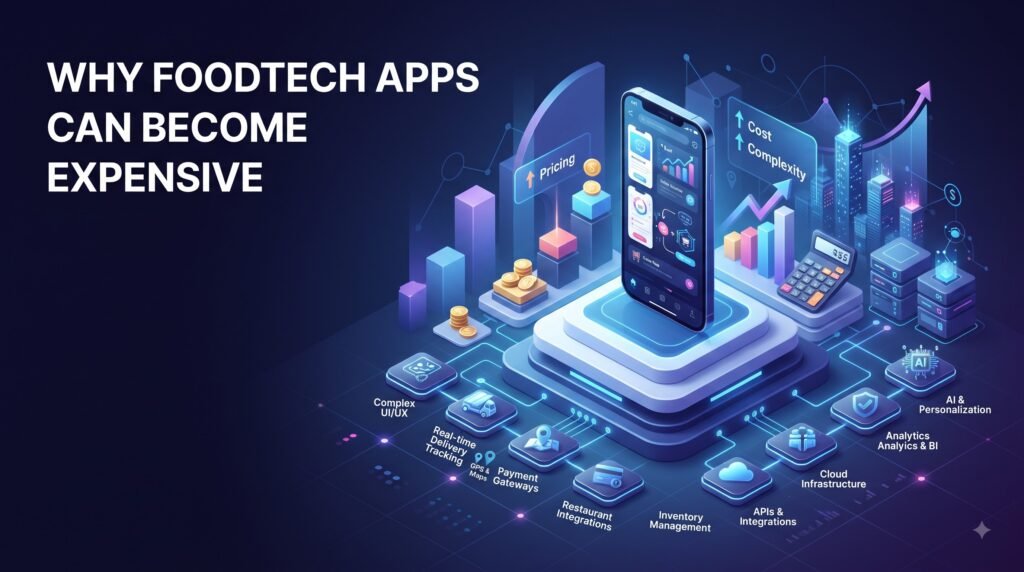
The number of operational actors
One of the biggest cost drivers is the number of people or businesses interacting with the system.
Consider this workflow:
Customer places order → Restaurant accepts → Kitchen prepares → Driver receives → Driver navigates → Customer tracks → Payment settles → Admin reconciles
Each arrow represents business logic that has to work reliably.
This is why a four-panel food delivery ecosystem is much more expensive than a simple food-ordering application.
Feature-by-Feature Cost Drivers
There is no reliable universal price for an individual feature because development cost depends on how the feature interacts with the rest of the system.
Still, these are the features that usually deserve the most attention during estimation.
Customer accounts
Basic authentication is relatively straightforward.
Complexity increases when you add:
- Multiple account types
- Social login
- Phone verification
- Saved addresses
- Multiple delivery addresses
- Account recovery
- Role-based access
Restaurant management
Restaurant-side software may need:
- Menu creation
- Pricing
- Availability
- Order acceptance
- Order status
- Inventory
- Promotions
- Branch management
- Sales reporting
The number of restaurants and branches matters as much as the feature list.
Payments
Payments aren’t just a checkout button.
The backend may need to handle:
- Payment authorization
- Payment confirmation
- Failed transactions
- Refunds
- Webhooks
- Settlement
- Order/payment reconciliation
For India-based businesses, payment providers also have their own pricing. Stripe currently lists 2% for most cards issued in India and 3% for cards issued outside India under its standard India pricing.
Payment-provider charges are therefore an operating expense, not simply a development cost.
GPS and live tracking
Location functionality can include:
- Address search
- Geocoding
- Driver location
- Route calculation
- ETA
- Delivery zones
- Distance calculations
- Route optimization
Google Maps Platform uses usage-based pricing, and its India pricing has specific eligibility and billing rules.
The Routes API can calculate routes and route matrices, which are useful building blocks for delivery and dispatch workflows.
Notifications
Foodtech products commonly use notifications for:
- Order confirmation
- Restaurant acceptance
- Preparation updates
- Driver assignment
- Delivery status
- Promotions
Firebase Cloud Messaging supports notification and data messages across supported client platforms.
The development work may be modest compared with the core ordering system, but notification infrastructure can still create ongoing usage and maintenance requirements.
Customer App vs Restaurant App vs Driver App vs Admin
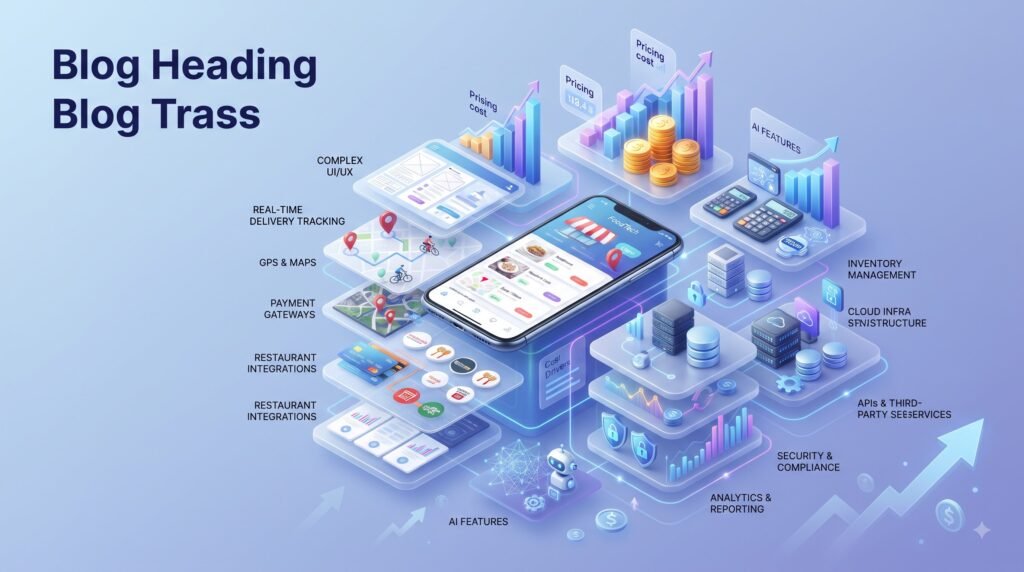
A common budgeting mistake is to think of the foodtech product as one mobile application.
For a delivery marketplace, the scope may look more like this:
| Component | Main responsibility |
| Customer app | Browse, order, pay, track |
| Restaurant dashboard | Manage menus and orders |
| Driver app | Accept, navigate and complete deliveries |
| Admin panel | Manage users, restaurants, orders, refunds and operations |
SoftTeco’s current breakdown similarly treats these as separate development components with independent scope.
If your first release doesn’t need all four, don’t automatically build all four.
A startup might validate demand with:
Customer app + simple restaurant dashboard + manual delivery operations
before investing in a dedicated driver application.
That’s a product decision, not merely a technical cost-cutting trick.
Technology Stack and FoodTech Development Cost
Technology should follow the product requirements.
For a relatively conventional foodtech MVP, possible components include:
- React or Next.js for web interfaces
- React Native or Flutter for mobile
- Node.js or another backend framework
- PostgreSQL or another suitable database
- Cloud hosting
- Payment APIs
- Maps APIs
- Notification services
- Analytics
The specific stack should be selected after the workflow and scope are understood.
A stack that is familiar to the development team can reduce implementation friction, but choosing technology solely because it is popular isn’t enough.
The relevant questions are:
- Does it support the required integrations?
- Can the team maintain it?
- Does it fit the product’s data model?
- Does it support the required mobile capabilities?
- Can it scale appropriately?
- Does it avoid unnecessary infrastructure complexity?
BkAbhi’s current public technology positioning lists Next.js, React and Node.js for SaaS architecture, and React Native/Expo for mobile experiences.
For a deeper discussion of stack selection, see the BkAbhi guide on choosing a tech stack for MVP development.
Native vs Cross-Platform Development
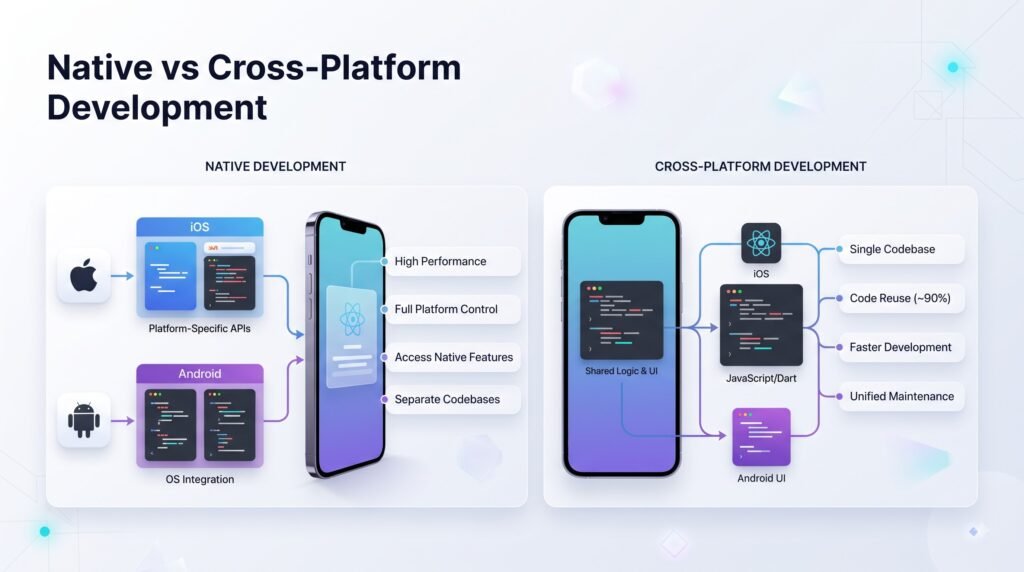
If you need both iOS and Android, you have a fundamental architectural choice.
Native
Separate iOS and Android implementations can provide strong platform-specific control, but they generally require more development resources.
Cross-platform
Cross-platform frameworks allow much of the application logic and interface work to be shared.
For an early-stage startup, that can make cross-platform development attractive when:
- Budget is constrained
- Both platforms are required
- The product doesn’t depend heavily on platform-specific functionality
- Speed of iteration matters
The correct choice depends on the product rather than a universal rule.
How Much Does AI Add to a FoodTech App?
AI isn’t automatically valuable just because it can be integrated.
Possible foodtech AI applications include:
- Personalized food recommendations
- Search assistance
- Demand forecasting
- Customer-support automation
- Menu categorization
- Review analysis
- Fraud detection
- Delivery prediction
- Inventory forecasting
But AI can also add:
- API usage
- Prompt and evaluation work
- Data pipelines
- Monitoring
- Model-specific infrastructure
- Testing
- Privacy considerations
If the core business question is simply “will customers order food through this service?”, an AI recommendation engine may belong in version two rather than the MVP.
FoodTech App Development Timeline
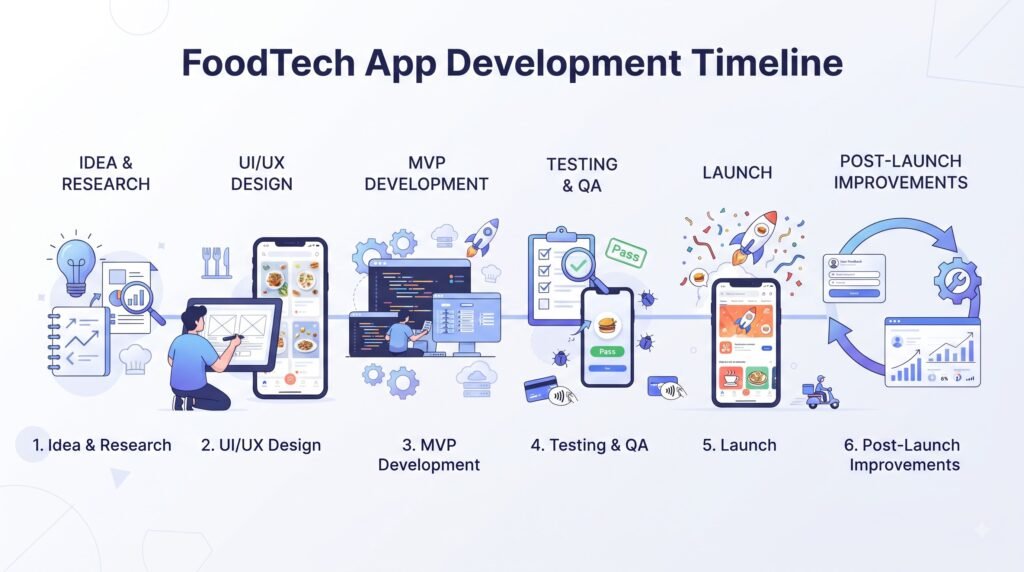
A useful planning model is:
| Stage | Typical focus |
| Discovery | Business model, users, workflow, scope |
| UX/UI | User journeys, wireframes, visual design |
| Architecture | Backend, database, integrations |
| Development | Core application functionality |
| QA | Functional, device, payment and workflow testing |
| Deployment | Production environment and store submission |
| Iteration | Feedback, fixes and next features |
Published 2026 estimates for food delivery applications range from approximately 2–4 months for basic products to 6–12 months for advanced platforms, although the actual timeline depends heavily on scope and team structure.
Don’t accept “three months” as a useful estimate without asking:
Three months for what?
A customer ordering MVP and a four-sided multi-city marketplace are not equivalent projects.
Hidden Costs Beyond Development
Your development quote isn’t necessarily your total product budget.
1. Cloud infrastructure
Hosting, databases, storage, bandwidth, monitoring and backups may continue after launch.
2. Maps and routing
Usage-based mapping and routing costs can increase with order volume. Google Maps Platform uses billable events and provides specific India pricing for eligible customers.
3. Payment processing
Payment providers charge transaction fees. These are separate from the developer’s implementation fee.
4. Messaging
SMS, email and push notification infrastructure can generate recurring costs.
5. Maintenance
Operating-system updates, security fixes, dependency updates and bug fixes continue after launch.
6. Customer support
A consumer food product can generate significant operational support requirements even when the software itself is stable.
7. App-store accounts
Apple currently charges $99 per membership year for the Apple Developer Program.
Google Play currently requires a one-time US$25 Play Console registration fee.
These fees are small compared with development, but they belong in a complete launch budget.
Food Delivery Payments Have a Useful Policy Distinction
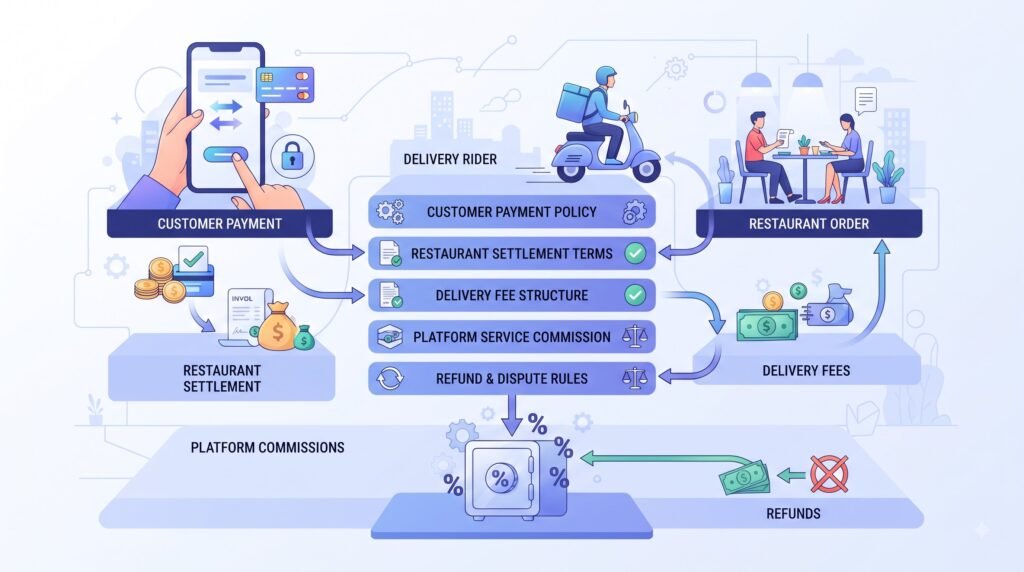
A food delivery application shouldn’t automatically be treated like a digital subscription application.
Google Play’s payments documentation states that Google Play Billing isn’t used for purchases of physical goods or physical services, including food delivery.
That means your payment architecture should be designed around the actual transaction model rather than copying the billing approach used by a digital-content app.
Always verify the current platform policies before launch because policies and regional requirements can change.
Privacy and Compliance
Foodtech applications can collect:
- Names
- Phone numbers
- Email addresses
- Delivery addresses
- Location information
- Order history
- Payment-related information
- Preferences
- Potentially dietary or health-related information
The applicable legal requirements depend on where the business operates and what data it processes.
For India-focused products, the Digital Personal Data Protection Act, 2023 is an important legal reference for digital personal-data processing. The government has also published the Digital Personal Data Protection Rules 2025. For a broader view of the budgeting factors involved in food delivery app development, see this food delivery app development cost guide.
This isn’t a substitute for legal advice. It is a reason to include privacy and data-handling requirements during product planning rather than treating them as a launch-week task.
Custom Development vs White-Label vs No-Code
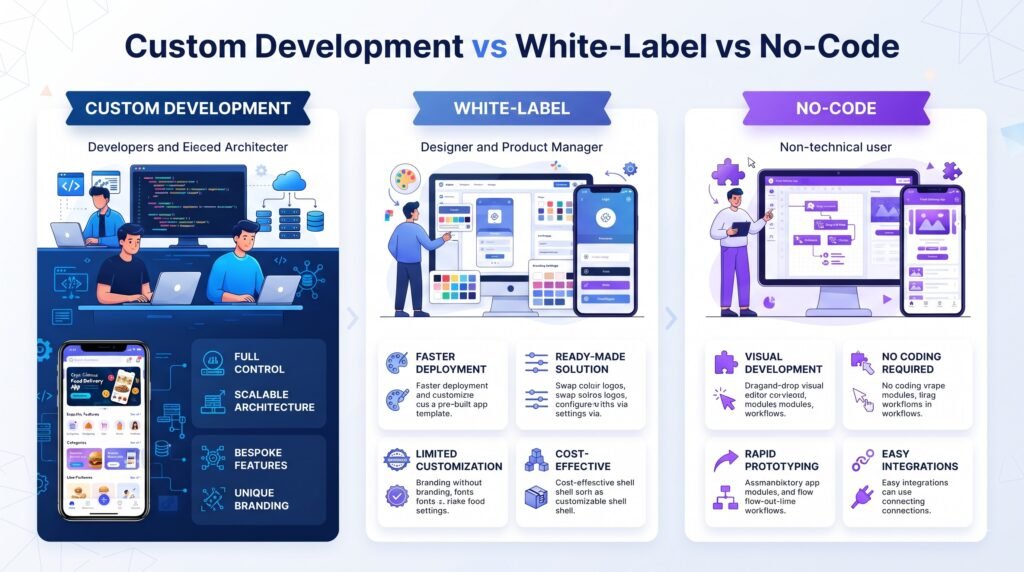
Custom development
Choose it when:
- Your workflow is differentiated.
- You need ownership of the product.
- You expect substantial customization.
- You need control over architecture and integrations.
- The product is intended to become a long-term software business.
Trade-off: Higher initial investment and longer development.
White-label
Choose it when:
- Speed is the main objective.
- Your workflow is relatively standard.
- You can accept platform constraints.
- You want to test a local market before deeper investment.
Trade-off: Customization and platform flexibility may be limited.
No-code/low-code
Choose it when:
- The first hypothesis can be tested without complex real-time logistics.
- The workflow is relatively simple.
- The goal is validation rather than long-term infrastructure.
Trade-off: Advanced integrations, performance requirements and complex operational workflows can eventually require custom engineering.
The best option depends on what you are trying to prove.
How to Reduce FoodTech App Development Cost
Start with one operational question
Instead of:
“How can we build the next Uber Eats?”
ask:
“What is the smallest product that proves our food business model?”
That question changes the budget.
Limit geography
Start with one city or service area if the business model allows it.
Reduce simultaneous platforms
If a responsive web application can validate demand, you may not need iOS and Android applications on day one.
Keep logistics manual initially
If order volume is low, dispatch can sometimes be operationally assisted instead of requiring sophisticated automated routing from the beginning.
Delay advanced personalization
AI recommendations, loyalty engines and predictive analytics can wait until actual usage data justifies them.
Use proven integrations
Payment, mapping, authentication and notification services can be integrated instead of reinvented.
Define change requests
Every new feature during development affects:
- design
- engineering
- testing
- deployment
- documentation
- schedule
A written change-control process protects the budget.
For more on this issue, see BkAbhi’s guide to hidden MVP development costs.
How to Get an Accurate FoodTech Development Quote
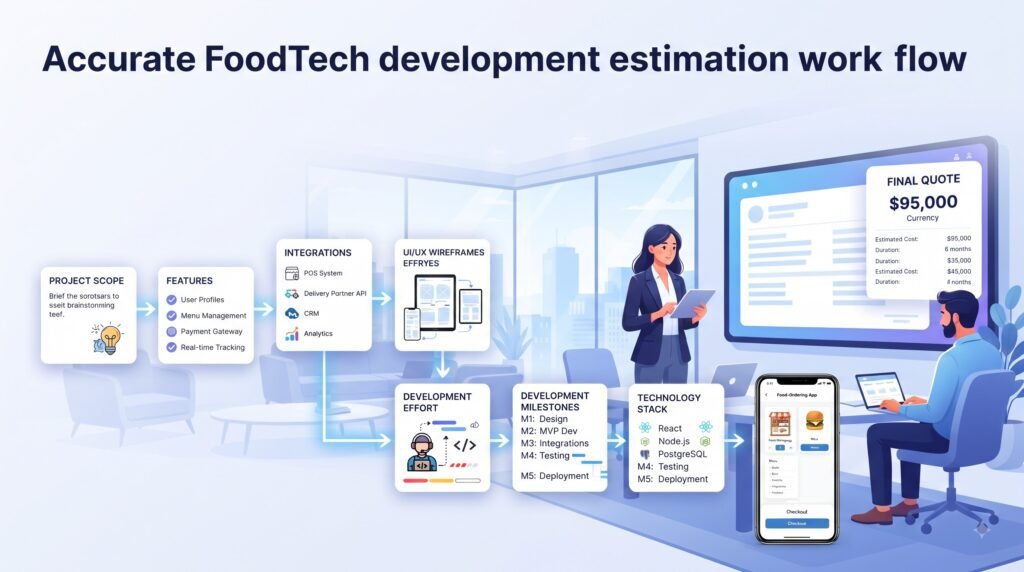
Don’t ask a development company:
“How much does a foodtech app cost?”
Give them enough information to estimate the actual project.
Your initial brief should include:
Product model
Is it:
- single restaurant
- marketplace
- grocery
- meal subscription
- restaurant SaaS
- corporate food platform
- cloud-kitchen system?
Users
List every role:
- customer
- restaurant
- driver
- administrator
- operations manager
- corporate buyer
Platforms
Specify:
- Web
- iOS
- Android
- responsive web
- internal dashboard
Core workflow
Explain the complete journey from signup to completed order.
Integrations
List expected:
- payment provider
- maps
- SMS
- push notifications
- analytics
- POS
- accounting
- CRM
Launch geography
Country and city can affect:
- payments
- tax
- privacy
- maps
- logistics
- language
- store requirements
Scale assumption
Don’t say “millions of users” unless that’s actually part of your near-term requirement.
Estimate the first meaningful milestone instead.
What a Good FoodTech Quote Should Show
A useful proposal should make it possible to understand:
| Quote area | What to verify |
| Discovery | What planning is included? |
| Design | How many flows/screens? |
| Development | Which platforms? |
| Backend | Which services are included? |
| Integrations | Which APIs are included? |
| QA | What testing is performed? |
| Deployment | Who handles store submission? |
| Infrastructure | Who pays cloud/API costs? |
| Ownership | Who owns source code and IP? |
| Changes | How are change requests priced? |
| Support | What happens after launch? |
If a proposal gives you one large number without explaining the assumptions, you don’t really have a comparable quote.
For a broader vendor-selection framework, see BkAbhi’s MVP app development company guide.
Where BkAbhi Fits
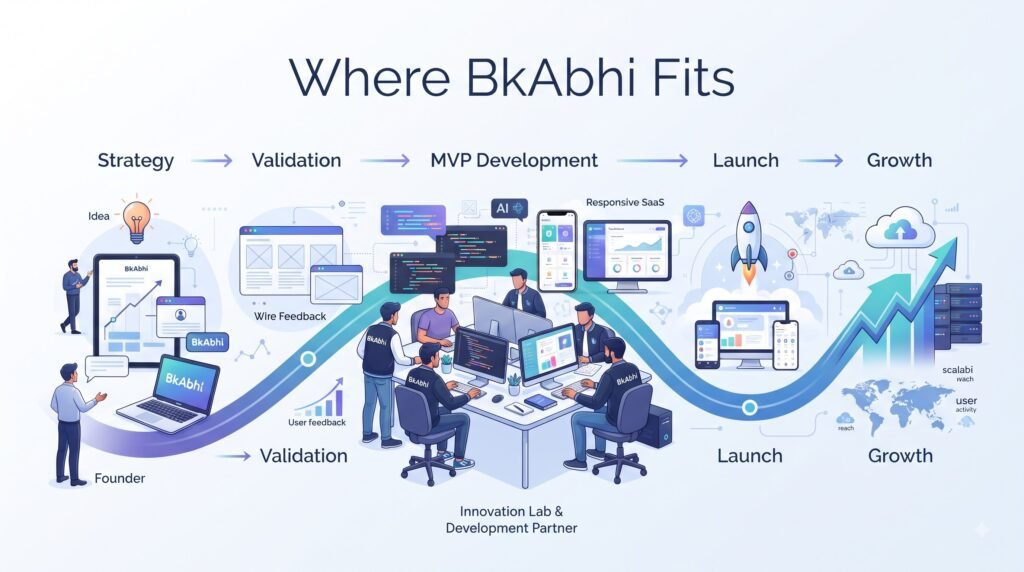
BkAbhi’s current website positions the company around rapid MVP development and publicly lists capabilities in SaaS architecture, mobile experiences, AI integration and motion design.
It currently publishes a $2,999 one-time starting package for its “Ship My MVP” offering, alongside a $997/month Live Product Partner offering.
The important qualification is that the website’s estimator is explicitly illustrative, with final scope and timeline confirmed through discovery.
So a founder shouldn’t read the $2,999 figure as:
“A complete food delivery marketplace costs $2,999.”
That would not be supported by the public information.
A better interpretation is:
Verified fact: BkAbhi publicly advertises a $2,999 starting MVP package.
Analysis: A foodtech product with multiple operational roles, real-time logistics and external integrations may require a different scope.
Recommendation: Take the actual foodtech workflow into discovery and request an itemized scope rather than assuming the generic package applies.
BkAbhi’s public site also states 100% IP ownership as part of its current positioning.
A foodtech-specific service or fixed foodtech price was Not publicly verified during this research.
Final Budget Framework
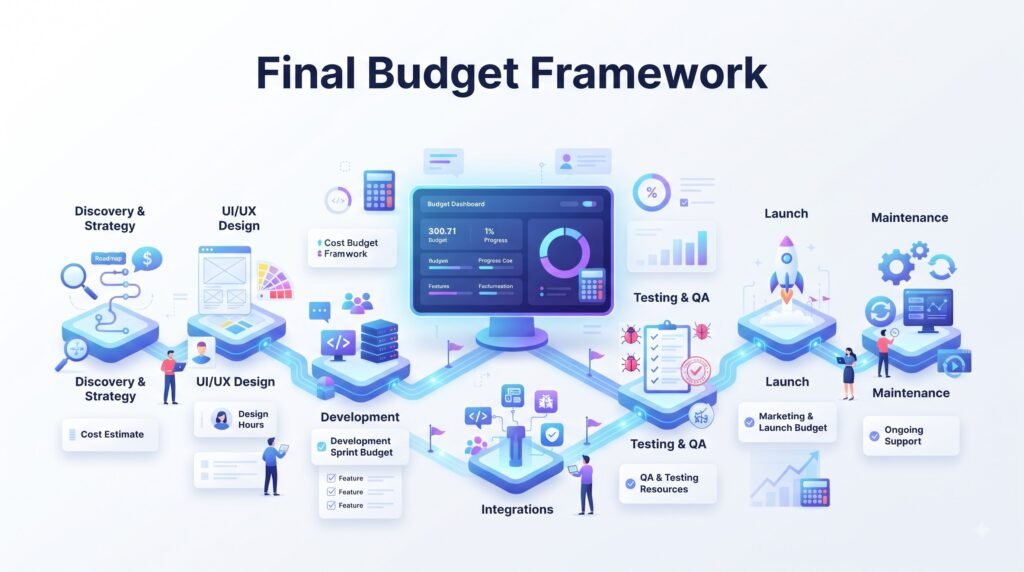
If you’re preparing an early foodtech budget, think in these terms:
20K–40K
A focused MVP with a limited ordering workflow and relatively few operational roles.
40K–100K
A more complete product with multiple users, vendor management, payments, dashboards and additional integrations.
80K–250K+
An advanced delivery ecosystem with dedicated driver functionality, live tracking, analytics, sophisticated administration and additional automation.
$250K+
A large platform with substantial geographic coverage, advanced logistics, AI, complex integrations, high-scale infrastructure or enterprise requirements.
These aren’t guaranteed market prices. They are planning bands synthesized from current 2026 published estimates and the scope differences those estimates describe.
The biggest budget-saving decision usually happens before development starts.
If you can validate the business with one core workflow, one market and a limited number of roles, you don’t need to finance the entire future platform on day one.
Frequently Asked Questions
How much does foodtech app development cost in 2026?
A focused custom foodtech MVP can start around $20,000, while more sophisticated multi-sided food delivery platforms can reach 100,000–250,000+. Large enterprise platforms can exceed that. The exact cost depends on product type, user roles, platforms, integrations and scale.
How much does a food delivery MVP cost?
Current 2026 estimates commonly place a basic food delivery MVP around 20,000–40,000. A more complex MVP with multiple roles and integrations can cost substantially more.
Why does a food delivery app cost more than a normal mobile app?
Because the product often has several connected systems. A marketplace may require customer, restaurant, driver and admin experiences, plus payments, location services, order management and real-time status updates.
Is cross-platform development cheaper?
It can reduce development effort when the same product needs both iOS and Android because more code can be shared. Whether it is the right choice depends on the application’s platform-specific requirements.
How much do maps cost for a food delivery app?
Google Maps Platform uses usage-based pricing. Eligible India-based customers have separate India pricing, and the actual cost depends on which services and how much usage the application generates.
Does payment integration increase development cost?
Yes. Developers need to implement checkout, payment confirmation, failure handling, refunds and webhooks where applicable. Payment providers also charge transaction fees independently of development costs.
Do food delivery apps need Google Play Billing?
Google’s policy states that Google Play Billing is not used for purchases of physical services such as food delivery. However, products containing digital goods or services can fall under different rules, so the exact business model should be checked against current policy.
Should I build all four food delivery apps for the MVP?
Not necessarily. If your business can validate demand with a customer experience, a basic restaurant interface and operationally assisted delivery, that may be a more efficient first release than immediately automating every workflow.
What is the biggest hidden foodtech development cost?
Scope changes are one of the biggest controllable risks. Third-party services, infrastructure, testing, compliance and post-launch maintenance can also increase the total cost.
How much does BkAbhi charge for MVP development?
BkAbhi’s current website publicly lists its “Ship My MVP” package from $2,999 one-time. The site states that its estimator is illustrative and that final scope and timeline are confirmed during discovery. This should not be interpreted as a fixed price for a complete foodtech marketplace.
How can I reduce foodtech development cost?
Start with a narrow MVP, reduce the number of platforms, limit geography, postpone advanced AI and automation, use proven third-party services, and define change requests before development begins.
Author Bio
Jeevesh Tripathi
Email: jeevesh@bkabhi.com
Jeevesh Tripathi is a technology and product researcher focused on software, AI, SaaS and digital product development. His work emphasizes research-based writing, practical comparisons and evidence-based evaluation. He focuses on separating verified facts from analysis so founders can make more informed technology and product decisions.