

Table of Contents
Introduction: Understanding Probation Period Reviews
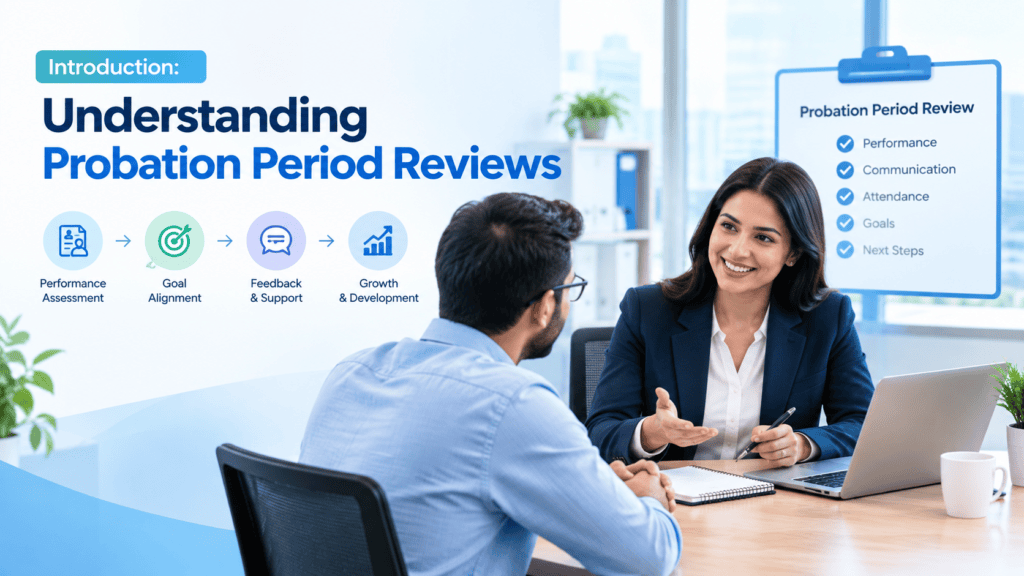
A probation period review is a formal assessment process which evaluates an employee’s performance, progress, conduct, and other factors throughout or at the conclusion of their probation period.
This assessment provides managers with valuable insight concerning the employee’s capability and potential in fulfilling the demands of the position for which they have been hired.
What Is a Probation Period Review?
A probation period review is a discussion between an employee and their manager. The review covers such aspects as work performance, skills, communication abilities, collaboration, attendance, adaptability, and achievement of goals. As a result of the talks, the employee can either be confirmed, his or her probation period can be extended, or a personal development plan can be created.
Why Do Probation Reviews Matter?
Probation reviews offer several benefits to employers, such as providing grounds for employment decisions and giving employees feedback on their performance. In addition, they help to ensure that the workers are aware of what is expected of them and any deficiencies that they might have.
Benefits for Employers and Employees
For employers, a probation review ensures that the employee meets the required standards, identifies their strengths and weaknesses, helps make the right hiring decisions, and ensures they are fit for the proposed job role.
For employees, a review ensures that they receive constructive feedback about their performance, understand the areas that need improvement, recognize their strengths, and have a forum to discuss and address any issues. In addition, a review helps establish good rapport and boosts the overall performance of an employee.
Steps for Conducting a Probation Period Review
A probation period review is an important step that allows companies to determine whether a newly hired employee is a good fit for the long term. It also helps the worker to understand how he is performing. A well-structured review can protect both the employer and the employee from adverse consequences. Below are the steps for conducting a probation period review.
1. Preparing for the Review
Preparation sets the tone for the entire process. Before the review, managers should:
- Revisit the employee’s job description and the goals set during onboarding
- Review any notes from check-ins or one-on-ones held during the probation period
- Block sufficient, uninterrupted time for the review meeting
- Loop in HR if there’s a standard probation review process or template to follow
Good preparation ensures the review feels organized and fair, rather than rushed or reactive.
2. Setting Clear Evaluation Criteria
Vague feedback like “doing okay” or “needs improvement” doesn’t help anyone. Effective probation reviews are built on specific, measurable criteria, such as:
- Job-specific competencies and skills
- Quality and quantity of work performed
- Adherence to company policies and standards of conduct
- Effective communication and teamwork
- Achievement of objectives set forth at the commencement of employment
These criteria should ideally be shared with the employee at the start of their probation period, not sprung on them during the review.
3. Collecting Employee Performance Data
Objective decisions require objective data. This might include:
- Manager observations and feedback logs
- Peer or cross-functional feedback
- Attendance and punctuality records
- Output metrics (sales numbers, project completions, error rates, etc.)
- Feedback from clients or customers, if relevant
Gathering data from multiple sources helps avoid bias and gives a fuller picture of performance than any single perspective could.
4. Completing a Probation Review Document
A standardized probation review form or document helps keep the process consistent and legally defensible. It typically includes:
- Employee’s information and probation dates
- Summary of the job duties carried out
- Performance level against each of the criteria
- A strengths and weaknesses section
- A recommendation to either confirm, extend, or terminate the employee.
Having this documented in writing before the meeting ensures the conversation stays focused and evidence-based.
5. Conducting the Review Meeting
This is where preparation meets communication. A well-run review meeting should:
- Start by setting context for the conversation
- Share both strengths and areas of opportunity for improvement
- Ask for your perspective on the discussion and any challenges you are facing
- Clearly outline next steps, whether it be confirmation, extension or termination
- End on a positive note (even if the discussion is around termination)
Two-way dialogue is essential here. Employees are far more receptive to feedback when they feel heard, not just evaluated.
6. Documenting the Review
Once the meeting concludes, the outcome and key discussion points should be formally recorded. This includes:
- The final decision and the reasons for it
- Action items or improvement plan (if extension is needed)
- Both signatures (manager and employee) signifying that the talk has taken place
- The filing of the form in the employee’s HR file for the future reference
Proper documentation ensures that the organization is protected in the case of any disputes and provides the employee with a tangible description of what was discussed and decided.
In short, a proper probation review procedure ensures that employees are judged in a just and equitable manner.
Would you like this information put into a downloadable Word doc or blog post format?
How to Conduct an Effective Probation Review Meeting
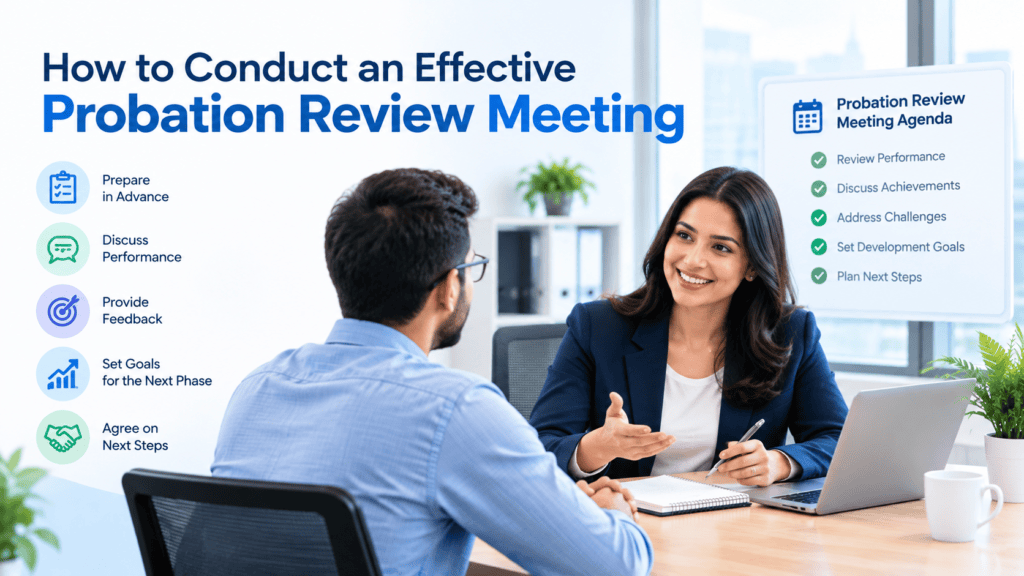
A probation review meeting should not be an agonizingly tense affair. When done right, a probation review meeting can achieve the dual purpose of aligning the employee with the expectations of the organization while also serving as a morale booster during what can be a stressful period in the life of an employee.
Here are some tips on conducting an effective probation review meeting.
1. Facilitate an Honest Discussion
An effective review relies on psychological safety. If the employee feels defensive, they’ll stop listening; if you hide critical feedback behind indirect language, the meeting loses all value.
- Make sure right at the beginning of the meeting you clearly state the purpose of the session. Instead of asking “How can I help you be more successful?” try “Let’s talk about how we can make sure you’re a good fit for this position and how you can grow in the company.”
- Avoid the “sandwich method” of giving feedback. “I really like your work, but you need to be more responsible, but I really like your work” is not effective feedback.
- Remember to always separate the person from the problem. For example, instead of saying “You are disorganized,” try “We noticed that three important deliverables have been missed this month due to poor task delegation.”
2. Provide Feedback with Concrete Examples
Vague observations like “you need to communicate better” leave the employee guessing what changes are actually required. Specificity removes ambiguity and creates a clear baseline for growth.
- Use the SBI Model (Situation-Behavior-Impact):
- Situation:“During last Tuesday’s sprint planning…”
- Behavior:“…you submitted the project scope without reviewing the design team’s inputs.”
- Impact:“…which delayed our dev timeline by two days and caused unnecessary rework.”
- “I understand that during last Tuesday’s sprint planning…
- you were submitting the project scope without incorporating the design team’s recommendations
- which resulted in a two-day delay of our dev timeline and unnecessary rework
- I suggest we set clearer expectations on all deliverables beforehand, including specific pull requests, reports, time intervals or client feedback we should take into account before each planning session to avoid such mishaps in the future
- In addition to pointing out your mistakes during the project, I’d also like to acknowledge your accomplishments to stay motivated
- I appreciated how you were able to implement the changes to the design we discussed during the discovery session
- Your version of the redesign has improved the onboarding process by XX% in the week four.
3. Listen to Employee Feedback
Probation is a two-way street. The review is as much about whether your company is providing the environment they need to succeed as it is about their output.
- Ask open-ended discovery questions:
- “Where have you felt supported, and where have you felt blocked?”
- “Is the reality of this role matching the expectations set during hiring?”
- “What tools, training, or context do you feel you’re currently missing?”
- “Where have you felt supported and where have you felt blocked?”
- “Is the reality of this role living up to your expectations based on the hiring criteria?”
- “What tools, training, or context do you feel you are missing?”
- Let them finish speaking before reacting to defend a process or management decision. Take written notes to show the employee that their feedback is being captured and considered.
- Look for systemic bottlenecks where the process was flawed.
- If the employee isn’t reaching their goals, by asking these questions, you are likely to discover that it’s because of a faulty process, not the employee – such as insufficient training material or lack of tools or support from other departments
4. Evaluate Performance and Future Potential
The final objective of the review is to determine long-term trajectory and make a firm, actionable decision regarding their probation status.
- Distinguish between performance and potential:
- Current Performance: Are they fulfilling the core deliverables and output requirements of the role at this time?
- Future Potential: Do they have adaptability, fit into the cultural framework, exhibit a growth mindset, and be able to scale with the team in the next 12-18 months?
- Establish explicit outcomes:
- Pass: Probation complete, goal setting quarterly with 1 year development path.
- Extend: Performance is satisfactory but could use further support and guidance, extend probation by 30-60 days with performance improvement plan (PIP).
- Fail: There is an obvious lack of skill/cultural fit which can’t be improved on, proceed to offboarding.
- Agree on clear next steps: End the meeting with written action items, clear milestones for the next 30/60/90 days, and a scheduled date for your next regular 1-on-1.
What Happens After a Probation Review Meeting?
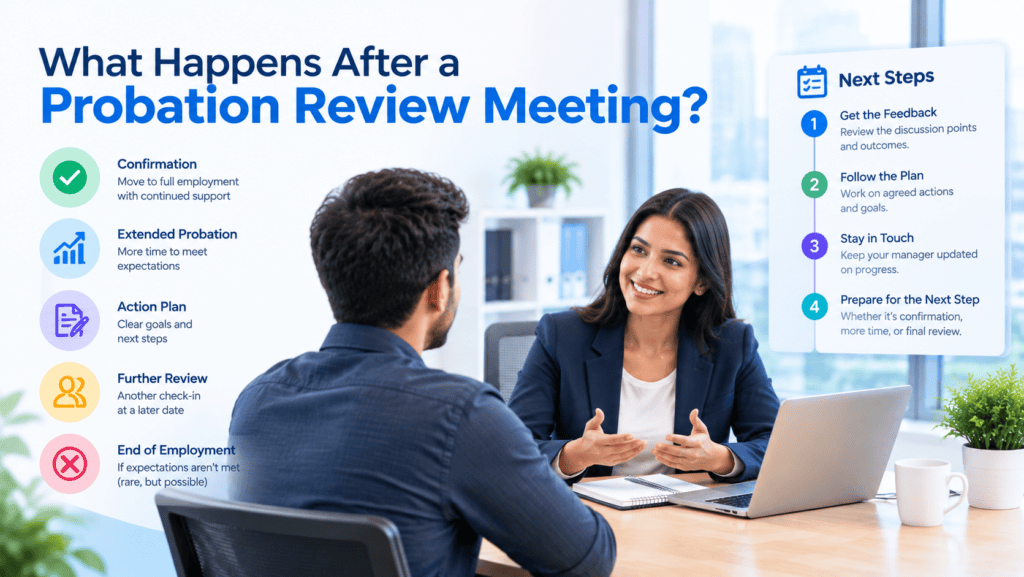
A probation review meeting is used by an employer to determine whether a newly hired employee is a good fit for the company in the long term. After the meeting, either of the following four outcomes usually occurs:
1. Confirmation of Employment
If the employee has met or exceeded expectations, the employer confirms them as a permanent member of staff. This typically comes with:
- Informal confirmation letter or email
- Removal of any probationary-related restrictions (e.g., reduced notice periods)
- Access to full benefits that were previously withheld
- A short note in the employee’s file about a successful probation period
2. Extension of the Probation Period
Sometimes performance is not good enough, or they need more time to show an improvement in working. Employers can sometimes prolong the trial period instead of just ending the trial at once. A good extension should contain:
- A clearly defined new end date
- Specific, measurable areas for improvement
- Regular check-ins during the extended period, not just a final decision point
3. Termination of Employment
If performance hasn’t improved despite feedback and support, the employer may decide to end employment. This is usually handled with:
- Clear documentation of reasons in accordance with previously provided feedback
- Compliance with the notice period as stipulated in the employment contract or local labor law
- A respectful exit conversation and offboarding procedure
4. Setting Goals and Follow-Up Actions
Even when confirmation is granted, most well-run probation reviews don’t end with just a decision — they end with a plan. This might include:
- Short-term performance goals for the next 30-90 days
- Training or mentorship recommendations
- A scheduled follow-up meeting to track progress
- Clarity on role expectations going forward
The bottom line is that any form of probation review is only a stage. Thus, regardless of the outcome (confirmation, extension or termination of probation), it is necessary to establish clear objectives and specific actions that probationer and/or employer should carry out in the future.
Would you like me to format this information in a blog post file (MS Word or Markdown) you can use or share?
Probation Review Questions Managers Should Ask
A probation review is not merely a formality, but a significant step towards transforming a new recruit into a seasoned professional. Asking the right probation questions can make all the difference to a manager. Here are the key five areas of operation that a manager should focus on while scheduling a probation review meeting:
A detailed list of probation review questions and the indicators that a manager should look out for in the answers is given below.
1. Questions About Achievements
Focusing on achievements at the end of a probation period helps validate hiring decisions, boosts employee confidence, and reveals where the individual finds value in their work.
Core Questions
- Looking back over your first [3/6] months, what accomplishment are you most proud of, and why?
- Which completed projects or milestones best show what impact you have made on the team so far?
- Have you achieved the key initial goals we set for you for your first 30-60-90 days?
- Where do you feel you have exceeded the expectations in your role description?
What Managers Should Look For
Look for self-awareness and an understanding of value creation. Strong answers connect personal efforts to direct business outcomes or team improvements rather than just listing daily tasks.
2. Questions About Strengths and Weaknesses
Understanding how employees evaluate their own skill set helps managers align future tasks with natural talents while proactively addressing skill gaps.
Core Questions
- Which parts of your work do you feel most confident and competent in performing?
- What aspects of the job did you find yourself struggling with or uncomfortable doing?
- Are there skills or tools needed for the job that you feel unprepared or underqualified for?
- How have you adjusted your work style to best fit our team?
What Managers Should Look For
Look for candor over self-preservation. High-performing employees comfortably acknowledge areas where they struggle and actively seek ways to improve, rather than claiming perfection.
3. Questions About Challenges
Probationary periods naturally involve friction. Uncovering hidden roadblocks allows managers to clear obstacles before they turn into long-term performance issues or burnout.
Core Questions
- “What has been the biggest unexpected hurdle or setback you’ve run into since we’ve started working together?”
- “Is there anything about our internal processes, systems, or cross-team collaboration that feels non-optimal in your day-to-day work?”
- “Have you had any issues around workload pacing, or work-life balance?”
- “Is there anything about the role or company that is substantially different than what was presented during the interview process?”
What Managers Should Look For
Listen for constructive problem-solving vs. finger-pointing. Pay attention to process bottlenecks that might be affecting not just this employee, but the broader team.
4. Questions About Training and Support
A probation review is a two-way evaluation. These questions shift the focus onto managerial responsibility, ensuring the organization provides the right tools for success.
Core Questions
- “How effective was your onboarding process? Is there anything that we should have done earlier?”
- “Do you have access to all the tools, documentation, and resources that you need in order to perform your job effectively?”
- “How can I, as your manager, help you each day or week?”
- “Are there any particular technical trainings, workshops, or mentorship opportunities that you feel that you need at this time?”
What Managers Should Look For
Actionable feedback on your team’s onboarding flow. Note where communication may have fallen through the cracks so you can optimize the experience for future hires.
5. Questions About Future Career Development
Even during probation, high performers look ahead. Connecting initial performance to long-term growth builds loyalty and long-term retention from day one.
Core Questions
- “Now that you understand the role well, where do you see yourself contributing mostly within the next 12 months?”
- “What particular skills or areas of responsibility would you like to stretch towards in your first year here?”
- “How do your current areas of work tie into your long-term career aspirations?”
- “Are there any projects or cross-departmental initiatives you would like to get involved in the future?”
What Managers Should Look For
Ambition, alignment, and vision. Ensure their personal growth trajectory matches the realistic opportunities available within your organization.
Best Practices for Conducting the Review
| Step | Best Practice |
| Preparation | Send these questions to the employee 3–5 days prior so they can formulate thoughtful answers. |
| Tone | Frame the conversation as a collaborative dialogue, not an interrogation. |
| Documentation | Record agreed-upon goals, support measures, and timelines in a central HR or performance management tool. |
| Follow-through | Schedule immediate follow-up check-ins to act on any training requests or operational blockers raised during the review. |
Tips for a Successful Probation Process
A well-managed probation process helps both employers and employees understand expectations, identify challenges, and build a strong working relationship. Here are some practical tips for making the process effective:
- Set Expectations From Day One: Ensure the employee knows what you expect from him during the probation period. Outline his duties, responsibilities, objectives, policies, and probation period length.
- Give Feedback Often: The review of an employee on probation should not be a surprise. Give feedback regularly and take notes so that the final review is not up to your memory.
- Document Everything: Make sure that everything you told the employee and all the feedback you got are documented. It will make the final review easy as you can refer to the exact notes you made.
- Take Feedback From The Employee: Probation is supposed to be a two-way process. Get the employee’s perspective of the probation process thus far. Ask him how he feels about the whole process, including policy, training, work environment, objectives, and concerns.
- Use Available Technology: There are many technological tools that can make the whole process easier. The task can be done with ease if you use performance management systems and Human Resource Information System.
Probation Review Meeting Format: A Complete Guide

A probation review discussion is a conversation between a manager and a new employee to decide whether the latter should be confirmed on the job after a short-term trial (usually 3-6 months). An efficient meeting will establish clear expectations for the future. The following steps will assist in conducting a successful dialogue.
1. Welcome and Introduction
Start by putting the employee at ease. The probation talk can be intimidating, so begin by chatting casually and make a point to explain exactly what you’re going to discuss and how much time you’ll need to do it. By doing this, you allow the employee to relax and not immediately get on the defensive.
2. Review Responsibilities and Expectations
Revisit the original job description and the goals set at the start of the probation period. This grounds the discussion in facts rather than impressions. Walk through:
- Core responsibilities assigned when they joined
- Any specific targets, KPIs, or milestones agreed upon
- How expectations may have evolved since day one
This step creates a shared reference point so both parties are evaluating performance against the same yardstick.
3. Discuss Achievements
Start by focusing on the positives and specifically state what the employee did right, what did he or she accomplish, demonstrate or achieve successfully. For example, using specific dates and situations, you may say something like, “The way you handled the client escalation back in March was really well done,” rather than the “You’ve done a good job.” It will help you gain the employee’s attention and make him or her more receptive to what you want to discuss next.
4. Assess Performance
This is the core evaluative portion of the meeting. Go through performance systematically:
- Compare the actual results with the expectations presented in step 2
- Use real examples instead of generic statements
- Make sure to address both technical/functional and soft skills, as well as general workmanlike qualities
- Be forthcoming about any shortcomings, since the purpose of this exercise is to improve future performance
5. Discuss Challenges
Allocate space for describing the challenges the employee has encountered, including processes, resources, and interactions, which impacted their approach to work. This will help explain the circumstances surrounding the employee’s performance and guide the improvement of their work. These difficulties are often related to the employee’s inadequate understanding of the work environment, which is not an issue that the worker can resolve independently.
6. Gather Employee Feedback
Flip the conversation and invite the employee to share their perspective:
- How do they feel the role has gone so far?
- Do they feel adequately supported, trained, and resourced?
- Is there anything about the job or team that surprised them?
This step matters for retention. Employees who feel heard during probation are more likely to stay engaged, even if the review includes critical feedback.
7. Agree on Plans and Next Steps
Close with clarity, not ambiguity. Depending on the outcome, this might include:
- Confirmation of the job offer — describe the conditions and terms of further success.
- Extension of the probation period — specify the requirements that it is necessary to fulfill and the date of the next meeting.
- Termination — indicate the reasons and method of dismissal.
Whatever the outcome, it’s important that you put the decision in writing and that the employee leaves the meeting knowing what will happen next.
A successful probation review is a two-way street. Both you and the employee should enter the meeting armed with specific evidence of successes and struggles and leave with a clear understanding of what happens next.
If you’d like Word docs for all of these or a printable checklist for your meeting, let me know.
Probation Reviews for Remote Employees
Probation reviews have always been a key point to assess the suitability of a newly hired employee, but they may become more difficult under remote work conditions because employers have fewer opportunities to control their activities.
In particular, managers cannot observe their subordinates as easily as before, for instance, by checking if they are doing their job in the office or overhearing their conversations. Therefore, probation evaluations must be approached more carefully in the remote work setting.
Challenges of Remote Performance Assessment
The biggest challenge with evaluating remote workers during their probation period is the lack of passive observation. Within the office, managers are naturally exposed to a greater amount of information about how their employee approaches their work, thinking process, and general attitude, whereas these are more difficult to ascertain in the case of remote work.
This creates a few specific problems:
- Output bias: Managers can be inclined to prioritize easily measurable activities (completed tickets, deadlines met) over more nebulous criteria that require a judgment call or an assessment of one’s ability to act beyond given instructions.
- Time zone differences/asynchronous work: If one’s team is working in one’s home time zone, a manager will have limited ability to assess one’s work based on direct observation during working hours.
- Isolation: One’s ability to perform one’s job can be diminished due to the inability to ask questions in real time. This can create the appearance of underperformance even if the circumstances of one’s employment make it impossible to receive adequate guidance.
To combat these issues, it is critical to establish clear performance standards from the get-go. As such, make sure that specific, written criteria are established that the new employee has to meet within the first 30, 60, and 90 days of being on the job. In addition, instead of having one performance review at the end of the probation period, it is better to introduce regular weekly meetings and conversations.
Evaluating Communication and Collaboration
Communication, above all other skills, is the most important but also the hardest to assess for remote employees. When working from home, collaborative work must always be interpreted from the context of specific messages, meetings, and response behaviors.
Some practical ways to evaluate this during probation:
- Clarity and proactivity in written communication: Are employees providing status updates without having to be chased? Are their Slack messages, emails, and documentation clear enough that other people do not have to ask clarifying questions?
- Presence in meetings: Are they chiming in during video conferences or remaining uncharacteristically quiet? Are they asking clarifying questions when instructions are unclear, a critically important skill for asynchronous work?
- Collaboration: Getting feedback from teammates and other groups the employee collaborates with, in addition to their manager, can provide a more holistic view of how an employee is performing. Most managers aren’t privy to the types of interactions their reports have with other teams, so a 360-degree (albeit informal) survey can highlight opportunities for improvement.
- Receptiveness to feedback: How do employees respond to and act on feedback that’s been sent to them asynchronously, where nuance and intent are often lost, making it easy to misunderstand the degree to which someone’s feedback may be perceived as harshly?
Instead of intuition, some organizations use a brief communication rubric as part of the probation review process, in which employees are scored on such aspects as responsiveness, clarity, and initiative, along with examples.
Assessing Company Culture and Engagement
Cultural fit and engagement are the most elusive and often overlooked components of a remote probation review, as they are challenging to quantify. At the same time, a lack of enthusiasm can be a predictor of longer-term attrition.
Key indicators to look for:
- Participation in non-core activities: Are those people showing up for optional lunch events or serving on non-essential task forces? That’s a sign of engagement.
- Adherence to stated values: How do they react when real-world circumstances contradict the values they recited during their interviews?
- Self-reported sense of belonging: Quick pulse surveys or even one-to-ones asking how attached they feel to the team can help identify early when someone is growing disengaged.
- Manager and peer buddy system: The practice of pairing new hires with a peer (in addition to their manager) can provide valuable social and cultural information, since people tend to be more honest with their peers than with their superiors.
It is essential to consider that low levels of visible participation in a remote work environment do not necessarily reflect disengagement. There are individuals who are introverted and do not demonstrate their engagement as openly and enthusiastically as their extroverted colleagues. This metric aims to recognize and reward the effort of such employees rather than punish them for not following the standard of explosive self-expression.
Bringing It Together
A strong remote probation review process combines structured, written performance criteria; deliberate evaluation of communication patterns across multiple channels and stakeholders; and intentional (not just observational) tracking of cultural engagement. The common thread is intentionality — nothing about remote assessment happens by accident the way it might in an office, so managers need to build the visibility they’d otherwise get for free.
Common Reasons Employees Fail Probation
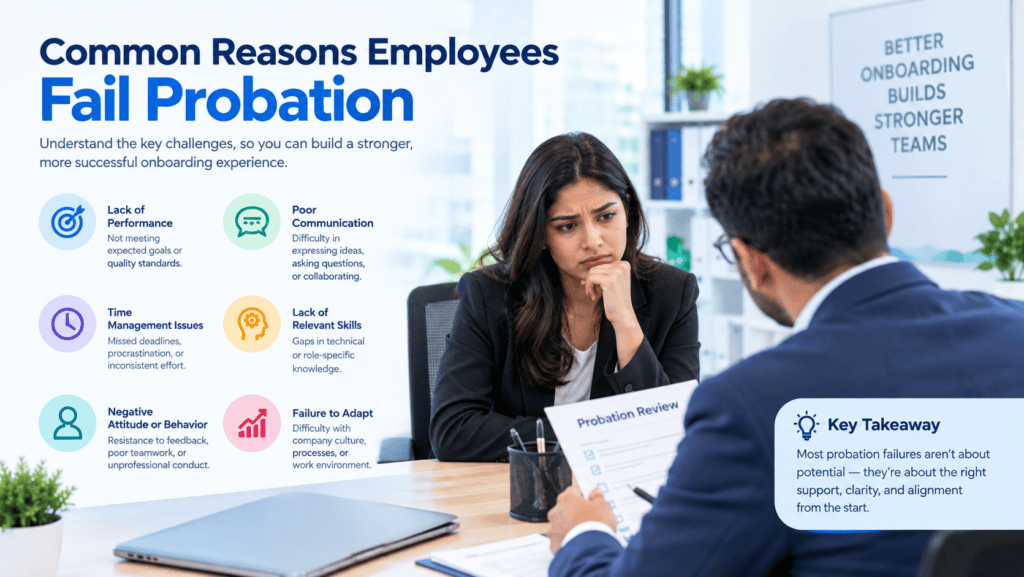
If your boss asked you to come on board for a trial period before formally offering you the job, then you are at a probation period. The period enables the organization to protect itself against the risks posed by bad hires while giving the new employee a chance to settle down.
It is a short-term, often 3 to 6 months, test that most people pass through successfully after their job interviews. However, there are instances where probationers underperform and end up getting dismissed.
This article contains the main reasons why new staff fail during their probation, a description of the problems, and possible solutions for the issues.
1. Persistent Poor Performance
Passing an interview is a demonstration of selling skills. Passing probation shows you can execute. A poor performance record is typically a misalignment between what was sold and what happens in day-to-day execution.
- Not meeting targets: Missing key deadlines, key performance indicators (KPIs) or output quotas early on, as these are clear signs of underperformance.
- Inadequate quality of work: Providing work with numerous mistakes, formatting errors, or missing information that requires someone else to re-do.
- No initiative: Waiting for others to tell you what to do and not taking control of your own work.
2. Lack of Required Skills
Sometimes, candidate profiles look great on paper, but a gap becomes apparent when hands-on execution begins.
- Skill exaggeration: Overstatement of one’s skills or abilities, for example, computer skills, coding skills, or data analysis skills during an interview can lead to faster exposure when the actual work requires such skills.
- Inability to learn: Employers expect new employees to have some learning curve, but if they are unable to learn new things even when they are given training, it is an indication that they cannot handle the technical aspects of the job.
- Poor or no analytical skills: Some people always want others to solve their problems instead of trying to find solutions.
3. Attendance or Punctuality Issues
Reliability is the foundation of professional trust. Attendance and time management issues during the probation period are often interpreted as a preview of long-term work ethic.
- Frequent tardiness: Being late to work, arriving tardy for a remote worker login session, or constantly showing up late to team meetings shows disrespect for other people’s time
- Unexcused or frequent absences: Taking multiple unplanned days off during the first few months without communicating or having a valid reason is unacceptable.
- Poor time management: Over-pushing deadlines and failing to meet due dates.
4. Misconduct or Lack of Professionalism
Soft skills and personal conduct carry just as much weight as technical abilities. Behavior that breaches company policy or standard workplace decorum often results in immediate probation failure.
- Inappropriate communication with colleagues, management, or clients
- Violation of any workplace rules, policies, or regulations, including but not limited to data security or dress codes
- Inability to accept feedback, criticism, or advice from a superior in a non-defensive, non-confrontational manner
5. Poor Teamwork or Cultural Alignment
Every company operates on a specific set of shared values, communication styles, and collaboration methods. Failing to integrate into the organizational culture can be just as fatal to a new job as failing technically.
- Siloed working: refusing to collaborate, withhold information, and not keeping colleagues updated on the status of a project.
- Creating friction: stirring office drama, complaining, and bickering with colleagues instead of building working relationships.
- Mismatched work ethic: working at a pace and standard that is unsuited to the company culture (e.g., struggling to keep up in a fast-paced start-up, or slowing down an entire department due to your excessive bureaucracy).
6. Insufficient Improvement
Managers rarely expect someone to be perfect on day one. It’s meant to be a learning period. The biggest mistake many failing employees make is that they don’t acknowledge they made a mistake after being told.
- Repeating the Same Mistakes: Getting direct feedback on the error and then repeating it in subsequent work.
- Ignoring Action Plans: If your manager points out where you need to improve during the probation period, and you’re not making any effort to adjust, you’re likely to get fired.
- No Self-Awareness: Blaming others, circumstance, or ‘poor onboarding’ rather than accepting responsibility for your growth trajectory
Key Takeaways for Managers & Employees
- For Employees: Think of probation as a demonstration of your professionalism. It is essential to establish open communication with your manager, ask for feedback, document all your achievements, and admit your mistakes promptly.
- For Employers: Setting expectations is critical to the success of your employee. Make sure that your new workers have received all necessary information and know precisely what you expect from them. Organize regular check-in meetings to review the progress and set new goals to ensure that nobody is surprised by the probation results.
How Employees Can Prepare for a Probation Review

A probation review can be a stressful experience, but by preparing properly, you can turn it into a chance to demonstrate your worth to the company and move on to the next stage in a positive light. Some pointers on how to do this are presented below.
Review Job Expectations
Before anything else, take a look at the job description, onboarding notes, and any goals you’ve been set in your first few weeks in the role. What was the job you were hired to do? Ask yourself how well you’ve done it, and whether there’s room for improvement.
If your manager has set out key performance indicators or goals for you, use these as a benchmark to see where you’re at, and what they might be looking to discuss.
This way you can identify what areas of concern your manager may have, and prepare notes for your own performance improvement plan if necessary.
Highlight Achievements
Do not expect managers to remember or acknowledge your accomplishments. You will have to remind them by preparing a list of all the tasks you accomplished, problems addressed, or processes improved during your probation. Wherever possible, quantify your achievements and performance improvements to demonstrate the value you brought to the company. This way, you would show the manager you are a valuable asset and deserve a raise.
Prepare Examples of Contributions
Apart from accomplishments, one should also think about their contributions to the team/company culture. Did you help a co-worker who was overwhelmed with workloads? Did you come up with a great idea that was implemented by the management? Were you proactive enough to take up a project that was beyond your job duties? It is a good idea to have at least two or three such examples.
Identify Areas for Improvement
A probation review presents a chance to discuss both positive and negative aspects of your performance. When giving feedback on your work, remember that a probation review is a learning experience. You might also want to talk about areas in which you could use improvement. If you are asked to provide feedback, think through what you could do to change or improve upon your existing abilities and what tools or training could help you succeed. In many cases, it is better to admit when you do not do something well than to pretend that nothing needs adjustment.
Prepare Feedback and Questions
Finally, you should remember that a probation review is a two-way conversation. This means that you can ask a few questions regarding your role, expectations, and goals for the future. You could also share your thoughts on your experience so far and what you think can be done to support your future development in the company. This way, you will show your interest in the position and even encourage the management to hire you permanently.
Concluding, we have discussed the main tips that will help you prepare for a probation review. The key point is that you should not perceive this meeting as a threatening procedure but instead look at it as a possibility to enhance your performance. By doing that, you will successfully shift the focus from your worries about getting fired to the exciting perspective of developing your skills further.
Would you like me to generate a file with these recommendations (as .docx or markdown) for your blog?
FAQs
What is a probation period review?
A probation period review refers to a process in which a company assesses the performance of aprobation employee to determine their suitability for a permanent position.
It is a procedure that enables a manager to evaluate an individual based on specific competencies and behaviors that the business expects from them. In most cases, it focuses on whether the employee has demonstrated the degree of proficiency anticipated when they joined the organization.
It also determines their work attitude and evaluates how well they have met the set objectives. During the probationer’s review, the conversation can include observations on how well they deliver work results, communicate, collaborate, attend to work, resolve conflicts, and accomplish assigned tasks.
Moreover, it is an opportunity for the reviewer to give feedback and recognition on work done and highlight areas that need improvement. Therefore, this meeting helps the organization to decide whether to retain the worker, extend their probation, or reject them due to a poor performance record.
Why is a probation period review important?
A probation period review is essential because it allows both the employer and the employee to take a step back and understand what works for them before committing fully to the position. It ensures that the employee is knowledgeable enough to perform their duties effectively.
Besides, the probation period test enables the employer to ensure that the employee works well within the company culture.
Another benefit of the probation period test is that it protects the company from legal implications in case an employee has to be terminated. Most importantly, the review allows new employees to understand what is anticipated of them within the company.
Can I get this rewritten in precise 100 words, or modify this according to some specific instructions?
What should be discussed during a probation review meeting?
A probation review meeting should evaluate performance, alignment, and mutual fit before finalizing a permanent role. Key points to cover include:
- Performance and Core Metrics: Discuss such matters as attained major performance indicators, productivity level, and fulfillment of the objectives set at the beginning of the probationary period.
- Culture Fit and Teamwork: Ask about the ability to communicate with others, collaborate with team members, demonstrate soft skills, and conform to the organization’s values.
- Feedback and Improvement: Give feedback on the things the employee is doing right and wrong. Ask the employee to talk about their experience and challenges.
- Next Steps and Goal Setting: Set the conditions for extending the probationary period, terminating it, or discussing further improvement options.
What questions should managers ask during a probation review?
While scheduling a probation review with an employee, managers may ask clarifying and feedback-seeking questions to conduct the talk effectively.
Such questions include asking the worker about their feelings regarding their progress, understanding of their responsibilities, challenges they have experienced, whether there is the required support and resources to handle the job duties, and obtain their feedback on how the probation period is assisting them achieve the anticipated performance.
Other questions the manager may ask include what they would like to learn to become more successful, if they have encountered any obstacles while performing their duties, and whether they can collaborate effectively with other team members.
Moreover, the manager may seek feedback on their expectations for the employee and know if they can handle the job requirements. Hence, asking the staff for their goals for the next few months enables the manager to have a fruitful one-on-one talk with them.
What happens after a probation period review?
After a probation period review, the outcome typically falls into one of three paths:
- Confirmation: The worker fully satisfies performance, behavioral, and technical expectations. The employee is confirmed, which typically results in the commencement of full company benefits, salary increases, or adjustment of the notice period as stipulated in the contract.
- Extension: Should the worker present partial performance, and the goals be achievable, the employer can extend the probation period by one to three months for restructuring, specific guidance on performance, and monitoring.
- Termination: When a candidate fails to satisfy the required performance, and they are terminated with reduced notice.
Can an employer extend an employee’s probation period?
Yes, it is possible to extend the trial period of an employee, but this extension should be reasonable and justified. Usually, this extension is reflected in the company’s HR policy or contract.
An employer can ask an employee to extend the trial period if, during the probation time, the employee has demonstrated performance that is far from expectations but shows a chance for improvement.
In such cases, the employer should explain to the employee the reasons for the extension and outline the expected outcomes. It is better to make an additional written document that would specify the revised date of the end of the probation period.
However, if the probation period is extended several times without any significant justification, this practice can be considered unfair.
What are the common reasons an employee may fail probation?
An employee usually fails probation due to performance or culture misalignment rather than a lack of basic skills. Common reasons include:
- Poor Performance or Work Quality: Consistently Failing to Meet Standards or Making Mistakes.
- Attendance & Punctuality: Chronic Tardiness, Leaving Without Notice, or Not Showing Up When Expected.
- Poor Attitude/Fit: Inability to Coordinate, Being a Negative Influence, or Having an Incompatible Attitude.
- Poor Communication: Lack of Responsiveness, Willingness to Ask for Help, or Accepting of Advice.
- Poor Skillset Match: Poor Representation of Skills Listed on a Resume and What the Employee Can Actually Do.
How should employees prepare for a probation review?
The process of preparing for a probation review interview begins before it is scheduled. Some goals that an employee should strive to achieve before an impending conversation are: examining the original goals or terms of the probation and realistically assessing one’s own progress towards them and providing specific examples or figures of achievements if applicable; seeking feedback from one’s manager or coworkers during the probation period, instead of waiting until a review meeting, and reflecting on the difficulties experienced during the probation and the ways they were resolved or could be resolved in the future to avoid similar issues.
Additionally, an employee may want to prepare questions for the reviewer to ask about their future prospects within the company or the field. Lastly, the employee should remain composed and open-minded in the meeting to be able to ask clarifying questions and receive actionable advice.
How should managers provide feedback during a probation review?
Managers should focus on being able to communicate clearly and concisely to the employees during their probation review. They should set goals based on the information at hand instead of what they think or feel at that moment. They should also focus on being encouraging and give advice on what to do and not do.
Managers should encourage two-way communication during a probation review. They should also give the employee feedback on what needs to be improved while being firm with the expectations and consequences of not meeting the desired performance. Finally, the managers should motivate the employees to achieve the set goals, set the next steps to reach the top line, and remind them of the end date of their probation.
What should be included in a probation review document?
A probation review document should capture a clear picture of the employee’s performance during the trial period. Key elements include: employee and role details, review period dates, and the original probation objectives set at hiring.
It should assess performance against job expectations, key achievements, and areas needing improvement, supported by specific examples rather than vague impressions. Include feedback from the manager and, where relevant, peers.
State clearly whether probation is being passed, extended, or terminated, along with reasoning. Add an action plan with measurable goals and timelines if extended. Finally, include sign-offs from the manager, HR, and employee to confirm mutual understanding.
Author Bio
Jeevesh Tripathi is one of our technical content writers and creators here at BkAbhi. He works to create and write about software engineering, as well as growing and scaling startups. He offers knowledge about databases, SaaS engineering, software engineering, and fundraising for young companies. Jeevesh created this profile to share his knowledge, experience, and information about the latest and richest technical content and topics for developers, technical leads, and heads of engineering who want to build excellent products and scale their technical departments while also managing costs and engineering debt.