
Table of Contents
What Is SaaS MVP Development?
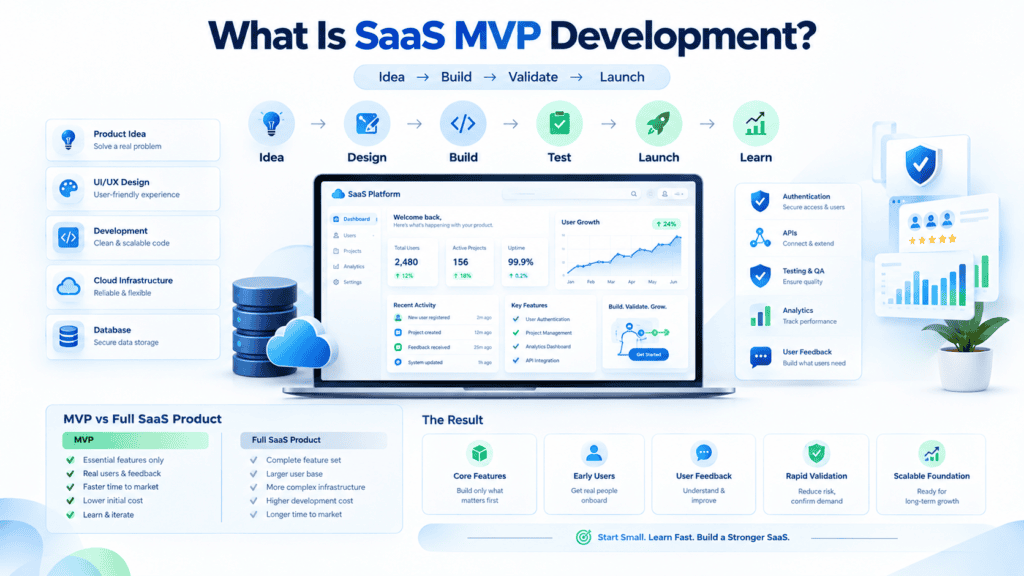
SaaS MVP development refers to the creation of a software-as-a-service (SaaS) product or project that has only the necessary features to address an initial set of problems for its target audience.
To reduce expenditures associated with developing a large-scale platform and launch an effective product, SaaS companies with the minimum viable product (MVP) allow them to introduce a product and fine-tune it according to user requests and behavior.
SaaS MVP vs. Full-Scale SaaS Product
A SaaS MVP (Minimum Viable Product) focuses on the essential features that define the product’s value. A full-scale SaaS-based application has more features and offers extended functionality and multiple integrations, automations, customizations, and scalability. In addition, MVP is typically faster to develop and more cost-effective to build than a comprehensive product.
| SaaS MVP | Full-Scale SaaS |
|---|---|
| Essential features only | Comprehensive feature set |
| Faster development | Longer development cycle |
| Lower initial investment | Higher development cost |
| Designed for validation | Designed for broader growth |
| Early user feedback | Mature product experience |
Benefits of Launching a SaaS MVP
Launching an MVP provides startups with the ability to test their theories and assumptions. A minimum viable product can inform companies about the features that the customers will be interested in and those that will not.
An MVP can be utilized to discover usability issues, test the product at a lower cost, evaluate cost-effectiveness, establish demand, and attract the first customers and investors. Most importantly, creating an MVP reduces the risk of substantial investment in a product that the market does not need.
Real-World SaaS MVP Examples
Many successful SaaS products started with relatively focused solutions and not full-platform ones. For instance, an early project-management SaaS product might offer only task creation, assignment, and progress tracking. Advanced reporting and automation features could be postponed to subsequent stages of development.
An email marketing service’s MVP should also have a specific focus. It can begin with contact management, campaign creation, and tracking but defer more sophisticated segmentation and analytical tools to later stages of development.
The purpose of building an MVP for a SaaS product is not to make it low-end but to make it focused. This way, the product will solve one particular problem for the user and help the developers understand what else to build upon it.
Step-by-Step SaaS MVP Development Process
Launching a SaaS product of your own is thrilling – but rushing into development blind is one of the worst ideas. You can save yourself both money and time by building an MVP – a Minimum Viable Product – which will help you test the waters and see whether there is any demand for your product at all.
Here’s a practical, step-by-step breakdown of how to go from idea to a scalable SaaS business.
1. Market Validation
Before you write a single line of code, make sure there is an actual problem worth solving and people are actually willing to pay for your solution.
- Do customer discovery by talking to at least 15-20 potential customers to understand their needs and pain points.
- Benchmark against competitors: What similar products exist? What are they priced at? What are they lacking?
- Test the demand through a landing page, waitlist, or survey.
- Have a clear value proposition. Understand what you’re building and be able to summarize your product’s value in one sentence to a prospect customer.
Failing to do customer discovery is the #1 reason why SaaS startups fail.l — they build something nobody actually needs.
2. Feature Prioritization
After validating the problem, avoid building everything at once.
- Make a list of all features and start eliminating.
- Use MoSCoW (Must-have, Should-have, Could-have, Won’t-have) prioritization framework, or RICE (Reach, Impact, Confidence, Effort) scoring model to sort features out.
- Focus on the product’s core loop, i.e., a closed set of actions delivering the product’s primary value.
- Build the reduced set of features around the core loop and try to ship the smallest viable product version to address the customer’s problem.
3. Prototyping
Before development starts, make a cheap visual prototype of your product.
- Wireframes to plan the layout and flow.
- Clickable prototypes (in Figma) to simulate the experience.
- User testing on the prototype to find usability issues: much cheaper to fix than production code.
4. Development
Now it’s time to build – keep that MVP mindset close
- choose the technology stack based on scalability, team experience, and time-to-market
- use available solutions (like auth providers or payment systems) whenever possible
- work in short sprints, ship early and often
- focus on core features first – it’s better to have a functional but ugly MVP than a pretty but empty one
5. Launch
A soft launch helps in collecting feedback for iteration before the official launch.
- Organize a beta group of your early adopters, waitlist, or any specific audience you’re targeting
- Define success metrics for activation, retention, product feature exploration.
- Prepare the onboarding process so that your users can discover the product’s value right away.
- Watch closely during the first days for critical issues, drop-off points, and confusing moments.
6. User Feedback
The primary function of your MVP is to create learning, not make money.
- Establish feedback loops (in-app surveys, support desk, interviews).
- Focus on behavioral metrics; let them guide you.
- Look for patterns in the feedback you collect.
- Rapidly iterate on what prevents users from adopting your product or getting engaged.
7. Monetization
After you’ve identified engagement and retention levers, it’s time to formalize your pricing.
- Test different pricing models (freemium, tiered subscriptions, usage-based) against your target audience’s willingness to pay.
- Make sure to price products and services according to the value they deliver, not just costs plus a markup.
- A/B test your pricing pages and conversion funnels from freemium to paid usage. Churn is often the best barometer of value perception.
8. Scaling
With a validated, monetized product, the focus should shift to growth and long-term sustainability.
- Invest in infrastructure to scale: better hosting, databases, caching solutions.
- Develop repeatable acquisition channels: content, ads, partnerships, referrals.
- Hire strategically to balance the team as the product becomes more complex, particularly in engineering and customer success roles.
- Automate operations as much as possible to preserve margins at scale: billing, support, onboarding processes.
Final Thoughts
The SaaS MVP process is typically an iterative process: you constantly go through the cycle of validating your ideas, building software, launching it to users, looking at the results, and optimizing the product. That said, companies that got to the finish line understand that you cannot plan every little detail ahead — you need to move fast, listen to users, and embrace the changes.
Iterate on your initial findings and focus on delivering core functionality to your customers. Let quantitative and qualitative data drive your product decisions, not theories.
Market Validation for a SaaS MVP: A Practical Guide
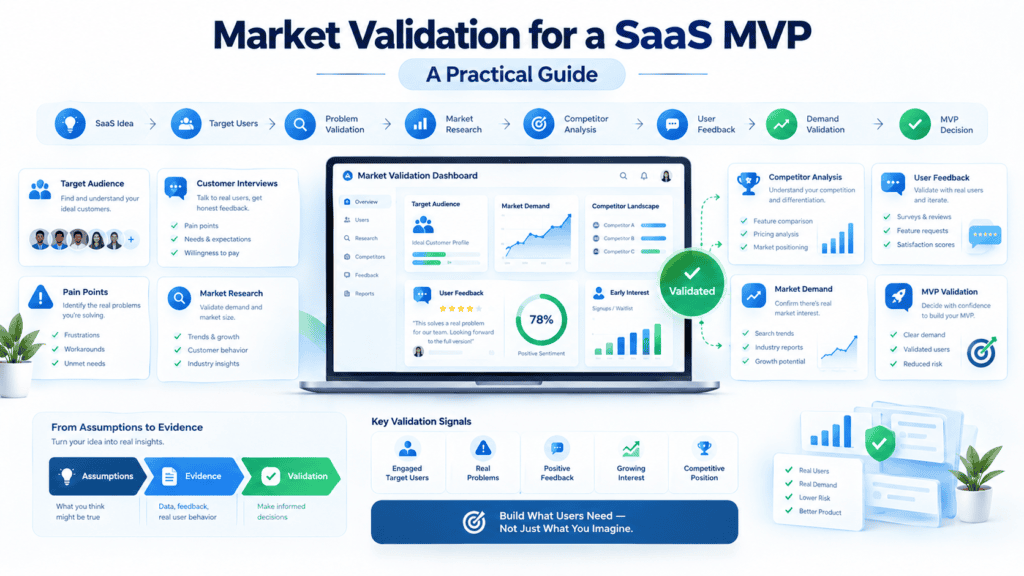
Before you can code. You need to ask a very important question. Is someone willing to pay for it, and how much are they willing to pay? Market validation helps you know if a potential market will buy what you are trying to sell before you spend a lot of time and money on a product that no one wants.
Here is an example of how you can validate a market for a SaaS product.
1. User Research: Talk to Real People First
Almost every SaaS product failure occurs due to non-relevant problems addressed by the product: either issues no one is facing or problems that people are not willing to spend money fixing.
What good user research looks like:
- Make sure to conduct 15-20 problem discovery interviews with people in your target segment before you go pitching your solution
- Ask them about their current workflow and associated pains instead of asking if they would be interested in your product (people tend to be humble and say yes to almost everything)
- Pay attention to language patterns. The words they use to describe their frustrations will become your marketing copy later.
- Watch out for signs of active pain, such as people already using Excel or other workarounds to solve the same problem
A good rule of thumb: if someone hasn’t tried to solve this problem themselves in some scrappy way, the pain probably isn’t sharp enough yet.
2. Competitor Analysis: Map the Landscape, Don’t Fear It
Competitors are not a sign of a bad idea — they represent the market. The objective in this process is to understand the principles by which other companies operate and the reasons for their successes and failures.
A useful process:
- List your direct competitors (same problem, similar solution) and indirect competitors (same problem, different solution) with manual workarounds like Excel, Notion, etc.
- Read reviews on G2, Capterra, Reddit to understand what competitors are lacking based on 2, 3-star reviews (actual complaints) and what they are doing right (5-star reviews).
- Create a rudimentary position matrix to prioritize what features you will build.
- Take note of competitor pricing and packaging to understand the value spectrum in the market.
3. Identifying Market Gaps
A market gap isn’t just “a feature nobody has.” The strongest gaps usually fall into one of three buckets:
- Underserved segments – a niche audience that existing tools consider an afterthought
- Workflow gaps – the tool works but integration/onboarding friction convinces users to abandon it
- Value-for-price mismatches – existing tools are overbuilt (and overpriced) for what a segment actually needs
Cross-reference what you heard in interviews with what you saw in competitor reviews. If you see the same complaints there as well, then you’ve found a legitimate pain point to address.
4. Validating Demand Before You Build
Demand validation is about getting evidence of intent, not just interest. A few effective, low-cost approaches:
- Landing page test: describe the value proposition, collect email addresses, and calculate the conversion rate.
- Waitlist with a qualification question: ask what tools they are using today to get past the “I’m just curious” sign-ups.
- Concierge MVP: deliver the MVP manually for a handful of customers before you automate the process.
- Smoke test ads: create a small budget of paid ads directing users to your landing page to test the value proposition’s appeal to cold traffic.
The goal is a signal that costs you days, not months.
5. Willingness to Pay: The Real Test
Interest is cheap. Payment is the real signal. A few ways to test willingness to pay before building the full product:
- Pre-sell access — offer a “founding member” price for a limited time or lifetime deal at a much higher price.
- Van Westendorp pricing survey — ask them where on a scale a product or service is priced “too cheap to be of value/too expensive/too cheap to be worth/bargain price,” and extrapolate the value based on these answers.
- Letter of intent — for B2B, ask the prospect for a letter of intent (LOI) that is not binding but obligates the customer to purchase your product after its launch.
- Deposit — even a symbolic, refundable deposit is useful as a litmus test for users who are “just interested.”
If people won’t commit even a small amount of money or effort now, be skeptical they’ll pay once the product exists.
Putting It Together
Market validation is not a one-step process:
Talk to customers, research the competition, define the opportunity, test the hypothesis, look at pricing, and ensure that there is willingness to buy.
Each stage should give you greater confidence (or lack thereof) in your idea and allow you to invest more into it. And the point is not to prove your idea right — but rather to learn as much as you can about your idea for as low a cost as possible — before you write serious production code.
Building a Software-as-a-Service (SaaS) Minimum Viable Product (MVP)is all about ruthless prioritization. The number one threat to any young SaaS company is feature creep: the addition of too many features to a product, resulting in an overly complex launch.
To reduce costs and time to market while simultaneously maximizing value, you need to establish a prioritization framework that will serve as the backbone for your decision-making. It will help you understand what features to build, what to defer, and what to cut altogether.
1. Defining Your MVP Scope: The “Problem-First” Approach
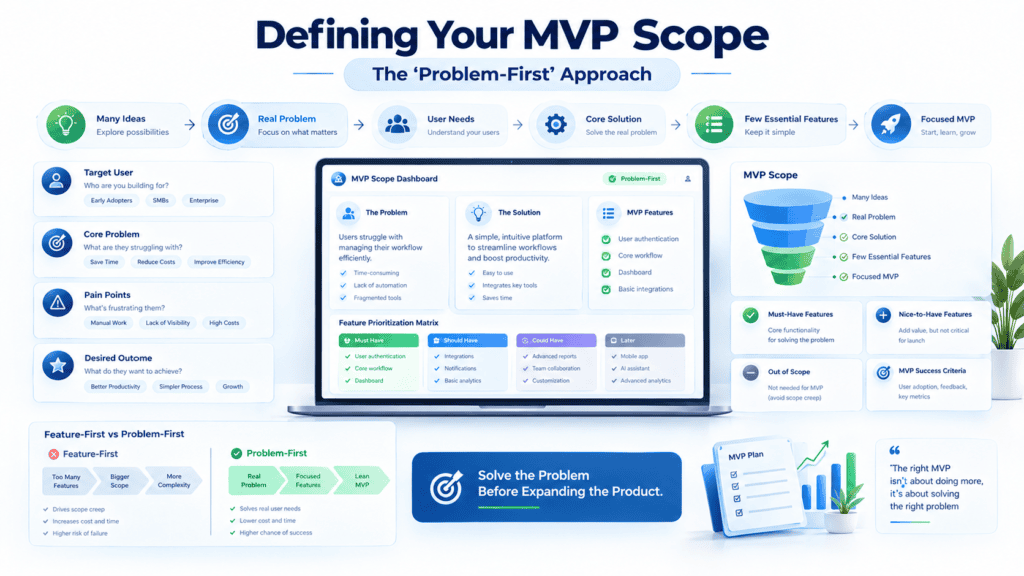
Before designing a scoring model, it is essential to determine your MVP’s boundaries. The key idea behind MVP is to choose the first product version, which would be fully developed for a selected customer group, addressing one of the main problems.
Step 1: Pinpoint the Core Value Hypothesis
Ask yourself: What single element of action does the user need to perform in order to get value from this tool?
- Airbnb: Book a room with a host.
- Uber: Request a riding service from point A to point B.
- Stripe: Process a credit card payment online.
Anything else besides the critical path is non-essential and should be cut for the launch version.h.
Step 2: Map the User Journey
List out every step a user needs to perform from opening your application up until they achieve their goal:
- Sign up / onboarding
- Input data / set up account
- Perform the main action (generate report, send email, create invoice)
- View/export results
Your MVP scope has to include only the features necessary for a user to perform the outlined actions without any interruptions.
2. Core Features vs. “Nice-to-Have” Features
A common trap for founders is mistaking a “nice-to-have” feature for a “must-have.” Here is how to distinguish between the two:
| Feature Category | Definition | Example (Project Management SaaS) |
|---|---|---|
| Core (Must-Have) | Essential to solve the core problem. Without it, the product fails. | Creating tasks, assigning team members, setting due dates. |
| Delighter (Nice-to-Have) | Adds polish, convenience, or automation, but the product functions without it. | AI auto-summaries, dark mode, custom color themes, 50+ integrations. |
| Distraction | Impressive on paper, but unnecessary for early user validation. | Custom domain mapping, multi-language support, complex team roles. |
The Golden Rule for MVP Features:
If dropping a feature makes a user solve their primary problem impossible, it should be in the MVP. If it makes their experience just a tiny bit less convenient, it can wait till V2.
3. The MoSCoW Method: Categorizing Your Backlog
The MoSCoW Method is a qualitative framework designed to align founders, developers, and designers on feature priority.
       MoSCoW MATRIX
┌───────────────────┬───────────────────┐
│     MUST HAVE     │    SHOULD HAVE    │
│ Non-negotiable    │ High value,       │
│ core features     │ workarounds exist │
├───────────────────┼───────────────────┤
│    COULD HAVE     │     WON'T HAVE    │
│ Desirable, but    │ Explicitly out of │
│ first to cut      │ scope for launch  │
└───────────────────┴───────────────────┘
1. Must Have (Core MVP Scope)
- Rule of Thumb: It comprises 50% to 60% of the entire engineering effort during the MVP development stage.
- It cannot be postponed if any of the “Must Have” features are missing at the launch.
- Examples: The authentication system, the basic CRUD (Create, Read, Update, Delete) operations, and calculation logic.
2. Should Have
- High-value features that significantly improve user experience, but for which manual workarounds exist.
- Example: Automated email notifications (workaround: simple in-app alerts).
3. Could Have
- Small enhancements or “delighters” that are low effort, but offer minimal impact to the core problem.
- Example: Exporting reports as PDF in addition to CSV.
4. Won’t Have (For Now)
- Features explicitly out of scope for the MVP launch. Documenting these prevents team scope-creep.
- Example: Enterprise SSO (SAML), custom Zapier integrations, white-label branding.
4. The RICE Framework: Quantitative Scoring
While MoSCoW prioritization model helps to group requirements, the RICE framework goes one step further and scores them to eliminate the possibility of personal biases.
The RICE formula is represented as:
$$\text{RICE Score} = \frac{\text{Reach} \times \text{Impact} \times \text{Confidence}}{\text{Effort}}$$
Breaking Down the Variables:
Reach (R): How many users/customers will this feature impact over a specific period (e.g., first 3 months)?
Example: 500 users/month.
Impact (I): How much will this feature increase value or conversion? Use a standardized scale:
- 3 = Massive impact
- 2 = High impact
- 1 = Medium impact
- 0.5 = Low impact
- 0.25 = Minimal impact
- Confidence (C): How confident are you in your estimates (Reach, Impact, Effort)?
- 100% = High confidence (backed by quantitative user data/interviews)
- 80% = Medium confidence
- 50% = Low confidence (mostly an assumption)
- Effort (E): How many person-months/weeks will it take to design, build, and test this feature? (Always use the same unit of time).
- Example: 0.5 person-months (2 weeks).
Example RICE Calculation Matrix
| Feature | Reach (R) | Impact (I) | Confidence (C) | Effort (E) | RICE Score | Action |
|---|---|---|---|---|---|---|
| Core Dashboard | 1,000 | 3 (Massive) | 100% | 1.0 month | (1000 × 3 × 1) / 1 = 3000 | Build First |
| Stripe Billing Integration | 1,000 | 3 (Massive) | 90% | 0.5 months | (1000 × 3 × 0.9) / 0.5 = 5400 | Build First |
| Social Media Sharing | 200 | 0.5 (Low) | 50% | 0.5 months | (200 × 0.5 × 0.5) / 0.5 = 100 | Defer to V2 |
5. Combining the Frameworks: Step-by-Step Blueprint
To maximize efficiency, combine both qualitative and quantitative approaches into a structured 4-step workflow:
Step 1: Brainstorm & Backlog  ──>  List all feature ideas without filtering.
Step 2: MoSCoW Screening      ──>  Filter out "Could Have" and "Won't Have".
Step 3: RICE Scoring          ──>  Score the remaining "Must Have" and "Should Have" items.
Step 4: MVP Backlog Lockdown ──> Select top RICE scores up to your capacity limit.- Filter with MoSCoW First: Split your whole feature backlog according to the 4 MoSCoW categories. Immediately throw out all the ‘Could have’ and ‘Won’t have’ features to the post-launch roadmap.
- Score with RICE Second: Apply the RICE formula to your ‘Must have’ and ‘Should have’ features to get objective scoring.
- Set an Effort Ceiling: Set a hard budget or time limit for your project (8 weeks of development time) and start stacking up features according to their RICE score until you reach the point where the next one would push you over the edge.
- Build, test and iterate: Build your product with the reduced set of features, get some analytics on the actual user behavior and use this information (instead of guesswork) to plan your V2.
Summary Checklist for SaaS Founders
Before you commit any code to your MVP, ask yourself if the following is true:
- [] Every feature directly addresses the core problem being solved by the product
- [] The user can accomplish the desired outcome even if the delayed features are not implemented
- [] The team has constrained the scope of “must-have” features to no more than 60% of capacity
- [] The team has evaluated each feature against the cost to implement and impact to users
SaaS MVP Prototyping and UX Testing
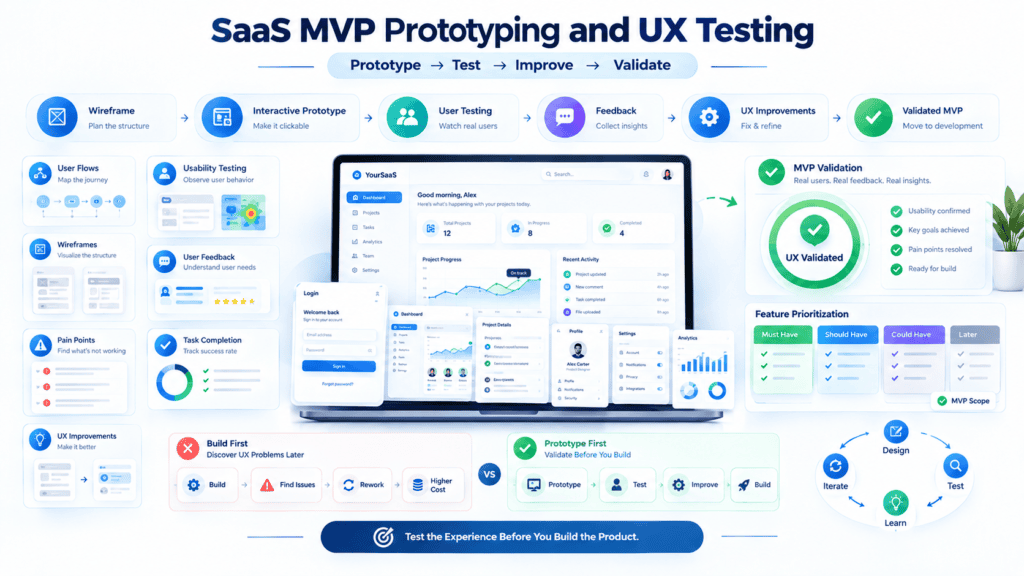
SaaS MVP prototyping helps transform ideas for a product at its earliest stage into a visual prototype that will reduce costs and risks in later developments. First, make wireframes to plan the design and content of each page and describe how the product works. Then, develop an interactive prototype that will demonstrate the most critical user scenarios.
The prototype should include a few key scenarios for the users: signing up for the service, setting up their preferences, completing the main task, upgrading the account, and so on. Conduct a series of tests with real customers or the target audience to identify pain points and usability issues.
Based on the results, optimize the workflow and prototype to perfect the product and set a clear vision for the SaaS MVP development. This way, you will avoid delays and budget waste since the issues with the product design will be eliminated at an early stage.
SaaS MVP Tech Stack and Development: A Practical Guide
Building a SaaS MVP is not about trendiness. It is about finding the best stack to help you learn, adapt, and move quickly at the earliest stages without getting stuck in tech debt. We have broken down the key components for you below.
Frontend
For an MVP, prioritize speed of development and a good developer ecosystem over cutting-edge tech.
- React or Vue, both have large component ecosystems and a significant amount of experienced developers. However, React (along with Next.js) is the most common default option.
- Next.js itself provides server-side rendering, routing, and API routes, saving you from having to set up multiple services when first starting your project.
- Tailwind CSS allows you to rapidly build your UI without switching back and forth between files to write or update CSS.
- TypeScript may add some overhead at first, but it will pay off in the long run by preventing bugs and easing the onboarding process of new developers.
Backend
The backend should be boring and reliable — this is not the place to experiment.
- Node.js (Express/NestJS) – better to choose it if your team is already well-versed in JavaScript and you want to avoid context-switching while writing both front-end and back-end code.
- Python (Django/FastAPI) – is a great choice if you need to rapidly develop prototypes and ship working MVPs with admin panels, and you intend to add ML/Data Science components down the road.
- Ruby on Rails – still remains a viable option if you want to leverage its convention-over-configuration philosophy to get an MVP out the door faster.
Pick based on team familiarity first — the “best” framework is the one your team can ship features in quickly.
Database
- PostgreSQL is probably the default recommendation for most SaaS MVPs. It’s a relational database, so it will scale well with a properly designed schema and support complex queries as your data model evolves.
- MongoDB is a good choice if you have truly unstructured data or expect significant schema changes as your product evolves.
- With managed databases (Supabase, Neon, PlanetScale, Amazon RDS), you want to offload as much database operations as possible to avoid having to maintain and scale your own database cluster at the MVP phase.
APIs
- Design your API first, and use GraphQL only if you have a clear case of nested data fetching; otherwise, REST is more straightforward to implement, document, and support.
- Document your API with OpenAPI/Swagger from the start if there is an expectation of third-party integration.
- For any third-party API interactions, use established services such as Stripe for payments, Clerk/Auth0 for authentication, and SendGrid/Resend for emails.
Cloud Infrastructure
- Vercel or Netlify — for frontend hosting — zero-config deploys and great for Next.js apps
- Render, Railway, or Fly.io — for backend — much easier to configure and set up for a small team than AWS and provides sufficient value at low scale
- AWS/GCP/Azure — only consider if you have specific compliance, scaling, or infrastructure needs that the others don’t provide
- S3 or equivalent — object storage for file uploads
Don’t over-engineer infrastructure early. A monolith on a managed platform is almost always the right call for an MVP — microservices add operational overhead you don’t need yet.
CI/CD
- GitHub Actions — the default choice; it’s integrated with your repo and has a generous free tier.
- Set up a simple pipeline — run tests → build → deploy to staging → manually promote to production.
- Even a minimal pipeline (lint + test + deploy) will pay for itself the first time it catches a broken build before it reaches production.
Development Methodology
- Lean/Agile with short sprints (1-2 weeks) to keep the team focused on shipping testable increments rather than a big-bang launch
- Build-Measure-Learn loop: every MVP feature should represent a hypothesis that you’re trying to test against real user feedback, not just a feature that you think is cool
- A tight feedback loop with your early adopters/users: even having 5-10 people who can test your product for you is much better than any tooling decision
- No scope creep: an MVP is all about testing your core value proposition, not about delivering a complete solution
The Bottom Line
A good MVP stack is something your team is familiar with, has managed infrastructure around, and is boring enough to be successful. Your goal is not to find the best possible technology, but a way to get feedback from real users with a codebase you’re not afraid to iterate on once you know what you’re building.
Building a Software-as-a-Service (SaaS) Minimum Viable Product (MVP) isn’t about launching a bare-bones app that barely works; it’s about launching the leanest version of your product that reliably delivers value to early adopters.
Critical Components of a Successful SaaS MVP
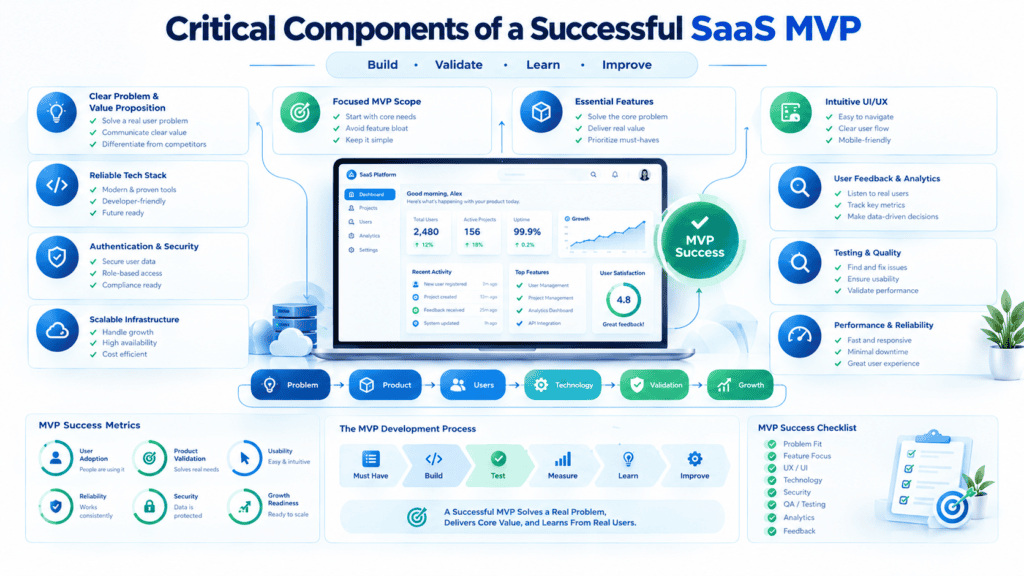
While the set of features will be determined by your niche, every Minimum Viable Product (MVP) of a SaaS application will have a common architectural basis. Without due consideration of these elements, your product may face users’ churn, have security issues, or technical debt.
Below you will find the list of the features every successful SaaS MVP needs to launch and thrive.
1. User Authentication & Onboarding
Security and user management begin at the front door. You need a smooth signup/login process so your users can get exploring
Security Features
Implement secure sign-up, login, password reset, and consider MFA. Most of these features can be implemented quickly using standard Identity providers such as Auth0, Firebase Authentication, or Supabase Auth. For more guidance on building a secure and scalable SaaS MVP, see this SaaS MVP development guide. This is important to protect your users’ data and yours (if any).
SSO
Most of your users are likely to sign up using social accounts. For a faster onboarding process, you can implement single sign-on (SSO) for the major providers: Google, GitHub, Microsoft, etc.
Who can do what
In your MVP, there is a high chance that user roles will matter. For example, you may need to differentiate between Admins, Regular Users, and Read-only Users.
2. Intuitive Dashboard
The dashboard is your app’s command center. When a user logs in, it needs to answer two basic questions: Where am I? And what should I do?
- Show value first: The dashboard is the first screen a logged-in user sees, so it needs to help them understand where they are and what they should do next.
- Use a minimalist global navigation: The dashboard is the primary place to access your application’s core features. Make sure to keep it easily accessible to the user via a simple sidebar or top bar.
- Include an onboarding checklist: To help non-logged-in users learn the basics and get to their “aha” moment faster, you can include an empty-state checklist or a simple getting started wizard.
3. Core Functionality (The “Value Engine”)
This is your MVP’s core – the set of features central to addressing the main pain point of your product’s target audience.
- Focus on creating an MVP with a laser-focus on one key feature. Avoid the temptation to build “nice-to-have” features around it.
- Prioritize speed and reliability over breadth: most often, a less multi-functional but better-debugged tool will win against a “feature-packed” version with a plethora of glitches.
- Make sure that you build your MVP with the possibility of future expansion in mind: write clean code so that you can easily iterate on the existing functions and add new ones later based on user feedback.
4. Subscription & Billing Infrastructure
To get started with your SaaS business model, you must be able to collect payments seamlessly from day one.
- Flexible Tiering: Set up a simple pricing architecture (e.g., Free Trial, Starter, Pro).
- Payment Processor: Make sure you have a good payment processor (Stripe, Paddle, or Chargebee), which will allow you to collect payments easily, retry (“dunning”) failed charges, send invoices or receipts, and bill your clients in different currencies or tax-friendly jurisdictions like Germany or the Netherlands.
- Self-Serve Portal: A self-serve portal that allows customers to upgrade/downgrade their plan, update their payment method, or look at their invoices without asking for your help is essential.
5. Security & Compliance Essentials
Security can’t be neglected even by the simplest SaaS users — make them secure right away.
- Data Encryption: Make sure all data is transmitted over HTTPS/TLS and, where needed, encrypted in the database.
- Basic Compliance Readiness: Choose the most relevant regulation (usually GDPR or CCPA but sometimes specific industry regulations or SOC 2 if you sell to enterprise customers) and make your system at least minimally compliant.
- Automated Backups: Set up automated database backups — they will save you if something goes wrong.
6. Integrations (Connecting to Existing Workflows)
Modern users are much less likely to accept a standalone application and expect seamless integration into their existing software ecosystem. Your MVP should prioritize the tools already used by your target audience.
- Core webhooks/APIs: Offer a simple webhook setup or 1-2 native connections to the most popular tools in your market (Slack, Hubspot, Google Workspace, Zapier/Make, etc.)
- Zapier/Make connectors: For many applications, a Zapier/Make integration is an easy way to fulfill 80% of third-party API requests with little engineering effort.
7. Product Analytics & Feedback Loops
Launching your MVP is merely the beginning. To iterate upon your product successfully and figure out what to build next, you need to understand user behavior.
- Behavior analytics: Utilize such services as PostHog, Mixpanel, or Google Analytics 4 to see what users are doing inside your application. See the entire conversion funnel, where exactly users are getting lost, and what features they are using the most.
- In-app feedback collection: Add an in-app widget (Canny, Marker.io, or something as simple as a modal window) and ask your users directly what features they would like you to build.
- Error tracking: Set up an error tracking tool (Sentry or Bugsnag) to be alerted when your application is crashing unexpectedly or has other issues that you are not yet aware of.
The Golden Rule for SaaS MVPs
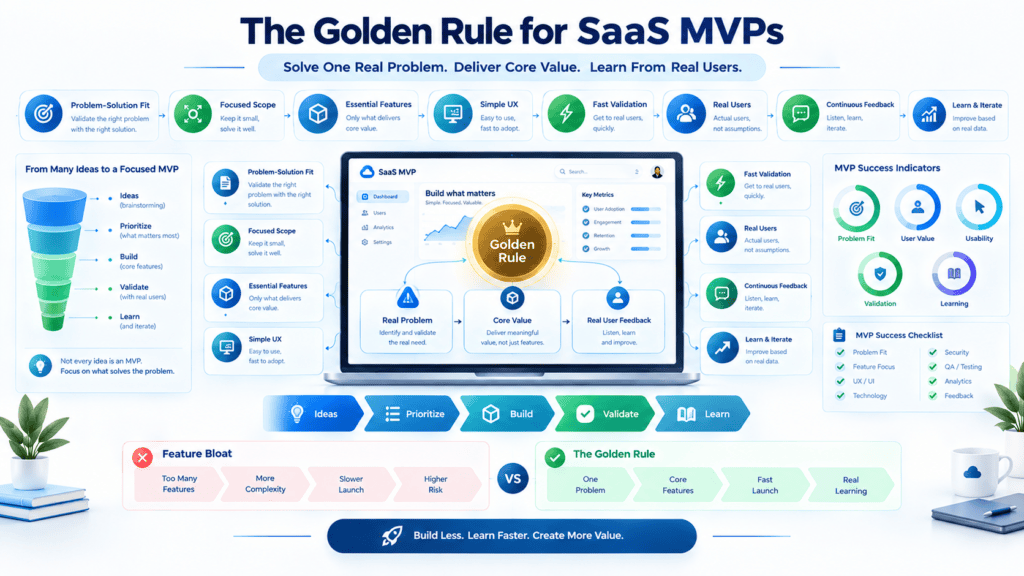
Contrary to popular belief, MVP development is not a compromise on quality — it is a limitation of scope. Designing a lean, safe, and highly performing system around a single solution will provide the basis for the dependable accumulation of users, feedback, and growth.
SaaS MVP Launch and User Feedback
Launching a SaaS MVP is not an end but a means to an ongoing learning process. The first crucial step is to release the software to a small group of users in a controlled environment and observe how it is adopted and which features can be refined.
The key idea here is to aim for a high-value launch, i.e., beta-version release with a handful of passionate customers who will give you honest feedback on whether your product is worth investing more resources into.
The onboarding process should be as smooth as possible to encourage engagement and reduce early-stage drop-offs. It is critical to make the sign-up procedure user-friendly and short and enable customers to experience the main product value shortly after landing on your website or signing up.
You should also track user behavior on your website to see which CTA (call-to-action) buttons are popular, which pages have high bounce rates, and what engagement CTA buttons are. These buttons can be used to collect product feedback from the users directly via in-app surveys or organize interviews.
The quantitative data about the target market can be obtained by analyzing the survey results, customer support interactions, and feedback forms.
NPS (Net Promoter Score) surveys can also be a good source of qualitative information if they are designed right. Once again, the critical point is to combine quantitative and qualitative data about user behavior and correlate it with demographics and user segments.
Although the first-time sign-ups are a critical metric for any SaaS product, long-term retention is an even more important metric to track.
Essentially, retention is a percentage of users who return to the product after the first-time use, so analyzing retention will give you insightful data about your product-market fit. If your retention is low, you need to revisit the onboarding process and do more research as to why exactly users fail to return. You should also segment your users based on their behavior and demographics.
Finally, it is a good idea to collect product feedback in a spreadsheet and group similar suggestions together, prioritizing product enhancements based on impact, effort, and other factors.
Most SaaS products fail because they try to address every single feature request, whereas persistent efforts to solve the most pressing issues and questions will gradually push the product towards the desired product-market fit.
SaaS MVP Monetization Strategy: Choosing the Right Pricing Model for Early-Stage Growth
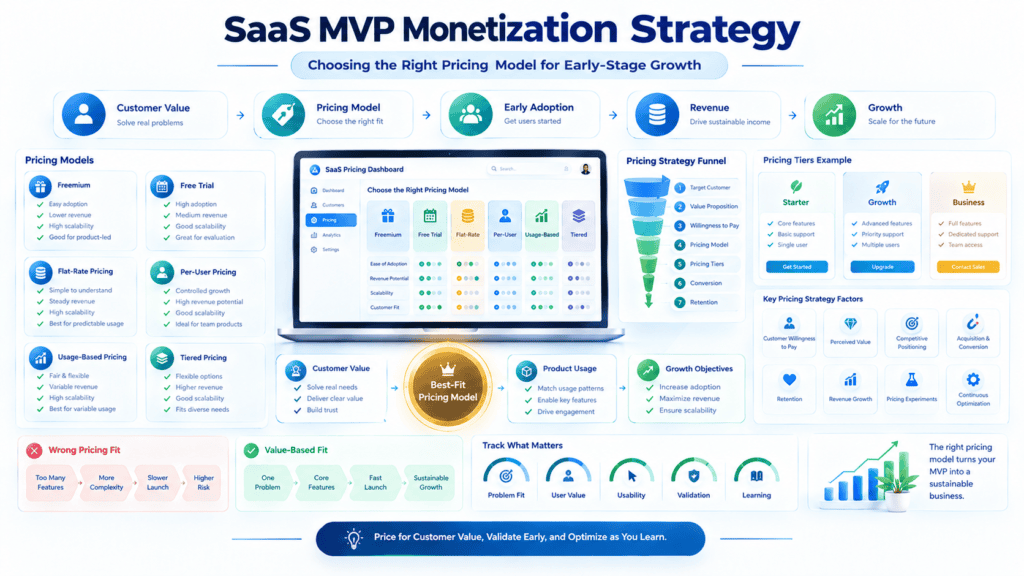
Choosing a monetization model is one of the most essential decisions to make when launching a SaaS MVP. The choice will determine whether you create the basis for sustainable growth or waste time and effort trying to mitigate the consequences of your mistake. Below are the key options and how to evaluate their combination.
1. Freemium: Growth Engine, Not a Business Model
Freemium offers limited features for free and hopes that some percentage of users will upgrade to the paid version. It is great for virality and organic growth and has become increasingly popular among product-led growth (PLG) companies, such as Slack, Notion, or Dropbox.
When it works:
- Your product has strong network effects or viral loops
- The free tier delivers real value but has a natural ‘ceiling’ that paying users outgrow
- You have the infrastructure to support free users without crushing your margins
The trap: most early-stage freemium products fail because the free tier is either too generous (nobody upgrades), or too stingy (nobody sticks around to feel the value). A good rule of thumb: your free tier should make users successful at a small scale, and painfully aware of its limits at a larger one.
2. Flat-Rate Pricing: Simplicity Sells
One price, one set of features, no usage meters. Simpler to explain and sell to customers, and easier to forecast revenues for, which is why many MVPs begin with this approach.
Pros: MRR is easy to predict, simple to discuss with sales, and can be tested and A/B’ed easily.
But: Can’t scale with higher value customers. Your solopreneur and your 500-person team plan both cost the same, which may leave you underpricing your top tier or overpaying for lower support.
Flat-rate is a good launching point for an MVP due to its reduced friction in early conversations, as you’re focusing on a proof of value, not a proof of value curve.
3. Usage-Based Pricing: Align Price with Value
Customers are paying for the usage of a product or a service. API calls, seats, storage, transactions — you name it. Twilio, Snowflake, and AWS know that first well: the amount of revenue grows exponentially with the number of producers adopting the solution.
Pros: Lower barriers to entry, higher organic growth, and better perceived value by the customer.
Cons: Lower predictability and granular control over revenue, less attractive for some customers, requires more complex infrastructure for metering and billing.
A usage-based pricing model is best suited for products that solved an obvious problem and have a simple metric that the customer can easily associate with the value provided.
4. Subscriptions: The SaaS Default
Recurring monthly or annual billing, typically tiered (Basic/Pro/Enterprise). In subscription billing, subscriptions are more of a cadence on top of a flat-rate, usage-based, or hybrid pricing model.
Why it’s popular for SaaS: Predictable recurring revenue (MRR/ARR) is the holy grail for SaaS founders and investors. It also provides a great renewal checkpoint to re-engagement and upsell.
Tiering tips for MVPs:
- Start with 2–3 tiers max — most creates decision paralysis
- Anchor pricing psychologically (Pro-tier priced just below what most users would pay is their obvious choice)
- Annual discounts (typically 15–20%) boost cash flow and reduce churn
5. Billing Platforms: Don’t Build This Yourself
If you are building an MVP, this problem has already been solved for you! Billing infrastructure like Stripe Billing, Paddle, Chargebee, or Lemon Squeezy provide everything you need out of the box to manage subscriptions, proration, dunning, taxes, and metering.
Paddle and Lemon Squeezy both act as a “merchant of record”, which means they take care of all the sales tax/VAT liabilities for you globally, which is great if you’re a small team selling products internationally. Stripe offers more flexibility and lower fees, but leaves you responsible for tax compliance (Stripe Tax aims to help with that).
MVP recommendation: Pick a platform that supports your likely future pricing model, not just your launch model. Migrating billing infrastructure later is painful.
6. Churn: The Metric That Kills SaaS Companies
You may have great acquisition, but if customers are leaving at the same rate, you’re filling a leaking bucket. There are two types of churn:
- Customer churn: Percentage of customers cancelling.
- Revenue churn: Percentage of Monthly Recurring Revenue (MRR) lost (can be offset through upsells, hence negative churn).
Reducing churn on an MVP budget:
- track early usage signals (a user who doesn’t activate in week one is a churn risk)
- light onboarding flow: most SaaS churn is due to failure to achieve an “aha moment” rather than a price issue
- billing platform dunning tools to recover failed payments automatically (a huge, underrated source of churn is simply expired cards)
- talk to churned users directly: at the MVP stage this qualitative data is gold
Putting It Together: A Practical MVP Framework
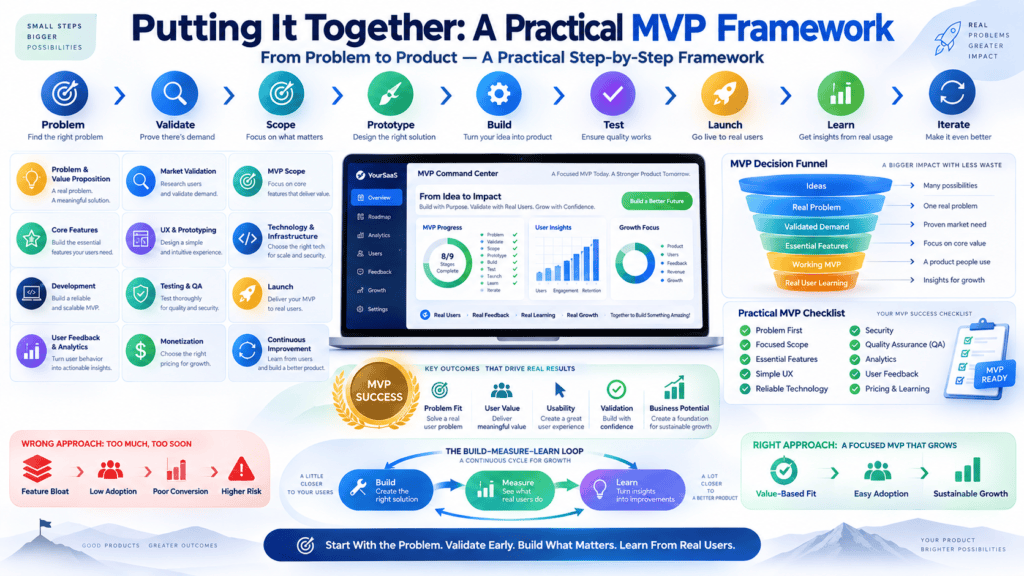
For most early-stage SaaS products a hybrid approach is most viable:
- launch with flat-rate subscription tiers to gauge willingness to pay,
- add a generous free trial (not a freemium) to reduce friction during sign-up but not have to support an ongoing free tier,
- and then add usage-based add-ons (extra seats, API calls, storage) once you have a sense of your product’s value metric.
- Outsource billing to Stripe/Paddle from the get-go to save engineering time spent on invoicing.
- Instrumentation for churn tracking should also be installed ahead of time, since a post-hoc analysis of the reasons for churn can be much more involved than observing the process unfold in (near) real-time.
It should be changing — most successful SaaS companies tend to rework their pricing every 12-18 months anyway during their growth, as they learn more about their customers’ willingness to pay and how much each customer is worth to them. Think of your initial minimum viable product pricing as a hypothesis, not as an answer.
SaaS MVP Cost & Resource Optimization
Creating a SaaS Minimum Viable Product (MVP) is not a matter of cutting costs. It is a matter of achieving the best value for money. Many SaaS products and web apps fail because their creators invest more than 100 thousand dollars in development without realizing what the market needs.
A competent roadmap implies optimization of costs, reducing the product’s scope, choosing the right tech stack, assembling an efficient team, and preventing unnecessary expenditures.
1. Calculating SaaS MVP Costs: What to Expect
Before diving into optimization, establish a realistic financial baseline. The cost of a SaaS MVP varies dramatically based on execution path:
| Development Path | Estimated Cost | Timeline | Best For | Risk Level |
| No-Code / Low-Code | $3,000 – $10,000 | 2 – 4 weeks | Simple workflows, internal tools, B2C MVPs | High (Scalability limits) |
| Solo Developer / Small Freelance Team | $15,000 – $35,000 | 6 – 10 weeks | Experienced technical founders | Medium (Single point of failure) |
| Specialized Agency | $40,000 – $90,000 | 8 – 14 weeks | Non-technical founders needing end-to-end execution | Low (Standardized processes) |
| In-House Team | $100,000+ | 12 – 20+ weeks | Venture-backed startups | High (High fixed overhead) |
2. Eliminating Unnecessary Features: The “Thin Slice” Strategy
Feature creep is the single biggest destroyer of startup budgets. Every extra feature adds code complexity, UI clutter, testing requirements, and long-term maintenance costs.
The MoSCoW Scoping Framework
Apply the MoSCoW method strictly before writing any code:
      [ MUST-HAVE ]
   The single non-negotiable core workflow.
               │
               ▼
     [ SHOULD-HAVE ]  ───>  Move to Post-Launch Version 1.1
               │
               ▼
      [ COULD-HAVE ]  ───>  Move to Product Backlog
               │
               ▼
       [ WON'T-HAVE ] ───>  Cut Entirely
- Must-Haves (Include in MVP): The ability for a user to sign-up/authentication, the core value action (ex. report generation or file processing), and basic payments (ex. stripe).
- Should-Haves (Defer to V1.1): Dark mode, custom user roles, team permissions, advanced analytics dashboard.
- Could-Haves / Won’t-Haves (Cut): Custom reporting builders, multiple third party integrations, social logins, AI chat assistants (if the offering isn’t focused on being an AI itself)
Rule of Thumb: Figure out the one core metric or outcome your software provides. If a feature doesn’t directly get the user to said metric or outcome faster, cut it.
3. The Optimal Developer Tool Stack for Speed and Economy
Avoid bleeding-edge tools or over-engineered architectures. Choose time-tested technologies with rich library ecosystems to minimize custom code.
Standard High-Speed Tech Stack
        ┌─────────────────────────────────────────┐
        │  Frontend: Next.js (React) / Tailwind   │
        └────────────────────┬────────────────────┘
                             │
        ┌────────────────────▼────────────────────┐
        │ Backend: Supabase or Firebase (BaaS)    │
        └────────────────────┬────────────────────┘
                             │
        ┌────────────────────▼────────────────────┐
        │ Payments & Auth: Stripe + Clerk / Auth0 │
        └─────────────────────────────────────────┘
- Frontend: The choice would be between Next.js (React) or Vue/Nuxt with Tailwind CSS or pre-bought UI kits (Shadcn UI, Chakra UI). Using UI libraries will save 4-6 weeks of custom css coding.
- Backend & Database: A BaaS (Backend-as-a-Service) such as Supabase or Firebase, which take care of user management, relational databases (PostgreSQL), security, and storage, saving $10 000 – $20 000 in custom backend engineering.
- Authentication & Billing: Third-party services like Clerk or Auth0 for user logins, and Stripe Checkout or Lemon Squeezy for payments. No custom auth or subscription engine will be built.
- Hosting & CI/CD: Vercel or Render, which are able to deploy directly from a GitHub repository, with costs under $20 – $50/month during early validation.
4. Structuring a Lean SaaS MVP Team
Hiring too many roles too early leads to high burn rates and communication overhead. Keep the core team tightly focused.
┌─────────────────────────────────────────────────────────────┐
│                      Product Lead                           │
│           (Founder / Fractional CPO / PM)                   │
└──────────────┬──────────────────────────────┬───────────────┘
               │                              │
               ▼                              ▼
┌──────────────────────────────┐┌──────────────────────────────┐
│     Full-Stack Engineer      ││    UI/UX Designer (Part-Time)│
│  (Next.js / Node / Database) ││     (Figma Design System)    │
└──────────────────────────────┘└──────────────────────────────┘
- Product Lead (Founder / Fractional PM): Sets the product scope, conducts the occasional user interviews, and cuts off any feature creep.
- 1–2 Full-Stack Developers: They should be comfortable with both building out the UI and connecting it to an API. You shouldn’t be hiring three different people for the front-end, back-end, and database if you’re just building an MVP. It’ll kill your development speed.
- Part-Time UI/UX Designer: Someone who can dedicate 10–15 hours per week to design and create a Figma kit that the dev team can use as a starting point and iterate on for the foundational user flows.
5. Avoiding Wasted Resources: Core Execution Principles
1.Build UI Prototypes Before Code:Saves 3x to 5x in developer rework.
Validate the user flow with clickable Figma prototypes before developers write a single line of code. It only takes 15 minutes to modify a screen in Figma, but it takes days to refactor production code.
2.Buy or Integrate, Don’t Build:Outsource non-core functionality.
Use third-party APIs for standard functionality. Need transactional emails? Use Resend or SendGrid. Need search? Use Algolia. Focus engineering hours exclusively on your proprietary value proposition.
3.Avoid Premature Scaling and Over-Architecture:Design for 100 users, not 1,000,000.
Do not waste time on monstrosities like Kubernetes (or other orchestration layers) and microservices. Monolithic architectures on top of modern serverless platforms host initial user surges at a fraction of the investment and operational overhead.
4.Execute Manual Operations Behind the Scenes:The ‘Wizard of Oz’ MVP model.
Instead of building complex backend automation for data processing or enrichment, process incoming data manually for your first 10–20 customers. Automate code only after proving users value the output.
Final Checklist for Launching Lean
Before investing your money and time into developing the app, there are several questions that you need to answer:
- Is your MVP focused on a particular issue that you want to solve for a specific user category?
- Are you planning to use any UI design systems or try to design all graphics from scratch?
- Did you select a certain backend as a service or integrated a sandbox for payments?
- Is your team going to be small (1-3 full-time developers) to reduce the costs and simplify coordination?
Common SaaS MVP Mistakes
A minimum viable product (MVP) for SaaS is a developing product, not a large-scale launch, but certain mistakes can make an MVP expensive and ineffective. The most common error is including too many features in a product, which can make it hard to analyze the results. Another challenge in creating such a product is an inadequate check of its viability, which can lead to the development of something that the customer does not need.
Weak user onboarding can result in users not knowing what the product is about, while the absence of analytics will make it impossible to track activation, usage, and retention. Poor testing can lead to usability problems, bugs, and security issues. Lastly, the scope creep is a possibility that will hamper the product development process. A SaaS MVP must have a controlled scope and focus on the critical features, test them with real users, and rely on feedback and analytics to inform future improvements.
Post-MVP Roadmap: Scaling Successfully
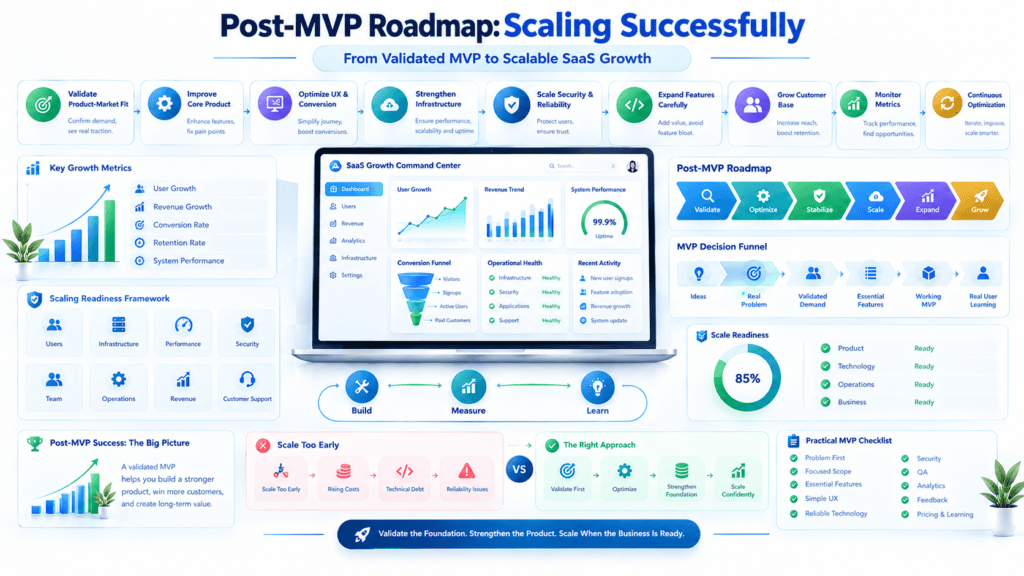
Getting your MVP (Minimum Viable Product) to market is a major milestone; however, it is only a beginning, not an end. After you have proven that people actually want your product, you need to think through what the next steps are going to be. You have successfully turned a concept into something tangible and valuable. Now you need to turn this MVP into a working, profitable business.
1. Product Iteration
Your MVP was created to test your hypothesis, so it’s off to a great start! Now, after launch, pivot from a mindset of “is this working?” to “how can we make this amazing?”
- Listen to your users systematically: create feedback loops, such as in-app surveys or interviews, rather than relying on ad hoc conversations
- Be ruthless in your prioritization: use a prioritization framework, such as RICE (an acronym for Reach, Impact, Confidence, and Effort) or a value versus effort matrix
- Eliminate technical debt early and often: the compromises you made to get to market quickly will only slow you down in the long run. Allot regular sprints to clean up your code
- Release in small increments: remember to continue your build-measure-learn loop, not switch to a big release cycle.
2. Infrastructure Scaling
What solved the problem for 100 users will fail for 10 thousand, so infrastructure needs to grow to meet demand, not simply respond to crises.
- Decomposing the monolith: you don’t have to leapfrog immediately to microservices, but identify which modules can be decoupled and scaled independently.
- Caching and load-balancing solutions: take off some of the pressure off the database and host frontends that can scale horizontally.
- Infrastructure automation: enables faster releases with fewer problems, which is critical as the team grows and becomes more distributed.
- Architecture reliability: backup systems, failover clusters, and monitoring with appropriate alerts (response time, uptimes, error rates) should be designed and deployed before they’re actually needed.
- Managed services: to maximize efficiency, leverage cloud operated and maintained services for undifferentiated functions (authentication, storage, message queues, etc.), reserving internal resources for development and operations.
3. New Features
Feature expansion should be informed by something other than the envy of one’s competitors.
- Focus on your own value proposition, and don’t feel pressured to build what other people think you should, especially if it doesn’t serve the particular needs of your own users.
- Test ideas out before investing heavily in them; get a sense of potential interest from users through means like fake-door testing, waiting lists or otherwise.
- Build features around different types of users. Power users, light users, and big-enterprise buyers all have different needs; keep this in mind when deciding what to work on.
4. Automation
Manual processes that were just fine for your first 50 customers won’t scale to 5,000.
- Automate onboarding: Signup flows, guided tutorials, email drip campaigns…anything that reduces the need for human-to-customer interaction should be automated.
- Automate internal operations: Billing, provisioning, reporting, QA testing – anything that takes away a boring repeatable task and puts it on a machine is a good candidate.
- Let humans handle the judgment and nuance: The point isn’t to eliminate humans from your operations, but to free your staff up to do the things that only humans can do.
5. Customer Support
Support is usually significantly underestimated, and customer churn occurs right there.
- Create a multi-tier support system in which users will receive help in a particular case: from self-service (helpline or documentation), through chatbots, to real people, who will solve the most complicated issues.
- Invest in the creation of a comprehensive knowledge base for the product: it will reduce the number of requests and the load on the support team.
- Measure key performance indicators (KPI): response and resolution time, customer satisfaction (CSAT). This will reduce frustration and help determine where the problem occurs.
- In addition, make sure that product support closes the feedback loop and conveys all product issues to the relevant departments.
6. Analytics
You cannot scale what you do not measure.
- Define north star metrics. Pick one to two metrics that represent value delivered (not vanity metrics).
- Instrument the entire user acquisition funnel. Think about the entire acquisition lifecycle from awareness to activation, retention, referral and revenue (AARRR) to understand what drives users to become paying customers.
- Segmentation and cohort analysis. Beyond general aggregate numbers, it is important to analyze user segments and cohorts to identify patterns.
- Make data accessible to non-analyst stakeholders. The quicker data is surfaced in consumable formats such as dashboards, the faster decisions can be made at all levels in the company.
The Common Thread
Each of these areas — product, infra, features, automation, support, analytics — shares a common theme — shifting from being reactive to proactive. At the MVP stage, your company is surviving. In post-MVP stage, you are building systems that allow the company to function (and thrive) without a huge amount of heroic effort.
The companies that scale successfully are often the ones that build boring foundations early on, allowing growth to happen without fundamentally disrupting the existing systems.
SaaS MVP Scalability and Architecture
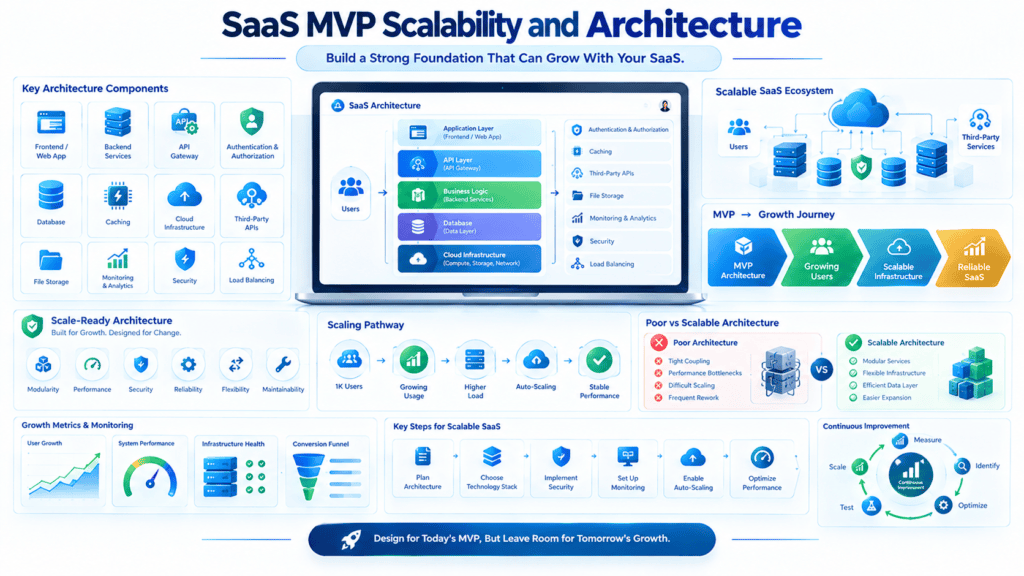
When building an MVP (Minimum Viable Product) for your SaaS platform, you have to walk a tight rope between rushing to release and planting the architectural debt that will make you pull out the hair when users start signing up.
While you need to iterate quickly and release new features to retain your audience, you still want to scale easily and not rewrite your codebase from scratch every time your user base grows x10.
Scaling Your SaaS MVP: A Guide for Founders
Scaling your SaaS MVP is a nuanced art that requires choosing the right abstractions and patterns to evolve your codebase without incurring technical debt. It has nothing to do with trying to over-engineer your architecture from the get-go by spending 10x more time than needed on designing the system that would support thousands of concurrent users.
1. Architectural Blueprint: The Pragmatic SaaS MVP
For an MVP, the goal is high velocity with a low maintenance footprint. Architectural complexity should grow alongside your customer base, not ahead of it.
       [ Client Application ] (Web / Mobile)
                 │
                 ▼
        [ Edge CDN & WAF ] (Cloudflare / AWS CloudFront)
                 │
                 ▼
     [ API Gateway / Load Balancer ]
                 │
                 ▼
      [ Modular Monolith App Server ]
                 │
  ┌──────────────┼──────────────┬──────────────┐
  ▼              ▼              ▼              ▼
[ Primary DB ]  [ Redis ]   [ Async Workers ]  [ S3 Object Store ]
(PostgreSQL)    (Cache/MQ)   (Celery/Sidekiq)  (Assets & Files)
The Modular Monolith Advantage
Avoid breaking your MVP into microservices. Microservices add distributed tracing overhead, network delays between services, challenges in deploying changes across services, and high infrastructure costs.
Alternatively, try to make a
- Modular Monolith.
- Split your code into different modules based on the domain they represent (like Auth, Billing, Notifications, etc.), and use internal API’s/event buses to communicate between them.
- If one of the modules has intense reads/writes (like pdf rendering or data processing), you can always split that one module out into a microservice or serverless function later.
Multi-Tenancy Strategy
How you handle multi-tenancy shapes your application from the start:
| Pattern | Isolation Level | Cost Efficiency | Scale Target |
Shared Database, Shared Schema (Discriminator column like tenant_id) | Low | Very High | Ideal for early-stage MVPs (0–10k tenants) |
| Shared Database, Separate Schemas | Medium | Medium | Good for SMBs with mild compliance needs |
| Separate Database per Tenant | High | Low (Expensive) | Strict Enterprise compliance / Healthcare / Finance |
- Recommendation for MVP: Start with Shared Database, Shared Schema. Enforce tenant boundaries using middleware and Row-Level Security (RLS) at the database layer to prevent cross-tenant data leaks.
2. Database Scaling: Protecting Your Core Bottleneck
In 90% of SaaS applications, the database becomes the bottleneck before the application tier does.
Day 1 Database Choices
- PostgreSQL or MySQL — pick an actual relational database for your MVP prototype. PostgreSQL in particular has some nice features for SaaS like native JSONB support, Row-Level Security (RLS), etc.
- Don’t try to use NoSQL for relational data modeling, unless your product’s primary value proposition is generic event logging or real-time graph traversing. Relational databases are usually a much better fit for SaaS MVP’s user-subscription relational model and other common entities.
Database Scaling Roadmap
- Connection Pooling: Using connection poolers such as PgBouncer or serverless poolers (AWS RDS Proxy, Prisma Accelerate), to manage hundreds of transient application connections.
- Indexing: Make sure that every query in your hot path has appropriate compound indexes, especially queries which filter by tenant_id and timestamps (tenant_id, created_at).
- Read replicas: If you experience overload on your database due to excessive read queries, consider provisioning Read Replicas and routing analytical/read only traffic to them.
- Partitioning & Sharding: When tables grow to tens of millions of rows, think about partitioning it by tenant_id or date ranges before moving towards sharding an entire database across multiple nodes.
3. Performance Optimization & Caching Strategies
Performance directly impacts user retention. Optimize early by reducing unnecessary backend work.
Caching Layers
- Edge Caching: Cache public marketing pages and static app assets at the CDN level.
- Application Caching (Redis/Memcached): Cache expensive queries, user sessions, system configs, and feature flags in Redis.
- Query Invalidation: Implement cache invalidation policies (e.g., Cache-Aside pattern) to prevent serving stale operational data to users.
Asynchronous Background Processing
Never carry out heavy or slow tasks in the HTTP request-response cycle.
Move such operations into a background task queue, which can be processed by workers:
- Transactional or webhook emails/PDF/image generation.
- Calls to third-party APIs (Stripe sync).
- Heavy data export or aggregation queries
4. Cloud Services & Hosting Stack
Leverage Managed Services (PaaS and Serverless) to keep your team focused on shipping features rather than managing infrastructure.
The Modern SaaS MVP Stack
- Hosting Platforms:
- Option A (Maximum Speed):Vercel / Render / Fly.io for frictionless frontend and application server deployments.
- Option B (Growth & Control):AWS (ECS / App Runner) or GCP (Cloud Run) for containerized workloads using Docker.
- Option A (max speed): Vercel, Render or Fly.io for frontend and application server deployments.
- Option B (growth and control): AWS (ECS / App Runner), GCP (Cloud Run) for Docker container workloads.
- Managed Database: AWS RDS / Aurora, Supabase, Neon or PlanetScale.
- Object Storage: AWS S3, Cloudflare R2 or GCP Cloud Storage for user uploads.
- Background workers + Redis: Upstash or AWS ElastiCache.
- CDN + Edge security: Cloudflare (including DDoS protection, DNS and CDN).
5. Essential SaaS Security Requirements
Security cannot be an afterthought in SaaS; a single data leak can end a startup before it gains momentum.
Key Security Protocols for MVPs
- Authentication & Authorization
- Use proven identity providers like Auth0, Clerk, Firebase Auth, or Supabase Auth rather than building custom password hashing and session tokens from scratch.
- Implement Role-Based Access Control (RBAC) early (e.g.,
Admin,Member,Billing Manager).
- Tenant Isolation Enforcement
- Ensure that database queries always scope requests to a given tenant by tenant_id.
- Write tests that explicitly test that User A is not able to retrieve resources from Tenant B by manipulating path parameters or query input (IDOR).
- Data Protection & Encryption
- In-Transit: Enforce TLS 1.3 across all endpoints.
- At-Rest: Enable AES-256 storage encryption on your database and object storage buckets.
- Secrets Management: Keep API keys, DB strings, and secrets out of version control by using environment variables managed by something like Doppler, HashiCorp Vault or AWS Secrets Manager.
- Rate Limiting & Threat Protection
- Apply rate-limiting middleware (e.g., Redis-backed rate limiters) on public-facing APIs and login endpoints to prevent brute-force attacks and abuse.
MVP Architecture Checklist
Before launching your SaaS MVP, ensure you have ticked these critical infrastructure boxes:
- Use Terraform or Pulumi to define and configure cloud resources
- Implement CI/CD Pipeline (automated tests, zero downtime deployment)
- GitHub Actions or GitLab CI
- Set up centralized logging and monitoring with error tracking (Sentry), uptime/infrastructure monitoring (Datadog or Better Stack), and logs (Logtail)
- Automated daily DB backups with Point In Time Recovery
- Stripe Billing or Paddle setup with webhook retries, billing grace period
By designing your application to be modular and using managed services in the cloud, and by keeping your database operations light, your SaaS MVP will scale from the first user to one hundred thousand users without requiring you to do expensive rework on its core architecture.
SaaS MVP Trends: What’s Actually Changing in 2026
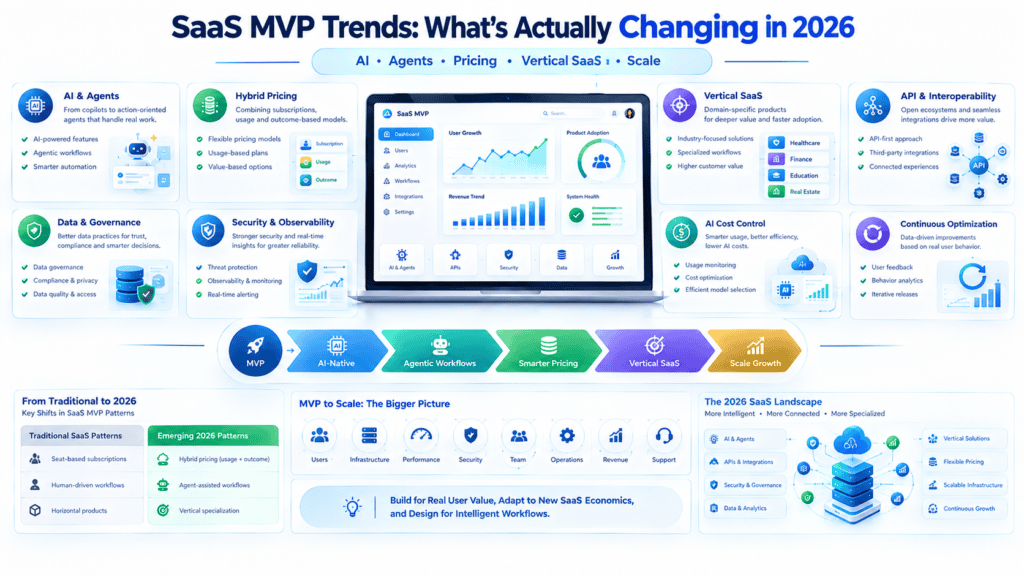
The bar for a “minimum viable product” seems to be constantly raised. A product with an initial prototype and a presentation deck was sufficient some time ago, but now it is not enough.
Users now expect AI assistance, competition increases, and the tools that start-up founders use also affect the creation of a minimum viable product. These are the main challenges in the development of SaaS MVP.
1. AI Isn’t a Feature Anymore — It’s the Baseline
The single biggest change is that AI has gone from being an impressive add-on to being expected. By 2026, users will expect AI assistance in any given digital product and features such as summary, suggestion, and automation will no longer be impressive but rather table stakes even in niche SaaS products with a limited target audience. MVPs are already launching with LLMs, recommendation engines and lightweight predictive analytics baked in from launch.
The important nuance here is that it’s not about novelty; it’s about solutions.
It’s not about building cool new tech for the sake of innovation, but rather about finding out if AI can genuinely help to solve a particular problem faster than without it.
Successful founders will always tie their AI-assisted processes to some metric that reflects how much time/money they saved by implementing the solution.
There’s also a real financial incentive here; AI SaaS companies are capturing 30-110% pricing premiums and achieving revenue milestones roughly 10x faster than traditional SaaS companies, and captured nearly half of all global venture funding in 2025, spending on generative AI jumped $11.5 billion to $37 billion year over year.
However, adoption and maturity are not the same, 78% of organizations use AI in at least one business function, but only around 1% have mature deployments, leaving a ripe gap for early MVPs to exploit
2. AI-Assisted Development Has Collapsed Build Timelines
The other half of the story is the builder’s side of the equation: not just the product, but the tools and frameworks that make creating said products less of a time investment.
But the problem is that competition is growing in all corners of the SAAS sphere and users are expecting polished, quick, and reliable tools whether they’re working with established products or up-and-coming startups.
Concretely, this looks like:
- AI-powered code editors and terminal agents handling the heavy lifting, with solo founders shipping production-grade products within weeks via AI-assisted code synthesis, design prototyping, and workflow automation.
- Hybrid no-code + custom code stacks: Teams leveraging an AI coding layer + low-code platform for commodity features are out-pacing pure custom development teams by 30-50% in time-to-market.
- Compressed timelines across the board, with certain teams shipping full SaaS MVPs within 6 weeks by decoupling the core product (rapidly built in no-code) from payment processing, compliance, and data infrastructure layers that get added on later.
The catch, noted in almost all of these sources: rushing without discipline leads to failure. It is the teams that are the most thoughtful, not the quickest, that win the validation races.
3. Automation Has Moved Into the Feedback Loop, Not Just the Backend
Automation used to be about internal processes: billing, onboarding emails, and so on. Now, it is being built into the product itself. In 2026, artificial intelligence is used extensively in minimum viable products to accelerate the feedback loop between users and developers.
Products increasingly feature embedded analytics, event tracking, segmentation, and predictive modeling to help developers act on the data rather than spending weeks or months manually analyzing cohorts.
Practical, product-level examples of this trend are things like AI-powered onboarding flows that personalize the first run experience, auto-reported B2B dashboards that save hours of report writing, and smart routing features that help users make decisions at each step.
4. Modern Dev Tooling Is Pushing Toward Modular, API-First Architecture
Founders are building faster, but not necessarily in the same way. Modular, API-first architectures are enabling modern MVPs to scale and adapt without rewriting their codebase, while microservices and modular AI components are becoming popular choices for decoupled, replaceable building blocks that let startups iterate without disrupting their whole system.
This is more important than it seems: an MVP that demonstrate demand but has poor design architecture is just delaying the inevitable. Teams are starting to treat these as part of the MVP bar, rather than a post launch problem.
5. Compliance Is Becoming a Day-One Constraint, Not a Later Cleanup Job
This is a pretty steep shift. Enterprise buyers in healthcare, fintech, and SaaS are demanding SOC 2, HIPAA, or GDPR compliance, and an MVP that achieves product-market fit without this baked in is going to struggle to acquire its most valuable segment. It’s expensive to retrofit compliance, and it delays enterprise sales: you should budget $150,000-$300,000 and six to twelve months.
For founders targeting B2B or regulated verticals, this pushes compliance planning up into the MVP scoping phase, right alongside choosing your AI features.
What This Means If You’re Building One Now
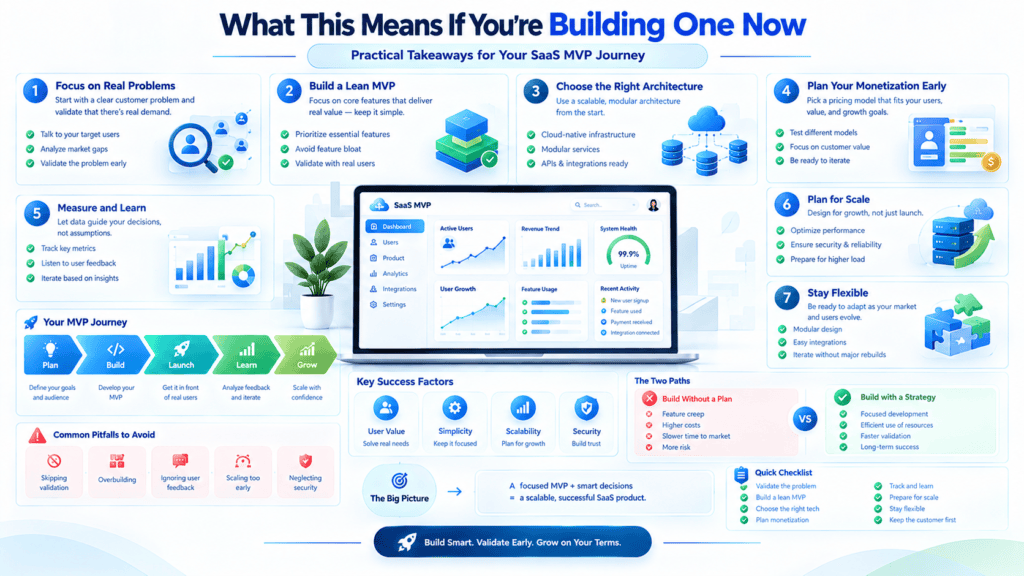
Considered together, they suggest a single lesson: the definition of “minimum” now includes previously “later” concerns like AI-native features, real-time analytics, modular design, and regulatory groundwork in restricted domains.
Available tools (AI coding assistants, no-code/low-code platforms, pre-trained models fine-tuned rather than trained from scratch) make such a minimum viable product attainable without a full engineering team, but not eliminate the need for a hypothesis: pick one AI-assisted feature and one metric, prove its value.
Do you want this rewritten for a particular audience (technical readers vs. founders vs. investors)? Would you like a more compact LinkedIn-friendly version of this post? I can also prepare this content in downloadable version if needed.
From MVP to Product-Market Fit
Launching a Minimum Viable Product (MVP) is a major milestone, but it is only the starting point. The challenge of getting from where you are to a place where you can sustainably continue building the product lies ahead.
Product-Market Fit (PMF) is a state of being in a good market with a product that can satisfy that market. To cross the bridge from MVP to PMF, you will need to measure your way there, retain users, solicit feedback in a structured manner, and prioritize aggressively.
1. Measuring Traction: Quantitative Signals of Initial Demand
Traction proves whether users actually care about the problem you are solving. Early on, focus on quality metrics over vanity numbers.
Key Traction Metrics
- Customer Acquisition Cost (CAC) vs. Lifetime Value (LTV): At first, measure organic reach against paid acquisition costs to understand intrinsic demand.
- Conversion Rates: Measure the conversion rate at every step of your funnel (e.g., Visitor $\rightarrow$ Signup $\rightarrow$ Active User $\rightarrow$ Paid Subscriber).
- Activation Rate: Activation rate is the percentage of new users who reach your product’s “Aha!” moment (the point in which users experience the first value) in their first session or week.
The Traps to Avoid
- Vanity Metrics: High Sign-Ups or Page Views but No Engagement Equals Nothing
- Buying Traction: Heavy Spend on Paid Ads to Boost Early Numbers Hides Product Flaws
2. Retention: The Ultimate Indicator of PMF
Acquisition brings users through the front door; retention keeps them from walking out the back. High retention is the single most reliable sign that you are moving toward PMF.
How to Measure Retention
Cohort Analysis: This analysis follows a selected cohort of users who joined the service during a particular week or month. For this study, we consider the percentage of repeat visitors on Week 1, Month 1, Month 3, and so on.
- The visual representation of a retention analysis is the retention curve. On the Y-axis, we plot the percentage of active users after a specific period, and the X-axis represents time.
- Unfit Product: In this instance, the retention curve trends downward towards zero.
- Product-Market Fit: A retention curve that has a long tail that flattens out indicating a core audience that regularly uses the product.
| Retention Profile | Curve Behavior | What It Means |
| Leaky Bucket | Slopes down continuously to 0% | Users try the product but find no long-term value. |
| Healthy PMF | Drops initially, then flattens out | A core group finds recurring value and continues using it indefinitely. |
3. Gathering & Processing Customer Feedback
Quantitative data tells you what users are doing; qualitative feedback tells you why.
Core Feedback Channels
In-App Micro-Surveys: Leverage targeted, brief prompts following specific in-app interactions.
1-on-1 User Interviews: Conduct direct conversations with your most engaged users and those who have churned (discontinued using your product). The latter group can highlight areas where your product’s value proposition may be insufficient.
The Sean Ellis PMF Survey: Pose the question to users: “How would you feel if you could no longer use our product?”
- Very disappointed
- Somewhat disappointed
- Not disappointed
PMF Benchmark: If 40% or more of respondents answer “Very disappointed,” you have reached a strong indicator of Product-Market Fit.
4. Iterating & Improving the Product
Raw feedback can be overwhelming. The key is separating noisy opinions from actionable, scalable product improvements.
- Focus on Your Core Segment: Focus on the users who selected “Very disappointed” on the PMF survey and analyze their common characteristics to create a better experience for them.
- Eliminate Friction First: Before adding new features, focus on removing friction points in the onboarding process, UI, and user flows, which prevent new signups from having their “Aha!” moment.
- Double Down on What Works: It is often more efficient to invest effort in reinforcing your main core feature, rather than trying to develop three different secondary features.
5. Deciding What to Build Next (Prioritization)
Deciding what not to build is just as critical as deciding what to build. Frame feature development using proven decision tools:
Prioritization Frameworks
- RICE Scoring Method:
$$\text{Score} = \frac{\text{Reach} \times \text{Impact} \times \text{Confidence}}{\text{Effort}}$$
Reach: How many uses will it affect over a period of time?
Impact: How much will it improve the users experience? (3- huge, 0.5- little)
Confidence: How confident are you that your estimate is correct? (Percentage)
Effort: How many person-months will it take?ICE Scoring Method:
$$\text{Score} = \frac{\text{Reach} \times \text{Impact} \times \text{Confidence}}{\text{Effort}}$$- Reach: How many users will this impact over a given timeframe?
- Impact: How much will this improve the user experience? (e.g., 3 = massive, 0.5 = low)
- Confidence: How sure are you about your estimates? (Percentage)
- Effort: How many person-months will this take?
- The Eisenhower Matrix for Product:
- Urgent & Important: Critical bug fixes and retention blockers.
- Not Urgent & Important: Strategic feature enhancements for core users.
- Urgent & Not Important: Low-impact visual tweaks or edge-case requests.
- Neither: Distractions, vanity requests, or feature creep.
Summary Checklist for Early-Stage Founders
- Track Retention First – Check if your cohort is flattening before you invest significantly in growth.
- Run the 40% Rule Test – Test with the Sean Ellis survey to understand your user’s sentiments about losing your product.
- Analyze the Drop Off – Find the drop-off point before their Aha! Moment
- Use Frameworks – To prioritize new requests, use objective criteria like the RICE scoring model or others.
Your MVP Isn’t the Endgame — It’s the Launchpad
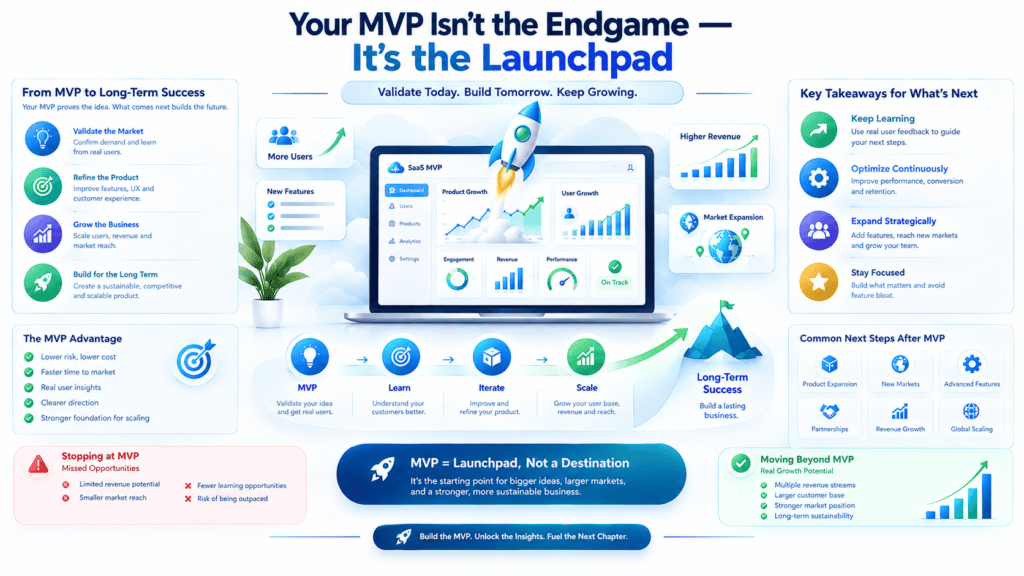
Creating a Minimum Viable Product (MVP) is one of the most celebrated achievements in a SaaS company’s history. You made it big — not only did you manage to test your idea and build an actual product, but you also proved there is a market for it.
But what many forget is that an MVP is a means to an end, not an goal in itself — and a short-lived one at that.
You must learn to think about your MVP not as a product, but as a process — and change your strategy for launching an actual product based on that process. That is the key to building a truly great SaaS product rather than a novelty MVP.
1. The Post-MVP Mindset Shift
When launching an MVP, the emphasis is on speed and verification. Therefore, the critical success factor after launch will be a shift in gears from building something fast to learning and scaling it correctly.
- From Hypothesis to Evidence: before launch, your assumptions were in the realm of hypotheses; after launch, you must back each new feature or improvement with hard-to-ignore statistics on user behavior, churn rates, and feedback.
- Refactoring Tech Debt: MVP software is frequently developed in a hurry, resulting in a slew of workarounds that aren’t nearly as sturdy as they should be. Iterating on the product after its release requires investing much time and effort in rewriting and reorganizing the codebase, as well as addressing security issues.
- Focusing on Retaining the Core Cohort: A leaking bucket can’t hold water. Your product has a limited amount of potential users before it needs to acquire new customers to replace those who have disengaged or moved on to alternatives, so it’s critical to keep a close eye on your existing users.
2. The Iteration Loop: Measure, Learn, Build
Continuous improvement isn’t about endlessly adding new features—it’s about optimizing value for your target audience. A disciplined iteration strategy relies on three main inputs:
      ┌─────────────────────────┐
      │  Quantitative Telemetry │
      └────────────┬────────────┘
                   │
                   ▼
┌─────────────────────────────────────┐
│    The Continuous Iteration Engine  │
└──────────────────┬──────────────────┘
                   │
                   ▼
      ┌─────────────────────────┐
      │  Qualitative Feedback   │
      └─────────────────────────┘
- Quantitative Metrics: Measure usage of features, drop-off points in the product, cohorts retention analytics, and session depth to indicate how users are engaging with your product. They tell you what is actually happening in the software.
- Qualitative Metrics: Perform one-to-one customer interviews, track customer support tickets, and analyze exit surveys. These will help identify the reasons behind the quantitative data.
- “The One Metric That Matters”: Set your engineering team’s focus on an Overall Metric To Track and drive improvement in that area. This could be any single business metric such as decreasing onboarding drop-off by 15%, or increasing weekly active users of a certain feature by a given percentage, for a specific amount of time.
3. Key Phases of Scaling Your SaaS Product
Moving from an MVP to a mature product requires navigating distinct growth stages:
| Stage | Core Objective | Key Focus Areas |
| 1. Product-Market Fit (PMF) | Validate core value | High retention rates, organic user acquisition, refining core feature loop. |
| 2. Operations & Performance | Build scalable foundations | Infrastructure optimization, platform uptime, automated billing, customer support workflows. |
| 3. Product Expansion | Broaden market reach | Native integrations, advanced analytics, enterprise-grade RBAC (Role-Based Access Control), security compliance (SOC 2, GDPR). |
| 4. Ecosystem & Platform | Maximize retention & LTV | Open APIs, marketplace apps, multi-product strategy, self-service developer tools. |
4. Strategic Pitfalls to Avoid
As you move past your MVP, avoid these common traps:
- Feature Bloat: Creating products with each requested feature will lead to bloated and confusing software that will alienate your target customer persona. Say no to features that don’t serve your core customer persona.
- Ignoring Technical Debt: Ignoring the technical debt in the system will eventually bring you down to a crawl as you try to deploy new code with higher concurrency requirements.
- Premature Scaling: Scaling too early and spending resources on user acquisition before you’ve achieved reasonable product-market fit will burn you.
Summary
The Minimum Viable Product (MVP) only takes you so far. Your post-launch product strategy should be designed to let you stay in the race. By using your initial release as a springboard, iterating on continuous feedback, methodically paying down technical debt, and focusing on sustainable retention strategies — you can build an enterprise-grade SaaS business that will stick around for years to come.
FAQs
1. What is the main difference between a SaaS MVP and a Full-Scale SaaS product?
A SaaS Minimum Viable Product is a stripped-down version of an MVP that targets one major core problem and a potential fix to help test the idea in the marketplace. A full-scale SaaS product has everything from advanced integrations and automation to options and tools for scaling the user base.
2. How do I effectively prioritize features for my SaaS MVP without overbuilding?
To avoid falling victim to feature creep, first, make a list of prioritization frameworks (such as the MoSCoW method) and project management approaches (like the RICE scoring formula, $\text{Reach} \times \text{Impact} \times \text{Confidence} / \text{Effort}$). You can start by defining your product’s core loop — the simplest set of actions allowing the user to gain value from the product and remove everything else.
3. What is the best way to validate market demand before writing code?
Market validation can be achieved through conducting 15-20 problem discovery interviews with potential customers, creating a simple landing page or waiting list to gauge interest, running smoke-advertising tests, or developing a concierge (manual) MVP. In this way, demand validation helps you avoid wasting time and energy on a product that no one needs or is willing to pay for.
4. How should I choose the right tech stack for building a SaaS MVP?
Rather than try to follow fads, focus on the speed of development, reliability, and team expertise. The most popular tools are React / Next.js + Tailwind CSS stack (front-end), Node.js, Python (Django/FastAPI) or Ruby on Rails (back-end) and PostgreSQL (relational database).
5. How can I test willingness to pay before launching the full version?
You can measure your audience’s willingness to pay by
offering discounted “founding member” pre-sales or lifetime deals,
running Van Westendorp pricing surveys,
collecting refundable deposits in exchange for the ability to purchase earlier,
or
seeking non-binding Letters of Intent (LOI) from B2B prospects.
6. Why is rapid prototyping and UX testing crucial before MVP development?
Creating clickable wireframes (such as in Figma) and testing key user flows with real users helps you identify usability problems and workflow issues early on. Fixing user experience bugs in a prototype is a lot faster and easier than in production code during development.
7. What comes after launching the SaaS MVP?
After the initial release, the emphasis is on feedback loops (surveys, tickets, interviews), quantitative analysis of user behavior, iteration on retention levers, pricing experimentation, and infrastructure/market growth as the product achieves fit with the market.
Author Bio
Jeevesh Tripathi works in the field of AI Researcher, SEO Content Strategist, and Technical Writer at BkAbhi. He has been developing his expertise in SaaS and MVP strategies and writing about them for a while. His main areas of expertise are technical and content writing for SEO. Jeevesh is a firm believer in supporting his audience of young founders scaling their SaaS products. Thus, he writes about software development and product management to help saas founders build their products better. In his free time, he focuses on learning and writing about the latest in the SaaS space and building products of his own.