

Table of Contents
What Is a Cap Table, Exactly?
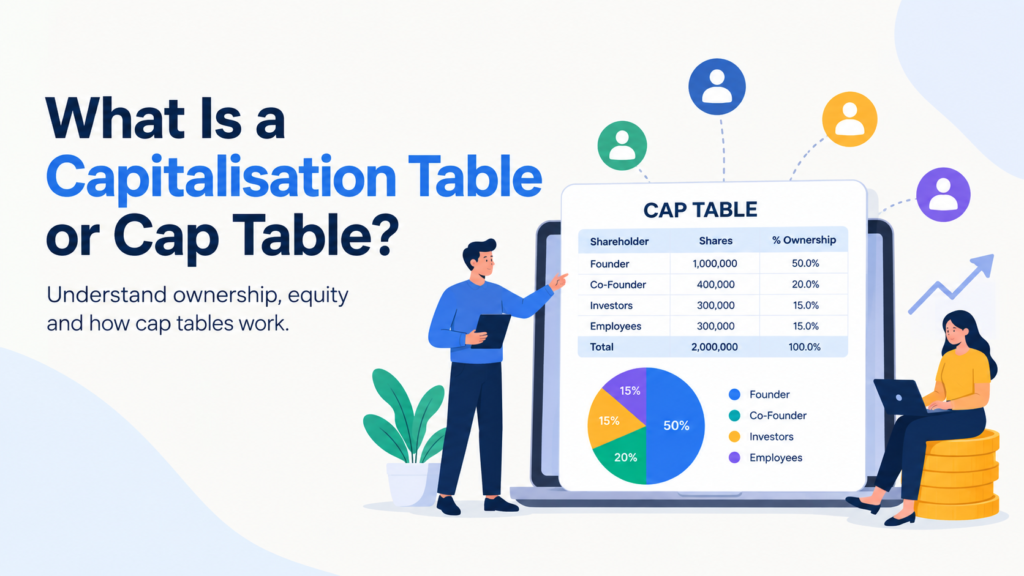
A capitalisation table (cap table) is a record of a company’s ownership structure. It shows who owns the company, how much they own, and what type of equity or ownership interests they hold.
A cap table is exceptionally important for start-ups during its funding rounds, issuing employee stock options, adding new investors, and reorganizing of ownership. Typically, a cap table contains the following information:
Common stock owned by the founders, employees, and early advisors;
- Preferred stock issued to the investors during the different funding stages (usually, seed, series A, series B);
- Employee stock options, warrants, and the option pool;
- Convertible notes and SAFE (simple agreement for future equity) that have to be paid out;
- The percentage of ownership for each shareholder on a fully diluted and non-diluted basis.
In simple terms, a cap table helps answer three fundamental questions:
- Who owns the company?
- How much does each person or entity own?
- What type of shares or ownership interests do they hold?
For example, a startup with two cofounders, early investors, and an employee option pool might have a basic ownership structure like this:
| Stakeholder | Ownership |
| Founder A | 45% |
| Founder B | 35% |
| Investors | 15% |
| Employee Option Pool | 5% |
| Total | 100% |
In the early stages, founders may be able to manage a relatively simple cap table using a spreadsheet. However, as the company has a number of additional funding rounds, attracting more investors, issuing various classes of stock, employee options, or convertible notes, the cap table becomes more difficult to manage. At this point, cap table management software can help to ensure that ownership records are always up to date and make it easier to raise subsequent funds and understand dilution.
What Does a Cap Table Include?
A cap table summarizes the following information:
- The stakeholders who have an ownership interest in the company, for instance, Founders, Investors, Employees, and others.
- The number of shares, namely the amount of equity that each stakeholder owns.
- The stakeholders’ percentage ownership, for instance, the percentage of the company each owner possesses.
- The share class, such as Common Shares, Preferred Shares, and others.
- The stock options, including the shares set aside for employees and advisors.
- The convertible securities, such as convertible notes and SAFE (Simple Agreement for Future Equity) that can be converted to shares.
- The investment and valuation, including the amount of money each investor has contributed to the company.
Why Is a Cap Table Important for Startups?
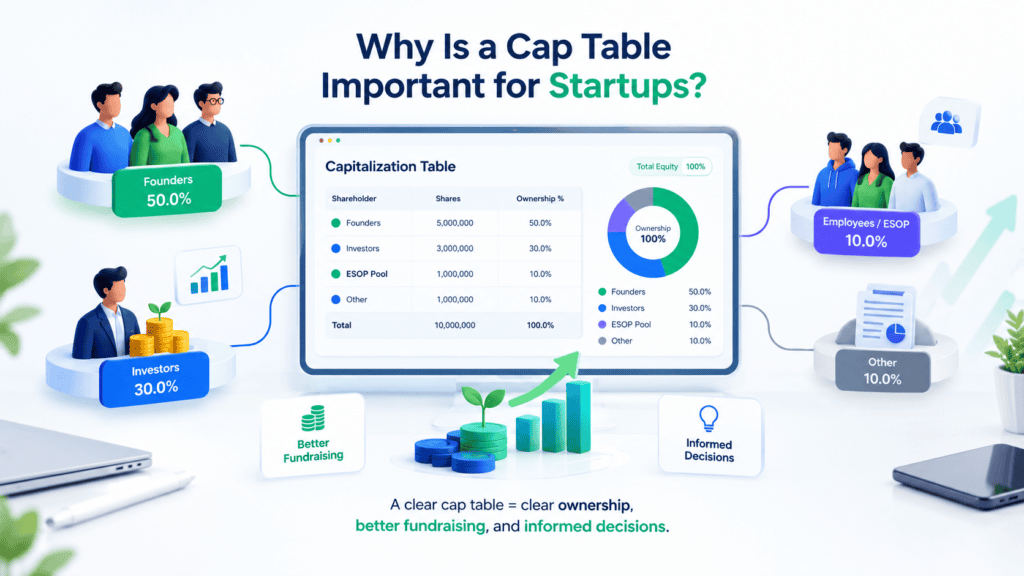
A cap table is more than just a simple spreadsheet. A cap table is an essential financial and ownership management tool for founders and investors.
When a new funding round is issued, it can dilute (decrease) the percentage of ownership that the current shareholders have.
This is why a well-kept cap table is so crucial to found ers, as it helps them know exactly how a new funding round will affect their percentage of ownership.
For example, if a founder has 60% ownership before a funding round and the new investors acquire 20% of the company, the founder’s percentage of ownership will most likely decrease after the funding round, even if they have the same amount of shares. A cap table can help founders see what scenarios will do to their ownership, before they make any big decisions.
Simple Example of a Cap Table
Consider a startup with 1,000,000 shares:
| Shareholder | Shares Owned | Ownership |
|---|---|---|
| Founder A | 500,000 | 50% |
| Founder B | 300,000 | 30% |
| Employee Option Pool | 100,000 | 10% |
| Investor | 100,000 | 10% |
| Total | 1,000,000 | 100% |
This table is the simplest example of who owns what in a company. Real-world examples of a cap table for a start-up may include funding rounds, shares allocation, liquidation preferences, employee options, SAFEs, convertible notes, and more.
Cap Table vs. Ownership Structure
Although they are closely related, these terms are not interchangeable.
An ownership structure is a general description of the distribution of ownership in a company, while a cap table is the actual document that records and calculates this information.
The cap table, therefore, becomes a company’s key reference for its ownership structure as its startup grows and develops.
What Is a Fully Diluted Cap Table?
A fully diluted cap table reflects ownership of a company after assuming that all securities that could potentially be converted into equity have been converted or exercised.
This includes:
- Outstanding shares
- Employee stock options
- Warrants
- SAFEs
- Convertible notes
- Other convertible securities
This is especially important during fundraising because an investor may want to see the potential dilution to existing shareholders if a new round of funding were to occur.ant to understand their expected ownership after considering the company’s entire potential equity pool.
When Should a Startup Create a Cap Table?
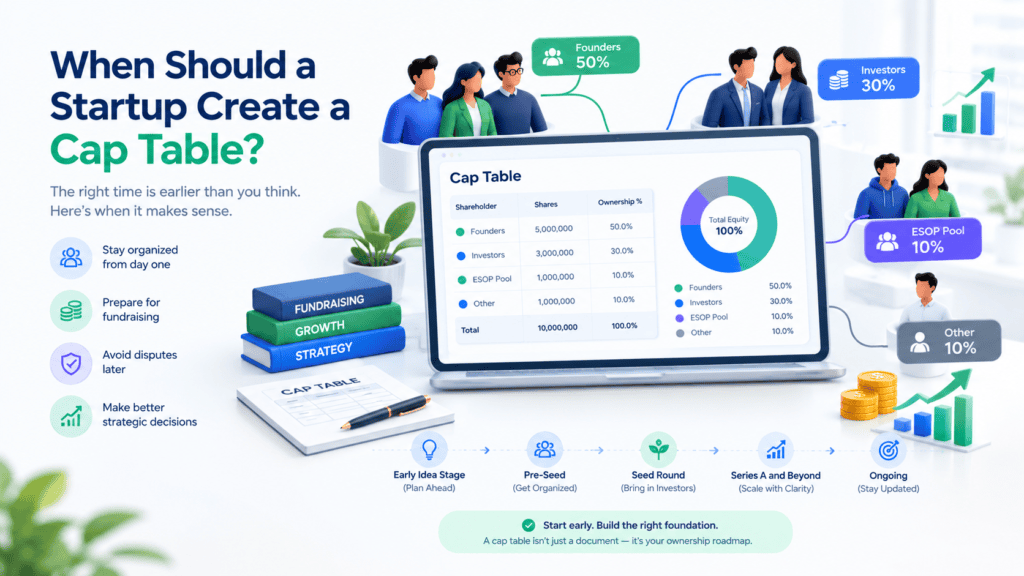
A startup should generally create a capitalization table even at the inception of the company, including when there are few or two cofounders.
It should be updated every time there is a relevant event such as
- issuance of founder shares,
- addition of a new investor,
- funds raise,
- issuance of employee options,
- creation or adjustment of an option pool,
- issuance of SAFE or convertible notes,
- transfer or repurchase of shares,
- reorganization or mergers and acquisitions, or
- any other events that affect the capital structure of the company.
Having a properly maintained cap table from the beginning can prevent a plethora of ownership and calculation disputes later.
In Simple Terms
A cap table, short for capitalization table, is a document that depicts the share distribution of a startup company. It highlights the number of shares, their percentage, and the ownership structure between different stakeholders. It also provides information on the potential new issuance of shares and its impact on the current shareholders’ percentage.
The cap table is critical in reflecting the ownership position of the founders, investors, and employees. It is, therefore, important to have an updated cap table since it simplifies raising funds, dilution, planning for employees, and other essential transactions associated with the equity.
Key Components of a Cap Table
Shareholder Names
Every entity and individual who owns equity, options, warrants, or convertible notes should be identified.
- Who are they? They are your founders, early employees, advisors, angel investors, VCs, funds, etc.
- Why is this important? Legal accuracy, voting, and communication – for example, when your shareholders want to vote on something, you need to know how each one votes.
Share Classes
Equity is not created equal; a cap table helps illustrate the different types of shares that have been issued to different stakeholders.
- Common Stock: Typically owned by the founders, employees, and advisors; this form of ownership has standard voting privileges and is junior to preferred stock in terms of liquidation preference.
- Preferred Stock: This type of equity is typically reserved for investors who have provided funding in the form of Series A, B, and so on. Preferred shareholders also have liquidation preferences, anti-dilution protection, and other similar privileges.
- Convertible Notes and SAFEs: These are unissued forms of debt or equity that are convertible into common or preferred shares at a later date when the company raises a qualified round of financing.
Number of Shares Issued
This section provides the information regarding the number of shares issued to each shareholder.
- Authorized Shares: It refers to a total number of shares that a company can issue.
- Issued & Outstanding Shares: It represents the number of shares issued to the founders, investors, and optioned to employees.
- Fully Diluted Shares: It is the total number of shares that contain the dilution from all the sources like convertible securities, unallocated options pools, and warrants.
Ownership Percentage
Calculated on a basic and fully diluted basis, this metric controls voting rights, level of influence, as well as payout shares at exit.
- Basic Ownership: $(\text{Shareholder’s Issued Shares} / \text{Total Issued Shares}) \times 100$
- Fully Diluted Ownership: $(\text{Shareholder’s Shares} + \text{Potential Shares from Options/Convertibles} / \text{Total Fully Diluted Shares}) \times 100$
Valuation Details
Valuation metrics are used to determine the share price in different financing rounds and the company’s development stage.
- Pre-Money Valuation: The value of the company prior to the raise of capital in a certain round.
- Post-Money Valuation: The pre-money valuation plus the total amount of money raised in a given round $(\text{Pre-Money} + \text{Investment})$.
- Price Per Share (PPS): $\text{Pre-Money Valuation} / \text{Fully Diluted Pre-Money Share Count}$, which indicates the number of shares that an investor will get for the amount of money they invest.
ESOP & Vesting Schedules
An Option Pool (also known as an Employee Stock Option Plan or ESOP) is created to attract and retain employees.
- Unallocated Option Pool is the number of shares allocated for future employees that have not been issued yet.
- Vesting Schedules track employee stock options’ vesting schedules. The plan usually contains a 4-year vesting period with a 1-year cliff (which means that 25% of the shares shall vest after 12 months of continuous employment with the company and the remaining shares will vest every month or quarter during the next 36 months).
- Vesting Status summarizes the number of shares that have been granted, vested, unvested, and exercised for each employee.
Dilution Impact
Dilution indicates the reduction of an individual shareholder’s ownership percentage in the company when additional equity is issued (i.e., option pool increase or new financing rounds).
- Priced Rounds: The introduction of new shares of investment increases the total number of issued shares and, thus, decreases the proportional ownership of existing shareholders and increases the total value of the company.
- Anti-dilution Provisions: A special set of terms (e.g., Broad-Based Weighted Average or Full Ratchet) designed to protect the preferred investor class from significant reductions in value of their investment in the case of a down round.
Funding Round Details
A cap table is a company’s historical financial database. It typically includes the following information about its equity financing rounds:
- Round Names: financing stages (Pre-Seed, Seed, Series A, Series B, etc.)
- Investment Amount: money raised in the round and per each investor
- Close Date: the date when the funding round was closed
- Liquidation Preference Multiple: details about liquidation preference (e. g. 1x non-participating preferred)
How Does a Cap Table Work?
If you are raising funds for the first time or working at a start-up early on in their journey, there is a good chance that you have come across the term captable. If you have, a lot of it probably sounded like gobbledygook, but it’s really just a fancy way of referring to the ownership structure of a company, who owns what percent of anything. This post serves to explain what a cap table is, why it’s useful, and how it works.
What Is a Cap Table?
A capitalization table, also referred to as a cap table, is a record of a company’s ownership. In the most basic sense, a cap table is a spreadsheet that displays information about a company’s shareholders. More specifically, it lists each shareholder’s percentage of ownership in the company.
A cap table can take many forms, but it should ideally indicate the types and amounts of shares (or other forms of security) owned by each of the company’s shareholders. Every time any equity transaction occurs — for example, when a founder issues a new round of shares to a co-founder or an investor buys some of the company’s stock — the cap table is updated to reflect that change.
Why Cap Tables Matter
A cap table is not just a record-keeping tool. It plays an important role in nearly all significant company decisions:
- Fundraising: Investors use the cap table to evaluate potential investments. The table provides information on ownership concentration, dilution, and control of the firm.
- Employee compensation: Stock options are often issued with reference to company ownership and value; thus, the cap table can determine the issuance amount for each employee.
- Exit and acquisition: The distribution of proceeds from an acquisition or exit is based on the cap table.
- Decision-making and control: Frequently, shares are endowed with voting rights; thus, the cap table can sometimes indicate who controls the firm.
Incorrect or poorly maintained tables can cause financing and fundraising issues or serve as a basis for litigation.
The Core Components of a Cap Table
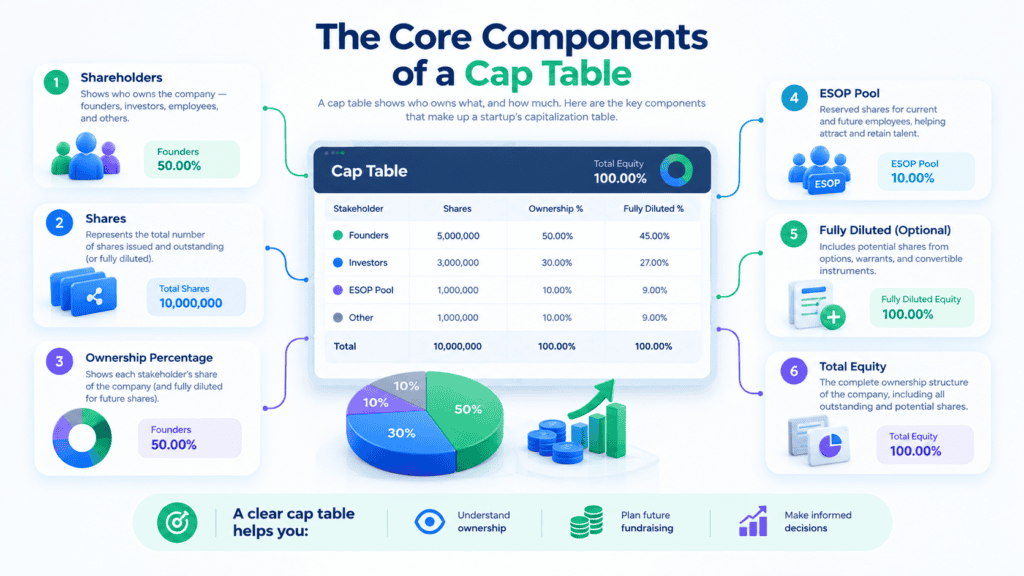
A basic cap table typically includes the following elements:
1. Shareholders
This includes founders, employees, advisors, and investors — anyone who owns equity or has the right to acquire it.
2. Share Classes
Not all the shares are the same. Most commonly there are two types of shares:
- Common stock: Usually held by the founders of the company and by the employees. It has the lowest priority in the event of liquidation.
- Preferred stock: Typically owned by investors and allows them to have rights such as liquidation preference, anti-dilution protection, and a seat on the board of directors.
3. Number of Shares
The actual count of shares each person or entity holds within each class.
4. Fully Diluted Shares
This is the number of shares that would exist if all convertible securities (options, warrants, convertible notes, SAFEs) were exercised or converted. It’s important to consider this number because it reflects the ownership percentages of shareholders, in addition to the issued shares.
5. Ownership Percentage
Each shareholder’s stake, usually calculated on a fully diluted basis, so everyone can see the real picture of ownership rather than a distorted one based only on issued shares.
6. Valuation and Price Per Share
Many cap tables also track the price paid per share in each round, which helps calculate the company’s valuation and how much dilution occurs with new investment.
How a Cap Table Changes Over Time
A cap table changes and grows over time with the lifetime of the company. Let’s consider this hypothetical cap table evolution:
At founding: Two cofounders form the company and issue 5M shares each (for a total of 10M outstanding shares) and own the company jointly and equally.
After raising the seed round: The company has raised money from a private investor who has purchased preferred shares that represent 20% of the company.
After establishing the employee option pool: The company has set aside an employee option pool (typically 10-15% of the company’s equity) that will be allocated to employees in the form of stock options.
After raising Series A: The company has raised money from another private investor who has purchased preferred shares at a higher valuation than the previous round, and the percentage of ownership for everyone is diluted again (ideally, their share is worth more due to increased valuation).
In this way, the dilution is normal, and the important thing is that the value of the pie is growing quickly enough that everyone’s slice – although smaller – is still worth more.
Fully Diluted vs. Outstanding Shares
This distinction confuses a lot of people, so I’ll clarify it here:
- Outstanding shares are shares that have been issued and are held by someone.
- Fully diluted shares include the shares that have been issued (the outstanding shares) plus the shares that can be created from stock options, warrants, convertible notes and SAFEs if they are exercised or converted.
Investors pretty much always think about fully diluted ownership, since it reflects true, ultimate ownership (the dilution from exercise/conversion of options, warrants, etc. has already been taken into account).o equity later.
SAFEs, Convertible Notes, and How They Complicate Things
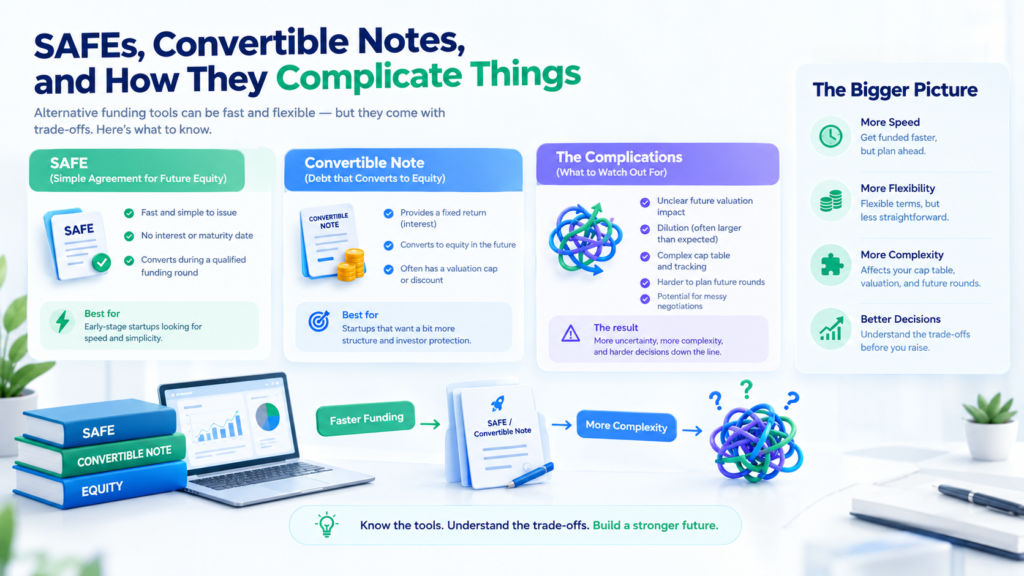
Early-stage start-ups often use a SAFE (Simple Agreement for Future Equity) or convertible note to raise money instead of issuing equity. While they are initially issued as debt-like instruments, they get converted into equity at the price of the next funding round on a discounted basis or with a valuation cap.
Until the time the convertible note or SAFE converts into common shares, the cap table has to factor in the “hidden” dilution because of the future conversion into equity. A cap table that makes it easy to see how the dilution works at the time of conversion will help both founders and investors understand how much ownership will change when the time comes.
Cap Table Management Tools
As companies scale they can outgrow spreadsheet cap tables that introduce complexity and potential for error, prompting the use of dedicated cap table management software (such as Carta, Pulley, or Capdesk) that automate calculations, track vesting, model dilution, and ensure regulatory compliance; and that are required to prepare clean, accurate data for a due diligence process in the case of a fundraise or acquisition.
The Bottom Line
A cap table is a compilation of the ownership of an entity. It provides a historical perspective of equity ownership in the company and serves as a reference for many crucial decision-making processes in a company’s life cycle, ranging from financing to personnel to exit strategy.
The complexity of a cap table can be overwhelming for either a founding team or an employee considering an equity offer at the time of joining. Dilution has to be considered at the time of any financing round, any key employee hire, or even when a founder leaves. Taking the time to understand the nuances of a cap table is always worth it, whether as an employee or a founder.
Disclaimer: This article is intended for informational purposes only and should not be used as a substitute for professional advice from qualified advisers. Founders and equity holders are encouraged to seek the guidance of legal professionals or financial advisors before taking any action.
Different Types of Capitalisation Tables: A Founder’s Guide
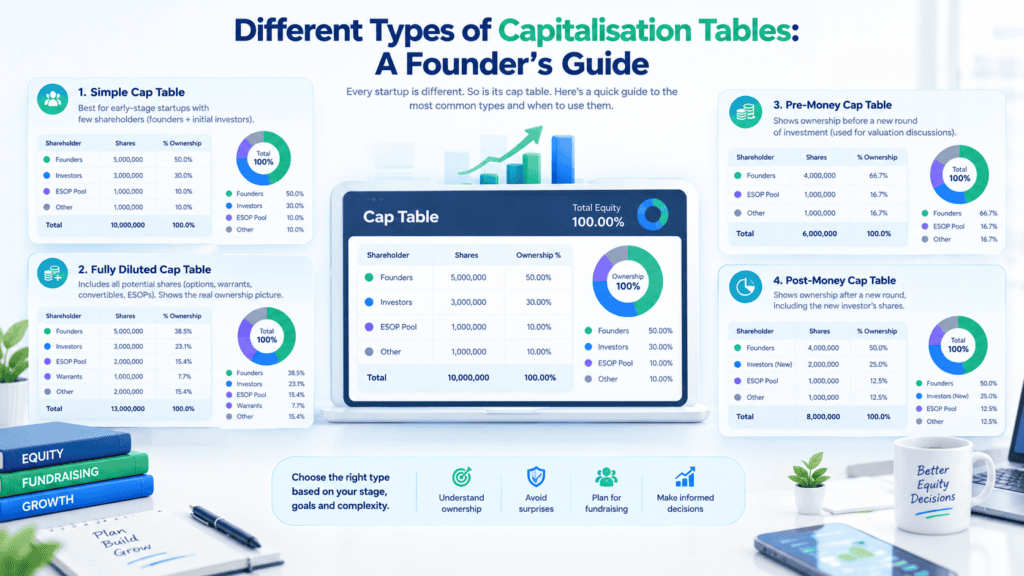
A capitalization table or, simply, cap table, is one of the most critical documents a start‐up founder will ever create. It contains information about all the changes in the equity ownership of a company, including the founding team members’ shares.
There are several ways that a cap table for a company that has raised outside capital can develop over time. The different types and variations of cap tables, as well as their characteristics, should be discussed.
Standard / Default Cap Table
The standard cap table serves as your company’s foundational ownership record. It contains a list of all your shareholders (founders, employees, investors, and advisors) and their share distribution and ownership percentages .
A standard cap table should contain:
- Your shareholders’ names and the type of shares they hold (common and preferred)
- The number of shares owned by each stakeholder
- Ownership percentages in both basic and fully-diluted
- The option pool size (granted and unallocated options)
- The share price and valuation details in the company’s last priced round
The standard cap table should be the version of reference from which all other variants are generated. It has to be correctly built, as it guides almost all operations of equity management, fundraising, compensation planning, liquidation, and exits.
Basic Vs. Fully-Diluted Ownership: One of the most essential aspects of building a standard cap table is understanding the difference between basic ownership and fully-diluted ownership. The basic ownership means that the calculated share distribution does not include the unallocated options, whereas, the fully-diluted ownership takes into account all shares, including unallocated and unissued shares owned by the company.
When raising funds, an investor will always negotiate the fully-diluted column, as it depicts the actual picture of ownership, once all available options are exercised.
For instance, if your company has 8,000,000 shares issued and 1,000,000 shares in the option pool (totaling 9,000,000), and a founder’s ownership at 40%, the basic value would be 3,200,000, while the fully-diluted (9,000,000) would be 3,600,000.
This means that when negotiating the investment deal, a founder’s ownership can potentially reduce by 0.5% (from 40% to 39.5%). This is why when you negotiate with investors, you should consider the fully-diluted value rather than the basic one.sic basis might drop to around 35% on a fully-diluted basis .
Pre-Seed Cap Table
The pre-seed cap table represents the earliest stage of your company’s life cycle. At this stage, the ownership structure is typically simple: founders own most of the common stock, and early financing usually takes place through convertible instruments.
Founders own most of the common stock: The founding team owns virtually all common shares.
Financing usually takes place through convertible instruments: Pre-seed investments are often made through convertible instruments (such as SAFEs) rather than priced equity rounds. This is partly because there’s no valuation for a pre-seed round — it’s simply “unpriced”.
How pre-seed convertible instruments work
A convertible note is a short-term debt instrument that converts to equity at your next institutional funding round (usually a Series A). Notes and SAFEs include either a discount to the price per share at which the next round is priced or a valuation cap to protect the early investor who has taken on more risk by investing without knowing the ultimate value of the company.
Example: Suppose an angel investor gives you $50,000 in exchange for a convertible note. When your company raises its first official round of financing (a Series A), the amount invested will be converted to a specific number of shares based on a predetermined discount to the price per share at which that round is priced.
The rise of the post-money SAFE: Since their introduction in 2018, post-money SAFEs have become the market standard — representing approximately 87% of SAFEs issued on Carta as of the most recent data. With a post-money SAFE, each investor’s ownership percentage is fixed at the time of issuance, with the cap determining exactly what percentage they’ll own when the next priced round occurs.
This has important implications for founders: post-money SAFEs concentrate dilution directly on founders, rather than spreading it across all SAFE holders as the older pre-money structure did .
Pre-Investment Cap Table
The pre-investment cap table reflects your company’s ownership structure prior to a particular funding round closing. Often referred to as the “pre-money” cap table, it serves as a reference for determining investor ownership percentages.
What the Pre-Investment Table Reflects:
- Current shareholders: All common and preferred share owners
- Option pool: The size of the employee stock option pool (typically created or increased before the round at the investor’s insistence)
- Outstanding convertible instruments: SAFEs and convertible notes that will convert in this round
The Provisions of the Option Pool Tug-of-War: Investors typically demand that the option pool be created or increased in the pre-money cap table. This means that the dilution due to the option pool will come entirely from existing shareholders (primarily founders), not from the new investor .
This may sound like a technicality, but it has a big impact. If a $10 million pre-money investment features a 10% option pool created pre-money, founders take all the dilution before the investor’s shares are even figured in. If the pool were created post-money, the investor would be diluted by the size of the option pool .
Pro-Forma Cap Tables: During financing negotiations, parties prepare a “pro-forma” cap table–a version reflecting the updated company ownership after the round closes. This allows everyone to model exactly how the financing will impact ownership percentages and negotiate from a position of clarity .
Post-Money Cap Table
The post-money cap table is a picture of who owns what after a funding round has been closed and all instruments have been converted. It’s the “this is what actually happened” version of the cap table that reflects the new reality of your ownership structure.
Key Components:
New investor shares: Shares issued to investors in the current funding round
Converted instruments: SAFEs, convertible notes, and other equity instruments that have been converted to shares
Updated ownership percentages: Everyone’s ownership recalculated against the new total share count
The Post-Money Valuation Formula: Understanding the relationship between pre-money and post-money valuation is crucial:
Post-Money Valuation = Pre-Money Valuation + Investment Amount
The investor’s ownership percentage is calculated using the post-money valuation. If an investor invests $5 million at a $20 million post-money valuation, they will own 25% of the company .
Calculating Shares to Issue:
- To calculate how many shares to issue a new investor:
- Take your pre-money fully-diluted share count
- Let Y = shares to issue to the investor
- Solve for Y / (Pre-money shares + Y) = Investor’s target ownership percentage
Example: With 675,000 pre-money shares and an investor targeting 10%, the equation is Y / (675,000 + Y) = 10%, giving Y = 75,000 shares .
Dilution Impact: The post-money cap table tells you the real value of fundraising. A founder who owned 40% of a pre-round company might find themselves with only 30% of a post-round company angel at 20% might drop to 15% . However, dilution doesn’t automatically mean economic loss—if the company’s valuation increases, your equity can be worth more in dollars even with a lower ownership percentage .
Practical Implications for Founders
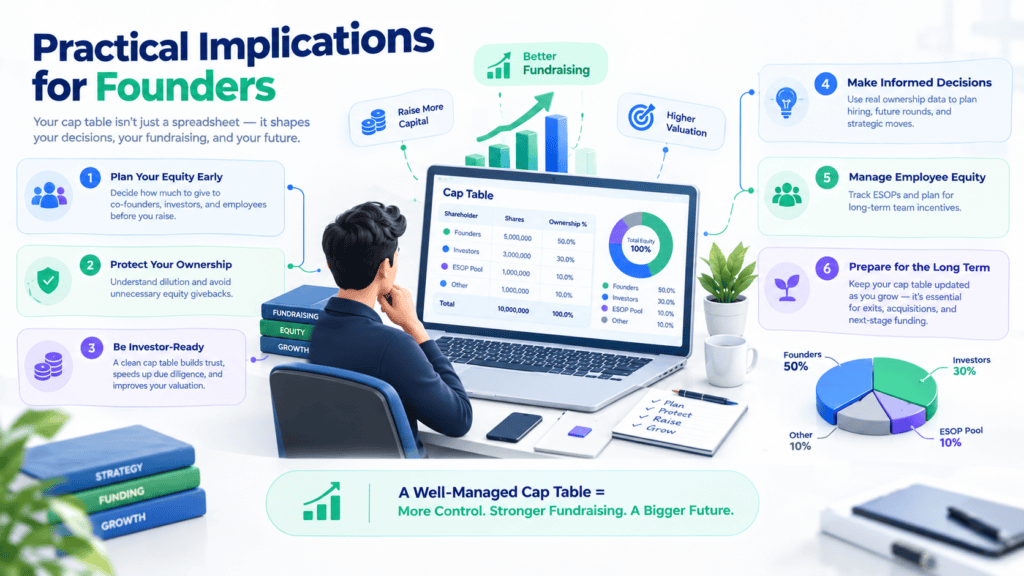
Stacking Risk with Multiple SAFEs
The most common early-stage trap for founders is stacking multiple post-money SAFEs without fully modeling the cumulative dilution impact. Each SAFE, however, takes a certain chunk of ownership away at the time of conversion. Here’s an example of how it can add up.
A $$500K SAFE on a $5M post-money cap will take 10%. Another $$250K SAFE on a $2.5M cap takes another 10%. If you then add a 10% option pool on top of that, you’ve already committed 30% to the company before the Series A investor even gets involved. A Series A investor taking 20%, means the founders could be left with just 50% .
Investor Negotiations
Experienced investors will expect that you know the mechanics of your cap table. If you cannot explain to me how your existing SAFEs will convert and how much ownership you will have at the Series A, it will damage your credibility.
Maintaining the Cap Table
As your company grows, the complexity of its capitalization table increases exponentially. While spreadsheets can be useful up to a point, specialized cap table management platforms like Carta become necessary to ensure compliance and ease of documentation for investors .
Important information that needs to be captured on a cap table includes:
- Issuances of new equity
- Exercises and grants of options
- Conversions of convertible notes
- Liquidation preferences and other investor rights
Key Features of a Cap Table
A cap table or capitalization table is a snapshot of who owns what in a company. Some of the important details that a cap table contains are: shareholder’s ownership, and share classes along with the rights that come along with them.
In the case of financial stakes, equity percentages indicate the owners’ shares. The cap table also provides information about the stock options, warrants, and convertible securities – the potential dilution sources. Valuation, investment rounds, share price, and dilution are relevant details provided by the cap table as well.
By keeping this information organized, a cap table helps the founders and the investors understand the ownership, plan the fundraising, and make the right equity decisions.
A capitalization table (cap table) is an important financial document that describes the startup’s equity ownership structure. Specifically, it contains information about the owners and their percentage of the company (founders), the investors and their shares (issuable stock), and the employees and their options (exercised stock).
Startups need a cap table to
- attract investors
- manage dilution
- issue equity or options,
- and
- ensure compliance.
- Venture capitalists want a clean cap table to analyze who owns what and how much power they have during the due diligence process.
Founders can use the cap table to see how the upcoming fundraising events will affect the current distribution of the shares and control dilution.
Another purpose of the cap table is issuing the options to the employees and structuring the Employee Stock Ownership Plan (ESOP). The third reason is to stay compliant, which means that the cap table is necessary to review all the papers during the audit or at the time of exit when calculating the proceeds.
To build the cap table from scratch, one needs to list all the shareholders and determine the ownership structure. First, it should include the Founders, Investors, Employees, and other Equity Holders. Then, the number of shares owned by each and the total number of issued shares should be specified.
Next, the calculations of their percentage of ownership based on the issued and outstanding shares. It is essential to note any options, convertible notes, and other equity-related securities. Finally, the cap table should be maintained and updated, and using cap table software may minimize mistakes and streamline the process.
A startup’s Cap Table (Capitalization Table) is far more than an administrative spreadsheet—it is a live reflection of ownership, decision-making power, and financial returns. As a founder, every equity grant, advisory share, and investment round leaves a permanent footprint on this document.
A clean, strategic cap table builds investor confidence and preserves your control, while a messy one can derail funding rounds or trigger costly legal disputes during an exit.
1. Maintain Uncompromising Hygiene from Day One
The most common cap table mistakes are not financial ones – they are administrative errors made early on that compound over time. Treating early equity allocations casually will create problems when institutional investors perform due diligence.
- Avoid verbal promises of equity: Make sure to put every issuance of stock, options or convertible instruments into a formal agreement, and make sure to reflect them immediately in your master cap table.
- Standardize founder vesting schedules: Make sure to have a standard 4 year vesting + 1 year cliff for all your founding team members, to make sure that early departures do not unfairly dilute the remaining founders and investors.
- Adopt cap table management software: Make sure to move away from using Excel or other spreadsheet programs to manage your cap table, as soon as you can afford to. There are many great options available (see our detailed guide) including Carta, Pulley or Cake Equity, which will let you keep your cap table up to date, auditable and that will also let you easily model potential future dilution events.
2. Model Dilution Dynamically Before Signing Any Term Sheet
Equity dilution is an unfortunate side-effect of raising capital in any company, but dilution that is not calculated and carefully modelled is extremely dangerous for founders: it is surprisingly common that founders who model nothing end up significantly under-owned in the Series A or B.
Make sure to take the Option Pool Refresh into account: a pre-money ESOP (Employee Stock Option Pool) of 10-15% is normal for many investors before any Series A investment. This dilution falls on the shareholders (i.e. founders) and not on the incoming investors since the option pool is taken from the pre-money valuation.
Convertible instruments (SAFEs/Notes) hide dilution: The dilution from SAFEs and similar convertible note structures is difficult to calculate, especially when multiple SAFEs are outstanding with different discounts or caps.
Always model forwards: Have an internal model that always lets you quickly see what your ownership would be in the company for a given Series A, B etc. valuation. Know what you think the ownership should be in a realistic pricing scenario.
3. Keep Your Roster Clean and Restrict Early Equity Waste
A bloated cap table with dozens of different small non-accredited individual investors or huge allocations to advisors can create enormous operational frictions.
Consolidate small investors by SPVs: if you are raising funds from many angels or from friends and family try to consolidate their investment in a Special Purpose Vehicle or roll their voting rights in a lead proxy. Institutional VCs prefer to negotiate with one counterparty rather than 40 different checks with a separate signature.
Tighten the control on advisors and service allocations: reserve fully-vetoed equity grants for the core hires and biggest investors. For advisors, consider time-vested (ideally 0.25%-1.0%) and milestone-tied compensation rather than outright stock grants.
Maintain voting control: make sure that there is a distinction between economic and voting interests. Structure your equity classes (i.e. issue dual-class voting shares) or create voting agreements to ensure that the founding team maintains its decision-making power through key growth phases.
Key Takeaways for Founders
- Document the hell out of it: handshake deals are expensive legal landmines waiting to happen.
- Model the hell out of it: what is the dilution going to be from pre-money option pools and SAFE conversions before you sign the term sheet?
- Keep it lean, use SPVs for small angels and save the equity for your rainmakers and for institutional leads.
How to Manage & Maintain Your Cap Table
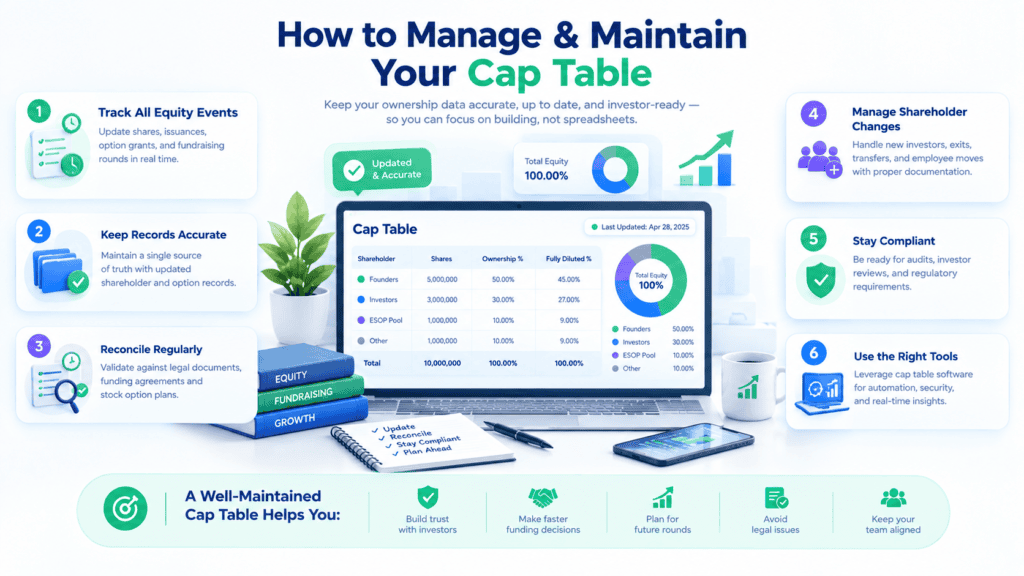
If you have a startup and raise funds, your capitalization table, or cap table, is probably one of the most critical but least prioritized documents in your desk. Your cap table is the complete and official registry of who owns what in your company, and it usually dictates the decision-making process in your board, as well as the financial and distribution strategy, particularly with fundraising, hiring, and acquisition exits.
A lot of founders, however, don’t put enough attention into their cap table, and leave it trashed or untouched for months and even years, only updating it when a new round of funding occurs, or an investor requests it.
This can cause problems in fundraising and deals because of poor information management. A cap table that is not organized and up-to-date might give the wrong impression to stakeholders, investors, potential acquirers, and others.
This guide will discuss everything about cap tables: what they are and how they dictate who owns what in a company, and provide some guidelines and best practices on how to manage and maintain one.
Why Cap Table Management Matters
Here are some of the most important advantages of a cap table audit. See why startups need to analyze their cap tables more closely:
Fundraising – investors are likely to take a closer look at the cap table before making a large investment. An inaccurate or incomplete cap table reveals negative information about the management, dragging the financing process.
Dilution modeling – any raise or new hires with options will dilute existing shareholders. Before taking any action, current shareholders should accurately model the dilution of their shares.
Legal/ tax implication – many equity grants and exercises carry tax liabilities while 409A valuations are required to be performed by qualified professionals. All this affects employees as well: faulty calculations may inflict unwelcome tax bills on workers.
Employee communication – employees who received options, grants, and other forms of equity compensation expect the company to value their shared stock correctly. The wrong number can offend the employee – and may lead to a hostile exit if the worker is exercising their options.
Exit strategy – during an acquisition or IPO, bidders and underwriters will examine the cap table of a company for potential problems. Discrepancies or errors in the calculation will damage the deal or cause unplanned expenses.
Best Practices for Managing Your Cap Table
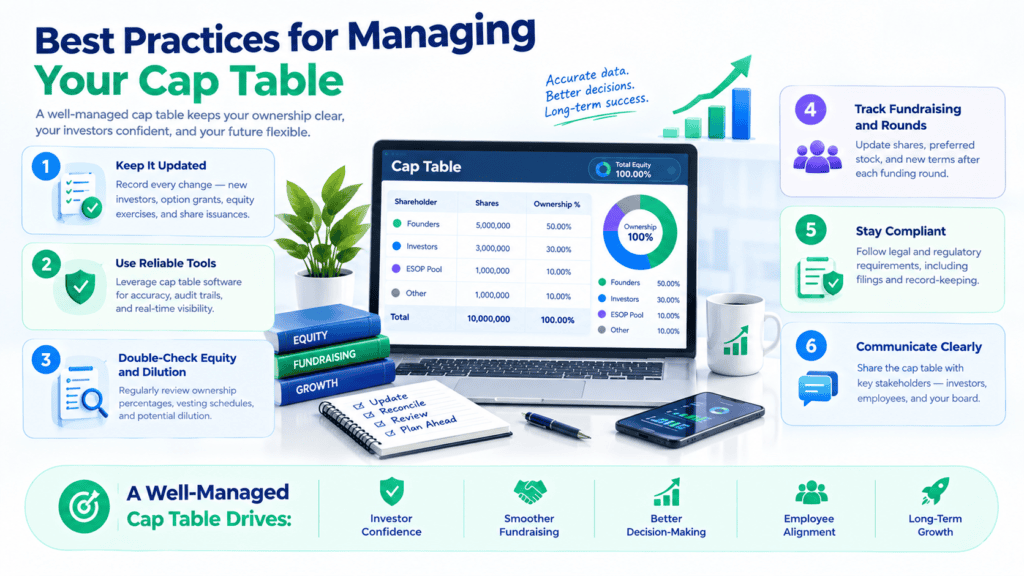
1. Use dedicated cap table software early
Spreadsheets can get you through the first 20 shareholders, but beyond that, it’s just too error prone. You need to move to a proper tool like Carta, Pulley or Cake equity to model dilution and vesting and produce the reports your auditors (or the SEC) will need. Moving to the next stage early prevents rework.
2. Update it in real time, not in batches
Every time you issue equity or options or raise a round, update the cap table right away. If you wait until “cap table cleanup day” you will inevitably forget something or misremember the details of a conversation.
3. Reconcile your cap table with your legal documents regularly
Your cap table must always reflect all outstanding capitalization information. The best way to achieve this is to have regular quarterly reconciliations of the cap table to evidence of issue, including the stock purchase agreements, option grant notices, and board consents to issue options. Regular reconciliations are much more efficient than trying to untangle big problems several years hence.
4. Model dilution before every fundraising round
Before you sign a term sheet, work out the numbers for how the new round will affect everyone’s ownership in the company — founders, existing investors, and the option pool. In particular, look out for “pool shuffles,” in which investors request that you expand the option pool (thereby diluting existing shareholders) before the closing of the round.
5. Keep your option pool sized appropriately
If a particular round has a very small pool, you are going to have to do an awkward dilutive top-up in the middle of the round. Too big and you are diluting founders and early shareholders unnecessarily. The industry standard for option pools at each major round is 10-20% of then fully diluted share, depending on how aggressive your hiring plans are.
6. Get your 409A valuations done on schedule
409A valuations usually require update every 12 months or within 12 months following a significant transaction like new financing round in order to stay compliant and not dilute value of new options issued to employees.
7. Limit who can edit the cap table
Consider your cap table infrastructure. You want to protect it like you would financial infrastructure. Don’t allow edit access to anyone on the team, only your finance lead, general counsel or CEO should have access and changes should always an audited trail.
8. Communicate clearly with employees about their equity
Many people don’t know what vesting or strike price means. They also don’t understand the difference between fully diluted ownership and the percentage that they own. Providing statements on a regular basis in simple terms (which many cap table tools offer) reduces the risk that a founder will be surprised and disappointed at the time of an option exercise.
9. Prepare for due diligence before you need to
Don’t wait for your Series B investor to ask for your cap table history. Keep supporting documents (board consents, executed agreements, amendment records) on file and cross-referenced to relevant entries so you can quickly put together a clean data room.
10. Loop in legal and tax advisors for anything unusual
Convertible note conversions, secondary transactions, or equity buybacks often have nuance that a standard cap table tool will not capture. In the case of any transaction that is not a standard equity issuance, consult a lawyer or tax advisor before making an entry.
The Unseen Engine of Your Business: Why Maintaining a Cap Table is Non-Negotiable
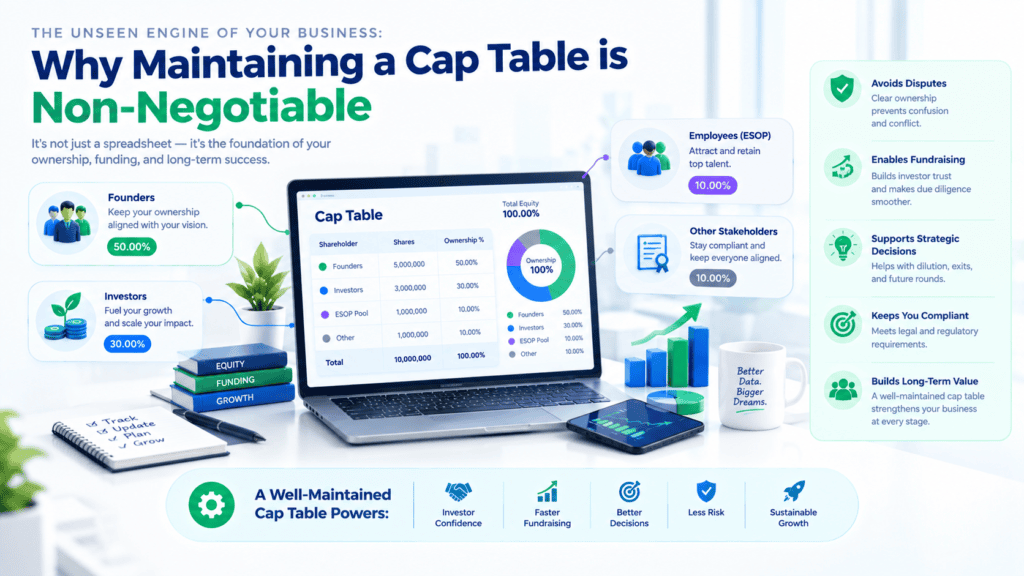
For many early-stage founders, the “Cap Table” (Capitalization Table) is something that lives as an Excel sheet in the cloud. It is created at one point, usually when a funding round is closed, and then put away until the next funding round.
This approach is not optimal
It is important to understand that the cap table has to be actively maintained as it reflects your company’s equity structure and is, therefore, a strategic document.
Below are reasons why you should think of your cap table as something much more important than just an Excel file:
It can help you save money when issuing stocks to employees and advisors
The cap table is your company’s DNA
It is a strategic tool
It will help you raise your next round
It will help you govern your cap table
1. The Bedrock of Fundraising: Transparency Breeds Trust
When you’re getting to the due diligence phase for a series A or B round, the first thing a VC will ask for is your cap table. The way you present it says a lot about how you manage your company.
- Speed: Having a clean, accurate, and well-formatted cap table shows that you’re a detail-oriented operator who respects the VC’s time.
- Accelerated due diligence: A messy table with tons of manual calculations and errors will make the VCs second-guess their numbers and take longer to close the deal. A clean cap table will speed things up, save you and the lawyers time, and get you the money you need faster.
- Scenario modeling: Having a dynamic cap table enables you to show a potential VC what their investment would do to the founder’s and early employees’ shares right then and there.
2. Avoiding the “Death by a Thousand Cuts” (Error Prevention)
Spreadsheets are inherently dangerous. One wrong keystroke in a 500-row Excel document can have massively destructive consequences downstream.
- The “Share Count” Disaster: Say, for instance, you made a mistake while performing a preferred-to-common conversion and issued the wrong number of options to a new employee.
- Valuation Errors: Maybe you messed up a decimal point while entering a linking formula, and now you’re going to net your cofounder millions of dollars less in a liquidation event than he’s owed.
- Audit Trails: With modern cap table management software, you can track every single edit made to a document, providing an easily auditable trail of information. Not only do you know who made a change, you also know when it happened. With Excel, if a cell gets erased, it’s gone for good, and you’ll likely learn about it … after the lawyers have caught it.
3. Employee Motivation and Retention (Trust and Transparency)
Equity compensation is one of the most powerful recruiting tools that a start-up has in its arsenal, but it needs to be wielded effectively.
- Accurate “Fully Diluted” Numbers: When you are hiring a VP of Engineering and giving her 0.5% of the company, you want to make sure that you are actually giving her what she thinks she is getting. That means making sure that you are using “issued shares” numbers and not “fully diluted” numbers (or the other way around, depending on who you are talking to). Getting these numbers wrong can result in giving far less equity than promised.
- The “What is this worth?” Conversation: A properly maintained cap table can give you the information that you need to build out simple employee-facing interfaces (typically in the form of a “waterfall”) that show employees the value of the options that they have been granted at a variety of exit valuations. This is an important conversation to have with employees, and being able to show people exactly how much their “paper money” is worth can help you avoid explaining why you can’t buy them a house.
- 409A Compliance: In order to grant options legally, you need to have a 409A valuation done on the company. Your cap table serves as the backbone of the 409A report, and having a proper cap table can make the difference between an easy, clean 409A and a nightmarish one that leaves you and the IRS at odds.
4. Strategic Decision Making: The “What If” Simulator
A cap table is not a history book, it is a crystal ball. By keeping it up to date, you can make smart decisions in the future
- Future Fundraising Strategy: If you know you want to raise a Series B in 18 months, you can decide how much dilution a $20M round will cause. You can decide to raise $15M instead to keep more control, or you can expand the option pool now to hire key executives.
- Acquisition Scenarios (M&A): In an acquisition, the “Waterfall Analysis” determines who gets paid what, and in what order. By keeping up to date with your cap table, you can model different acquisition prices to see how the payout would distribute. This is essential to the final sale price negotiation; you will know the “breakpoints” where investors get their preferred returns.
- Maintaining your option pool increases: When VCs ask you to increase the option pool pre-financing, it dilutes the founders more than the VCs. A good cap table can help you know the cost of this option pool increase, letting you negotiate from a well-informed position.
5. Legal and Tax Compliance (The Shield of Safety)
This is the most dry-sounding but critically important benefit.
- Securities Law Compliance: Every time you issue stock, you are issuing a security, which needs to be filed with relevant authorities (SEC, via Form D, etc.) A clean cap table keeps you honest about the number of shares issued, preventing unintentional issuance of more shares than your corporate charter allows.
- Section 83(b) Elections: Founders and early employees have to make section 83(b) elections in order to avoid steep tax liabilities when their stock options vest. An accurate cap table timeline keeps you apprised of the relevant dates for these elections.
- Succession Planning: As the company grows, you will want to make sure that the right people are on the board of directors, and the cap table is your only resource for knowing who the shareholders are.
The Verdict: Ditch the Spreadsheet
The days of the Excel cap table are over if you have any hopes of a real exit
While it might be good enough for a three person garage shop, the second you raise a seed round you’re going to want to move to a proper cap table solution (Carta, Pulley, AngelList et al) because:
Automation
They do all the math for you, convert your SAFE notes to priced rounds when needed, and can generate reports on the fly
Investor portals
for your investors to check for themselves, decreasing your workload by an order of magnitude (trust me, you don’t want 40 people asking you “hey, what’s my % please?” and you having to explain that you have to run a report and send them an excel sheet)
And
scalability
They handle all the complicated edge cases you may need (how much money do people get paid out in the event of a liquidation preference override with multiple classes of preferred shares)
How to Use a Cap Table During Funding Rounds
Fundraising is exciting. This is true for everyone until the question is asked — and it always gets asked — of how much something will cost in terms of ownership. At this point, wishing you had spent more time with your cap table becomes a recurring thought for any founder who has negotiated a deal.
A capitalization table (cap table) captures economic and control rights relevant to a company’s capital structure. When used correctly, a cap table serves as a decision-making aid in understanding how a transaction will affect control and economic rights at different stages of a company’s development and in different capital structures. When used incorrectly, it can cause unpleasant surprises at the closing of a deal or at a subsequent financing.
This article provides an overview of the information contained in a cap table and how it can be actively used when raising a round of financing: during the preparation of the deal, negotiation of the investment terms, and closing of the deal itself.
What a Cap Table Actually Tracks
At its most basic level, a cap table is a record of who owns what (and in what form). A cap table that’s put together correctly will have:
Core Elements to Track
- Common stock: Founders, early employees, and occasionally early advisors
- Preferred stock: Investors, usually in the form of “series” (Seed, Series A, Series B, etc), with a specified price per share
- Option pool: The number of shares set aside for future employees, either issued or unissued
- Convertible instruments: SAFEs, convertible notes, or warrants which have not yet converted to shares
- Fully-diluted shares: The total number of shares, including any shares that are not yet issued
- Ownership percentages: Both “as is” and “fully diluted”
The difference between “as is” and “fully diluted” ownership is critical. A founder might be said to own 60% of issued shares, but only 45% of fully-diluted shares.% on a fully diluted basis once you account for the option pool and outstanding SAFEs. Investors almost always negotiate and evaluate deals on a fully diluted basis — so founders should too.
Step 1: Clean Up the Cap Table Before You Start Raising
Before a single term sheet is signed, a solid cap table is needed. It’s needed because investors will quickly ask to see it as part of due diligence, and a disorganized one is a great way to scare away potential investors.
Before hitting the road to find investors, make sure that your cap table reflects:
- All the safes and notes that have been issued, along with any valuation caps and discounts
- All the stock that has been vested and that hasn’t been vested yet, along with the appropriate timing for when it will vest
- Any side agreements or other special terms, such as pro-rata rights, information rights, or board seats
- Options that have been formally approved by the board but not yet issued to employees
- Any verbally agreed-upon but not formalized equity (get it formalized before signing anything!)
If there are any convertible notes or safes outstanding that are yet to be converted, you should also be prepared to show investors what would happen if they were to be converted at a particular valuation. This is actually one of the biggest “gotchas” for many founders, because one round of safes with a low valuation cap can turn into a ton of dilution when that round’s cap is crossed.
Step 2: Model the New Round Before You Negotiate
A cap table is not only a record-keeping tool but a strategic decision-making aid. Before accepting or negotiating a term sheet, founders should create a pro forma cap table that reflects the ownership distribution after the investment has been made. To build such a table, you will need the following four inputs:
- Pre-money valuation
- The investment amount
- The size of the option pool and its installation timing (if any)
- The conversion terms of existing SAFE/notes (caps, discounts, and conversion timing)
Given that information, you will be able to calculate the following four numbers:
- The post-money valuation equals pre-money valuation plus the investment amount.
- The new investor’s ownership is given by the ratio of the investment amount to the post-money valuation.
- The price per share equals the pre-money valuation divided by the fully diluted pre-money share count.
- The dilution of existing shareholders occurs when new shares are issued to the incoming investors. It is calculated as the new ownership percentage divided by the old ownership percentage (times 100 for a percentage).
The Option Pool Shuffle
One of the most consequential (but little understood) mechanics in a priced round is the option pool refresh. Most investors expect the company to raise up the option pool to a target size (usually 10-15% of the post-money cap table) before calculating the new investment.
Since this pool expansion eats into the value right before the new investment comes in, it dilutes existing shareholders (founders), not the incoming investor.
A cap table tells you precisely how much this will cost you. You’ll see a significant percentage-point difference in founder ownership for the same headline valuation under two different scenarios (pool created pre-money vs post-money).
This is the single highest leverage negotiation lever most founders miss. Two identical “$10M at a $40M pre-money valuation” term sheets can result in radically different founder ownership depending on the option pool sizing and timing.
Step 3: Run Scenarios, Not Just One Outcome
A cap table used correctly is not merely a record-keeping device, but rather a scenario modeling tool. Before finalizing a deal, founders should walk through the following cases with their cap table:
Multiple valuation scenarios: what does ownership look like at both ends of your target range?
Multiple raise scenarios: how does hitting the lower or higher ask impact dilution (nonlinearly)?
SAFE/note conversion scenarios: if you have multiple SAFEs with a valuation cap, how does the price per share change at the next raise?
Waterfall scenarios: if you have participating preferred stock or liquidation preferences across multiple classes, how much do common shareholders stand to make at both a small and a large exit?
The last scenario in particular is critical to understand, as it defines the control and payout waterfall in the case of acquisition or liquidation. A cap table with a proper waterfall scenario can show how much cash is available to common shareholders (founders, employees) at various liquidation values, and how much is due to preferred shareholders (if any).
This is critical to understand since liquidation preferences determine the payout waterfall in the case of acquisition or liquidation.ch can look very different from raw ownership percentages once multiple preference stacks are involved.
Step 4: Use the Cap Table to Evaluate the Full Term Sheet — Not Just Valuation
Founders tend to anchor on one number: valuation. But several other terms materially affect what your cap table — and your outcome — looks like:
| Term | Why it matters on the cap table |
|---|---|
| Liquidation preference | Determines who gets paid first, and how much, in an exit |
| Participation rights | “Participating preferred” can mean investors double-dip — preference plus pro-rata share of remaining proceeds |
| Anti-dilution provisions | Protects investors if a future round prices lower (“down round”), at the cost of further founder dilution |
| Pro-rata rights | Existing investors’ right to maintain ownership % in future rounds, which affects how much room is left for new investors |
| Board composition | Not a cap table line item directly, but often tied to ownership thresholds |
A cap table alone won’t show liquidation preferences and participation rights explicitly — you’ll want a companion waterfall analysis — but every one of these terms changes the effective value of the equity each shareholder holds, which is the real thing you should be optimizing for.
Step 5: Get the Cap Table Auditable and Investor-Ready
Once terms are agreed, your cap table serves as a legal and administrative cornerstone for the closing:
- it is used to draft the stock purchase agreement and issue new share certificates
- it confirms board and shareholder approval thresholds for the transaction
- it is referenced for 409A valuations and ongoing option strike price setting
- it provides the baseline for your next round’s dilution calculations
Many companies at this stage begin using dedicated cap table management software (Carta, Pulley, Ledgy, Capshare, etc.) to replace spreadsheet tracks, which reduces manual error and gives investors a verifiable, audit-ready view. If you’re still on a spreadsheet past a Series A, it’s worth the switch — the risk of a manual error compounds with every subsequent round.
The Bottom Line
A cap table is most useful to you before you sign anything, not after. Keep your cap table clean throughout the funding process, using it as a modeling tool to help you negotiate the best possible terms. It’s also important to use the cap table to run multiple scenarios and to keep it up to date after the deal is done.
Founders that model their cap tables out while in the process of negotiating are more likely to understand the true cost of a deal and have a stronger position to negotiate from in order to obtain the best possible outcome.
Common Cap Table Mistakes to Avoid
Cap tables can quickly become inaccurate if founders treat them as static spreadsheets rather than continuously updated records of ownership and dilution. The most common mistakes include:
1. Keeping the Cap Table Outdated
Failure to update the cap table after issue of new shares, transfers of shares, grants, raise of financing, or any other changes and events affecting ownership could make it incorrect.
2. Ignoring Fully Diluted Ownership
Looking only at issued shares can overstate a founder’s actual ownership. Founders should take into account all the outstanding options, option pools, warrants, convertible securities when calculating their fully diluted ownership in the company.
3. Underestimating Option Pool Dilution
Option pools can have a significant impact on existing shareholders, particularly when the pool is increased before a financing round. Founders should understand what dilution from the option pool is before accepting an investment offer.
4. Miscalculating SAFEs and Convertible Notes
Unconverted SAFEs and convertible notes can materially affect future ownership. Ignoring valuation caps, discounts, conversion terms or accrued interest can cause founders to not realize how much they are diluted or their ownership post-conversion
5. Forgetting Vesting and Informal Equity Commitments
Changes to vesting schedules, forfeited shares, or promised equity should be documented and reflected in the cap table. Informal or verbal equity terms not properly set down in a formal agreement can result in disagreements about percentage ownership at some point in the future.
6. Modeling Only One Future Scenario
A cap table should not show only the current ownership structure.Founders should model different potential financings, valuation assumptions, new option pools, SAFE / note conversions and exits.
7. Confusing Pre-Money and Post-Money Ownership
Mixing up pre-money and post-money percentages can make investment offers appear more or less favorable than they actually are. Founders should consider carefully how much ownership they are likely to retain in the event of different types of financings, including
8. Ignoring Exit Waterfalls and Liquidation Preferences
Ownership percentages alone do not determine how much shareholders receive during an exit. liquidation preferences and other preferred stock terms that can substantially offset the value of a small exit. Modeling out the numbers is a good way to see just how much an investment can really hurt or help your economic position as a founder.
9. “Back of the envelope”
calculations using Excel or similar tools by someone unversed in the math of security offerings may involve erroneous formula entry or incorrect manual entry of critical variables Cap tables should use carefully checked formulas, consistent data, and, where appropriate, professional review.
10. Failing to Get the Cap Table Reviewed
Legal and financial terms can be complex, particularly when preferred shares, liquidation preferences, convertible instruments, and option pools are involved. Having the cap table and related financing terms reviewed by qualified legal or financial professionals can help identify errors before they become costly problems.
FAQs
What Is Cap Table Management?
Cap table management is an important practice referring to the full lifecycle of ownership in your company.
The right management of it helps in tracking shareholders, options, notes, and equity positions. Additionally, it ensures proper valuation of the company for investors, facilitates tax obligations, and minimizes legal conflicts. Therefore, when your business grows, this process becomes more complicated, and you need to get all details in order to have a sufficient amount of funds at each stage.
What Does a Cap Table for an Early-Stage Startup Look Like?
The early-stage capitalization tables are surprisingly simple. They normally have founders’ shares of common stock, one possibly sizable option pool for future employees, and a single class of preferred stock for the lead investor. There will be names, numbers of shares, and a fully diluted percentage per founder. Simple, right?
Nothing complicated like several series of preference shares or convertible notes on the tables. A glance at the distribution tells you who controls the company and how much everyone has been diluted from the founding team selling their stock for the initial seed investment.
Where Can I Find a Cap Table Template?
You can find cap table templates on many online sites developed for entrepreneurs. Thus, the platforms of Carta, SeedInvest, Gust offer free downloads of cap table Excel files designed specifically for startups. The SEC’s official web page contains downloadable templates created for entrepreneurs and organizations. Microsoft Excel also has a set of financial documents, including the capitalization table.
However, note that free cap table templates are appropriate for early-stage startups but may be too limited for later financing rounds. In this case, you might want to choose a SaaS platform that can help you update the document every time you raise new funds.
How to Read a Cap Table?
Interpretation of the cap table begins with an overview of the “Pre-Money” and “Post-Money” columns, which describe the company’s valuation. Next, it is a good idea to look at the “Common Stock” section to review Founders’ and employees’ ownership and the “Preferred Stock” area to go over the terms of investors’ shares.
An experienced founder or investor will also look at the “Option Pool” to understand what percentage of shares is reserved for future employees. The “Fully Diluted” column is another important aspect of the document.
It is used to calculate how much ownership a common stockholder possesses after all the options and warrants have been exercised. Finally, the “Share Price” and “Investment Amount” columns need to be analyzed to understand how much each investor has owned in the company.
How Often Should a Cap Table Be Updated?
Your cap table must be updated with every transaction that impacts your equity. This can include issuing stock, exercising stock options, fundraises, and conversions of convertible notes. It is best practice to update this spreadsheet on a monthly basis.
Some people suggest updating it right after a board meeting where equity matters were discussed. This is an important tool and it needs to be accurate in order to prevent headaches during audits or tax season. If you are using a manual spreadsheet (not a cap table software), you should update it every week so you don’t fall behind and have to add all of those transactions at once.
Conclusion
Understanding one’s cap table is paramount to preserving one’s stake in the company and ensuring the proper financial trajectory of the business.
A capitalization table, which serves as a company’s ledger of shareholders and their respective ownership percentage, must be utilized to its full potential in order to ensure that dilution, rights, and valuation are properly taken into account for the lifetime of the company’s funding rounds.
By using one’s cap table to its full potential (diluted percentages, options pools, SAFEs, and convertible notes) from the get-go, one can accurately predict their future funding scenarios, avoid costly legal issues, and manage negotiations with investors from an informed and empowered position. A well managed cap table will allow one to maintain power and flexibility, and maximize the value of their stake in the company and its growth.
Author Bio
Jeevesh Tripathi is a passionate content creator and writer. He has an interest in providing his view on different topics and putting forth ideas to his readers so that they are benefitted. With a constant strive to put forth his thoughts and ideas in a well-digested manner, he engages in various activities. Through his blog, be it on personal development, technology, startups, or anything related to the modern world, he tries to present his thoughts and ideas on the topics. At BkAbhi, he shares his thoughts and ideas related to technology and the modern world. In his free time, he likes to learn new things and interact with people.