
Table of Contents
What Is an AI Startup Tech Stack?
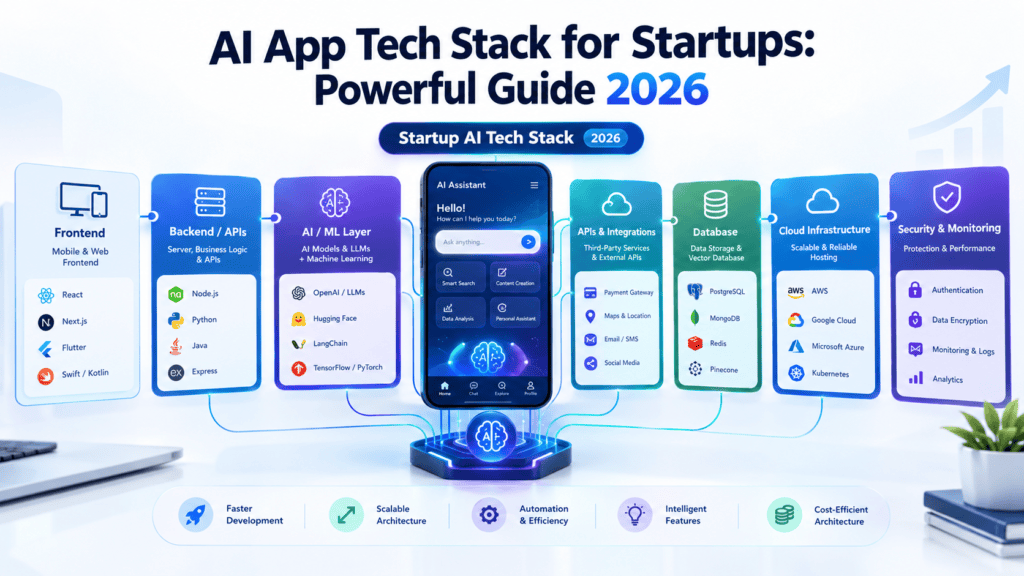
An AI startup tech stack refers to a combination of programming languages, frameworks, databases, AI models, APIs, cloud services, and development tools that are required to build and operate an AI-based product. The choice of the tech stack is sometimes complicated by unnecessary hype surrounding certain languages, frameworks, and tools.
When choosing the tech stack for an AI-based product, companies should focus on their needs and not on the latest trends. One should realize that an AI-based product will require programming languages, databases, AI models, cloud services, and development tools.
For instance, to develop an AI application, one might need Python programming language, AI frameworks, cloud to deploy AI models, and databases to store application data and user data.
The proper choice of the tech stack can help to reduce the time to market and ensure that the product will stay scalable as the number of users and data grows.
Why Python Is Important for AI Startups
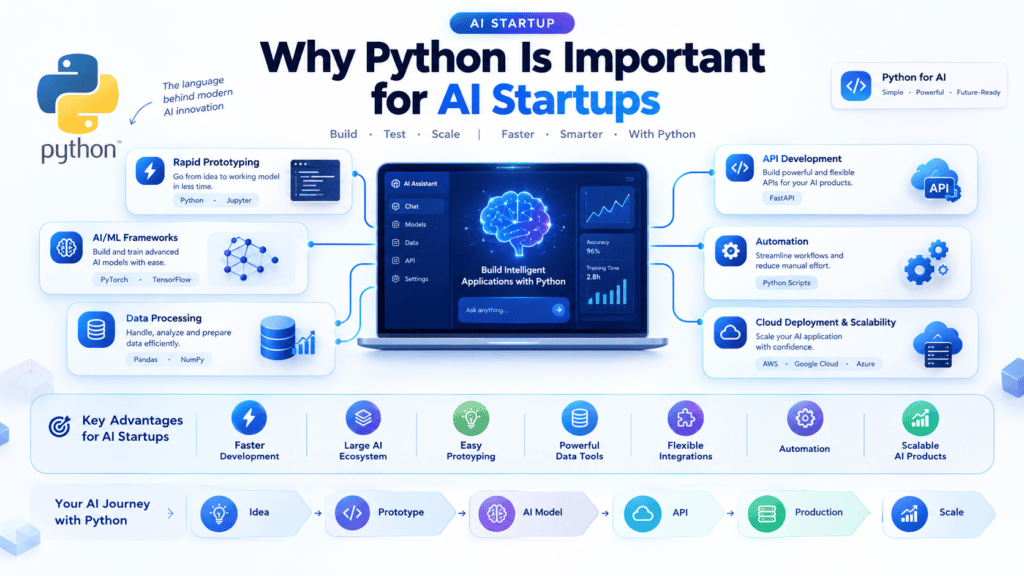
For an AI startup, rapid prototyping is more important than anything else. One has to get ideas out there fast, have a viable product before their runway ends, and update as the technology evolves. The most popular language for this is Python. Here’s why, and where it fails.
Python for Data Science and AI
Python became the default language of AI because it allows people to focus on the problem, rather on the syntax. Python’s readable, English-like code allows any technically-savvy researcher, data analyst, or founder to learn it quickly and write working code in days, rather than months.
Several things make it a natural fit for data science and AI:
- Fast experiments: Machine learning is all about trial-and-error, and Python makes it particularly easy to whip up code that loads in data, trains a model, and evaluates the results in just a few lines (especially in a notebook).
- Everything in one place: From data loading/cleaning to model training and evaluation, you can do everything in one language. Your team doesn’t have to be between different languages for different tasks.
- Research-friendly: Most research papers coming out of the ML space tend to include Python code implementing their proposed methods. If you see a cool algorithm, there’s a good chance someone has already made a Python implementation of it (or you can find the paper’s code and run it yourself).
- Easy to glue to other languages: If you need to write performance-critical code in something faster like C/C++ or CUDA, you can call that code from Python with minimal hassle.
For a startup, this means shorter time from idea to working prototype, which directly affects how fast you can learn from customers.
Popular Python Libraries and Frameworks
Python’s greatest strength lies in its ecosystem. You rarely need to write anything yourself if a working, well-maintained alternative already exists.
Data handling and analysis
- NumPy for fast numerical computing
- Pandas for cleaning and analyzing tabular data
- Matplotlib, Seaborn, and Plotly for visualization
final
- Machine learning
- Sklearn for classical ML such as regression, classification, and clustering
- Xgboost and LightGBM for high-performance models on structured data
Deep learning
- PyTorch is widely used in both research and production
- TensorFlow and Keras are established options for building and deploying neural networks
- JAX is popular for high-performance numerical work
Generative AI and LLMs
- Hugging Face transforms for pretrained language, vision, and audio models
- LangChain and LlamaIndex for building applications on top of large language models
- Official Python SDKs from most major AI providers, which makes API integration straight forward
Deployment and backend
- FastAPI and Flask for API serving
- Docker friendly tools and MLOps tooling such as MLflow for tracking experiments and models
- This ecosystem allows small teams to achieve a lot. build something that once required a research lab. Instead of spending months building infrastructure, you spend that time on what makes your product different.
Availability of Python Developers
Startups are limited by people as much as technology, and that’s where Python excels.
- Large talent pool. Python is one of the most popular programming languages in the world, taught in universities, coding bootcamps and online courses. Most data scientists and ML engineers know it already.
- Less time-to-hire. Post a job opening and start interviewing candidates from entry-level analysts to senior ML engineers.
- Lower training cost. Python is easy to learn even for someone from a different programming background (web dev, etc.), so your team can scale faster and more responsively.
- Community and resources. Unlike some other languages, Python has an extensive knowledge base, documentation, tutorials, open-source projects and a friendly community willing to help.
- General purpose. Your data scientists, backend developers, ML engineers and researchers can all read the same code and understand each other’s work.
Being able to hire and train new engineers faster may be the competitive advantage your pre-revenue startup needs to survive and thrive in the race to ml-powered product-market fit.estone and missing it.
When Python Should and Should Not Be Used
Python is a great default, but it isn’t the right tool for everything.
When to use Python
- Prototyping and MVPs. When you need something done now, Python really shines.
- Model training and experimentation. Almost every AI research software is built around it.
- Data pipelines and analysis. Performing ETLs, data transformation, analysis is what Python is loved for.
- LLM-powered applications. Building chatbots, retrieval systems, AI agents is straightforward in Python.
- Backend APIs for AI features. With tools like FastAPI, most of the traffic for a startup API service is handled with ease.
- Automation and scripting. Small utilities to help a startup with its day-to-day are best built in Python.
When Python may not be the best choice
- Performance-critical systems that require low-latency responses
- Python is generally slower than compiled languages like C++ or Rust, making it a poor choice for implementing microsecond-level real-time systems, unless you’re willing to put up with significant performance overhead.
- High-performance applications such as high-frequency trading platforms or embedded control systems often require the responsiveness and reliability of compiled code.
- Mobile applications
- Developers are rapidly adopting native mobile development, choosing between Swift and Kotlin for iOS and Android development respectively. Cross-platform mobile development frameworks like Flutter or React Native are also gaining popularity among developers seeking to target both mobile platforms with a single codebase.
- Front-End Web Applications
- Browsers are built with JavaScript engines, which is why web interface development always involves some level of JavaScript or TypeScript expertise – even when using Python backends.
A practical approach
Most successful AI startups do not see this as a binary choice, and use Python for research and prototyping while only writing performance-critical parts of their applications in lower-level languages. Many Python libraries used in performance-critical contexts actually use C++ or CUDA under the hood, meaning you can often get the benefits of both worlds.
Conclusion
While Python isn’t the right tool for every layer of your product, when it comes to building, iterating and releasing AI solutions at pace, it has no equal. The language enables rapid experimentation while also providing unparalleled access to libraries, packages, and deep model architectures. And since there’s a huge supply of Python developers, you can staff new hires faster. While there’s an argument to build certain elements in another language, the best approach is to prototype in Python, release to production, and then optimize in the language of choice if needed.
How to Choose a Backend and Frontend Stack
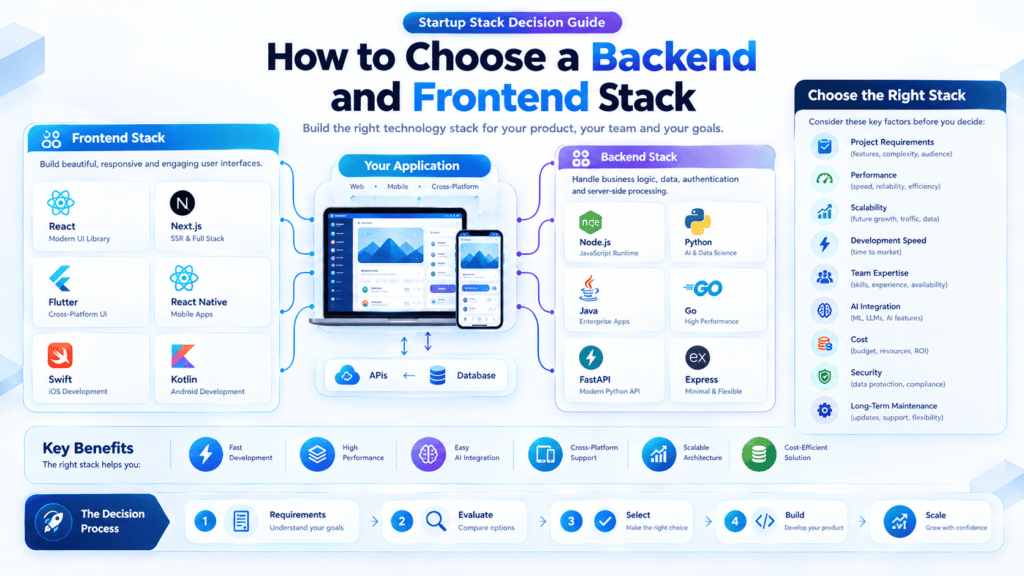
Choosing the right backend and frontend stack is one of the most important decisions in software development. Your technology stack will determine your team’s speed, scalability, complexity, and cost.
This article will provide you with some insights on how to approach the decision, as well as explore the options in detail, including Python/JavaScript combinations, modern frameworks, unified stacks, and machine learning-specific solutions.
Key Criteria for Choosing a Stack
Before selecting technologies, evaluate your project across five main axes:
- Team Expertise: The fastest team to build a stack is the one that already knows it. There is overhead and friction in learning a new language.
- Time-to-Markets: Startups need to iterate quickly to find product market fit. An enterprise application or one expecting to handle huge volumes needs type-safety and performance.
- Product Requirements: If your product is going to have real-time features such as chat or notifications, building an asynchronous backend will help you scale. If your application is going to be data or machine learning intensive, it will need a mature ecosystem around it.
- Ecosystem/Community: Larger communities usually means that there are production-grade frameworks, third-party services, and easier onboarding and hiring.
1. Python Backend + JavaScript Frontend
Combining a Python backend (e.g., Django, FastAPI, Flask) with a JavaScript frontend (React, Vue, Svelte) is one of the most popular full-stack architectures in modern web development.
Architecture Overview
This decoupled (headless) architecture separates the application into two distinct layers:
- Backend: Python is used to create a REST or GraphQL API server that handles business logic, database ORM operations, security, and external services.
- Frontend: JavaScript Single Page Application (SPA) or Server-Side Rendered (SSR) framework consumes the API and manages the user interface.
┌─────────────────────────┐          HTTP / JSON API          ┌─────────────────────────┐
│   JavaScript Frontend   │ ────────────────────────────────► │     Python Backend      │
│  (React / Vue / Svelte) │ ◄──────────────────────────────── │ (FastAPI / Django REST) │
└─────────────────────────┘                                   └─────────────────────────┘
Pros & Cons
| Advantages | Trade-offs |
| Separation of Concerns: Clear boundary between business logic and UI layer. | Dual Context Switching: Developers must jump between Python and JavaScript syntax and paradigms. |
| Independent Scaling: Backend and frontend can be deployed, scaled, and hosted independently. | Type Disconnect: Sharing data models requires manually maintaining TypeScript interfaces or generating them from API schemas. |
| Ecosystem Strength: Leverages Python’s backend ecosystem alongside rich JavaScript UI libraries. | Deployment Overhead: Requires managing two distinct builds, pipelines, and deployment environments. |
2. React vs. Vue for Frontend Development
When choosing a JavaScript framework, React and Vue dominate the landscape. Both are component-driven and performant, but they cater to different developer workflows.
                      ┌───────────────────────────────┐
                      │    Frontend Framework Choice  │
                      └───────────────┬───────────────┘
                                      │
              ┌───────────────────────┴───────────────────────┐
              ▼                                               ▼
   ┌─────────────────────┐                         ┌─────────────────────┐
   │     React.js        │                         │       Vue.js        │
   ├─────────────────────┤                         ├─────────────────────┤
   │ • JSX Paradigm      │                         │ • Template Syntax   │
   │ • Unopinionated     │                         │ • Progressive/Gradual│
   │ • Large Ecosystem   │                         │ • Built-in Router/  │
   │ • Enterprise Standard│                        │   State Management  │
   └─────────────────────┘                         └─────────────────────┘
React.js
- Paradigm: JS-centric (JSX). HTML, logic, everything lives inside JavaScript functions.
- Ecosystem: JS has a huge ecosystem covering every possible use case, though you have to choose your own router, state management, and styling tools.
- Best For: Building enterprise-level applications, apps with React Native, or if you want to work with a purely JS-based functional paradigm.
Vue.js
- Paradigm: Template-centric (Single File Components split into template, script (Vue Router) and style sections).
- Ecosystem: Very progressive, uses official tools (Vue Router, Pinia for state management)
- Best For: Rapid prototyping, teams that have a strong legacy in HTML/CSS/JS, and projects that need to be developed quickly.
3. Unified Technology Stacks
A Unified Stack uses a single language across both backend and frontend—most commonly full-stack JavaScript or TypeScript (e.g., Node.js / Next.js / NestJS).
Why Choose a Unified Stack?
- Shared Codebase: Sharing types (TypeScript models), request/response schema (Zod), and utility functions between client and server is seamless.
- Single Language Stacks: Developers can work across the entire stack in one language.
- Meta Frameworks: Next.js, Remix, or Nuxt make it easy to reason about and build full-stack applications by abstracting away much of the complexity between the server and client while exposing it when needed, such as with Server Components, built-in API routes, or hybrid rendering.
4. Using Python Specifically for Machine Learning
If your application relies heavily on Artificial Intelligence, Machine Learning, Data Analytics, or Computer Vision, Python becomes non-negotiable for your core domain logic.
┌─────────────────────────────────────────────────────────────────┐
│                    Machine Learning Stack                       │
├────────────────────────────────┬────────────────────────────────┤
│      ML / AI Data Layer        │          Web API Layer         │
├────────────────────────────────┼────────────────────────────────┤
│ • PyTorch / TensorFlow         │ • FastAPI / Django REST        │
│ • NumPy / Pandas / Scikit-Learn│ • Asynchronous Execution       │
│ • Hugging Face / OpenCV        │ • OpenAPI / Swagger Generation │
└────────────────────────────────┴────────────────────────────────┘
The Python ML Ecosystem
In the Python language, the use of Python in AI/ML is dominated by a mature ecosystem:
- Core data science: NumPy, Pandas, SciPy
- Machine learning and deep learning: PyTorch, TensorFlow, Scikit-Learn
- LLMs and AI workflows: LangChain, LlamaIndex, Hugging Face Transformers
Architecture Integration Strategies
There are two common options for an architecture if you’re using Python for ML:
- All-in-One Python Stack: use Python for the web server (FastAPI) and Python for the ML pipeline. FastAPI is a great choice as it’s performant and exposes native Pydantic data classes for validation in the API routes, so you can serve your ML model as a prediction endpoint next to regular endpoints.
- Microservices / Dedicated Inference API: have your main web backend in a different language (Node.js, Go, Ruby) and expose a separate inference API (FastAPI/Ray Serve) for the ML part via gRPC or REST.
5. Reducing Programming-Language Complexity
One of the most effective ways to lower operational costs and improve developer productivity is to minimize language clutter.
The Danger of Multi-Language Polyglot Architectures
Using different languages for different layers (Go for APIs, Python for data, Node.js for microservices, TypeScript for frontend) creates high mental overhead:
- Developers cannot reason across contexts and paradigms.
- Collaboration between teams is fragmented by language silos.
- CI/CD, linting, formatting, and security tooling must be maintained separately for each language.
Strategies to Simplify Your Tech Stack
- Adopt TypeScript End-to-End (The JS/TS Solution):
Use TypeScript for both React/Vue on the frontend and Node.js/Bun on the backend.
Benefit: Full stack type-safety, shared libraries, and no context-switching between languages.TypeScript End-to-End (The JS/TS Solution):- Use TypeScript for both React/Vue on the frontend and Node.js/Bun on the backend.
- Benefit: Complete full-stack type safety, shared libraries, and zero language context switching.
- Standardize on Python Full-Stack (The Python Solution) Use Django or FastAPI with traditional SSR or modern hypermedia approaches (e.g., HTMX or Alpine.js) to decouple your client and server. This approach can eliminate the need for a heavy JavaScript SPA framework if your UI interaction needs are modest.Standardize on Python Full-Stack (The Python Solution):
- Use Django or FastAPI with traditional SSR or modern hypermedia approaches (e.g., HTMX or Alpine.js).
- Benefit: Eliminates a heavy JavaScript SPA framework entirely if your UI interaction requirements are modest.
- Isolate Complexity with Microservices
If a multi-language setup is strictly needed (say Node.js for general API’s and Python for some specific ML tasks), isolate the second language in a separate service- If a multi-language setup is strictly necessary (e.g., Node.js for general APIs + Python for specialized ML), keep the core stack standardized and restrict the second language strictly to an isolated service.
Decision Matrix: What Should You Build With?
| Your Goal / Scenario | Recommended Stack | Reason |
| Fastest MVP / General Web App | Next.js (TypeScript) or Django + HTMX | Single-language development with minimal setup overhead. |
| AI / Data-Driven Application | FastAPI (Python) + React or Vue | Python handles ML models seamlessly; React/Vue provides a modern UI. |
| Enterprise / Large Engineering Team | Node.js (NestJS) + React (TypeScript) | Scalable architecture, strong type safety, and deep developer talent pool. |
| Content-Heavy / E-commerce App | Nuxt (Vue) or Next.js (React) | Excellent SSR, SEO performance, and dynamic routing capabilities. |
How Team Skills Influence Tech Stack Decisions
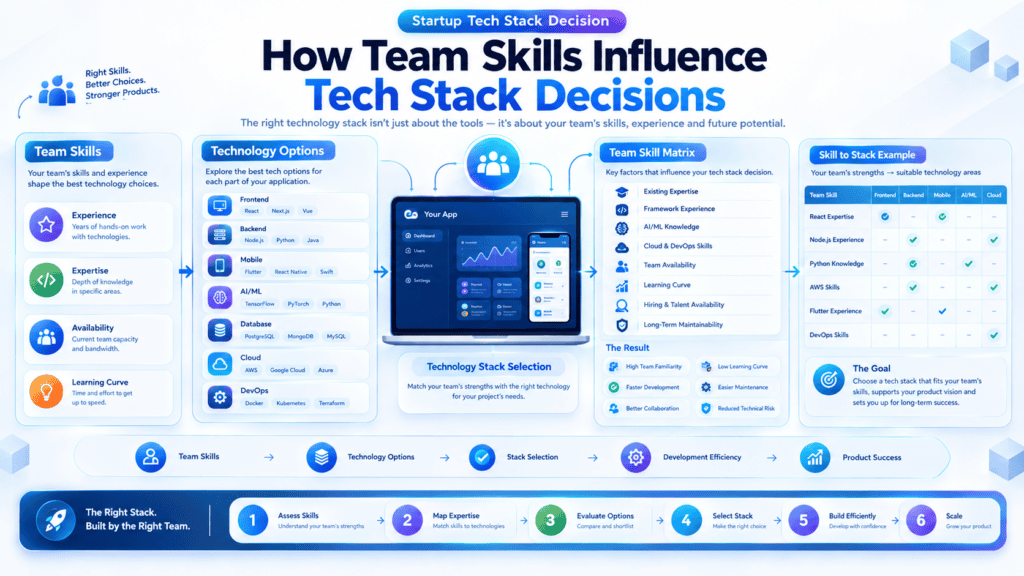
Choosing a technology stack is often treated as a purely technical decision: which framework is the fastest, the database that will scale, the language that is trendiest. The reality is that the best tech stack on paper is going to be useless if the people who are actually using it do not know how to use it well. Your team is your most important component of your architecture and you should be making decisions based on these four factors.
These are the four ways that the skills of your team can dictate the decisions that you make with your tech stack.
1. Existing Developer Expertise
A team that knows the technology deeply has a much greater chance of shipping faster and with fewer bugs than a team that is learning the technology on the job. The team will know how to navigate the framework, the common pitfalls and the best libraries for the task, and how to debug quickly.
Why it matters:
- Faster introduction of features: Without the learning curve, you get new functionality to your end-users faster.
- Higher quality of code: Your developers will write better-structured code using established patterns.
- Fewer production issues: With greater experience, you can avoid common pitfalls associated with a particular technology.
- More accurate estimations: Your team will plan the project better and provide more realistic deadlines.
For example, if your team consists of experienced Python developers, building an MVP in Django or FastAPI will be more productive and less error-prone than attempting to build the same product in Go or Rust. Although the latter two languages may provide better performance and reliability, they will require more effort from the developers, which ultimately increases the cost and extends the timeline of the project.
2. Availability of Technical Talent
A stack is only your solution as long as you can staff it. Some technologies have huge pools of talent, while others are niche, and it can take a lot of time and money to find someone who knows them.
Consider the following factors:
- The depth of the talent pool: JavaScript/TypeScript, Python, Java, and PHP have enormous communities of developers, while newer or more specific languages like Elixir, Haskell, or Clojure have few.
- The level of salaries: The scarcer the technology, the higher the cost of hiring.
- The time required to fill the position: A niche technology can remain vacant for months.
- The balance between supply and demand in your region: The popularity of a particular stack varies from city to city; although remote work is becoming more common, local conditions remain important.
Before choosing a stack, look at these factors and research the markets to find the technologies that are in demand and affordable to adopt.k at job boards and hiring trends in your target market. If it takes six months to fill a single role, that’s a strategic risk.
3. Minimizing Learning Curves
Every new technology has a learning curve associated with it, which is a significant investment of time and effort. It does not mean that you should refrain from adopting new solutions; however, when it comes to a high-profile project with a limited timeline, such a learning curve can be detrimental.
The ways to reduce the learning curve include
- prioritizing technologies with extensive documentation and ongoing support,
- preferring those paradigms that the team is already familiar with
- minimizing the number of new technologies to be integrated into the project,
- allocating sufficient time and resources to learn the new solutions.
When it comes to prioritization, you should only consider adopting new solutions if there is no adequate alternative for your team. If you integrate too many new solutions into the project, you will create a significant learning curve for your team.
On the other hand, sometimes you do not have any choice regarding new solutions because your team will need to adopt them in order to meet the requirements of your project.
In such cases, make sure to set aside enough time for developers to get familiar with new coding standards, documentation, programming languages, tools, and technologies.
Finally, when choosing between languages, frameworks, databases, or cloud solutions, prioritize those with extensive documentation and ongoing support.n small doses, and where the benefit clearly justifies the learning cost.
4. Planning for Future Hiring Needs
Tech stack decisions have long-term consequences. The developers you have today won’t be the only ones who ever touch your codebase. As your company grows you’ll need to onboard new engineers, replace departing ones, and scale your teams.
Questions to ask:
- Will we be able to hire for this stack in two or five years?
- Is the technology growing in adoption or declining?
- Can new hires become productive quickly or does the stack require specialized knowledge?
- Does the stack attract the kind of talent we want? Some modern technologies also help with recruitment as developers are often excited to work with them.
Choosing a stack with a healthy, growing ecosystem makes scaling your team far easier. Conversely, picking an obscure or fading technology can leave you with a codebase few people want to maintain, creating costly rewrites down the road.
Finding the Right Balance
None of this means you should never adopt new technology. Innovation matters, and sometimes a new tool is the right answer. The key is balance:
| Factor | Favor Familiar Stack | Consider a New Stack |
|---|---|---|
| Deadline | Tight | Flexible |
| Team experience | Strong in current tools | Open to learning |
| Project type | Core product, MVP | Experimental, internal tool |
| Hiring market | Deep talent pool | Niche but strategic need |
A practical approach is to keep your core stack stable and proven, while experimenting with new technologies in low-risk, isolated projects.
Conclusion
In your opinion, what is the most popular, advanced, and widely used technology stack? These are not the questions you should be asking. The right tech stack is the one that your team can build, maintain, and scale with confidence. Making informed tech stack decisions requires considering factors such as existing expertise, staffing, learning curve, and future hiring needs, which will help you get the most value out of your development investment.
Ask yourself these questions before selecting the technology stack for your next project: What is the most suitable technology which our team can use to build the product? What is the most suitable technology for our team to build the product?
Advanced Tools for AI Startups
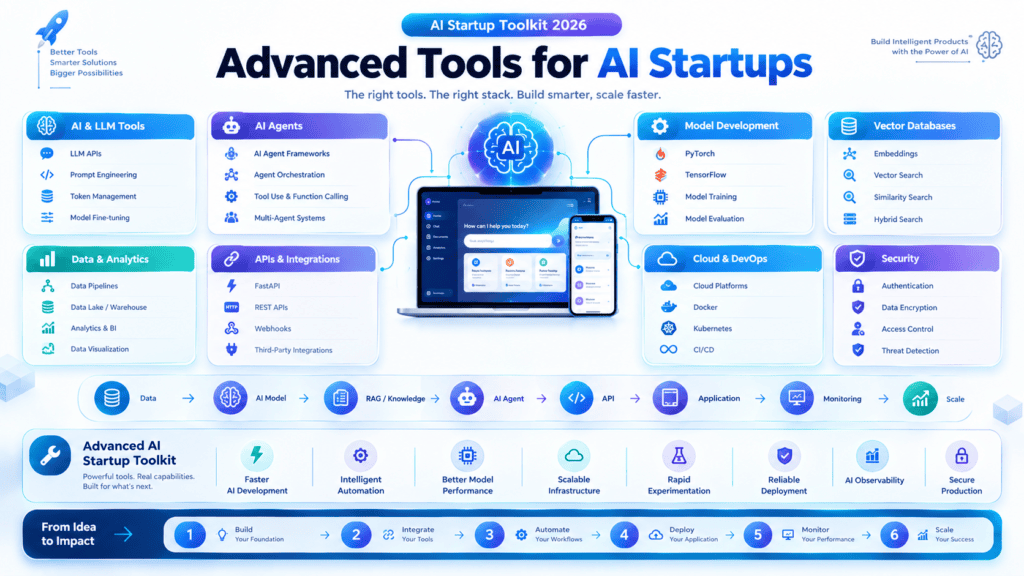
Building modern AI products requires leaving the local Jupyter notebooks and scrips to a side to create a resilient, scalable and reproducible infrastructure stack. This article provides a list of advanced tools and architectural decisions that the AI startups use to engineer their model lifecycle.
1. Hosting AI Models
Model hosting deals with turning trained artifacts into active, API-accessible microservices. The main challenges here are balancing cold start latency, hardware costs, and throughput.
[ User Request ] ---> [ Load Balancer ] ---> [ Serverless Inference / Dedicated Pod ]
                                                       |
                                            (Model Artifact Storage)
Serverless GPU & Specialized Inference Platforms
Startups favor serverless GPU infra to avoid costs of idle kubernetes clusters
- Brev / Modal / RunPod: For running custom pytorch workloads / fine-tuned LLMs on-demand. Near-instant container cold start with billing by second of execution.
- Replicate & Banana.dev: Serverless infrastructure for hosting open source AI models over REST/WebSockets. Abstracts all underlying infrastructure management.
- Fireworks AI & Together AI: Inference hosting optimized for high-throughput low-latency Open-LLM serving (Llama, Mistral etc)
Specialized Inference Engines
To obtain the highest performance across the set of our hosted instances, the model weights are evaluated using the following inference engines:
- vLLM is the state-of-the-art open-source LLM inference engine that leverages PagedAttention to allow efficient management of KV-cache memory and increase the requests per second.
- Triton Inference Server (NVIDIA) is the standard open-source model serving software for achieving high-performance AI inference by providing first-class support for multiple machine learning frameworks including TensorFlow, PyTorch, ONNX and others. It has built-in support for dynamic batching and GPU acceleration.
- TensorRT / TensorRT-LLM (NVIDIA) is the native NVIDIA software stack for accelerating inference by optimizing and fusing operations and using the hardware instruction set.
- TGI (Text Generation Inference) from Hugging Face is a production-level text generation inference engine for running transformer-based models with token streaming and speculative decoding support.
2. Model Deployment and Scaling
Deploying AI models requires addressing challenges around fluctuating demand, heterogeneous hardware (GPUs vs. CPUs), and safely rolling out model updates.
Orchestration & Compute Abstractions
- Ray & Ray Serve : a python first distributed framework ideal to build and deploy production grade pipelining logic, batch inference and model serving over auto-scaling multi-GPU clusters.
- Kubernetes + KServe : enterprise standard for cloud native model deployment. Define serverless abstractions on Kubernetes with built in support for scale to zero and canary deployments.
- Karpenter : node auto scaler (often used on AWS) that provisions specific type of GPU according to pending pod requirements reducing overall waste.
Deployment Strategies
| Strategy | How it Works | Primary Use Case |
| Canary Deployment | Routes $5\text{–}10\%$ of traffic to the new model version while monitoring error rates before full rollout. | High-risk production model updates. |
| Shadow Deployment | Mirrors real live traffic to the new model without returning its output to the user. | Validating model outputs, drift, and performance in real conditions. |
| Dynamic Batching | Groups incoming individual inference requests into a single GPU batch within a millisecond threshold. | Maximizing GPU utilization and throughput. |
3. Model Tracking and Version Control
Because machine learning is inherently non-deterministic, code version control (e.g., Git) is insufficient. Startups must track code, data, hyperparameter configurations, and resulting binary weights together.
                  +-----------------------+
                  |    ML Pipeline /      |
                  |  Training Pipeline    |
                  +-----------+-----------+
                              |
       +----------------------+----------------------+
       |                      |                      |
       v                      v                      v
[ Data Versioning ]  [ Experiment Tracker ]  [ Model Registry ]
  (DVC / LakeFS)        (W&B / MLflow)         (W&B / MLflow)
Experiment Tracking & Metadata
- Weights & Biases are one of the most efficient solutions for tracking the model training process, storing artifacts, visualizing the model loss curve, and performing hyperparameter sweeps.
- MLflow is an open-source platform that offers model tracking, packaging, and registry services, as well as a centralized repository for experiment data and code versioning.
- Comet ML is an enterprise-level model tracking tool focused on governance, comparison, and model explainability.
Data & Weight Versioning
- What is DVC (Data Version Control)? Please describe the Git-extension that allows versioning large data sets, model artifacts, and pipeline stages alongside code repositories while avoiding the overhead of large binary commits to Git.
- What is LakeFS? Please describe the tool that brings Git-like branching and committing capabilities to object storage data lakes such as AWS S3 and Google Cloud Storage.
4. Building Production-Ready AI Infrastructure
A production-ready AI stack goes beyond individual tools; it connects telemetry, data pipelines, evaluations, and security into a cohesive ecosystem.
A. Observability, Monitoring & Evaluations (LLMOps)
AI models have unique failure modes including concept drift, long tail latency increase, and hallucination. Arize AI / Fiddler are advanced MLOps observability tools that detect data drift, performance degradation of features, and embedding shifts in production models.
LangSmith / Phoenix / Langfuse are observability tools specifically for LLMs that track the execution of chains, measure prompt latency, debug RAG workflows, and evaluate test-case evaluations.
B. Feature Stores & Vector Infrastructure
- Feast / Hopsworks: Central repository for storing, engineering and serving batch and real-time features consistently across training and real-time inference
- Pinecone / Qdrant / Milvus: Production vector databases for fast similarity search, long term memory and Retrieval-Augmented Generation (RAG) pipelines.
C. Security & Guardrails
- The Nemo Guardrails from NVIDIA are designed to provide conversational boundaries, safety constraints, and factuality guardrails to large language model outputs.
- On the contrary, the Lakera Guard and Rebuff are both about protecting production large language model applications from prompt injection and data exfiltration.
Recommended Architecture Stack for Startups
- Inference Serving: vLLM running on RunPod / Modal (Early Stage) or Ray Serve on EKS / GKE (Growth Stage).
- Experiment & Registry: MLflow or Weights & Biases.
- Observability: Langfuse (Open Source) or LangSmith (Managed) + Arize AI.
- Data & Vector Storage: DVC for data sets; Qdrant or Pinecone for vector retrieval.
Tools for Hosting Your Own AI Models
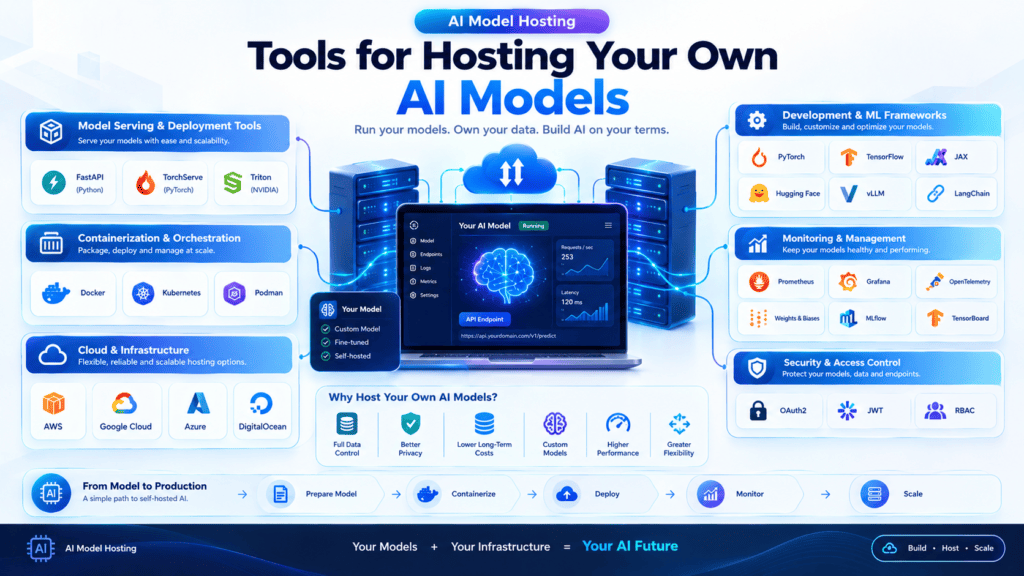
When organizing independent AI model hosting, it is vital to remember that it is necessary to use the appropriate set of tools for deploying, versioning, monitoring, and scaling the model. First, to deploy the model with all its dependencies, it is suitable to use software called Docker.
It allows you to create containers with an isolated environment, while Kubernetes will help to launch and manage these isolated environments separately. In addition, such model management systems as MLflow and DVC are needed to version control and track changes. Finally, TensorFlow Serving and TorchServe are responsible for deploying the trained machine learning models.
All of the above tools, when used together, can allow an organization to provide an efficient and scalable AI model hosting service capable of delivering the best performance. It will provide the team with opportunities to experiment with different versions of the model, roll back changes, and fine-tune resources to achieve the best performance.
ETL Pipelines for AI Startups: A Practical Guide to Building Data Workflows That Scale
Every AI startup worth its salt will claim that their model is the moat. The moat is actually the data pipeline feeding that model. While models are commoditized, clean data sets that are fresh and ready for training and inference are not.
In this post, you’ll learn about the role of ETL pipelines in a modern data infrastructure, what tools successful startups use (Apache Airflow, AWS Step Functions, AWS Glue, Spark, and Databricks) and how to structure your team’s data workflow at different stages of growth.
What ETL Pipelines Do
ETL stands for Extract, Transform, Load:
- Extract: Extract raw data from various sources such as the application’s database, API, event streams, logs, third-party SaaS, web scraping, and files stored in a cloud data lake.
- Transform: Process, clean, validate, deduplicate, join, enrich, and structure the data. When working with AI workloads this includes tokenization, feature engineering, labeling, and filtering out low-quality records.
- Load: Write the transformed data into a destination such as a data warehouse, data lake, feature store or vector database.
A similar ETL pattern is ELT (Extract, Load, Transform), where the transformation takes place in the target system.w data is loaded first and transformed inside the warehouse (for example with dbt). Many modern teams use both.
Why ETL matters more for AI startups
- Model quality depends on data quality. Garbage in, garbage out is doubly true for ML.
- Training data needs to be reproducible, and you need to know exactly which version of data was used to train which model.
- Features have to be consistent between training and production inference, or else you get training-serving skew.
- Data is messy and multimodal. Text, images/audio, and tabular all need to be processed differently.
- Compliance is a growing concern. PII handling, consent, and data lineage are important to enterprise customers.
Typical AI data pipeline stages
| Stage | Example tasks |
|---|---|
| Ingestion | Pull user events, scrape documents, sync CRM data |
| Cleaning | Remove duplicates, handle nulls, filter toxic or low-quality content |
| Enrichment | Add metadata, generate embeddings, call labeling services |
| Feature engineering | Aggregate user behavior, compute rolling statistics |
| Storage | Data lake (S3), warehouse (Snowflake, BigQuery), vector DB |
| Serving | Feature store, retrieval index for RAG, training datasets |
Orchestration: Apache Airflow vs. AWS Step Functions
Pipelines are rarely a single script. They are a set of dependent tasks that need scheduling, retries, alerting, and monitoring. That is the job of an orchestrator.
Apache Airflow
Airflow is the most widely adopted open-source workflow orchestrator. You define workflows as DAGs (Directed Acyclic Graphs) in Python.
Strengths
- Huge ecosystem of operators and integrations (AWS, GCP, Databricks, Snowflake, and more)
- Workflows as code for version control and code review
- Rich UI for monitoring, backfills, and re-running tasks
- Large community and talent pool
Weaknesses
- Operational overhead if self-hosted (scheduler, workers, metadata DB)
- Not designed for low-latency or event-driven workloads by default
- Can get messy if you have hundreds of DAGs and no conventions
Best for: Batch-oriented pipelines, teams with Python skills, and multi-cloud/hybrid setups. Managed options like Amazon MWAA, Astronomer, or Cloud Composer remove most of the ops overhead.
from airflow import DAG
from airflow.operators.python import PythonOperator
from datetime import datetime

with DAG("daily_training_data", start_date=datetime(2026, 1, 1),
         schedule="@daily", catchup=False) as dag:

    extract = PythonOperator(task_id="extract", python_callable=extract_fn)
    transform = PythonOperator(task_id="transform", python_callable=transform_fn)
    load = PythonOperator(task_id="load", python_callable=load_fn)

    extract >> transform >> load
AWS Step Functions
Step Functions is a serverless orchestrator designed to coordinate AWS services via state machines, which can be defined either with JSON (Amazon States Language) or a visual designer.
Strengths
- Serverless orchestration of AWS services
- Native integrations with Lambda, Glue, ECS, SageMaker, Batch, etc.
- Built-in retries/error handling, parallel and map states
- Inexpensive with low usage volumes (pay per state transitions)
Weaknesses
- AWS lock-in
- JSON state definitions get verbose for complex logic
- Less suited to complex scheduling, backfills, and data-aware dependencies
Best for: AWS-native startups, event-driven workflows (for example, trigger on an S3 upload), and orchestrating ML steps like preprocessing → training → evaluation → deployment.
Which should you choose?
| Need | Pick |
|---|---|
| Rich scheduling, backfills, many data sources | Airflow |
| Serverless, event-driven, deep AWS integration | Step Functions |
| Small team, minimal ops | Step Functions or managed Airflow |
| Multi-cloud portability | Airflow |
Many teams use both: Airflow for scheduled batch pipelines, Step Functions for event-driven ML workflows.
AWS Glue: Serverless ETL
AWS Glue is a fully managed, serverless data integration service. It handles both the compute (Spark jobs) and the metadata (a central catalog).
Key components
- Glue Data Catalog: Central repository for metadata that makes S3 data queryable by Athena, Redshift Spectrum, and EMR
- Glue Crawlers: Discover schemas and register tables
- Glue ETL Jobs: Serverless spark (or Python shell) jobs for transformation
- Glue Studio: Visual interface for creating jobs
- Glue Workflows and Triggers: Simple orchestration within Glue
- Glue Data Quality: Rule based checks on datasets
Why startups like Glue
- No cluster management. Pay only for the amount of compute you use.
- Fast to stand up: crawl your S3 bucket, get a queryable catalog, and write a job in an afternoon.
- Tight AWS integration with S3, Redshift, RDS, Athena, and Lake Formation.
Watch out for
- Cost at scale. Glue’s DPU hours can get expensive for heavy or inefficient jobs.
- Cold-start latency on jobs makes it a poor fit for real-time requirements.
- Debugging friction compared to running Spark locally.
- Less control than running your own Spark cluster.
Best for: Early to mid-stage startups on AWS looking to offload serverless batch ETL without the cost of a dedicated data platform team
Spark and Databricks: Processing at Scale
Apache Spark
Apache Spark is the standard open-source engine for large-scale distributed data processing. It divides data among a set of nodes in a cluster and processes it in parallel, in memory whenever possible.
Why Spark matters for AI
- Can process datasets that are too large for a single machine (from terabytes to petabytes)
- Provides unified APIs for batch, streaming (Structured Streaming), SQL, and ML (MLlib)
- Python (PySpark) is a natural fit in ML teams’ skill sets
- Ideal for large-scale data preprocessing for model training
from pyspark.sql import SparkSession
from pyspark.sql.functions import col, length

spark = SparkSession.builder.appName("clean_corpus").getOrCreate()

df = spark.read.json("s3://my-bucket/raw/documents/")
clean = (df.dropDuplicates(["text"])
           .filter(length(col("text")) > 200)
           .filter(col("language") == "en"))

clean.write.mode("overwrite").parquet("s3://my-bucket/processed/documents/")
Reality check: Spark is overkill for small data. If you work with data that fits in memory on one machine, pandas, Polars, or DuckDB will be much easier and faster to work with. You should move to Spark when you genuinely outgrow single-machine tools.
Databricks
Databricks is a managed data and AI platform, built by the creators of Spark, which essentially wraps Spark in a collaborative, production-friendly environment.
Key capabilities
- Managed Spark clusters with autoscaling and optimized runtimes (Photon engine)
- Delta Lake: Open storage layer with ACID transactions, schema enforcement, and time travel (query data as it was at a past version, which is valuable for reproducible model training)
- Unity Catalog: Centralized governance, access control, and lineage
- Workflows / Lakeflow: Built-in orchestration and pipeline tooling
- MLflow integration: Experiment tracking and model registry
- Notebooks and collaboration for data scientists and engineers together
Why AI startups choose it
- One platform for data engineering, analytics, and ML
- Less infrastructure work, so more time on product
- Delta Lake’s versioning helps with reproducibility and auditability
Trade-offs
- Costs can climb quickly without cluster governance
- Some platform lock-in, although Delta Lake and MLflow are open source
- Small teams may not need the full platform on day one
Glue vs. Databricks (quick view)
| Factor | AWS Glue | Databricks |
|---|---|---|
| Setup | Very fast, serverless | Workspace setup, more features |
| Best at | Simple to moderate batch ETL | Complex pipelines + ML + analytics |
| Governance | Glue Catalog / Lake Formation | Unity Catalog |
| Cost model | Pay per DPU-hour | DBUs + underlying cloud compute |
| Ideal stage | Early | Growth and beyond |
Managing Large-Scale Data Workflows
Choosing tools is easy! Making them reliable as data and team grow is not. The following practices will help you to do that.
Design for idempotency
A single run of transformation should not produce duplicate data. This allows retries and backfills with predictable results. You may want to write on top of existing data using the overwrite-by-partition pattern or upsert (e.g. Delta Lake MERGE).
Partition your data
Partition by date or other common query dimensions. Partitioning is critical for reducing cost and execution time. It’s easy to make mistakes here, so you want to avoid having too many or too few partitions.
Use columnar formats
Store data in Parquet (or Delta/Iceberg tables) instead of CSV or JSON. Achieve compression, faster read speeds, and schema support by using these columnar formats.
Bake data quality checks into the pipeline
Implement early and frequent validation:
- Row counts and null rates
- Schema drift detection
- Value range and uniqueness checks
- Freshness checks
Tools like Great Expectations, Soda, dbt tests, and Glue Data Quality help. Fail loudly instead of silently feeding bad data to a model.
Versioning of data and lineage tracking
Have a process to know which version of which dataset was used to train which model. You can use the time travel feature of Delta Lake, or external tools such as DVC or lakeFS, and track the lineage in MLflow or Weights & Biases. This helps a lot in debugging why a model stopped working as intended, and for audit purposes.
Monitoring and alerting
- Monitor job durations, failure rates, and data trends
- Set alerts on SLA violations or unexpected changes (such as a 50% decrease of rows in a dataset)
- Use Airflow alerts, CloudWatch, Datadog, Databricks monitoring, etc.
Control costs early
- Use spots or preemptible instances for fault tolerant jobs
- Set cluster auto-termination and autoscaling limits
- Process incrementally rather than reprocessing everything
- Tag resources to attribute cost per pipeline/team
Handle secrets and sensitive data correctly
Keep credentials in a secret management system and rotate often.ager (AWS Secrets Manager, Vault). Mask or tokenize PII. Apply least-privilege access and log data access.
Treat pipelines as software
- Store code in Git with code review
- Write unit tests for transformation logic
- Use CI/CD to deploy pipeline changes
- Separate dev, staging, and production environments
Don’t over-engineer too early
A common startuptoolsake is building a petabyte-scale platform for gigabytes of data. A sensible evolution looks like this:
| Stage | Data scale | Suggested stack |
|---|---|---|
| Seed / MVP | GBs | Python scripts, cron or managed scheduler, S3 + Postgres/DuckDB |
| Early growth | 10s–100s of GB | Managed Airflow or Step Functions, Glue, a warehouse |
| Scaling | TBs+ | Spark / Databricks, Delta Lake, feature store, full observability |
| Mature | PBs | Dedicated data platform team, streaming + batch, strong governance |
Start simple, and add complexity only when a real bottleneck justifies it.
Putting It All Together: A Sample Architecture
A typical AI startup pipeline on AWS might look like this:
- Ingestion: Application events and API data arrive in S3 (raw zone) via Kinesis, Fivetran, or custom jobs.
- Orchestration: Airflow (MWAA) or Step Functions trigger the daily pipeline.
- Transformation: Glue or Databricks/Spark clean and dedupe data and write Delta/Parquet tables to a curated zone.
- Validation: Data quality checks guard the pipeline.
- Feature/embedding engineering: Features and embeddings are generated and stored in a feature store or vector database.
- Training/serving: Versioned data sets are used to train ML models (versioned in MLflow), and updated retrieval indexes are used for production data.
- Monitoring: Dashboards and alerts ensure data freshness, quality, and cost.
Final Thoughts
For an AI startup, ETL pipelines are not an afterthought — they are the infrastructure layer. Choosing the right tools for your team depends on your stage:
- Use Airflow/Step Functions for orchestration, Glue for fast and simple but reliable serverless ETL, Spark + Databricks for heavy lifting.
- It’s worth investing time and money into data quality, versioning, and monitoring since every failed model training will remind you of that.
Have reasonable expectations during the early stages, iterate quickly, and establish good engineering practices to evolve your pipelines in lockstep with your product. The startups that make it to the top have a culture of prioritizing reliable data infrastructure.ing.
How to Build a Scalable AI Tech Stack
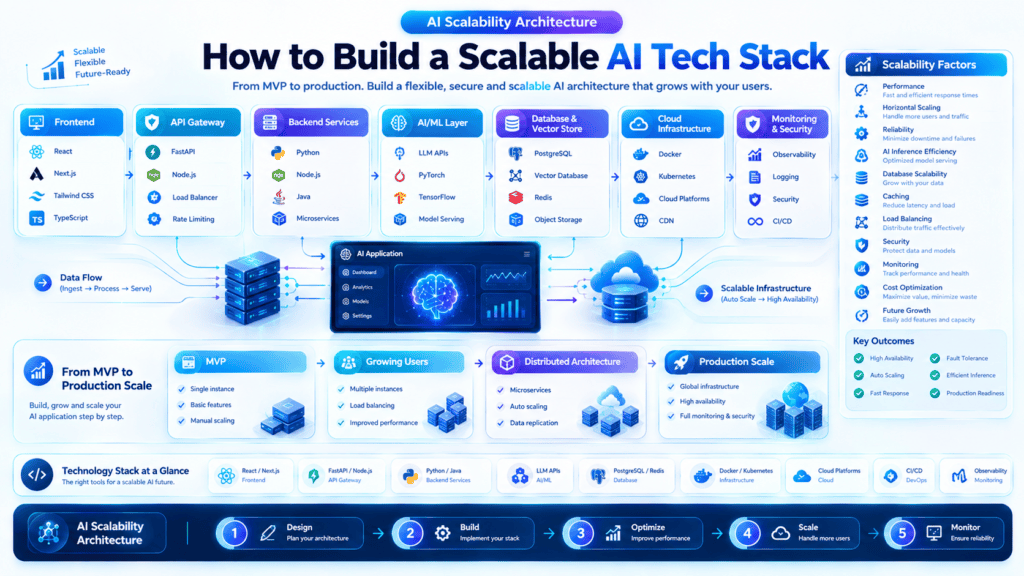
AI projects have a reputation for launching successfully on a prototype, only to fizzle out soon after — plagued by inaccurate results, unsustainable costs, technical debt, or an inability to scale with growing demands.
To truly realize the potential of an AI innovation, one must implement a scalable AI tech stack that can transition the proof-of-concept prototype into a working production system and evolve with a growing user base.
This guide explains the four principles of building a scalable AI tech stack: simplicity, scalability, flexibility-performance balance, and future-proofing.
The guide focuses on four key areas related to developing a scalable AI tech stack: simplicity, scalability, flexibility-performance balance, and future-proofing.
What Is an AI Tech Stack?
An AI tech stack is the set of tools, platforms, and infrastructure that allow you to build, deploy, and run AI applications. It typically consists of:
- Data layer: databases, data lakes, pipelines, and feature stores
- Model layer: frameworks, pretrained models, APIs, and fine-tuning tools
- Infrastructure layer: cloud compute, GPUs, containers, and orchestration
- Application layer: APIs, user interfaces, and integrations
- Operations layer: monitoring, versioning, security, and cost tracking (MLOps/LLMOps)
Each layer affects how well your system can grow, so decisions in one place ripple through the others.
1. Keep the Stack Simple
The most common mistake is over-engineering. Teams adopt every trendy tool, and the resulting system becomes fragile and only understood by two engineers.
Focus on the problem to be solved, not the tooling. Define the business goal (e.g., reduce support tickets, improve recommendations, automate document review) and identify the minimal tooling set to achieve it.
Leverage managed services whenever possible. Consider using a managed database, a hosted model API, or a serverless compute offering to ship a minimal viable product faster while reducing the team’s operational burden. It is easier to switch to a self-hosted solution when you have to deal with thousands of requests per hour than the other way around.
Avoid the tooling sprawl. Every new tooling surface increases the engineering surface: the amount of code to be maintained, production incidents to triage, and security audits to perform. The question to ask yourself before adding a new tool is
- Does it solve a problem we have today?
- Can an existing tool do this, and do it well?
- Who will be maintaining it?
Use proven, well-documented technologies. Your stack only has to be boring to work; it doesn’t have to be interesting. A widely used stack has an ecosystem of support, which is helpful when hiring, debugging, and deploying.
Document everything. A simple stack isn’t simple if no one understands it. Keep architecture diagrams and setup guides up-to-date.
2. Plan for Scalability
Scalability refers to the ability of your system to cope with increased demands without compromising performance and additional costs. You must design it into your system at the design stage, even if you don’t need it right away.
Build a strong data foundation
AI is only as good as its data. To scale:
- Build automatable, repeatable data pipelines rather than manually exported data.
- Standardize data formats and validation checks.
- Use scalable storage like cloud object storage or a warehouse that can scale.
- Track your data lineage so you know where it came from
Design for horizontal scaling
Systems that scale by adding more machines are generally easier to grow than ones that rely on a bigger machine. Use containers (Docker) and orchestrator (Kubernetes) to make load-balancing and replication easier.
Separate training from inference
Training is heavy and occasional, while inference is lightweight but constant and latency-sensitive. Scaling them independently keeps costs under control and performance predictable.
Automate with MLOps
Manual deployments do not scale. So, invest in
- CI/CD pipelines for your models and code
- model versioning and registries
- automated testing (accuracy, bias, regressions)
- monitoring (latency, errors, data drift, model drift)
Watch costs early
GPU and API costs can grow faster than usage. Set budgets and alerts, cache repeated requests, use smaller models where they’re good enough, and batch requests when real-time responses aren’t required.
3. Balance Flexibility and Performance
A trade-off occurs in every architecture. Highly flexible systems are usually more difficult to optimize (and thus can be slower or more expensive) while highly optimized systems are less flexible. The challenge is to find a good balance for whatever you’re trying to accomplish.
Use modular architecture
Break your stack into loosely coupled components, such as data ingestion, feature processing, model serving, and the application. Standard interfaces (REST or gRPC APIs) between components allow swapping out one component without rewriting other components.
Avoid vendor lock-in, within reason
Having one provider is a risk if prices rise, quality drops, or the service is discontinued. You might want to consider the following options in such cases:
- An abstraction layer between your application and any model providers
- Open standards and open-source models and frameworks such as PyTorch, ONNX, LangChain-style orchestration
- Portable containers that can run on any cloud
Meanwhile, you might not want to go for absolute portability or multi-cloud approaches for several reasons:ty so hard that you give up the real benefits of a platform. Some lock-in is an acceptable cost for speed.
Choose the right model for the job
The biggest model is not always the best one. Sometimes it can be more efficient to use a smaller and better-tuned model and gain the reduction of latency and cost without sacrificing much accuracy on the specific task. A possible way is to use a smaller model for simple requests and bigger one for the complicated ones.
Optimize where it matters
Profile your system prior to optimizing. Some wins are obvious, like caching common queries and embeddings,
- model quantization/distillation,
- efficient vector search/indexing,
- asynchronous processing of non-time-critical requests,
but you should also identify key performance bottlenecks and prioritize them.than optimizing prematurely.
4. Prepare for Future Growth
AI evolves quickly. The best model or tool today may be outdated in a year, so your stack should be built to adapt.
Stay adaptable
Design things so that they can be replaced. If a new model or database proves itself to be better, you should be able to upgrade without re-building everything. Periodically evaluate your stack, and remove anything no longer deserving of a place there.
Invest in governance and security
As your use of AI grows, so do the potential risks. Therefor you need to integrate the following systems and checks:
- Access controls and encryption for sensitive data
- Audit trails for model decisions
- Compliance with regulations such as GDPR and industry specific regulations
- And responsible AI practices like bias testing and human oversight
- It’s much easier to bake in governance than to add it on later.
Build a culture of learning
Technology alone is not easily scalable. People are much more easily scalable. Encourage collaboration across different functions (data scientists, engineers, and business teams) and ensure that they receive the right training, knowledge sharing, and sense of ownership over the relevant parts of the technology stack.
Measure what matters
You measure technical and business metrics: the former (latency, uptime, cost per request) reflect how well your service is performing; the latter (end-user satisfaction, time saved, revenue impact) — in what direction you are headed.
Plan for multimodal and agentic AI
AI applications are beginning to encompass more than text and include images, audio, video, and autonomous agents that take action in the world. Choose your infrastructure based on your needs for supporting multiple data types and long-acting multi-step workflows.
A Quick Checklist
- ✅ Well-defined business objective to choose the set of tools
- ✅ Managed services are used wherever possible
- ✅ Reliable data pipelines which are automated
- ✅ Containerized horizontally scalable solution
- ✅ MLOps practices (versioning, testing, and monitoring)
- ✅ Modular system with several interchangeable modules
- ✅ Budget tracking and optimization activities
- ✅ Embedded security and governance practices
- ✅ Continuous process of reviewing and updating the solution in order to adapt it to the latest developments
Final Thoughts
Final answer (only rewrite of the content is provided in this field):
The best way to build an infinitely scalable stack of technologies for artificial intelligence systems is to make the right choices. They should be guided by a number of considerations, including simplicity, which will enable the organization to operate efficiently and effectively, plan for the future and make the solution more attractive for clients, and focus on flexibility and performance to achieve a perfect balance between the two. Most importantly, one should think about long-term implications and make preparations for future needs in terms of technology.
A small beginning and continuous improvement measured in every step will lead the creation of an excellent stack that will serve the company for a long time.
How to Choose the Right Tech Stack for Your AI Startup
Selecting an AI tech stack is often one of the first critical decisions made by an AI startup, which rarely turns out to be easily reversible. A wrong decision at this stage can significantly impact the development of the product, increase operational costs, and put additional pressure on the hiring process. Meanwhile, a wisely chosen tech stack allows a small team of developers to build and scale the product quickly and efficiently. Below are four major principles that should guide such a decision.
1. Align Technology with Your Team’s Strengths
The best stack is the one that your team can build confidently on today. Something that seems cool but requires your engineers to learn new skills from scratch will cost you weeks or months.
- If your founders are strong in Python, build on Python. It also has an outsized presence in the AI ecosystem, with PyTorch, TensorFlow, Hugging Face, and LangChain.
- If your team comes from a JavaScript background, perhaps TypeScript for the frontend and Python for the model layer would be a good split.
- Pick the tools that your team can debug at 2 a.m., not the ones that seem cool on Twitter.
Speed at first is about comfort. You can always adopt new technology later on if the product and revenue trajectory dictate it..
2. Limit Unnecessary Complexity
Most startups are over-engineered. When building products for scale, it’s great to have microservices, Kubernetes clusters, homegrown ML pipelines, and dozens of databases. But when you have 10 users, it’s just a burden.
Before adding yet another tool to my stack, I need to ask myself: does it address a concrete need?
- I’ll build a monolith or have a few services communicate with each other
- I’ll use managed services (hosted databases, model APIs, serverless functions), not my own infrastructure
- I’ll employ pre-trained models and APIs before building my own. Most products can test their hypothesis with an existing model and only fine-tune something once they’ve found product-market fit.
Every additional tool I use will have a cost in terms of maintenance, security surface area, and cognitive overhead. Simplicity is the best teacher.
3. Plan for Hiring and Scalability
The choice of your tech stack can impact who you can hire and how easy it is to scale your operations.
Hiring: More popular technologies attract more people. The more popular the technology is, the bigger the talent pool is, making the hiring process easier, and the less time and effort it takes for an employee to get up to speed. A niche or less popular tech can lead to longer recruitment cycles and higher barter rates.
Scalability: While you might not need to support millions of users right away, you should think about how your choices will affect your ability to scale, both in terms of users and cost. Some questions to ask yourself are:
- Can my database scale with the increase in data size?
- Can my inference pipeline scale with the increase in traffic?
- Can I monitor and control the costs, as GPU hours and API calls can often be much more expensive than one might expect?
Make sure to choose the technologies that have clear upgrade paths, which will let you scale your operations without much rework.means adding capacity rather than starting over.
4. Build a Flexible Foundation for Future AI Development
AI moves fast. The best model today may be outmoded in six months, and your stack should be able to adapt without a painful rewrite.
- Make models swappable. Use an abstraction so that your app can interoperate with one or more model providers at once, so that you can switch from one provider to another (OpenAI, Anthropic, open source etc) easily.
- Decouple concerns. Make sure that your data storage, logic, and model inference layers are loosely coupled.
- Invest in your data. A well organized, cleaned, and versioned dataset is often more valuable than your model. Build pipelines that make it easy to process and version your data.
- Track experiments. With versioning, evaluation and monitoring tools you can iterate on an improvement process for your features and models.
Flexibility protects you from the risk that any one model will fail you, and makes you more valuable as an AI development partner. you from vendor lock-in and lets you take advantage of new breakthroughs as they arrive.
A Sample Starter Stack
For many early AI startups, a sensible starting point looks like this:
| Layer | Example Choices |
|---|---|
| Frontend | React or Next.js |
| Backend | Python (FastAPI) or Node.js |
| Database | PostgreSQL, plus a vector database if needed |
| AI/ML | Hosted model APIs, Hugging Face, PyTorch for custom work |
| Infrastructure | AWS, GCP, or Azure with managed services |
| Monitoring | Logging, cost tracking, and model evaluation tools |
This isn’t a rule, just a reasonable default you can adjust to your team and product.
Final Thoughts
Choosing an AI startup tech stack is not a matter of selecting the most sophisticated solutions. Instead, prioritize adaptability, simplicity, extensibility, and the ability to scale in tandem with the team’s evolution and the AI field’s development.
It is better to begin with something small and iteratively add more complex and specialized solutions based on the identified needs than build an overly complicated system that will be too difficult to maintain and evolve.
FAQs
What is an AI startup tech stack, and why is it important?.
An AI startup tech stack refers to a combination of languages, frameworks, databases, models, APIs, cloud services, and tools needed to build and operate an AI product. The tech stack in AI development is critical to reduce time-to-market and help scale the product up when the user base and data volume increase.
Why is Python considered the primary language for AI startups?
Python provides rapid prototyping, an extensive ecosystem of data science and AI libraries (PyTorch, TensorFlow, NumPy, LangChain, etc.), and high readability. Moreover, due to the popularity of the language, there is a large pool of Python developers, which makes the hiring process easier and less time-consuming for the initial stages of the project.
When should Python NOT be used as the primary choice?
Python is unsuitable for applications which demand extremely low latency levels (for example, stock market systems requiring microsecond responses), involve developing native software for mobile platforms (typically developed in Swift, Kotlin, etc.) or have complex frontend user interfaces written in JavaScript/TypeScript.
What are the advantages and trade-offs of combining a Python backend with a JavaScript frontend?
This decoupled approach breaks down the architecture into distinct components, thus enabling scaling of backend (API/ML services) and frontend (UI) independently of each other. But, it incurs cost in terms of context-switching between two different languages, managing two different development pipelines and ensuring API schema consistency between the two ends.
What is a “Unified Technology Stack,” and when should a startup adopt it?
A unified stack can be implemented using a single programming language for both backend and frontend (most common: full-stack JavaScript/TypeScript such as Next.js or Node.js). Startups should implement it if they want to avoid the mental overhead of working with different languages, share type definitions and utility functions, and simplify CI/CD tooling.
How should existing team skills influence the tech stack decision?
A team’s experience with the implementation stack directly impacts development speed, code quality, and the accuracy of project estimations. Choosing the right framework or language reduces the risks of project failure. On the contrary, the selection of an underused or niche tech stack increases hiring time and cost and postpones the product launch date.
Author Bio
Jeevesh Tripathi works as a content creator and technical writer at BkAbhi. He is passionate about emerging technologies and likes to learn about new frameworks and trends in the tech world. At BkAbhi, he writes technical articles for developers and founders. His work revolves around studying and sharing knowledge about state-of-the-art technologies and breaking them down for better understanding. In his free time, he likes to explore and write about different technologies and tools related to software development, web development, and modern frameworks.