
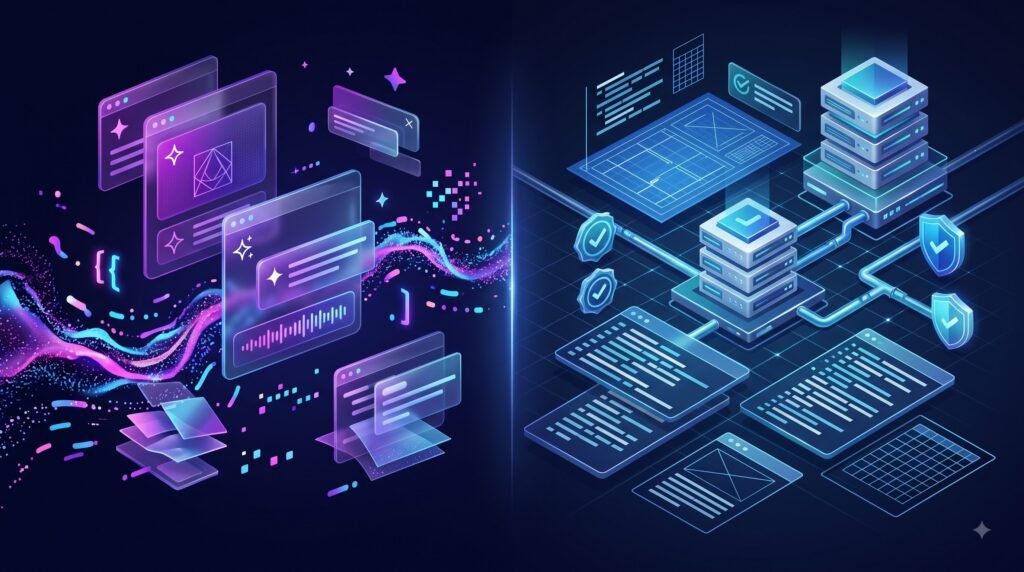
Creating an application with artificial intelligence assistance may appear to be a relatively straightforward process. Coming up with an idea, generating a few screenshots, connecting databases, and you are already done before actually writing any code.
However, having a prototype does not always mean that it is reliable, safe, and ready for launch for potential customers. This is the main difference between vibe coding and professional development, as the former may allow you to build a working model of your application, while the latter is required to make it secure, scalable, and sustainable.
Table of Contents
Quick Answer: Vibe Coding vs Professionally Developed Apps
Vibe coding uses natural-language instructions and AI tools to generate or modify software, often with limited direct coding by the user. Professional development usually involves more structured approaches, including requirements, architecture, testing, security reviews, deployments, and maintenance.
Vibe coding can be a practical choice for prototypes, experiments, and low-risk internal tools. Professional engineering is more critical when the app deals with payments, stores personal data, has complicated external integrations, or implements some critical business logic.
These methods can be combined since using the code generation tools does not prevent the development team from following professional standards. It can be employed during the maintenance and updates of an application.
What Is Vibe Coding?

Vibe coding is an approach to software creation in which a person describes the desired result to an AI coding tool and iteratively refines the output.
Instead of implementing every function manually, the user asks the AI to create interfaces, generate code, connect components, or fix errors. The exact workflow depends on the tool and the user’s technical knowledge.
For example, a founder might ask an AI tool to build a simple dashboard with a sign-up form, a list of customers, and a basic reporting screen.
The tool may generate a usable starting point quickly. The founder can then request design changes or additional features through further instructions.
Where vibe coding is useful
- Exploring an early product idea.
- Creating a clickable or functional prototype.
- Testing a user workflow before committing to a larger build.
- Automating a small, low-risk internal task.
- Learning how application components fit together.
- Generating a starting point for a developer to review.
The limitation is that visible functionality doesn’t prove the underlying code is correct. A screen may appear to work while the application has weaknesses in permissions, error handling, data validation, or its underlying architecture.
What Is Professional Software Development?
Professional software development is a systematic approach to software creation that results in verifiable, testable, deployable, maintainable, and upgradable code.
Depending on the project, the work may include:
- Requirements and scope definition.
- UI/UX design and user-flow planning.
- Architecture and database design.
- Frontend and backend implementation.
- API and third-party integrations.
- Automated and manual testing.
- Security and access-control reviews.
- Deployment, monitoring, and maintenance.
Not every project needs the same level of process. A simple landing page does not require the same level of engineering investment as a subscription-based SaaS platform that stores customer data and processes payments.
In the same way, professional development does not mean abstaining from using AI. Developers can utilize coding assistants to write tests, experiment with implementations, understand existing code, or become more efficient at repetitive tasks. The key differentiator is whether the deliverables meet the requirements and quality standards of the project.
Key Differences Between Vibe Coding and Professional Development
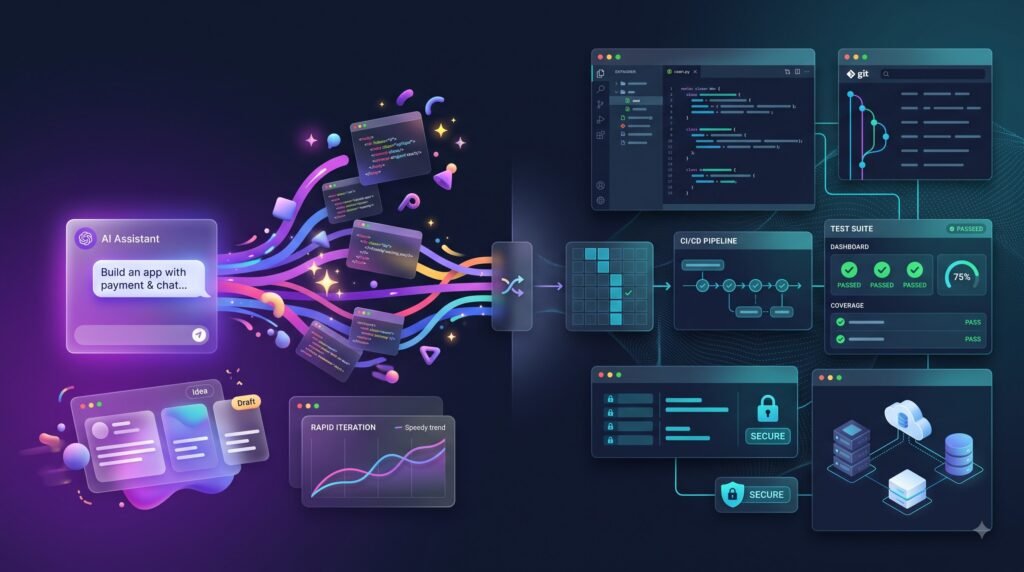
| Factor | Vibe coding | Professional development |
| Primary goal | Explore and build quickly | Deliver software against defined requirements |
| Starting point | Often a prompt or informal idea | Requirements, user flows, and agreed scope |
| Initial implementation | Can be rapid for small tasks | Depends on scope and engineering process |
| Architecture | May develop incrementally | Can be deliberately designed and reviewed |
| Testing | Depends on the workflow | Can include planned automated and manual testing |
| Security | Requires explicit verification | Can be incorporated throughout development |
| Maintainability | Depends on code quality and documentation | Can be planned as an engineering requirement |
| Cost | Tool costs may be low, but total effort varies | Includes the cost of engineering and delivery |
| Accountability | The user must verify the output | Responsibilities can be defined across the team |
| Best fit | Low-risk prototypes and experiments | Products that need reliable operation and ongoing changes |
Neither column is a sure thing. A well-managed AI-assisted project can be engineered badly, and a team of professionals can produce faulty requirements, insufficient testing, or rushed implementation.
Is Vibe Coding Faster Than Professional Development?
Vibe coding can shorten the time needed to produce an initial implementation, particularly when the task is small, the requirements are clear, and the selected tools support the required functionality.
However, the time to generate code is only one part of the delivery process.
Think about a situation where a founder creates a customer portal. An AI tool can help build a prototype quickly, but the founder still needs to review the sign-in process, permissions, password recovery, data storage, error messages, and deployment to ensure everything works correctly. As explained in this guide to vibe coding vs. professional development, AI-generated software can look polished while still having security, reliability, or maintenance issues. Without proper testing and validation, the result may look impressive but fail to meet users’ actual needs.
Professional growth can require prototyping, but spending time on it can save alterations and reveal some missing parts. The outcomes of the mentioned cases depend on the complexity of the project, the skill of the team, the tools used, and the quality of code-review.
The useful measure isn’t just time to first demo. It’s time to a tested, usable product that meets its requirements.
Vibe Coding vs Professional Development Cost
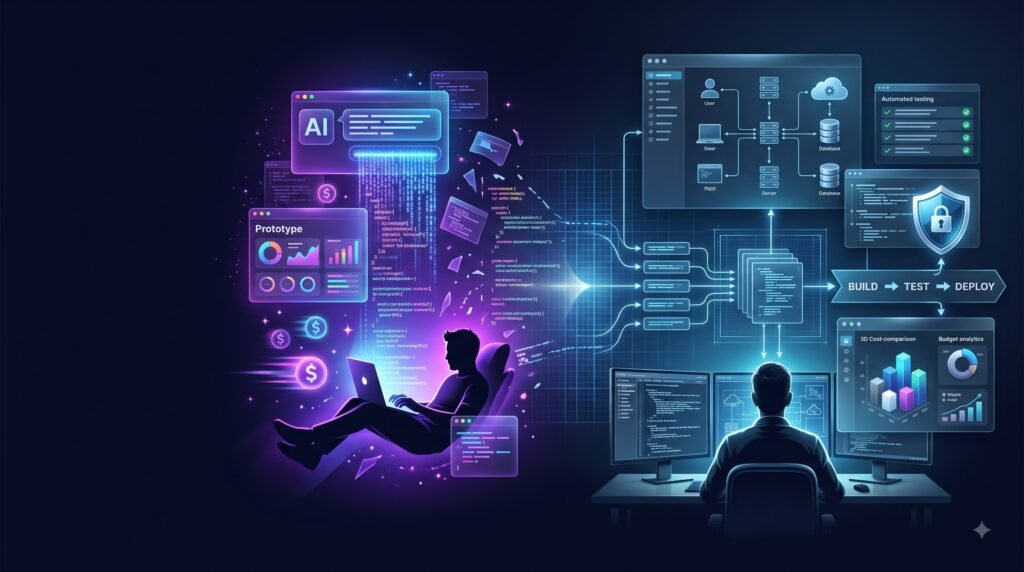
There is no universal price difference between these approaches. Costs depend on the application, the tools used, the amount of human engineering required, and the work needed after the first version is generated.
What affects vibe coding costs?
- AI tool subscriptions or usage charges.
- Hosting, databases, and third-party services.
- Time spent writing prompts and correcting output.
- Debugging and integration work.
- Code review and security testing.
- Future changes and maintenance.
What impact does that have on cost?
- Requirements discovery and design.
- Developer and specialist time.
- Backend, frontend, and integration complexity.
- Testing, security, and deployment.
- Documentation and handover.
- Maintenance and post-launch support.
A prototype made with cheap tools may be cheap to make if it’s truly disposable. The math changes if it needs to become a customer-facing product and undergoes significant debugging, restructuring, or security hardening.
To compare fairly, you need to consider the cost of getting to the same result, not just the costs of making the first version.
For example, compare two proposals for the same customer portal. One covers an AI-generated demo; the other covers a tested application with access controls, deployment, documentation, and an agreed maintenance plan. The second proposal includes more work, so comparing their headline prices alone would be misleading.
Security and Code Quality Checklist for Founders (What to Watch For) ?
Scalability and Maintainability
A prototype can work well for a small demonstration and still become difficult to extend.
As the application grows, the software’s developers may need to update the data model, incorporate new integrations, optimize the code or scale the system, add more users, or enforce new business logic.
The critical question is: can this code be changed and maintained by the development team in the future?
A maintainable code base usually has specific features that make comprehension and iteration faster and less error-prone. A good practice is to design the app’s architecture so that it would intuitively represent its purpose and not include any elements that could make maintenance harder, even if the product is expected to evolve and grow in the future.
Founders should also consider handover. If the initial developer is unavailable,
could someone else read the code, run it locally, deploy it, and know what it depends on?
If you’re not sure, document your gaps before relying on the application to support critical business operations.
When Does Vibe Coding Make Sense?
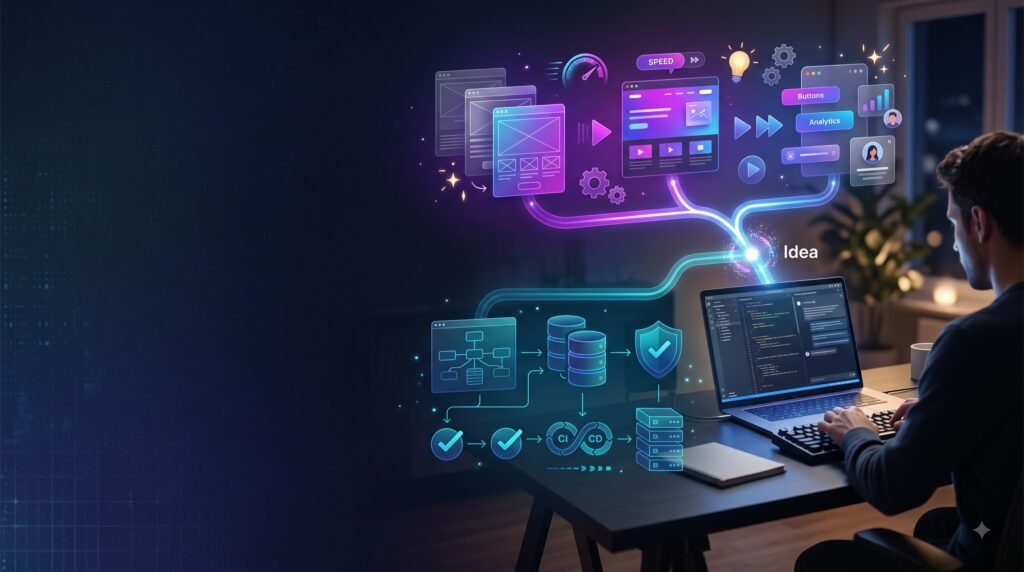
Vibe coding can be acceptable practice if mistakes can be made cheaply, the scope is constrained, and it can fail or be thrown away with minimal losses.
Scenario 1: prototyping a business idea
A founder wants to show the forces of nature that this or that booking process can function and make sense before designing a full-scale product. An AI prototype can serve as a communication tool for the founder, who will be able to convey the idea to the market more easily and receive feedback. However, one should not confuse the prototype’s very existence with the technical feasibility of the product as a whole.
Scenario 2: building a low-risk dashboard for internal use
A small team wants a dashboard to help it store and organize the information that is non-critical or can be backed up in another way. One should consider vibe coding only if the target environment is not available to the public, the data is not sensitive, and there is no need for the tool after a certain deadline.
Scenario 3: learning or experimenting
A coder or a founder wants to play with a particular API, design a user interface, or see how a certain function can be implemented in code.
AI can reduce the effort needed to create an experiment, provided the result is reviewed before it is reused in a more important system.
When Is Professional Development the Better Choice?
Professional engineering is particularly valuable when failure could affect customers, revenue, privacy, or business continuity.
Customer-facing SaaS applications
A subscription product may need account management, permissions, billing, cancellation flows, tenant isolation, and reliable handling of customer data.
When Is Professional Development the Better Choice?

Professional engineering is particularly valuable when failure could affect customers, revenue, privacy, or business continuity.
Customer-facing SaaS applications
A subscription product may need account management, permissions, billing, cancellation flows, tenant isolation, and reliable handling of customer data.
The challenge is not simply generating these features. It’s making sure they work together and continue to work as the application changes.
Payments and financial workflows
Payment processing requires careful handling of transaction states, failures, retries, refunds, and access to financial information.
Use appropriate payment-provider integrations and test the complete workflow. Don’t assume that an AI-generated checkout screen proves the underlying payment flow is reliable.
Healthcare and other sensitive applications
Applications that process sensitive information or operate under regulatory requirements need suitable privacy, security, and compliance controls. The relevant obligations depend on the jurisdiction and use case.
Complex business systems
CRM, ERP, logistics, and multi-platform applications often involve multiple users, permissions, integrations, and long-term operational requirements.
A structured engineering process helps manage these dependencies and establish who is responsible for testing, deployment, and maintenance. It’s making sure they work together and continue to work as the application changes.
Payments and financial processes
Payment processing involves careful tracking of transaction states, failures, retries, refunds, and access to financial information.
Use appropriate payment-provider integrations and test the complete workflow. Do not be fooled into thinking that an AI generated checkout screen means the underlying payment flow is sound.
Healthcare and other sensitive applications
Applications that process sensitive information or operate under regulatory requirements need suitable privacy, security, and compliance controls. The relevant obligations are determined by the jurisdiction and the use case.
Complex business systems such as CRM, ERP, logistics chains, or multi-platform applications require extensive collaboration, permission management, and long-life cycle maintenance.
A rigorous engineering process is required to design and implement the necessary testing and deployment procedures and to define responsibilities.
The Hybrid Approach: Use AI With Professional Oversight
The options are not limited to either mood coding or writing out all of the code manually.
A hybrid approach makes use of such methods as an aid to speed up appropriate tasks while humans take over where judgment is needed, such as with requirements, architecture, validation, and other areas that call for professional engineering decisions.
A practical workflow looks like this:
- Define the outcome. Describe the user problem, required behavior, and what counts as success.
- Build a small prototype. Use AI to find out what is on the screen, the processes taking place, or the subset features available inside of it.
- Check that what you are told works. Look into the code, required libraries, permissions, and data usage.
- Test the significant behaviors. Ensure that the happy paths, error cases, and relevant protection mechanisms perform up to standard.
- Finally, prepare your solution for deployment.
Set up the infrastructure, secrets, backups, monitoring, and rollback procedures as required.
Support the product under maintenance. Prepare documentation, and standard operating procedures for addressing bugs, upgrades, requirements, and so on.
The degree of care allocated to these stages depends on the product’s domain and impact. A throwaway prototype does not require extensive release preparation, while a financial system processing customer data needs to have the highest level of security.
How to Move From a Vibe-Coded Prototype to a Production Product
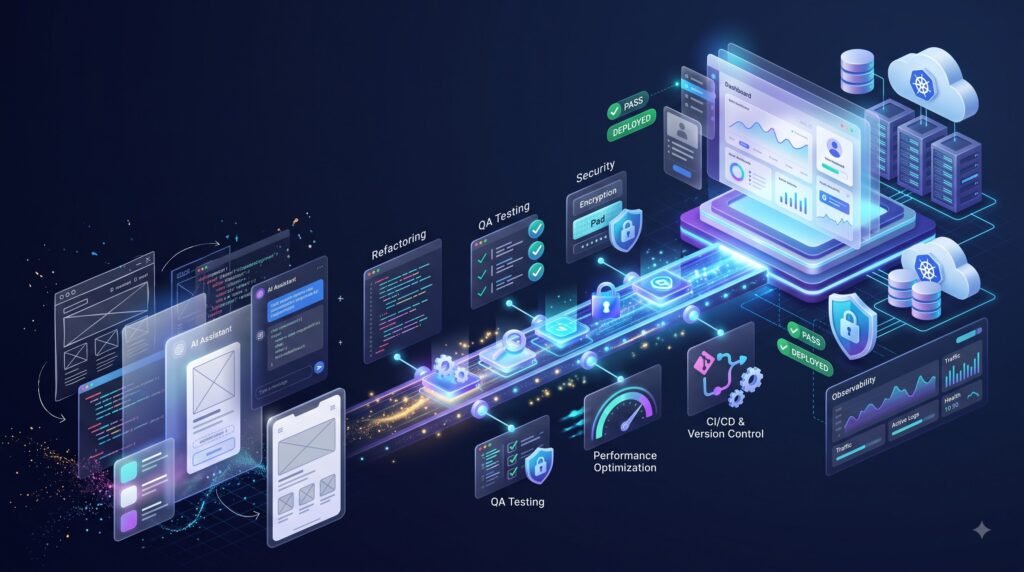
If you’ve already built an application with AI, you don’t necessarily need to throw it away and start over.
Begin by assessing what exists.
Step 1: Inventory the application. What should be done to identify the frontend, backend, database, external services, authentication, deployment setup, and dependencies?
Step 2: Establish the current state. Identify what works, what has been tried, and what has not been tested. Determine which features have proven themselves, which are well-documented, and which are based on unproven assumptions.
Step 3: Identify high-risk areas. determine whether it is possible to retain the application’s current design or if specific elements need to be redeveloped entirely.
Step 4: Evaluate the architecture and codebase . Determine whether the application’s current design can be retained or if any particular components should be completely redesigned.
Step 5: Decide on a testing strategy. Determine the application’s key scenarios that should undergo testing, as well as the crucial edge cases, external service integrations, and ways in which the system may fail.
Step 6: Document and deploy with care. Store the necessary setup and deployment instructions, environment variables, external service credentials, database schemas, and other critical information that may be required to re-create the system or restore it from backups.
Step 7: Determine the scope of enhancements. Use the assessment results to size the work required to bring the system to release readiness and prioritize the changes based on the insights gained from the technical debt audit.
This approach might help to save the potentially useful parts of the system, expose the technical debt for further prioritization before the product reaches an unsustainable state.
When Should You Hire a Developer or MVP Development Team?
Consider professional help when you are unable to understand how the application is handling permissions, storing data, processing payments, or recovering failures.
Professional help might also be required when the changes made by AI cause recurring breakdowns in other functions, when the code becomes incomprehensible, and during preparations for long-term maintenance of the product.
Before hiring someone, ask:
- What will be reviewed before the application goes live?
- How security, testing, and deployment will occur?
- Will I get the source code, documentation, and instructions of the deployment?
- Who owns code, and any intellectual property that might come up during the agreement?
- What happens if there is a bug discovered after launch?
- How will additional scope and ongoing maintenance be priced?
Founders should contrast the scope and obligations of proposals, not only the billable hour and estimated delivery term.
For founders evaluating structured MVP delivery, Bkabhi publishes information about its MVP development services and how to hire MVP developers for an early product launch. These resources may be helpful in asking the right questions around the scope of the work and what development support is available. Make sure to check their current services before finalizing your choice.
Final Verdict: Vibe Coding or Professional Development?

Vibe coding is useful for exploring ideas, generating prototypes, and accelerating well-defined tasks. Professional development is valuable when the product needs dependable behavior, appropriate security, maintainable architecture, and clear operational ownership.
For many startups, the most practical option is a combination of both: use AI where it saves effort, then apply the right level of engineering review and testing before relying on the result.
The deciding factor is not whether a human or an AI wrote the code. It’s whether the finished software meets its requirements and can be operated safely, maintained effectively, and improved as the business grows.
Start with the smallest useful version, understand the risks, and increase the level of engineering assurance as the consequences of failure increase.
Author Bio
Jeevesh Tripathi is a research-focused writer covering technology, artificial intelligence, software development, SaaS, and creator and business tools. His writing emphasizes practical comparisons, evidence-based evaluation, and clear explanations that help founders and businesses assess technology choices without unnecessary jargon.
Email: jeevesh@bkabhi.com
Website: BkAbhi Innovations Lab