

Choosing React Native or Flutter for an MVP shouldn’t start with a benchmark chart.
The more useful question is: which framework creates fewer risks for the product you’re actually trying to launch?
If you’re building an iOS and Android MVP, both React Native and Flutter can be strong choices. The difference becomes clearer when you consider your existing development team, web application, UI requirements, native device features, hiring plans, and what you expect to do after the MVP.
For a startup with an existing React and TypeScript team, React Native can be the more practical choice. For a new mobile product with a highly customized interface or animation-heavy experience, Flutter can be attractive.
Neither framework is automatically the right answer.
Table of Contents
Quick Answer: React Native or Flutter for an MVP?
Choose React Native when your team already knows React/TypeScript, your product has a React-based web application, or you expect to rely heavily on the broader JavaScript ecosystem.
Choose Flutter when highly consistent custom UI, animation-heavy experiences, or a single Dart-based application codebase are major priorities.
For a typical startup MVP, performance differences shouldn’t be the only deciding factor. Both technologies are capable of producing production mobile applications. The bigger question is which technology fits the people, product requirements and roadmap behind the MVP.
What Is React Native?

React Native is an open-source framework for building mobile applications using React and JavaScript/TypeScript.
It lets developers create Android and iOS applications from a shared codebase while still interacting with native platform capabilities.
One important detail has changed considerably over the last few years.
Older React Native comparisons often describe the framework primarily around an asynchronous JavaScript-to-native bridge. That description is no longer sufficient for a 2026 comparison.
React Native’s New Architecture introduced JSI-based JavaScript/native interaction, Fabric, TurboModules and other architectural changes. The New Architecture became the default in React Native 0.76 and React Native 0.82 moved to a New-Architecture-only model.
The result is that founders evaluating React Native today shouldn’t base their decision on performance criticisms written for much older versions of the framework.
React Native also officially recommends using a framework such as Expo for new applications.
For an MVP team, that matters because the framework around React Native can affect development workflow, upgrades, builds and deployment—not just the UI code itself.
What Is Flutter?
Flutter is Google’s open-source UI framework for building applications from a shared Dart codebase.
Flutter has a different architectural approach from React Native.
Instead of primarily relying on platform-backed UI components, Flutter provides its own widget framework and rendering architecture. Its engine handles rendering and communicates with the target operating system through platform-specific integration layers, an architectural approach that distinguishes Flutter from frameworks such as React Native. For a broader comparison of Flutter and React Native, see Rishabh Software’s Flutter vs React Native comparison.
Flutter’s current rendering stack includes Impeller, which is designed to provide predictable rendering performance and reduce runtime shader compilation issues.
This architecture gives Flutter strong control over how the interface is rendered.
That’s particularly useful when the product’s visual identity is a major part of the experience.
React Native vs Flutter: Key Differences

| Factor | React Native | Flutter |
| Primary language | JavaScript / TypeScript | Dart |
| UI approach | React components backed by native platform components | Flutter widget and rendering system |
| Mobile targets | iOS and Android | iOS and Android |
| Existing React skills | Major advantage | No direct advantage |
| Custom visual UI | Strong | Very strong |
| Platform-native UI | Strong fit | Requires Flutter’s platform integration approach |
| Animation-heavy interfaces | Strong | Strong |
| Native integrations | Strong | Strong |
| Web ecosystem alignment | Strong | Different ecosystem |
| Cross-platform development | Yes | Yes |
| Developer workflow | React/TypeScript ecosystem + framework tooling | Dart + Flutter tooling |
| Best deciding factor | Team and ecosystem fit | UI/rendering and product fit |
The table is useful as a starting point, but it doesn’t answer the most important question: which one is better for your MVP?
For that, the individual trade-offs matter.
Development Speed: Which Gets an MVP Out Faster?
Both frameworks are designed to support cross-platform development.
That means you don’t have to build completely separate iOS and Android applications for the entire product.
But “one codebase” doesn’t automatically mean “half the development time.”
You’ll still need to deal with:
- Product requirements
- UI/UX design
- Backend development
- Authentication
- APIs
- Payments
- Notifications
- Testing
- App-store submission
- Device-specific behavior
- Analytics
- Security
- Third-party integrations
The framework is only one part of the delivery process.
React Native advantage
React Native can be particularly efficient when developers already know:
- React
- TypeScript
- JavaScript
- React-based web development
That knowledge can reduce context switching and make it easier to share concepts between web and mobile teams.
Flutter advantage
Flutter gives developers a consistent framework and widget system for building the interface.
For teams already comfortable with Dart and Flutter, this can make development highly productive.
MVP conclusion
Don’t ask:
“Which framework is inherently faster?”
Ask:
“Which framework can my actual team deliver confidently with?”
A team that knows React Native can easily outperform an inexperienced Flutter team, and the reverse can also be true.
Performance: Is Flutter Faster Than React Native?

This is one of the most repeated questions in this comparison.
The simple answer is:
There isn’t a useful universal winner for every MVP.
Flutter has a strong rendering architecture and Impeller is designed around predictable graphics performance.
React Native has also changed significantly through its New Architecture, including improvements to JavaScript/native interaction and its rendering system.
That makes older claims such as:
“Flutter is fast because React Native has a slow bridge”
too simplistic for current projects.
For a normal MVP involving:
- Login
- Profiles
- Forms
- Dashboards
- Search
- Payments
- API requests
- Messaging
- Notifications
- CRUD operations
both frameworks can provide sufficient performance when the application is properly engineered.
The framework becomes more important when the product depends heavily on:
- Complex animations
- Real-time graphics
- Advanced camera processing
- Large amounts of visual rendering
- Highly interactive gestures
- Specialized hardware
- Intensive background processing
In those situations, performance should be evaluated against the actual feature rather than a generic benchmark.
Practical rule
If your MVP is primarily a business application, don’t choose Flutter solely because you heard it is faster.
If your product’s core value depends on graphics-heavy interactions, evaluate Flutter seriously.
If your application depends heavily on existing React/native libraries, evaluate React Native just as seriously.
UI and Design: Which Is Better?
This is one of the areas where the architectural difference becomes visible.
React Native works with platform-backed components and lets developers create platform-specific implementations where necessary.
That can help an application behave in ways users expect from iOS and Android applications.
Flutter takes more control over rendering through its widget system and engine.
This makes it particularly attractive when the design needs to look highly consistent across platforms.
Choose React Native when:
- Native platform conventions matter
- You want platform-specific UI behavior
- Your team already uses React
- You have an existing React design system
- You want close alignment with a React web application
Consider Flutter when:
- Brand identity is heavily visual
- You need highly customized screens
- Animations are central to the product
- Pixel-level cross-platform consistency matters
- You don’t already have a strong React investment
Neither approach is automatically better.
The right question is whether you want the application to feel platform-native or visually consistent across platforms.
Native Device Features
MVPs often start simple and become more complicated.
A founder may initially ask for:
“A booking app.”
Six months later, the product may require:
- GPS
- Background location
- Bluetooth
- Camera processing
- Push notifications
- Biometrics
- NFC
- Audio
- Video
- Deep links
- Native payment SDKs
Both React Native and Flutter can work with native functionality.
React Native provides mechanisms for native modules and native components, including the ability to connect JavaScript/TypeScript code with native Android and iOS implementations.
Flutter also provides platform integration mechanisms and plugins.
The important issue isn’t whether either framework can technically access native functionality.
They can.
The real question is:
How mature is the specific integration your product needs?
If your MVP depends on a specialized SDK, check the actual package or plugin before choosing the framework.
Don’t assume that “Flutter supports it” or “React Native supports it” is enough.
Verify:
- Current maintenance
- New Architecture compatibility
- iOS support
- Android support
- Documentation
- Open issues
- Last release
- Production usage
- Native fallback options
React Native vs Flutter for SaaS MVPs

A SaaS founder may have a slightly different decision.
Suppose you’re building:
- A web dashboard
- A mobile application
- Subscription billing
- User accounts
- Notifications
- Analytics
- AI features
- Admin tools
If your web application is already based on React and TypeScript, React Native becomes especially interesting.
You may not literally share every component between web and mobile.
But the team can share:
- JavaScript/TypeScript knowledge
- Business logic concepts
- API patterns
- Validation approaches
- Data models
- Developer tooling knowledge
- General React expertise
That can simplify team organization.
Flutter can still be an excellent choice, particularly when the mobile experience has a strong independent identity.
Example
Imagine a SaaS platform with:
- Next.js web application
- React-based admin dashboard
- React Native mobile app
- Node.js backend
A React Native mobile application may create a more natural organizational fit.
Now imagine a consumer application where the mobile experience is almost entirely custom and highly animated.
Flutter may deserve more consideration.
Hiring and Long-Term Maintenance
This factor is often ignored during MVP discussions.
Founders usually think:
“We just need to build version one.”
But what happens after launch?
Your MVP may need:
- Bug fixes
- OS updates
- New features
- Analytics
- Performance improvements
- Security patches
- New integrations
- App-store maintenance
The framework you choose becomes part of your long-term engineering organization.
For that reason, developer availability matters.
A framework with a technically attractive architecture is less useful if you can’t reliably find people to maintain your codebase.
React Native
React Native benefits from the wider JavaScript/TypeScript and React ecosystem.
That can be useful for startups that already have web developers.
Flutter
Flutter requires developers comfortable with Dart and the Flutter ecosystem.
That’s not necessarily a problem.
A strong Flutter team can build and maintain an excellent product.
But a founder should account for the actual hiring market available to them.
The practical rule
Choose the technology you can realistically staff for the next two to three years, not only the next three months.
AI-Powered MVPs: Does the Framework Matter?

AI is increasingly part of mobile MVPs.
You might build:
- AI chat
- Recommendation features
- AI search
- Content generation
- Document analysis
- Voice assistants
- Image processing
- AI workflow automation
The mobile framework usually isn’t where the AI model runs.
A common architecture is:
Mobile app → Backend/API → AI service/model → Database
In that architecture, the critical engineering decisions are usually around:
- API design
- Authentication
- Streaming responses
- Data privacy
- Prompt management
- Model selection
- Cost controls
- Rate limiting
- Observability
- Data storage
Both React Native and Flutter can be the mobile part.
So do not choose Flutter because Flutter is better for AI, and React Native because React is better for AI.
Instead, look at the actual AI architecture.
Cost: Is React Native Cheaper Than Flutter?

There is no reliable universal price difference between React Native and Flutter.
The development framework is only one variable.
MVP cost is also affected by:
- Number of screens
- UX complexity
- Backend requirements
- Authentication
- Payments
- Third-party APIs
- Real-time functionality
- AI integrations
- Admin dashboards
- Testing
- Security requirements
- Native functionality
- Team seniority
- Project management
- Post-launch support
Two teams can quote completely different prices for the same framework.
So be cautious with articles claiming:
“Flutter always costs 20% less.”
or:
“React Native always costs 40% less.”
Those percentages aren’t universal rules.
What cross-platform development can change
If you build one cross-platform application instead of two completely separate native applications, you can potentially reduce duplicated development work.
But you still need iOS and Android testing, platform-specific adjustments and app-store work.
Cross-platform does not mean “build once and never think about platforms again.”
Can React Native and Flutter Scale Beyond an MVP?
Yes.
The bigger question is whether the architecture surrounding the framework is scalable.
A poorly designed application can become difficult to maintain regardless of whether it uses React Native or Flutter.
For a serious MVP, think about:
- Modular code
- API boundaries
- Authentication
- Data architecture
- Error handling
- Logging
- Testing
- CI/CD
- Environment management
- Dependency management
- Analytics
- Security
- Documentation
Don’t over-engineer for millions of users before you’ve validated the product.
But don’t deliberately create a disposable codebase either.
The goal is:
Lean enough to validate, structured enough to continue.
When React Native Makes More Sense
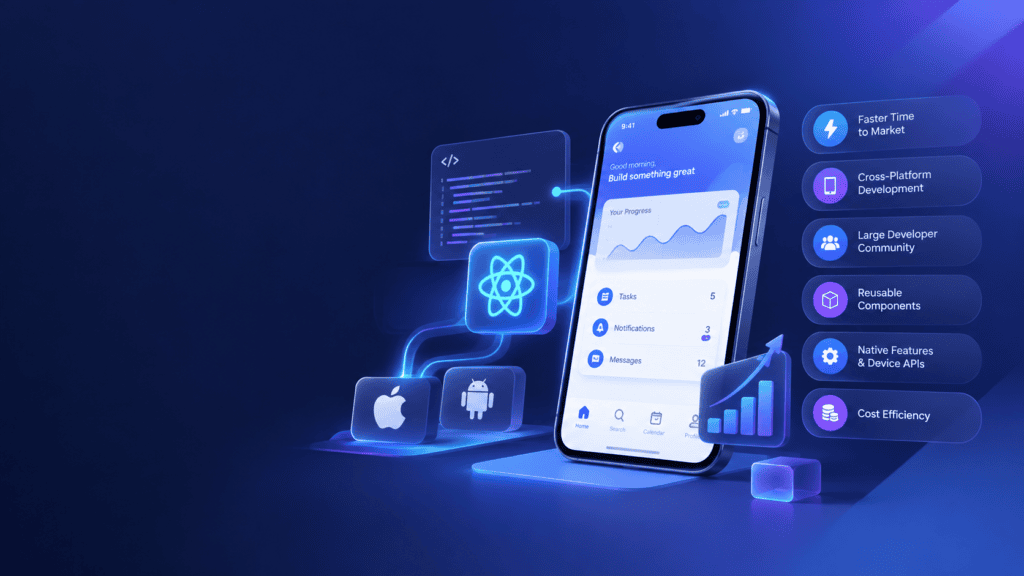
React Native may be the stronger choice when:
You already have a React team
This is probably the clearest reason.
If your developers already work in React and TypeScript, you aren’t starting from zero.
You have a React web application
A web + mobile product can benefit from having a shared technology ecosystem.
You need broad JavaScript ecosystem access
React Native sits within a very large JavaScript/TypeScript ecosystem.
You expect to hire more developers later
Your future hiring strategy matters as much as the initial build.
Your app uses conventional business UI
Examples include:
- SaaS companion apps
- Booking apps
- Marketplace applications
- CRM applications
- Productivity tools
- Customer portals
- Internal business applications
React Native can be a practical fit for these products.
When Flutter Makes More Sense
Flutter deserves serious consideration when:
The UI is the product
If visual experience is a major differentiator, Flutter’s rendering approach can be valuable.
You need highly customized UI
A product with unusual transitions, interactive visual elements and consistent cross-platform design may benefit from Flutter.
Animations are central
For products where animation isn’t decoration but part of the user experience, Flutter is worth evaluating closely.
You don’t have an existing React investment
If you’re starting a mobile product from scratch, the React-versus-Dart decision becomes more neutral.
You want Flutter’s broader platform model
Flutter officially supports mobile, web, desktop and embedded targets, although using Flutter across all of those targets doesn’t mean every application should do so.
When Neither React Native nor Flutter Is the Right Choice
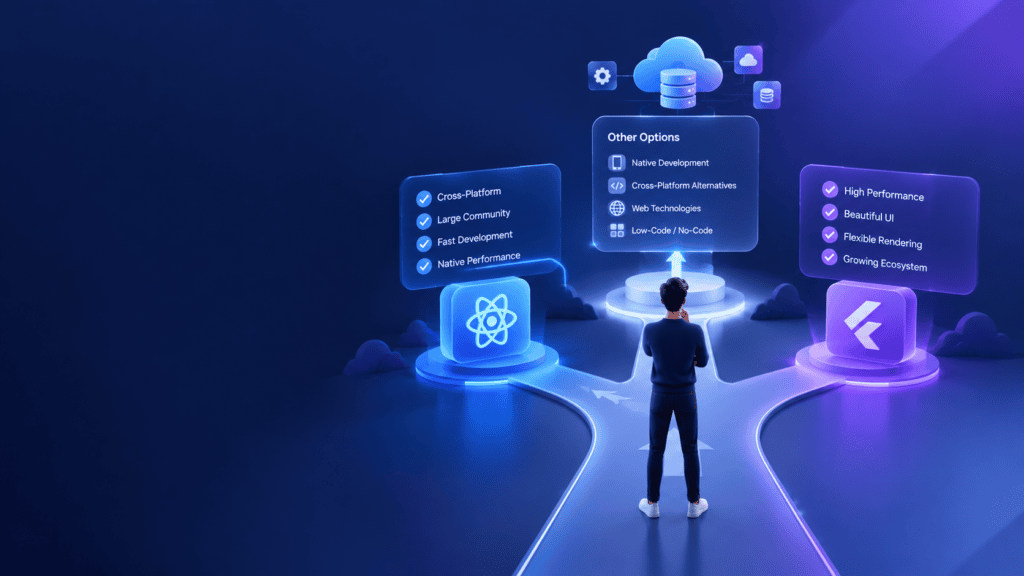
Sometimes the correct answer is neither.
Consider native development when your application depends heavily on:
- Advanced hardware
- Deep operating-system integration
- Specialized background processing
- Platform-specific UX
- High-end graphics
- AR/VR
- Highly specialized native SDKs
In those situations, Swift/SwiftUI for Apple platforms and Kotlin/Jetpack Compose for Android may be more appropriate.
There’s another possibility too.
If your objective is only to validate whether customers want the product, you may not need a full mobile application yet.
A responsive web application, PWA or even a no-code prototype could sometimes test the core hypothesis more cheaply.
The best MVP technology is not necessarily the technology that produces the most impressive architecture.
It’s the technology that helps you learn what you need to learn without creating avoidable technical risk.
A Practical Decision Framework
Use this checklist before choosing.
Choose React Native if most of these are true:
- Your team already knows React
- Your team uses TypeScript
- You already have a React/Next.js web application
- You want web/mobile organizational alignment
- Your application uses conventional business UI
- You expect to hire JavaScript/TypeScript developers
- You need mature native integrations
- Your UI isn’t primarily graphics-driven
Choose Flutter if most of these are true:
- You don’t already have a strong React investment
- Highly customized UI is important
- Animation is central to the product
- Cross-platform visual consistency matters
- Your team is comfortable with Dart
- The product is mobile-first
- You want Flutter’s widget/rendering model
Consider native if:
- The product relies heavily on specialized device APIs
- Platform-specific behavior is core to the product
- You need maximum platform control
- Cross-platform abstraction creates unacceptable limitations
What Should a Non-Technical Founder Ask a Development Partner?

You don’t need to become a React Native or Flutter expert.
Instead, ask the development team:
1. Why are you recommending this framework for my product?
A good answer will reflect your actual requirements
2. Which features could require native code?
This exposes the underlying technical complexity
3. What percentage of the code do you expect to share across iOS and Android?
The exact percentage isn’t the goal. The discussion is.
4. What happens if we need a native SDK later?
This tests the team’s ability to manage future requirements.
5. Who will maintain the application once it is launched?
This exposes the long term plans.
6. What happens if we change development teams?
You want a codebase another competent team can understand.
7. What framework version and tooling will you use?
Avoid answers such as “the latest version”.
8. What parts of the project are included in the quoted price?
This is particularly important for integrations, QA and deployment.
How BkAbhi Fits Into the Decision
BkAbhi’s current website positions its mobile capability around cross-platform mobile experiences and specifically lists React Native, Expo, iOS and Android. Its homepage also describes an MVP-focused development model and a broader capability set covering SaaS architecture, AI integration and motion design.
That makes React Native a natural part of the technology discussion when evaluating BkAbhi for a mobile MVP.
However, founders shouldn’t choose a development partner solely because it uses a particular framework.
The more useful evaluation is whether the partner can:
- Define the MVP scope
- Select the appropriate technology
- Explain trade-offs
- Handle backend/API work
- Integrate third-party services
- Test both platforms
- Prepare the product for launch
- Support post-launch iteration
BkAbhi currently publishes a $2,999 one-time “Ship My MVP” package and a $997/month “Live Product Partner” package on its homepage. The site also states that the estimator is illustrative and that final scope and timeline are confirmed during discovery.
So those figures should be treated as publicly listed packages, not a universal quote for every React Native mobile MVP.
For founders comparing development partners, the broader BkAbhi MVP material on stack selection and mobile MVP development can provide additional context.
Final Decision: React Native or Flutter?

There is no responsible one-line winner.
Instead:
Choose React Native if…
Your existing team knows React/TypeScript, you have a React-based web product, or the broader JavaScript ecosystem is strategically useful.
Choose Flutter if…
Your product is highly visual, animation-heavy or requires a tightly controlled cross-platform UI and you don’t have a strong React investment.
Choose native if…
Your product depends on deep platform functionality that makes a cross-platform abstraction more of a liability than an advantage.
And if you’re still unsure, don’t start with the framework.
Start with the MVP requirements.
List the five or six features that absolutely must work.
Then evaluate each framework against those features.
That’s a much more reliable decision than choosing based on a generic performance benchmark or an old “Flutter vs React Native” ranking.
Bottom Line
For most founders, React Native vs Flutter for MVP isn’t really a contest between two technologies.
It’s a decision about:
team → product → integrations → UI → roadmap → maintenance.
React Native is especially compelling when React and TypeScript are already part of your organization.
Flutter is especially compelling when custom UI and rendering control are central to the product.
Both can support serious mobile products.
The best choice is the one that gets your MVP into users’ hands without creating technical constraints that you’ll immediately regret after validation.
Author Bio
Jeevesh Tripathi
Email: jeevesh@bkabhi.com
Jeevesh Tripathi writes research-based content covering technology, AI, software, SaaS, and digital products. His work focuses on practical comparisons, evidence-based evaluation, and helping founders and technology teams understand product-development decisions without unnecessary jargon.
His articles emphasize source-backed research, practical trade-offs, and a clear distinction between verified facts and analysis.