
Table of Contents
Introduction
Startups often raise early-stage capital using convertible instruments before setting a formal company valuation. This structure simplifies early fundraising by deferring valuation discussions until a later, larger institutional round.
Valuation & Convertible Instruments Overview
- Valuation Deferral: Pre-seed and seed startups typically do not have revenues, established financial history, or other metrics that could be used for a standard equity valuation. A priced equity round at such an early stage may lead to either excessive dilution of the founders’ ownership or an unrealistically high valuation floor.
- Speed and Efficiency: Legal paperwork for a priced round (e.g., Series A) usually involves a lengthy discussion of such terms as seat on the board of directors, voting rights, and liquidation preferences. In contrast, a convertible round requires fewer negotiations and legal paperwork, saving both time and money.
- Bridge Mechanism: The capital raised in a convertible round is turned into shares during the next priced equity round (typically, a Series A fundraising).
What Is a Convertible Note?
Definition A convertible note is a short-term debt instrument used by start-ups to raise early-stage funds. In this instrument, the principal is converted to equity automatically upon the occurrence of a predefined event, usually a new round of financing.
How it works The convertible note helps in raising capital in the early stages when the start-up may not have a defined valuation. The convertible note provides the framework of convertible equity, which is issued to investors at the pre-seed or seed level. This note is then converted to common stock at the initiation of a future funding round, such as during Series A.
There are several terms that define the note’s features:
- Interest rate: The security has a specified interest rate set for any convertible note, unlike other types of debt, which are paid by additional shares of stock; thus, the former’s investors receive a bigger number of shares than they initially bought.
- Discount rate: This term implies additional shares of stock given to the investors for a lower price than the current valuation price per share. For instance, one can take the example of 30% discount on $10 shares means note holders pay $7.
- Valuation cap: This term refers to the highest value that a security can reach at the time when a conversion process begins. For that reason, if the cap is set lower than the company’s valuation at the time of conversion, the number of issued shares will be substantial for the investor.
- Maturity date: The term describes the day when the company can repay the note or extend it for further negotiations.
- Why startups use them Convertible notes appeal to founders mainly because they’re fast and flexible.
They allow a company to defer a formal valuation, thus giving the company more time to grow before setting a specific price for its equity, and are generally faster to execute than an equity round since they lack the complexity of a full legal transaction.
Conversion is tied to a specific future event rather than a date.
Conversion in a convertible note can happen in a few ways.
It can be triggered by a later fundraising event when the company has achieved a certain valuation, or it can be triggered by agreement between the parties when it is advantageous for both.
It most often takes place during a Series A, or other priced equity financing, since that is when the company will have set a valuation for itself.
Maturity and default.
If a note is not converted by its maturity date, then the company and the note holder must renegotiate the terms of the note, or the company must repay the loan.
Many notes, however, have automatic conversion at maturity built into their terms, and the choice between conversion and renegotiation is an important consideration for the parties at the time of funding.
Default and liquidation.
The failure of the company before any conversion event takes place results in a claim on the company’s assets like a debt obligation, making them effectively senior to equity.
If the company is liquidated and determined to have no assets for repayment, note holders who have not converted their notes will lose their investment; however, in the case of equity conversion, the note holder will not hold any equity in the company.
Reasons for preference for convertible notes by investors.
For risk-bearing investors, convertible notes provide upside potential while protecting the downside due to the dual nature of the return, similar to a debt obligation with a coupon and a conversion discount or cap.
The risk and reward profile of a convertible note is different from that of a straight equity investment.
Although note holders have fewer rights than equity investors since they cannot vote on issues such as new investments or mergers until conversion, they possess a degree of downside protection and potential for increased gain.
How a Convertible Note Works (The Flow)
A convertible note typically moves through five key stages, from the initial investment to conversion into equity.
1. Investor Provides Capital
The investor supplies the start-up with capital in the form of a convertible note rather than buying shares directly. The investor agrees to allow the company to settle this debt by converting it into equity if a certain conversion event occurs. For a more extensive comparison of convertible note vs SAFE, including their key differences, terms, and use cases, see the detailed comparison.
2. Note Is Issued
The startup issues the convertible note and will have to accept the conditions that this document imposes. Typically, they are related to the principal amount, interest rate, valuation cap, conversion discount, the maturity date, and factors that will trigger the conversion.
3. Interest Accrues
Interest accrues on the outstanding principal according to the terms of the note. In many convertible note agreements, the accrued interest is not paid in cash but is added to the amount that converts into equity.
4. Qualified Financing Occurs
When the company has completed a qualified financing, the conversion event is triggered.
A qualified financing would generally be a future priced equity round which meets a minimum investment amount or other criteria specified in the note agreement.
5. Note Converts Into Equity
The principal amount plus any accrued interest shall be converted into equity based on the terms of the conversion feature in the agreement. The investor could get the shares based on the valuation cap, a discount rate, or a different conversion formula that shall be indicated in the note and financing round.
To summarize, the convertible note provides a start-up company with the ability to raise funds prior to the valuation while offering the investor a contract feature that allows him to participate in the next round of financing.
Key Convertible Note Terms
- Interest Rate: The annual interest rate that is charged on the face value of the convertible note. Accrued interest is subject to conversion into equity, together with the initial principal amount, upon occurrence of a conversion event.
- Maturity Date: The date by which the convertible note becomes due and payable. If the company does not complete a qualified financing or other specified event by the maturity date, the note may be subject to repayment or alternative terms.
- Valuation Cap: The maximum valuation at which an investor’s note converts into equity, which is usually set higher than the expected valuation at the time of the next financing round. The cap protects early investors against significant increases in the company’s valuation between the time of their investment and the conversion event.
- Conversion Discount: A percentage discount off the price per share for purposes of converting the note into equity, typically applicable if the next round of financing involves a higher valuation. It gives investors who converted their notes the right to purchase shares at a lower price than the price paid by new investors.
- Qualified Financing: A contemplated round or series of equity financing of the company in which the amount of money raised meets or exceeds a specified threshold, or otherwise satisfies certain criteria set forth in the convertible note agreement. Qualified financing usually triggers the conversion of the note into equity.
- Conversion Trigger: An event that causes the conversion of the note into equity. A conversion trigger can be a qualified financing, sale of the company, or another defined event.
What Is a SAFE?
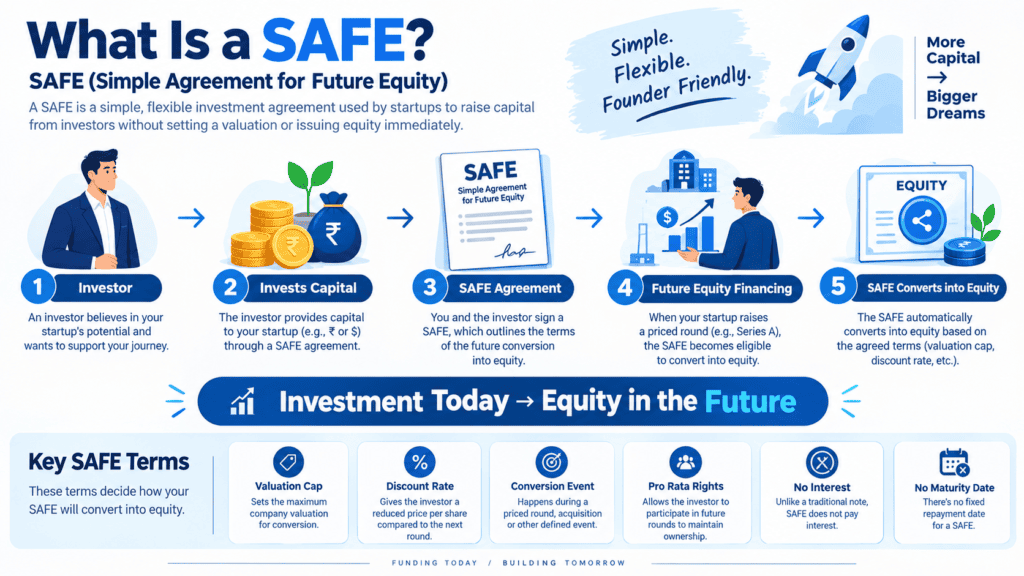
A SAFE (Simple Agreement for Future Equity) is a financial contract used by start-ups to raise money from investors. It is a type of convertible note which means that the investor does not purchase shares outright or lend the money to the company. Instead they provide the cash and in return receive a contract giving them the option to convert their investment into equity at some point in the future when the company completes a priced round of funding.
What Does SAFE Stand For?
SAFE stands for Simple Agreement for Future Equity.
Origin and Purpose
- Created by: The Silicon Valley-based start-up accelerator Y Combinator introduced the notion of a SAFE (security free equity) in 2013 in order to offer a novel approach to a traditional convertible debt instrument.
- Simplifies Seed Rounds: Typically, a priced equity raise at the seed stage involves a lengthy discussion over valuation, voting control, and board composition among founders and angel investors. In this sense, a SAFE allows more flexibility in designing investment terms.
- No Interest Charges: In contrast to a traditional convertible note, a SAFE does not accrue any interest rate and does not have a maturity date, thus preventing any default risk and debt dilution in case of liquidation during an early-stage financing.
How Does a SAFE Work?
The SAFE contract goes through four major stages throughout its life cycle:
- Capital Transfer: Investor transfers the capital to the startup upon signing the contract.
- Deferred Issuance: No shares are actually issued at the time of investment. In addition, the investor does not receive voting power or stock certificates.
- Holding Period: The contract stays in force as an obligation to the company’s cap table as an equity claim.
- Equity Conversion: Upon the occurrence of a specified future financing event (typically either a Series A or priced VC round), the initial investment amount is converted into preferred shares of the company based on the terms of a Series A agreement.
Key SAFE Terms
While a SAFE is designed to be a standardized document, founders and investors customize it using several core mechanisms:
| Term | How It Protects the Parties |
| Valuation Cap | Sets the max company valuation that investor’s capital will convert to equity, giving early investors a guaranteed minimum percent of the company’s equity, no matter how high the valuation goes. |
| Discount Rate | Gives the SAFE investor a price incentive (typically 10%–20% off) relative to new venture capital investors in the subsequent priced round. |
| MFN (Most Favored Nation) Clause | Allows early SAFE investors to adopt more favorable conversion terms if the company subsequently issues SAFEs with better conditions to later investors before a priced round. |
| Conversion / Trigger Events | Defines the conditions under which equity is issued, typically a priced equity financing round above a specified threshold, an acquisition/sale of the company, or an Initial Public Offering (IPO). |
| Pro-Rata Rights | Grants the investor the option to contribute additional funds in future rounds to maintain their existing ownership percentage and avoid dilution. |
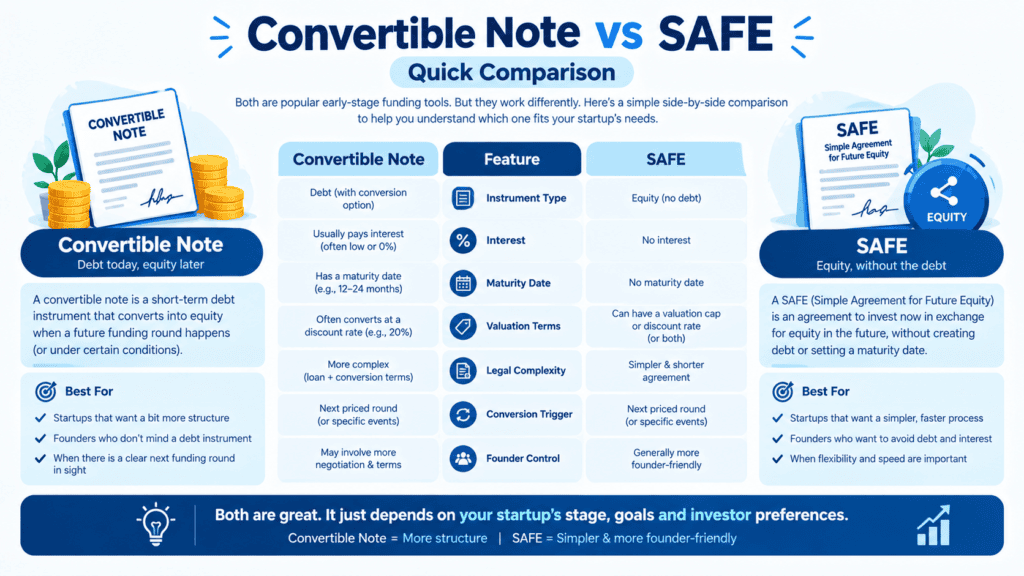
Convertible Note vs SAFE: Quick Comparison
This should be one of the most important sections of the article.
| Feature | Convertible Note | SAFE |
| Legal structure | Debt | Contractual future-equity instrument |
| Debt? | Yes | Generally no |
| Interest | Usually yes | No |
| Maturity date | Usually yes | Usually no |
| Valuation cap | Common | Common |
| Discount | Common | May apply |
| Repayment risk | Possible | Generally no maturity repayment |
| Conversion | Future financing/other trigger | Future financing/other trigger |
| Documentation | More complex | Generally simpler |
| Investor protection | Stronger due to debt status | Different protections |
| Founder flexibility | Moderate | Generally higher |
| Typical use | Seed/bridge financing | Pre-seed/seed |
The debt-versus-non-debt distinction is the main difference that the sources Wise, PandaDoc, Qapita, and others emphasize.
Raising capital in the form of convertible notes or SAFE contracts allows the start-up founder to balance flexibility for the company with the investor’s need for protection during the early stages of development. Both options defer the valuation of the company to a later priced round of financing, but their economic consequences are different due to the variations in the legal structure of these financial instruments.
10 Key Differences
1. Debt vs. Future Equity
A Convertible Note is essentially a debt instrument. It creates a liability on the company’s balance sheet and represents a loan that is to be converted to equity in the case of a future priced round of financing.
A SAFE is not a debt instrument, but rather an equity note. It is a contractual obligation allowing an investor to obtain equity in the company at a future date upon certain triggering events (e.g., Series A round of investment).
2. Interest Rate
- Convertible Notes bear interest over time, usually between 4% and 8% simple interest per year.
- SAFEs don’t accrue interest since they are not a loan.
- The impact of interest on dilution can be significant. The interest that has accrued on a convertible note gets added to the dollar amount of shares at conversion – meaning more equity is being issued than might be expected.
- For example, a $100,000 note at 8% interest converting after two years yields $116,000 worth of shares, which causes additional dilution to the founders beyond what would be the case with a standard SAFE.
3. Maturity Date
Convertible Notes stipulate a maturity date, which is generally between 18 and 24 months. This means that the note has to be converted or paid back by this particular date. In contrast, if there is no qualifying round before the maturity date, the company defaults on the note unless the investors choose to extend the due date. On the contrary, SAFEs do not have a maturity date because they do not expire.
4. Valuation Cap
A valuation cap sets the highest company valuation at which an investor’s capital will be converted into shares in the target company, regardless of how high the target valuation may be during the priced round.
- The Purpose: it protects early risk-takers by ensuring a minimum equity stake in the target company.
- The Dilution Effect: a lower cap usually results in a lower conversion price, per share. This gives the investor more shares for his money, therefore, increasing founder dilution.
5. Conversion Discount
A conversion discount is a percentage (typically 10% to 20%) that provides early investors a discount on the share price at which they are able to purchase shares in the case of a priced round.
Example: 20% Discount: If new investors purchase Series A shares for $1.00 per share, a SAFE or Note holder with a 20% discount converts their capital at $0.80 per share, it will yield 25% more shares for each dollar that has been invested.
If a contract includes both a valuation cap and a discount, the conversion mechanism usually takes the lower share price, which is more beneficial to the investor.
6. Conversion Triggers
Both instruments are converted into preferred stock in the event of an equity financing, although Convertible Notes typically include a “qualified financing” threshold (e.g., raising at least $1M–$2M) that would automatically trigger the conversion. Both instruments define payment mechanisms in the event of liquidity events (e.g., an acquisition or IPO). In addition, however, the Convertible Note includes a separate conversion/payout right triggered by the maturity date.
7. Repayment Risk
Since Convertible Notes are issued as debt, failure to raise a qualified round before the maturity date will result in the right of note holders to demand immediate repayment. In the case of a startup’s inability to repay a note holder, insolvency, restructuring, or bankruptcy proceedings can be initiated. On the contrary, SAFEs do not pose a threat of short-term insolvency.
8. Investor Protection
- Creditor Status: In most respects, convertible note holders are creditors and hence are senior to equity investors in the capital structure. Therefore, in the case of liquidation, the note holders should be repaid before any of the common or preferred shareholders can receive distributions.
- SAFE Priority: SAFE investors have a right to a certain number of equity shares as a contract feature. Consequently, in the case of liquidation, post-money SAFEs typically are senior to common stock but pari passu with (equal to) other standard debt instruments or junior to them.
9. Legal and Administrative Complexity
- Convertible Notes are based on the idea of negotiating interest rates, maturity periods, default scenarios, and other terms, which makes the process time-consuming, expensive, and complicated since there are ongoing interest accruals and complexities on the cap table.
- Meanwhile, SAFEs involve standardized legal contracts (such as those provided by Y Combinator), which allow for faster negotiations, fewer legal charges, and fewer complications with the capitalization table.
10. Founder Dilution
Founders tend to consider their first round of fundraising as the sum of the money raised in dollars, when, in reality, there may be a significant amount of dilution through caps, discounts, and accrued interest. Having uncapped notes or low valuation caps throughout your early-stage notes can severely impact the opportunity cost of a down-round during a Series A priced round. Using a cap table simulator to model post-money SAFEs or converting the debt is essential in order to ensure that the founders do not lose control of the company during the funding round.
Convertible Note vs SAFE: How Conversion Works
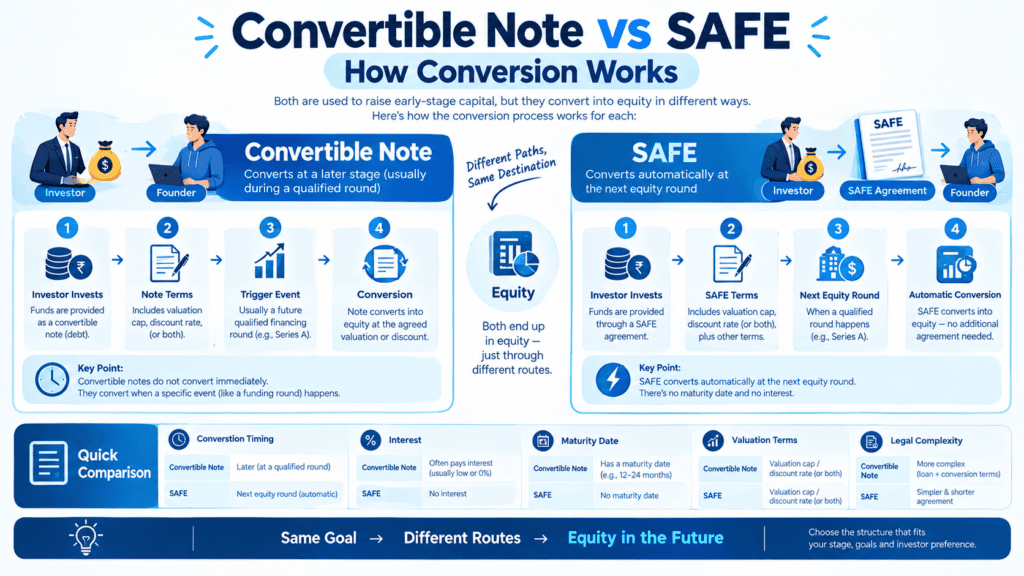
Convertible Note Conversion Example
Setup: $100,000 invested via convertible note, $5M valuation cap, 20% discount.
A convertible note can convert to equity two ways — and the investor typically gets whichever price is lower (since a lower price per share means more shares for the same dollar amount).
Mechanism 1: The Discount The note converts at a discount to whatever price new investors pay in the next round.
Say the startup raises a Series A at a $10,000,000 pre-money valuation, with 10,000,000 shares outstanding — that’s $1.00/share.
- Discounted price = $1.00 × (1 − 20%) = $0.80/share
- Shares received = $100,000 ÷ $0.80 = 125,000 shares
Mechanism 2: The Valuation Cap The note converts as if the company were valued at the cap, no matter how high the actual round valuation is.
- Cap price = $5,000,000 ÷ 10,000,000 shares = $0.50/share
- Shares received = $100,000 ÷ $0.50 = 200,000 shares
Result: Since $0.50 is lower than $0.80, the cap wins. The noteholder converts at $0.50/share and gets 200,000 shares — not 125,000.
One more wrinkle: most convertible notes also accrue interest (often 5–8% annually) that gets added to the principal before conversion. So a note held for a year at 6% interest would convert $106,000 worth of principal instead of $100,000 — pushing the share count even higher.
SAFE Conversion Example
Same numbers: $100,000; $5M cap; 20% discount; same Series A ($10M pre-money, 10M shares, $1.00/share).
SAFEs are basically identical, except they don’t accrue interest, and (in the now-standard post-money version) express the cap as the ownership percentage that the SAFE would amount to if the cap price was used to calculate the total shares issued during the Series A round.
- Discounted price = $1.00 × 0.80 = $0.80/share → 125,000 shares
- Cap-based price = $5,000,000 ÷ 10,000,000 = $0.50/share → 200,000 shares
- Lower price wins → SAFE converts at $0.50/share → 200,000 shares
This simplified example is basically the same as the note scenario, but in practice there are two important differences:
No interest — The SAFE-holder will never accrue additional principal, so the note (all other things being equal) has the potential to convert into more shares when the time comes.
Post-money SAFE mechanics — A post-money SAFE’s cap is calculated as the ownership that the SAFE would represent if it were converted right after all other SAFEs had converted, but before the Series A round had diluted them (had there been other SAFEs). This can sometimes result in a better-than-expected conversion for the SAFE-holder, particularly if there are several other SAFEs that will be extinguished alongside it during the Series A conversion.
Which One Gives Investors More Equity?
There is no single answer, as it depends on several factors:
- The size of the investment – bigger checks benefit more from whichever of the two mechanisms has a bigger discount
- The valuation cap – the lower the cap is compared to the eventual price of the next round, the more shares the investor will get
- The discount – the bigger the discount is, the more shares the investor will get
- The interest (in case of notes) – the more interest has accrued, the higher the principal converted into shares will be, thus the more shares the noteholder will get
- The eventual valuation of the next round – the higher it is compared to the cap, the more shares will be issued to the investor who has a cap in their SAFE/note
- Other SAFE/note holders – in case there are other convertible note or SAFE holders in the company, each of their notes will affect the conversion of the other one, especially if it’s a post-money SAFE or the cap is calculated based on the shares outstanding at the time of conversion
- The conversion mechanics – whether the company has pre-money or post-money SAFE, or the shares issued at the time of conversion for the purpose of calculating the cap for a note are counted as issued or outstanding – can affect the number of shares issued upon conversion
- In short, you should do the math for your specific cap table before assuming that a note or a SAFE with a particular discount or cap is a better deal for you than the other – depending on the circumstances, the other option might have a bigger discount or a lower cap, which would make it a better deal for the investor.d in a SAFE or convertible note, the investor receives the lower of the two conversion prices, providing protection under any funding scenario.
Valuation Cap vs. Conversion Discount Comparison
- Valuation Cap: This is used to protect the investor against an upside risk. In the case where the start-up takes off tremendously and the next round valuation is extremely high, the investor will then convert their note at the lower valuation which gives them a much better percentage.
- Conversion Discount: This protects the investor against downside risk or a flat round. If the very next round happens to be somewhat low or on the lower end of expectations, the discount will ensure that the investor is in a better position than the new investors in the next round.
- Combined Clause: This ensures that the investor benefits from either of the two cases described above.
Worked Example
An investor puts in $100,000 into a SAFE featuring a $5M Valuation Cap and a 20% Conversion Discount.
- Scenario A: High Valuation Series A ($10M Valuation at $10/share)
- Discount Price: $10 × (1 – 0.20) = $8.00/share
- Cap Price: $10 × ($5M Cap / $10M Valuation) = $5.00/share
- Outcome: Valuation Cap provides a better price ($5.00/share) and gives the investor 20,000 shares.
- Scenario B: Moderate Valuation Series A ($5M Valuation at $5/share)
- Discount Price: $5 × (1 – 0.20) = $4.00/share
- Cap Price: $5 × ($5M Cap / $5M Valuation) = $5.00/share
- Outcome: The Conversion Discount provides a better price ($4.00/share) and gives the investor 25,000 shares.
The valuation cap is significant if the company has a high valuation, but if it has a moderate valuation, the conversion discount is more important. The most valuable scenario for the investor is scenario B because it provides them with more shares for the same investment.nificantly more to investors during high-growth raises, as it protects against massive founder dilution. The conversion discount matters more during modest raises where the valuation cap isn’t reached.
Advantages of Convertible Notes
Investor protection: Convertible notes are generally binding legal obligations and provide for some degree of downside protection since investors are creditors of the company.
In the case of bankruptcy, note holders are paid before any dividends can be distributed to stockholders.
Interest compensation: The value of notes is generally increased by interest that accrues during the life of the note (between 2 and 8 percent per year).
The interest is compensation for the use of the investor’s capital during the life of the note before any conversion to common stock.
Defined maturity: Since convertible notes have a maturity date (usually ranging from 12 to 24 months), they provide for a fixed timeline when either a qualified financing or repayment of debt is due.
Familiar structure: The structure of convertible notes is similar to a standard debt instrument.
Many angels and funds are more comfortable dealing with familiar transaction structures.
Usual use: Convertible notes are mostly used in connection with bridge financings. A bridge note is used to provide liquidity to the company during the period between the closing of one financing and the next one (typically a Series A).
Disadvantages of Convertible Notes
Creates debt: The note creates an obligation which is classified as a liability on the balance sheet, thus adversely impacting the debt-to-equity ratio of the company and its capacity to raise further bank loans or venture debt.
Interest increases conversion amount: The accrued interest is not paid out as cash but added to the principal amount of the note and is converted into equity in the next round. Thus, the founder team gets diluted more than expected as compared to just the principal amount.
Maturity pressure: There is a huge obligation on the founder team in case of a down-round or no round before the maturity date. This causes significant stress as the company might be obligated to repay the principal amount with interest, which could put the company into insolvency.
Potential for repayment obligation: In the case of no qualified financing before the maturity date, the company will have to repay the outstanding amount, which will have a detrimental impact on its cash flows, thereby potentially putting the company into insolvency.
More complicated documentation: Documentation is significantly more complex as legal counsel needs to be hired to draw up the fine print regarding the interest rate, maturity date, conversion terms, seniority, and other relevant terms. Thus, the legal expenses and negotiating time are much higher than in the case of simpler instruments
Advantages of SAFEs (Simple Agreement for Future Equity)
SAFEs are usually a 4-8 page document (standardized by Y Combinator) which don’t have complicated debt terms and are written in plain english so that a founder doesn’t need to spend time understanding them.
Founders can raise money faster with a SAFE (compared to a traditional convertible note):
The terms of a SAFE are largely standardized, allowing a founder to get a deal done in days instead of weeks. This can be critical in getting a lead investor in quickly or taking advantage of a hot market.
There is no interest with a SAFE, and the entire amount invested converts to equity at the next priced round with no extra cost to the company or dilution to the founders (aside from the discount/valuation cap if applicable).
A SAFE never matures, meaning that there’s no date by which the company needs to repay the investment. This avoids the dreaded “dilution event” in which a company has to quickly raise money in order to avoid having to pay back a large debt (often with exorbitant interest).
A SAFE generally has less administrative and accounting burden than a debt instrument:
No interest due, repayment schedule, or debt covenants to worry about or administer.
Disadvantages of SAFEs
Potential Dilution: Since SAFEs convert at future priced round on a valuation cap and discount basis, Founders may not have an exact idea of how much equity they are selling at the time of the next round of pricing.
Multiple SAFEs can complicate cap table: SAFEs that are issued at different caps and discounts at various times can make calculation of final ownership at time of conversion mathematically intensive. This can delay closing the priced round as well as new investors.
Investors can negotiate economic rights: Although ‘standard’, sophisticated investors often negotiate in side letters which can include MFN, pro-rata rights, information rights etc which makes the instrument less simple and can create investor asymmetry.
SAFEs outstanding can impact future fundraising: New lead investors in a priced round will often want all outstanding SAFEs to be either converted or capped at a certain valuation. A large SAFE overhang can deter VCs who feel that early investors are unfairly getting a better deal than them.
Quick Decision Matrix
| Factor | Convertible Note | SAFE |
|---|---|---|
| Best for | Bridge rounds, later-stage startups, investors wanting protection | Early-stage, pre-product, fast-moving startups |
| Risk to founders | Maturity/repayment risk | Dilution risk |
| Risk to investors | Company insolvency risk (unsecured debt) | No creditor rights, fully at risk |
| Legal cost | Higher | Lower |
| Tax implications | Interest may be taxable | No interest, generally tax-neutral until conversion |
Convertible Note vs. SAFE for Indian Startups

Are SAFEs Legally Recognized in India?
A pure, unwrapped U.S. SAFE (as popularized by Y Combinator) is not classified as a share, debenture, or security under the Indian Companies Act, 2013.
- U.S. Safe: A pure unwrapped U.S. SAFE represents a mere contractual right to receive equity in the future upon a qualifying event. It has no interest rate, no maturity date, and is completely devoid of any debt character.
- Indian Law: Indian law mandates that any inward cash flow on behalf of an investor must be characterized as Equity, Debt, or Recognized Convertible Security.
- Moreover, the RBI (under the FEMA NDI rules) does not have a reporting framework (e.g., form FC-GPR or CN) for a bare U.S.-style SAFE.
How Convertible Notes Work in India
- The Indian government had a specific set of rules for Convertible Notes (CN) as stated in the Rule 4 of the FEMA NDI Rules.
- DPIIT Recognition: Only startups recognized by the Department of Promotion of Industry and Internal Trade (DPIIT) can issue Convertible Notes legally. Startups that had not been recognized had to compulsorily issue either equity shares or Compulsorily Convertible Debentures (CCDs).
- Minimum Investment: Non-resident investors who invested in the convertible notes had to make a single payment of at least ₹25 Lakhs (~$30,000 USD)
- Conversion/Repayment: The note has to be either converted into equity or repaid back within 10 years time since its issuance (earlier it was 5 years).
- FEMA/NDI & Foreign Investor Rules:
- Issuance of convertible notes to the non-resident investors had to be filed in the RBI’s FIRMS portal (in the form of CN) within 30 days.
- The foreign inward remittance had to be cleared through normal Banking Channels.
- The issuance of convertible notes for the neighboring land-border countries (like China), the transaction had to be approved by the government regardless of the nature of the deal.
- Pricing guidelines: The conversion of the note into equity had to be done on a fair market value (FMV) basis as determined by either a Chartered Accountant or a SEBI registered Merchant Banker.
What Is an iSAFE?
Meaning:
iSAFE stands for India Simple Agreement for Future Equity. It is a contract created by 100x.VC that is designed to bring the economic terms of the US SAFE to Indian startups. It has the same advantages of a US SAFE such as no valuation, no interest rate and immediate conversion at the time of the future funding round.
Replicating SAFE Economics:
The iSAFE replicates the early-stage founder friendly features of the valuation caps, discounts and MFN (Most Favored Nation) clauses of a US SAFE, without creating immediate liabilities on the company’s balance sheet.
Legal Implementation Wrapper:
Since a pure contractual obligation is not permissible under the Indian Companies Act, the iSAFE takes the form of a Compulsory Convertible Preference Shares (CCPS) with a conversion trigger event specified by the parties.
Careful structuring required:
Since CCPS is issued as shares, the following additional steps are required:
- The Special Resolution needs to be passed by the shareholders for issue of CCPS.
- The issue of CCPS needs to be done by way of Private Placement as per Section 42 and Section 62 of the Companies Act.
- The authorized share capital of the company needs to be increased beforehand. At the time of issue instead of the valuation being deferred till the time of conversion, the valuation reports and the filing of the same with the ROC (Form PAS-3) need to be done.
SAFE vs. Convertible Note: India Comparison

| Metric / Dimension | U.S.-Style SAFE / iSAFE (CCPS Wrapper) | Convertible Note (CLN) |
| Legal Structure | Quasi-equity contract wrapped as Compulsorily Convertible Preference Shares (CCPS) | Debt instrument that converts to equity or requires repayment |
| Indian Regulatory Treatment | Governed under Sections 42, 55, and 62 of the Companies Act, 2013 | Governed under Rule 4 of FEMA NDI Rules 2019 & Companies Act |
| Foreign Investment (FEMA) | Treated as equity FDI under NDI Rules; reported via Form FC-GPR | Recognized debt-to-equity instrument; reported via Form CN on FIRMS portal |
| Minimum Investment | No regulatory minimum under FEMA for CCPS structure | ₹25 Lakhs per tranche minimum for foreign investors |
| Conversion & Maturity | No maturity repayment obligation; compulsory conversion upon trigger/time cap | Convertible or repayable within a maximum maturity of 10 years |
| Valuation & Pricing | Requires FMV pricing valuation report at the time of CCPS issuance | Valuation deferred until conversion; must adhere to CA/Merchant Banker FMV caps |
| Compliance & Filings | Higher upfront load: Board & Shareholder Resolutions, PAS-3, MGT-14, FC-GPR | Lower initial load: Board Resolution, Stamp Duty, and Form CN within 30 days |
| DPIIT Requirement | Available to any Indian private limited company (no DPIIT needed) | Mandatory: Startup must hold a valid DPIIT Recognition Certificate |
How Convertible Notes and SAFEs Affect Your Cap Table
Convertible notes and SAFEs (Simple Agreements for Future Equity) are the fastest ways to get money in the door at the earliest stages, but with speed comes sacrifice: the math gets kicked down the road.
Every dollar raised through a convertible note or SAFE represents a claim on equity that will have to be settled at some point in the future, most likely at your next priced equity financing when you can least afford to have difficult conversations about your cap table.
Knowing how these claims affect your cap table and founder ownership before they convert is one of the highest leverage things a founder can do.
Why Future Dilution Matters
A SAFE or convertible note is a claim on equity. That means your “true” capitalization table (that is, who owns what) is not apparent until conversion. Founders who are evaluating their own ownership in the company are potentially looking at a moving target.
The reason has to do with the fact that each SAFE converts down the road at the time of a priced round, which always results in dilution to previous SAFE owners (and anyone else on the cap table).
If you have done multiple rounds of SAFE fundraising within a 12-18 month period, you may be surprised to discover how much dilution is “hidden” beneath the most recent SAFE round — dilution that has not been incorporated into anyone’s current understanding of the cap table.
At the time of the Series A term sheet, many founding teams are shocked to learn just how much of the company the SAFE stack represents.
Multiple SAFEs and Convertible Notes
Many early-stage companies raise multiple SAFEs with varying caps, discounts, and dates. Each SAFE converts independently, but competes for the same pool of shares.
A number of factors make analysis of multiple SAFEs more complicated than the case of a single SAFE:
- Different caps convert at different effective prices. A SAFE with a lower cap will convert to more shares than a higher-capped SAFE of the same vintage.
- Discounts compound in different ways, depending on the ordering of the SAFEs. There is no intuitive way to combine a valuation cap and a discount: whichever gives the investor a larger return (i.e. lower price) dominates, but this can vary from SAFE to SAFE.
- Pro-rata and MFN clauses change the allocation of subsequent rounds’ shares between SAFEs, sometimes dramatically.
The key takeaway is that one cannot simply sum the amounts raised on SAFEs and allocate dilution between them at a first approximation: one must consider the actual shares issued on conversion, which depends on the combination of discounts, caps, and pro-rata/MFN clauses.
In particular, there are situations where later SAFEs with less favorable terms can dominate earlier ones through MFNs, leading to significantly higher dilution than might be expected.hare conversion at your anticipated round size and valuation.
How Valuation Caps Affect Founder Ownership
The valuation cap is the knob that determines how much of the company SAFE investors will own.
It puts a ceiling on the valuation at which the convertible security converts, protecting early investors who purchased the SAFE at the price stated in the contract.
The lower the cap, the higher the percentage owned by SAFE investors (and the lower the percentage owned by the founders), when the cap is reached and the SAFE converts.
Because of this, caps tend to be set low at the beginning when investment rounds are risky and founders face the highest potential dilution.
Founders that naively raise multiple rounds of optimistically priced SAFE loans without considering the impact of the cap on their ownership may find themselves with much less equity in the company than they think.
Another reason why many founders and investors alike misunderstand SAFE terms is due to the fact that a
$500K SAFE at a $
5M
$500K SAFE at a $
10M cap raised six months apart would convert to vastly different ownership percentages for the same amount of capital.
Why Founders Should Model Dilution Before Signing

Because they are so simple to execute, the terms of SAFEs and notes can too often be viewed as “deals of default”, easy to ignore.
They are not! Everything you agree to now, particularly the capping of your ownership in any subsequent round, will affect what you are owed in ownership when the company prices its first round (and you can no longer negotiate new terms).
Before executing any SAFE or note, model the conversion against a range of possible next round sizes to understand the true cost to your ownership in the next round.
Before/After Example: Modeling a SAFE Stack
Imagine a founder who owns 100% of a company at formation, then raises two SAFEs before a priced Series A:
| Stage | SAFE Terms | Founder Ownership |
| At formation | — | 100% |
| After SAFE #1 | $500K at $5M cap | ~90% (SAFE #1 investors hold ~10%, pending conversion) |
| After SAFE #2 | $750K at $8M cap | ~82% (both SAFEs still uncoverted, but reserved) |
| After Series A converts both SAFEs | $3M new money at $12M pre-money | ~58% |
The founder didn’t “lose” 42% in a single transaction, it was a series of reasonable looking transactions that compounded and had limited visibility until a priced round came along to force the issue.
This is why modeling dilution before signing each SAFE (rather than after the round closes) is what’s known as a founder-friendly cap table.
(Note: the numbers above are illustrative and greatly simplified for the purposes of this post. In practice, the math will depend on the size of the option pool, applicable discounts, MFN terms and more)
Common Mistakes Founders Make
Focus Only on the Valuation Cap: While the founders may focus on raising the best possible valuation cap, they tend to ignore other aspects such as conversion discounts, MFN (Most Favored Nation) or pro-rata, etc. One must understand the secondary terms that may adversely affect the cap.
Ignore the Accrued Interest: Unlike SAFEs, the convertible notes accrue interest on a yearly basis (about 4-8%). At the time of conversion, this additional amount has to be converted into shares. Therefore, it results in significantly higher dilution levels in case of conversion after a few years.
Forget about the Maturity: Convertible notes have a maturity date on which the company either has to repay the loan with interest or let the investor convert the debt into equity. So, if the company does not raise a proper round before the maturity date, the founders will have to pay off the debt investors.
No Modeling for Future Dilutions: One must remember that the stocks issued during the conversion of a convertible note or SAFE impact the ownership structure during the subsequent priced round. It is important to model future dilution after every SAFE or convertible note issuance.
Multiple SAFEs with No Understanding of Stacking Dilution: The dilution due to post-money SAFEs issued in informal funding rounds can stack up massively and impact ownership in the final priced round. SAFEs with no cap or with a very high cap may massively dilute the ownership of the founders.
Applying U.S. SAFE Structure without Understanding Local Laws: The standard Y Combinator SAFE is written for the U.S. jurisdiction (Delaware). Companies in other jurisdictions (India, for instance) must consult local attorneys to tweak the SAFE language according to the laws of land and applicable foreign exchange regulations (like iSAFE, CCD, or CN in India).
No Clarity around Conversion Terms: The definition of Qualified Financing in a SAFE/convertible note determines how much equity a founder will have to give up to the early investors. At times, such terms may lead to a dispute between founders and early investors. A similar misunderstanding may happen around liquidation events as well.
Both convertible notes and SAFEs (Simple Agreements for Future Equity) enable a start-up to raise money without a formal valuation. However, the two instruments differ significantly in terms of interest, maturity, and legal aspects.
Executive Comparison
| Feature | Convertible Note | SAFE (Post-Money) |
| Legal Nature | Debt Instrument (Unsecured Loan) | Warrant / Convertible Security |
| Maturity Date | Yes (18–24 months standard) | No (No expiration or repayment pressure) |
| Interest Rate | Yes (Typically 4%–8% per annum) | No (No interest accrual) |
| Investor Protection | High (Debt priority upon liquidation) | Moderate (Standard equity conversion rights) |
| Document Complexity | Moderate (Requires note purchase agreement) | Low (Standard Y Combinator templates) |
| Valuation Cap / Discount | Yes (Can include both) | Yes (Can include both) |
Decision Framework
Consider a SAFE if
- you want pure simplicity and speed to an investor-friendly instrument,
- you want to remove liabilities and the headaches of interest rate math from your balance sheets,
- and you want to avoid the burden or complexity of an expiring maturity date.
Choose a Convertible Note if:
- Your investors demand structured debt protections or mandatory repayment terms.
- You’re fundraising in a geography/market where local investors demand traditional debt mechanics.
- You need the flexibility of accrual mechanics (interest adding to convertible principal).
Choose Neither (Price Equity Round) if:
- You’re ready to negotiate a fixed valuation and share price today.
- You’re raising a larger institutional round (e.g., $2M+) where investors demand voting rights and governance seats.
FAQs
Is a SAFE better than a convertible note?
A SAFE can be more attractive than a convertible note in terms of reduced complexity, faster closing, and avoidance of interest and maturity issues. On the other hand, convertible notes could be better in terms of providing debt-like features, interest, and a maturity date. Which security is better would depend on the context of the given situation.
What is the biggest difference between a SAFE and a convertible note?
The primary difference between SAFE and convertible note is that SAFE is not a debt, whereas, convertible note is a debt instrument. Secondly, convertible notes usually have an interest rate and maturity date while SAFE do not have these terms. Moreover, both financial instruments can be converted into equity during a qualified financing event, however, there are significant differences in their conversion terms.
Is a SAFE considered debt?
No. A SAFE (Simple Agreement for Future Equity) typically does not carry interest or have a maturity date. It is a debt-instrument that does not accrue interest and has no maturity, but grants investors the right to receive equity in the issuing company at a future date, subject to the terms of the SAFE.
Do SAFE notes have interest?
No, SAFE securites are not considered debts, they do not accrue interests nor have maturity dates. They are equity linked by the terms that they give an investor rights to shares of stock at the time of any future equity financing.
Do SAFEs have a maturity date?
Generally, no. SAFEs do not have a maturity date – unlike convertible notes, a SAFE typically does not mature, and therefore has less pressure on the startup. A SAFE converts to equity when triggered (typically when a liquidity event occurs) or terminated by the terms of the agreement.
Can a convertible note be repaid instead of converted?
Yes, it could be. A convertible note could be repaid in the case if the terms stated that it has to be repaid instead of converted. It all depends on the contract terms and conditions and the law. If there is no financing event occurred by the maturity date, the investor might have a right to repayment.
What happens to a SAFE if the startup never raises another round?
Generally, if a start-up does not raise another round of financing, a SAFE will likely never convert to equity. Unlike a convertible note there is no maturity date on which the initial investment must be repaid. The return to the SAFE buyer depends on the particular terms of their purchase and whether the company’s stock eventually sells or dissolves.
Are SAFEs legal in India?
Not exactly. A standard US-style SAFE is not recognized as a permitted investment instrument under Indian law. Indian startups use either convertible notes, CCPS or an India specific iSAFE structure which incorporates necessary amendments to be in compliance with the Companies Act and FEMA regulations.
What is the difference between a SAFE and iSAFE?
A SAFE (Simple Agreement For Future Equity) is a United States security instrument which grants the investor a right in the future shares of the company, whereas an iSAFE is an Indian derivative of the SAFE, designed to capture the local law nuances of various Indian start-ups. Thus, the main difference between an iSAFE and a SAFE lies in the jurisdiction in which they are used and the particular legal details which are adjusted to comply with the law in a specific territory.
Which is better for pre-seed startups?
A For most pre-seed startups, a SAFE is often preferred because they are simple, fast to negotiate, and avoid the interest and maturity dates of convertible notes. However, an iSAFE is more appropriate for Indian start-ups as it is based on Indian laws. An investor, jurisdiction, and terms of the funding also play a significant role in the decision.
Does a SAFE cause dilution?
Yes, a SAFE can result in dilution because it eventually converts into equity in the future. It means that the founders will have to issue more shares to the investor, thus reducing their own ownership percentage. The dilution level depends on the money amount, valuation cap, discount rate, and terms of a future financing round.
Does a convertible note dilute founders?
Yes, a convertible note can dilute the founders if it converts into equity. It happens due to the principal amount of the note, the accrued interest, the valuation cap, the discount rate, and the price of the next financing round. Unlike the SAFE, a convertible note is initially a debt; therefore, its conversion to equity can decrease the percentage of the founders’ ownership in the company.
Final Verdict: (Which Is Better for Founders?)
SAFE agreements and convertible notes address similar fundraising challenges but offer different solutions.
In general, a SAFE (Simple Agreement for Future Equity) is a more attractive option for companies that want to avoid interest and maturity date terms, whereas a convertible note is preferred by investors that seek returns via dividends, accruals, and other note-specific limitations.
At the same time, neither of the instruments is better per se; both SAFE and convertible note have their advantages and disadvantages, and the choice depends on the situation, including the development stage of the company, the investors’preferred exit strategy, the expected valuation at the time of the company’s IPO, the ability of founders to dilute their shares, the jurisdiction of the founding documents, and a few other factors.
Therefore, before signing any of the contracts, it is essential to evaluate the potential conversion outcome and thoroughly assess the impact of the chosen instrument on the capitalization table.
Author Bio
Jeevesh Tripathi is a Content Writer at BkAbhi.com , with an expertise in startup, tech, SaaS, AI, and product space. He is responsible for creating research driven, founder friendly and SEO optimized content around these verticals, to help actualize the vision of building a repository of information that makes technology and products more accessible to everyday entrepreneurs and businesses. By leveraging his knowledge of technology and writing ability, Jeevesh contributes to BkAbhi’s mission to democratize information around products and technology for the masses.