
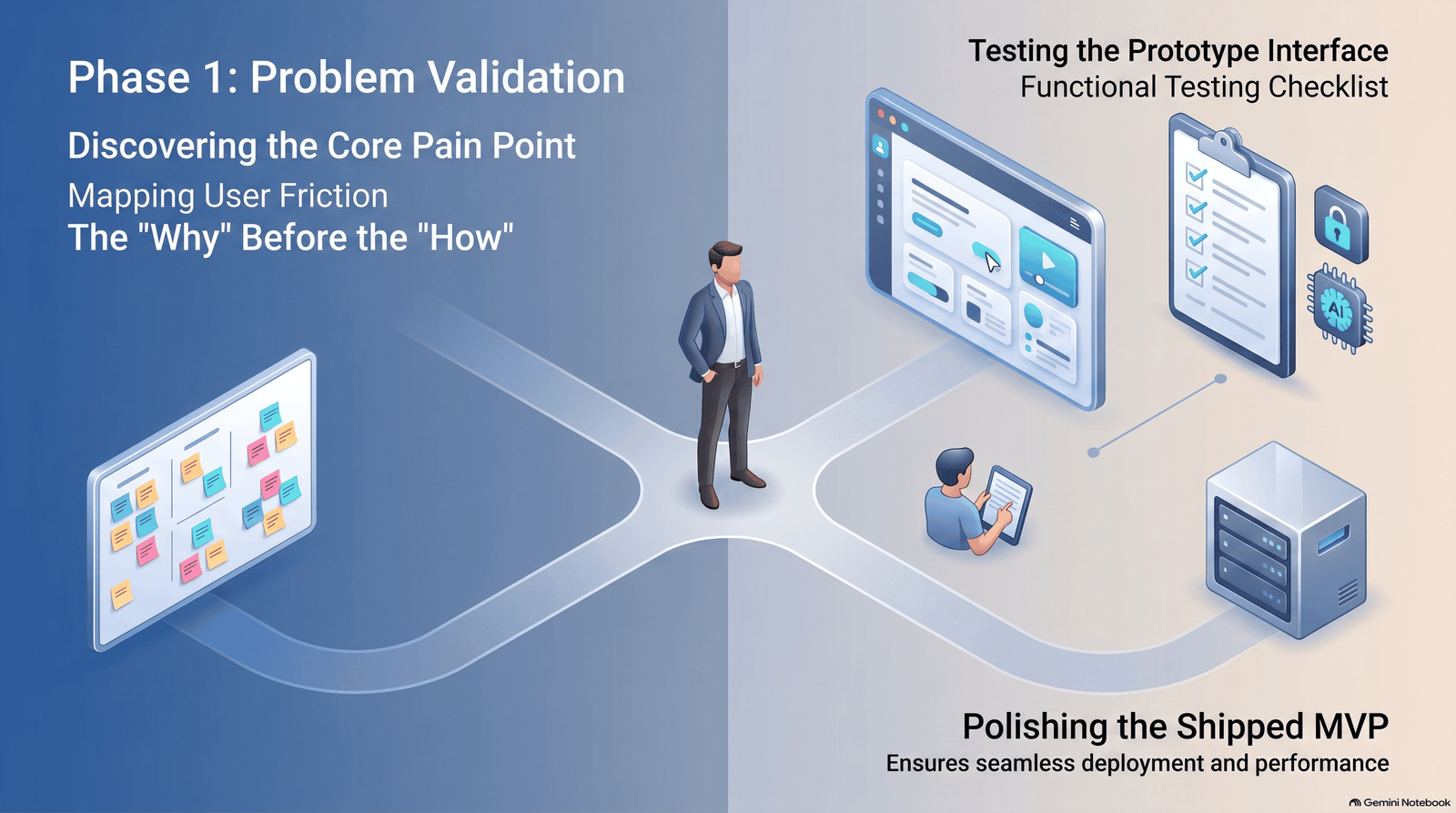
Most failed startups didn’t fail because the code broke. They failed because founders built something nobody actually needed.
This is where the confusion between problem validation vs solution validation costs founders months and real money.
Get the order wrong, and you end up polishing a solution for a problem that never existed. Get it right, and every dollar you spend after is backed by evidence.
This guide breaks down both stages, shows you why you must validate the problem first, and gives you a working solution validation framework you can apply this week.
Table of Contents
What Is Problem Validation?
Problem validation is the process of confirming that a real, painful, and frequent problem exists for a specific group of people — before you design anything to fix it.
It has nothing to do with your app, your feature list, or your UI. It’s purely about the pain itself.
At this stage you’re asking three things: Does this problem exist? Is it frequent enough to matter? Are people already trying (and failing) to solve it?
If you skip this step, you’re building on a guess dressed up as an insight.
Signs a Problem Is Worth Solving
A validated problem usually shows up in a few consistent patterns during research.
- People are already paying for a clumsy workaround (spreadsheets, freelancers, manual processes)
- The same complaint shows up unprompted across multiple, unrelated conversations
- People get visibly frustrated or animated when describing it
- They’ve tried at least one other tool or method and abandoned it
If none of these show up, you likely have a “nice to have,” not a real problem worth building a company around.
How to Run a Problem Validation Interview
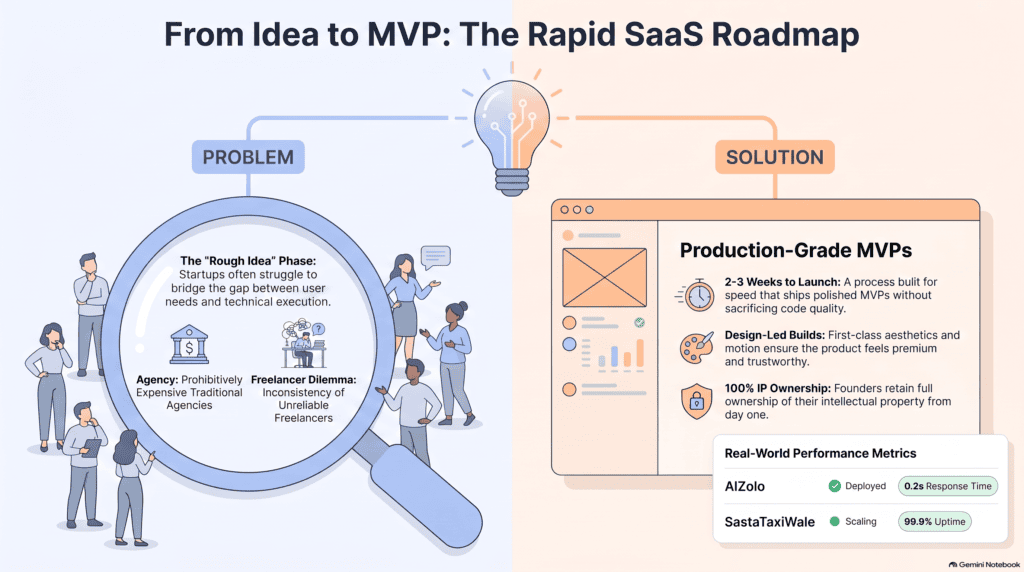
A good problem validation interview feels like a conversation, not a pitch. You’re there to listen, not to sell your idea.
Keep your own product a secret for as long as possible. The moment you mention it, people start being polite instead of honest.
Sample questions that work well:
- “Walk me through the last time you dealt with [the problem area].”
- “What do you currently use to handle that?”
- “What’s the most frustrating part of that process?”
- “When was the last time this happened, and what did you do?”
- “Have you looked for a better way to handle it? What did you find?”
Notice none of these mention your solution. They’re all about the person’s current reality.
Aim for past behavior, not future intentions. “What did you do last time” is far more reliable than “would you use an app for this.”
What Is Solution Validation?
Solution validation happens after you already know the problem is real. Now you’re testing whether your specific fix actually solves it in a way people will use, and ideally pay for.
This stage usually involves a prototype, a landing page, a clickable mockup, or an early MVP.
You’re no longer asking “does this pain exist.” You’re asking “does my answer to it actually work for them.”
A common tool at this stage is a lean prototype rather than a fully built product — the same logic behind why teams use quick, low-cost prototypes to test assumptions and gather feedback before committing to full development, as covered in our guide on rapid prototyping vs MVP development
What Solution Validation Actually Measures
Solution validation checks usability, willingness to pay, and whether the fix fits naturally into someone’s existing routine.
- Can a first-time user complete the core task without help?
- Will they give payment details, an email, or a deposit to access it?
- Does it reduce their effort compared to their current workaround?
If people like the idea but won’t act, your solution — not the problem — needs rework.
Problem Validation vs Solution Validation: Key Differences
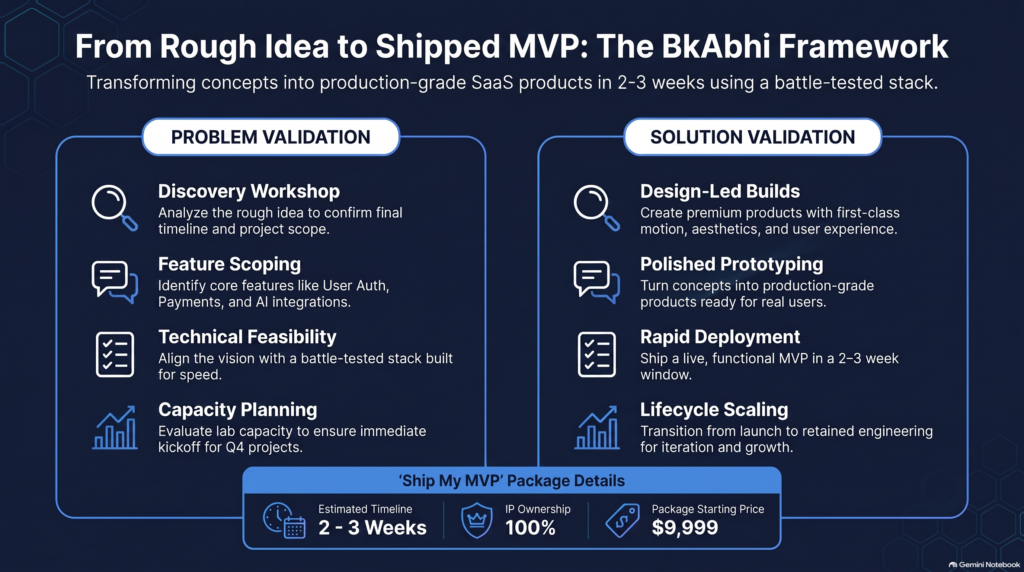
Here’s the distinction laid out side by side, since founders often blur the two.
| Aspect | Problem Validation | Solution Validation |
|---|---|---|
| Question asked | Does this pain really exist? | Does my fix solve it well? |
| Stage | Before any building | After a prototype or MVP exists |
| Method | Interviews, forums, surveys | Prototype tests, landing pages, demos |
| Output | A confirmed, painful problem | Evidence people will use or pay |
| Risk if skipped | You build the wrong thing | You build the right thing poorly |
Notice the order. Solution validation is meaningless if the problem underneath it was never confirmed in the first place.
Why You Must Validate the Problem First
Skipping straight to a solution feels productive. You’re designing, coding, shipping — momentum feels like progress.
But momentum without evidence is just speed in the wrong direction.
1. It Prevents Building for an Imaginary Customer
Founders are close to their own idea, which makes it easy to assume everyone shares the same pain point. Talking to real people first strips that assumption out early.
2. It Saves the Budget That Actually Matters
Every week spent coding a feature nobody asked for is a week of runway you can’t get back. Problem interviews cost almost nothing compared to development hours.
3. It Shapes a Sharper Solution
Once you deeply understand why a problem hurts and how people currently cope with it, your eventual solution becomes obvious instead of guessed.
This mirrors the classic customer development approach pioneered in Silicon Valley: get out of the building and test hypotheses with real people before writing a line of code.
4. Investors and Partners Look for It
Investors regularly treat proof of market validation as one of the most important factors when deciding whether to back an early-stage company, which is exactly why “we talked to 40 potential customers” carries more weight in a pitch than a polished mockup alone.
When to Move From Problem Validation to Solution Validation
Founders often ask how they’ll know they’re “done” with problem validation. There’s no magic number, but a few signals reliably point to yes.
You’re likely ready to move forward when:
- The same problem surfaces unprompted in at least 70% of your conversations
- People describe specific, recent instances of the pain — not vague, hypothetical ones
- At least a few people are already spending time or money on a workaround
- You can describe the problem back to someone in one sentence and they say “exactly”
You’re not ready yet if:
- Most conversations feel like you’re explaining the problem to them, not the other way around
- The pain only shows up when you ask leading questions
- Nobody has tried to solve it themselves in any way
If you’re seeing the “not ready” signals, it’s worth another round of interviews with a slightly different audience segment before touching a prototype.
Startup Validation Stages: The Complete Framework
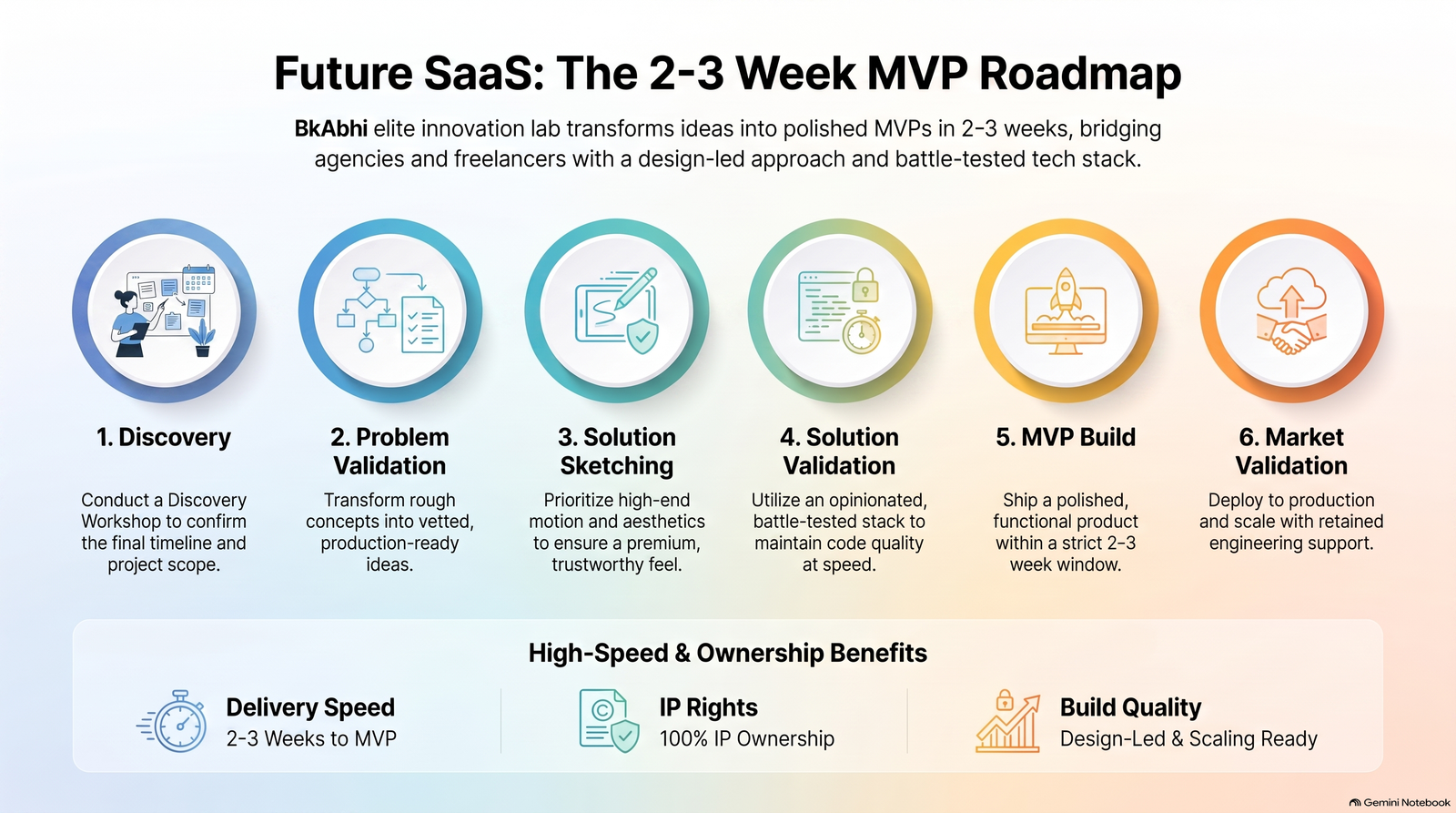
Validation isn’t a single checkbox — it moves through connected startup validation stages, each with its own exit criteria.
Stage 1: Problem Discovery
Talk to 15–30 people in your target audience without pitching anything. Ask open questions about their current workflow and frustrations.
Stage 2: Problem Validation
Look for patterns across those conversations. A validated problem shows up repeatedly, unprompted, across different people.
Stage 3: Solution Sketching
Sketch two or three rough approaches to solving the confirmed problem. Keep this on paper or in a simple prototype tool — no code yet.
Stage 4: Solution Validation
Show the sketch or clickable prototype to the same audience. Watch what they do, not just what they say.
Stage 5: MVP Build
Only after both stages check out do you move into building. This is where a structured MVP development process takes over, turning validated assumptions into a working, testable product.
Stage 6: Market Validation
Launch to a small segment and track real usage, retention, and payment — the final proof that both the problem and the fix hold up at scale.
A Practical Solution Validation Framework
Once the problem is confirmed, use this lightweight solution validation framework before committing engineering time.
Step 1: Define One Core Assumption
Pick the single riskiest assumption behind your solution — usually “people will actually use this” or “people will pay for this.”
Step 2: Build the Smallest Testable Version
This could be a landing page with a waitlist, a clickable Figma prototype, or a no-code demo. Full development comes later, which is also why many teams explore no-code MVP development at this stage.
Step 3: Put It in Front of Real Users
Run five to eight moderated sessions. Watching users interact with a design and hearing them explain their thought process out loud tends to surface far more honest feedback than a survey ever will, a method well documented by usability research groups like Nielsen Norman Group
Step 4: Measure Behavior, Not Opinions
Track signups, click-throughs, or pre-orders instead of relying on “I’d probably use this” comments, which are notoriously unreliable.
Step 5: Decide — Build, Pivot, or Kill
If the numbers hold up, move to MVP development. If not, revisit the solution — or, in rare cases, revisit the problem itself.
Common Mistakes Founders Make
Even experienced founders slip into these traps when the two validation stages blur together.
Falling in love with the solution first. It’s tempting to sketch the app before confirming anyone actually needs it. The idea feels exciting, so building starts to feel like validation — it isn’t.
Asking leading questions. Phrasing like “wouldn’t it be great if…” nudges people toward agreement out of politeness, not genuine interest.
Treating “that’s a great idea” as validation. Verbal enthusiasm costs nothing. Watch what people do with their time, money, or attention instead of what they say.
Skipping straight from problem to MVP. Jumping from a confirmed problem directly into full development skips the cheap, fast solution test that could save weeks of rework.
Testing with friends and family. People close to you have no real stake in the outcome and rarely give the blunt, useful feedback strangers will.
Each of these creates false confidence, which is more dangerous than no data at all — because it sends you into development with a green light that was never earned.
Tools and Methods for Each Validation Stage
| Stage | Best Tools | What to Track |
|---|---|---|
| Problem Discovery | Interviews, Reddit, niche forums | Recurring complaints, workaround habits |
| Problem Validation | Surveys, Typeform, community polls | Frequency and intensity of the pain |
| Solution Sketching | Figma, paper wireframes | Clarity of the core flow |
| Solution Validation | Landing pages, clickable prototypes | Signups, click-through rate, pre-orders |
| Market Validation | Analytics, retention dashboards | Repeat usage, willingness to pay |
Pick two or three tools per stage rather than trying every method at once — depth beats breadth here.
Real Signals vs Vanity Signals
Not every positive reaction during validation actually means something. Learning to tell the two apart saves founders from chasing false hope.
Vanity signals feel good but prove little:
- Likes, shares, or comments on a social post about your idea
- “I would definitely use this” without any action attached
- Friends and family saying it’s a great idea
- High traffic to a landing page with no signups
Real signals cost the visitor something — time, money, or effort:
- A completed signup with a real email address
- A pre-order or deposit, even a small one
- A returning visitor who comes back without being prompted
- Someone asking “when can I actually start using this?”
If your validation data is mostly vanity signals, treat it as encouragement, not proof. Keep testing until you see people act, not just react.
A Quick Example: Two Founders, Two Outcomes
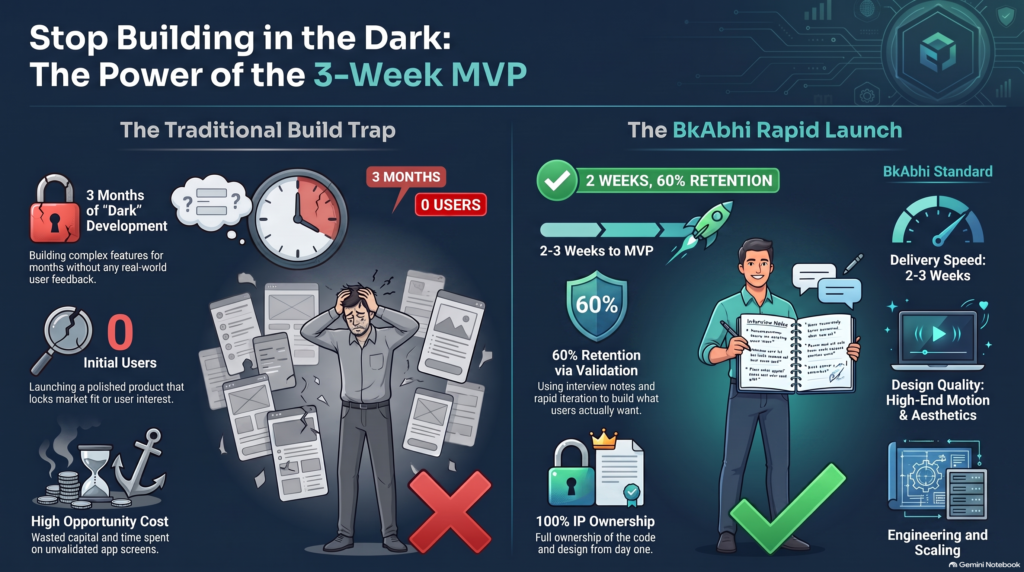
Founder A built a scheduling app for freelance tutors without talking to a single tutor first. Three months and a working MVP later, tutors said they already had a system that worked fine.
Founder B spent two weeks interviewing 25 tutors before writing any code. She found a shared complaint: rescheduling with parents was the real pain, not booking itself.
Her MVP focused only on rescheduling. It launched to a small group, and 60% of testers kept using it after week one — because it solved the confirmed problem, not an assumed one.
How BkAbhi Helps You Validate Before You Build
At BkAbhi, product strategy conversations start with the problem, not the feature list. Before any code gets written, the goal is to confirm the pain is real and the fix is worth building.
Once that’s confirmed, the path forward is a lean, testable build — the same approach detailed in our guide on what MVP development actually involves
For founders who want to compare how far to take that first build, our breakdown of MVP vs MMP vs full product development is a useful next read.
And if speed matters more than scope right now, see how a focused team can help you launch a SaaS MVP fast without skipping validation.
This sequence — problem first, then solution, then build — is also why many founders bring in an outside team for the discovery conversations. An outside perspective tends to ask sharper, less biased questions than someone emotionally attached to their own idea.
Whether that support looks like structured interview scripts, a clickable prototype, or a full MVP development process, the underlying principle stays the same: never spend serious development budget on an assumption you haven’t tested.
Frequently Asked Questions
What is the difference between problem validation and solution validation? Problem validation confirms a real, painful issue exists for a target audience. Solution validation tests whether a specific fix for that confirmed problem actually works and gets used.
Should I validate the problem before building an MVP? Yes. Building an MVP without validating the problem risks spending weeks or months on something nobody needed in the first place.
How long does startup validation usually take? Problem validation typically takes one to three weeks of structured interviews. Solution validation, using a prototype or landing page, can often be completed in another two to four weeks.
Can I validate the problem and solution at the same time? It’s possible for very fast-moving ideas, but running them separately gives cleaner data, since combining them makes it harder to tell which part of your idea people actually reacted to.
What is a solution validation framework? It’s a repeatable process — defining the riskiest assumption, building a small testable version, gathering real behavioral data, and deciding whether to build, pivot, or stop — used to confirm a solution before full development.
How many people do I need to talk to for problem validation? Fifteen to thirty conversations is usually enough to spot clear, repeated patterns. Fewer than ten tends to leave too much room for coincidence or bias.
What happens if solution validation fails but the problem is still real? That’s a pivot, not a failure. Go back to the sketching stage, design a different approach to the same confirmed problem, and test again before building.
Final Thoughts
Problem validation vs solution validation isn’t a debate about which one matters more — both do, in the right order.
Validate the problem first, confirm your fix actually solves it, and only then commit real development budget to it.
Founders who follow this sequence spend less money learning the same lessons the hard way.
Treat problem validation as the foundation and solution validation as the structural test before anyone moves in. Skip either one, and even a beautifully built product can stand on ground that was never checked.
The next time an idea feels exciting enough to start building immediately, pause and ask the harder question first: has anyone actually confirmed this problem is real?
Author Bio
Jeevesh Tripathi Product Strategy Researcher, BkAbhi Innovations Lab
Jeevesh researches early-stage product validation and startup decision-making, working closely with founders navigating the path from idea to MVP. His writing focuses on practical, evidence-based frameworks over trend-chasing advice.