
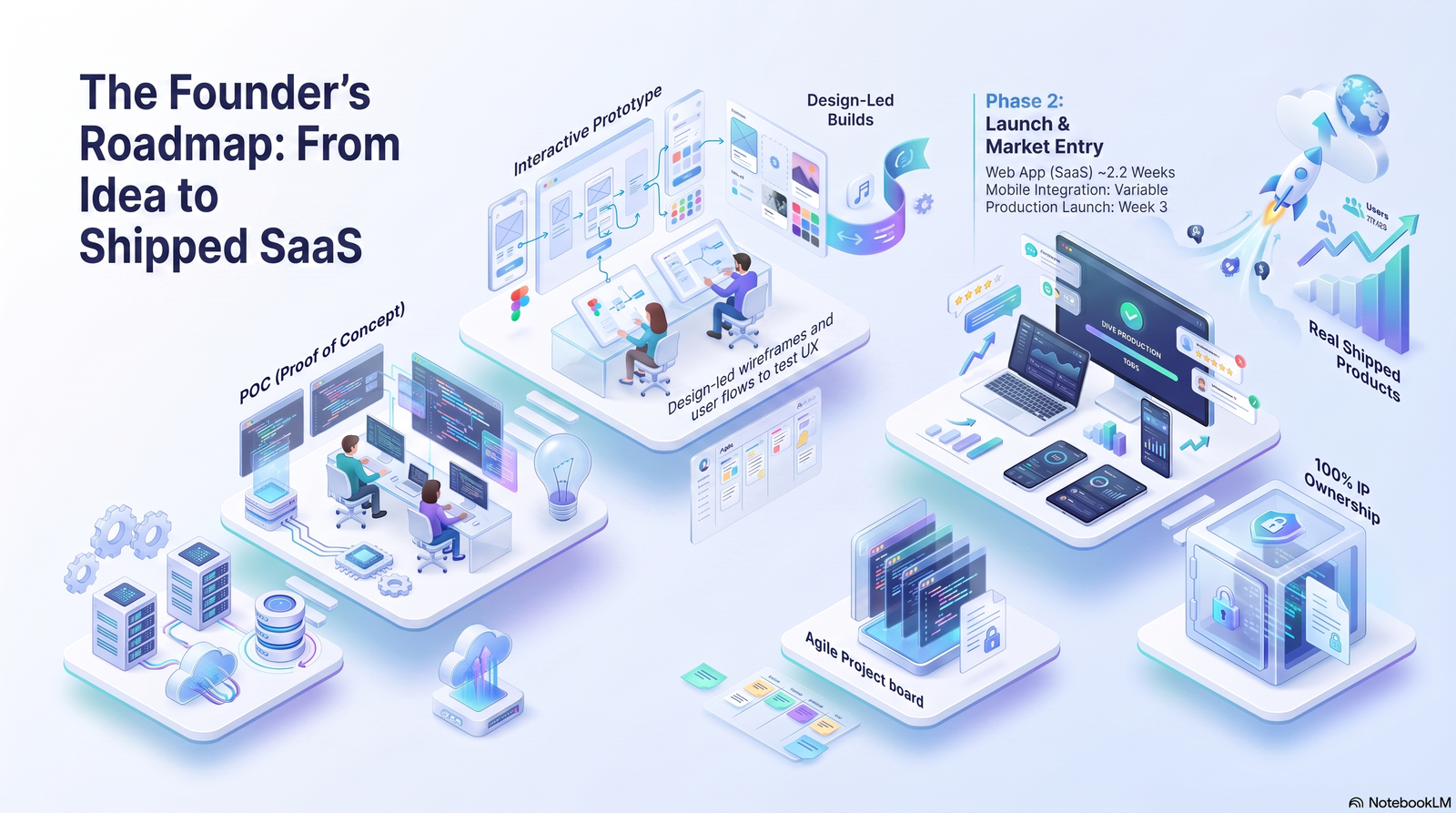
Quick Answer: A proof of concept (POC) proves an idea is technically possible. A prototype shows how the product looks and feels. An MVP is a working product real users can actually use to validate demand. Most startups should build a POC only when there’s serious technical risk, a prototype when they need investor or user feedback on design, and an MVP when they’re ready to test the business itself in the market. At Bkabhi, we recommend choosing the approach that matches your current stage, budget, and business goals so you can validate ideas faster while avoiding unnecessary development costs and delays.
Founders searching for a best MVP development company often get stuck one step earlier: they don’t know what stage they’re actually at. Should you sketch a clickable prototype first? Do you need to prove the tech works before spending a rupee on design? Or are you ready to skip straight to a real, working MVP?
This guide breaks down MVP vs prototype vs proof of concept in plain language, with comparison tables, real-world patterns, and a simple framework so you stop guessing and start building the right thing first.
Table of Contents
Why This Confusion Costs Startups Real Money
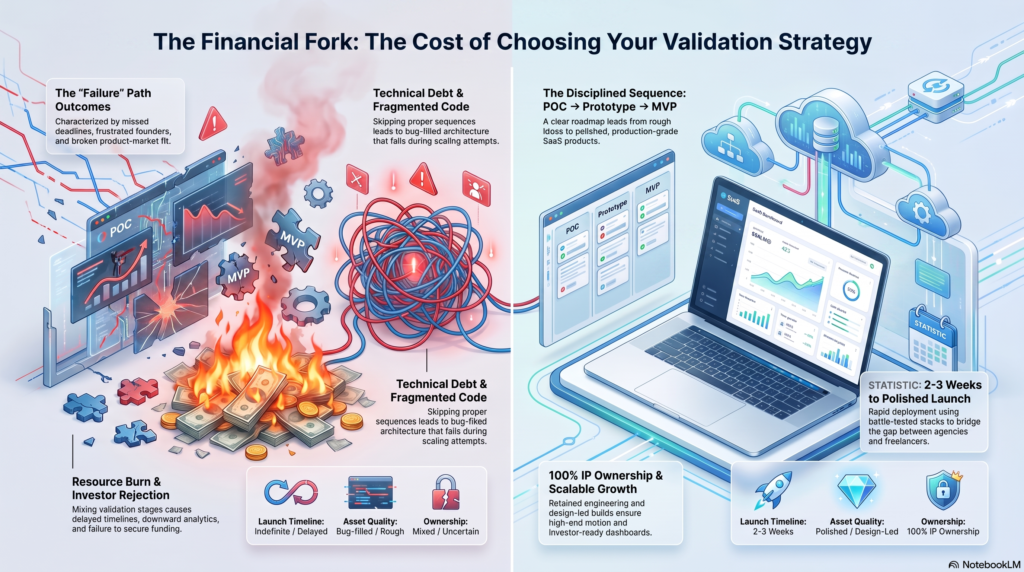
Founders lose months and lakhs of rupees building the wrong artifact at the wrong stage. A founder who spends four months on a fully coded MVP when a two-day clickable prototype would have answered the same investor question has burned runway for nothing.
The opposite mistake is just as common. Teams build a pretty prototype, show it to a few friendly users, and then treat the positive reaction as proof the business will work — without ever validating that people will actually pay or return.
Getting the sequence right — POC, then prototype, then MVP, or skipping stages when they genuinely don’t apply — is a product strategy decision, not a technical one. It directly affects your MVP development cost and how fast you reach real market feedback.
What Is a Proof of Concept (POC)?
A proof of concept is a small, internal exercise built to answer one question: can this actually be built? It’s not meant for users, investors, or even a polished demo — it’s for your own team’s confidence.
A POC usually has no user interface at all. It might be a script, an API test, or a rough integration check that confirms a technical assumption before real money goes into development.
When a POC Makes Sense
A POC is worth building when your idea depends on unproven or unusual technology. Think AI models with uncertain accuracy, hardware-software integrations, or a workflow that pulls data from three different legacy systems that have never talked to each other before.
If your startup is a fairly standard SaaS tool, marketplace, or booking app using well-established technology, you likely don’t need a POC at all — the technical risk is close to zero, so you can move straight to a prototype or MVP.
What a POC Is Not
A POC is not a design exercise, and it’s not something you show to early users for feedback. It answers “can we build this,” not “do people want this” or “does this look good.” Confusing the two wastes time on polish nobody asked for yet.
What Is a Prototype?
A prototype is a visual, often interactive representation of your product that lets people click through screens and experience the intended flow — without any real backend functionality behind it.
Most prototypes today are built in tools like Figma, Adobe XD, or InVision. Buttons look real, transitions feel real, but nothing is actually saved, processed, or connected to a database.
Why Founders Build Prototypes
Prototypes exist to test usability, gather early user reactions, and give investors or co-founders a tangible feel for the product before a single line of production code is written. They’re fast — usually days, not months — and cheap compared to development.
A prototype is also the fastest way to catch confusing navigation, unclear value propositions, or a cluttered onboarding flow. Fixing these issues on a Figma screen costs a afternoon; fixing them after launch costs users.
The Limits of a Prototype
A prototype cannot validate whether your business model actually works, because nothing behind the screen is real. You can’t process a real payment, store real user data, or measure real retention. It answers “does this make sense to people,” not “will people actually use and pay for this.”
What Is an MVP (Minimum Viable Product)?

An MVP is the smallest version of your product that is fully functional — real users can sign up, use the core feature, and get genuine value from it. It’s not a mockup or a demo; it’s live software solving one problem well.
The term comes from the Lean Startup methodology, where the goal isn’t to build a smaller version of your final vision, but to build the smallest thing that lets you test your riskiest business assumption with real users.
What Makes an MVP Different
An MVP has working code, a real database, and at least one core feature end to end. If it’s a payments app, money actually moves. If it’s a scheduling tool, bookings are actually saved and calendars actually update.
Because it’s live, an MVP produces data a prototype never can: activation rates, retention curves, and whether people come back on day seven. That’s the entire point — you’re testing the business, not just the interface.
If you’re mapping out how this actually gets built, our MVP development process guide walks through each stage from idea validation to launch.
MVP vs Prototype: The Core Differences
The MVP vs prototype question comes up constantly because both are “early” versions of a product — but they answer completely different questions and cost very differently to build.
| Factor | Prototype | MVP |
|---|---|---|
| Functionality | Clickable mockup, no real backend | Fully working software |
| Purpose | Test usability and design direction | Test market demand and retention |
| User data | Not stored anywhere real | Stored, processed, and analyzed |
| Typical timeline | Days to 2 weeks | 6 to 16 weeks |
| Cost | Low (design-only effort) | Higher (development + infra) |
| Who uses it | Internal team, investors, test users | Real, paying or signed-up customers |
| What it proves | “This is usable and makes sense” | “People actually want and use this” |
The difference between MVP and prototype ultimately comes down to reality: a prototype simulates the experience, while an MVP delivers it. You cannot get real retention or revenue data from a prototype, no matter how polished it looks.
Proof of Concept vs MVP: The Core Differences
Proof of concept vs MVP is a different comparison altogether, because a POC usually has no user-facing layer at all, while an MVP is a complete, if minimal, product experience.
| Factor | Proof of Concept (POC) | MVP |
|---|---|---|
| Audience | Internal technical team | Real end users |
| Interface | Usually none | Fully built, minimal UI |
| Goal | Prove technical feasibility | Prove market demand |
| Output | Confidence the idea can be built | Real usage and retention data |
| Investment level | Very low | Moderate to significant |
| Failure means | The approach won’t work technically | The market doesn’t want it |
If your idea has no unusual technical risk, you can often skip the POC stage entirely and move straight into prototyping or MVP development, which is exactly how most SaaS and marketplace founders operate.
POC vs Prototype vs MVP: Side-by-Side Comparison
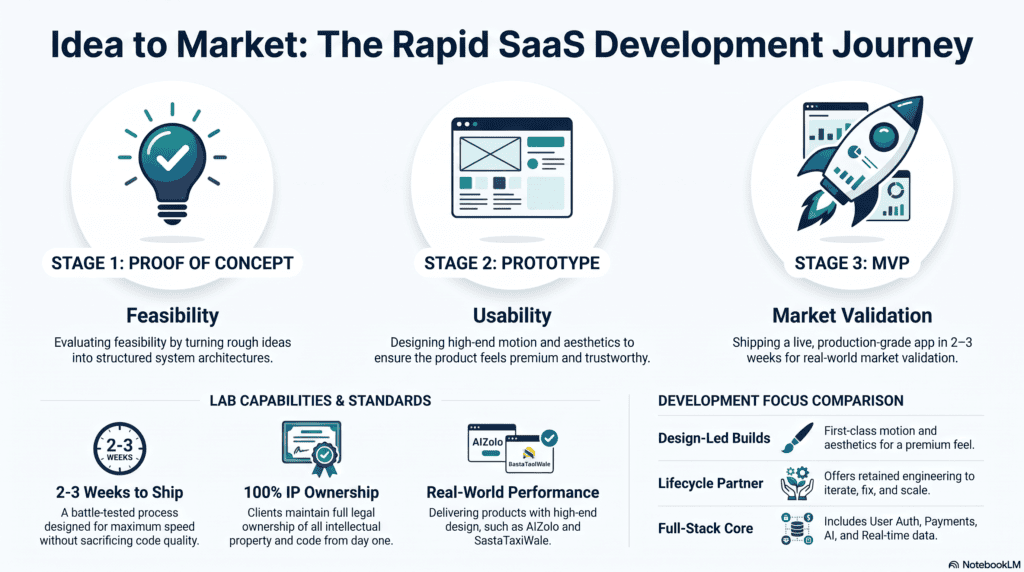
Putting all three together makes the progression clearer. Each stage exists to de-risk a different part of your startup before you commit serious capital.
| Stage | Answers | Built For | Real Backend? |
|---|---|---|---|
| Proof of Concept | Can we build this? | Internal team | No |
| Prototype | Does this make sense to users? | Investors, early testers | No |
| MVP | Will people actually use this? | Real market/customers | Yes |
Not every startup needs all three. A team building a fairly standard e-commerce app with proven technology can often skip the POC and go straight from prototype to MVP. A team building something with genuine technical uncertainty — say, a novel AI matching engine — should validate the POC before investors even see a prototype.
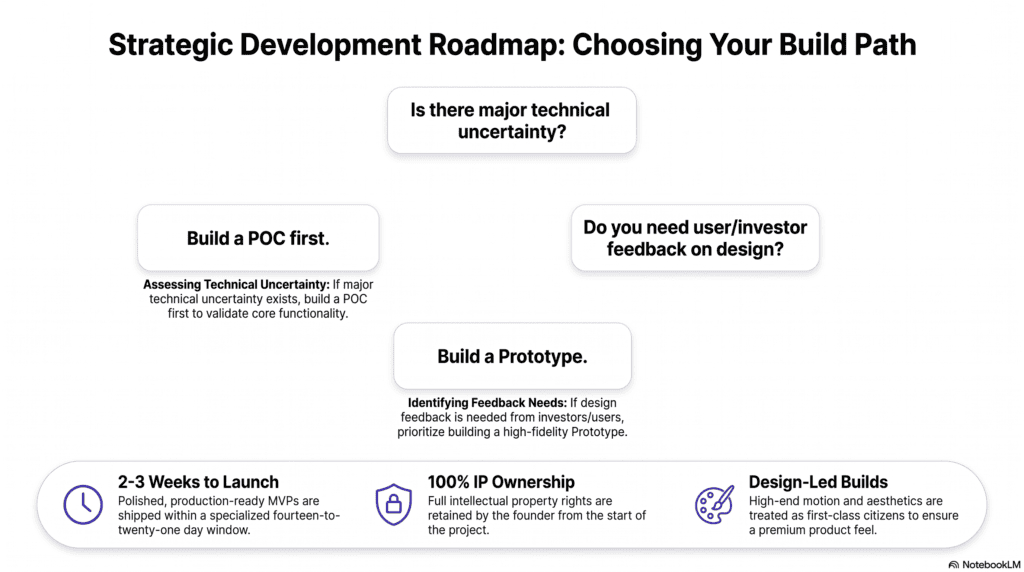
When Should a Startup Build a POC First?
Build a proof of concept first only when there’s real, specific technical doubt about whether your idea can work — not just general nervousness about a new project.
Common triggers include unproven AI/ML accuracy for your exact use case, integrating with hardware or IoT devices, or connecting to third-party systems with poor or undocumented APIs. In these cases, a failed POC saves you from months of wasted MVP development.
When Should a Startup Build a Prototype First?
A prototype makes sense when your biggest open question is about usability, flow, or investor buy-in — not whether the technology can work, but whether people will understand and like using it.
Pre-seed founders raising their first round often lean on a prototype because it’s fast, cheap, and gives investors something tangible to react to, long before actual development spend is justified.
When Should a Startup Build an MVP First?
Build an MVP directly when your technology is well-understood and your core question is genuinely about the market: will real people sign up, use the core feature, and come back?
This is the right call for most SaaS, marketplace, and service-based startups today, since the underlying tools — web frameworks, cloud infrastructure, payment gateways — are mature and well-documented. Choosing the right tech stack for MVP development at this stage also shapes how quickly and cheaply you can iterate later.
Real Patterns Founders Follow (Not Case Studies, Just Common Sense)
Founders building consumer-facing products with well-known interaction patterns — a to-do app, a booking tool, a simple marketplace — rarely need a formal POC. The risk isn’t technical; it’s whether anyone cares enough to use it, which only an MVP can answer.
Founders working on anything involving new AI capabilities, novel hardware integration, or complex compliance workflows (healthcare, fintech) benefit from a short, focused POC before committing budget to a full build. It’s a cheap insurance policy against a very expensive mistake.
Teams raising a pre-seed round with no product yet often lean on a prototype purely as a fundraising tool — it’s the fastest way to make an abstract pitch deck idea feel real to an investor in a 20-minute meeting.
Common Mistakes Startups Make Between These Stages
Treating a prototype as if it were market validation. Positive reactions to a clickable mockup are not the same as people actually using and paying for a live product. Only an MVP produces that signal.
Skipping the POC on genuinely risky technology. Founders eager to move fast sometimes jump straight into MVP development on an unproven technical approach, only to discover mid-build that the core mechanism doesn’t work as assumed.
Over-building the MVP. The “M” in MVP stands for minimum. Adding five features when one would answer your core question just increases cost and delays the real feedback loop you’re trying to create.
Confusing cost stages. Because POC, prototype, and MVP cost very differently, founders sometimes budget for an MVP but only get investor-ready prototype-level output, or vice versa. Getting clear on the deliverable upfront avoids this mismatch — something a detailed look at MVP development cost in India can help you plan around.
How to Decide What Your Startup Needs Right Now
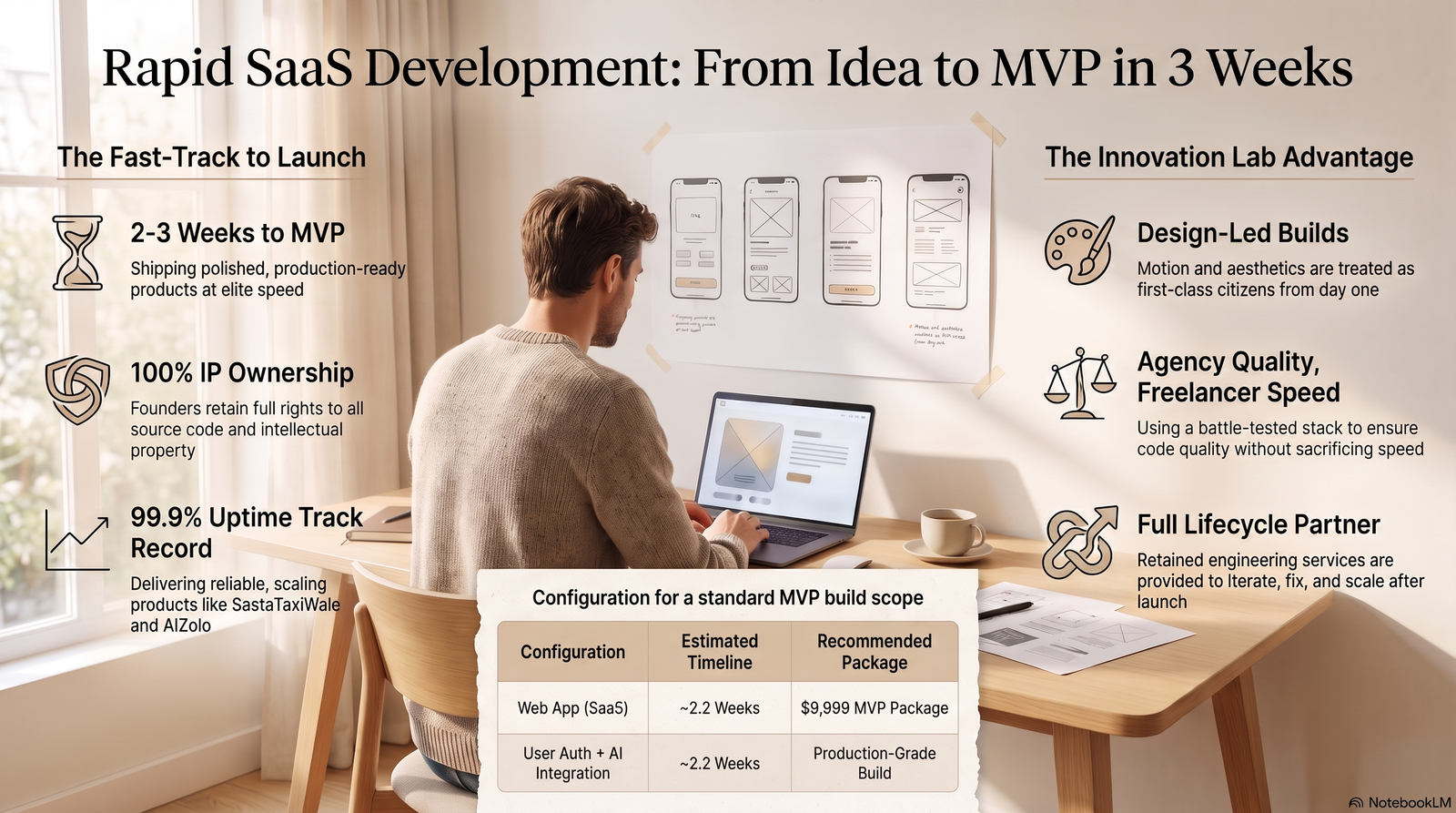
Start by asking whether your biggest open risk is technical, experiential, or commercial. Technical risk points to a POC, experiential risk points to a prototype, and commercial risk — will people actually use and pay for this — points straight to an MVP.
Next, factor in your runway and timeline. A POC and prototype are both fast and cheap, so they’re reasonable even with a tight budget. An MVP is a bigger commitment, so it should only start once you’re reasonably confident the idea deserves that investment.
Finally, think about what you’re presenting and to whom. Investors evaluating a pre-seed idea are often satisfied by a strong prototype. Investors or customers evaluating whether to actually commit money need to see a working MVP with real usage data.
Choosing the Right Development Partner for Each Stage
Not every agency is built to handle all three stages well. Some are strong at rapid prototyping but slow and expensive once real development starts; others jump straight to code without ever validating the idea first.
If you’re now confident you’re ready for a real, working product, the next decision is who builds it. Our guide on how to choose an MVP development company covers the exact questions to ask before signing any contract.
Frequently Asked Questions
Is a prototype the same as an MVP? No. A prototype is a non-functional mockup used to test design and usability, while an MVP is a fully working product used to test real market demand with actual users.
Do I need a proof of concept before building an MVP? Only if there’s genuine technical uncertainty in your idea. If you’re using well-established technology, you can usually skip the POC and move straight to prototyping or MVP development.
Which is cheaper: POC, prototype, or MVP? A POC and prototype are both significantly cheaper than an MVP, since neither requires production-ready code, real infrastructure, or ongoing hosting and maintenance costs.
Can I skip the prototype stage and go straight to MVP? Yes, especially if your team already has strong conviction on design direction or you’ve validated the flow informally with users. Many experienced founders skip prototyping entirely.
What comes after the MVP stage? After the MVP validates demand, most startups move into iterative development — adding features based on real user feedback, improving retention, and eventually scaling toward a full product.
How long does each stage typically take? A POC usually takes a few days to two weeks. A prototype takes days to two weeks as well. An MVP typically takes six to sixteen weeks, depending on scope and complexity.
Final Thoughts
MVP vs prototype vs POC isn’t really a competition between three options — it’s a sequence, and your startup’s specific risk profile decides how many of the three you actually need. Technical risk calls for a POC, design and usability risk calls for a prototype, and market risk calls for an MVP.
Most startups building fairly standard software products can skip straight to a lean MVP and start collecting real user data within weeks. If you’re at that stage now, understanding the full MVP development process — and picking a partner who has actually shipped products like yours — is the next logical step.
Author Bio
Jeevesh Tripathi is a startup product strategist and MVP development consultant with hands-on experience helping early-stage founders decide what to build first — and what to skip. He writes about lean product development, MVP strategy, and startup technology decisions at BkAbhi.