
Quick Answer
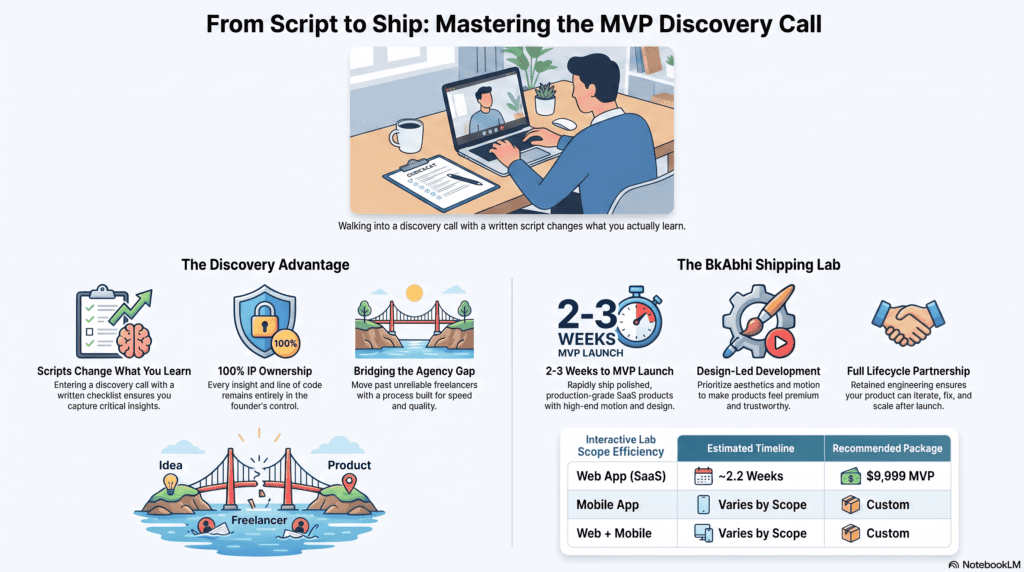
The right MVP discovery call questions cover five areas: team composition, process and communication, pricing structure, technical decision-making, and past outcomes. Ask each shortlisted vendor the same script so answers are comparable, push for specifics over confidence, and always follow up in writing. For the full vendor-selection framework this script fits into, see our pillar guide on the best MVP development company.
Aman had six calls booked in one week. Six agencies, six pitch decks, six confident sales reps promising a working app in eight weeks.
By Thursday, he couldn’t remember which company said what. Every call had blurred into the same reassuring pitch.
He hadn’t written a single question down. He’d just let each agency lead the conversation, and every agency led it somewhere flattering to themselves.
This is the script he wishes he’d had before call one. Use it before yours.
Table of Contents
Why the Discovery Call Matters More Than the Pitch Deck
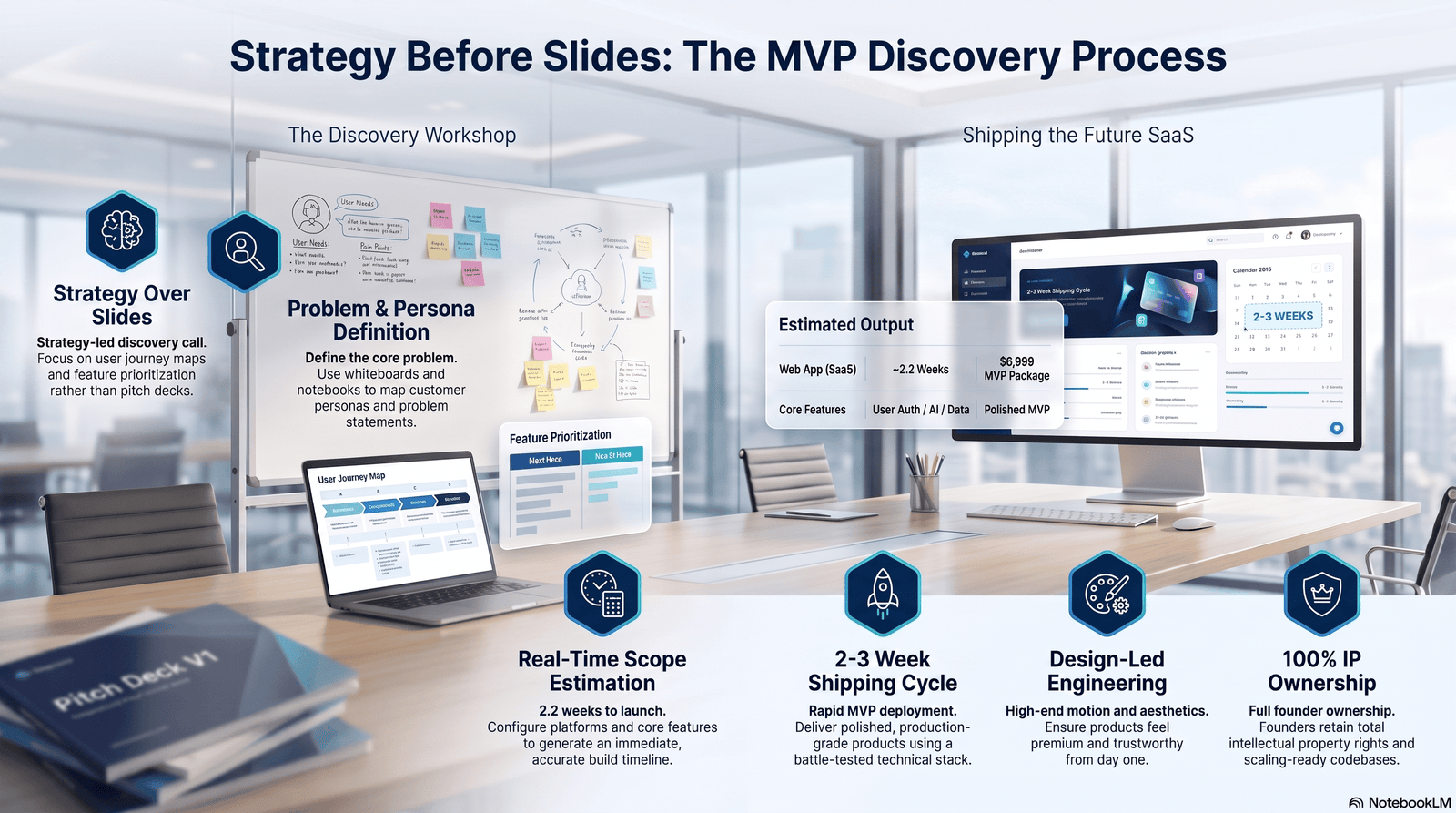
Every agency’s website looks similar. Clean portfolio grid, client logos, a headline promising fast, reliable delivery.
The discovery call is where that polish either holds up or cracks. It’s the first unscripted moment in the entire sales process.
Good MVP discovery call questions aren’t about catching a vendor in a lie. They’re about creating enough specificity that vague answers become obvious.
A rehearsed pitch survives a slide deck. It rarely survives five minutes of a founder asking “can you walk me through exactly how that worked.”
Our pillar guide on choosing a best MVP development company covers the full selection framework. This article is the deep dive into the one conversation that framework depends on most.
How to Prepare Before Your First MVP Discovery Call
Fifteen minutes of prep before the call matters more than any question you’ll ask during it.
Write your one-paragraph problem statement first. If you can’t describe the problem in three sentences, the vendor can’t either, and the call will drift.
List your three non-negotiable features. Everything else is a “nice to have” you should be willing to cut if a vendor suggests it.
Decide your budget range before the call, not during it. Vendors read hesitation on pricing questions instantly, and it changes how much they’ll push back on scope.
Pull up any MVP development company rankings research you’ve already done. Bring specific claims from their profile into the call instead of asking generic questions their marketing already answers.
Bring this same prep to every shortlisted vendor. Comparing five calls only works if each one starts from identical ground.
How These Questions Change by Founder Stage
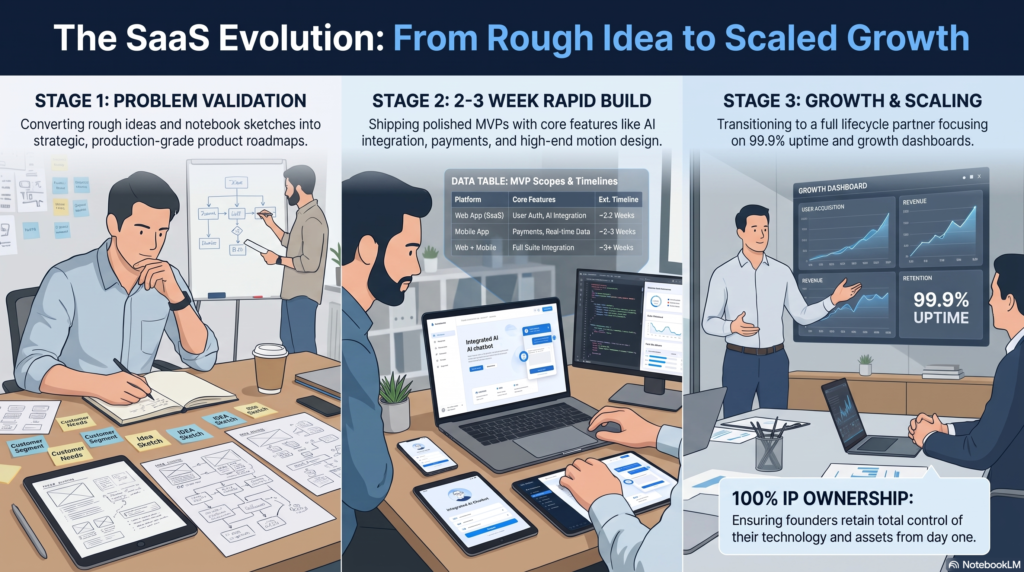
The right questions to ask an MVP development company shift slightly depending on how far along your idea already is.
Pre-seed, idea stage: Lead with validation questions. Ask how the vendor tests whether a feature is worth building before writing any code for it.
Seed-stage, funded but lean: Lead with timeline and milestone questions. Every extra week of scope creep burns runway investors are already watching closely.
Series A, scaling fast: Lead with documentation and handoff questions. You’ll likely bring development in-house eventually, and clean documentation determines how painful that transition is.
Our guide on how to hire MVP developers for an early product launch breaks down staffing needs at each of these stages in more depth, which pairs well with adjusting this call script to match.
The Complete MVP Discovery Call Script
Run this script in order. Each section builds on the last, and skipping ahead usually means missing the follow-up that would have mattered.
Budget 45 minutes, not the 30-minute default most sales teams propose. The extra 15 minutes is where vague answers usually turn specific or fall apart.
Team and Process Questions
“Who exactly will be working on my project, and are they full-time employees or subcontractors?”
This is the single most important question on the call. A confident “our senior team” answer without names is a soft dodge worth pressing on.
“What are three MVPs you’ve shipped in the last 18 months, and what happened after launch?”
Portfolio pieces show what got built. This question shows whether it actually worked once real users touched it.
“How do you structure a typical MVP engagement from discovery to handoff?”
Listen for a documented process versus an improvised one. Our breakdown of full cycle MVP development services shows what a genuinely structured process looks like end to end.
“If my main point of contact leaves mid-project, what happens?”
Small teams especially need a real answer here, not a reassurance that it “won’t happen.”
Technical and Architecture Questions
“What tech stack would you recommend for this, and why that one over the alternatives?”
A good answer ties the choice back to your product’s actual needs, not the vendor’s internal comfort or a trendy framework.
“Who makes final architecture decisions, and can I speak with them directly, not just the account manager?”
Reluctance to connect you with actual engineers before signing is worth noting and revisiting later in the call.
“How do you approach the UI/UX side of an MVP build?”
A rushed, generic answer here is a real signal. Our guide on expert UI/UX design for startup MVP projects explains why design decisions at MVP stage carry more weight than founders expect.
“What’s your approach to technical debt on a compressed MVP timeline?”
Every MVP cuts corners somewhere. The honest answer names which corners, not a claim that none were cut.
Pricing and Scope Questions
“What’s included in this quote, and what typically triggers a change order?”
Vague scope boundaries are where “one more feature” quietly becomes a 40% budget overrun three weeks in.
“Can you break the milestone payments down by deliverable, not just by date?”
Date-based milestones can slip without consequence. Deliverable-based milestones give you real leverage if progress stalls.
“Where does this quote fall against typical MVP pricing for similar scope?”
Our detailed MVP development cost breakdown is worth reviewing before this call so you can push back with real numbers, not guesswork.
“What happens to the IP and codebase if I need to switch vendors mid-project?”
This question belongs on the call, but the real answer lives in the paperwork. Our MVP development contract checklist covers exactly which clauses should back up whatever they tell you here.
Communication and Reporting Questions
“What does a normal week of communication look like once the project starts?”
Listen for specifics: shared boards, async standups, a weekly demo. A vague “we’ll keep you updated” answer usually means you won’t be.
“If your team is offshore or distributed, what hours actually overlap with mine?”
Timezone gaps aren’t disqualifying, but they change how precise your written specs need to be. Our comparison of offshore MVP development versus onshore teams covers this trade-off in detail.
“Do I get direct repository access during development?”
A “yes” here, backed by an actual invite before you sign, is one of the strongest trust signals a vendor can offer.
Red-Flag Detection Questions
“What would you cut from my current feature list if you had to?”
A partner who pushes back here is protecting your runway. One who agrees to everything is optimizing for the signature, not the outcome.
“Tell me about a project that didn’t go well. What happened, and what changed afterward?”
Every real agency has one. A denial is more concerning than an honest, specific answer.
“Can I talk to two founders you’ve worked with recently, not just the ones in your case studies?”
Hesitation, or an offer to “check availability” that never resolves, is a signal worth weighing heavily.
Follow-Up Questions to Send After the Call
Some answers only reveal their gaps once you’re comparing notes across multiple vendors, a day or two after the call ends.
“Can you send a sample of a written spec or SOW from a past project?” This shows you their actual documentation habits, not just what they described verbally.
“What does your standard contract’s termination clause say?” Get this in writing before your first live legal review, so there are no surprises later.
“Who specifically will attend our kickoff call if we move forward?” Named individuals, not job titles, tell you whether the senior team you spoke with is the team you’ll actually get.
Industry-Specific Follow-Up Questions
Generic MVP discovery call questions work for most founders. A few industries need one or two sharper follow-ups added to the script.
Fintech and healthtech founders should ask: “Have you built anything that required PCI-DSS or HIPAA awareness, even informally?” Retrofitting compliance later costs far more than building with it in mind from day one.
Marketplace founders should ask: “Have you built two-sided matching logic before, and what broke the first time?” Single-user app experience doesn’t automatically transfer.
AI-feature founders should ask: “Are you integrating existing model APIs, or building custom models from scratch?” The cost and timeline gap between the two answers is substantial.
Questions Good Vendors Ask You Back
A discovery call worth continuing isn’t one-directional. Watch for whether the vendor is evaluating you as closely as you’re evaluating them.
“What would you cut if we had to launch two weeks earlier?” signals a team thinking in trade-offs, not just feature counts.
“Who’s your target user, and how do you know they want this?” from a vendor means they’re thinking about validation, not just execution.
“What’s your appetite for us pushing back on scope?” is a question a confident, experienced partner asks early, because they’ve been burned by founders who didn’t want honesty.
A Simple MVP Vendor Evaluation Script for Scoring Calls
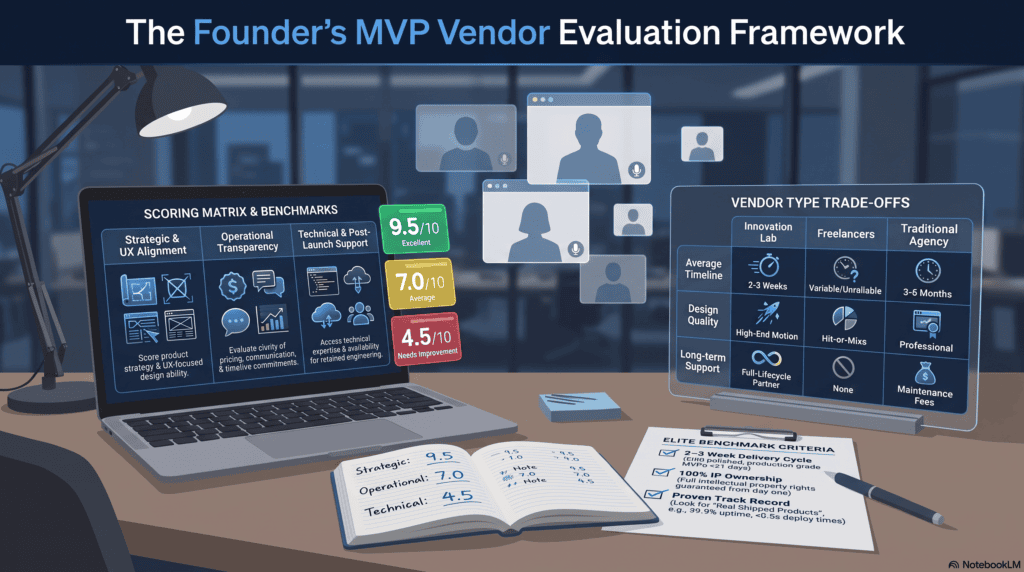
Running the same mvp vendor evaluation script across every shortlisted vendor is what makes five calls comparable instead of five separate impressions.
| Signal | What to Listen For | Weight |
|---|---|---|
| Team specificity | Named people, not just roles | High |
| Past outcome detail | What happened after launch, not just at handoff | High |
| Pushback on scope | Willingness to cut features, not just add them | High |
| Pricing transparency | Milestone breakdown by deliverable | Medium |
| Communication habits | Shared boards, async updates, repo access | Medium |
| Reference willingness | Offers unprompted, not after pressure | Medium |
| Sales-to-technical ratio | Engineers present, not just account managers | Low |
Score each vendor out of five per row immediately after the call, while details are still fresh. Waiting until you’ve done all five calls tends to blur the specifics that mattered most.
Why Vague Answers Cost More Than a Bad Quote
It’s tempting to treat a confident, well-rehearsed call as a good sign. Often it’s the opposite.
Research from McKinsey and the University of Oxford on large IT projects found that roughly half run significantly over budget, with average cost overruns near 45%. Most of that gap traces back to scope and expectations that were never pinned down early.
A structured set of mvp discovery call questions exists precisely to close that gap before a contract makes it expensive to fix.
The goal isn’t a longer call. It’s a call that ends with specifics you can actually act on, not just a good feeling about the team.
Sample Follow-Up Email After a Discovery Call
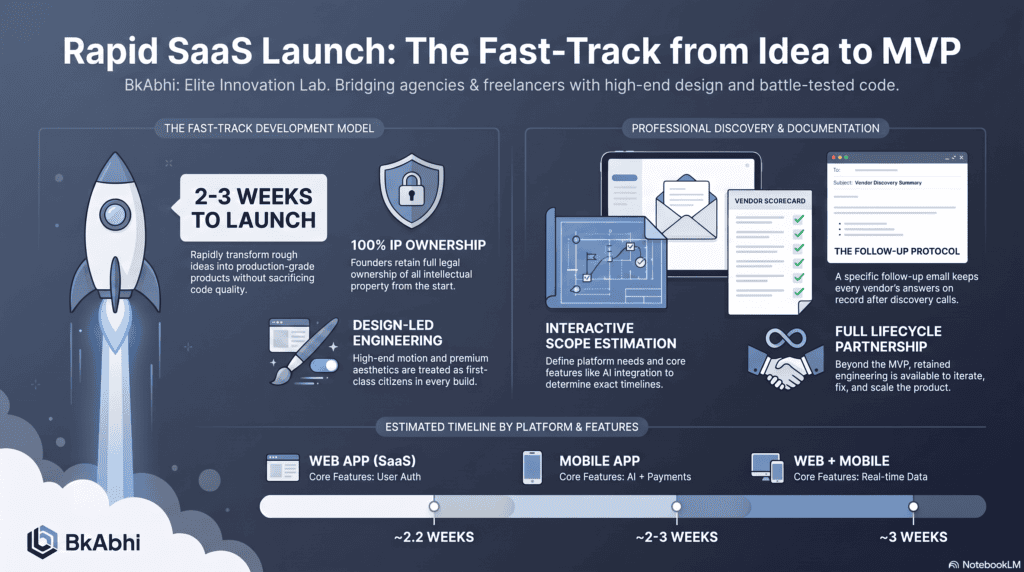
Keep this short. You’re confirming what was said, not reopening the whole conversation.
Subject: Recap and two follow-up questions from our call
Hi [Name], thanks for the time today. Quick recap of what I heard: [one-line summary of scope and timeline]. Two follow-ups before I finalize my shortlist: could you send a sample written spec from a past project, and confirm who’d personally attend our kickoff call? Appreciate it — happy to hop on a short call again if useful.
This email does double duty. It creates a written record, and it tests whether the specifics from the call hold up once the sales momentum has cooled.
Case Snapshot: Two Founders, Two Discovery Calls
Two founders building similar B2B SaaS MVPs took calls with the same shortlisted agency within the same month.
Founder A let the agency run the pitch, nodded along to the confident answers, and signed within 48 hours based on gut feeling.
Founder B ran the full script above, pushed on the team-composition question, and discovered the “senior team” was two contractors hired the week before.
Founder B chose a different vendor. Founder A’s project stalled at week five when both contractors left mid-build for another client.
The lists these two founders started from were nearly identical. What diverged was whether one of them treated the call as a formality and the other as real diligence.
Founder A later admitted the pitch deck alone had felt convincing enough. That’s exactly the trap a written script exists to prevent.
Warning Signs to Watch for During the Call Itself
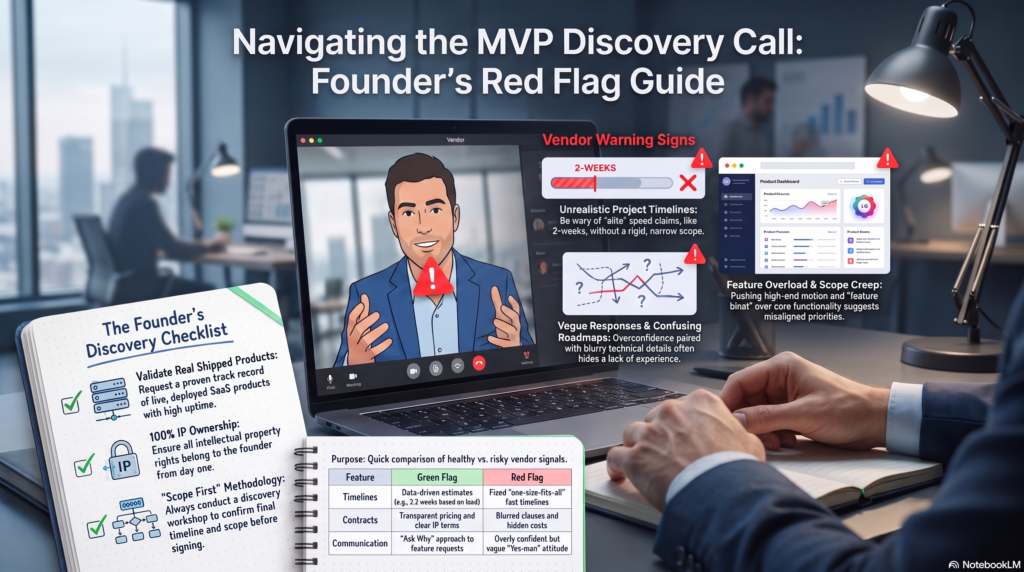
Some red flags show up in body language and pacing, not just in the words themselves.
Rushing past the team-composition question to get back to the pitch deck usually means the honest answer is unflattering.
Answering every question with “yes, we can do that” regardless of complexity is optimizing for the sale, not your outcome.
Redirecting every technical question to “our team will figure that out” without naming who “our team” actually is deserves a direct follow-up.
Our piece on why startups need MVP development services first covers real founder stories where signals like these, ignored early, became expensive months later.
How BkAbhi Approaches Discovery Calls
At BkAbhi, we treat the discovery call as a working session, not a sales pitch, and we tell founders that upfront.
We come prepared to name the engineers likely to work on your build, walk through a past project’s actual outcome, and push back on at least one feature before the call ends.
If a founder’s scope doesn’t fit what we do well, we say so on the first call. We’d rather lose the deal than take on a project we can’t deliver properly.
You can explore how we structure engagements once a discovery call moves forward, or book an MVP consultation directly with our team.
Frequently Asked Questions
How long should an MVP discovery call last? Plan for 45 minutes. The default 30-minute sales call rarely leaves room for the follow-up questions that surface real answers.
Should I ask every vendor the exact same questions? Yes. Identical questions across every call are what make five separate conversations genuinely comparable instead of five different impressions.
What’s the single most important question to ask an MVP development company? Who exactly will work on the project, by name, and whether they’re full-time staff or contractors brought on for this engagement.
Is it rude to ask for references from founders, not just case studies? No. A confident, established team expects this question and usually has answers ready without hesitation.
Should I record the discovery call? With the vendor’s permission, yes. It’s far easier to compare five calls accurately from notes than from memory a week later.
How many discovery calls should I take before deciding? Three to five shortlisted vendors is usually enough to compare meaningfully without diligence fatigue setting in.
Do these questions to ask an MVP development company still apply to freelancers? Mostly yes, though team-composition questions matter less and reference checks matter more, since a solo freelancer has no bench to fall back on if timelines slip.
What if a vendor refuses to answer one of these questions directly? Note it and move on to the next question rather than pushing repeatedly. A pattern of dodged questions across the call tells you more than any single answer would.
Final Thoughts Before Your Next Call
A good discovery call isn’t about catching a vendor off guard. It’s about creating enough specificity that confidence and competence stop looking identical.
Bring this script to every call, score each vendor the same way, and follow up in writing before you sign anything.
If you’re still building your shortlist before these calls even start, our pillar guide on the best MVP development company is the right place to begin, or explore BkAbhi’s full services directly.
Author Bio
Jeevesh Tripathi Email: jeevesh@bkabhi.com
Jeevesh Tripathi is a startup technology researcher and MVP strategy consultant at BkAbhi Innovations Lab, where he has sat in on discovery calls with founders across fintech, EdTech, and marketplace platforms as they evaluated development partners. His work focuses on translating what actually separates a strong vendor conversation from a well-rehearsed one into practical, jargon-free scripts early-stage founders can reuse. This article reflects hands-on research into vendor evaluation frameworks and founder interviews conducted throughout 2026.