
Table of Contents
SOC 2 Compliance for Early-Stage SaaS: A Practical Guide
An enterprise prospect asks for your SOC 2 report. Your SaaS has six employees, a small engineering team, and a product that is still evolving.
Do you start an expensive compliance program now, or wait until you have more customers?
The answer isn’t simply “get SOC 2 as early as possible.” For an early-stage SaaS, the more useful question is which security and compliance foundations should exist now, and when should you pursue a formal SOC 2 examination?
Quick Answer
SOC 2 is an AICPA reporting framework based on the Trust Services Criteria. It assesses controls relevant to security, availability, processing integrity, confidentiality, and privacy.
For an early-stage SaaS, SOC 2 usually becomes commercially important when enterprise customers, partners, or procurement teams ask for independent assurance. As bkabhi highlights in its product-development perspective, the right timing is dictated by your customer requirements, product scope, the sensitivity of the data being processed, your operational maturity, and your ability to consistently produce evidence.
You can build a security-conscious architecture early on and defer the expensive and time-consuming pursuit of a formal Type 2 examination for as long as possible.
That distinction can make all the difference between a fledgling security program that ignores threats until an enterprise deal is vetoed and an appropriately scoped compliance program whose controls are built before they’re needed.
What Is SOC 2 for SaaS Companies?
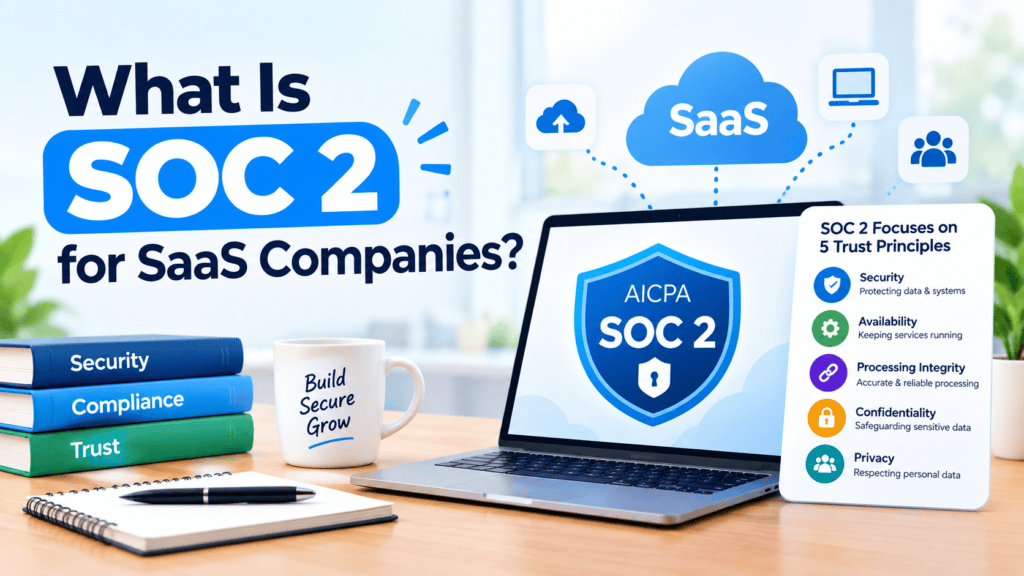
SOC 2 is an examination framework for service organizations. The AICPA’s Trust Services Criteria cover five areas:
- Security
- Availability
- Processing Integrity
- Confidentiality
- Privacy
The criteria are used to evaluate controls over systems and information used to provide products or services.
For SaaS companies, that can touch everything from user access and cloud infrastructure to change management, incident response, monitoring and vendor management.
One important terminology point: SOC 2 is better described as an attestation/reporting engagement, not a certification. The outcome is a report based on an examination of the organization’s controls.
That distinction matters when you’re evaluating vendors. A compliance platform can help with readiness, evidence collection and monitoring, but the formal report comes from the appropriate independent auditor.
Does an Early-Stage SaaS Company Actually Need SOC 2?
Not every SaaS startup needs a SOC 2 report immediately.
Start with your commercial requirements.
You should investigate SOC 2 earlier when:
- enterprise prospects are explicitly requesting it;
- security questionnaires are appearing during sales;
- customers will entrust you with sensitive business information;
- your contracts require security assurance;
- you sell into industries with formal vendor-risk programs;
- you expect enterprise procurement to become a major sales channel.
You may have more flexibility when:
- the product is still validating its market;
- your customers are small businesses that don’t request formal assurance;
- your architecture and scope are changing rapidly;
- there is no foreseeable customer requirement;
- your team cannot yet operate controls consistently.
The important distinction is that security work and formal certification timing aren’t the same decision.
A startup can establish MFA, least-privilege access, logging, secure development practices, backups and incident procedures before it is ready for a formal SOC 2 examination.
SOC 2 Type 1 vs Type 2
One of the first decisions you’ll encounter is whether to pursue Type 1 or Type 2.
| Area | Type 1 | Type 2 |
| Primary question | Are controls suitably designed at a point in time? | Are controls are suitably designed and operating effectively |
| Time perspective | Specific point in time | Defined observation period |
| Evidence burden | Lower | Higher |
| Operational history | Limited | Important |
| Typical use | Earlier assurance | Demonstrating sustained operation |
A Type 1 report can provide an earlier snapshot of control design and implementation.
A Type 2 examination goes a step further by testing if the controls actually operated effectively during an observation period. Current startup guidance often refers to this observation period as being several months (though the engagement structure depends on the auditor and scope).
Should every startup do Type 1 first?
No.
If your target customers specifically require Type 2, obtaining Type 1 first may create an additional project rather than removing work.
On the other hand, Type 1 can make sense when a buyer accepts it and the startup needs an earlier independent assessment while building toward Type 2.
The buyer’s exact requirement shall decide the path.
Ask:
“Do you require SOC 2 Type 1, Type 2, or simply evidence that we’re actively preparing?”
Get the answer in writing before choosing an audit path.
What Does SOC 2 Readiness Actually Look Like?
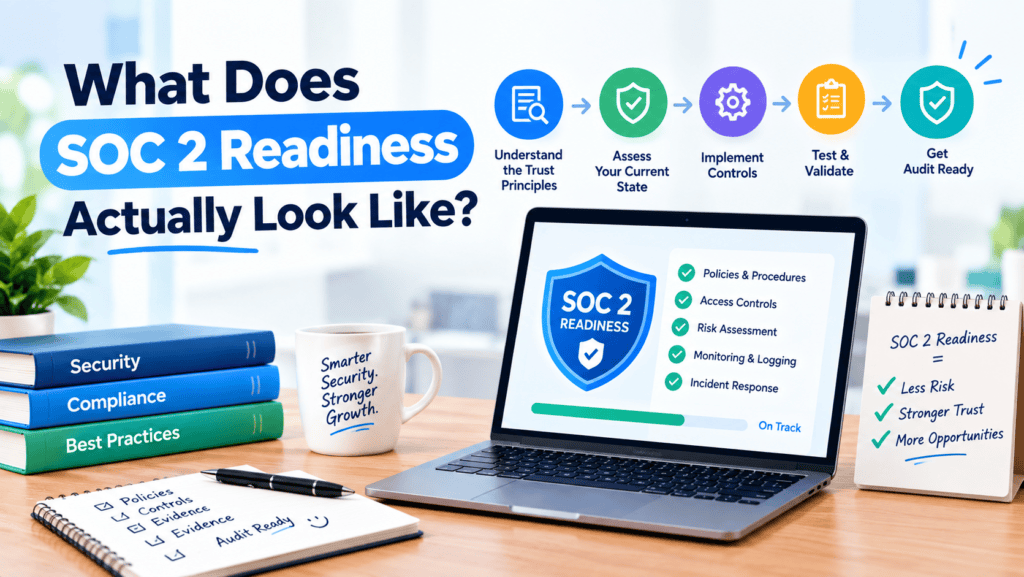
Being “ready” doesn’t mean having a folder full of policies.
Your controls need to match how the company actually operates.
An early-stage SaaS should examine at least these areas.
1. Identity and Access Management
Know who can access:
- production systems;
- databases;
- source code;
- cloud infrastructure;
- customer information;
- administrative tools;
- security systems.
Use least privilege rather than giving everyone broad administrator access.
OWASP recommends designing access controls deliberately, applying least privilege, auditing accounts and disabling unused accounts.
2. Employee Onboarding and Offboarding
Create a repeatable process.
When someone joins, define the access they need.
When they change roles, review whether access should change.
When they leave, remove access promptly.
The process should be documented and produce evidence.
3. Multi-Factor Authentication
MFA is particularly important for privileged accounts and administrative systems.
The exact implementation should reflect your threat model and control requirements, but privileged access shouldn’t depend on a single password.
4. Logging and Monitoring
You need to know what happened when something goes wrong.
Depending on your environment, useful events can include:
- authentication failures;
- authorization failures;
- administrative actions;
- configuration changes;
- sensitive data access;
- security events;
- production changes;
- system errors.
OWASP recommends security logging and monitoring that supports investigation and detection, while also warning against placing passwords, tokens and other sensitive secrets into logs.
5. Change Management
Your startup should be able to explain how code moves into production.
For example:
- Developer creates a change.
- Code is reviewed.
- Automated tests run.
- The change is approved.
- Deployment occurs through a controlled process.
- Evidence is retained.
The exact workflow can vary. The important point is consistency and traceability.
6. Incident Response
Write down what happens when there is a security incident.
Define:
- who is notified;
- who investigates;
- who makes containment decisions;
- how evidence is preserved;
- how customers are contacted when appropriate;
- how the incident is reviewed afterward.
A short, usable incident-response process is more valuable than a long document nobody follows.
7. Vendor Management
Your SaaS probably relies on third parties.
Examples include:
- cloud providers;
- payment processors;
- email providers;
- authentication services;
- analytics platforms;
- AI model providers;
- monitoring services;
- customer-support tools.
Maintain an inventory of important vendors and understand what data or systems they can access.
Your Development Team Has a Role — But It Doesn’t Own SOC 2
A common mistake is treating SOC 2 as something the development company can simply “add” to the software.
It can’t.
SOC 2 involves organizational processes as well as technical controls.
A development team can help implement things such as:
- authentication;
- authorization;
- audit logging;
- encryption;
- secure deployment;
- environment separation;
- backups;
- monitoring;
- vulnerability management;
- access controls;
- infrastructure configuration.
But the company still needs owners for policies, employee processes, vendor management, incident response and governance.
This distinction becomes particularly important for startups using external developers.
Before signing with a development partner, ask:
- Who controls the production cloud account?
- Who owns the source repository?
- How are developer permissions granted?
- How are credentials stored?
- How are production changes approved?
- What happens when a developer leaves?
- What security evidence can the team provide?
- Who is responsible for responding to vulnerabilities?
- Who owns infrastructure documentation?
Does AWS, Google Cloud or Azure Make a SaaS Product SOC 2 Compliant?
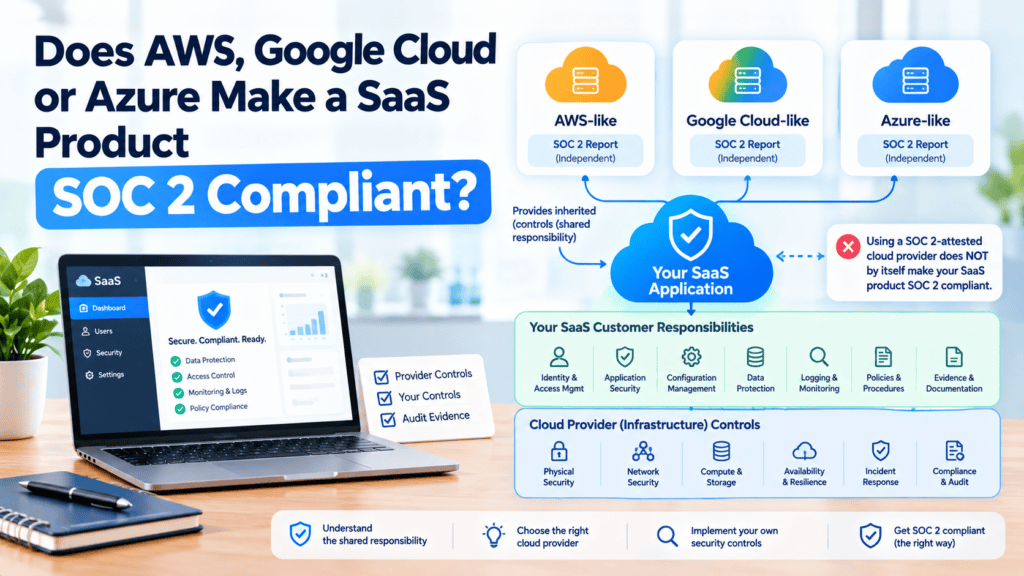
No.
A cloud provider can have its own compliance reports and security controls, but your SaaS remains responsible for the controls that fall within your environment.
AWS describes security and compliance as a shared responsibility: AWS operates certain underlying infrastructure controls, while customers remain responsible for areas including guest operating systems, applications and configuration depending on the services they use.
That means:
Cloud-provider compliance ≠ application compliance.
For example, your cloud provider may secure the physical infrastructure while your team is still responsible for:
- IAM configuration;
- application authorization;
- database permissions;
- secrets;
- deployment controls;
- logging;
- user access;
- application vulnerabilities.
The same principle applies across major cloud platforms.
What Evidence Does a SOC 2 Auditor Need?
Evidence demonstrates that your controls are actually operating.
Examples can include:
- access review records;
- employee onboarding records;
- offboarding records;
- MFA configuration;
- code review records;
- deployment records;
- vulnerability scans;
- security-training records;
- incident-response exercises;
- backup tests;
- monitoring alerts;
- vendor assessments;
- change approvals.
This is why evidence collection shouldn’t begin the week before an audit.
If your Type 2 examination evaluates how controls operated over time, your startup needs a reliable history of those activities.
Build evidence into the workflow
Instead of asking engineers to manually create screenshots every month, automate wherever practical.
For example:
Bad process:
“Someone needs to remember to screenshot the production access list every quarter.”
Better process:
“Access-review workflow generates a dated record showing who reviewed access, what was reviewed and whether changes were required.”
The goal isn’t more paperwork.
The goal is repeatable evidence generated by normal business operations.
Security Foundations to Build Into a SaaS MVP
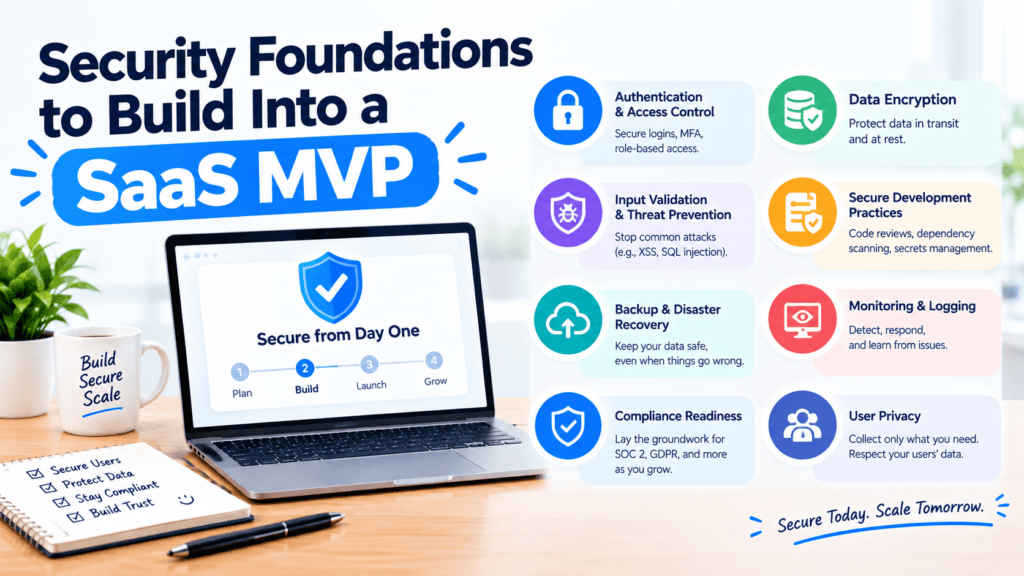
You don’t need to turn a three-person startup into a Fortune 500 security department.
But some decisions become expensive to retrofit.
Authentication and authorization
Design roles and permissions carefully.
A user should not receive access simply because their browser hides a button. Authorization needs to be enforced server-side.
OWASP specifically recommends that authorization checks not rely on client-side controls.
Secrets management
Don’t put API keys, database credentials or other secrets directly into source code.
Use an appropriate secrets-management approach and restrict access according to least privilege.
OWASP recommends centralized secrets management, controlled access and rotation practices.
Environment separation
Keep development, staging and production environments appropriately separated.
Production access should be narrower than development access.
Audit logging
Identify important actions that need traceability.
For a SaaS application, that may include:
- administrator actions;
- permission changes;
- authentication events;
- sensitive record changes;
- billing changes;
- security configuration changes.
Backup and recovery
Don’t just create backups.
Test whether you can restore them.
A backup that has never been restored successfully is an assumption, not demonstrated recovery capability.
How Much Does SOC 2 Cost for a Startup?
There is no universal SOC 2 price.
The total budget can contain several separate components:
| Cost area | What it covers |
| Readiness | Gap assessment and preparation |
| Auditor | Formal examination and report |
| Compliance software | Evidence collection and monitoring |
| Penetration testing | Security testing where required or appropriate |
| Remediation | Fixing identified gaps |
| Internal labor | Engineering, HR, operations and leadership time |
| Security tools | IAM, endpoint security, monitoring and related tooling |
| Legal/compliance | Policies, contracts and specialist advice where needed |
Current published market estimates vary substantially. Drata’s 2026 guidance gives roughly 7,500–15,000 for Type 1 audits for small-to-midsize companies and $12,000 to $100,000+ for Type 2, while noting that total compliance costs can be considerably higher once tooling, readiness, remediation and internal labor are included.
Vanta’s current startup guidance similarly places first-year all-in planning around 20,000–80,000+, depending on scope, readiness, complexity and auditor.
These are third-party market estimates, not official SOC 2 prices.
Your actual budget can be substantially different.
What increases the cost?
Common drivers include:
- larger audit scope;
- multiple products;
- multiple environments;
- more employees;
- complicated infrastructure;
- several cloud providers;
- custom security requirements;
- immature access controls;
- missing evidence;
- significant remediation;
- additional Trust Services Criteria;
- extensive third-party integrations.
The biggest budgeting mistake is looking only at the auditor’s invoice.
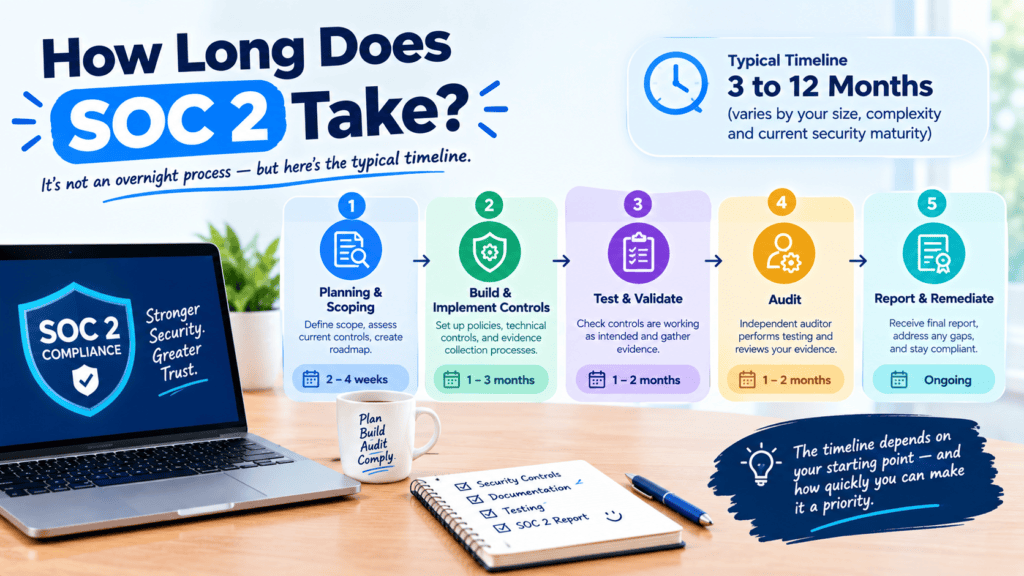
How Long Does SOC 2 Take?
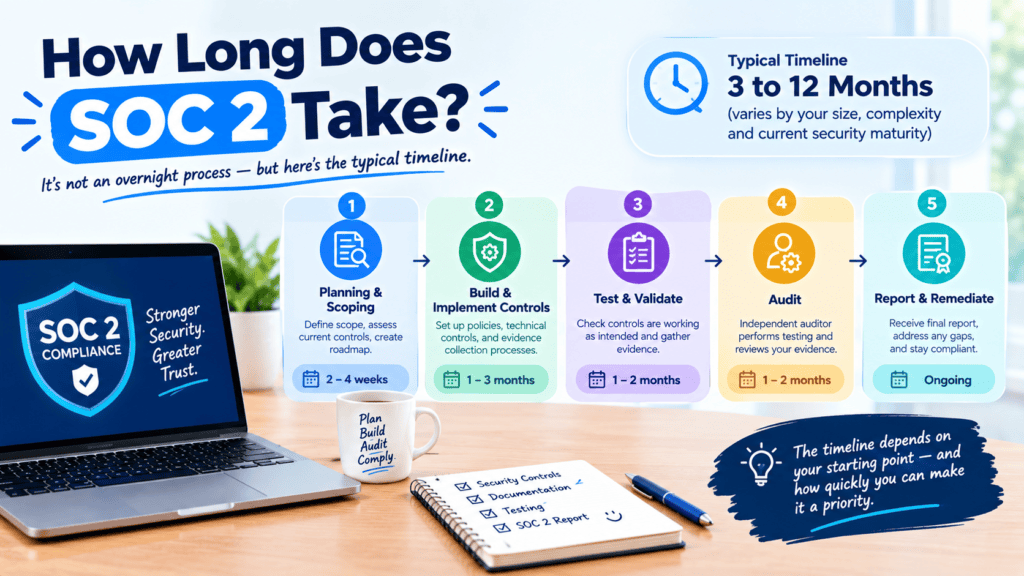
Think about the timeline in stages.
Stage 1: Scope
Define:
- the product;
- systems;
- services;
- locations;
- people;
- vendors;
- Trust Services Criteria.
Stage 2: Readiness
Identify gaps and implement missing controls.
Stage 3: Operating period
For Type 2, controls need to operate over the defined examination period.
Stage 4: Audit
The auditor reviews evidence and performs the examination.
Stage 5: Report
The resulting report documents the examination and findings.
A Type 1 can generally move faster because it doesn’t require the same multi-month observation period. A Type 2 necessarily requires time to demonstrate ongoing operation.
Vanta’s current Type 1 guidance describes preparation, auditor fieldwork and report delivery, while emphasizing that Type 2 cannot simply be rushed because the controls must operate over time.
Don’t Scope Your First SOC 2 Around Your Entire Company
Scope deserves more attention than it usually gets.
Suppose you operate:
- one SaaS product;
- an unrelated consulting service;
- an internal marketing website;
- several development experiments.
You may not need all of those environments in the same audit scope.
A narrower, defensible scope can make preparation more manageable.
But don’t artificially exclude systems that are genuinely relevant to the service being examined.
Your auditor should help determine the appropriate scope.
The objective is not to make the audit artificially easy.
It’s to make the scope accurately represent the service you’re offering customers.
SOC 2 and AI SaaS
AI-powered SaaS creates additional questions.
If your application sends customer information to an external model provider, understand:
- what information is sent;
- where it is processed;
- what the provider does with it;
- retention practices;
- access controls;
- contractual commitments;
- sub-processors;
- logging;
- deletion processes.
Don’t assume that using a well-known AI API automatically makes the application compliant.
The AI provider is another component in your vendor and data-flow analysis.
The same principle applies to vector databases, model-hosting platforms, transcription APIs, analytics services and other external systems.
SOC 2 vs GDPR: They Aren’t the Same Thing
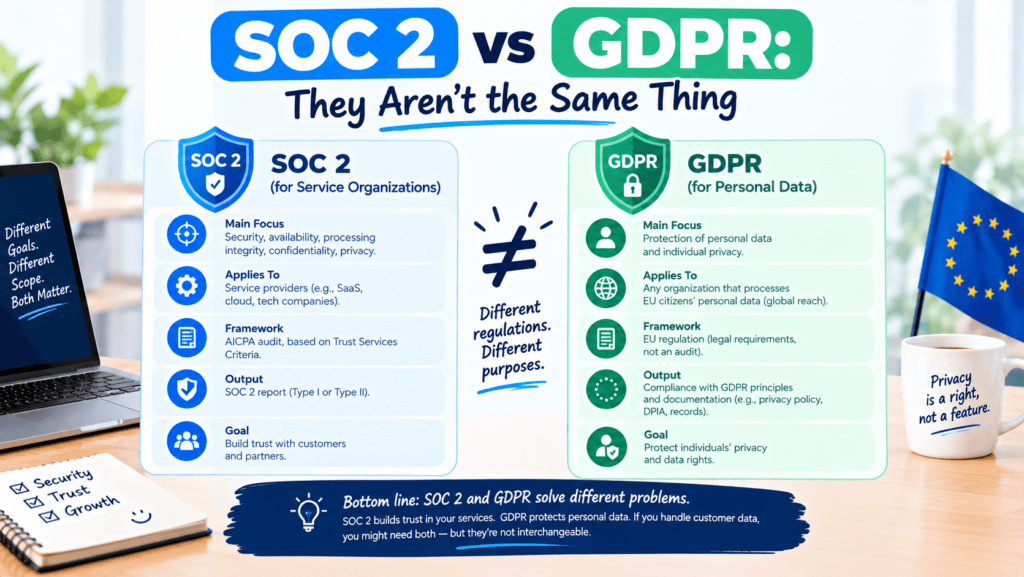
SOC 2 and privacy regulations solve different problems.
SOC 2 provides assurance around controls under the applicable Trust Services Criteria.
Privacy regulations such as GDPR establish legal obligations around personal-data processing.
A company can therefore have SOC 2 and still have GDPR obligations.
Likewise, GDPR compliance does not automatically produce a SOC 2 report.
For an early-stage SaaS, map the two separately and identify where the controls overlap.
When Should You Start Preparing?
A useful approach is to divide the decision into three stages.
Stage 1: Pre-validation
Focus on foundational security.
You probably don’t need a formal SOC 2 program yet unless a specific customer requirement exists.
Priorities:
- secure authentication;
- authorization;
- secrets;
- backups;
- basic monitoring;
- secure development;
- data mapping.
Stage 2: Early commercial traction
Start formalizing processes.
Priorities:
- access reviews;
- onboarding/offboarding;
- vendor inventory;
- incident response;
- change management;
- documented policies;
- evidence collection.
Stage 3: Enterprise sales
If enterprise customers are actively asking for SOC 2, treat it as a sales-enablement and risk-management project.
At this stage, determine exactly what buyers require.
Don’t assume that every customer wants the same report.
How a Development Partner Can Support SOC 2 Preparation
A software development partner can contribute to the technical foundation.
For example, a SaaS development team can help with:
- secure authentication;
- role-based access;
- database permissions;
- audit logs;
- cloud infrastructure;
- environment separation;
- CI/CD controls;
- monitoring;
- backup configuration;
- security testing;
- documentation.
But founders should avoid asking:
“Can you make my SaaS SOC 2 compliant?”
Ask more precise questions:
“Which technical controls are you implementing?”
“What evidence will those controls produce?”
“Who owns the infrastructure?”
“How are production changes approved?”
“How are credentials managed?”
“What happens when your developer’s access ends?”
That produces a much more useful conversation.
Where BkAbhi Fits
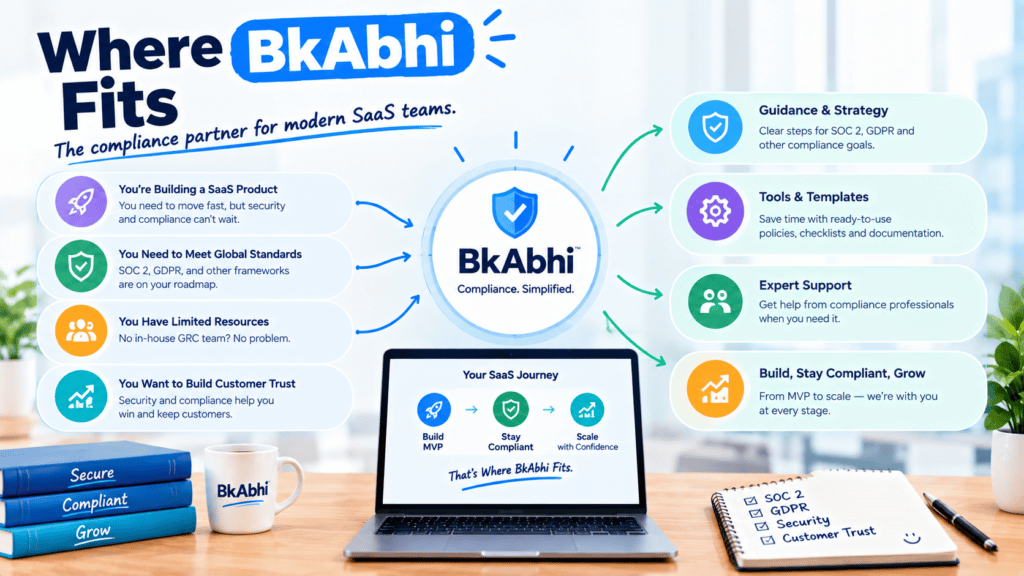
BkAbhi’s current website describes the company as an innovation lab focused on SaaS products and currently lists SaaS architecture, cloud deployment, API development, AI integration, mobile development and ongoing engineering support among its capabilities. The site also publicly lists a $2,999 MVP package, 2–3 week target, and 100% IP ownership.
For a founder building a new SaaS, those capabilities can be relevant when security and compliance requirements need to be considered during architecture and development rather than retrofitted later.
However, BkAbhi’s current public website does not establish that BkAbhi itself holds or issues a SOC 2 report. Founders should therefore distinguish between development support and independent SOC 2 attestation.
If you are evaluating BkAbhi or another development partner, ask for specific evidence of how they handle:
- access to your repositories;
- production credentials;
- infrastructure ownership;
- deployment permissions;
- security testing;
- documentation;
- IP ownership;
- post-launch maintenance.
A Practical Early-Stage SOC 2 Checklist
Before starting a formal engagement, review the following.
Governance
- SOC 2 scope is defined
- Control owners are assigned
- Security policies reflect actual practices
- Management understands responsibilities
Identity
- MFA is enabled where appropriate
- Privileged access is restricted
- Least privilege is implemented
- Access reviews are performed
- Former employees lose access
Application
- Authorization is enforced server-side
- Sensitive actions are logged
- Secrets aren’t stored in source code
- Dependencies are monitored
- Security testing is performed
Infrastructure
- Production access is restricted
- Development and production are appropriately separated
- Cloud permissions are reviewed
- Backups exist
- Restoration is tested
- Monitoring and alerting are configured
Operations
- Incident-response process exists
- Change-management process exists
- Vendor inventory exists
- Security training is documented
- Evidence is retained consistently
Audit readiness
- Scope is agreed
- Buyer requirements are understood
- Type 1/Type 2 requirement is confirmed
- Auditor selection is underway
- Evidence collection is repeatable
- Remediation work is tracked
Common SOC 2 Mistakes Early-Stage SaaS Teams Make
Mistake 1: Waiting for the first enterprise deal
If the prospect asks for SOC 2 tomorrow, you can’t manufacture months of operating evidence overnight.
Mistake 2: Treating SOC 2 as documentation
Policies matter, but policies that don’t reflect actual behavior won’t solve the underlying problem.
Mistake 3: Buying compliance software and assuming the work is finished
Software can automate evidence collection and monitoring.
It can’t make an immature process mature by itself.
Mistake 4: Giving every developer production access
Convenience today can become an access-control problem later.
Mistake 5: Logging everything
More logs aren’t automatically better.
Logs should be useful, protected and designed so sensitive credentials and unnecessary personal information aren’t exposed.
Mistake 6: Forgetting third-party vendors
Your SaaS probably depends on more external services than you realize.
Map them early.
Mistake 7: Overbuilding
A pre-revenue SaaS doesn’t necessarily need the same security program as a company selling to large regulated enterprises.
Scope security controls around actual risk and customer requirements.
How to Choose the Right SOC 2 Path
Ask five questions:
1. Who is asking for SOC 2?
Is it a real customer, a prospective customer, a partner or simply something you think you might need?
2. What exactly do they require?
Type 1? Type 2? A current report? A bridge letter? A security questionnaire?
3. What systems are actually in scope?
Don’t accidentally audit systems unrelated to the service.
4. How mature are your controls?
If controls aren’t operating consistently, jumping directly into an examination can create avoidable problems.
5. What evidence can you already produce?
Your evidence trail is often a better readiness indicator than the number of policies in your shared drive.
Final Takeaway
SOC 2 compliance for early-stage SaaS isn’t about obtaining a badge as quickly as possible.
It’s about building the right level of security governance for the stage you’re actually in.
If enterprise customers already require SOC 2, start with their exact procurement requirement and work backward.
If you’re still validating your SaaS, establish durable security foundations without necessarily rushing into a formal examination.
And if you’re preparing for Type 2, remember that consistent operation matters as much as documentation.
The most useful early investment is usually not “doing everything for SOC 2.”
It’s designing the product, infrastructure and operating processes so that security evidence becomes a natural byproduct of running the company.
That makes the eventual examination a structured review of how the business operates—not a last-minute attempt to recreate months of history.
Author Bio
Author: Jeevesh Tripathi
Email: jeevesh@bkabhi.com
The author positioning should remain research-focused rather than claiming professional audit credentials.
Jeevesh Tripathi writes research-based content on technology, AI, software, SaaS, and digital products. His work focuses on practical comparisons and evidence-based evaluation, helping founders and technology teams understand product-development and technology decisions without unnecessary jargon.