
Table of Contents
Introduction
Creating an MVP in 2026 may cost you more than $10,000 to $150 000+. It depends on several factors, including the product’s complexity, required features, technology stack, design, development team, and the team’s location.
The MVP development cost for a simple product with basic features can be lower. Still, using AI technologies, real-time components, API’s, implementing strong security measures, or building a product with complex role management can increase the cost significantly.
Apart from the development budget, several other expenses must be considered when launching a product. MVP planning, UI/UX prototyping, and technical debt removal after MVP launch also take a certain amount of effort and thus impact the cost.
Therefore, to estimate how much an MVP development would cost in your case, you should have a clear understanding of what features you need for your MVP and what validation goals you have.
In this article, we describe the most important factors that determine the cost of MVP Development in 2026, outline the standard rates, and highlight any additional hidden costs you may encounter.
MVP Cost Overview
MVP or Minimum Viable Product is one of the best options to test a business idea without spending too much of your budget. But how much does it cost to build an MVP? This is one of the most common and frequently asked questions, and the response is never straightforward. However, it is possible to find out the estimated average cost for developing an MVP and the primary factors influencing the price.
Average MVP Development Cost
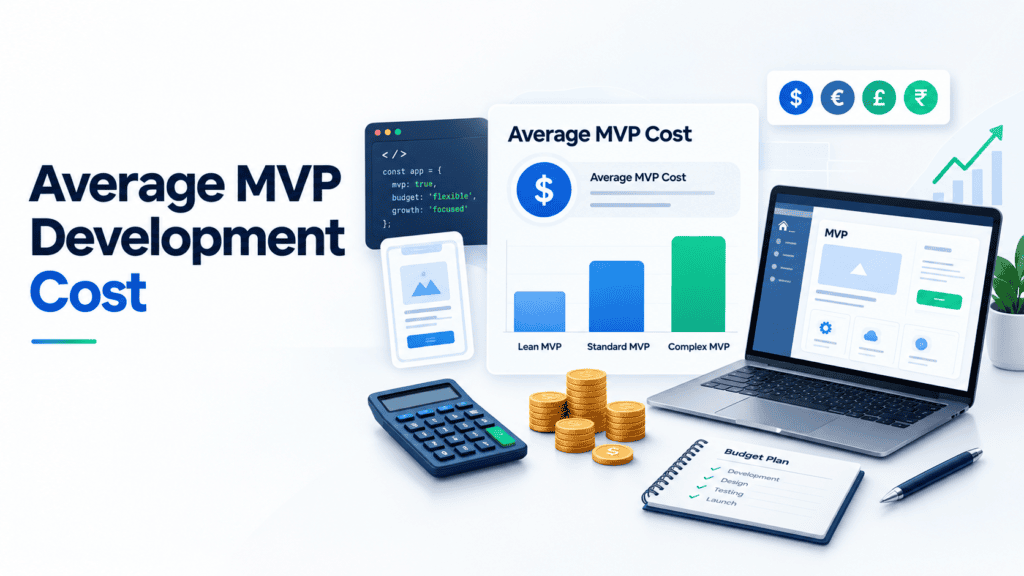
Based on extensive research and analysis, a simple MVP costs between $15,000 and $60,000. Depending on a wide range of requirements and specifications, including hours needed, the experience of developers, etc., the final price can vary.
MVP App Development Cost Range
The average MVP development cost for simple MVPs (apps with basic functions) is between $15,000 and $30,000. Medium-level MVPs (with user accounts, third-party payments, and some admin panel functions, take between $30,000 and $60,000. Finally, complex MVPs (with advanced functionalities and multiple roles) require an investment between $60,000 and $150,000 or more.
It takes between 2 to 4 months to develop an MVP, while some simple MVPs can be built and launched within 6 weeks. At the same time, there are also MVP development examples that took as long as 6 months.
Please note that these are average figures for MVP development companies. The final price varies depending on whether you hire an in-house team or a freelancer, outsource the task to an agency, etc. Also, the location of your employees or contractors can impact the final cost significantly.
Factors Affecting MVP Price
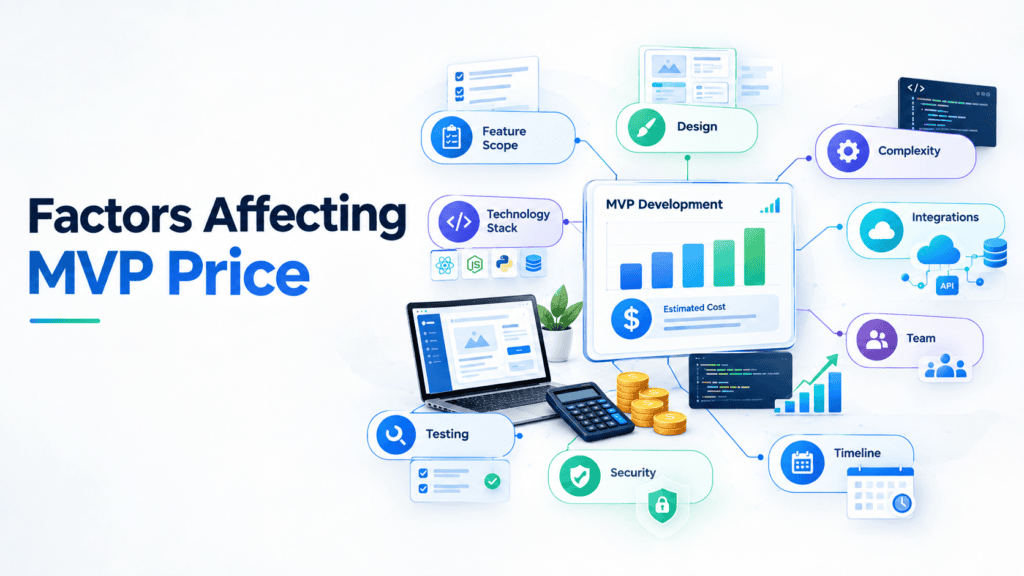
When discussing MVP development cost, these factors should also be taken into consideration:
Feature Set and Complexity
The more features the app has, the higher the cost. At the same time, not only the quantity of features but their complexity also impacts the final price. Using the example of a content-based application, MVP development for a blog would be cheaper than for a marketplace app.
The Chosen Tech Stack
The chosen tech stack also plays a significant role in determining how much it costs to build an MVP. First and foremost, you need to decide what platforms you want to support. If you are not ready to build apps for all three platforms (iOS, Android, and web), it is better to choose one. In that case, you can also think about using cross-platform development tools.
Design Requirements
It is of utmost importance to plan your MVP design budget. If you want to have a custom UI/UX design instead of using some MVP design templates, it would impact the final price. The same goes for prototyping.
MVP Backend Requirements
How complex the backend of your MVP is also matters. The more custom tools and technologies it uses, the more it would cost. A custom database, third-party API, etc., would require additional hours from your developers.
The Development Team’s Experience and Location
Experienced software development teams usually work for a higher hourly rate than junior ones. At the same time, remote development teams, including eastern European companies, are often cheaper than American ones. For instance, the average price for American developers is $80 – $200 per hour, while eastern European developers’ hourly rates only reach $60.
Third-Party Tools and Integrations
Each third-party tool, including payment systems, API, CRMs, analytics, etc., that the MVP would use would add to the cost of MVP development.
Security and Compliance
If your MVP stores and processes sensitive data, you would have to invest more time and money in making sure that it meets all security standards.
QA Testing
QA testing is essential for any application, and MVP is not an exception. The more time is spent on testing and debugging, the fewer issues there would be after the MVP launch.
MVP Maintenance
Finally, while not directly related to MVP development cost, it is essential to think about MVP maintenance and support after the launch. It is usually recommended to allocate 15 – 25% of the initial cost per year for this purpose.
Building Minimum Viable Product (MVP) is the most efficient method to prove one’s business idea, yet its cost depends on the product’s complexity. The following factors usually affect the MVP development range: scope, technical architecture, team location, and regulatory requirements.
MVP Cost Breakdown By Complexity
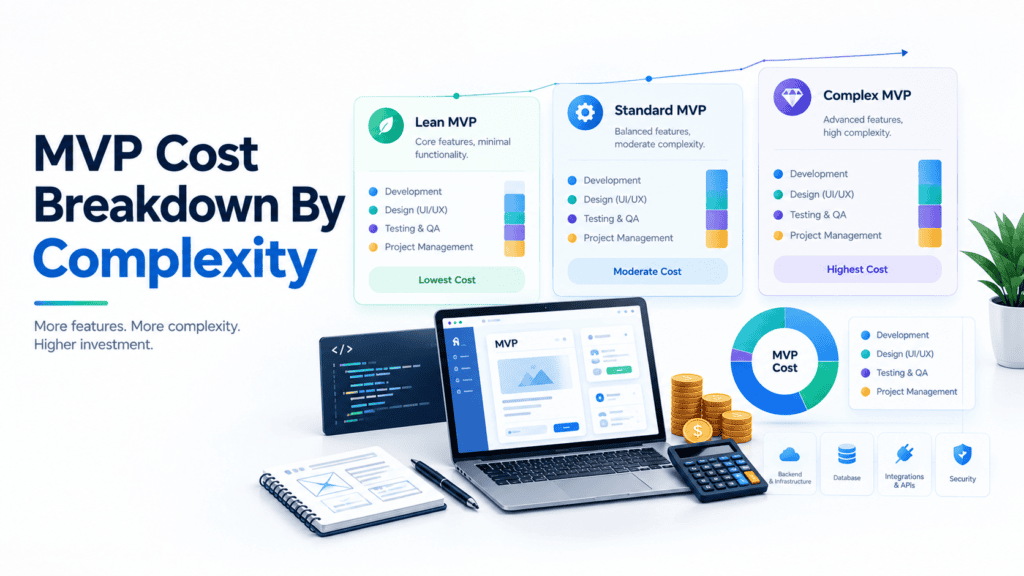
Complexity Tier Estimated Cost Range Timeframe Best For
Simple MVP $5,000 – $20,000 2 – 6 weeks Quick experiments, landing page MVP, no-code/similar tools
Medium MVP $20,000 – $80,000 6 – 14 weeks Seed-stage startups, SaaS, two-side marketplace
Complex MVP $80,000 – $250,000+ 14 – 24 weeks+ AI/ML-products, FinTech, HealthTech, multi-platform native apps
Three Types of MVP Development Cost
Simple MVP ($5,000 – $20,000)
A simple MVP targets only one core value proposition, does not involve complicated custom backend solutions, and utilizes rapid web development or no-code prototyping tools to test the concept and design. It generally has 3–6 screens, 3 to 6 simple dynamic pages, basic user authentication (email/password, or social), and simple stripe integration to process payments.
Technologies Utilized in a Simple MVP
- No-code prototyping tools (i.e. Bubble, Webflow, FlutterFlow Similar)
- Firebase, Supabase similar backend solutions
- Email, SMS service provider APIs (i.e. Twilio, SendGrid Similar)
Scopes and Features
- 3–6 dynamic/static screens
- 3–4 CRUD operations
- Email/Social Auth
- Stripe integration
- Simple UI/UX
Team
- A single developer, a small agency, or a freelancer
Medium MVP ($20,000 – $80,000)
A medium MVP is a fully-coded MVP ready to raise investments and launch the MVP in a matter of weeks. It is usually developed by a project team that can provide the necessary frontend and backend expertise, product design, project management, QA engineering, and third-party API integrations.
Technologies Utilized in a Medium MVP - React, Vue, Node.js, Python, similar
- Firebase, Supabase, or similar
- Stripe, Twilio, similar API services
- Web Appropriate Backend Architecture
Scopes and Features - 8–20 dynamic screens
- 8–12 CRUD operations
- Role-based authentication (i.e. Buyer/Seller/Admin)
- Real-time database, analytics, and notifications
- 3-party service API integrations (i.e. maps, CRM, marketing)
Team - PM, designer, frontend, backend, QA
Complex MVP ($80,000 – $250,000+)
A complex MVP requires deep technical expertise, includes regulation compliance, and involves high-level mobile/desktop application development, and native AI/ML algorithms. A complex MVP usually has native iOS and Android builds, requires specific security hardening and regulations, and has a sophisticated tech stack.
Technologies Utilized in a Complex MVP - Custom backend ML models/AI training
- Swift, Kotlin, React Native, Flutter, similar
- Firebase, Supabase, AWS, Google Cloud, similar
- Custom security architecture, i.e. HIPPA, SOC2, PCI-DSS, similar
- Custom API-first solutions, backend systems, data warehouses, similar
Scopes and Features - 14+ dynamic screens
- 14+ CRUD operations
- Role-based authentication (i.e. Buyer/Seller/Admin)
- Real-time database, analytics, notifications
- 3-party service API integrations (i.e. maps, CRM, marketing)
- Sub-accounts, multiple roles, white-label, and advanced reporting
- Native app builds (iOS and Android)
Team - Agency, senior-level engineers, and specialists
What Factors Typically Affect the Cost
Location
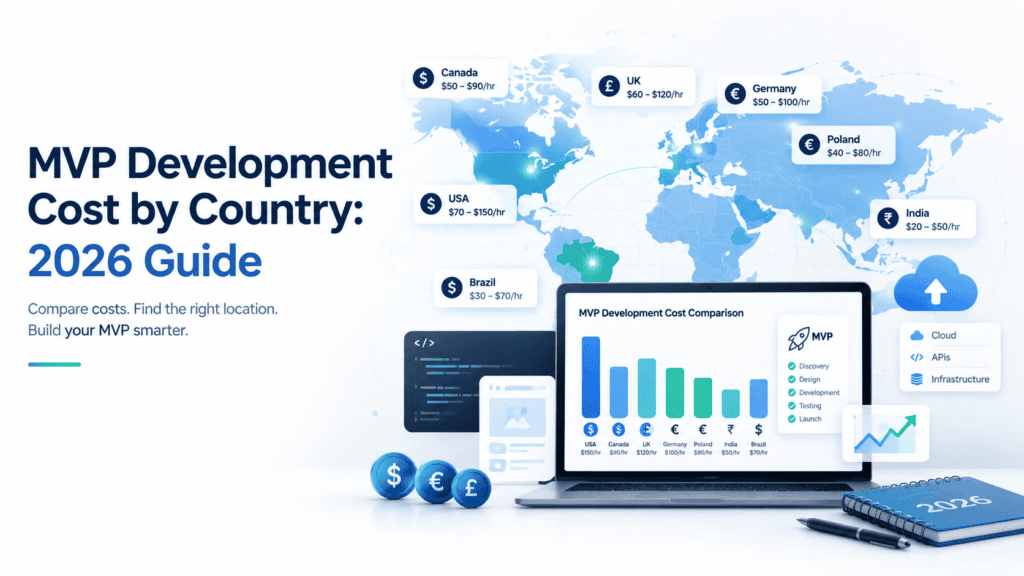
Depending on the development location, one can choose from remote and local agencies, freelancers, and project teams. The rates in North America/Western Europe vary from $100-200+, Eastern Europe or Latin America range from $40-$90/h, and South Asia (India) range from $20-$50/h.
Platforms
A web-based MVP build would be the most affordable, whereas a native build for iOS and Android may take more time and effort. Therefore, a cross-platform MVP build for mobile applications (Flutter or React Native) can be considered an economical option as well.
Additional Costs
Depending on the product, one may need to budget for cloud hosting and database storage (i.e. AWS, Google Cloud), which vary from $50-$500+/month, API subscriptions (i.e. 3rd party service utilization), and app store subscriptions (Apple: $99/year, Google: $25 once ).
When developing a Minimum Viable Product (MVP), the decision about the development model shapes the entire project, including MVP development costs. In this article, we will explore the three main types of development teams — Freelancers, In-house teams, and Development agencies — and highlight their benefits, drawbacks, and overall suitability for a startup.
We will also provide a brief comparison of costs, time, and control over the development process.
The choice of the development team for MVP creation depends on several aspects, including the technical expertise of the founding team and their involvement in the development process, the expected product lifespan and the projected total number of working hours needed for the project, and the projected risks and required level of process control.
1. Freelancers
A team of freelancers is formed when an individual signs contracts with several different developers, each responsible for a particular aspect of the product.
Pros:
- Low cost due to no employee benefits
- Discretion and high discretion
- Rapid assembly of the team
Cons: - The time spent on testing and implementing the solution may be too long
- Uncertainty of the result
- The need for constant search and selection of new partners
Use cases: - Low budget and need for rapid development
- The need for a rapid but specific solution
- No technical skills within the founding team
The engagement of freelancers is appropriate in those initial stages when the project has a limited scope and a rapidly evolving structure. This option is optimal in terms of speed and cost, but it is also the riskiest in terms of quality and stability.
2. In-house Team
An in-house team consists of employees hired directly by the company and incorporated into the existing structure.
Pros:
- Complete control and supervision
- The ability to shape the product vision
- Focus on the product
Cons: - Relatively high cost due to employee benefits
- Difficult and time-consuming search and screening
- Limited technical expertise
Use cases: - The need for a sustainable long-term product
- The need for rapid development in the future
- Significant funding opportunity
This type of development team is ideal for those who have the time, money, and knowledge to invest in the sustainable long-term development of the product. However, given the difficulty of finding qualified developers, this method is not recommended for use within a short timeframe.
3. Development Agency
A development agency engages a qualified software development house that has the expertise and staff to provide comprehensive assistance in MVP development.
Pros:
- Comprehensive range of services
- Relatively rapid assembly of the team
- The ability to form a multi-skilled unit
Cons: - The cost of development can be significantly higher than the hourly rate of a freelancer
- A lower degree of control and oversight
- The learning curve for new technologies and methodologies
Use cases: - Lack of technical expertise and infrastructure
- The absolute necessity of rapid development
- The need for an objective expert opinion
The use of a development agency is appropriate when the company lacks the infrastructure and knowledge to implement rapid development. However, when using an external agency in the development of an MVP, particular attention should be paid to the degree of control and level of detail of the accompanying documentation.
How Development Location Impacts MVP Cost
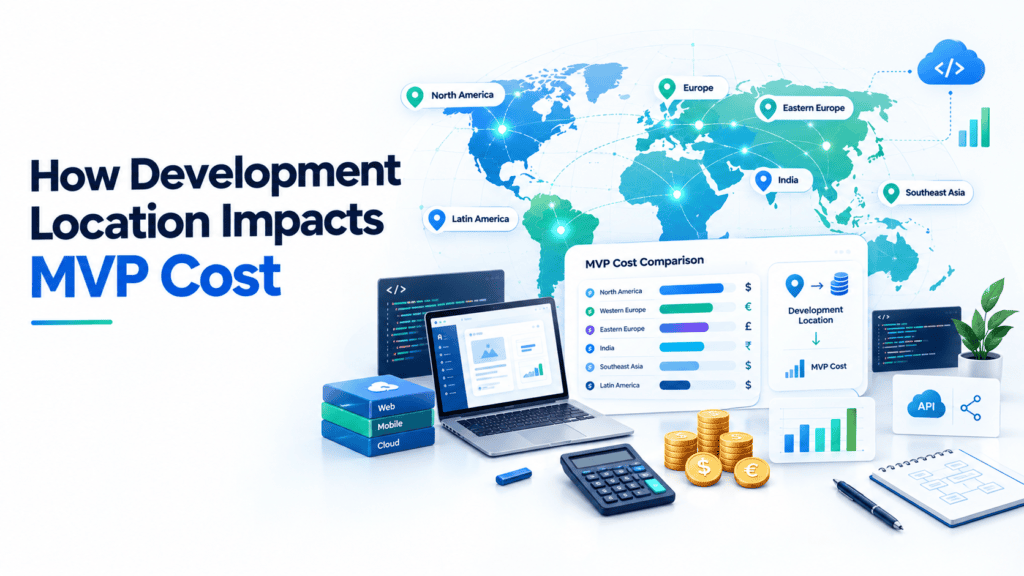
The single biggest lever in your budget for MVP development is not the scope of the product you’re going to build, but rather the location where the development team is based. Hourly rates for software development can vary 5-10x across different regions, and these differences become magnified if you factor in the length of the development process.
Here’s how the major outsourcing destinations compare:
United States
Hourly rate: $100–$200+
The American market serves as a reference point for the industry as a whole, with hourly rates commanded by US-based developers being among the highest in the world. You pay a premium for the convenience of close communication (no time difference, no language barrier), superior understanding of the US-specific regulation, and the ability to collaborate intensively in person if needed.
For a typical MVP (requiring 300–600 hours of work), this usually translates into $40,000–$150,000+ in development costs. The value proposition of “local expertise” is often particularly compelling for highly-regulated industries (healthtech, fintech), projects that require a very close collaboration between the client and the agency, and for companies that simply have a very large budget.
Europe
Hourly rate: $40–$90 (varies significantly within the region; Western Europe commands higher rates than Eastern Europe)
Europe is, in many ways, the best of both worlds: excellent quality of code, good command of English, and a close enough match of working hours to both the US and the other European companies you might be collaborating with. Eastern European countries, in particular, have invested heavily in building their IT expertise and reputation, with many talented developers seeking long-term careers in the international markets. Due to a lower hourly rate compared to Western Europe and the US, Eastern Europe is, on average, the most cost-effective destination for MVP development.
The expected budget for an MVP in Europe would be in the range of $20,000–$60,000.
LATAM (Latin America)
Hourly rate: $30–$70
LATAM is becoming an increasingly popular destination for companies that want to benefit from close collaboration with an offshore team. LATAM developers tend to have excellent English skills and comparable technical expertise to Eastern European developers, while working in a similar time zone to the US, which facilitates real-time communication.
A project in LATAM is likely to cost between $15,000–$45,000.
Asia
Hourly rate: $15–$50 (India, Pakistan, Philippines, Vietnam have much lower rates than more developed digital economies in Asia)
Asia is a mixed bag: while you can get excellent value for your budget in terms of hourly rate, many Asian outsourcers have limited English proficiency and less developed project management practices than Western companies used to working with international clients.
Projects in Asia are the most budget-friendly, with the expected budget for MVP development in Asia being approximately $8,000–$30,000.
Compare the average hourly rates and MVP budgets for the different regions:
| Region | Hourly rate | MVP development budget |
|—|—|—|
| United States | $100–$200+ | $40K–$150K+ |
| Europe | $40–$90 | $20K–$60K |
| LATAM | $30–$70 | $15K–$45K |
| Asia | $15–$50 | $8K–$30K |
In addition to the simple difference in the hourly rate, consider the practical implications of working with developers on the other side of the world: the challenges of communication, the risks of cultural misunderstandings, and the likelihood of additional costs due to project delays. With that in mind, many founders opt to work with a hybrid team: a small in-house team or a local product lead who works closely with a larger offshore team of developers.
MVP Cost by Platform
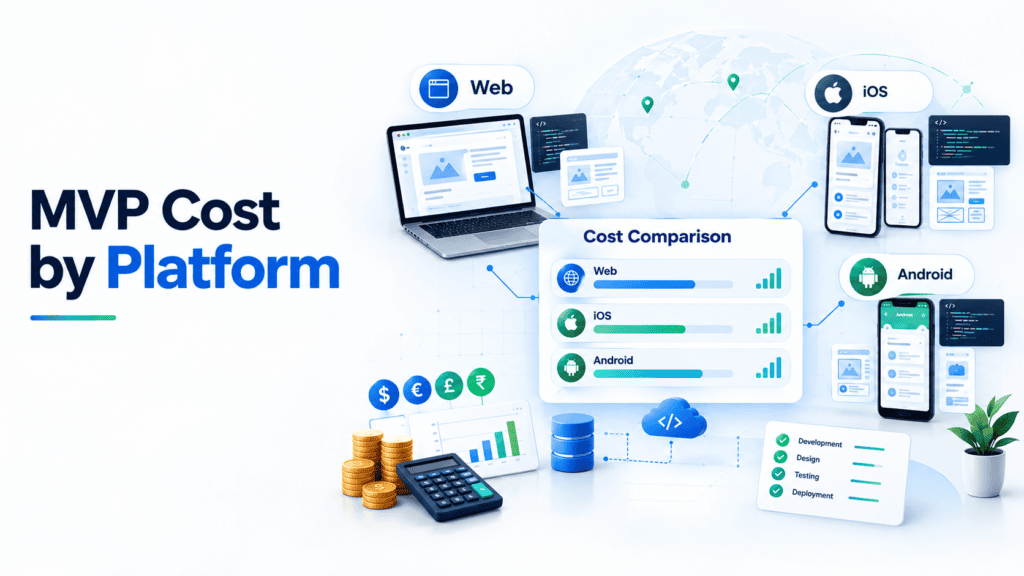
The cost of an MVP depends significantly on the platforms selected for development. Each platform has its particular set of requirements, ranging from design and development to testing and maintenance.
Web MVP: A web-based MVP is usually the most affordable solution because it can be used by any device via a browser. Typically, it contains the basic set of features, including user registration, dashboards, payments, and others
Mobile MVP: Unlike the web version, mobile MVP should be developed as a native application for iOS and Android devices. Such an MVP usually takes more time and effort to build since native apps are different in their development processes.
Cross-platform MVP: a cross-platform solution is another option for MVP development. It is somewhat between native and web apps since it allows you to reach both platforms with one code base. Thus, it reduces development costs and enables you to release the MVP faster to validate the idea.
The choice of which MVP to develop depends on the target audience, features needed, budget, and other factors.
Choosing the right technology stack directly impacts the initial MVP budget, time-to-market, long-term scalability, and maintenance costs.
The baseline for an MVP ranges from $5,000 to $150,000+ depending on the technical complexity, compliance needs, and stack architecture.
Tech Stack Category Est. Initial Build Cost Time-to-Market Ongoing Monthly Cost Ideal For No-Code / Low-Code $3,000 – $15,000 2–4 weeks $50 – $300/mo (SaaS subscriptions) Fast market validation, simple workflows, clickable prototypes Modern Web & Cross-Platform $20,000 – $55,000 6–10 weeks $100 – $500/mo (Basic hosting & DB) Multi-platform launches, SaaS apps, mobile-first products Backend-Heavy $40,000 – $90,000+ 10–16 weeks $300 – $1,500/mo (Dedicated DBs & servers) Data-heavy apps, fintech, complex security & transactional logic Cloud-Native Architecture $50,000 – $120,000+ 12–18 weeks Dynamic ($200 to scale-based) High-concurrency systems, microservices, enterprise SaaS AI/ML-Integrated MVP $60,000 – $150,000+ 12–20 weeks $500 – $5,000+/mo (LLM APIs, Vector DBs, GPUs) Generative AI features, predictive analytics, RAG pipelines
1. No-Code / Low-Code Tech Stack
Popular Tools: Bubble, FlutterFlow, Webflow, Make, Supabase/Firebase, Glide.
Estimated Cost: $3,000 – $15,000.
Key Drivers: Lower developer labor costs, as drag-and-drop visuals replace boilerplate code. Most of the budget goes toward visual design, business logic workflow configuration, and third-party platform configuration.
Trade-Offs: While low upfront cost, a technical ceiling is quickly reached when complex custom logic, high volume, or proprietary IP is needed.
2. Modern Web & Cross-Platform Technologies
Popular Tools: React, Next.js, Node.js, Flutter, React Native, Tailwind CSS.
Estimated Cost: $20,000 – $55,000.
Key Drivers: Cross-platform frameworks allow you to build one codebase that targets iOS, Android, and Web, saving 30–40% compared to separate native iOS (Swift) and Android (Kotlin) builds.
Trade-Offs: Best balance of rapid time-to-market, performance, and code reuse, but very specialized device APIs (e.g., advanced camera processing or Bluetooth hooks) may need native adjustments.
3. Backend-Heavy Technologies
Popular Tools: Python (Django/FastAPI), Java (Spring Boot), Go, PostgreSQL, Redis, GraphQL.
Estimated Cost: $40,000 – $90,000+.
Key Drivers: Higher cost driven by backend logic density, security, database schema modeling, data pipelines, complex transactional integrity, and compliance requirements.
Trade-Offs: Requires senior engineers for high-quality architecture, prolonging the build time. Offers high performance, security, and scalability for complex software.
4. Cloud-Native Architecture
Popular Tools: AWS, Google Cloud, Azure, Docker, Kubernetes, Terraform.
Estimated Cost: $50,000 – $120,000+.
Key Drivers: Includes Infrastructure-as-Code setup, CI/CD automated deployment pipelines, microservices or serverless logic, and environment orchestration.
Trade-Offs: Higher initial architecture configuration costs, but it optimizes operational efficiency while preventing expensive infrastructure rewrites at scale.
5. AI/ML-Integrated MVP
Popular Tools: Python, PyTorch, OpenAI API, Anthropic, LangChain, LlamaIndex, Pinecone/Weaviate, Hugging Face.
Estimated Cost: $60,000 – $150,000+.
Key Drivers: Fine-tuning open-source models, setting up RAG pipelines, managing embeddings, vector database configurations, and testing non-deterministic model outputs.
Trade-Offs: Significant ongoing operational costs for LLM tokens, GPU hosting, vector searches, and model monitoring.
Hidden Costs of MVP Development
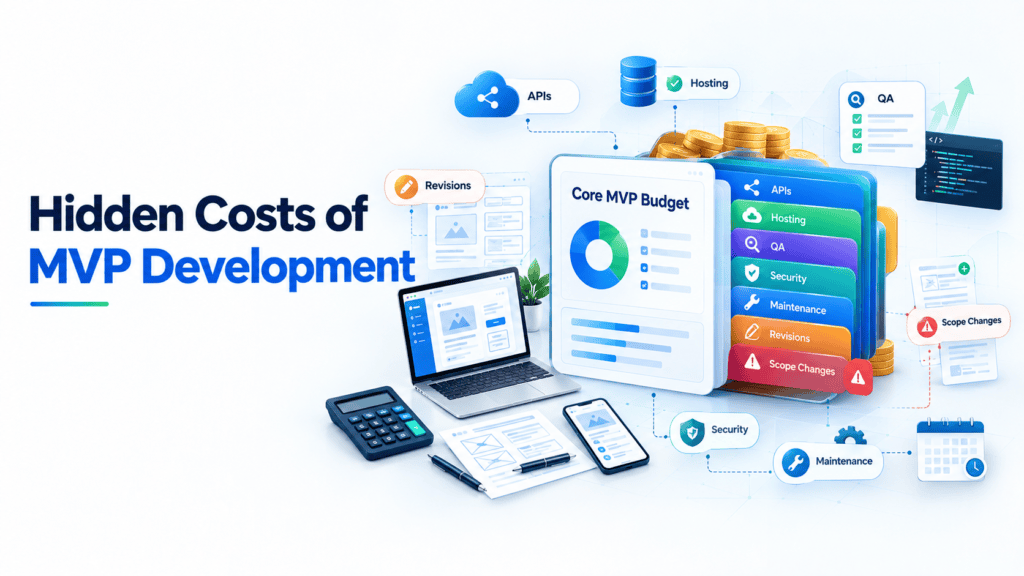
Founders planning to build a Minimum Viable Product tend to think in terms of hours needed for design and development only. In practice, the total amount of money needed to launch a high-quality product compliant with legal and technical requirements may prove to be several times higher than the development budget.
Hidden Cost 1: Legal Documents and Policies
A working software product legally compliant with the requirements of the marketplace requires such documents as a Privacy Policy, Terms of Service, and End User License Agreement to exist and be publicly available. A generic template may work locally, but a lawyer should review and approve all policy documents to ensure there are no loopholes and it covers all of the software’s features.
Hidden Cost 2: GDPR/HIPAA Compliance
Products addressing users in the EU or handling healthcare data must be prepared for stricter privacy laws, such as GDPR or HIPAA. Compliance often requires software to undergo significant redesign and introduce new security and data protection features.
Hidden Cost 3: App Store Fees
Note that the App Store or Google Play commission depends on the product category and may eat into 15 to 30 percent of revenues. Apart from that, a developer typically pays a one-time fee for a company account (\$$99/year for Apple, $ for Google).
Some products also host their code on a third-party cloud platform, often on a subscription basis. The cost of a server lease depends on the platform and scales exponentially with usage. The more users you have, the more you pay – and the bill for a small “MVP team” of one or two developers often comes as a surprise.
Hidden Cost 5: Third-Party APIs
Software products are rarely developed from scratch – they utilize existing APIs for payment processing, analytics, mapping, SMS, email, and other services. APIs have usage tiers – and the more active users you have, the higher the subscription price you will pay.
Hidden Cost 6: Monitoring Services
Once deployed in production, an MVP requires 24/7 monitoring to detect and resolve crashes or performance issues promptly. Monitoring tools typically offer a free tier suitable for testing, but you will need to invest in faster, enterprise-level inspection and alerting tools as your user base grows.
Hidden Cost 7: Database, CDN, Storage
Data storage and bandwidth consumption are two additional costs that scale with the number of users. The faster your site grows, the more money you will spend on virtual servers and databases. Your software will also need a CDN to cache static content and deliver it to users globally with low latency.
Hidden Cost 8: Maintenance and Support
Finally, budget in time for maintenance and support – the ongoing costs for a product that has shipped to production. Keeping the software up-to-date, responding to user feedback, patching bugs, and supporting multiple operating systems and devices can take away as much as 15 to 20 percent of the initial development budget.
The budget required for product development is only a part of the final picture – legal, privacy, and technical compliance and ongoing support may consume additional resources. At least some of the costs listed above would apply to almost any software product, and founders ought to budget at least \$$50/month hosting bill into a $ per month for expenses like database hosting and API access.
How AI Changes MVP Development Costs
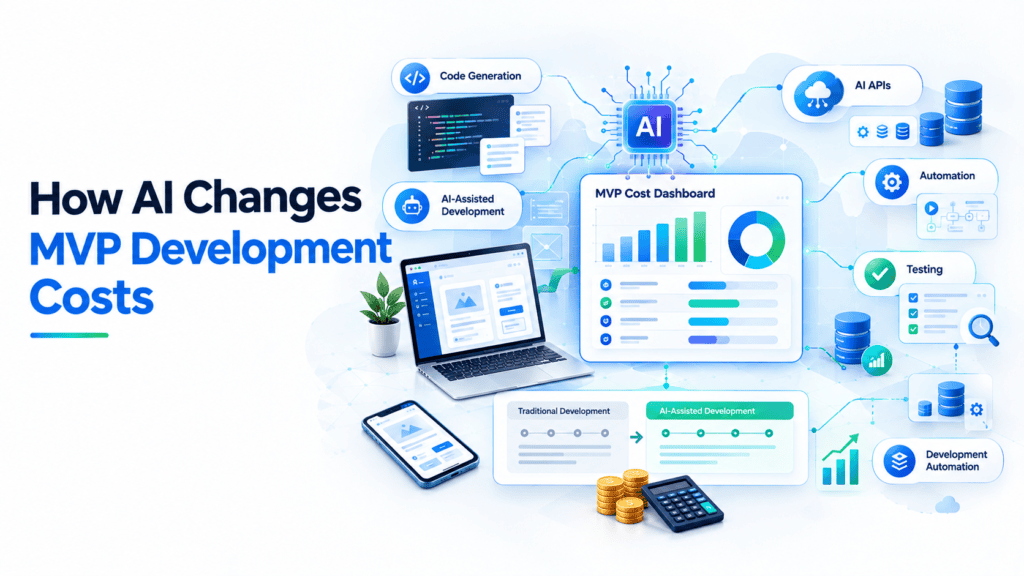
The creation of a Minimum Viable Product used to have a relatively simple cost structure: hire developers, estimate the required hours, multiply them by the hourly rate, and add a security cushion to cover the unknowns. The emergence of artificial intelligence will disrupt this long-established industry practice in ways that are already apparent in the way that startups and development houses approach MVP creation pricing and scoping. Below are three examples of these changes.
1. Reduced Coding Time
AI coding assistants (think GitHub Copilot, Cursor, Claude, or any other similar tool) can autocomplete, scaffold, and write boilerplate code much faster than a human could.
This is especially useful for an MVP (Minimum Viable Product) project, where most of the code being written will be fairly generic (authentication, API calls, boilerplate CRUD operations, etc) and thus are ideal to be generated by an AI coding assistant.
Practical impact:
- Developers can prototype features in hours rather than days
- Reduced time spent searching documentation/Stack Overflow for common patterns
- Faster iteration between “idea” and “working demo”
The net effect is that founders can compress the initial build timeline — sometimes by 30–50% depending on the complexity of the product — which directly reduces labor costs, since most MVP budgets are essentially time × hourly rate.
2. Code Review and QA
AI doesn’t only help write code faster, but also helps avoid issues. With an AI-powered code review, it becomes possible to prevent bugs, security breaches, and illogical decisions before a human reviews the pull request.
This helps reduce QA costs in several ways:
- Less late-stage bugs: Finding issues at the commit stage is much cheaper than in staging or production
- Faster code reviews: Senior developers spend less time on reviewing and more time on architectural decisions
- Better test coverage: AI can help write the tests alongside the code, which many teams fail to do under the pressure of an MVP launch
For a cash-strapped early-stage team, this can make the difference between a project that works and one that is constantly plagued by production issues. QA and bug fixing eat into a lot of budgets, and QA costs are often one of the largest expenses in software development.
By reducing the cost per bug fix and speeding up the review process, an AI-based code review can help teams get more done with less.en” MVP costs that don’t show up in the initial estimate but appear later as delays and rework.
3. Potential Cost Savings
Considered together, faster coding and improved QA practices result in considerable savings that should be easy to find anywhere in the budget, specifically:
- Shorter working hours due to a reduced complexity of implemented tasks
- A smaller team of contributors due to the option to build less feature-rich products (i.e., MVP) that can be developed by fewer coders or are partially coded by AI
- Shorter working hours due to faster QA-coding cycles
- Shorter time-to-market leading to cheaper development due to easier detection of errors or the ability to cut losses on a project that does not gather the expected audience
At the same time, it should be noted that the costs are not inevitably lower as AI solutions still require coding by developers who have the expertise to build reliable and expandable architecture,QA testing of AI-coded software requires a special approach, and business analysts are still required to design products.ns AI can’t make on its own.
Teams that lean on AI without technical oversight often end up with messy codebases that cost more to fix later — effectively trading short-term savings for long-term technical debt.
The Bottom Line
AI is reducing the cost floor for MVP development by accelerating repetitive processes and identifying errors. However, it has not eliminated the need for skilled developers and deliberate planning. The MVPs that benefited most from the application of AI were those that relied on it as a force multiplier to complement the expertise of developers rather than replace it.
Where AI Helps in MVP Development
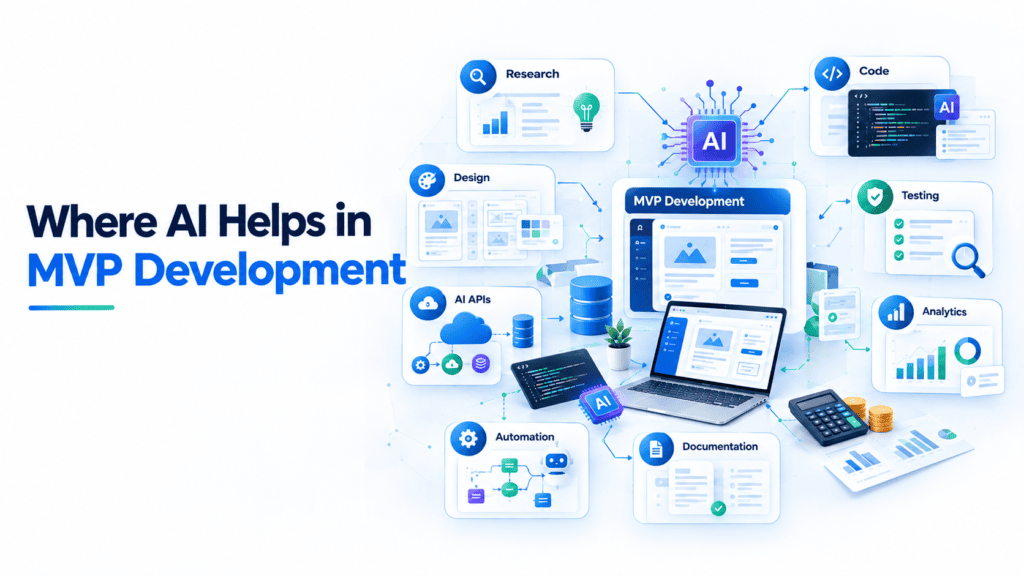
Building an MVP is a race against time and budget. Every hour spent on repetitive setup work is an hour not spent validating your core idea. This is exactly where AI tools have become indispensable for startups and development teams. Here’s a breakdown of where AI makes the biggest difference.
Project Scaffolding
Starting a new project traditionally means hours of boilerplate setup — folder structures, configuration files, dependency management, and environment setup. AI tools can generate this scaffolding in minutes, spinning up a working project structure based on your tech stack and requirements. This lets developers jump straight into building features instead of wrestling with initial setup.
CRUD Development
Create, Read, Update, and Delete operations form the backbone of almost every application, yet they’re some of the most repetitive code to write. AI coding assistants excel at generating these standard operations — API endpoints, database queries, and basic UI forms — freeing developers to focus on the unique business logic that actually differentiates the product.
Testing
Writing comprehensive tests is often the first thing sacrificed under MVP deadlines, which can create technical debt down the line. AI can generate unit tests, integration tests, and edge case scenarios quickly, helping teams maintain reasonable test coverage without dedicating disproportionate time to it.
Documentation
Documentation tends to lag behind development, especially in fast-moving MVP cycles. AI tools can generate API documentation, code comments, README files, and even user guides directly from the codebase, keeping documentation current with far less manual effort.
Code Refactoring
As an MVP evolves quickly, code quality can slip. AI assistants can identify code smells, suggest cleaner patterns, and help refactor code for readability and maintainability — without requiring a full-time engineer dedicated solely to code quality.
The Bottom Line
AI doesn’t replace the strategic thinking, product decisions, or creative problem-solving that goes into building a successful MVP — but it dramatically accelerates the mechanical, repetitive parts of development. This means teams can validate ideas faster, iterate quicker, and get to market with a working product sooner.
Challenges and Risks of AI-Assisted MVP Development
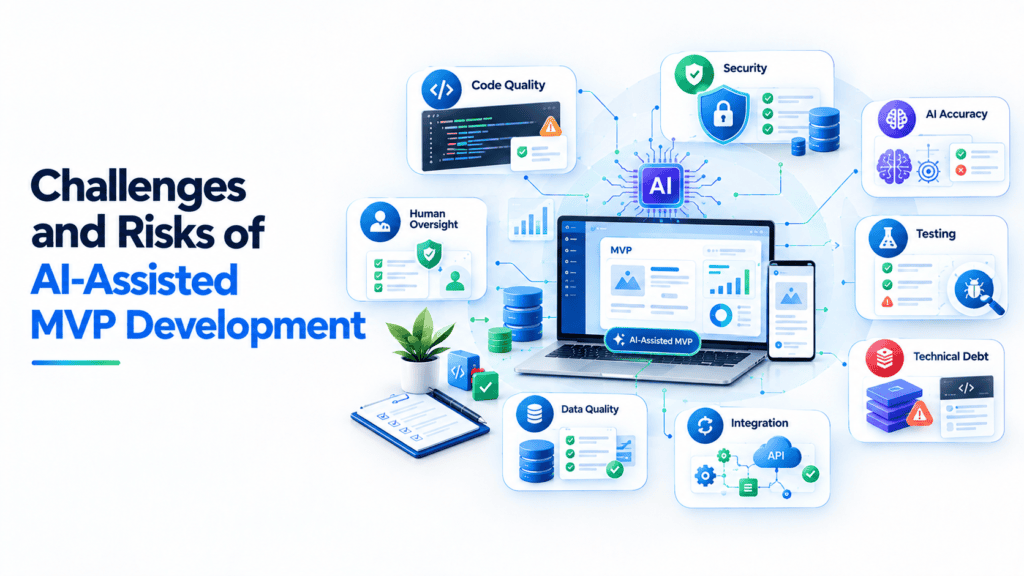
While utilizing such tools as AI coding assistants and generative models to develop a product may significantly reduce the time needed for its launch in the early phases, relying on AI for the creation of Minimum Viable Product presents with its own set of challenges.
Understanding and addressing them is essential for product managers, founders, and engineers.
Key Technical Challenges
- The “Looks Right” Code Review Trap
- AI tools are often optimized to return syntactically correct code, which may appear reasonable to a code reviewer but contain subtle logical errors that are challenging to spot
- Hallucinated Dependencies
- Sometimes, language models invent open-source packages or other third-party dependencies that don’t exist. Attackers can take advantage of these hallucinated dependencies by publishing packages with the same name but different code (“slopsquatting”).
- Architecture Debt
- Because AI tools are typically not optimized to plan out an entire application at the architectural level, the code they generate is often “spaghetti” that works for a simple demo but proves impossible to evolve for real-world applications.
Financial & Operational Risks
- Unpredictable Unit Economics (The AI FinOps Spike): Early testing with low query volumes can give a false impression of low operating costs. As usage scales, token consumption, vector database queries, and inference API calls rise exponentially, quickly eroding margins if cost controls are not implemented early.
- Model Drift & Maintenance Overhead: Unlike static software, probabilistic AI features degrade over time. External model providers update underlying weights, user input styles shift, and third-party API deprecations occur, creating ongoing evaluation and maintenance overhead post-launch.
- Prompt Injection & Security Threat Surfaces:Applications that pass user-supplied input directly into AI prompts remain vulnerable to prompt injection attacks. AI-assisted tools rarely build defensive sanitation or guardrails natively unless explicitly instructed to do so.
Core Comparison: Human-Led vs. AI-Assisted MVP Builds
| Risk Dimension | Traditional Human-Led MVP | AI-Assisted MVP |
| Primary Failure Mode | Scope creep, slow development velocity, missed deadlines. | Silent logic bugs, unscalable architecture, security oversights. |
| Code Structure | Deliberate design patterns, human-readable structural intent. | Fragmented logic snippets optimized for localized readability. |
| Cost Scaling | Predictable infrastructure costs linked directly to server usage. | Dynamic, token-based usage costs that scale unpredictably with prompt complexity. |
| Security Posture | Conventional vulnerability vectors (SQLi, XSS). | Expanded threat surface including prompt injection and hallucinated package risks. |
Practical Best Practices for Founders & Teams
- Enforce strict peer code reviews: Treat AI-generated code with more skepticism than human-written code. Focus code reviews on verifying state management, security boundaries, and edge case handling rather than syntactic correctness.
- Document automated testing early: Write assertions and integration tests before relying on AI to auto-complete business logic features in order to surface logic errors sooner.
- Establish FinOps guardrails: Set spending limits, rate limits, and caching policies at the outset in order to avoid unpleasant surprises when an AI feature inadvertently maxes out your API budget.
- Decouple core business logic from AI APIs: Wrap all external AI model interactions in standardized interface layers that allow swapping out LLM providers or prompt engineering approaches without disrupting the MVP architecture.
MVP Development Timeline vs. Cost
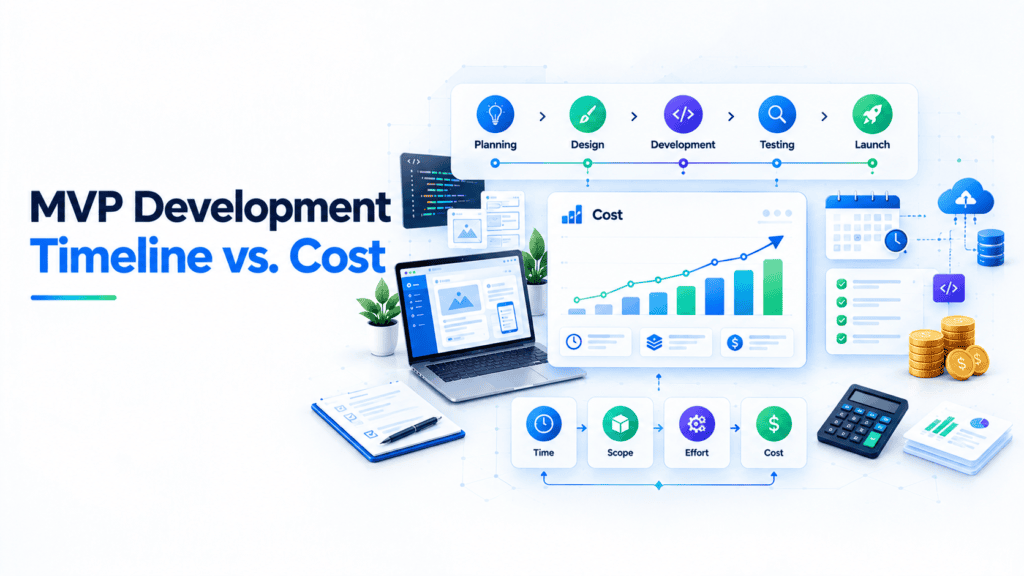
The duration of the MVP development timeline plays a critical role in the cost since a faster development may require more developers, overtime, or parallel development, which may raise the price. The normal development rate is the best option for most startups since it allows finding a balance between speed, quality, and cost. While it takes longer to build a product with a proper development plan, it significantly reduces the costs of redesigning and fixing bugs after launch.
| Development Approach | Timeline | Cost Impact | Best For |
|---|---|---|---|
| Fast Development | 4–8 weeks | Higher | Startups needing quick market validation |
| Normal Development | 8–16 weeks | Moderate | Most startup MVPs |
| Careful Development | 16+ weeks | Higher upfront | Complex or highly regulated products |
Choosing the right timeline depends on your MVP’s features, technical complexity, team size, and validation goals.
How to Reduce MVP Development Costs Without Cutting Corners
Reducing MVP development costs does not accompany the loss in product quality or the absence of essential features. The main idea is to prioritize costs and invest in those products that are relevant for the client instead of focusing on what the outsourced team wants to do. We have prepared for you a list of five proven ways to reduce costs.
- Focus on the must-have features. Do not complicate your product by adding functions that address only some minor issues and postpone the launch of features that do not seem to be critical. Wait for the first wave of users to provide feedback before introducing new elements.
- Use the existing solutions. Whenever possible, rely on API’s, ready-to-deploy platforms, cloud storage and databases, user authentication systems, payment systems, and other third-party programs.
- Outsource the software development. Compare the rates of local, nearshore, and offshore outsourcing companies.
- Build a Minimum Viable Product for one platform first. Choose between Web, iOS, and Android: the two last options will allow you to reach more users, although they may be more expensive to develop at the proof-of-concept stage.
- Go for AI-driven coding software. Opt for AI coding assistants that support code writing, documentation, testing, debugging, and code reviewing. Note that human expertise is required to ensure that no vulnerabilities are introduced in the code.
A cost-efficient MVP is not the cheapest possible product to build. It is a product which will help you spend your budget wisely and get the quality required to test the viability of your business idea and gain insights from real customers.
MVP Development Costs and Timelines at Helpware Tech: The Complete Guide
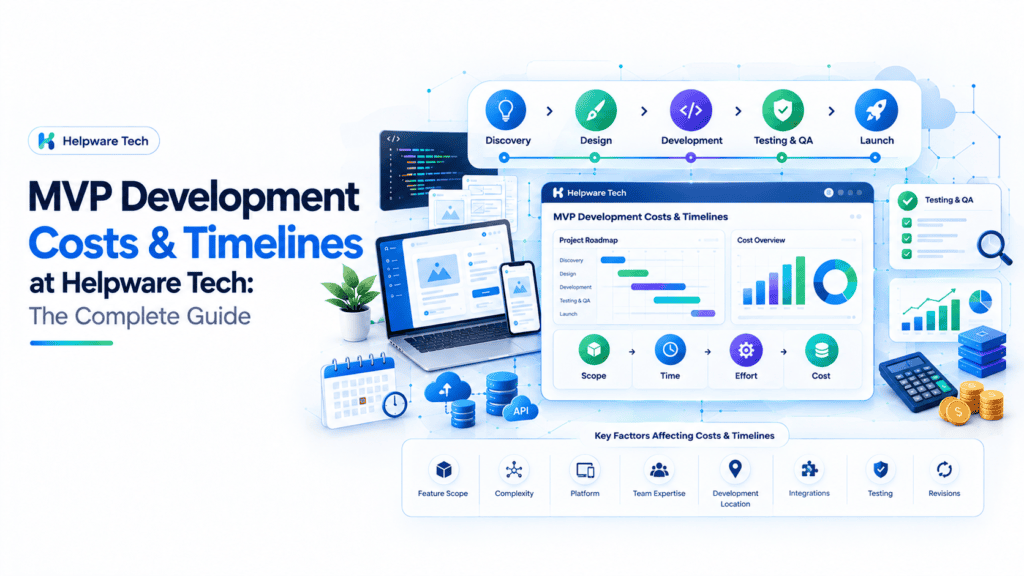
Creating the Minimum Viable Product (MVP) is the best way to test your business idea, raise money, and get customers on board without wasting resources. Helpware Tech can assist you in this task using AI-powered engineering and a spec-driven approach that allows building products 30% faster than traditional agencies.
Helpware Tech MVP Pricing & Timelines Tier Breakdown
Helpware Tech categorizes MVP builds into four primary tiers based on complexity, required integrations, and target platform.
| Product Complexity | Scope & Features Included | Est. Cost Range | Est. Timeline |
| No-Code / Low-Code Prototype | Rapid proof-of-concept, minimal custom code, basic user flows | $10,000+ | 2 – 4 Weeks |
| Basic MVP | Core value-prop features, single platform (web or mobile), light integrations | $25,000 – $60,000 | 1 – 3 Months |
| Mid-Level MVP | Custom UI/UX, user authentication, payment processing, third-party APIs | $40,000 – $100,000 | 3 – 6 Months |
| Complex / Enterprise MVP | AI/ML capabilities, strict regulatory compliance (HIPAA, GDPR, SOC2), advanced infrastructure | $120,000 – $200,000+ | 4 – 6+ Months |
Cost Breakdown by Development Phase
Where does your budget go during the MVP build? Helpware Tech breaks down the product lifecycle into three core execution phases:
- Pre-development & Product Discovery (10-15% of Budget)
- User research, wireframing, UI/UX prototyping, and spec documentation
- Establishes clear engineering requirements to prevent scope creep during core builds
- Core development & Quality Assurance (70-80% of Budget)
- Frontend and backend engineering, cloud database architecture, custom API integrations
- Automated QA and security auditing to ensure scalable, maintainable code base
- Post-launch & Early Maintenance (10% of Initial Budget)
- Production deployment, initial development operations, post-launch bug fixes, user analytics collection
5 Key Factors Driving Your Final Cost
- Feature Complexity: The simpler the input, the deeper the discount. Static data processing costs much less than dynamic data routing, split payment processing, or real-time communication features.
- Platform Target: A single-platform web solution launch costs significantly less than developing and launching native iOS + Android apps at the same time.
- New Technologies: The use of OpenAI/LLMs, bespoke data science models, or blockchain-based protocols adds complexity and cost to the design process.
- Regulatory Compliance: Specialized regulatory requirements such as HIPAA healthcare data security standards or KYC/AML financial regulatory compliance add security layers to the design.
- Development Speed: Choosing between 2-4 week rapid-cycle sprints requires allocating bigger senior engineer pods to work on the project simultaneously.
Frequently Asked Questions
How much does an MVP cost?
The cost of developing an MVP (Minimum Viable Product) may vary from $15,000 to $150,000 or more, depending on a product’s complexity, required features, platforms, design, and the location of the development team.
A simple MVP with basic functions may cost $15,000 – $30,000, while a medium-complexity product may cost $30,000 – $75,000. More involved MVPs requiring AI, advanced integrations, real-time components, high-level security, or other factors, may cost more than $100,000.
In addition, design, testing, third-party API (Application Programming Interface) development, maintenance, and potential improvements may add to the final budget. It is crucial to identify key features and development goals to reduce MVP development costs.
How long does MVP development take?
The majority of MVPs take 6 to 12 months to develop. Simple MVPs with limited functions may take 4–6 weeks, but more feature-rich and complex MVPs may take 3–4 months to build.
Development timelines typically include 1–2 weeks for discovery and planning, 1–2 weeks for design, 4–8 weeks for development, and 1–2 weeks for QA and testing. To speed up the process, you can use the Agile approach and design and develop the MVP in parallel.
How much does a no-code MVP cost?
A no-code MVP (Minimum Viable Product) typically costs between $1,000 and $10,000, depending on the complexity of your project and who builds it.
If you choose to do it yourself (DIY): You’ll need to subscribe to a no-code platform (Bubble, Webflow, Glide, etc.) and basic integrations will cost you around $50 to $300/month.
If you hire a freelancer: The average budget for a custom no-code MVP is between $1,500 to $5,000.
If you hire a specialized no-code agency: You’ll be spending between $5,000 to $15,000+ on a complex no-code MVP with custom logic, design, and rapid development.
No-code MVPs are significantly cheaper and faster to build than traditional custom software development (which can cost between $20,000 – $80,000+).
Can you build an MVP for under $10,000?
Yes, indeed for many MVPs $10,000 is a realistic budget. To save money, it is important to prioritize and only include those elements that are critical for the proof of concept. It is always a good idea to start small, without using all the cool functionality you want to add someday.
First, you need to determine what would you include in the MVP to test the idea with real users. Secondly, you should consider using no-code or low-code development tools because they can reduce the cost significantly.
Thirdly, it might be cheaper to outsource the app development to a professional coder or team rather than hire someone full-time. Finally, avoid spending time and money on cosmetics. Make the MVP simple but attractive enough to draw users in and help you achieve your goal of testing the concept.
How can you estimate MVP costs accurately?
How to Estimate MVP Budget
An experienced developer’s approach to estimating MVP costs
Focus on the following critical success areas to hit the best value for money at MVP launch:
Categorize features using MoSCoW Method
First and foremost, identify Must-have features only. All the rest are nice-to-have. The key is to clearly distinguish between different types of requirements and tie them to the specific goal your MVP will address.
Structure all the deliverables according to the core requirements
Break down the MVP features into UI/UX design tasks, front-end, back-end, and API development requirements.
Define hours needed for every task
Use a task list to identify how much time your developers will need to spend on designing, developing, and testing.
Determine hourly rates
Set a rate that reflects the cost of your in-house team or the outsourcing partner’s hourly or monthly charges.
Include risk adjustment and maintenance costs
MVP budget estimation requires an additional 15-20% allocated to cloud hosting costs and changes needed after launch.
Conclusion
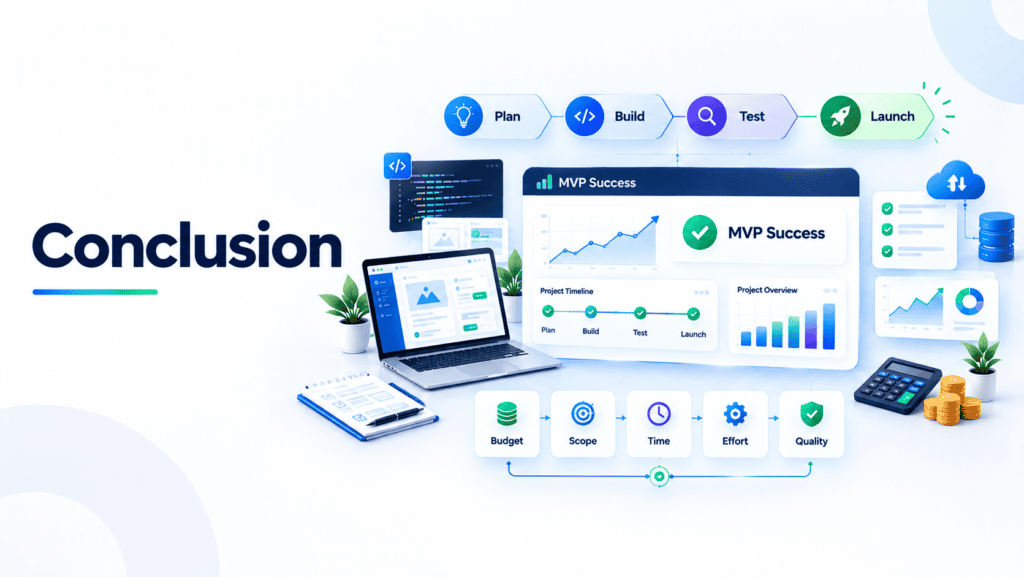
The cost of developing an MVP in 2026 depends on several factors, including the scope of features, technology stack, and geographical location.
While the prototyping and proof-of-concept stage can cost anywhere between $5,000 to over $150,000 depending on complexity and technological requirements, it is possible to reduce costs by choosing the right team structure and region (LATAM, Eastern Europe, Asia).
A part from development costs, maintenance, cloud platform, API subscriptions, and regulatory compliance also add to the overall expenditure.
However, at the end of the day, cutting costs on MVP development will enable you to test your hypothesis efficiently and have better control of overall expenditure throughout the product’s life cycle.
Author Bio
Jeevesh Tripathi who works as a tech-savvy content writer and researcher at bkabhi. He has a fervent interest in learning about software development, startups, and the tech economy. With a vast knowledge of modern trends in software development and tech markets, Jeevesh has been actively engaged in deepening his understanding of software development and the global tech outsourcing market. He is willing to discuss, beyond the research and writing process, product management and development, and always on the lookout for the latest programming tools and languages. In his free time, he likes to stay up-to-date with the latest news and trends in his field of expertise.