

It was 3:47 AM when Tom finally admitted he’d made a catastrophic mistake.
For eighteen months, his team had been building in stealth mode. They’d raised $800,000 in seed funding. Hired three senior developers. Designed 47 different screens. Built a comprehensive admin dashboard. Integrated machine learning for personalized recommendations. Created a sophisticated onboarding flow with gamification elements. Yet, what they failed to understand was why startups need MVP development services first—a lesson that could have saved them time, money, and months of wasted effort before launching a product the market wasn’t ready for.
The product was beautiful.
And when they finally launched? Crickets.
Two hundred sign-ups in the first month. Twelve paying customers. Zero product-market fit.
“We should have tested this with real users six months ago,” his co-founder said, staring at the analytics dashboard. “We should have understood why startups need MVP development services first before burning through most of our runway.”
By the time Tom’s startup pivoted based on actual user feedback, they had $150,000 left and nine months to find traction. They didn’t make it.
This isn’t a cautionary tale. It’s a pattern.
And it’s exactly why startups need MVP development services first—not as an option, but as a survival strategy.

The Brutal Truth About Why Startups Need MVP Development Services First
Let’s cut through the noise: the startup failure rate hovers around 90%. According to CB Insights, the number one reason startups fail isn’t competition, funding, or even execution—it’s building something nobody wants.
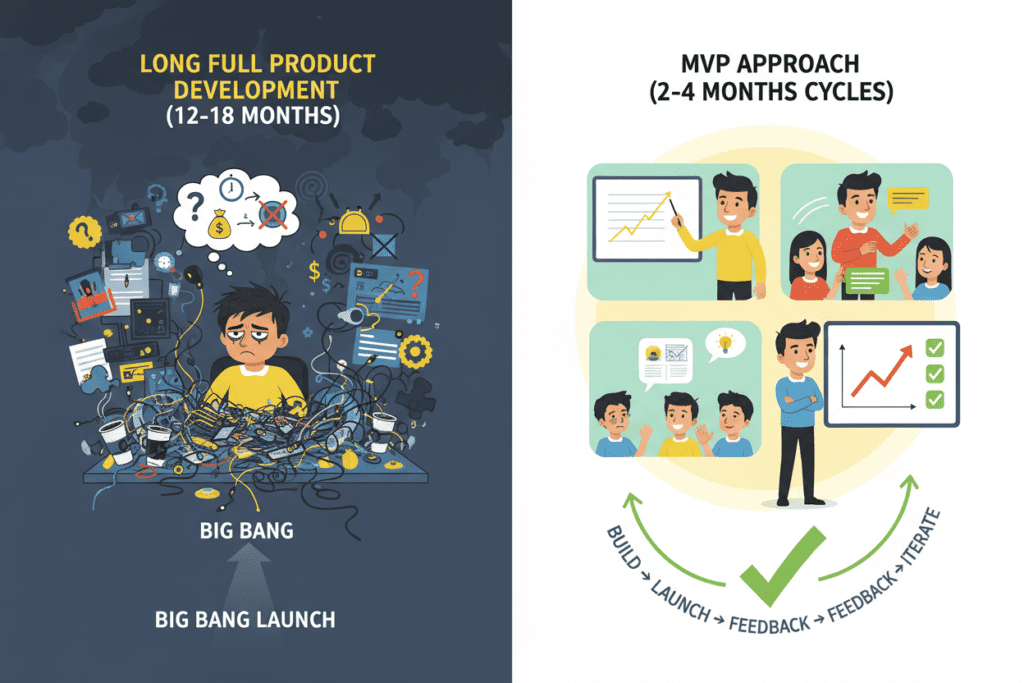
Think about that. Most founders don’t fail because their product is buggy. They fail because they spent 18 months building the wrong product.
This is precisely why startups need MVP development services first. Not because MVPs are trendy. Not because investors expect them. But because they’re the fastest, cheapest way to answer the only question that matters in your early days:
Will real humans pay real money to solve this problem?
Everything else—scalability, pixel-perfect design, advanced features, comprehensive analytics—is academic until you answer that question.
The Core Principle: Validation Before Investment
When founders understand why startups need MVP development services first, they grasp a fundamental shift in thinking:
You’re not building a product. You’re testing a hypothesis.
Your hypothesis might be: “Busy professionals will pay $20/month for an AI-powered meal planning app that integrates with their grocery delivery service.”
That’s a beautiful hypothesis. It might even be true.
But you won’t know it’s true until you put a minimal version in front of real users and watch what they actually do—not what they say they’ll do in surveys, but what they do when presented with a “Buy Now” button.
This is the difference between founders who succeed and founders who burn out:
Successful founders: Build small, learn fast, iterate quickly Failed founders: Build big, launch late, discover they’re wrong when it’s too late to pivot
The data backs this up. Startups that validate with MVPs before scaling have a 70% higher chance of reaching product-market fit, according to research from the Lean Startup methodology pioneers. This clearly explains why startups need MVP development services first, as early validation dramatically reduces risk and increases the likelihood of building something the market truly wants.
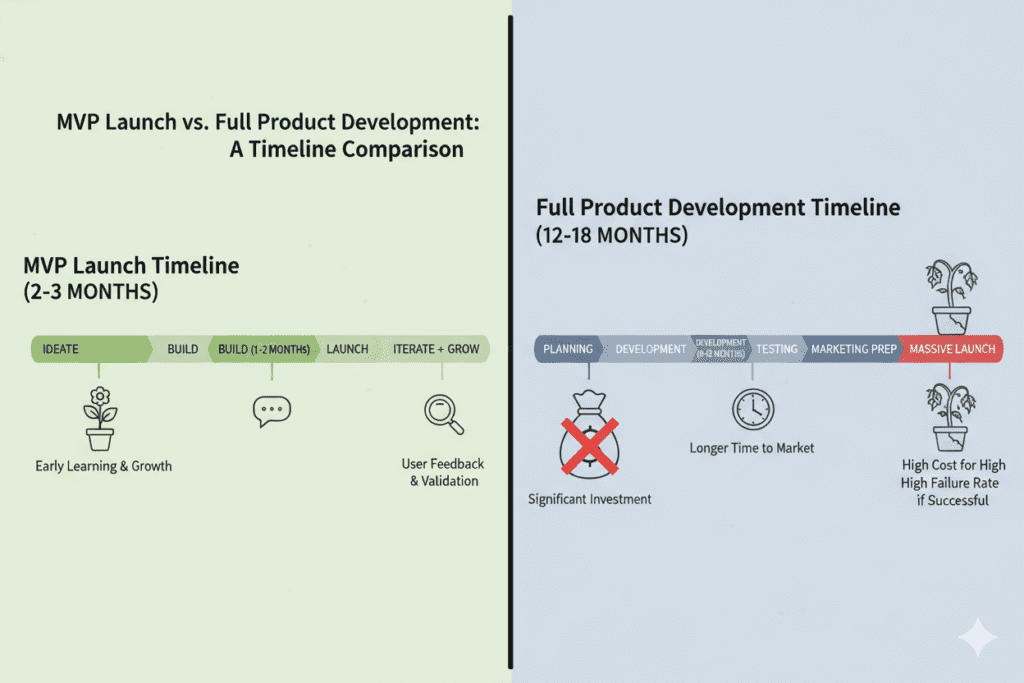
Why Startups Need MVP Development Services First: The Financial Reality
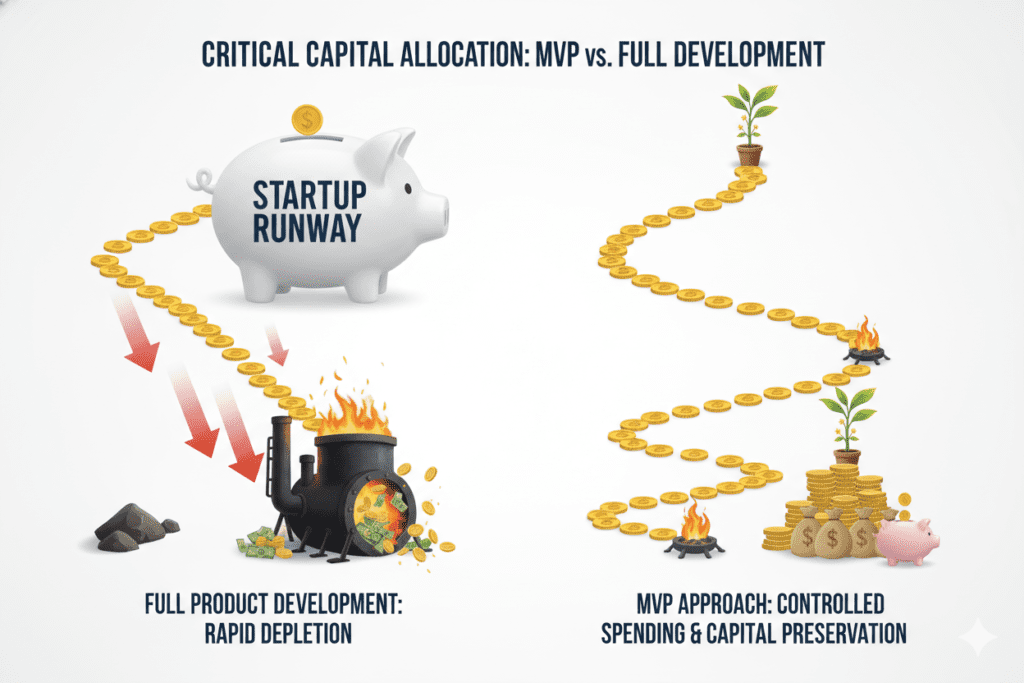
Here’s what nobody tells you about startup finances: your runway isn’t just about how much money you have—it’s about how many learning cycles you can afford before your capital runs out.
Let me break this down.
Scenario A: Building Without MVP Services
Budget: $500,000 seed funding. Development cost: $300,000 for a full product. Timeline: 12–16 months. Launch: Month 16. Result: The product doesn’t resonate with the market. Remaining capital: $200,000. Time to pivot: 4–6 months. Outcome: Likely failure—not enough runway to iterate meaningfully. This scenario perfectly illustrates why startups need MVP development services first, because validating early with a lean version could preserve capital, shorten timelines, and dramatically improve the chances of success.
Scenario B: Why Startups Need MVP Development Services First
Budget: $500,000 seed funding MVP development cost: $45,000 Timeline: 8-10 weeks Launch: Month 3 Result: Learn what users actually want First iteration cost: $30,000 Timeline: 6 weeks Second iteration cost: $35,000 Timeline: 6 weeks Total spent: $110,000 Total time: 6 months Remaining capital: $390,000 Learning cycles completed: 3 Outcome: Product-market fit validated with 75% of capital still available for scaling
See the difference?
The founders in Scenario A spent three times more and learned one-tenth as much. The founders in Scenario B understood why startups need MVP development services first—because validating ideas early, testing with real users, and gathering actionable feedback is far more valuable than building a full-scale product too soon. By focusing on an MVP approach, they preserved capital for the inevitable pivots and iterations every startup goes through, increasing their chances of long-term success.
The Real Cost of Getting It Wrong
At BkAbhi, we’ve worked with founders who came to us after burning $200,000+ with agencies that promised the moon. The pattern is always the same:
- Founder has a vision
- Agency says “yes” to everything
- Scope creeps like ivy on a brick wall
- Timeline extends month after month
- Budget explodes with “necessary” additions
- Launch happens 14 months later
- Market has moved on, or worse—the product misses the mark entirely
This is exactly why startups need MVP development services first. Professional MVP development isn’t about building cheap prototypes—it’s about validating ideas with real users, minimizing risk, and making data-driven decisions before scaling. Understanding why startups need MVP development services first helps founders focus on strategic discipline rather than premature expansion, ensuring every dollar and development hour is invested wisely.
A good MVP development service—like BkAbhi—will push back on your feature requests. We’ll challenge your assumptions. We’ll force you to prioritize ruthlessly.
Not because we’re difficult to work with, but because we’ve seen what happens when you don’t.
Why Startups Need MVP Development Services First: The Time Advantage
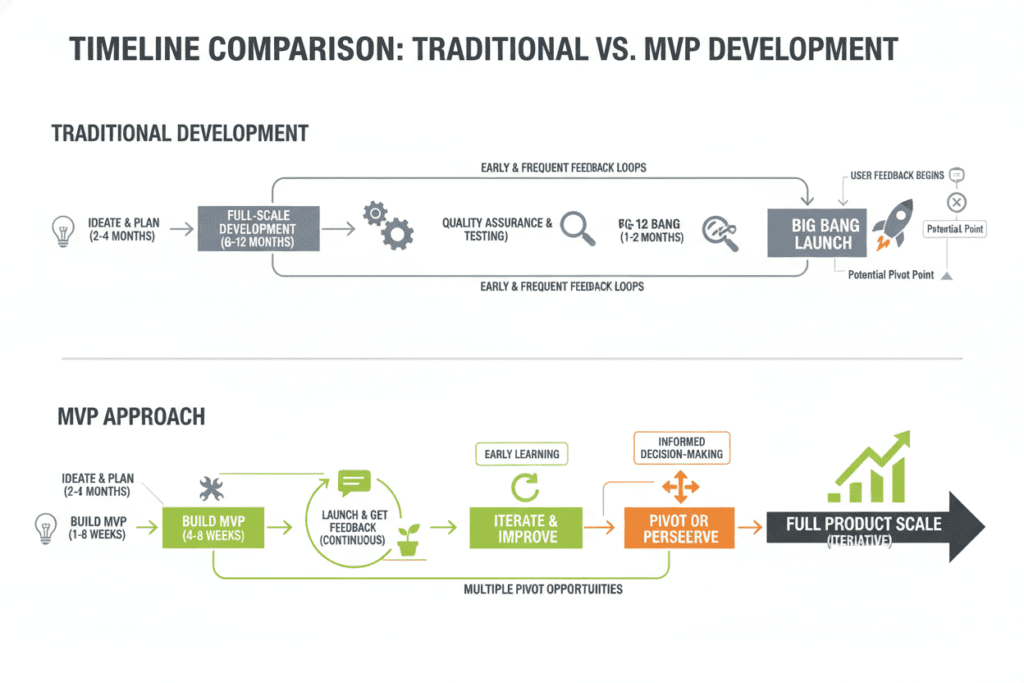
Time is your second most precious resource after capital. And here’s the harsh reality: every month you spend building without user feedback is a month you could have spent learning and iterating.
The Speed-to-Learning Metric
Smart founders don’t measure success by how fast they build. They measure success by how fast they learn.
This fundamentally changes how you think about development and highlights why startups need MVP development services first. Instead of asking, “How long until this is perfect?” you start asking, “How quickly can we test our riskiest assumptions?” That shift in mindset—focused on validation, speed, and learning—is exactly why startups need MVP development services first before committing significant time and capital to full-scale product development.
Here’s why startups need MVP development services first from a time perspective:
Traditional Development Timeline:
- Month 1-2: Requirements gathering
- Month 3-5: Design and architecture
- Month 6-12: Development
- Month 13-14: Testing and bug fixes
- Month 15-16: Launch preparation
- Month 17: First real user feedback
- Month 18-24: Rebuilding based on what you learned
MVP Development Services Timeline:
- Week 1-2: Core problem and solution validation
- Week 3-4: Rapid prototyping and user flow design
- Week 5-10: Focused development on core features
- Week 11-12: Testing and refinement
- Month 3: Launch to early adopters
- Month 4: Gather feedback and iterate
- Month 5-6: Ship improved version 2 based on real data
- Month 7-12: Scale what’s working
Notice something? With MVP development services, you’re learning from real users by month 3. With traditional development, you’re still building in month 12.
That nine-month difference could mean the difference between catching a market opportunity and watching it pass you by.
Real-World Example: How BkAbhi Accelerates Time-to-Market
Sarah came to BkAbhi with an idea for a freelancer management platform. She’d already spent $25,000 with a freelancer who’d been “working on it” for five months with little to show.
We sat down with Sarah and asked hard questions:
- What’s the core problem you’re solving?
- Who specifically has this problem?
- What’s the simplest version that would actually help them?
In 7 weeks, BkAbhi delivered an MVP that included:
- Client onboarding
- Basic project tracking
- Simple invoicing
- Contractor time logging
We cut everything else—no fancy dashboards, no complex analytics, no AI-powered recommendations. Just the core features that solved her target users’ immediate pain point. That laser focus on essentials clearly demonstrates why startups need MVP development services first: to prioritize what truly matters, eliminate unnecessary complexity, and validate real user demand before investing in advanced features.
Within 60 days of launch, Sarah had 50 paying customers. Within 90 days, she was generating $4,000 in monthly recurring revenue. Within six months, she used that traction to raise a proper seed round.
This is why startups need MVP development services first. Not eventually. Not “when we’re ready.” First.
Why Startups Need MVP Development Services First: The Risk Mitigation Factor
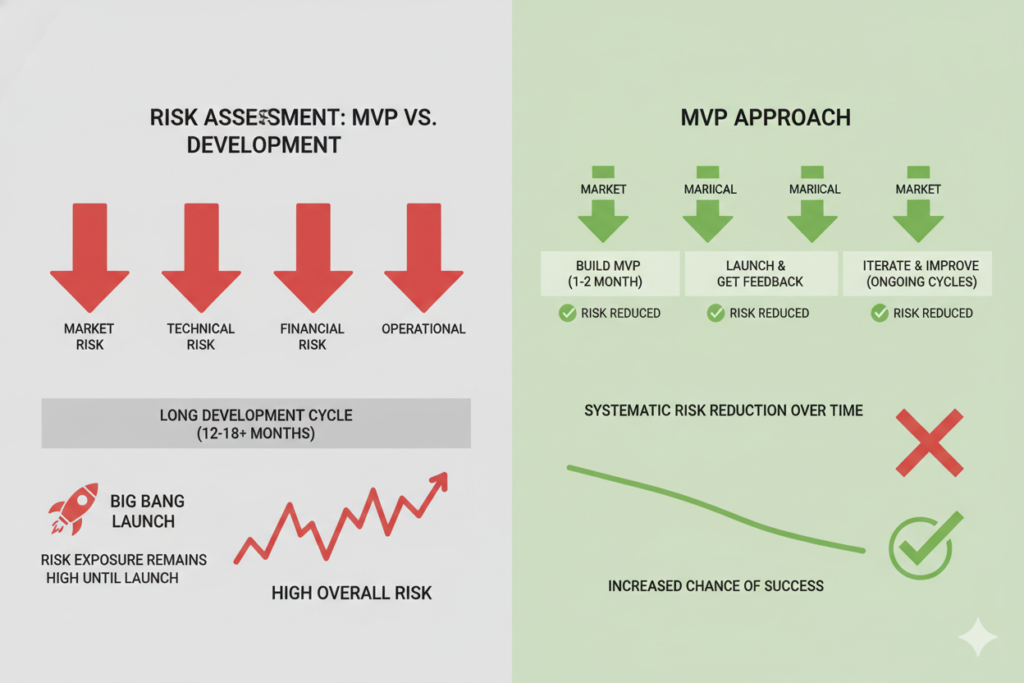
Every startup carries risk. Market risk. Technical risk. Team risk. Timing risk.
You can’t eliminate all risk—if you could, you wouldn’t need venture capital. But you can systematically de-risk your biggest assumptions before betting everything on them.
This is perhaps the most overlooked reason why startups need MVP development services first.
Understanding Your Risk Stack
Most startup ideas contain multiple layers of risk:
Market Risk: Will people actually want this? Willingness-to-Pay Risk: Will they want it enough to pay for it? Pricing Risk: How much will they pay? Channel Risk: How will we reach our target users? Technical Risk: Can we actually build this reliably? Timing Risk: Is the market ready for this now? Competition Risk: Can we differentiate meaningfully?
Here’s the trap: founders try to solve all these risks simultaneously by building a comprehensive product that addresses every angle.
That’s backwards.
The Sequential De-Risking Approach
Professional MVP development services—the kind BkAbhi provides—clearly illustrate why startups need MVP development services first: they help you tackle risks in order of importance, validate critical assumptions early, and focus resources on what truly drives traction before scaling further.
Phase 1: Market Risk (Pre-MVP) Before writing a single line of code, validate that the problem exists and people care about it. This takes conversations, not code.
Phase 2: Solution Risk (Concierge or Manual MVP)
Manually deliver the solution to 5-10 early users. This validates that your proposed solution actually helps before you build anything scalable.
Phase 3: Willingness-to-Pay Risk (Paid MVP) Build the simplest version that you can charge for. Even if it’s imperfect, can you get people to exchange money for value?
Phase 4: Product Risk (Functional MVP) Build the core features well enough that users can self-serve without your manual intervention.
Phase 5: Scale Risk (Growth) Only after you’ve validated all of the above do you optimize for scale, polish, and advanced features.
Most founders skip straight to Phase 5. That’s why they fail.
Understanding why startups need MVP development services first means recognizing that professional guidance helps you navigate this sequence without wasting time or capital on the wrong things at the wrong time. In fact, truly grasping why startups need MVP development services first allows founders to prioritize validation, reduce uncertainty, and build momentum through informed, strategic decision-making.
The Insurance Policy Effect
Think of MVP development services as insurance against catastrophic product failure.
For $40,000-70,000, you buy yourself certainty. You learn whether your idea has legs before you commit $300,000 to full development. You validate your value proposition before you hire a team of ten. You prove product-market fit before you quit your job to go full-time.
That’s not an expense. That’s strategic risk management.
At BkAbhi, we’ve had founders come to us saying, “I wish I’d found you before I spent $150,000 with [big agency].” The painful part? Their $150,000 product was solving a problem that didn’t exist. An MVP would have revealed that in month 2 for one-tenth the cost.
Why Startups Need MVP Development Services First: The Founder Psychology Angle
Let’s talk about something rarely discussed: the emotional and psychological toll of building without validation.
Founders are optimistic by nature—you have to be; pessimists don’t start companies. But that optimism becomes dangerous when it’s not balanced with rapid reality checks. That’s precisely why startups need MVP development services first: to ground big vision in real-world validation, test assumptions early, and ensure enthusiasm is supported by data rather than guesswork.
The Confirmation Bias Trap
When you spend 18 months building in isolation, something insidious happens: you fall in love with your solution. You rationalize every design decision. You convince yourself that the market just “doesn’t get it yet.” You double down on features that nobody asked for because you’ve invested so much already.
Psychologists call this the sunk cost fallacy. In startups, we call it the death spiral.
This is a subtle but crucial reason why startups need MVP development services first. Professional MVP developers have one massive advantage: they’re not emotionally attached to your idea.
When you work with BkAbhi, we’ll tell you the hard truths:
- “These three features aren’t necessary for version 1”
- “Your target customer probably won’t pay $99/month for this”
- “This use case is more valuable than the one you’re focused on”
You might push back—and that’s fine. But you’ll have an external voice challenging your assumptions before you’ve spent $200,000 building those assumptions into a product. That’s exactly why startups need MVP development services first: to gain objective feedback, validate core ideas early, and avoid locking costly assumptions into a full-scale build before they’ve been tested in the real market.
The Confidence-Through-Validation Effect
Here’s the flip side: when you ship an MVP and people actually use it—when they actually pay for it—something powerful happens.
You gain confidence. Not blind confidence, but earned confidence backed by data.
When you approach investors and say, “We built an MVP in 8 weeks, got 100 users, and 30 are paying customers,” you’re telling a completely different story than “We’ve been building for 18 months and we think the market will love this.”
One is conviction backed by evidence. The other is hope wrapped in uncertainty.
Founders who understand why startups need MVP development services first also understand that MVPs provide emotional fuel. Every piece of positive feedback, every dollar of revenue, every user who “gets it”—these are proof points that keep you going through the inevitable challenges of building a startup.
Avoiding Burnout
Building a startup is a marathon, not a sprint. And nothing burns founders out faster than spending 18 months in a dark room building something that flops on launch day. That’s precisely why startups need MVP development services first—to test ideas early, gather real user feedback, and avoid the emotional and financial drain of launching a fully built product that hasn’t been validated in the market.
MVPs create momentum. They create small wins. They create learning that feels productive rather than speculative—and that’s exactly why startups need MVP development services first. By focusing on early validation and measurable progress, founders can turn uncertainty into structured learning, building confidence and clarity with every iteration instead of relying on assumptions.
The psychological benefit of shipping something real to real users within 90 days cannot be overstated. It transforms your startup from a theoretical exercise into a living, breathing entity that’s learning and growing.
Why Startups Need MVP Development Services First: The Investment Angle
If you’re planning to raise funding—or if you’ve already raised a small friends-and-family or pre-seed round—understanding why startups need MVP development services first becomes even more critical. Knowing why startups need MVP development services first ensures you use that capital strategically, demonstrate traction to investors, and prove market validation before committing to a full-scale product build.
What Investors Actually Want to See
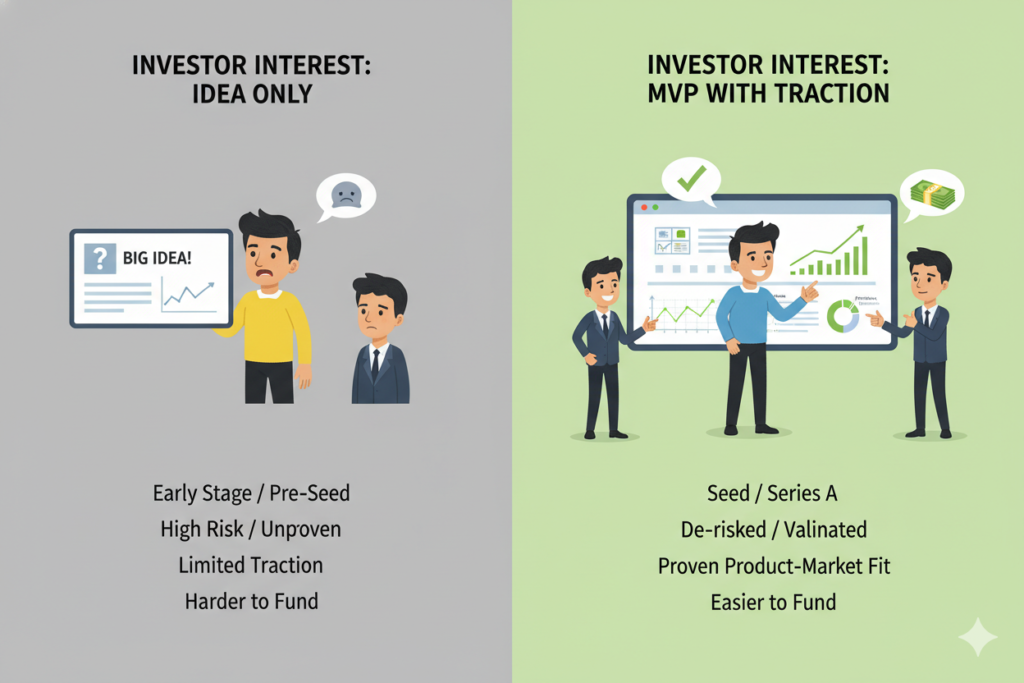
Investors don’t invest in ideas. They invest in traction.
Your pitch deck might be gorgeous. Your market size might be massive. Your team might be impressive. But investors will always ask: “What proof do you have that this will work?”
An MVP gives you multiple proof points:
Proof of Execution: You can ship product Proof of Market: People use what you build
Proof of Value: Users find it valuable enough to stick around Proof of Monetization: People pay for it Proof of Learning: You iterate based on feedback
Notice what’s not on that list? Comprehensive features. Beautiful animations. Cutting-edge architecture.
Investors want to see that you can build efficiently, learn quickly, and iterate intelligently. All three of these attributes are demonstrated through MVP development, not through 18-month stealth builds.
The Traction Multiplier
Here’s a secret that most founders learn too late: traction is worth 10x more than potential.
A startup that’s raised $100,000 and has 500 users and $5,000 in monthly revenue will raise their Series A more easily than a startup that’s raised $1,000,000 with a beautiful product and zero users.
Why? Because the first startup has proven they can acquire users profitably. The second startup has only proven they can spend money.
This is why startups need MVP development services first. Your MVP is the foundation of your traction story. It’s what transforms you from “entrepreneur with an idea” to “founder with market validation.”
The Pivot Advantage
Here’s something else investors appreciate: founders who pivot intelligently based on data.
Pivoting after spending $500,000 looks like failure. Pivoting after spending $40,000 on an MVP looks like smart learning.
When you use MVP development services, you buy yourself permission to be wrong—and to correct course before it’s catastrophic.
BkAbhi has worked with founders who’ve done complete 180-degree pivots after their first MVP. In one case, a founder came to us wanting to build a B2C fitness app. The MVP revealed the real opportunity was B2B corporate wellness. They pivoted, and within 18 months they were doing $2M in annual revenue.
Would that pivot have been possible after spending $300,000 on a consumer fitness platform? Highly unlikely.
Why Startups Need MVP Development Services First: The Talent and Team Perspective
Building your early-stage team is one of your highest-leverage activities. But here’s a question most founders don’t ask: What kind of team do you need for an MVP vs. a full product?
The answer reveals another dimension of why startups need MVP development services first.
The “Right Team, Wrong Time” Problem
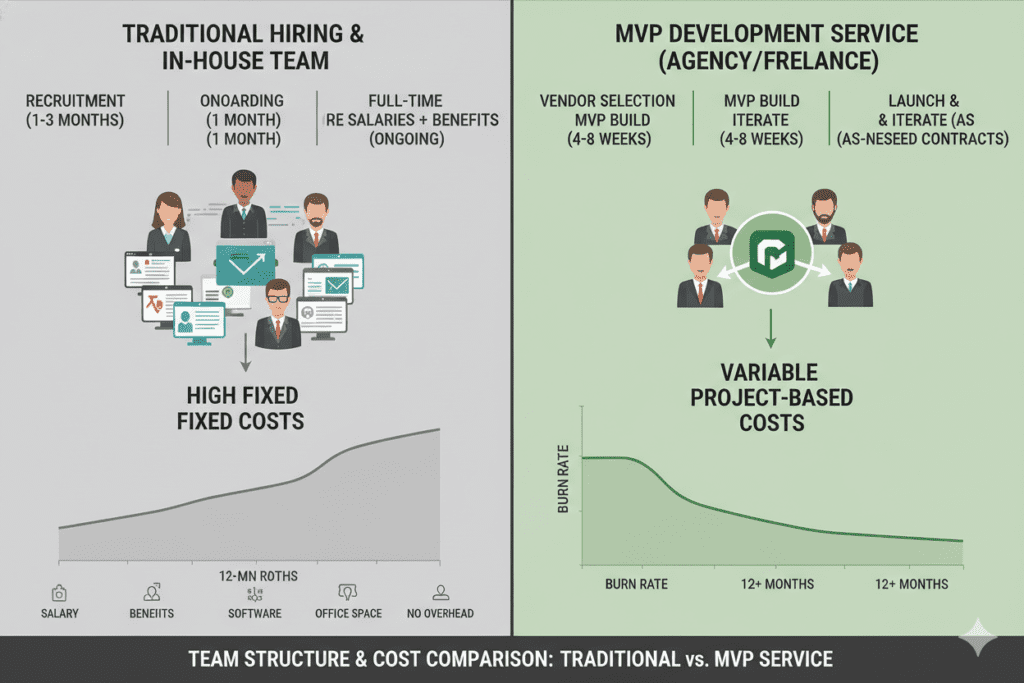
Many founders hire too early. They bring on a senior backend engineer, a senior frontend engineer, a designer, and a product manager before they know what they’re building.
Burn rate: $50,000-80,000/month for a team of four.
Now you’re not just racing to find product-market fit—you’re racing against a burn rate that gives you 6-8 months of runway before you’re fundraising again.
Compare this to working with an MVP development service:
BkAbhi’s MVP Approach:
- Fixed cost: $40,000-70,000
- Timeline: 8-12 weeks
- Outcome: Launched product with real user feedback
- Burn rate during MVP phase: Zero (you’re not on payroll yet)
- Learning achieved: Product-market fit validation or clear pivot direction
Once you have that validation, then you hire your team—and you hire based on what you’ve learned you actually need.
Maybe you don’t need that senior backend engineer because your infrastructure is straightforward. Maybe you need a growth marketer more than another developer. Maybe you need a customer success person because your MVP revealed a high-touch sales model.
MVP development services give you the luxury of hiring intentionally rather than speculatively.
The Founder Technical Gap
Not every founder is technical. If you’re a domain expert, business strategist, or industry insider without coding skills, you face a dilemma:
Should you spend six months learning to code and building yourself? Should you find a technical co-founder? Should you outsource to freelancers?
Here’s why startups need MVP development services first in this scenario: they bridge the gap between your vision and technical execution without requiring you to spend months learning to code or months finding the perfect co-founder.
A professional MVP development team (like BkAbhi) becomes your interim technical team. We help you:
- Validate your technical assumptions
- Make smart architecture decisions
- Avoid costly technical debt
- Build something actually scalable (even if minimal)
And here’s the bonus: after you launch your MVP and gain traction, you’re in a much stronger position to recruit a technical co-founder or early engineering hire. You’re not asking them to join based on an idea—you’re asking them to join based on proven traction.
The Skill Stack Question
Different stages of your startup need different skills:
MVP Stage Needs:
- Rapid prototyping
- User experience thinking
- Technical pragmatism
- Speed over perfection
Scale Stage Needs:
- System architecture
- Performance optimization
- Security hardening
- Advanced features
The person who’s great at MVP development might not be great at scaling to millions of users—and that’s perfectly okay. They’re different skill sets.
This is why startups need MVP development services first: you get specialist expertise for the stage you’re actually in, without hiring for a stage you haven’t reached yet.
Why Startups Need MVP Development Services First: Real Founder Stories
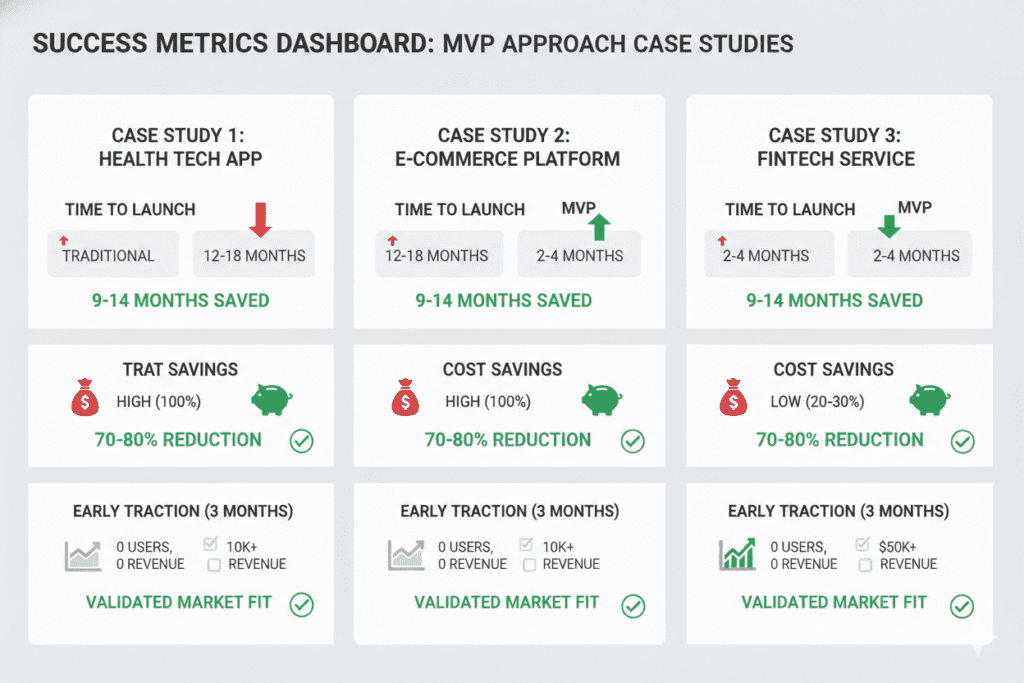
Theory is helpful. But let’s look at how this plays out in reality with founders who’ve worked with BkAbhi.
Case Study 1: The EdTech Pivot
Founder: Priya Initial Idea: AI-powered study planner for college students
Initial Budget: $120,000 Original Plan: Build comprehensive platform with gamification, social features, and AI recommendations
What Actually Happened:
Priya came to BkAbhi wanting to build her vision. We asked hard questions:
- Have you talked to 50 college students about this?
- What’s the core problem you’re solving?
- What’s the simplest version that would help?
After interviewing users, she discovered students didn’t want another app—they wanted help focusing during study sessions.
The MVP Pivot: Instead of a complex AI platform, we built a simple study timer with accountability features in 6 weeks for $32,000.
Results:
- 200 users in first month
- 45% daily active usage
- Users asking for premium features
- $2,400 MRR by month 3
- Clear roadmap based on actual usage data
Priya later told us: “If I’d built my original vision, I’d have spent $120,000 on something nobody wanted. The MVP saved my startup.”
This exemplifies why startups need MVP development services first—professional guidance helps you build the right thing, not just the thing you think you want.
Case Study 2: The B2B SaaS Success
Founder: James
Initial Idea: Project management tool for creative agencies Initial Approach: Hired freelance developers Initial Spend: $55,000 over 8 months Initial Result: Half-built product, developers disappeared
BkAbhi’s Approach:
James came to us frustrated and nearly out of capital. We did three things:
- Salvaged what was usable from his existing codebase
- Ruthlessly cut 60% of planned features
- Focused on one core workflow: client feedback management
The Rebuild:
- Timeline: 8 weeks
- Cost: $38,000
- Features: Client uploads, annotated feedback, simple approvals
Results:
- Launched to first 10 agency clients
- 8 converted to paid within 45 days
- $1,600 MRR by month 2
- Clear feature requests from actual users
- Raised $250,000 seed round based on traction
James’s lesson: “I thought I needed to build everything. BkAbhi showed me I only needed to build the one thing that mattered. That focus made all the difference.”
This demonstrates why startups need MVP development services first: experienced developers know how to identify and build the core value proposition without getting distracted by nice-to-haves.
Case Study 3: The Solo Founder Win
Founder: Maria Background: Non-technical marketing professional Initial Idea: Marketplace connecting freelance designers with small businesses Initial Challenge: No technical co-founder, no coding skills
The Solo Founder Dilemma:
Maria had a great idea and industry expertise but no way to build it. She considered:
- Learning to code (6-12 months)
- Finding a technical co-founder (who knows how long)
- Hiring an agency (most quoted $150,000+)
- Using no-code tools (limiting and not scalable)
Why BkAbhi Made Sense:
We positioned ourselves as her interim technical team:
- Fixed scope, fixed price: $52,000
- Clear timeline: 10 weeks
- Built with scalable architecture from day one
- Provided technical guidance beyond just coding
Results:
- Launched marketplace MVP in 11 weeks
- 30 designers and 45 businesses signed up in first month
- First transaction happened on day 12
- $800 in marketplace fees by month 2
- Used traction to recruit technical co-founder
- Raised $400,000 friends-and-family round
Maria’s insight: “BkAbhi didn’t just build my product—they taught me how to think about product development. That knowledge was invaluable even after I brought on a technical co-founder.”
This showcases why startups need MVP development services first for non-technical founders: professional services democratize access to quality development without requiring founders to become developers themselves.
Why Startups Need MVP Development Services First: The BkAbhi Difference
You’re probably thinking: “Okay, I get it—MVPs are important. But why BkAbhi specifically?”
Fair question. Let’s talk about what makes professional MVP development services different from generic development shops.
The Founder-First Philosophy
BkAbhi was founded by Abhijeet Kumar—a full-stack developer who’s been in the trenches building MVPs for years. This isn’t a corporate agency optimizing for billable hours. This is a founder helping founders.
That distinction matters because our incentives are aligned with yours:
- We want you to spend less, not more
- We want you to launch faster, not slower
- We want you to learn quickly, not build blindly
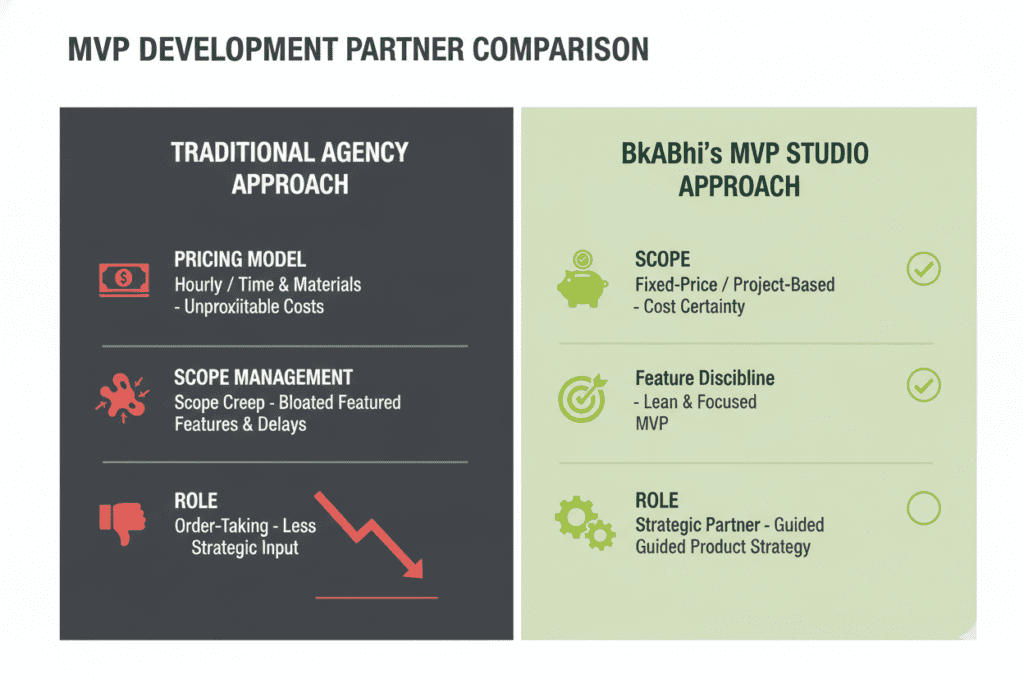
When an agency’s revenue model depends on extending timelines and adding features, their advice is inherently biased. BkAbhi’s model is different: we succeed when you validate quickly and move to your next stage—whether that’s scaling, fundraising, or iterating.
The Battle-Tested Tech Stack
We don’t experiment with shiny new frameworks on your dime.
BkAbhi’s Proven Stack:
- Frontend: React (proven, scalable, massive talent pool)
- Backend: Node.js or Python (fast development, industry-standard)
- Database: PostgreSQL or MongoDB (reliable, scalable, well-documented)
- Hosting: AWS or Vercel (industry leaders with startup credits available)
Why does this matter? Because we’re not just building your MVP—we’re building your foundation. The decisions we make at the MVP stage shouldn’t box you in later.
Choosing battle-tested technologies means:
- Easy to find developers when you hire your team
- Extensive documentation and community support
- Proven scalability path as you grow
- Lower long-term maintenance costs
Ruthless Feature Prioritization
Here’s what happens in your first BkAbhi strategy session:
You: “I want to build a social network for dog owners with AI-powered photo filters, a treat marketplace, a vet appointment booking system, and gamified walking challenges.”
Us: “What problem are you solving?”
You: “Dog owners want to connect with other dog owners in their area.”
Us: “Okay. For version 1, you need profiles, location-based discovery, and messaging. Everything else is version 2, 3, and 4.”
You: “But what about the—”
Us: “Version 2.”
This disciplined approach is exactly why startups need MVP development services first. Left to their own devices, most founders build feature bloat. Professional guidance keeps you lean.
Transparent, Fixed Pricing
No surprises. No scope creep. No “oh by the way” additions to your invoice.
When BkAbhi quotes you, we break down:
- Discovery and planning cost
- Design cost
- Development cost by feature
- Testing and QA cost
- Deployment cost
- 30 days post-launch support
You approve the scope. We lock the price. We deliver on timeline.
Compare this to agencies that bill hourly and benefit from your project taking longer than expected. Our incentive is to deliver efficiently, not to extend billable hours.
Post-Launch Partnership
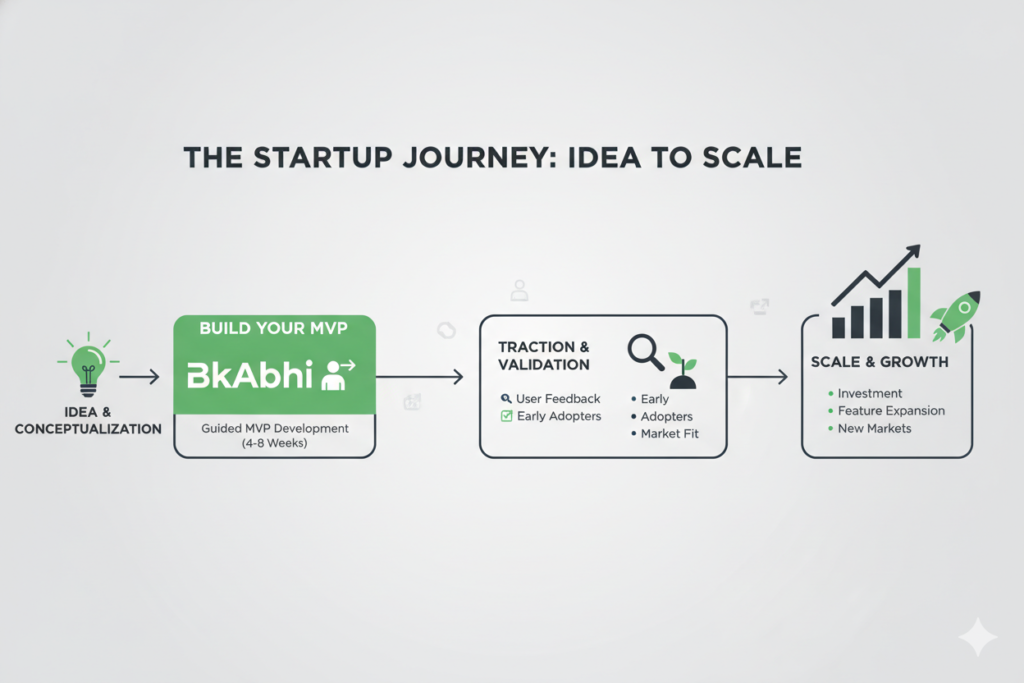
Launching your MVP isn’t the finish line. It’s mile marker 1 of a marathon.
BkAbhi includes 30 days of post-launch support in every package because we know the first month after launch is when you need the most help:
- Fixing unexpected bugs
- Responding to user feedback
- Making small but critical UX improvements
- Optimizing performance based on real usage
After those 30 days, you have options:
- Continue with retainer support as you iterate
- Transition to your own technical team (we’ll help with handoff)
- Come back when you’re ready for version 2
Real Technical Expertise, Not Just Coding
Anyone can write code. Not everyone understands product development.
BkAbhi brings strategic technical thinking:
- “This architecture won’t scale past 10,000 users—here’s a better approach”
- “These two features conflict from a UX perspective—let’s rethink”
- “This integration is overkill for your stage—here’s a simpler solution”
We’re not just executing your spec—we’re helping you define the right spec.
This is why startups need MVP development services first: professional expertise doesn’t just build faster, it builds smarter.
Why Startups Need MVP Development Services First: Your Action Plan
Alright. You’re convinced that MVP development is the right approach. Now what?
Here’s your step-by-step action plan:
Step 1: Validate the Problem (Before Spending a Rupee)
Don’t hire developers until you’ve validated that the problem you’re solving actually exists and people care about it.
Your Task:
- Interview 30-50 potential users
- Ask about their current pain points
- Understand how they currently solve the problem
- Gauge willingness to pay for a better solution
BkAbhi Tip: We offer free problem-solution fit consultations. Before you spend anything on development, let’s validate that your idea has legs.
Step 2: Define Your MVP Ruthlessly
Most founders can’t articulate their MVP clearly. They describe their vision, not their minimum viable version.
The Test: If you can’t describe your MVP’s core value proposition in one sentence, you don’t have an MVP—you have a vision.
Good MVP Definition: “A simple web app that lets freelancers track client hours and generate invoices.”
Bad MVP Definition:
“A comprehensive freelancer management platform with time tracking, invoicing, expense management, client communication, project templates, reporting dashboards, and integration with accounting software.”
One is an MVP. The other is a full product.
BkAbhi Approach: In our discovery session, we force you to get clarity. We use the “Must-Have, Should-Have, Could-Have, Won’t-Have” framework until you can clearly articulate the absolute core.
Step 3: Get Realistic Budget and Timeline Estimates
Don’t guess. Don’t assume. Get actual estimates from professionals.
Questions to Ask MVP Development Services:
- What’s the total fixed cost?
- What’s the timeline from kickoff to launch?
- What’s included vs. what’s extra?
- What happens if requirements change?
- What’s the post-launch support model?
Red Flags:
- Vague pricing (“it depends”)
- Hourly billing without caps
- No portfolio of launched MVPs
- Pushback when you try to reduce scope
Green Flags:
- Fixed-price proposals
- Clear milestone breakdowns
- Examples of similar MVPs they’ve shipped
- Advice to cut features, not add them
Step 4: Plan for Iteration, Not Perfection
Your MVP will not be perfect. That’s the point.
Budget accordingly:
- 40% on initial MVP
- 30% on customer acquisition and feedback
- 30% on iteration and improvements
Don’t blow your entire budget on version 1.
Step 5: Choose the Right Partner
This is where founders often get paralyzed. Freelancers? Agency? In-house?
Our Recommendation: For early-stage founders without technical co-founders, boutique MVP development services like BkAbhi offer the best balance:
- Professional quality without enterprise pricing
- Strategic guidance, not just code execution
- Accountability and clear communication
- Fast turnaround times
Ready to get started?
Explore more insights on BkAbhi to learn about MVP strategies, cost breakdowns, and real founder stories.
Book a free MVP strategy call with BkAbhi where we’ll help you:
- Validate your MVP scope
- Get realistic cost and timeline estimates
- Identify your riskiest assumptions
- Map out a clear path to launch
Learn from real-world experience at BkAbhi—because understanding why startups need MVP development services first is just the beginning. Executing on that knowledge is what separates founders who ship from founders who stall.
Frequently Asked Questions: Why Startups Need MVP Development Services First
Q: Can’t I just build the MVP myself using no-code tools?
A: Absolutely—and for some ideas, that’s the right move. No-code tools like Bubble or Webflow are great for testing concepts that don’t require custom logic or unique features.
However, understand the tradeoffs:
- No-code tools have limitations that may constrain your product
- They can become expensive as you scale
- Migration from no-code to custom development later is often a complete rebuild
- Technical debt accumulates faster
If you’re testing a hypothesis and don’t know if the market wants it, no-code is fine. If you’re building something you plan to scale, professional development from the start saves you rebuilding costs later.
Q: What if I can find freelance developers cheaper than BkAbhi?
A: You absolutely can. Freelancers can be 30-50% cheaper than boutique development services.
But ask yourself:
- Do they have a track record of launched MVPs?
- Will they provide strategic product guidance, or just execute your spec?
- What happens if they disappear mid-project?
- Can they handle full-stack development, design, and deployment?
- Do they understand startup constraints and timeline pressure?
The founders who come to us after trying the freelancer route typically spend 2x more overall (initial freelancer cost + BkAbhi rebuild cost) and lose 6+ months.
Cheap isn’t cheap if you have to rebuild.
Q: How do I know if I actually need an MVP or if I should just launch a full product?
A: You need an MVP if:
- You’ve never built a product in this market before
- You’re not 100% certain users will pay for your solution
- You have limited capital and need to preserve runway
- You want to test quickly before committing to a large investment
- You’re a first-time founder
You might be able to skip MVP development if:
- You’re a serial entrepreneur with deep domain expertise
- You have strong validation from existing customer relationships
- You’ve pre-sold the product to customers who are waiting for it
- You have unlimited capital (rare)
For 95% of startups, an MVP is the smart move.
Q: What’s the realistic timeline for MVP development?
A: At BkAbhi, typical timelines are:
- Simple web app: 6-8 weeks
- Standard SaaS platform: 10-12 weeks
- Mobile app: 10-14 weeks
- Complex features (AI, real-time): 12-16 weeks
If someone promises you an MVP in 2 weeks, you’re getting a landing page, not a functional product. If someone says 6+ months, you’re building too much.
Q: How much should I budget for MVP development in 2026?
A: Realistic ranges:
- Basic web app: $18,000-35,000
- SaaS platform: $45,000-85,000
- Mobile app: $35,000-75,000
- AI-powered: $70,000-150,000+
BkAbhi’s sweet spot is $40,000-70,000 for most standard MVPs. This includes everything from planning through launch and 30 days of support.
Budget less than $15,000 and you’re likely getting incomplete work or unreliable execution. Budget more than $150,000 and you’re probably overbuilding.
Q: What happens after the MVP launches?
A: The real work begins. Post-launch:
- Gather user feedback systematically
- Monitor usage analytics
- Identify which features matter most
- Plan version 2 based on real data
- Iterate and improve
BkAbhi’s post-launch support helps you navigate this critical phase. We don’t just throw your MVP over the wall—we stick with you through the learning phase.
Q: Why should I trust BkAbhi specifically?
A: Fair question. Here’s our track record:
- Founded by a practicing full-stack developer, not an MBA
- Launched 50+ MVPs for founders across industries
- Fixed pricing—no surprise charges
- Founder-first philosophy—we optimize for your learning, not our billing
- Transparent process with weekly check-ins
- Real founder testimonials and case studies
But don’t take our word for it. Read more expert guides on BkAbhi to see our approach in action.
Q: What if my MVP fails—is that money wasted?
A: This is a fundamental mindset shift. A “failed” MVP that teaches you your idea won’t work is invaluable. It saved you from spending $300,000 building the wrong thing.
At BkAbhi, we measure success by learning, not by product survival. If your MVP reveals you need to pivot, that’s success. If it validates demand, that’s success. The only failure is spending years building without user feedback.
Final Thoughts: Why Startups Need MVP Development Services First
Let me leave you with the core truth that every successful founder eventually learns:
Your startup’s success isn’t determined by your best ideas. It’s determined by how quickly you can test ideas, learn from them, and iterate toward product-market fit.
This is why startups need MVP development services first. Not because MVPs are trendy. Not because investors expect them. But because they’re the most capital-efficient, time-efficient, risk-efficient way to turn an idea into validated traction.
The founders who succeed aren’t the ones with the biggest visions or the most capital. They’re the ones who ship fast, learn fast, and iterate intelligently.
They understand that perfection is the enemy of progress. They understand that shipping beats stalling.
They understand that user feedback is worth more than internal opinions. They understand that runway is measured in learning cycles, not months.
At BkAbhi, we’ve built our entire practice around helping founders ship their first version without burning their entire budget on untested assumptions.
Whether you work with us or another MVP development service, the key is this: start building.
Not the full vision. Not the perfect product. Not the comprehensive platform.
Build the smallest version that lets you learn something real about real users in the real market.
Because here’s the secret nobody tells you: your version 1 will be wrong. Every founder’s version 1 is wrong.
The question is: will you discover you’re wrong in month 3 with 70% of your capital left, or month 18 with 10% of your capital left?
That’s why startups need MVP development services first.
Ready to build your MVP the right way?
Follow BkAbhi for practical tech & startup insights and stay updated on MVP strategies, cost guides, and real founder stories.
Start building smarter with BkAbhi — where your first version is just the beginning of your learning journey, not the end of your runway.
Suggested Internal Links:
- The $87,000 Question: Cost to Build MVP in 2026 – Deep dive into MVP cost breakdown and budgeting
- MVP Development Roadmap for Non-Technical Founders – Complete guide for founders without coding backgrounds
- Micro SaaS Development Cost – For founders building smaller-scope SaaS products
- 7 Reasons Why Choosing the Right SaaS Development Company Matters – How to choose development partners wisely
- Hire Freelance MERN Stack Developer: Hidden Costs – Understanding the true cost of different development approaches
Suggested External Links:
- CB Insights: Why Startups Fail – Authoritative research on startup failure rates and causes
- Eric Ries: The Lean Startup Methodology – Foundational resource on MVP and lean principles
- Y Combinator Startup Library – Trusted advice from leading startup accelerator
- Product Hunt – Platform for launching and validating MVPs
- AWS Activate Credits Program – Resources for managing infrastructure costs for startups
- Stripe Atlas – Trusted resource for startup incorporation and payment processing