
The Email That Changed Everything
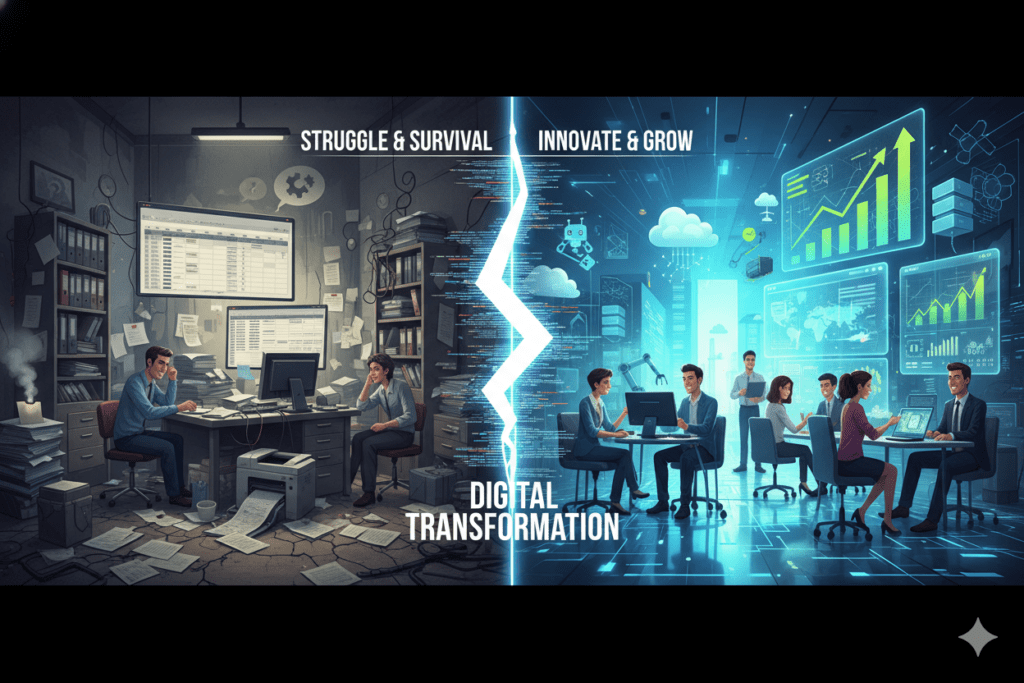
Priya sat in her small Mumbai office at 11 PM, staring at three different spreadsheets open on her laptop. Her manufacturing SME had grown from 5 to 50 employees in two years, but her systems hadn’t. Orders were tracked in Excel, inventory in another tool, and customer communications scattered across WhatsApp, email, and a legacy CRM that crashed twice a week.
That night, a major order got lost between systems. A client received the wrong shipment. Her operations manager quit out of frustration.
“There has to be a better way,” she thought, reaching for her phone to search for solutions.
If you’re an SME owner, founder, or manager, you’ve probably had a similar moment. That breaking point where off-the-shelf software no longer cuts it, but hiring a full development team seems impossibly expensive.
This is where custom software development for SMEs becomes not just an option—but a strategic necessity.

The Hidden Crisis Most SMEs Don’t Talk About
Here’s an uncomfortable truth: 73% of small and medium enterprises are running on software that’s actively holding them back.
According to industry research, SMEs typically juggle between 15-30 different software tools to manage daily operations. Each tool requires separate logins, manual data entry, and constant reconciliation between systems. The result? Teams spend up to 40% of their time on administrative tasks that should be automated.
But the real cost isn’t just time—it’s opportunity.
While you’re manually updating inventory across three platforms, your competitor with integrated custom software is scaling faster, responding to customers quicker, and making data-driven decisions in real-time.
The gap between SMEs with custom software solutions and those without is widening every quarter. And it’s not about being “tech-savvy” anymore—it’s about survival in an increasingly digital marketplace.
What Exactly Is Custom Software Development for SMEs?
Let’s clear up the confusion. Custom software development for SMEs isn’t about building the next Facebook or creating complex enterprise systems that take years to develop.
Instead, it’s about creating purpose-built digital tools that solve your specific business problems—nothing more, nothing less.
Think of it this way: Off-the-shelf software is like buying a house that’s already built. You adapt your life to fit the space. Custom software development for SMEs is like building a house designed exactly for your family’s needs, lifestyle, and future plans.
For SMEs, this typically includes:
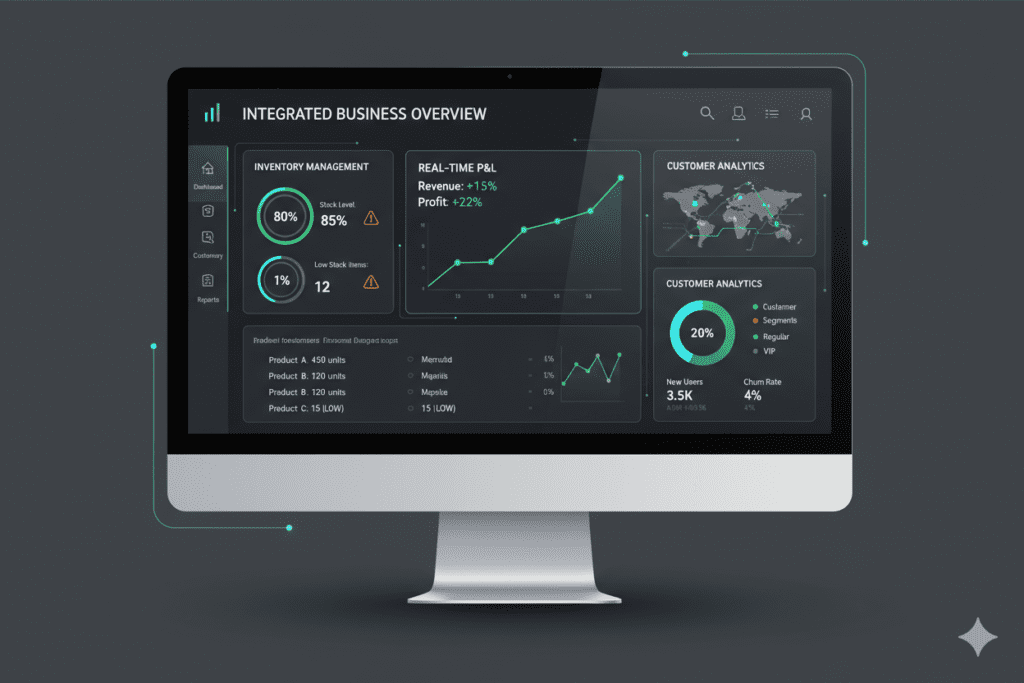
Operations Management Systems: Connecting your inventory, orders, suppliers, and logistics in one unified platform Customer Relationship Tools: Custom CRMs that match your exact sales process, not some generic template Process Automation: Eliminating repetitive tasks that drain your team’s productivity Data Integration: Pulling information from multiple sources into actionable dashboards Industry-Specific Solutions: Software built around the unique workflows of your sector
The beauty of custom software development for SMEs is scalability. You start with what you need now and expand as you grow—without switching platforms or losing data.
Why SMEs Are Finally Embracing Custom Software Development
Ten years ago, custom software development was exclusively for large enterprises with massive budgets. The minimum engagement would start at lakhs of rupees, and projects would take 12-18 months.
Today, everything has changed.
Thanks to modern development frameworks, agile methodologies, and cloud infrastructure, custom software development for SMEs has become remarkably accessible. Projects can launch in weeks, not years. Costs are a fraction of what they used to be. And maintenance is simpler than ever.
Rohit, a logistics SME founder from Pune, shares his experience:
“We were using four different tools—one for dispatch, one for tracking, one for customer notifications, and Excel for everything else. Our custom logistics platform from BkAbhi unified everything. The ROI was positive within six months because we eliminated manual errors and cut processing time by 60%.”
This is the new reality of custom software development for SMEs. It’s no longer about massive budgets—it’s about smart investments that compound over time.
The Real Problems Custom Software Development Solves for SMEs
Let’s get practical. What actual business problems does custom software development for SMEs address?
The Integration Nightmare
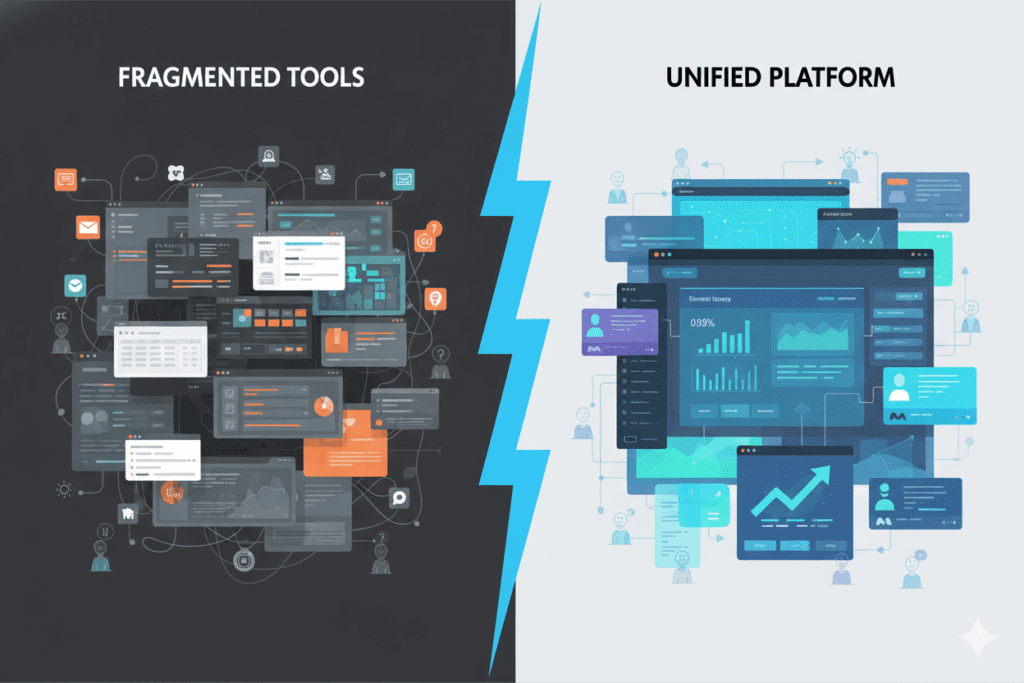
Your accounting software doesn’t talk to your inventory system. Your CRM doesn’t sync with your email platform. Every evening, someone manually exports data from one system and imports it into another.
Custom software eliminates this nightmare by creating unified systems where data flows automatically. No more manual exports, no more reconciliation errors, no more duplicate work.
The Scalability Trap
You chose a software solution when you had 10 employees. Now you have 50, and the software is creaking under the load. Upgrading to the “enterprise tier” would triple your costs.
With custom software development for SMEs, you build systems that grow with you. Add users, features, and capacity as needed without hitting arbitrary pricing tiers or feature limits.
The Competitive Disadvantage
Your industry has unique processes, but your software is generic. You spend hours configuring workflows that still don’t quite fit. Meanwhile, the software forces you into processes that slow you down.
Custom development means software that mirrors your competitive advantages—not generic best practices that make you average.
The Security and Compliance Gap
Off-the-shelf software might handle industry regulations, but does it handle your company’s specific security needs? Your customer data, proprietary processes, and sensitive information deserve better than one-size-fits-all security.
Custom software development for SMEs allows you to build security and compliance into every feature from day one.
How BkAbhi Approaches Custom Software Development for SMEs
At BkAbhi, we’ve seen the transformation that happens when SMEs move from cobbled-together tools to integrated custom solutions. Our approach is built on real-world experience and a deep understanding of what growing businesses actually need.
We Start With Your Actual Workflow
Most development companies start with a technology stack and try to fit your business into it. We start by understanding how your business actually works—the good, the bad, and the inefficient.
Our team spends time mapping your current processes, identifying bottlenecks, and understanding where technology can make the biggest impact. This isn’t about digitizing broken processes; it’s about reimagining workflows for maximum efficiency.
We Build for Today and Tomorrow
One of the biggest mistakes in custom software development for SMEs is building for current needs without considering growth. You’ll outgrow the system in six months and be back where you started.
BkAbhi’s development philosophy centers on scalable architecture. We build modular systems that can expand as your business grows. Need to add a new warehouse? A new sales channel? An integration with a new vendor? Your custom software adapts without requiring a complete rebuild.
We Prioritize User Experience
Here’s something most technical teams miss: The best-coded software in the world is useless if your team won’t use it.
Our UI/UX design process ensures that your custom software is intuitive, fast, and actually enjoyable to use. We conduct user research, create prototypes, and iterate based on feedback from the people who’ll use the software daily.
Because software adoption isn’t just about features—it’s about designing interfaces that make your team’s work easier, not harder.
We Make Maintenance Simple
The nightmare scenario: You build custom software, the development team disappears, and you’re stuck with an unmaintainable codebase.
At BkAbhi, we build with maintainability in mind from day one. Clean code, comprehensive documentation, and transparent architecture mean you’re never locked in. We provide ongoing support, but the software we build can be maintained by any competent development team.

Real-World Custom Software Development for SMEs: Use Cases
Let’s look at how different types of SMEs benefit from custom software development:
For SaaS Builders and Tech Startups
You’re building a product, but you also need internal tools for customer onboarding, usage tracking, and support management. Custom development creates admin panels, analytics dashboards, and automation tools that help you scale your SaaS without scaling your team proportionally.
For E-Commerce and Retail SMEs
Inventory management across multiple channels (online, offline, marketplaces) becomes chaotic fast. Custom software unifies your stock management, automates reordering, syncs across platforms, and provides real-time visibility into what’s selling and what’s sitting.
For Service-Based SMEs
From marketing agencies to consulting firms, service businesses need custom project management, time tracking, resource allocation, and client portals. Generic tools force you into rigid structures. Custom development builds around your service delivery model.
For Manufacturing and Logistics SMEs
Production planning, supply chain coordination, quality control, and dispatch management require tight integration. Custom software development for SMEs in manufacturing creates end-to-end visibility and control that off-the-shelf tools can’t match.
For Healthcare and Wellness SMEs
Patient management, appointment scheduling, treatment tracking, and compliance reporting have unique requirements. Custom solutions ensure HIPAA compliance, seamless workflows, and patient experiences that build loyalty.
The Investment: What Custom Software Development for SMEs Actually Costs
Let’s address the elephant in the room: cost.
Many SME owners assume custom software development is prohibitively expensive. This misconception keeps them trapped in inefficient systems for years.
The reality is more nuanced. Yes, custom development requires upfront investment. But when you factor in the total cost of ownership, the math often favors custom solutions.
Consider this comparison:
Off-the-Shelf Approach:
- Software licenses: ₹50,000-200,000 per year across multiple tools
- Integration tools: ₹30,000-100,000 per year
- Additional modules and users: Escalating costs as you grow
- Data migration costs when you inevitably switch: ₹100,000-500,000
- Productivity loss from inefficient workflows: Difficult to quantify but substantial
Custom Development Approach:
- Initial development: ₹300,000-1,500,000 (varies based on complexity)
- Hosting and maintenance: ₹20,000-50,000 per year
- Feature additions and updates: As needed, predictable costs
- No vendor lock-in, no per-user fees
- Productivity gains from optimized workflows: Measurable ROI
The breakeven point for most SMEs is 18-36 months. After that, the custom solution becomes increasingly cost-effective while delivering compounding value.
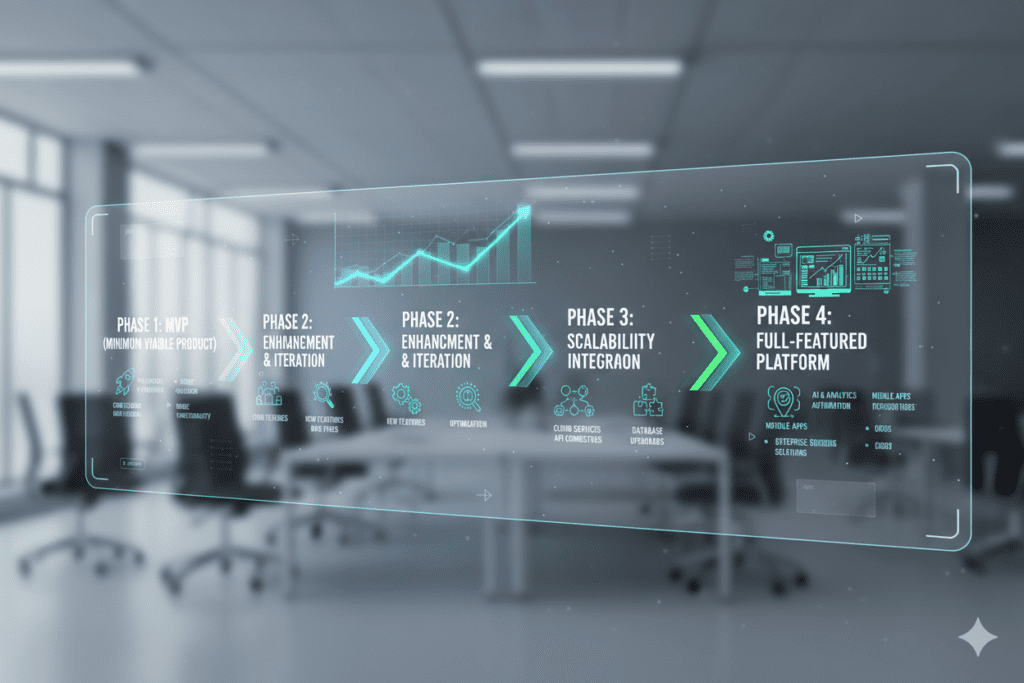
At BkAbhi, we work with SMEs to phase development, starting with high-impact features and expanding over time. This approach spreads costs and delivers value faster than traditional “big bang” implementations.
Common Mistakes SMEs Make With Custom Software Development
After years of working with SMEs, we’ve seen patterns in what works and what doesn’t. Avoid these common pitfalls:
Mistake #1: Starting Without Clear Requirements
“We need software for our business” is too vague. Successful custom software development for SMEs starts with documented pain points, specific goals, and measurable success criteria.
The Fix: Invest time upfront in discovery. Map current workflows, identify problems, prioritize features, and create detailed requirements before writing a single line of code.
Mistake #2: Trying to Build Everything at Once
The temptation is to solve every problem in version 1.0. This leads to bloated projects, delayed launches, and software that’s complex before it’s useful.
The Fix: Start with a Minimum Viable Product (MVP) that solves your most painful problem. Launch it, gather feedback, then iterate. This agile approach delivers value faster and reduces risk.
Mistake #3: Choosing Development Partners Based Only on Price
The cheapest bid is rarely the best value. Under-resourced teams cut corners, miss deadlines, and deliver buggy software that costs more to fix than it would have cost to build properly.
The Fix: Evaluate development partners on experience, portfolio, communication, and cultural fit—not just price. The right partner becomes a long-term technology advisor, not just a vendor.
Mistake #4: Ignoring User Training and Change Management
You’ve built amazing software, but your team still uses the old spreadsheets because “that’s how we’ve always done it.”
The Fix: Plan for training, documentation, and change management from day one. Software adoption is as important as software development.
Mistake #5: Not Planning for Maintenance and Updates
Software isn’t a one-time purchase—it’s a living system that needs ongoing attention.
The Fix: Budget for maintenance, security updates, feature enhancements, and technical support. A good development partner makes this transparent and manageable.
The Future of Custom Software Development for SMEs
The landscape of custom software development for SMEs is evolving rapidly. Here’s what’s shaping the future:
Low-Code and No-Code Integration
Modern custom development increasingly incorporates low-code platforms for rapid prototyping and non-critical features. This hybrid approach accelerates development while maintaining quality.
AI and Machine Learning for SMEs
Custom software is embedding AI capabilities that were once exclusive to enterprises. From predictive analytics to automated customer support, SMEs can now leverage intelligent systems tailored to their data and processes.
Mobile-First Custom Solutions
With teams working remotely and on-the-go, custom software development for SMEs prioritizes mobile experiences. Your sales team, field workers, and management need full functionality from their smartphones.
API-First Architecture
Modern custom software is built to connect. API-first development ensures your custom solution integrates seamlessly with existing tools, future platforms, and emerging technologies.
Edge Computing and Real-Time Processing
For SMEs in manufacturing, logistics, and retail, real-time data processing at the edge (on devices, not just in the cloud) enables faster decisions and better customer experiences.
Making the Decision: Is Custom Software Development Right for Your SME?
Not every SME needs custom software development immediately. Here’s how to know if it’s time:
You Should Consider Custom Development If:
- You’re using 5+ different software tools that don’t integrate well
- Your team spends significant time on manual data entry or reconciliation
- Off-the-shelf solutions don’t match your unique processes
- You’re hitting scalability limits with current software
- Competitors with better technology are winning deals
- Compliance or security requirements exceed standard software capabilities
- The cost of multiple software licenses is becoming prohibitive
You Can Probably Wait If:
- Your business processes are still evolving rapidly
- Off-the-shelf solutions meet 80%+ of your needs
- You’re in very early stages with limited complexity
- Budget is extremely constrained with no ROI path
- You haven’t exhausted optimization of existing tools
The key question isn’t “Can we afford custom software?” It’s “Can we afford NOT to have it given our growth trajectory?”
How to Get Started With Custom Software Development for SMEs
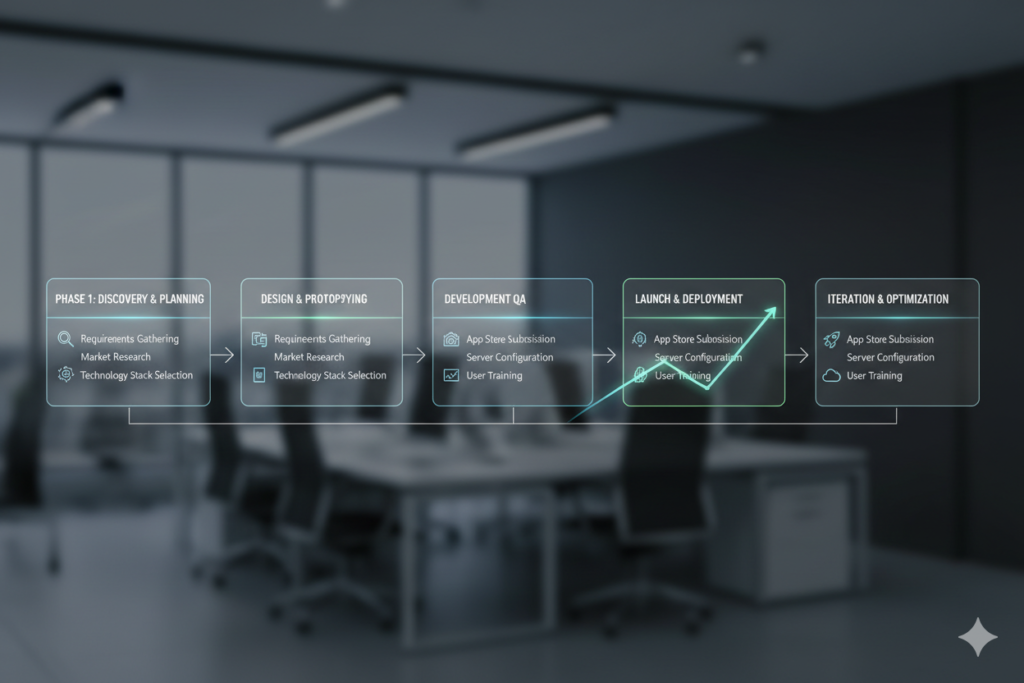
If you’ve decided custom software development makes sense for your SME, here’s a practical roadmap:
Step 1: Document Your Current State
Map out your existing workflows, tools, pain points, and bottlenecks. Be specific about what’s working and what’s breaking.
Step 2: Define Your Vision
What does success look like? How will you measure ROI? What would transform your operations?
Step 3: Prioritize Problems to Solve
You can’t solve everything at once. Rank problems by impact and urgency. Start with high-impact, feasible solutions.
Step 4: Research Development Partners
Look for teams with experience in your industry, strong portfolios, clear communication, and transparent processes. At BkAbhi, we offer discovery consultations to help SMEs clarify needs before committing to development.
Step 5: Start With Discovery or MVP
Rather than diving into full development, begin with a discovery phase or minimum viable product. This validates your approach and builds confidence before major investment.
Step 6: Plan for Iteration
Software development is iterative. Plan for multiple releases, user feedback loops, and continuous improvement.
Why BkAbhi Is Your Partner for Custom Software Development for SMEs
At BkAbhi, we’re not just developers—we’re problem solvers who understand the unique challenges SMEs face.
Our approach combines technical excellence with business acumen. We’ve built everything from e-commerce platforms to logistics management systems to custom CRMs. Each project taught us more about what SMEs actually need versus what vendors typically sell them.
What sets BkAbhi apart:
- SME-Focused Expertise: We specialize in the sweet spot of complexity that SMEs operate in—sophisticated enough to drive real value, practical enough to deploy quickly
- Transparent Communication: No technical jargon or black box development. You understand what we’re building and why
- Scalable Architecture: Every solution we build is designed to grow with your business
- User-Centric Design: Beautiful, intuitive interfaces that your team will actually enjoy using
- Long-Term Partnership: We’re invested in your success beyond the initial launch
We’ve seen firsthand how the right custom software transforms SMEs from surviving to thriving. It’s not about technology for technology’s sake—it’s about giving you the tools to compete at a higher level.
Your Next Steps
The gap between SMEs with optimized custom software and those struggling with disconnected tools is widening every month. The question isn’t whether you’ll eventually need custom development—it’s whether you’ll move proactively or wait until inefficiency forces your hand.
If you’re ready to explore what custom software development for SMEs could do for your business, explore more insights on BkAbhi where we break down complex technology decisions into practical business strategies.
Want to see how we’ve helped other SMEs transform their operations? Read more expert guides on BkAbhi that dive deep into specific industries, technologies, and implementation strategies.
And if you’re ready to have a conversation about your specific situation? Start building smarter with BkAbhi—reach out for a no-obligation discovery consultation where we’ll map your current challenges and potential solutions.
The software that will transform your SME doesn’t exist yet in any pre-built package. It exists in the unique combination of your processes, your team, and your vision for growth.
Custom software development for SMEs isn’t about keeping up with technology trends—it’s about unlocking the potential that’s already in your business, waiting for the right tools to set it free.
Follow BkAbhi for practical tech & startup insights as we continue sharing real-world experience, actionable strategies, and honest perspectives on navigating technology decisions for growing businesses.
The SMEs that will dominate their industries five years from now are making their technology decisions today. Make sure you’re one of them.
Suggested External Links
- Gartner’s Digital Transformation Research – Industry insights on SME technology adoption
- GitHub – Open Source Tools for SMEs – For discussing development best practices
- Amazon Web Services for SMEs – Cloud infrastructure references
- React Documentation – For discussing modern web development frameworks
- MongoDB for Business Applications – Database solutions for scalable software